Accounting Theory and Current Issues Tutorial Questions - HI6025
VerifiedAdded on 2022/12/27
|9
|1666
|75
Homework Assignment
AI Summary
This document presents a comprehensive solution to a set of tutorial questions from the HI6025 Accounting Theory and Current Issues unit. The solution addresses key concepts in accounting theory, including the primary users of financial reports and the application of accounting standards. It analyzes topics like asset revaluation, goodwill, and the implications of IFRS 3. Furthermore, the solution delves into the specifics of IAS 16 regarding property, plant, and equipment (PP&E), covering recognition, initial measurement, and different accounting models. The assignment also explores corporate social responsibility (CSR) and its connection to accountability and accounting practices, providing a well-rounded understanding of the topics covered in the unit. References to relevant academic sources are also provided.
HI6025 Accounting
Theory and Current Issues
1
Theory and Current Issues
1
Paraphrase This Document
Need a fresh take? Get an instant paraphrase of this document with our AI Paraphraser

Contents
Contents...........................................................................................................................................2
Question 1........................................................................................................................................3
Question 2........................................................................................................................................3
Question 3........................................................................................................................................4
Question 4........................................................................................................................................5
Question 5........................................................................................................................................6
Question 6........................................................................................................................................7
2
Contents...........................................................................................................................................2
Question 1........................................................................................................................................3
Question 2........................................................................................................................................3
Question 3........................................................................................................................................4
Question 4........................................................................................................................................5
Question 5........................................................................................................................................6
Question 6........................................................................................................................................7
2

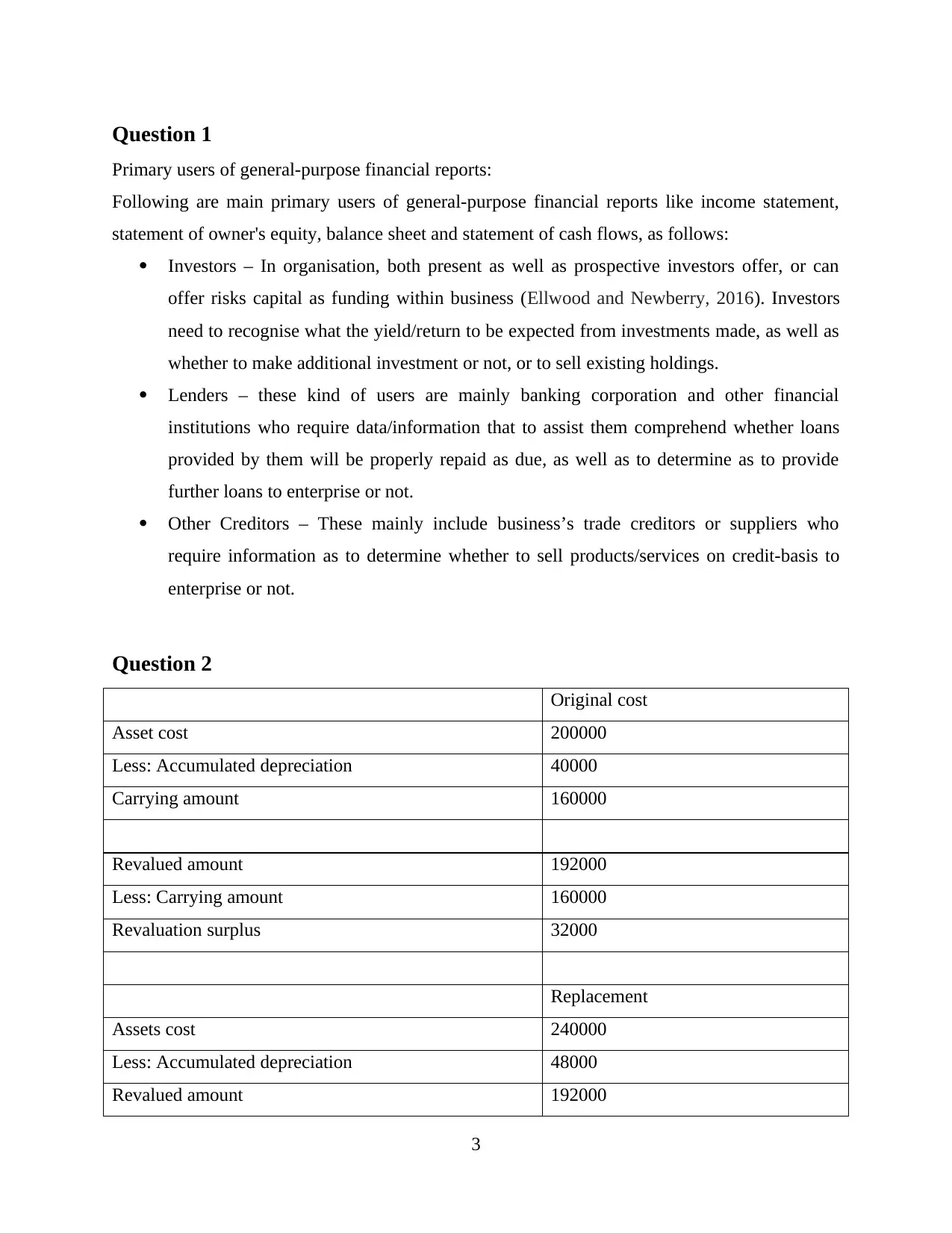
Question 1
Primary users of general-purpose financial reports:
Following are main primary users of general-purpose financial reports like income statement,
statement of owner's equity, balance sheet and statement of cash flows, as follows:
Investors – In organisation, both present as well as prospective investors offer, or can
offer risks capital as funding within business (Ellwood and Newberry, 2016). Investors
need to recognise what the yield/return to be expected from investments made, as well as
whether to make additional investment or not, or to sell existing holdings.
Lenders – these kind of users are mainly banking corporation and other financial
institutions who require data/information that to assist them comprehend whether loans
provided by them will be properly repaid as due, as well as to determine as to provide
further loans to enterprise or not.
Other Creditors – These mainly include business’s trade creditors or suppliers who
require information as to determine whether to sell products/services on credit-basis to
enterprise or not.
Question 2
Original cost
Asset cost 200000
Less: Accumulated depreciation 40000
Carrying amount 160000
Revalued amount 192000
Less: Carrying amount 160000
Revaluation surplus 32000
Replacement
Assets cost 240000
Less: Accumulated depreciation 48000
Revalued amount 192000
3
Primary users of general-purpose financial reports:
Following are main primary users of general-purpose financial reports like income statement,
statement of owner's equity, balance sheet and statement of cash flows, as follows:
Investors – In organisation, both present as well as prospective investors offer, or can
offer risks capital as funding within business (Ellwood and Newberry, 2016). Investors
need to recognise what the yield/return to be expected from investments made, as well as
whether to make additional investment or not, or to sell existing holdings.
Lenders – these kind of users are mainly banking corporation and other financial
institutions who require data/information that to assist them comprehend whether loans
provided by them will be properly repaid as due, as well as to determine as to provide
further loans to enterprise or not.
Other Creditors – These mainly include business’s trade creditors or suppliers who
require information as to determine whether to sell products/services on credit-basis to
enterprise or not.
Question 2
Original cost
Asset cost 200000
Less: Accumulated depreciation 40000
Carrying amount 160000
Revalued amount 192000
Less: Carrying amount 160000
Revaluation surplus 32000
Replacement
Assets cost 240000
Less: Accumulated depreciation 48000
Revalued amount 192000
3
⊘ This is a preview!⊘
Do you want full access?
Subscribe today to unlock all pages.

Trusted by 1+ million students worldwide

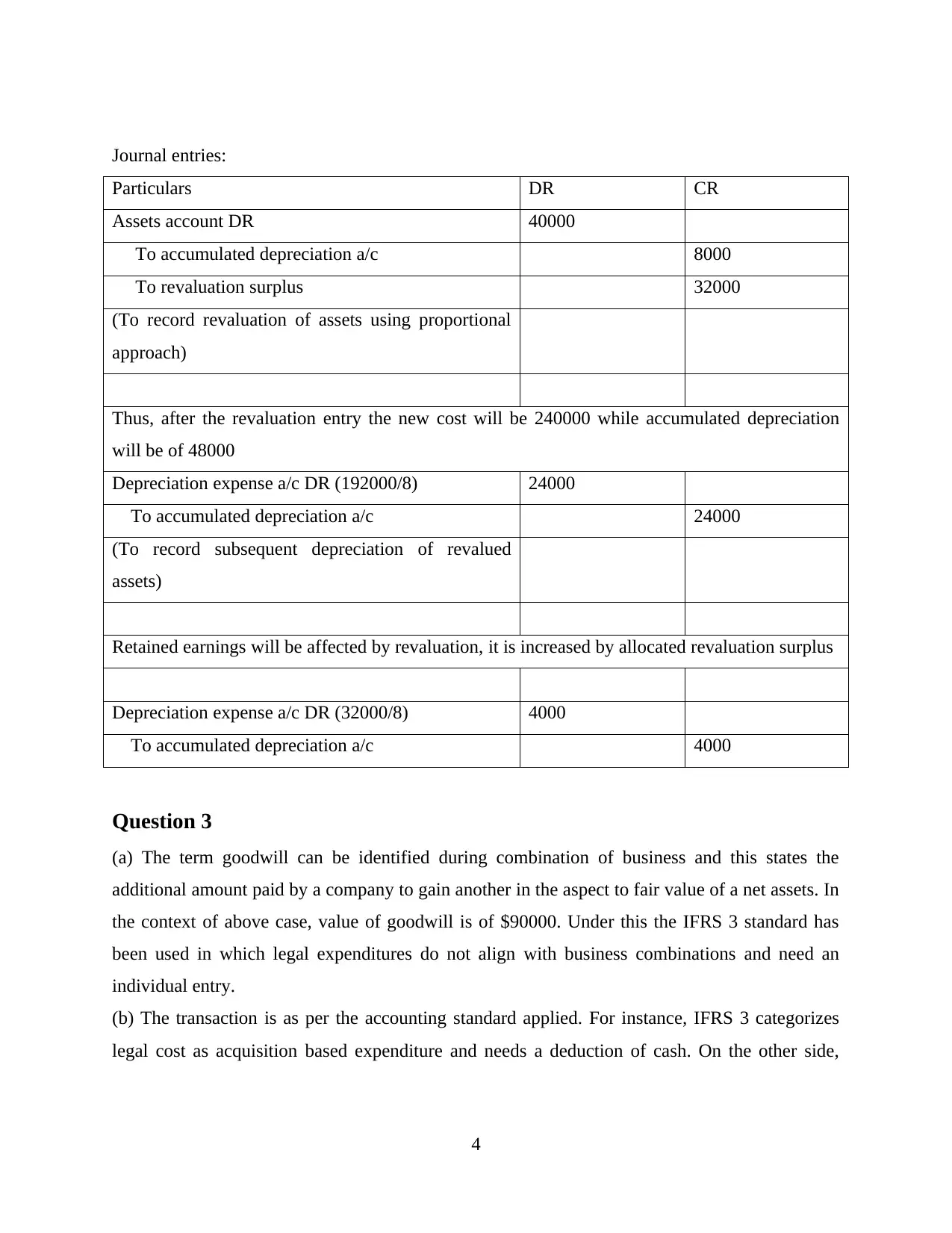
Journal entries:
Particulars DR CR
Assets account DR 40000
To accumulated depreciation a/c 8000
To revaluation surplus 32000
(To record revaluation of assets using proportional
approach)
Thus, after the revaluation entry the new cost will be 240000 while accumulated depreciation
will be of 48000
Depreciation expense a/c DR (192000/8) 24000
To accumulated depreciation a/c 24000
(To record subsequent depreciation of revalued
assets)
Retained earnings will be affected by revaluation, it is increased by allocated revaluation surplus
Depreciation expense a/c DR (32000/8) 4000
To accumulated depreciation a/c 4000
Question 3
(a) The term goodwill can be identified during combination of business and this states the
additional amount paid by a company to gain another in the aspect to fair value of a net assets. In
the context of above case, value of goodwill is of $90000. Under this the IFRS 3 standard has
been used in which legal expenditures do not align with business combinations and need an
individual entry.
(b) The transaction is as per the accounting standard applied. For instance, IFRS 3 categorizes
legal cost as acquisition based expenditure and needs a deduction of cash. On the other side,
4
Particulars DR CR
Assets account DR 40000
To accumulated depreciation a/c 8000
To revaluation surplus 32000
(To record revaluation of assets using proportional
approach)
Thus, after the revaluation entry the new cost will be 240000 while accumulated depreciation
will be of 48000
Depreciation expense a/c DR (192000/8) 24000
To accumulated depreciation a/c 24000
(To record subsequent depreciation of revalued
assets)
Retained earnings will be affected by revaluation, it is increased by allocated revaluation surplus
Depreciation expense a/c DR (32000/8) 4000
To accumulated depreciation a/c 4000
Question 3
(a) The term goodwill can be identified during combination of business and this states the
additional amount paid by a company to gain another in the aspect to fair value of a net assets. In
the context of above case, value of goodwill is of $90000. Under this the IFRS 3 standard has
been used in which legal expenditures do not align with business combinations and need an
individual entry.
(b) The transaction is as per the accounting standard applied. For instance, IFRS 3 categorizes
legal cost as acquisition based expenditure and needs a deduction of cash. On the other side,
4
Paraphrase This Document
Need a fresh take? Get an instant paraphrase of this document with our AI Paraphraser

USA GAAP permits straight attributable expense to minimize capital and be accounted as an
element of business amalgamation (Johansson, Hjelström and Hellman, 2016).
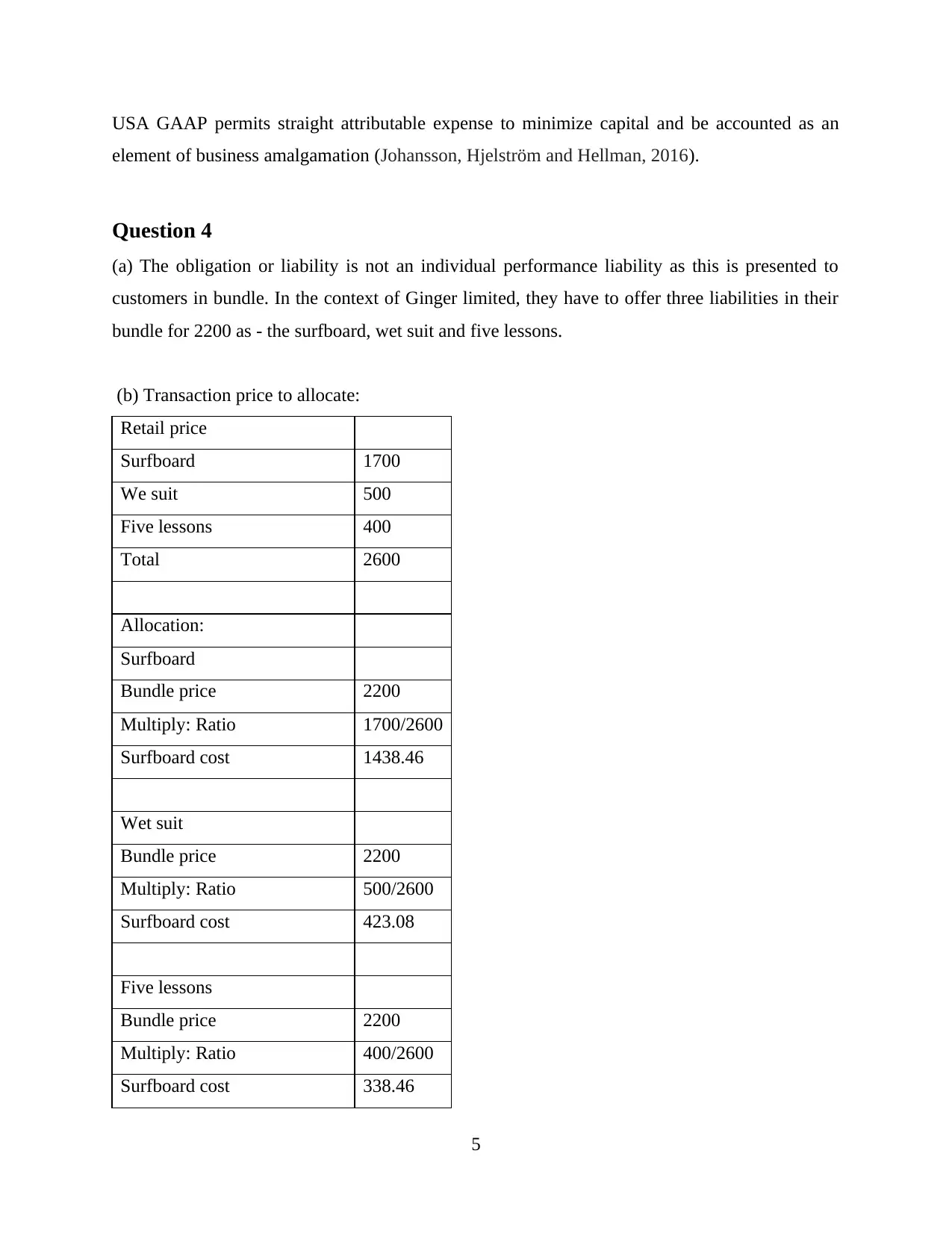
Question 4
(a) The obligation or liability is not an individual performance liability as this is presented to
customers in bundle. In the context of Ginger limited, they have to offer three liabilities in their
bundle for 2200 as - the surfboard, wet suit and five lessons.
(b) Transaction price to allocate:
Retail price
Surfboard 1700
We suit 500
Five lessons 400
Total 2600
Allocation:
Surfboard
Bundle price 2200
Multiply: Ratio 1700/2600
Surfboard cost 1438.46
Wet suit
Bundle price 2200
Multiply: Ratio 500/2600
Surfboard cost 423.08
Five lessons
Bundle price 2200
Multiply: Ratio 400/2600
Surfboard cost 338.46
5
element of business amalgamation (Johansson, Hjelström and Hellman, 2016).
Question 4
(a) The obligation or liability is not an individual performance liability as this is presented to
customers in bundle. In the context of Ginger limited, they have to offer three liabilities in their
bundle for 2200 as - the surfboard, wet suit and five lessons.
(b) Transaction price to allocate:
Retail price
Surfboard 1700
We suit 500
Five lessons 400
Total 2600
Allocation:
Surfboard
Bundle price 2200
Multiply: Ratio 1700/2600
Surfboard cost 1438.46
Wet suit
Bundle price 2200
Multiply: Ratio 500/2600
Surfboard cost 423.08
Five lessons
Bundle price 2200
Multiply: Ratio 400/2600
Surfboard cost 338.46
5

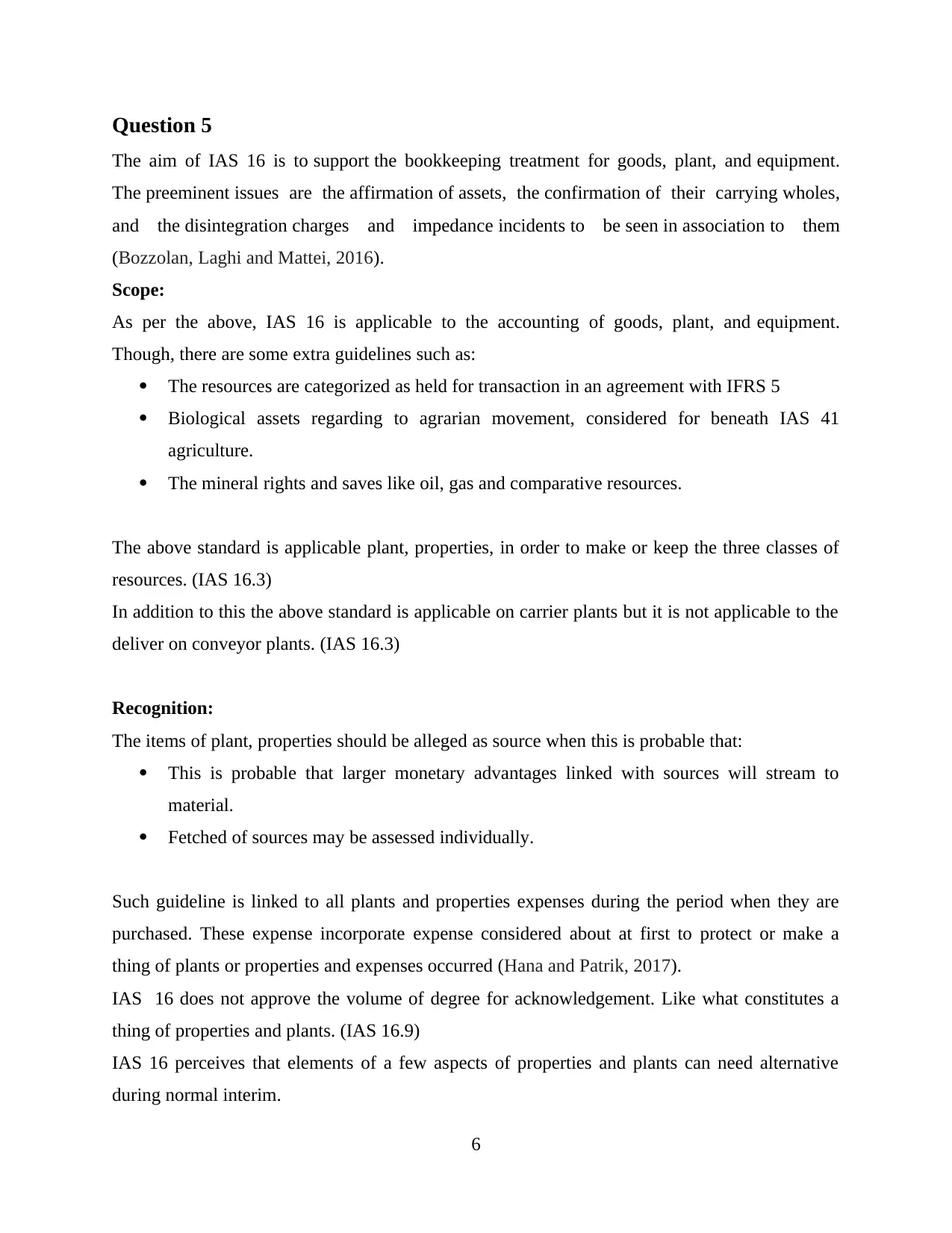
Question 5
The aim of IAS 16 is to support the bookkeeping treatment for goods, plant, and equipment.
The preeminent issues are the affirmation of assets, the confirmation of their carrying wholes,
and the disintegration charges and impedance incidents to be seen in association to them
(Bozzolan, Laghi and Mattei, 2016).
Scope:
As per the above, IAS 16 is applicable to the accounting of goods, plant, and equipment.
Though, there are some extra guidelines such as:
The resources are categorized as held for transaction in an agreement with IFRS 5
Biological assets regarding to agrarian movement, considered for beneath IAS 41
agriculture.
The mineral rights and saves like oil, gas and comparative resources.
The above standard is applicable plant, properties, in order to make or keep the three classes of
resources. (IAS 16.3)
In addition to this the above standard is applicable on carrier plants but it is not applicable to the
deliver on conveyor plants. (IAS 16.3)
Recognition:
The items of plant, properties should be alleged as source when this is probable that:
This is probable that larger monetary advantages linked with sources will stream to
material.
Fetched of sources may be assessed individually.
Such guideline is linked to all plants and properties expenses during the period when they are
purchased. These expense incorporate expense considered about at first to protect or make a
thing of plants or properties and expenses occurred (Hana and Patrik, 2017).
IAS 16 does not approve the volume of degree for acknowledgement. Like what constitutes a
thing of properties and plants. (IAS 16.9)
IAS 16 perceives that elements of a few aspects of properties and plants can need alternative
during normal interim.
6
The aim of IAS 16 is to support the bookkeeping treatment for goods, plant, and equipment.
The preeminent issues are the affirmation of assets, the confirmation of their carrying wholes,
and the disintegration charges and impedance incidents to be seen in association to them
(Bozzolan, Laghi and Mattei, 2016).
Scope:
As per the above, IAS 16 is applicable to the accounting of goods, plant, and equipment.
Though, there are some extra guidelines such as:
The resources are categorized as held for transaction in an agreement with IFRS 5
Biological assets regarding to agrarian movement, considered for beneath IAS 41
agriculture.
The mineral rights and saves like oil, gas and comparative resources.
The above standard is applicable plant, properties, in order to make or keep the three classes of
resources. (IAS 16.3)
In addition to this the above standard is applicable on carrier plants but it is not applicable to the
deliver on conveyor plants. (IAS 16.3)
Recognition:
The items of plant, properties should be alleged as source when this is probable that:
This is probable that larger monetary advantages linked with sources will stream to
material.
Fetched of sources may be assessed individually.
Such guideline is linked to all plants and properties expenses during the period when they are
purchased. These expense incorporate expense considered about at first to protect or make a
thing of plants or properties and expenses occurred (Hana and Patrik, 2017).
IAS 16 does not approve the volume of degree for acknowledgement. Like what constitutes a
thing of properties and plants. (IAS 16.9)
IAS 16 perceives that elements of a few aspects of properties and plants can need alternative
during normal interim.
6
⊘ This is a preview!⊘
Do you want full access?
Subscribe today to unlock all pages.

Trusted by 1+ million students worldwide

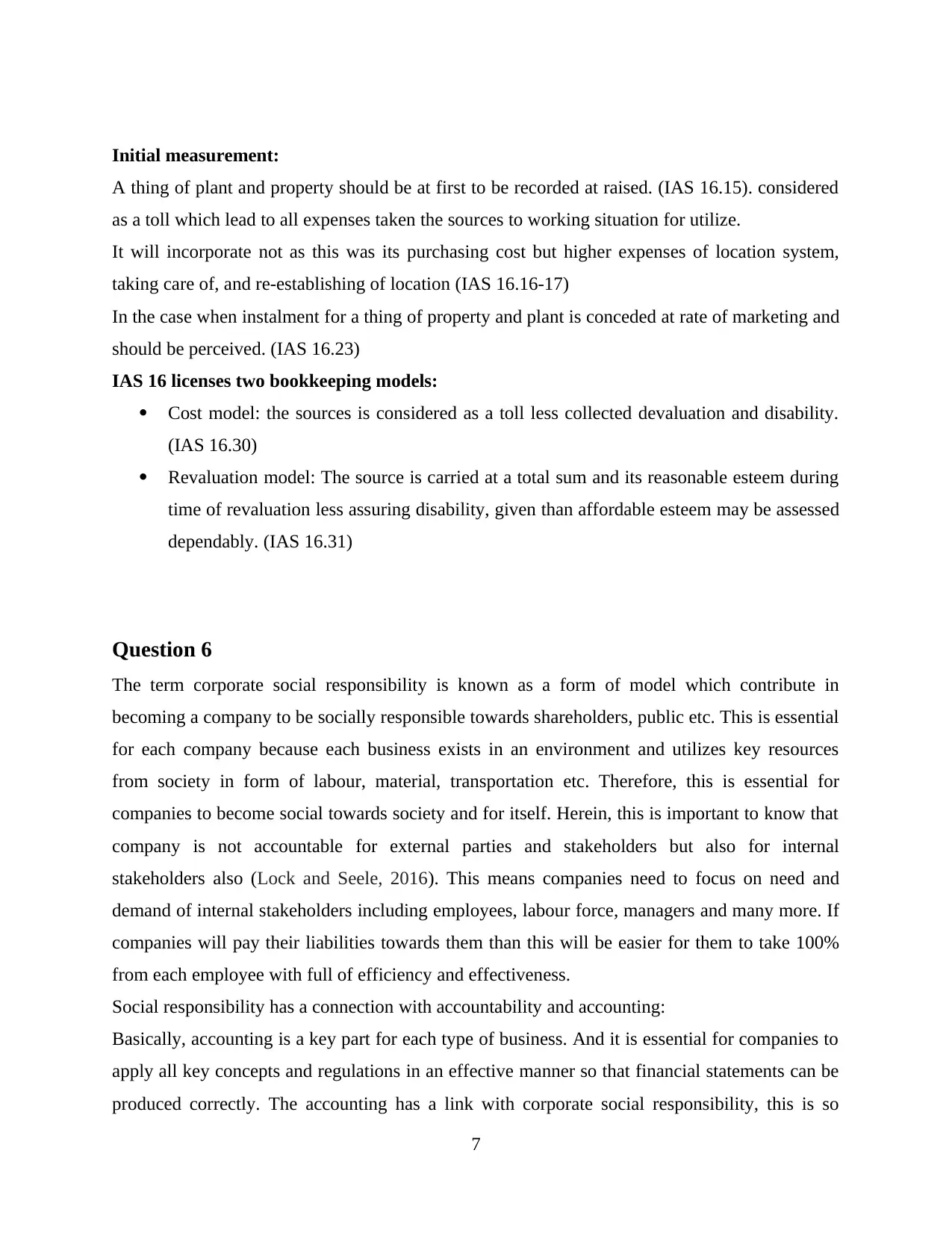
Initial measurement:
A thing of plant and property should be at first to be recorded at raised. (IAS 16.15). considered
as a toll which lead to all expenses taken the sources to working situation for utilize.
It will incorporate not as this was its purchasing cost but higher expenses of location system,
taking care of, and re-establishing of location (IAS 16.16-17)
In the case when instalment for a thing of property and plant is conceded at rate of marketing and
should be perceived. (IAS 16.23)
IAS 16 licenses two bookkeeping models:
Cost model: the sources is considered as a toll less collected devaluation and disability.
(IAS 16.30)
Revaluation model: The source is carried at a total sum and its reasonable esteem during
time of revaluation less assuring disability, given than affordable esteem may be assessed
dependably. (IAS 16.31)
Question 6
The term corporate social responsibility is known as a form of model which contribute in
becoming a company to be socially responsible towards shareholders, public etc. This is essential
for each company because each business exists in an environment and utilizes key resources
from society in form of labour, material, transportation etc. Therefore, this is essential for
companies to become social towards society and for itself. Herein, this is important to know that
company is not accountable for external parties and stakeholders but also for internal
stakeholders also (Lock and Seele, 2016). This means companies need to focus on need and
demand of internal stakeholders including employees, labour force, managers and many more. If
companies will pay their liabilities towards them than this will be easier for them to take 100%
from each employee with full of efficiency and effectiveness.
Social responsibility has a connection with accountability and accounting:
Basically, accounting is a key part for each type of business. And it is essential for companies to
apply all key concepts and regulations in an effective manner so that financial statements can be
produced correctly. The accounting has a link with corporate social responsibility, this is so
7
A thing of plant and property should be at first to be recorded at raised. (IAS 16.15). considered
as a toll which lead to all expenses taken the sources to working situation for utilize.
It will incorporate not as this was its purchasing cost but higher expenses of location system,
taking care of, and re-establishing of location (IAS 16.16-17)
In the case when instalment for a thing of property and plant is conceded at rate of marketing and
should be perceived. (IAS 16.23)
IAS 16 licenses two bookkeeping models:
Cost model: the sources is considered as a toll less collected devaluation and disability.
(IAS 16.30)
Revaluation model: The source is carried at a total sum and its reasonable esteem during
time of revaluation less assuring disability, given than affordable esteem may be assessed
dependably. (IAS 16.31)
Question 6
The term corporate social responsibility is known as a form of model which contribute in
becoming a company to be socially responsible towards shareholders, public etc. This is essential
for each company because each business exists in an environment and utilizes key resources
from society in form of labour, material, transportation etc. Therefore, this is essential for
companies to become social towards society and for itself. Herein, this is important to know that
company is not accountable for external parties and stakeholders but also for internal
stakeholders also (Lock and Seele, 2016). This means companies need to focus on need and
demand of internal stakeholders including employees, labour force, managers and many more. If
companies will pay their liabilities towards them than this will be easier for them to take 100%
from each employee with full of efficiency and effectiveness.
Social responsibility has a connection with accountability and accounting:
Basically, accounting is a key part for each type of business. And it is essential for companies to
apply all key concepts and regulations in an effective manner so that financial statements can be
produced correctly. The accounting has a link with corporate social responsibility, this is so
7
Paraphrase This Document
Need a fresh take? Get an instant paraphrase of this document with our AI Paraphraser

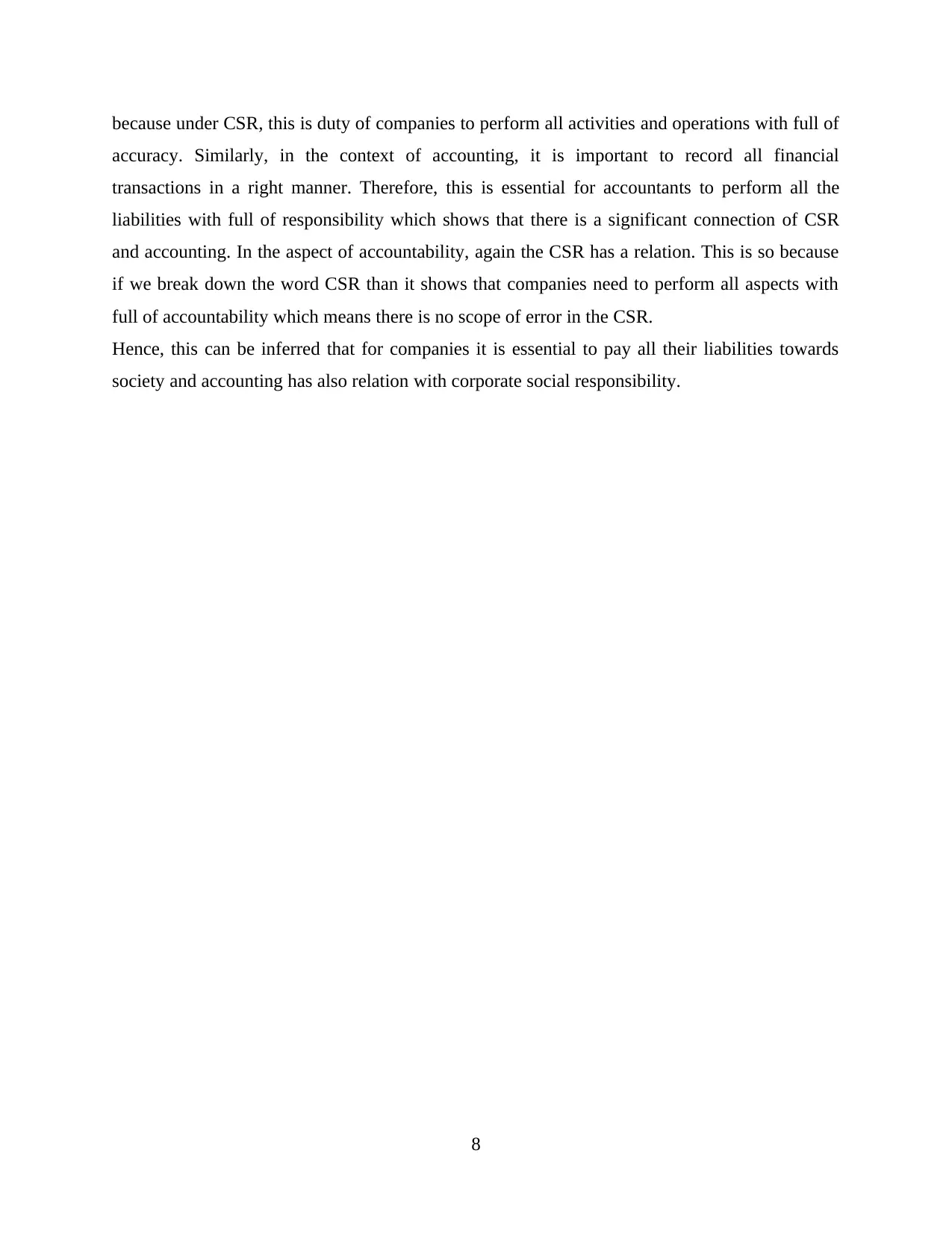
because under CSR, this is duty of companies to perform all activities and operations with full of
accuracy. Similarly, in the context of accounting, it is important to record all financial
transactions in a right manner. Therefore, this is essential for accountants to perform all the
liabilities with full of responsibility which shows that there is a significant connection of CSR
and accounting. In the aspect of accountability, again the CSR has a relation. This is so because
if we break down the word CSR than it shows that companies need to perform all aspects with
full of accountability which means there is no scope of error in the CSR.
Hence, this can be inferred that for companies it is essential to pay all their liabilities towards
society and accounting has also relation with corporate social responsibility.
8
accuracy. Similarly, in the context of accounting, it is important to record all financial
transactions in a right manner. Therefore, this is essential for accountants to perform all the
liabilities with full of responsibility which shows that there is a significant connection of CSR
and accounting. In the aspect of accountability, again the CSR has a relation. This is so because
if we break down the word CSR than it shows that companies need to perform all aspects with
full of accountability which means there is no scope of error in the CSR.
Hence, this can be inferred that for companies it is essential to pay all their liabilities towards
society and accounting has also relation with corporate social responsibility.
8

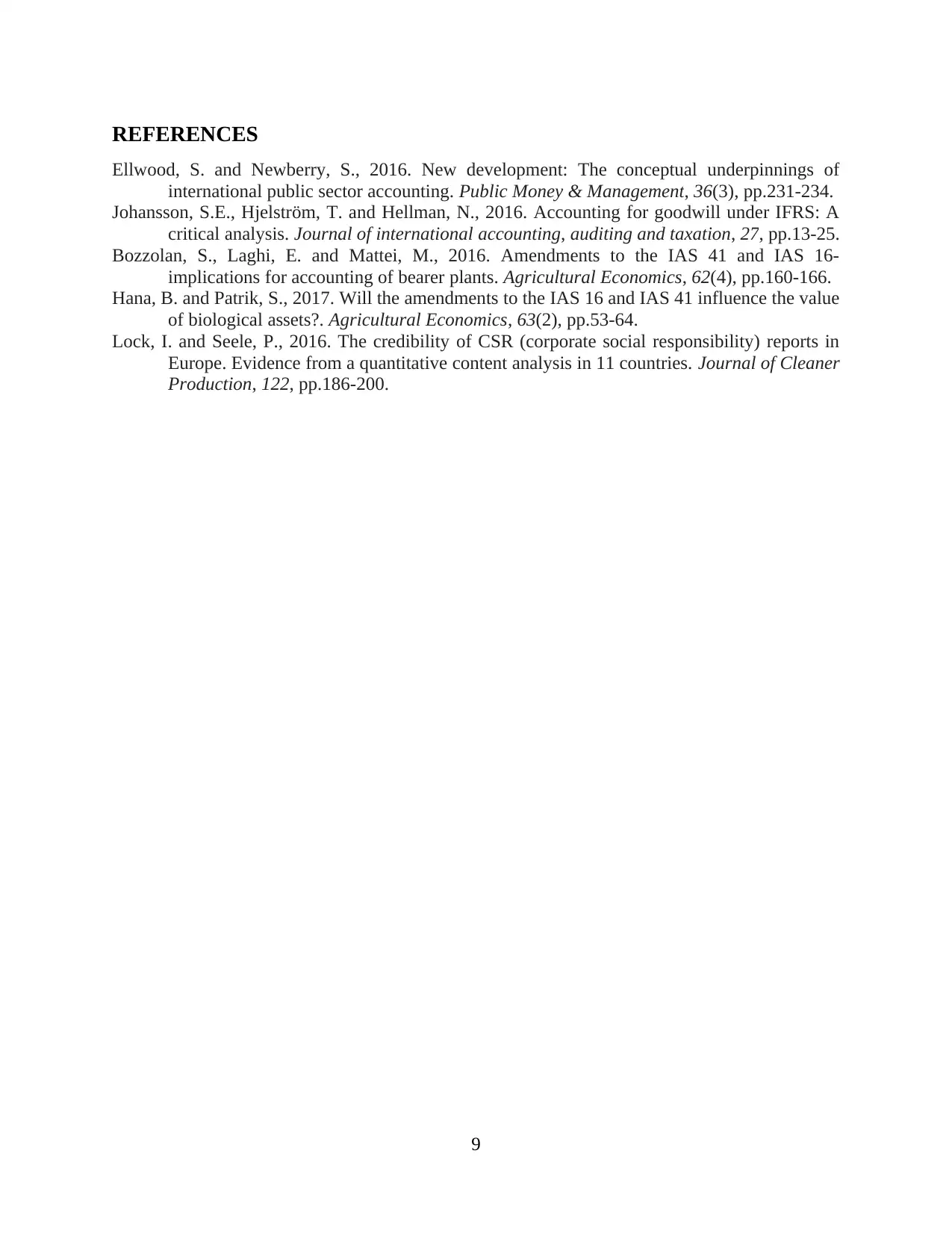
REFERENCES
Ellwood, S. and Newberry, S., 2016. New development: The conceptual underpinnings of
international public sector accounting. Public Money & Management, 36(3), pp.231-234.
Johansson, S.E., Hjelström, T. and Hellman, N., 2016. Accounting for goodwill under IFRS: A
critical analysis. Journal of international accounting, auditing and taxation, 27, pp.13-25.
Bozzolan, S., Laghi, E. and Mattei, M., 2016. Amendments to the IAS 41 and IAS 16-
implications for accounting of bearer plants. Agricultural Economics, 62(4), pp.160-166.
Hana, B. and Patrik, S., 2017. Will the amendments to the IAS 16 and IAS 41 influence the value
of biological assets?. Agricultural Economics, 63(2), pp.53-64.
Lock, I. and Seele, P., 2016. The credibility of CSR (corporate social responsibility) reports in
Europe. Evidence from a quantitative content analysis in 11 countries. Journal of Cleaner
Production, 122, pp.186-200.
9
Ellwood, S. and Newberry, S., 2016. New development: The conceptual underpinnings of
international public sector accounting. Public Money & Management, 36(3), pp.231-234.
Johansson, S.E., Hjelström, T. and Hellman, N., 2016. Accounting for goodwill under IFRS: A
critical analysis. Journal of international accounting, auditing and taxation, 27, pp.13-25.
Bozzolan, S., Laghi, E. and Mattei, M., 2016. Amendments to the IAS 41 and IAS 16-
implications for accounting of bearer plants. Agricultural Economics, 62(4), pp.160-166.
Hana, B. and Patrik, S., 2017. Will the amendments to the IAS 16 and IAS 41 influence the value
of biological assets?. Agricultural Economics, 63(2), pp.53-64.
Lock, I. and Seele, P., 2016. The credibility of CSR (corporate social responsibility) reports in
Europe. Evidence from a quantitative content analysis in 11 countries. Journal of Cleaner
Production, 122, pp.186-200.
9
⊘ This is a preview!⊘
Do you want full access?
Subscribe today to unlock all pages.

Trusted by 1+ million students worldwide
1 out of 9
Related Documents
Your All-in-One AI-Powered Toolkit for Academic Success.
+13062052269
info@desklib.com
Available 24*7 on WhatsApp / Email
Unlock your academic potential
Copyright © 2020–2025 A2Z Services. All Rights Reserved. Developed and managed by ZUCOL.