HI6028 Taxation Law Assignment: Residency, Ordinary Income Analysis
VerifiedAdded on 2019/09/25
|12
|2269
|332
Homework Assignment
AI Summary
This assignment delves into key aspects of Australian taxation law, specifically addressing the concepts of residency and ordinary income. The first question examines the tax residency status of an individual, Fred, who comes to Australia to establish a company branch. It analyzes his situation under Taxation Ruling 98/17 and the ITAA 1936, considering factors like place of residence, domicile, and length of stay. The second question explores the determination of ordinary income through various case studies, including Californian Copper Syndicate ltd v Harris, Scottish Australian Mining co ltd v FC of T, and others. Each case is analyzed to determine whether income from specific transactions is classified as ordinary income, providing a comprehensive understanding of the principles and their application in different scenarios. The assignment concludes with a list of references used to support the analysis.

HI6028 Assignment
~ 1 ~
~ 1 ~

Paraphrase This Document
Need a fresh take? Get an instant paraphrase of this document with our AI Paraphraser

Table of Contents
Question 1
………………………………………………………………………………………………
………… Page no. 2
Question 2
………………………………………………………………………………………………
………… Page no. 5
References
………………………………………………………………………………………………
………… Page no. 11
~ 2 ~
Question 1
………………………………………………………………………………………………
………… Page no. 2
Question 2
………………………………………………………………………………………………
………… Page no. 5
References
………………………………………………………………………………………………
………… Page no. 11
~ 2 ~
Question 1
Issue
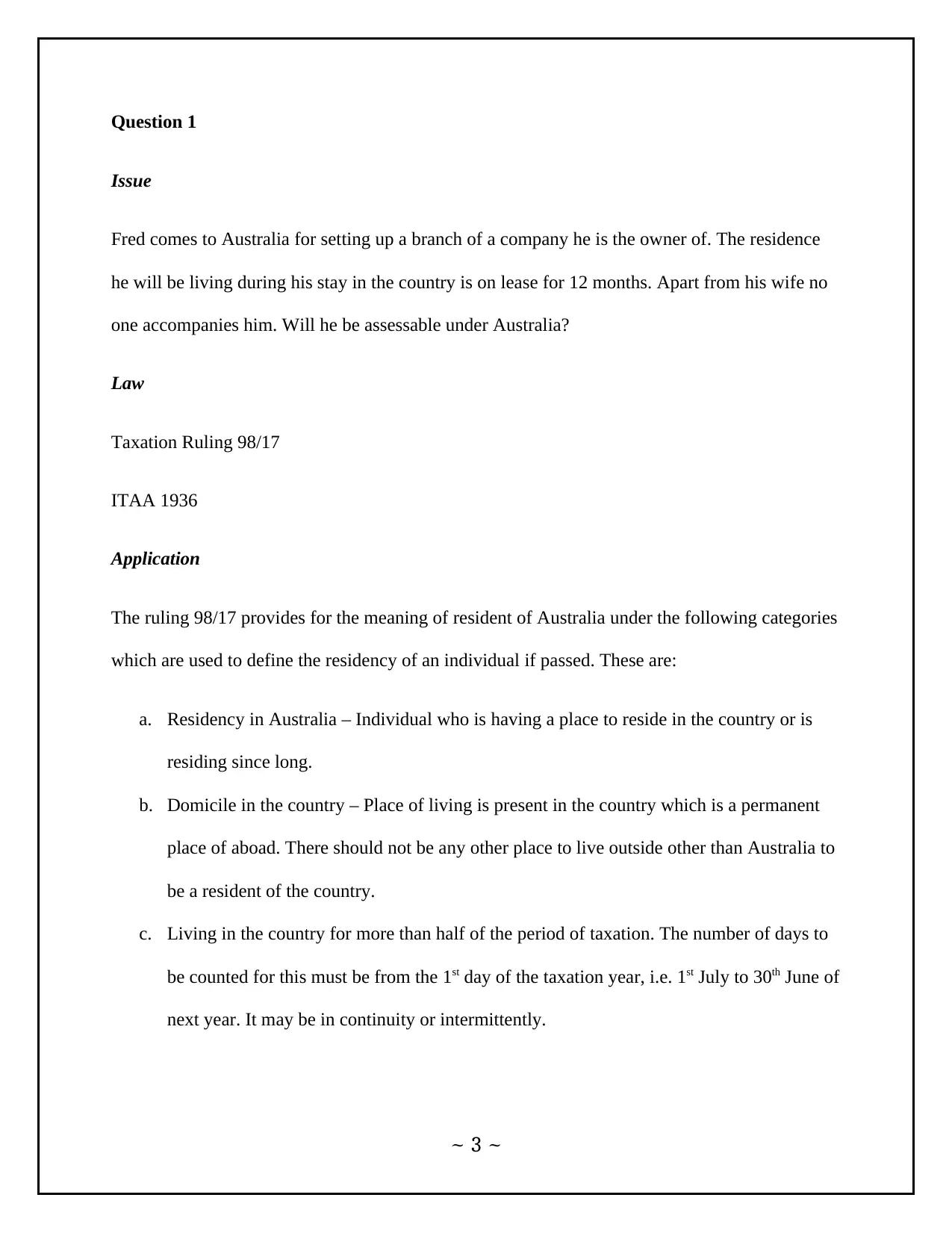
Fred comes to Australia for setting up a branch of a company he is the owner of. The residence
he will be living during his stay in the country is on lease for 12 months. Apart from his wife no
one accompanies him. Will he be assessable under Australia?
Law
Taxation Ruling 98/17
ITAA 1936
Application
The ruling 98/17 provides for the meaning of resident of Australia under the following categories
which are used to define the residency of an individual if passed. These are:
a. Residency in Australia – Individual who is having a place to reside in the country or is
residing since long.
b. Domicile in the country – Place of living is present in the country which is a permanent
place of aboad. There should not be any other place to live outside other than Australia to
be a resident of the country.
c. Living in the country for more than half of the period of taxation. The number of days to
be counted for this must be from the 1st day of the taxation year, i.e. 1st July to 30th June of
next year. It may be in continuity or intermittently.
~ 3 ~
Issue
Fred comes to Australia for setting up a branch of a company he is the owner of. The residence
he will be living during his stay in the country is on lease for 12 months. Apart from his wife no
one accompanies him. Will he be assessable under Australia?
Law
Taxation Ruling 98/17
ITAA 1936
Application
The ruling 98/17 provides for the meaning of resident of Australia under the following categories
which are used to define the residency of an individual if passed. These are:
a. Residency in Australia – Individual who is having a place to reside in the country or is
residing since long.
b. Domicile in the country – Place of living is present in the country which is a permanent
place of aboad. There should not be any other place to live outside other than Australia to
be a resident of the country.
c. Living in the country for more than half of the period of taxation. The number of days to
be counted for this must be from the 1st day of the taxation year, i.e. 1st July to 30th June of
next year. It may be in continuity or intermittently.
~ 3 ~
⊘ This is a preview!⊘
Do you want full access?
Subscribe today to unlock all pages.

Trusted by 1+ million students worldwide

d. Superannuation fund test where the individual is registered under Superannuation Act,
1990 or is an employee under the act of 1976 or the individual is the spouse or a child
who is below the age of 16 of such employee.
An individual who passes any of test or many, will be considered to be a tax resident of the
country. Under section 6-1 of the ITAA 1936, a person who is a resident of country is taxable for
his incomes earned in the country. For individuals who are residents of the country just for tax
purpose will be taxable on income which has he source in Australia.
To be a resident of the country, there must be one test from the above to be passed. For the first
test, Fred is residing in the country for a period of 11 months. He has a place to live in the
country. Second test, stating the domicile is not passed by him, as the permanent place to abode
is not located in country. UK is the place of domicile for him as it is clearly given that he will be
present in the country for 12 months period. Third test of living in country for more than half of
the year is fulfilled by him. He is present for 11 months continuously which is more than half of
the year. Last test of superannuation is not completed or taken for him, as there is no information
on such test.
Now, as it can be seen that Fred is fulfilling two test out of four, he is a tax resident of Australia.
Conclusion
Fred will be assessable for his incomes made in the country as he is a tax resident of Australia.
He will not be taxable for incomes made in UK.
~ 4 ~
1990 or is an employee under the act of 1976 or the individual is the spouse or a child
who is below the age of 16 of such employee.
An individual who passes any of test or many, will be considered to be a tax resident of the
country. Under section 6-1 of the ITAA 1936, a person who is a resident of country is taxable for
his incomes earned in the country. For individuals who are residents of the country just for tax
purpose will be taxable on income which has he source in Australia.
To be a resident of the country, there must be one test from the above to be passed. For the first
test, Fred is residing in the country for a period of 11 months. He has a place to live in the
country. Second test, stating the domicile is not passed by him, as the permanent place to abode
is not located in country. UK is the place of domicile for him as it is clearly given that he will be
present in the country for 12 months period. Third test of living in country for more than half of
the year is fulfilled by him. He is present for 11 months continuously which is more than half of
the year. Last test of superannuation is not completed or taken for him, as there is no information
on such test.
Now, as it can be seen that Fred is fulfilling two test out of four, he is a tax resident of Australia.
Conclusion
Fred will be assessable for his incomes made in the country as he is a tax resident of Australia.
He will not be taxable for incomes made in UK.
~ 4 ~
Paraphrase This Document
Need a fresh take? Get an instant paraphrase of this document with our AI Paraphraser

Question 2
Issue
Whether there will be ordinary income in the given below cases
Discussion
a. Californian Copper Syndicate ltd v Harris (1904):
In the taxation ruling 92/3, it is provided about this case, where the group of people
formed a syndicate or a company to purchase a mine property. It was acquired with the
intention of making some profit. There was no business done from the operations of the
mine. It was found that the purchase was a onetime event. To be an ordinary income the
incomes must be from personal exertion. It includes income from employment, or a
business activity or income from property as rent or dividend. It also includes such
isolated transactions which were entered into, just to make profit.
In this case, it can be seen that there are no features of personal exertion in it. The
operations of mine were not carried on; therefore no business activity takes place. Instead,
a onetime transaction was done. It was declared that even when a transaction which is
done just once, but was done to make profit comes under the concept of ordinary
incomes.
Therefore, the proceeds from such sale of mining were to be assessed in ordinary income.
b. Scottish Australian Mining co ltd v FC of T
The company decided to sell a land on which mining operations were done. In the
memorandum of the company, it was mentioned that the main object of the company
~ 5 ~
Issue
Whether there will be ordinary income in the given below cases
Discussion
a. Californian Copper Syndicate ltd v Harris (1904):
In the taxation ruling 92/3, it is provided about this case, where the group of people
formed a syndicate or a company to purchase a mine property. It was acquired with the
intention of making some profit. There was no business done from the operations of the
mine. It was found that the purchase was a onetime event. To be an ordinary income the
incomes must be from personal exertion. It includes income from employment, or a
business activity or income from property as rent or dividend. It also includes such
isolated transactions which were entered into, just to make profit.
In this case, it can be seen that there are no features of personal exertion in it. The
operations of mine were not carried on; therefore no business activity takes place. Instead,
a onetime transaction was done. It was declared that even when a transaction which is
done just once, but was done to make profit comes under the concept of ordinary
incomes.
Therefore, the proceeds from such sale of mining were to be assessed in ordinary income.
b. Scottish Australian Mining co ltd v FC of T
The company decided to sell a land on which mining operations were done. In the
memorandum of the company, it was mentioned that the main object of the company
~ 5 ~

remains in doing the mining. They were buying the properties rich in mineral production.
They were involved in investment of capital. In this the company used to purchase the
property and use it completely till the time of its exhaustion. He output of the mining was
sold in the market. The activity was done in a manner like that of a business. Also, the
intention of making the company was not to earn profits from the sale of land initially,
but to do mining operations. It was a business being carried on. There was no isolated
transaction made from the company and the sale will lead to a sale of capital asset.
Therefore, it was concluded that the sale of land doesn’t raise any tax implications and the
income so derived will not be assessable as income from ordinary concepts. Interestingly,
such income will be taxable under the head capital gains under statutory income.
c. FC of T v. Whit fords Beach Pty Ltd (1982)
In this case, the company was formed to acquire the land. Late on when the shareholders
of the company changed, the land development was done and then sold. They developed
the property and apply for rezoning and then making the subdivision and selling it in the
market.
The developments were made on the land as per the requirement. The people involved in
it were to make profits. When an activity is done where the operations for the same is
been carried on becomes a business. Here, also, the company was developing the lands
and changing its category to a different zone and the selling it on sub division shows that
an operation of business is carried. However, this transaction is a not a onetime event, as
the new shareholders are the people involved in land development and then selling it. The
income being made therefore will be a business income and will be taxable or assessable
under ordinary income.
~ 6 ~
They were involved in investment of capital. In this the company used to purchase the
property and use it completely till the time of its exhaustion. He output of the mining was
sold in the market. The activity was done in a manner like that of a business. Also, the
intention of making the company was not to earn profits from the sale of land initially,
but to do mining operations. It was a business being carried on. There was no isolated
transaction made from the company and the sale will lead to a sale of capital asset.
Therefore, it was concluded that the sale of land doesn’t raise any tax implications and the
income so derived will not be assessable as income from ordinary concepts. Interestingly,
such income will be taxable under the head capital gains under statutory income.
c. FC of T v. Whit fords Beach Pty Ltd (1982)
In this case, the company was formed to acquire the land. Late on when the shareholders
of the company changed, the land development was done and then sold. They developed
the property and apply for rezoning and then making the subdivision and selling it in the
market.
The developments were made on the land as per the requirement. The people involved in
it were to make profits. When an activity is done where the operations for the same is
been carried on becomes a business. Here, also, the company was developing the lands
and changing its category to a different zone and the selling it on sub division shows that
an operation of business is carried. However, this transaction is a not a onetime event, as
the new shareholders are the people involved in land development and then selling it. The
income being made therefore will be a business income and will be taxable or assessable
under ordinary income.
~ 6 ~
⊘ This is a preview!⊘
Do you want full access?
Subscribe today to unlock all pages.
Trusted by 1+ million students worldwide

d. Statham & Anor v FC of T 89
Here, the people or taxpayers in question were the trustees of a deceased estate. A parcel
of land which was used for farming was acquired by the deceased and the purpose of it
was to use it as a farming land to raise the family. Later on after few years, half of the
land was sold to people of the company who were the family members of the deceased.
The property then acquired by his family members was to be used for raising cattle under
their partnership. Later on non performance of the partnership the land was subdivided
and sold in the market.
The property was not purchased with any intention of making profit. There was no
isolated transaction. Also, the family members of the deceased were not performing any
business activity as there was no trade of land done on a regular basis.
An income to be assessed under ordinary income, should be generated either from
isolated transactions having intention of profit making or a business like activity. Here,
there was none of the both fulfilled. The sale of land’s income will not be taxable under
ordinary income.
e. Casimaty v FC of T 97
The land was acquired by the taxpayer from his father. The land was used for farming by
his father, but was acquired by the taxpayer for a primary production business. Due to
increasing debt on the taxpayer and ill health, the land was decided to be sold. The land
was made into smaller parts and was sold. Before the sale, the taxpayer builds roads,
other facilities in the area.
~ 7 ~
Here, the people or taxpayers in question were the trustees of a deceased estate. A parcel
of land which was used for farming was acquired by the deceased and the purpose of it
was to use it as a farming land to raise the family. Later on after few years, half of the
land was sold to people of the company who were the family members of the deceased.
The property then acquired by his family members was to be used for raising cattle under
their partnership. Later on non performance of the partnership the land was subdivided
and sold in the market.
The property was not purchased with any intention of making profit. There was no
isolated transaction. Also, the family members of the deceased were not performing any
business activity as there was no trade of land done on a regular basis.
An income to be assessed under ordinary income, should be generated either from
isolated transactions having intention of profit making or a business like activity. Here,
there was none of the both fulfilled. The sale of land’s income will not be taxable under
ordinary income.
e. Casimaty v FC of T 97
The land was acquired by the taxpayer from his father. The land was used for farming by
his father, but was acquired by the taxpayer for a primary production business. Due to
increasing debt on the taxpayer and ill health, the land was decided to be sold. The land
was made into smaller parts and was sold. Before the sale, the taxpayer builds roads,
other facilities in the area.
~ 7 ~
Paraphrase This Document
Need a fresh take? Get an instant paraphrase of this document with our AI Paraphraser

It was decided in the court that the built of the facilities shows that a business is carried
on but there was only realisation of the capital asset as the land was originally purchased
for doing farming and for the residence of the family.
There was no business income generated from the sale. Hence, there will be no taxable
ordinary income. Also, the sale will be termed as a capital gain if sold for more than the
cost of the property.
f. Moana Sand pty ltd v FC of T 88
A land was purchased by the company to sell the sand on it. An application was received
by the company members that government was interested in buying such land. For mining
the taxpayer appealed that such land was acquired to be sold for later on in subdivided
buildings. However, the government in order to preserve such land paid to the taxpayer an
amount of $500,000 in two instalments. The commissioner felt that such income was an
income from ordinary income as the intention of the taxpayer was to make profit by
selling the land in subdivided form.
It was held by the court though such transaction comes under isolated transaction but the
intention was to sell the land for the profit. Therefore, such income is taxable under
ordinary incomes.
g. Crow v FC of T 88
In this case, a big area of land was purchased in the period of ten years on loan amount. It
was used for farming, growing crops and grazing. The land was subdivided and sold 51
blocks for some profit. It was held by the court that the taxpayer knew that he will be in
~ 8 ~
on but there was only realisation of the capital asset as the land was originally purchased
for doing farming and for the residence of the family.
There was no business income generated from the sale. Hence, there will be no taxable
ordinary income. Also, the sale will be termed as a capital gain if sold for more than the
cost of the property.
f. Moana Sand pty ltd v FC of T 88
A land was purchased by the company to sell the sand on it. An application was received
by the company members that government was interested in buying such land. For mining
the taxpayer appealed that such land was acquired to be sold for later on in subdivided
buildings. However, the government in order to preserve such land paid to the taxpayer an
amount of $500,000 in two instalments. The commissioner felt that such income was an
income from ordinary income as the intention of the taxpayer was to make profit by
selling the land in subdivided form.
It was held by the court though such transaction comes under isolated transaction but the
intention was to sell the land for the profit. Therefore, such income is taxable under
ordinary incomes.
g. Crow v FC of T 88
In this case, a big area of land was purchased in the period of ten years on loan amount. It
was used for farming, growing crops and grazing. The land was subdivided and sold 51
blocks for some profit. It was held by the court that the taxpayer knew that he will be in
~ 8 ~

debt and is not able to pay the loan with the farming activity. Therefore, the sale of land
from subdivision was made.
The subdivision and sale of the property or the land was in continuity, which had he
features of a business. Hence, the profit earned from such activity will be taxable under
business income and under ordinary concept.
The case of Scottish Australian mining company v. FC of T was considered. It was seen
that in that case, an isolated transaction has been entered into. However, there were no
features of it as a business activity.
h. McCurry & Anor v FC of T 98
In this case, a land was purchased by the taxpayer having a house built on it. The house
was removed from it and new three townhouses were built in it. The sale of such houses
was advertised but couldn’t get any buyer. Therefore, the taxpayer’s family started living
in it until it was sold. Again after few years a block of land was purchased and units were
constructed on it and were sold then.
It was decided in the case, that the intention of buying the land was to make profit. The
profit to be a realisation of capital asset, the asset must be held as investment. There was
constantly purchase of land, construction of houses on it and then the sale. A business is
operated in such way. There is no isolated transaction being carried on as the sale is
taking place more than once. However, the activity o purchase and sale is been done
continuously. Therefore it will be treated a business income. It will be assessable under
the ordinary income concept as it is a business income.
~ 9 ~
from subdivision was made.
The subdivision and sale of the property or the land was in continuity, which had he
features of a business. Hence, the profit earned from such activity will be taxable under
business income and under ordinary concept.
The case of Scottish Australian mining company v. FC of T was considered. It was seen
that in that case, an isolated transaction has been entered into. However, there were no
features of it as a business activity.
h. McCurry & Anor v FC of T 98
In this case, a land was purchased by the taxpayer having a house built on it. The house
was removed from it and new three townhouses were built in it. The sale of such houses
was advertised but couldn’t get any buyer. Therefore, the taxpayer’s family started living
in it until it was sold. Again after few years a block of land was purchased and units were
constructed on it and were sold then.
It was decided in the case, that the intention of buying the land was to make profit. The
profit to be a realisation of capital asset, the asset must be held as investment. There was
constantly purchase of land, construction of houses on it and then the sale. A business is
operated in such way. There is no isolated transaction being carried on as the sale is
taking place more than once. However, the activity o purchase and sale is been done
continuously. Therefore it will be treated a business income. It will be assessable under
the ordinary income concept as it is a business income.
~ 9 ~
⊘ This is a preview!⊘
Do you want full access?
Subscribe today to unlock all pages.
Trusted by 1+ million students worldwide

References
~ 10 ~
~ 10 ~
Paraphrase This Document
Need a fresh take? Get an instant paraphrase of this document with our AI Paraphraser
Cahill. T, n.d. Statham & ANor v FC of. Retrieved 26th August 2016, from::
http://www.aicnsw.com.au/uploads/images/PDF/paperGST_Property%20Taxes
%20Update_toAICjune11.pdfh April 2016,
Bitomsky. G, 1991. The concept of Assessable income has it changed. Retrieved 26th August
2016, from:: http://epublications.bond.edu.au/cgi/viewcontent.cgi?article=1023&context=rlj
Cahill. G, 2010. Casimaty v FC of T. Retrieved 26th August 2016, from::
http://www.cgw.com.au/publication/ato-determines-that-developer-of-22-lot-subdivision-does-
not-have-to-register-for-gst/
Anon, n.d, Distinguish between capital and income receipts. Retrieved 26th August 2016, from:
Available at: http://www.austlii.edu.au/au/journals/JATax/1999/13.html
Anon, 1998. ATO ID 98/17. Retrieved 26th August 2016,
from:http://law.ato.gov.au/atolaw/view.htm?Docid=TXR/TR9817/NAT/ATO/00001
ANON, n.d. Residency. Retrieved 26th August 2016, from:
http://www.iknow.cch.com.au/#!/topic/tlp703/overview/residency
ANON, 2015, Australian Tax residency - Guidelines, Retrieved 26th August 2016, from:
http://www.exfin.com/australian-tax-residency>
~ 11 ~
http://www.aicnsw.com.au/uploads/images/PDF/paperGST_Property%20Taxes
%20Update_toAICjune11.pdfh April 2016,
Bitomsky. G, 1991. The concept of Assessable income has it changed. Retrieved 26th August
2016, from:: http://epublications.bond.edu.au/cgi/viewcontent.cgi?article=1023&context=rlj
Cahill. G, 2010. Casimaty v FC of T. Retrieved 26th August 2016, from::
http://www.cgw.com.au/publication/ato-determines-that-developer-of-22-lot-subdivision-does-
not-have-to-register-for-gst/
Anon, n.d, Distinguish between capital and income receipts. Retrieved 26th August 2016, from:
Available at: http://www.austlii.edu.au/au/journals/JATax/1999/13.html
Anon, 1998. ATO ID 98/17. Retrieved 26th August 2016,
from:http://law.ato.gov.au/atolaw/view.htm?Docid=TXR/TR9817/NAT/ATO/00001
ANON, n.d. Residency. Retrieved 26th August 2016, from:
http://www.iknow.cch.com.au/#!/topic/tlp703/overview/residency
ANON, 2015, Australian Tax residency - Guidelines, Retrieved 26th August 2016, from:
http://www.exfin.com/australian-tax-residency>
~ 11 ~

~ 12 ~
⊘ This is a preview!⊘
Do you want full access?
Subscribe today to unlock all pages.
Trusted by 1+ million students worldwide

1 out of 12


Related Documents


Your All-in-One AI-Powered Toolkit for Academic Success.
+13062052269
info@desklib.com
Available 24*7 on WhatsApp / Email
![[object Object]](/_next/static/media/star-bottom.7253800d.svg)
Unlock your academic potential
Copyright © 2020–2026 A2Z Services. All Rights Reserved. Developed and managed by ZUCOL.