Legal Analysis: High Court Ruling on Aboriginal Deportation and Rights
VerifiedAdded on 2022/08/19
|10
|2274
|14
Report
AI Summary
This report analyzes the High Court ruling regarding the deportation of Aboriginal Australians, focusing on the case of two individuals with criminal convictions. It examines the court's decision that Aboriginal people cannot be considered aliens and therefore cannot be deported, highlighting the legal arguments and the perspectives of the lawyers involved. The report explores the facts of the case, the limitations of the media coverage, and reflects on the impact of the ruling on Australian society, particularly concerning the rights and recognition of Indigenous people. It underscores the significance of the decision in challenging government practices and promoting a new understanding of Aboriginal rights within the Australian legal framework. The report also provides a critical reflection on the broader implications of the case, including discussions on the constitutional status of Aboriginal and Torres Strait Islander peoples and the legal definition of an alien.
Running head: ABORIGINAL PEOPLE OF AUSTRALIA
Aboriginal People Of Australia
Name of the student:
Name of the university:
Authors note:
Aboriginal People Of Australia
Name of the student:
Name of the university:
Authors note:

Paraphrase This Document
Need a fresh take? Get an instant paraphrase of this document with our AI Paraphraser
1
ABORIGINAL PEOPLE OF AUSTRALIA
Table of Contents
Introduction......................................................................................................................................2
Facts.................................................................................................................................................3
Opinions...........................................................................................................................................3
Reflection.........................................................................................................................................4
Critical Reflection............................................................................................................................5
Conclusion.......................................................................................................................................6
References........................................................................................................................................7
ABORIGINAL PEOPLE OF AUSTRALIA
Table of Contents
Introduction......................................................................................................................................2
Facts.................................................................................................................................................3
Opinions...........................................................................................................................................3
Reflection.........................................................................................................................................4
Critical Reflection............................................................................................................................5
Conclusion.......................................................................................................................................6
References........................................................................................................................................7
2
ABORIGINAL PEOPLE OF AUSTRALIA
Introduction
The media piece is on context of the judgment passed by the Australian court on the case
of the indigenous people of Australia besides their right in the lands of Australia. The case
mainly highlighted the feature that the native Australian people were not considered as the alien
to the land therefore they could not be deported. The name of the media piece is the ‘High Court
rules Aboriginal people cannot be deported for criminal convictions, cannot be alien to Australia’
by Elizabeth Byrne and Josh Robertson (ABC News, 2020). In the world there are nearly 370
million of indigenous people (Dhir, 2015). These people are diverse in nature but they also have
common issues which affect them altogether (O'Connor, 2017). The Australian high court
recently added a new dimension through their judgment and in this article brief insight regarding
the historic judgment is provided ( Rix, 2014). The following section of the paper will firstly
highlights the facts that the author has penned down. The facts is majorly traced in the first
section itself as the article is written in an inverted pyramid format. The paper will go on tracing
the opinion of the authors and majorly state the perspective of the author and state the major
opinions that has been addressed by the case. Then the paper will elaborate the limitations of the
article and will reflect my alignment with the case. The last section of the paper will address
how the coverage has altogether influenced the society and what is the significance and the after
effect of the article.
ABORIGINAL PEOPLE OF AUSTRALIA
Introduction
The media piece is on context of the judgment passed by the Australian court on the case
of the indigenous people of Australia besides their right in the lands of Australia. The case
mainly highlighted the feature that the native Australian people were not considered as the alien
to the land therefore they could not be deported. The name of the media piece is the ‘High Court
rules Aboriginal people cannot be deported for criminal convictions, cannot be alien to Australia’
by Elizabeth Byrne and Josh Robertson (ABC News, 2020). In the world there are nearly 370
million of indigenous people (Dhir, 2015). These people are diverse in nature but they also have
common issues which affect them altogether (O'Connor, 2017). The Australian high court
recently added a new dimension through their judgment and in this article brief insight regarding
the historic judgment is provided ( Rix, 2014). The following section of the paper will firstly
highlights the facts that the author has penned down. The facts is majorly traced in the first
section itself as the article is written in an inverted pyramid format. The paper will go on tracing
the opinion of the authors and majorly state the perspective of the author and state the major
opinions that has been addressed by the case. Then the paper will elaborate the limitations of the
article and will reflect my alignment with the case. The last section of the paper will address
how the coverage has altogether influenced the society and what is the significance and the after
effect of the article.
⊘ This is a preview!⊘
Do you want full access?
Subscribe today to unlock all pages.

Trusted by 1+ million students worldwide
3
ABORIGINAL PEOPLE OF AUSTRALIA
Facts
The Australian High Court ruled that the innate people of Australia who are accused of
criminal conviction cannot be deported. It was found by the court that the indigenous publics
secured a special position and were accepted from the immigration decrees. This was found in
the context of two criminal convicts whom the government of Australia desired to deport. The
two convicts in question was Brendan Thomas and Daniel Love. These two convicts due to jail
sentences had not been able to pass the migration character test. Though Mr. Love has not
cleared the case, as the court doubted on the whether he is a true aboriginal however, Mr.
Thomas has cleared the trial and was set free by the court (Byrne & Roberston, 2020).
In the case of Mr. Love, he was positioned in the immigration detention for sporadic
bodily harm (Byrne & Roberston, 2020).While in the case of Mr. Thomas, he was serving an
eighteen months judgment for a case of domestic violence and he was further reserved for
immigration detention for that. The fact is also given in the article in the form of facts provided
by thelawyers of both the parties.
Opinions
In this article, mainly the perspective of the lawyer is discussed and her observation is
given as an opinion. No other opinion has been incorporated in the article rather than the opinion
of the lawyer. Brandon Thomas lawyer explained that the ruling is about who the Australian
national and not about the Australian citizenship ABC News. (2020). It should be noted that in
the article in this article the author has incorporated certain opinion as well but restrained from
ABORIGINAL PEOPLE OF AUSTRALIA
Facts
The Australian High Court ruled that the innate people of Australia who are accused of
criminal conviction cannot be deported. It was found by the court that the indigenous publics
secured a special position and were accepted from the immigration decrees. This was found in
the context of two criminal convicts whom the government of Australia desired to deport. The
two convicts in question was Brendan Thomas and Daniel Love. These two convicts due to jail
sentences had not been able to pass the migration character test. Though Mr. Love has not
cleared the case, as the court doubted on the whether he is a true aboriginal however, Mr.
Thomas has cleared the trial and was set free by the court (Byrne & Roberston, 2020).
In the case of Mr. Love, he was positioned in the immigration detention for sporadic
bodily harm (Byrne & Roberston, 2020).While in the case of Mr. Thomas, he was serving an
eighteen months judgment for a case of domestic violence and he was further reserved for
immigration detention for that. The fact is also given in the article in the form of facts provided
by thelawyers of both the parties.
Opinions
In this article, mainly the perspective of the lawyer is discussed and her observation is
given as an opinion. No other opinion has been incorporated in the article rather than the opinion
of the lawyer. Brandon Thomas lawyer explained that the ruling is about who the Australian
national and not about the Australian citizenship ABC News. (2020). It should be noted that in
the article in this article the author has incorporated certain opinion as well but restrained from
Paraphrase This Document
Need a fresh take? Get an instant paraphrase of this document with our AI Paraphraser
4
ABORIGINAL PEOPLE OF AUSTRALIA
giving her own opinion. The author has only put out facts not. The author has put out the
perspective of the lawyer of Mr. Thomas and given her perspective regarding the case. Claire
Gibbs the lawyer has an opinion that the ruling was not about the nationality but it was only
about who the Australian people were and who were part of the Australian community.
Gibbs has given her perspective towards the behavior of the government and said that a
the government has been using the power unlawfully and now after the judgment it will held the
unlawful practicing of power by the government. According to her the judgment produced by her
required careful consideration (Byrne & Roberston, 2020). It was observe thorough out the
article that the perspective of the aboriginal people were upheld. This can be more evident in the
concluding section of the article where the author has not given her perspective rather restrained
in the work of the lawyer and what they have presented support their case. The article was based
more on facts and less on opinion.
Reflection
The limitation of the article in my opinion is that it fails to give an overall coverage of the
story and though the story has followed the inverted pyramid pattern, it has overall not provided
all the facts. The story in the middle section does not grip the reader and the reader loose the
interest in the middle section (Byrne & Roberston, 2020). The author has just jolted down the
fact and have not written the article keeping in mind the other perspective after reading the
article the reader cannot gauge the entire scenario. There is also a lack of opinion in the article.
The description of the case is also missing in the article just fragmentation is present.
However the main point of the article that is about the aboriginal rights I totally alien
with that. The indigenous people of Australia are vulnerable and have suffered discrimination
ABORIGINAL PEOPLE OF AUSTRALIA
giving her own opinion. The author has only put out facts not. The author has put out the
perspective of the lawyer of Mr. Thomas and given her perspective regarding the case. Claire
Gibbs the lawyer has an opinion that the ruling was not about the nationality but it was only
about who the Australian people were and who were part of the Australian community.
Gibbs has given her perspective towards the behavior of the government and said that a
the government has been using the power unlawfully and now after the judgment it will held the
unlawful practicing of power by the government. According to her the judgment produced by her
required careful consideration (Byrne & Roberston, 2020). It was observe thorough out the
article that the perspective of the aboriginal people were upheld. This can be more evident in the
concluding section of the article where the author has not given her perspective rather restrained
in the work of the lawyer and what they have presented support their case. The article was based
more on facts and less on opinion.
Reflection
The limitation of the article in my opinion is that it fails to give an overall coverage of the
story and though the story has followed the inverted pyramid pattern, it has overall not provided
all the facts. The story in the middle section does not grip the reader and the reader loose the
interest in the middle section (Byrne & Roberston, 2020). The author has just jolted down the
fact and have not written the article keeping in mind the other perspective after reading the
article the reader cannot gauge the entire scenario. There is also a lack of opinion in the article.
The description of the case is also missing in the article just fragmentation is present.
However the main point of the article that is about the aboriginal rights I totally alien
with that. The indigenous people of Australia are vulnerable and have suffered discrimination
5
ABORIGINAL PEOPLE OF AUSTRALIA
and mistreatment from the people (Altman, 2018). It should be emphasized that the aboriginal
people of Australia have time and again being open to discrimination and barred from
effectively participating in the process (Newton, 2016). The statement means that these people
are exposed to poverty, poor health and imprisonment and therefore the government should
ensue special proetection to these native people (Antkowiak, 2014). This will ensure that there
culture are continuing (Young, 2017). This judgment set the tone that the aboriginal people of
Australia are not alien according to the constitution and thus cannot be deported by the
government. It has altogether put a stop to the unlawful practice of the government.
Critical Reflection
The coverage of the story has an overall impact on the society. As the story has
emphasized and shed light on the rights of the aboriginal people. It has highlighted the saying of
the constitution that the Australian aboriginal are not alien and thus they cannot be deported from
the area (Walden & Dennis, 2014). This case is very important, as the case has initiated a new
conversation on the topic of deportation and immigration. However, the constitution ion law has
a grappling, as well as deeper question of whether the Australians of Torees Strait Islander can
be termed as alien and whether they can be excluded from the state of Australia (Beckett 2014).
The case has a broader impact of spotting the special status, which has been conferred by
the constitution of the Australia on the native people of Australia. In terms of the law, an alien is
a person who has their loyalty to a different country as they were born in that country. Those
who are recognized as aboriginal Australians and have a connection, which is longstanding with
that country, culture as well the traditional lands (Jeffries & Stenning, 2014). This case has
nailed the thought that the native Australians cannot be deported as they are not alien and belong
ABORIGINAL PEOPLE OF AUSTRALIA
and mistreatment from the people (Altman, 2018). It should be emphasized that the aboriginal
people of Australia have time and again being open to discrimination and barred from
effectively participating in the process (Newton, 2016). The statement means that these people
are exposed to poverty, poor health and imprisonment and therefore the government should
ensue special proetection to these native people (Antkowiak, 2014). This will ensure that there
culture are continuing (Young, 2017). This judgment set the tone that the aboriginal people of
Australia are not alien according to the constitution and thus cannot be deported by the
government. It has altogether put a stop to the unlawful practice of the government.
Critical Reflection
The coverage of the story has an overall impact on the society. As the story has
emphasized and shed light on the rights of the aboriginal people. It has highlighted the saying of
the constitution that the Australian aboriginal are not alien and thus they cannot be deported from
the area (Walden & Dennis, 2014). This case is very important, as the case has initiated a new
conversation on the topic of deportation and immigration. However, the constitution ion law has
a grappling, as well as deeper question of whether the Australians of Torees Strait Islander can
be termed as alien and whether they can be excluded from the state of Australia (Beckett 2014).
The case has a broader impact of spotting the special status, which has been conferred by
the constitution of the Australia on the native people of Australia. In terms of the law, an alien is
a person who has their loyalty to a different country as they were born in that country. Those
who are recognized as aboriginal Australians and have a connection, which is longstanding with
that country, culture as well the traditional lands (Jeffries & Stenning, 2014). This case has
nailed the thought that the native Australians cannot be deported as they are not alien and belong
⊘ This is a preview!⊘
Do you want full access?
Subscribe today to unlock all pages.
Trusted by 1+ million students worldwide
6
ABORIGINAL PEOPLE OF AUSTRALIA
to the land of Australia. This was very unfortunate previously to consider Australians as the
strangers in their own land (Judd & Butcher, 2016). This decision has mainly influenced the
native people of Australia as it is a good news for them and the judgment has formed a new form
of relationship between the natives and the state. The decision has upholds the recognition of the
law and emphasized the challenges which is faced by the indigenous Australian in their battle
against proper legal recognition by the state (Malaspinas et al. 2016). The article has highlighted
that the decision taken by the court is a milestone for the aboriginal people of Australia.
Conclusion
Thus from the above discussion it can be concluded that the article High Court rules
Aboriginal people cannot be deported for criminal convictions, cannot be alien to Australia’ by
Elizabeth Byrne and Josh Robertson’ has more facts than opinions. The article discusses the case
of two man namely Mr. Thomas and Mr. Love who were born overseas and therefore ordered by
the Australian government to deport from the country as they both a record of criminal
conviction against them. Thus, both the accused appealed to the high court in order to receive
justice. The article does not focus on giving an in-depth information about the background of
both the men rather the article present the scenario in terms of the case. The perspective of the
case is presented through the lawyer of Mr. Thomas. However it was also found in the article
that the article bears certain limitation as there was no opinions rather only the facts were jolted
down the tone was not suitable to grasp the attention of the reader. However, it cannot be ignored
that the article has an immense impact on the Australian society. It has mostly influenced the
native of the Australian as it reinforced their right on the land and they were no longer
ABORIGINAL PEOPLE OF AUSTRALIA
to the land of Australia. This was very unfortunate previously to consider Australians as the
strangers in their own land (Judd & Butcher, 2016). This decision has mainly influenced the
native people of Australia as it is a good news for them and the judgment has formed a new form
of relationship between the natives and the state. The decision has upholds the recognition of the
law and emphasized the challenges which is faced by the indigenous Australian in their battle
against proper legal recognition by the state (Malaspinas et al. 2016). The article has highlighted
that the decision taken by the court is a milestone for the aboriginal people of Australia.
Conclusion
Thus from the above discussion it can be concluded that the article High Court rules
Aboriginal people cannot be deported for criminal convictions, cannot be alien to Australia’ by
Elizabeth Byrne and Josh Robertson’ has more facts than opinions. The article discusses the case
of two man namely Mr. Thomas and Mr. Love who were born overseas and therefore ordered by
the Australian government to deport from the country as they both a record of criminal
conviction against them. Thus, both the accused appealed to the high court in order to receive
justice. The article does not focus on giving an in-depth information about the background of
both the men rather the article present the scenario in terms of the case. The perspective of the
case is presented through the lawyer of Mr. Thomas. However it was also found in the article
that the article bears certain limitation as there was no opinions rather only the facts were jolted
down the tone was not suitable to grasp the attention of the reader. However, it cannot be ignored
that the article has an immense impact on the Australian society. It has mostly influenced the
native of the Australian as it reinforced their right on the land and they were no longer
Paraphrase This Document
Need a fresh take? Get an instant paraphrase of this document with our AI Paraphraser
7
ABORIGINAL PEOPLE OF AUSTRALIA
considered to be alien to their nation and the wrongdoing of the government was addressed. The
article highlighted this issue and created a positive impact in the society.
ABORIGINAL PEOPLE OF AUSTRALIA
considered to be alien to their nation and the wrongdoing of the government was addressed. The
article highlighted this issue and created a positive impact in the society.
8
ABORIGINAL PEOPLE OF AUSTRALIA
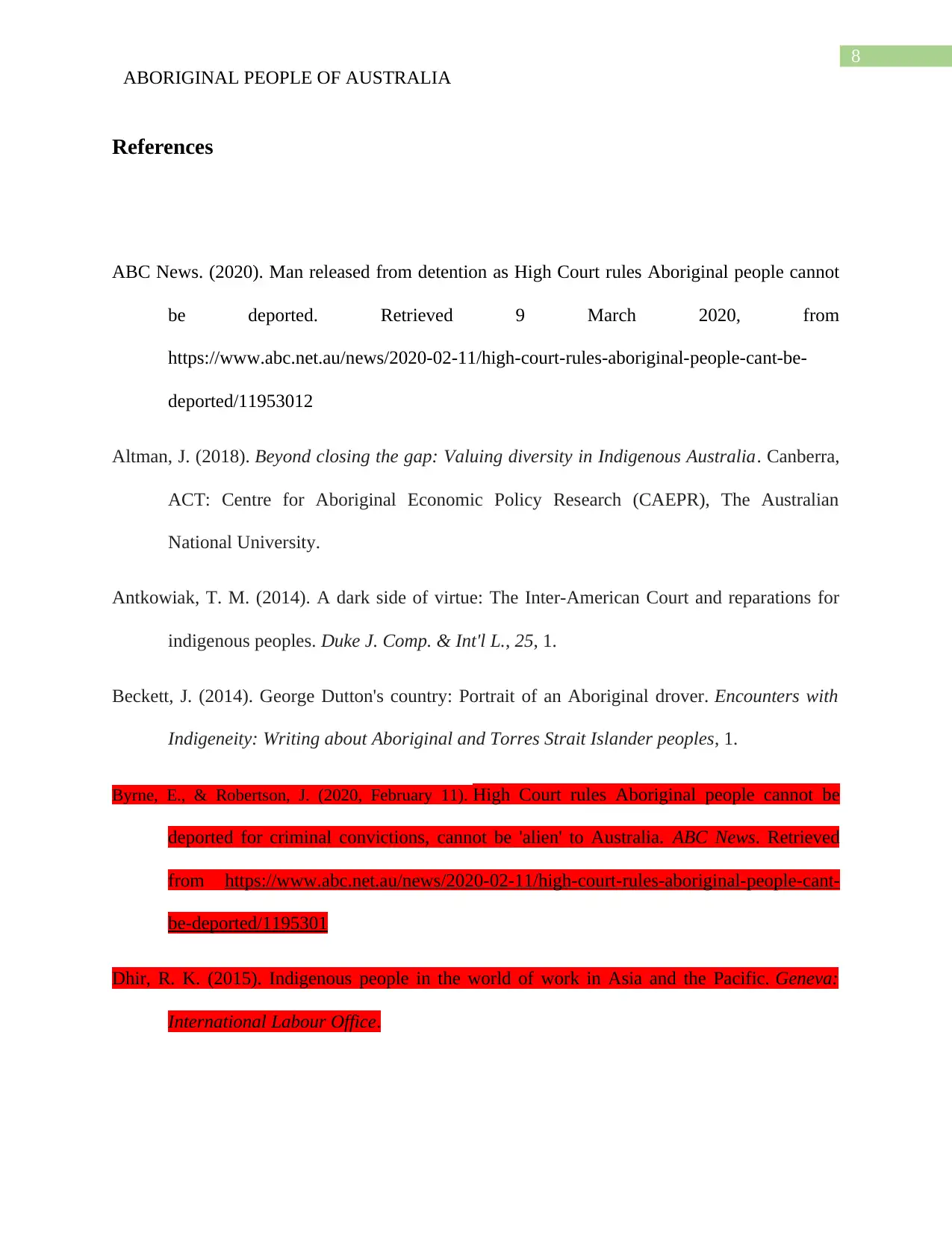
References
ABC News. (2020). Man released from detention as High Court rules Aboriginal people cannot
be deported. Retrieved 9 March 2020, from
https://www.abc.net.au/news/2020-02-11/high-court-rules-aboriginal-people-cant-be-
deported/11953012
Altman, J. (2018). Beyond closing the gap: Valuing diversity in Indigenous Australia. Canberra,
ACT: Centre for Aboriginal Economic Policy Research (CAEPR), The Australian
National University.
Antkowiak, T. M. (2014). A dark side of virtue: The Inter-American Court and reparations for
indigenous peoples. Duke J. Comp. & Int'l L., 25, 1.
Beckett, J. (2014). George Dutton's country: Portrait of an Aboriginal drover. Encounters with
Indigeneity: Writing about Aboriginal and Torres Strait Islander peoples, 1.
Byrne, E., & Robertson, J. (2020, February 11). High Court rules Aboriginal people cannot be
deported for criminal convictions, cannot be 'alien' to Australia. ABC News. Retrieved
from https://www.abc.net.au/news/2020-02-11/high-court-rules-aboriginal-people-cant-
be-deported/1195301
Dhir, R. K. (2015). Indigenous people in the world of work in Asia and the Pacific. Geneva:
International Labour Office.
ABORIGINAL PEOPLE OF AUSTRALIA
References
ABC News. (2020). Man released from detention as High Court rules Aboriginal people cannot
be deported. Retrieved 9 March 2020, from
https://www.abc.net.au/news/2020-02-11/high-court-rules-aboriginal-people-cant-be-
deported/11953012
Altman, J. (2018). Beyond closing the gap: Valuing diversity in Indigenous Australia. Canberra,
ACT: Centre for Aboriginal Economic Policy Research (CAEPR), The Australian
National University.
Antkowiak, T. M. (2014). A dark side of virtue: The Inter-American Court and reparations for
indigenous peoples. Duke J. Comp. & Int'l L., 25, 1.
Beckett, J. (2014). George Dutton's country: Portrait of an Aboriginal drover. Encounters with
Indigeneity: Writing about Aboriginal and Torres Strait Islander peoples, 1.
Byrne, E., & Robertson, J. (2020, February 11). High Court rules Aboriginal people cannot be
deported for criminal convictions, cannot be 'alien' to Australia. ABC News. Retrieved
from https://www.abc.net.au/news/2020-02-11/high-court-rules-aboriginal-people-cant-
be-deported/1195301
Dhir, R. K. (2015). Indigenous people in the world of work in Asia and the Pacific. Geneva:
International Labour Office.
⊘ This is a preview!⊘
Do you want full access?
Subscribe today to unlock all pages.
Trusted by 1+ million students worldwide
9
ABORIGINAL PEOPLE OF AUSTRALIA
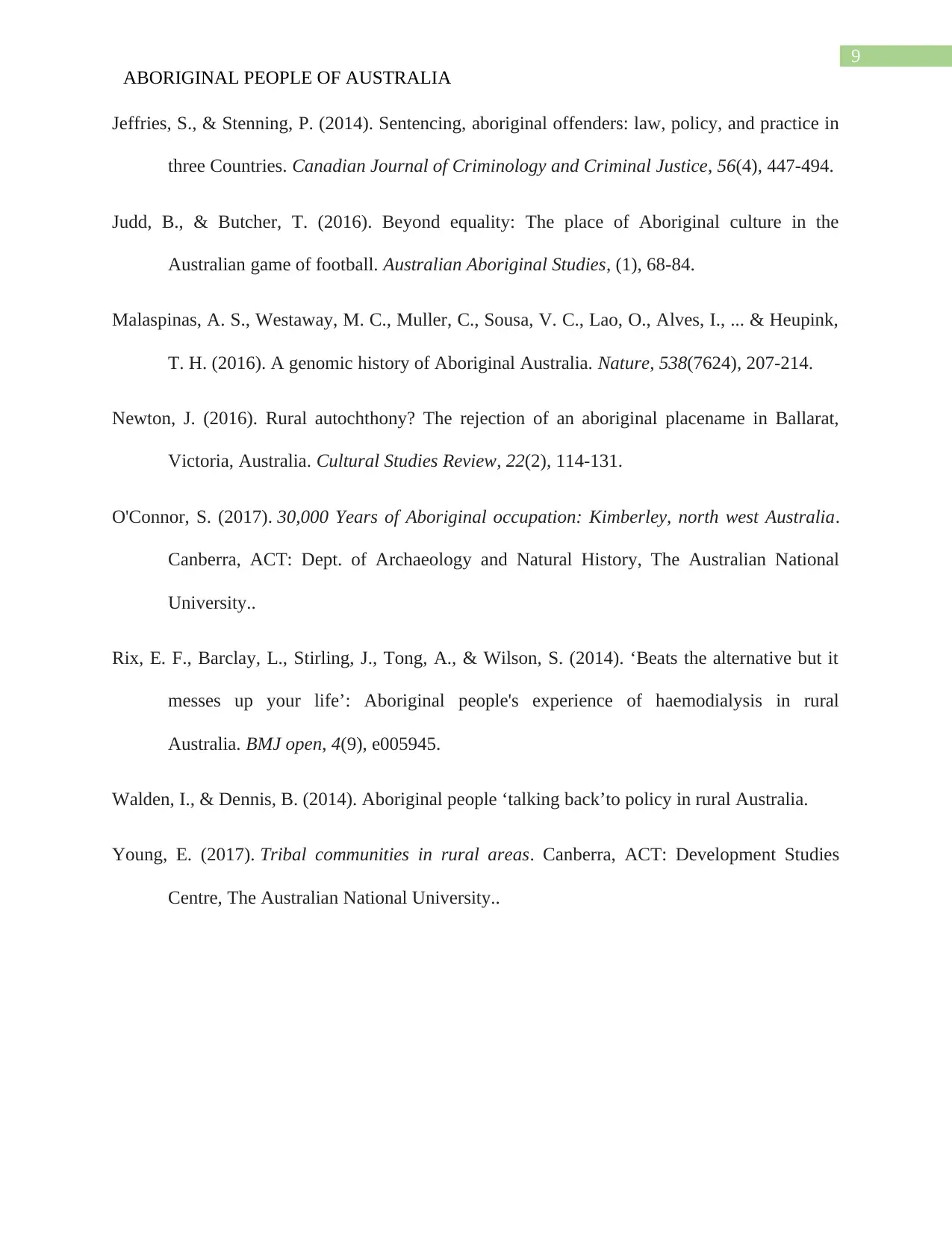
Jeffries, S., & Stenning, P. (2014). Sentencing, aboriginal offenders: law, policy, and practice in
three Countries. Canadian Journal of Criminology and Criminal Justice, 56(4), 447-494.
Judd, B., & Butcher, T. (2016). Beyond equality: The place of Aboriginal culture in the
Australian game of football. Australian Aboriginal Studies, (1), 68-84.
Malaspinas, A. S., Westaway, M. C., Muller, C., Sousa, V. C., Lao, O., Alves, I., ... & Heupink,
T. H. (2016). A genomic history of Aboriginal Australia. Nature, 538(7624), 207-214.
Newton, J. (2016). Rural autochthony? The rejection of an aboriginal placename in Ballarat,
Victoria, Australia. Cultural Studies Review, 22(2), 114-131.
O'Connor, S. (2017). 30,000 Years of Aboriginal occupation: Kimberley, north west Australia.
Canberra, ACT: Dept. of Archaeology and Natural History, The Australian National
University..
Rix, E. F., Barclay, L., Stirling, J., Tong, A., & Wilson, S. (2014). ‘Beats the alternative but it
messes up your life’: Aboriginal people's experience of haemodialysis in rural
Australia. BMJ open, 4(9), e005945.
Walden, I., & Dennis, B. (2014). Aboriginal people ‘talking back’to policy in rural Australia.
Young, E. (2017). Tribal communities in rural areas. Canberra, ACT: Development Studies
Centre, The Australian National University..
ABORIGINAL PEOPLE OF AUSTRALIA
Jeffries, S., & Stenning, P. (2014). Sentencing, aboriginal offenders: law, policy, and practice in
three Countries. Canadian Journal of Criminology and Criminal Justice, 56(4), 447-494.
Judd, B., & Butcher, T. (2016). Beyond equality: The place of Aboriginal culture in the
Australian game of football. Australian Aboriginal Studies, (1), 68-84.
Malaspinas, A. S., Westaway, M. C., Muller, C., Sousa, V. C., Lao, O., Alves, I., ... & Heupink,
T. H. (2016). A genomic history of Aboriginal Australia. Nature, 538(7624), 207-214.
Newton, J. (2016). Rural autochthony? The rejection of an aboriginal placename in Ballarat,
Victoria, Australia. Cultural Studies Review, 22(2), 114-131.
O'Connor, S. (2017). 30,000 Years of Aboriginal occupation: Kimberley, north west Australia.
Canberra, ACT: Dept. of Archaeology and Natural History, The Australian National
University..
Rix, E. F., Barclay, L., Stirling, J., Tong, A., & Wilson, S. (2014). ‘Beats the alternative but it
messes up your life’: Aboriginal people's experience of haemodialysis in rural
Australia. BMJ open, 4(9), e005945.
Walden, I., & Dennis, B. (2014). Aboriginal people ‘talking back’to policy in rural Australia.
Young, E. (2017). Tribal communities in rural areas. Canberra, ACT: Development Studies
Centre, The Australian National University..

1 out of 10


Your All-in-One AI-Powered Toolkit for Academic Success.
+13062052269
info@desklib.com
Available 24*7 on WhatsApp / Email
![[object Object]](/_next/static/media/star-bottom.7253800d.svg)
Unlock your academic potential
Copyright © 2020–2026 A2Z Services. All Rights Reserved. Developed and managed by ZUCOL.