High-Performance Management: Key Components and Benefits Essay

Verified

Added on  2023/01/13

|8
|2016
|60
Essay
AI Summary
This essay delves into the realm of high-performance management, emphasizing its pivotal role in ensuring organizational objectives are met efficiently and effectively. It dissects the multifaceted process of performance management, highlighting how it scrutinizes the performance of the organization, its departments, and individual employees to maintain optimal work efficiency. The essay identifies key components of performance management, including performance planning, ongoing performance communication, performance appraisal and reviewing, and performance improvement planning, illustrating how each contributes to enhancing employee capabilities and overall organizational success. Moreover, the essay emphasizes the benefits of these components, such as improved employee motivation, increased brand image, enhanced communication, and the establishment of competitive advantages. The analysis underscores the strategic and integrated approach of high-performance management in fostering a high-performing work environment, ultimately aimed at achieving organizational goals and objectives.
Document Page
High-Performance Management
The key components of High-Performance Work Systems and their benefits
tabler-icon-diamond-filled.svg

Paraphrase This Document

Need a fresh take? Get an instant paraphrase of this document with our AI Paraphraser
Document Page
HIGH PERFORMANCE MANAGEMENT 1
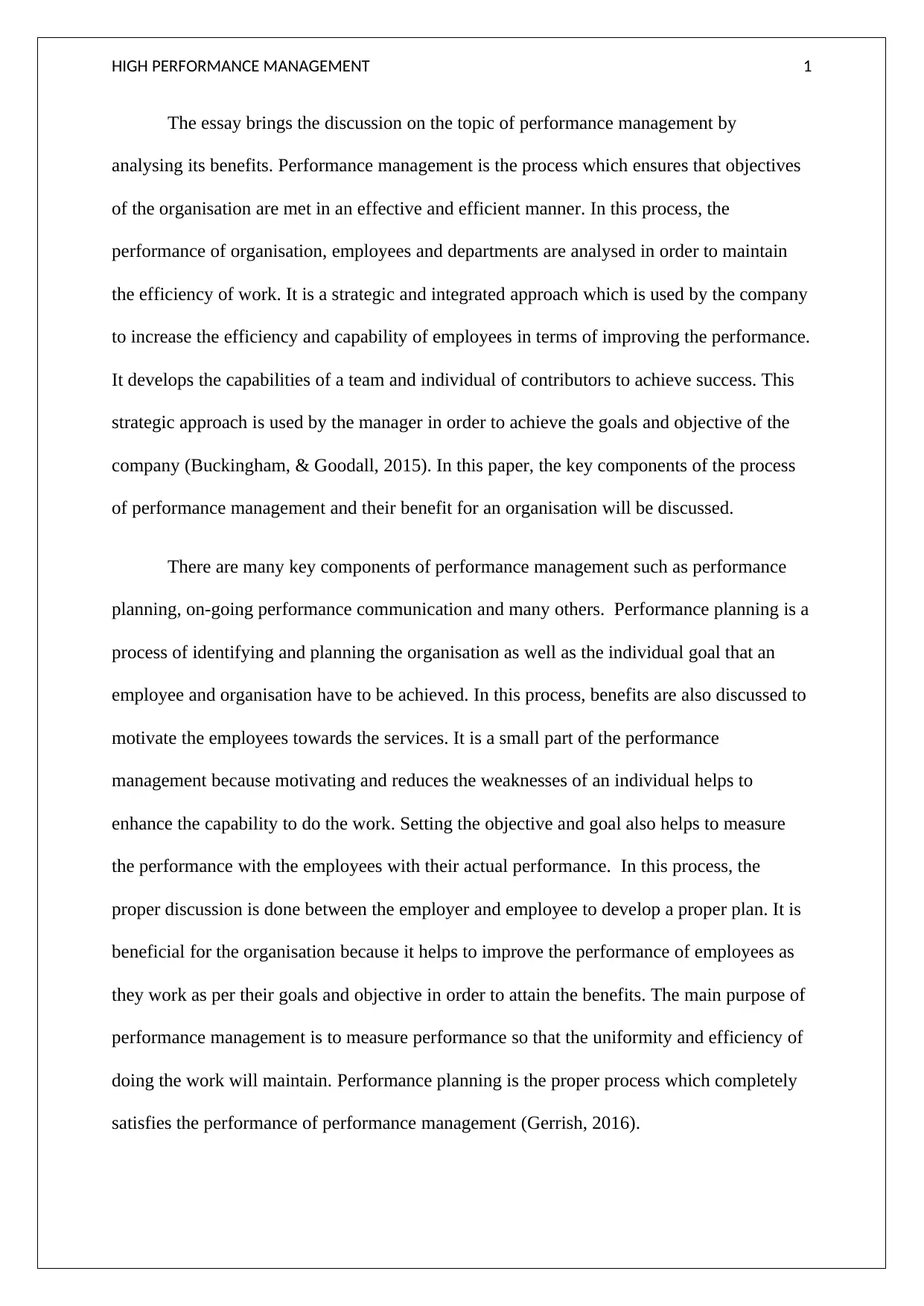
The essay brings the discussion on the topic of performance management by
analysing its benefits. Performance management is the process which ensures that objectives
of the organisation are met in an effective and efficient manner. In this process, the
performance of organisation, employees and departments are analysed in order to maintain
the efficiency of work. It is a strategic and integrated approach which is used by the company
to increase the efficiency and capability of employees in terms of improving the performance.
It develops the capabilities of a team and individual of contributors to achieve success. This
strategic approach is used by the manager in order to achieve the goals and objective of the
company (Buckingham, & Goodall, 2015). In this paper, the key components of the process
of performance management and their benefit for an organisation will be discussed.
There are many key components of performance management such as performance
planning, on-going performance communication and many others. Performance planning is a
process of identifying and planning the organisation as well as the individual goal that an
employee and organisation have to be achieved. In this process, benefits are also discussed to
motivate the employees towards the services. It is a small part of the performance
management because motivating and reduces the weaknesses of an individual helps to
enhance the capability to do the work. Setting the objective and goal also helps to measure
the performance with the employees with their actual performance. In this process, the
proper discussion is done between the employer and employee to develop a proper plan. It is
beneficial for the organisation because it helps to improve the performance of employees as
they work as per their goals and objective in order to attain the benefits. The main purpose of
performance management is to measure performance so that the uniformity and efficiency of
doing the work will maintain. Performance planning is the proper process which completely
satisfies the performance of performance management (Gerrish, 2016).
Document Page
HIGH PERFORMANCE MANAGEMENT 2
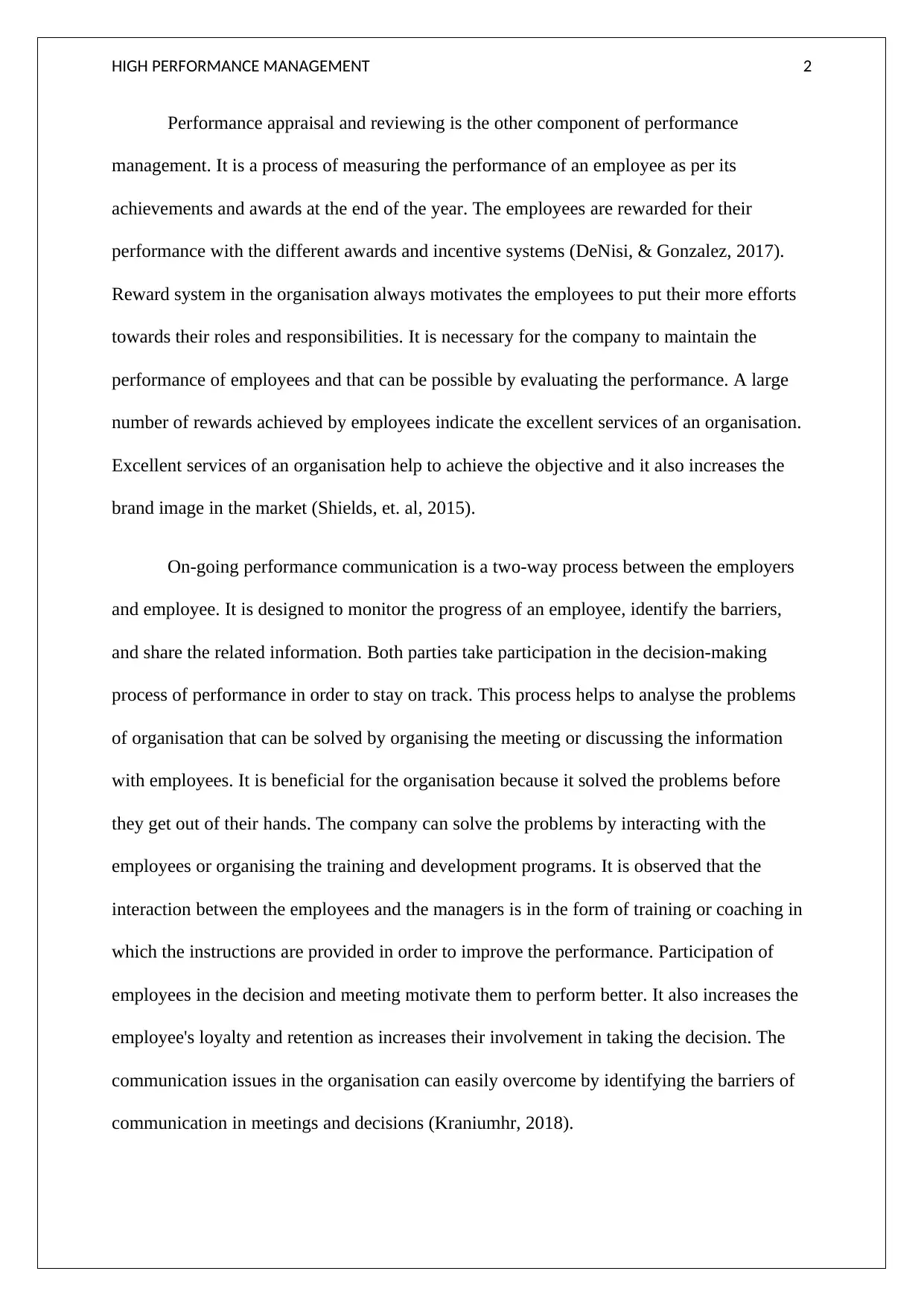
Performance appraisal and reviewing is the other component of performance
management. It is a process of measuring the performance of an employee as per its
achievements and awards at the end of the year. The employees are rewarded for their
performance with the different awards and incentive systems (DeNisi, & Gonzalez, 2017).
Reward system in the organisation always motivates the employees to put their more efforts
towards their roles and responsibilities. It is necessary for the company to maintain the
performance of employees and that can be possible by evaluating the performance. A large
number of rewards achieved by employees indicate the excellent services of an organisation.
Excellent services of an organisation help to achieve the objective and it also increases the
brand image in the market (Shields, et. al, 2015).
On-going performance communication is a two-way process between the employers
and employee. It is designed to monitor the progress of an employee, identify the barriers,
and share the related information. Both parties take participation in the decision-making
process of performance in order to stay on track. This process helps to analyse the problems
of organisation that can be solved by organising the meeting or discussing the information
with employees. It is beneficial for the organisation because it solved the problems before
they get out of their hands. The company can solve the problems by interacting with the
employees or organising the training and development programs. It is observed that the
interaction between the employees and the managers is in the form of training or coaching in
which the instructions are provided in order to improve the performance. Participation of
employees in the decision and meeting motivate them to perform better. It also increases the
employee's loyalty and retention as increases their involvement in taking the decision. The
communication issues in the organisation can easily overcome by identifying the barriers of
communication in meetings and decisions (Kraniumhr, 2018).
Document Page
HIGH PERFORMANCE MANAGEMENT 3
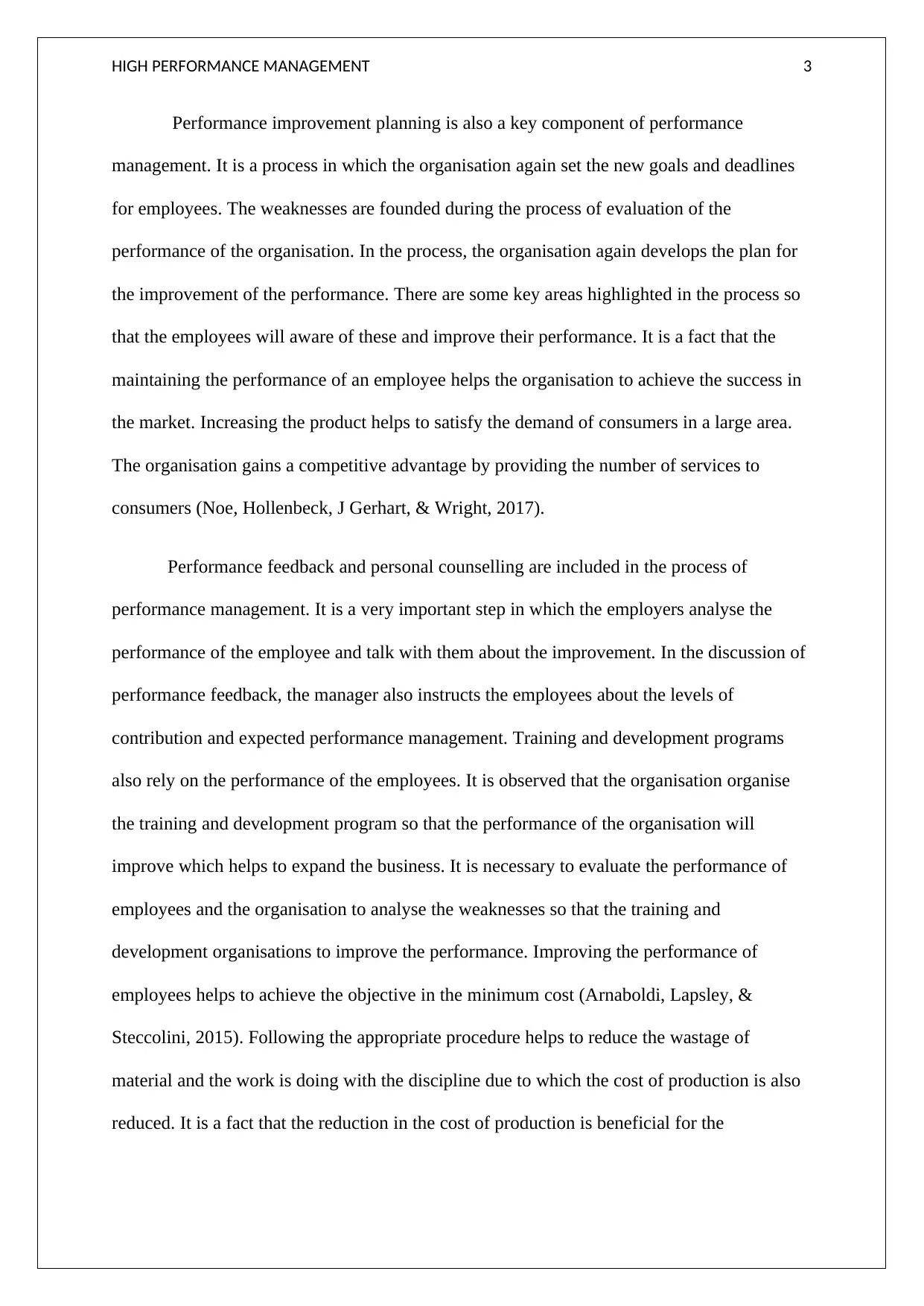
Performance improvement planning is also a key component of performance
management. It is a process in which the organisation again set the new goals and deadlines
for employees. The weaknesses are founded during the process of evaluation of the
performance of the organisation. In the process, the organisation again develops the plan for
the improvement of the performance. There are some key areas highlighted in the process so
that the employees will aware of these and improve their performance. It is a fact that the
maintaining the performance of an employee helps the organisation to achieve the success in
the market. Increasing the product helps to satisfy the demand of consumers in a large area.
The organisation gains a competitive advantage by providing the number of services to
consumers (Noe, Hollenbeck, J Gerhart, & Wright, 2017).
Performance feedback and personal counselling are included in the process of
performance management. It is a very important step in which the employers analyse the
performance of the employee and talk with them about the improvement. In the discussion of
performance feedback, the manager also instructs the employees about the levels of
contribution and expected performance management. Training and development programs
also rely on the performance of the employees. It is observed that the organisation organise
the training and development program so that the performance of the organisation will
improve which helps to expand the business. It is necessary to evaluate the performance of
employees and the organisation to analyse the weaknesses so that the training and
development organisations to improve the performance. Improving the performance of
employees helps to achieve the objective in the minimum cost (Arnaboldi, Lapsley, &
Steccolini, 2015). Following the appropriate procedure helps to reduce the wastage of
material and the work is doing with the discipline due to which the cost of production is also
reduced. It is a fact that the reduction in the cost of production is beneficial for the
tabler-icon-diamond-filled.svg

Paraphrase This Document

Need a fresh take? Get an instant paraphrase of this document with our AI Paraphraser
Document Page
HIGH PERFORMANCE MANAGEMENT 4
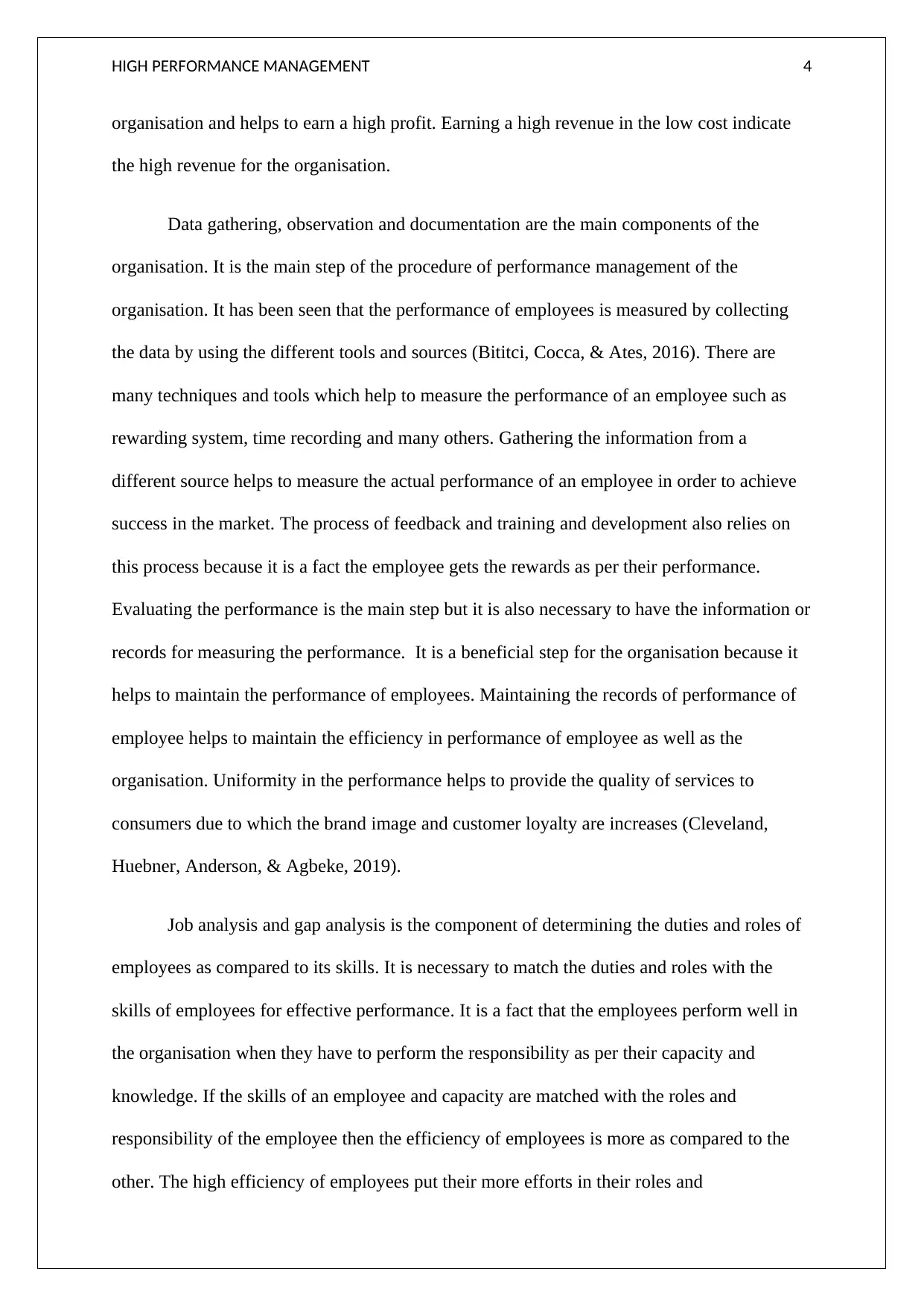
organisation and helps to earn a high profit. Earning a high revenue in the low cost indicate
the high revenue for the organisation.
Data gathering, observation and documentation are the main components of the
organisation. It is the main step of the procedure of performance management of the
organisation. It has been seen that the performance of employees is measured by collecting
the data by using the different tools and sources (Bititci, Cocca, & Ates, 2016). There are
many techniques and tools which help to measure the performance of an employee such as
rewarding system, time recording and many others. Gathering the information from a
different source helps to measure the actual performance of an employee in order to achieve
success in the market. The process of feedback and training and development also relies on
this process because it is a fact the employee gets the rewards as per their performance.
Evaluating the performance is the main step but it is also necessary to have the information or
records for measuring the performance. It is a beneficial step for the organisation because it
helps to maintain the performance of employees. Maintaining the records of performance of
employee helps to maintain the efficiency in performance of employee as well as the
organisation. Uniformity in the performance helps to provide the quality of services to
consumers due to which the brand image and customer loyalty are increases (Cleveland,
Huebner, Anderson, & Agbeke, 2019).
Job analysis and gap analysis is the component of determining the duties and roles of
employees as compared to its skills. It is necessary to match the duties and roles with the
skills of employees for effective performance. It is a fact that the employees perform well in
the organisation when they have to perform the responsibility as per their capacity and
knowledge. If the skills of an employee and capacity are matched with the roles and
responsibility of the employee then the efficiency of employees is more as compared to the
other. The high efficiency of employees put their more efforts in their roles and
Document Page
HIGH PERFORMANCE MANAGEMENT 5
responsibilities as compare to the other so that they can achieve success. It is the
responsibility of human resource department to recruit the right person at the right place at
the right time so that they put their efforts as per their interest (Van Dooren, Bouckaert, &
Halligan, 2015).
In the end, it is concluded that performance management is the process of measuring
the performance but it also helps to increases the productivity of the organisation. There are
many key components of performance management which help to evaluate the performance.
It has been evaluated that the organisation earns high profits due to improving the
productivity of the organisation. There are many other benefits of the performance
management that can easily attain by the organisation such as high brand image and
employee loyalty and many others. Proper planning, collecting data, evaluation, job analysis
and gap analysis are the main components of the company that helps to achieve success in the
market by improving the performance of employees.
Document Page
HIGH PERFORMANCE MANAGEMENT 6
References
Arnaboldi, M., Lapsley, I., & Steccolini, I. (2015). Performance management in the public
sector: The ultimate challenge. Financial Accountability & Management, 31(1), 1-22.
Bititci, U., Cocca, P., & Ates, A. (2016). Impact of visual performance management systems
on the performance management practices of organisations. International Journal of
Production Research, 54(6), 1571-1593.
Buckingham, M., & Goodall, A. (2015). Reinventing performance management. Harvard
Business Review, 93(4), 40-50.
Cleveland, J.N., Huebner, L.A., Anderson, K.J. & Agbeke, D.V. (2019) Lifespan
Perspectives on Job Performance, Performance Appraisal/Management and Creative
Performance. In Work Across the Lifespan (pp. 291-321). Academic Press.
DeNisi, A.S. & Gonzalez, J.A. (2017). Design performance appraisal systems to improve
performance. The Blackwell Handbook of Principles of Organizational Behaviour,
pp.63-75.
Gerrish, E. (2016). The impact of performance management on performance in public
organizations: A meta‐analysis. Public Administration Review, 76(1), 48-66.
Kraniumhr. (2018) Performance Management System – Objectives, Components and
Benefits. Retrieved from: http://kraniumhr.com/performance-management-system-
objectives-components-and-benefits/
Noe, R. A., Hollenbeck, J. R., Gerhart, B., & Wright, P. M. (2017). Human resource
management: Gaining a competitive advantage. New York, NY: McGraw-Hill
Education.
tabler-icon-diamond-filled.svg

Paraphrase This Document

Need a fresh take? Get an instant paraphrase of this document with our AI Paraphraser
Document Page
HIGH PERFORMANCE MANAGEMENT 7
Shields, J., Brown, M., Kaine, S., Dolle-Samuel, C., North-Samardzic, A., McLean, P., &
Plimmer, G. (2015). Managing employee performance & reward: Concepts,
practices, strategies. Cambridge University Press.
Van Dooren, W., Bouckaert, G., & Halligan, J. (2015). Performance management in the
public sector. Routledge.
chevron_up_icon
1 out of 8
circle_padding
hide_on_mobile
zoom_out_icon
[object Object]