Analyzing Factors Impacting Higher Education Quality & Promotion
VerifiedAdded on 2023/03/29
|9
|2543
|202
Report
AI Summary
This report examines the factors affecting the quality of higher education, focusing on an Australian university. It identifies five key factors: high staff turnover and an aging teacher workforce, lack of accommodation facilities, language skills deficiencies, a limited variety of programs, and a lack of mindfulness practices. The report then details a promotional plan for 2020, including communication objectives, promotional mix elements (social media, email, and traditional media), criteria for measuring success (surveys, performance indicators), and a budget allocation. The plan aims to address the identified factors and improve the overall quality of service delivery, with a focus on effective communication and resource allocation to enhance student experience and outcomes. The promotional activities are aligned with the objectives of the university to effectively communicate with the students.

Running Head: QUALITY OF HIGHER EDUCATION 0
Service Marketing
Service Marketing

Paraphrase This Document
Need a fresh take? Get an instant paraphrase of this document with our AI Paraphraser
QUALITY OF HIGHER EDUCATION 1
Introduction
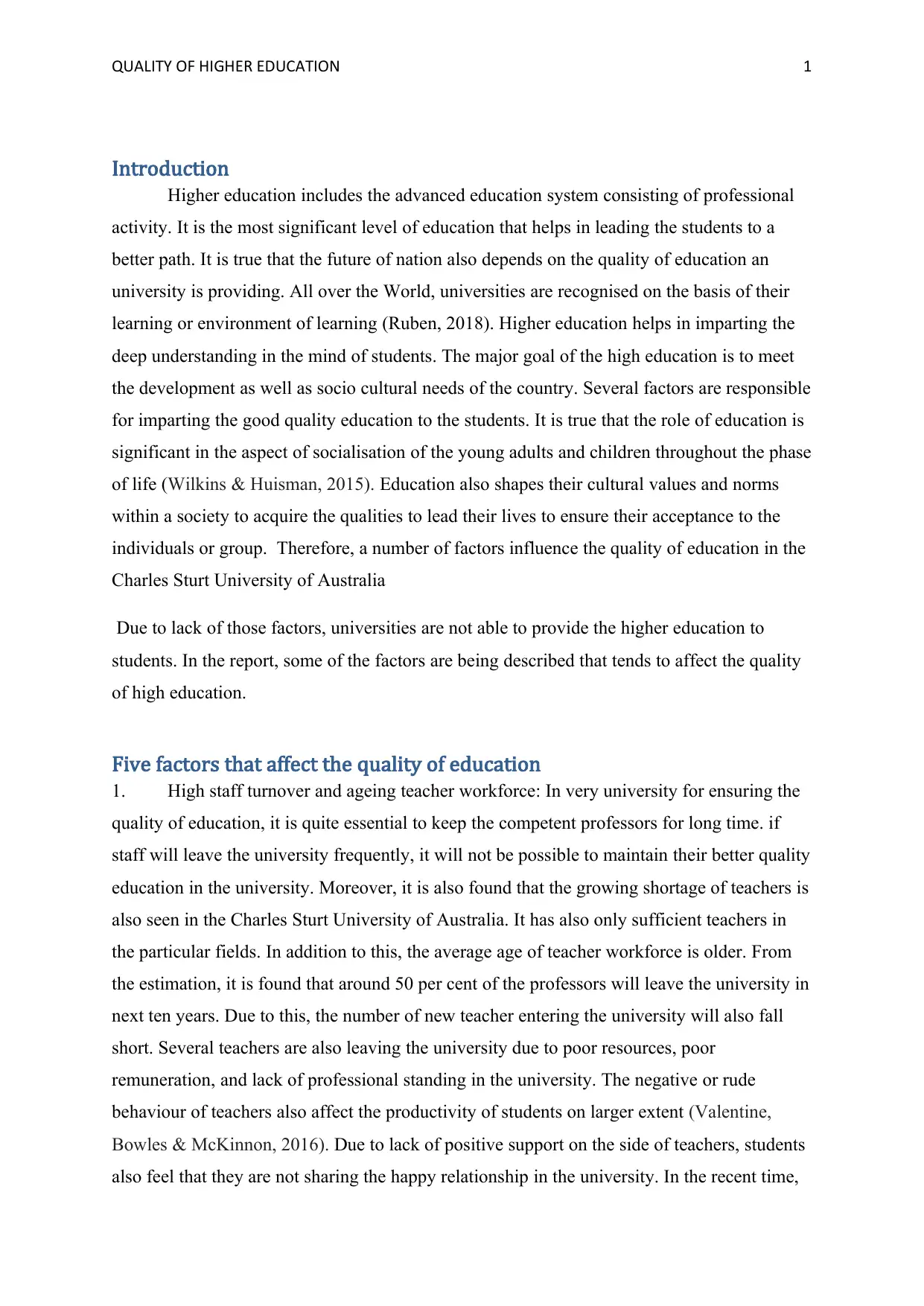
Higher education includes the advanced education system consisting of professional
activity. It is the most significant level of education that helps in leading the students to a
better path. It is true that the future of nation also depends on the quality of education an
university is providing. All over the World, universities are recognised on the basis of their
learning or environment of learning (Ruben, 2018). Higher education helps in imparting the
deep understanding in the mind of students. The major goal of the high education is to meet
the development as well as socio cultural needs of the country. Several factors are responsible
for imparting the good quality education to the students. It is true that the role of education is
significant in the aspect of socialisation of the young adults and children throughout the phase
of life (Wilkins & Huisman, 2015). Education also shapes their cultural values and norms
within a society to acquire the qualities to lead their lives to ensure their acceptance to the
individuals or group. Therefore, a number of factors influence the quality of education in the
Charles Sturt University of Australia
Due to lack of those factors, universities are not able to provide the higher education to
students. In the report, some of the factors are being described that tends to affect the quality
of high education.
Five factors that affect the quality of education
1. High staff turnover and ageing teacher workforce: In very university for ensuring the
quality of education, it is quite essential to keep the competent professors for long time. if
staff will leave the university frequently, it will not be possible to maintain their better quality
education in the university. Moreover, it is also found that the growing shortage of teachers is
also seen in the Charles Sturt University of Australia. It has also only sufficient teachers in
the particular fields. In addition to this, the average age of teacher workforce is older. From
the estimation, it is found that around 50 per cent of the professors will leave the university in
next ten years. Due to this, the number of new teacher entering the university will also fall
short. Several teachers are also leaving the university due to poor resources, poor
remuneration, and lack of professional standing in the university. The negative or rude
behaviour of teachers also affect the productivity of students on larger extent (Valentine,
Bowles & McKinnon, 2016). Due to lack of positive support on the side of teachers, students
also feel that they are not sharing the happy relationship in the university. In the recent time,
Introduction
Higher education includes the advanced education system consisting of professional
activity. It is the most significant level of education that helps in leading the students to a
better path. It is true that the future of nation also depends on the quality of education an
university is providing. All over the World, universities are recognised on the basis of their
learning or environment of learning (Ruben, 2018). Higher education helps in imparting the
deep understanding in the mind of students. The major goal of the high education is to meet
the development as well as socio cultural needs of the country. Several factors are responsible
for imparting the good quality education to the students. It is true that the role of education is
significant in the aspect of socialisation of the young adults and children throughout the phase
of life (Wilkins & Huisman, 2015). Education also shapes their cultural values and norms
within a society to acquire the qualities to lead their lives to ensure their acceptance to the
individuals or group. Therefore, a number of factors influence the quality of education in the
Charles Sturt University of Australia
Due to lack of those factors, universities are not able to provide the higher education to
students. In the report, some of the factors are being described that tends to affect the quality
of high education.
Five factors that affect the quality of education
1. High staff turnover and ageing teacher workforce: In very university for ensuring the
quality of education, it is quite essential to keep the competent professors for long time. if
staff will leave the university frequently, it will not be possible to maintain their better quality
education in the university. Moreover, it is also found that the growing shortage of teachers is
also seen in the Charles Sturt University of Australia. It has also only sufficient teachers in
the particular fields. In addition to this, the average age of teacher workforce is older. From
the estimation, it is found that around 50 per cent of the professors will leave the university in
next ten years. Due to this, the number of new teacher entering the university will also fall
short. Several teachers are also leaving the university due to poor resources, poor
remuneration, and lack of professional standing in the university. The negative or rude
behaviour of teachers also affect the productivity of students on larger extent (Valentine,
Bowles & McKinnon, 2016). Due to lack of positive support on the side of teachers, students
also feel that they are not sharing the happy relationship in the university. In the recent time,
QUALITY OF HIGHER EDUCATION 2
lots of home assignment also affecting the quality of education. Students are also feeling that
they are supporting them with the extracurricular activities that tends to hinder their talent in
some or other way. Teaching qualification is also one such factor that affects the quality of
education in number of ways. There are teachers who take the admission due to reference of
some other person. In such a situation, that teacher fails to deliver quality education to the
student that in turn affects the quality of education negatively. Training of such teacher
becomes essential in such a situation (Kauffman, 2015).
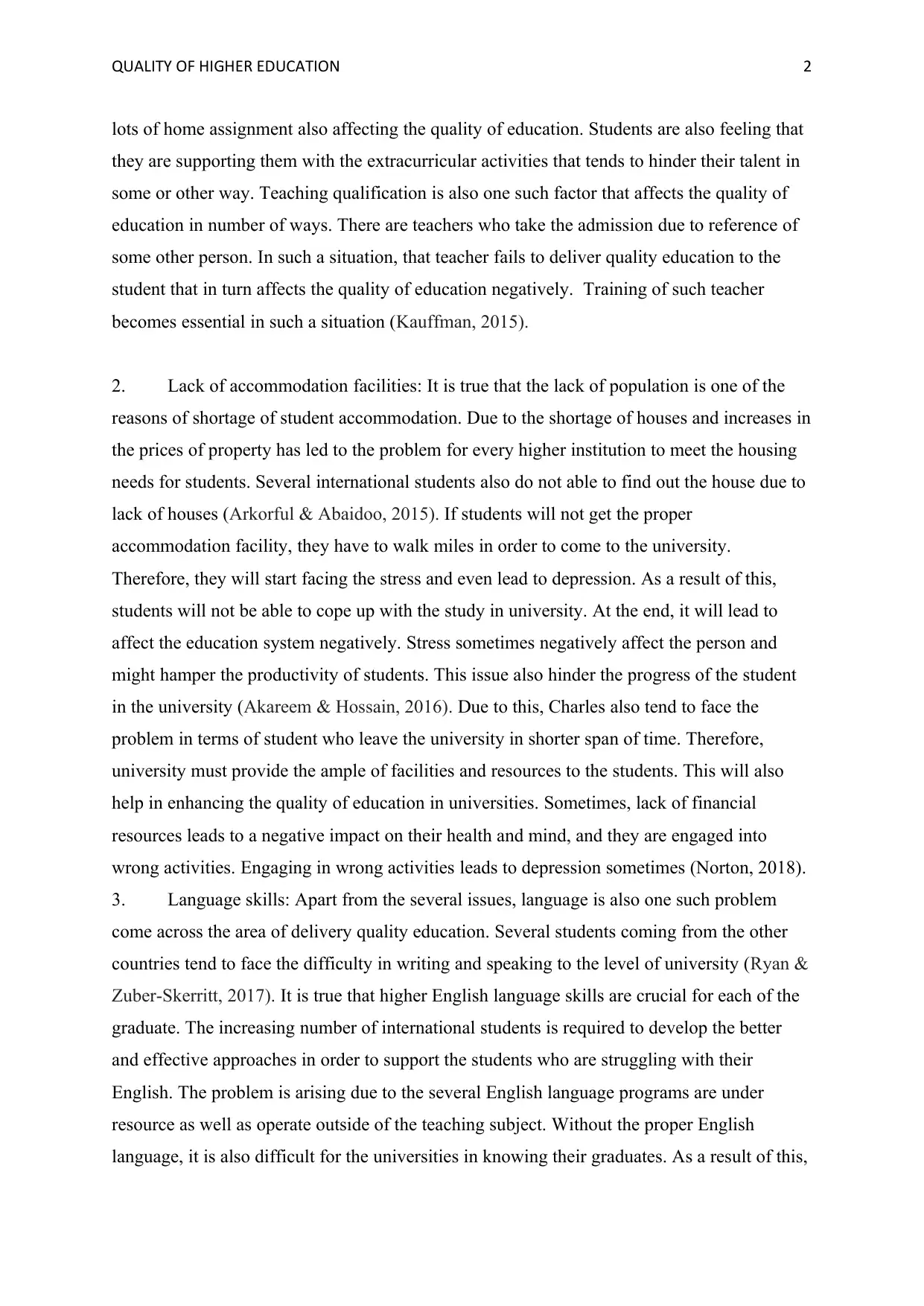
2. Lack of accommodation facilities: It is true that the lack of population is one of the
reasons of shortage of student accommodation. Due to the shortage of houses and increases in
the prices of property has led to the problem for every higher institution to meet the housing
needs for students. Several international students also do not able to find out the house due to
lack of houses (Arkorful & Abaidoo, 2015). If students will not get the proper
accommodation facility, they have to walk miles in order to come to the university.
Therefore, they will start facing the stress and even lead to depression. As a result of this,
students will not be able to cope up with the study in university. At the end, it will lead to
affect the education system negatively. Stress sometimes negatively affect the person and
might hamper the productivity of students. This issue also hinder the progress of the student
in the university (Akareem & Hossain, 2016). Due to this, Charles also tend to face the
problem in terms of student who leave the university in shorter span of time. Therefore,
university must provide the ample of facilities and resources to the students. This will also
help in enhancing the quality of education in universities. Sometimes, lack of financial
resources leads to a negative impact on their health and mind, and they are engaged into
wrong activities. Engaging in wrong activities leads to depression sometimes (Norton, 2018).
3. Language skills: Apart from the several issues, language is also one such problem
come across the area of delivery quality education. Several students coming from the other
countries tend to face the difficulty in writing and speaking to the level of university (Ryan &
Zuber-Skerritt, 2017). It is true that higher English language skills are crucial for each of the
graduate. The increasing number of international students is required to develop the better
and effective approaches in order to support the students who are struggling with their
English. The problem is arising due to the several English language programs are under
resource as well as operate outside of the teaching subject. Without the proper English
language, it is also difficult for the universities in knowing their graduates. As a result of this,
lots of home assignment also affecting the quality of education. Students are also feeling that
they are supporting them with the extracurricular activities that tends to hinder their talent in
some or other way. Teaching qualification is also one such factor that affects the quality of
education in number of ways. There are teachers who take the admission due to reference of
some other person. In such a situation, that teacher fails to deliver quality education to the
student that in turn affects the quality of education negatively. Training of such teacher
becomes essential in such a situation (Kauffman, 2015).
2. Lack of accommodation facilities: It is true that the lack of population is one of the
reasons of shortage of student accommodation. Due to the shortage of houses and increases in
the prices of property has led to the problem for every higher institution to meet the housing
needs for students. Several international students also do not able to find out the house due to
lack of houses (Arkorful & Abaidoo, 2015). If students will not get the proper
accommodation facility, they have to walk miles in order to come to the university.
Therefore, they will start facing the stress and even lead to depression. As a result of this,
students will not be able to cope up with the study in university. At the end, it will lead to
affect the education system negatively. Stress sometimes negatively affect the person and
might hamper the productivity of students. This issue also hinder the progress of the student
in the university (Akareem & Hossain, 2016). Due to this, Charles also tend to face the
problem in terms of student who leave the university in shorter span of time. Therefore,
university must provide the ample of facilities and resources to the students. This will also
help in enhancing the quality of education in universities. Sometimes, lack of financial
resources leads to a negative impact on their health and mind, and they are engaged into
wrong activities. Engaging in wrong activities leads to depression sometimes (Norton, 2018).
3. Language skills: Apart from the several issues, language is also one such problem
come across the area of delivery quality education. Several students coming from the other
countries tend to face the difficulty in writing and speaking to the level of university (Ryan &
Zuber-Skerritt, 2017). It is true that higher English language skills are crucial for each of the
graduate. The increasing number of international students is required to develop the better
and effective approaches in order to support the students who are struggling with their
English. The problem is arising due to the several English language programs are under
resource as well as operate outside of the teaching subject. Without the proper English
language, it is also difficult for the universities in knowing their graduates. As a result of this,
⊘ This is a preview!⊘
Do you want full access?
Subscribe today to unlock all pages.

Trusted by 1+ million students worldwide
QUALITY OF HIGHER EDUCATION 3
it will develop the negative perception regarding the quality of Australian education. Several
students also come from different cultural background that faces problems in understanding
other person linguistic as well as cultural background. The another factor besides the poor
quality of education is that several local students have very few opportunities in order to
socialise with the international students. Universities also have very less opportunities for the
students in order to engage themselves with each of the other person. The lack of investment
in purpose built learning spaces has also hindered the promotion of peer engagement and
collaborative learning. Still, Charles Sturt University failed in promoting the student
interaction effectively (van den Bogaard, Howlin, Lindsay & Morgan, 2018).
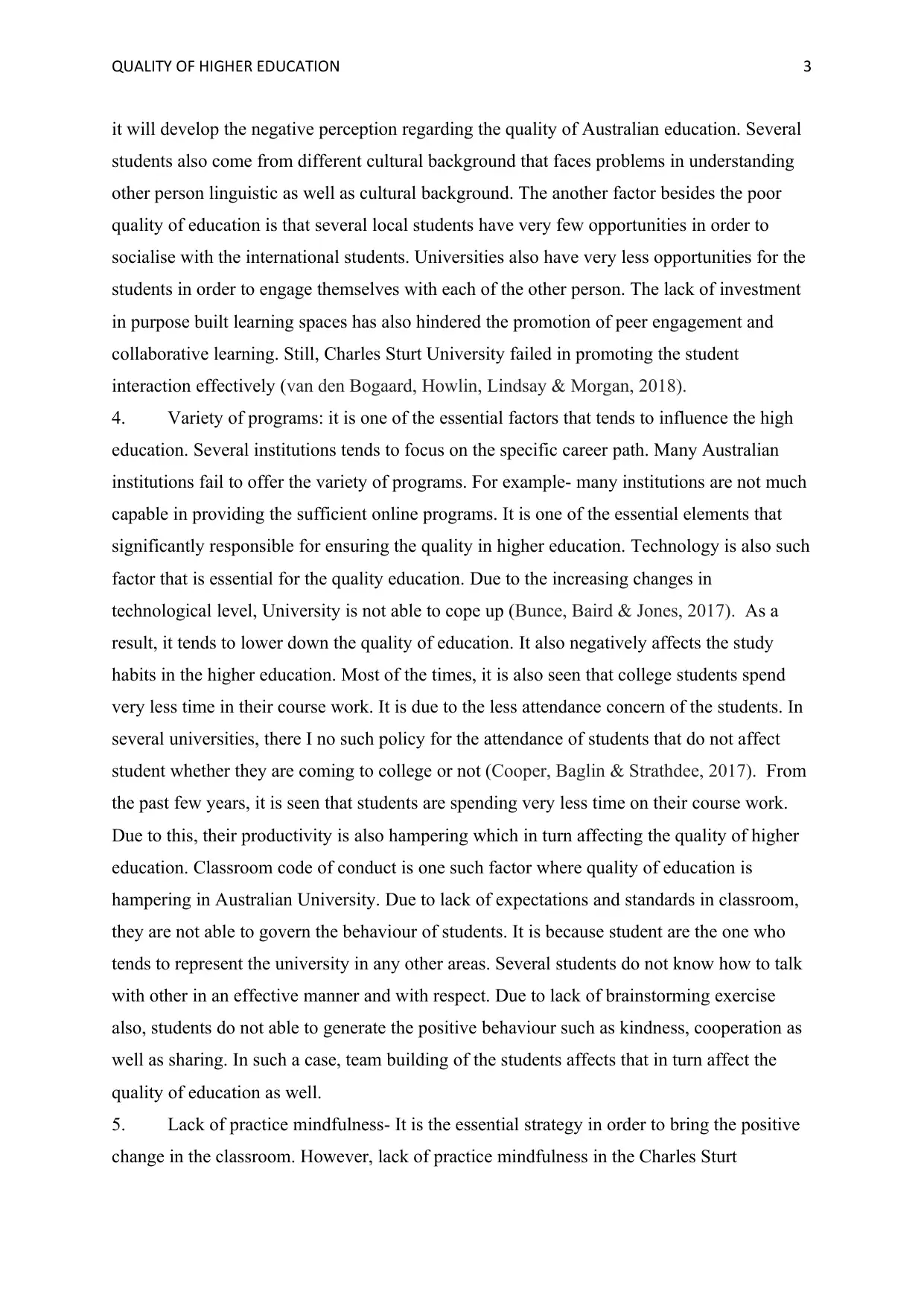
4. Variety of programs: it is one of the essential factors that tends to influence the high
education. Several institutions tends to focus on the specific career path. Many Australian
institutions fail to offer the variety of programs. For example- many institutions are not much
capable in providing the sufficient online programs. It is one of the essential elements that
significantly responsible for ensuring the quality in higher education. Technology is also such
factor that is essential for the quality education. Due to the increasing changes in
technological level, University is not able to cope up (Bunce, Baird & Jones, 2017). As a
result, it tends to lower down the quality of education. It also negatively affects the study
habits in the higher education. Most of the times, it is also seen that college students spend
very less time in their course work. It is due to the less attendance concern of the students. In
several universities, there I no such policy for the attendance of students that do not affect
student whether they are coming to college or not (Cooper, Baglin & Strathdee, 2017). From
the past few years, it is seen that students are spending very less time on their course work.
Due to this, their productivity is also hampering which in turn affecting the quality of higher
education. Classroom code of conduct is one such factor where quality of education is
hampering in Australian University. Due to lack of expectations and standards in classroom,
they are not able to govern the behaviour of students. It is because student are the one who
tends to represent the university in any other areas. Several students do not know how to talk
with other in an effective manner and with respect. Due to lack of brainstorming exercise
also, students do not able to generate the positive behaviour such as kindness, cooperation as
well as sharing. In such a case, team building of the students affects that in turn affect the
quality of education as well.
5. Lack of practice mindfulness- It is the essential strategy in order to bring the positive
change in the classroom. However, lack of practice mindfulness in the Charles Sturt
it will develop the negative perception regarding the quality of Australian education. Several
students also come from different cultural background that faces problems in understanding
other person linguistic as well as cultural background. The another factor besides the poor
quality of education is that several local students have very few opportunities in order to
socialise with the international students. Universities also have very less opportunities for the
students in order to engage themselves with each of the other person. The lack of investment
in purpose built learning spaces has also hindered the promotion of peer engagement and
collaborative learning. Still, Charles Sturt University failed in promoting the student
interaction effectively (van den Bogaard, Howlin, Lindsay & Morgan, 2018).
4. Variety of programs: it is one of the essential factors that tends to influence the high
education. Several institutions tends to focus on the specific career path. Many Australian
institutions fail to offer the variety of programs. For example- many institutions are not much
capable in providing the sufficient online programs. It is one of the essential elements that
significantly responsible for ensuring the quality in higher education. Technology is also such
factor that is essential for the quality education. Due to the increasing changes in
technological level, University is not able to cope up (Bunce, Baird & Jones, 2017). As a
result, it tends to lower down the quality of education. It also negatively affects the study
habits in the higher education. Most of the times, it is also seen that college students spend
very less time in their course work. It is due to the less attendance concern of the students. In
several universities, there I no such policy for the attendance of students that do not affect
student whether they are coming to college or not (Cooper, Baglin & Strathdee, 2017). From
the past few years, it is seen that students are spending very less time on their course work.
Due to this, their productivity is also hampering which in turn affecting the quality of higher
education. Classroom code of conduct is one such factor where quality of education is
hampering in Australian University. Due to lack of expectations and standards in classroom,
they are not able to govern the behaviour of students. It is because student are the one who
tends to represent the university in any other areas. Several students do not know how to talk
with other in an effective manner and with respect. Due to lack of brainstorming exercise
also, students do not able to generate the positive behaviour such as kindness, cooperation as
well as sharing. In such a case, team building of the students affects that in turn affect the
quality of education as well.
5. Lack of practice mindfulness- It is the essential strategy in order to bring the positive
change in the classroom. However, lack of practice mindfulness in the Charles Sturt
Paraphrase This Document
Need a fresh take? Get an instant paraphrase of this document with our AI Paraphraser
QUALITY OF HIGHER EDUCATION 4
University of Australia, students is unable to get the full advantage of the quality of
education. A positive attitude is also significant in order to keep the positive environment in
universities. Besides this, lack of daily meditation practices also does not able to make the
positive and mindful environment at the university. Being mindful means having the
capability to remain focused and clam. Several other activities also tends to lower down the
quality of education. It is true that there should be several other co-curricular activities in
order to make the students bold and capable enough so that he or she can communicate in
public. The lack of finance is also found through government, which is a major factor
affecting the quality of education In the university, lack of group activities affects the
communication skills of the students. The major disadvantage attached with this limitation is
also that students are not able to build the strong relationship with the other students.
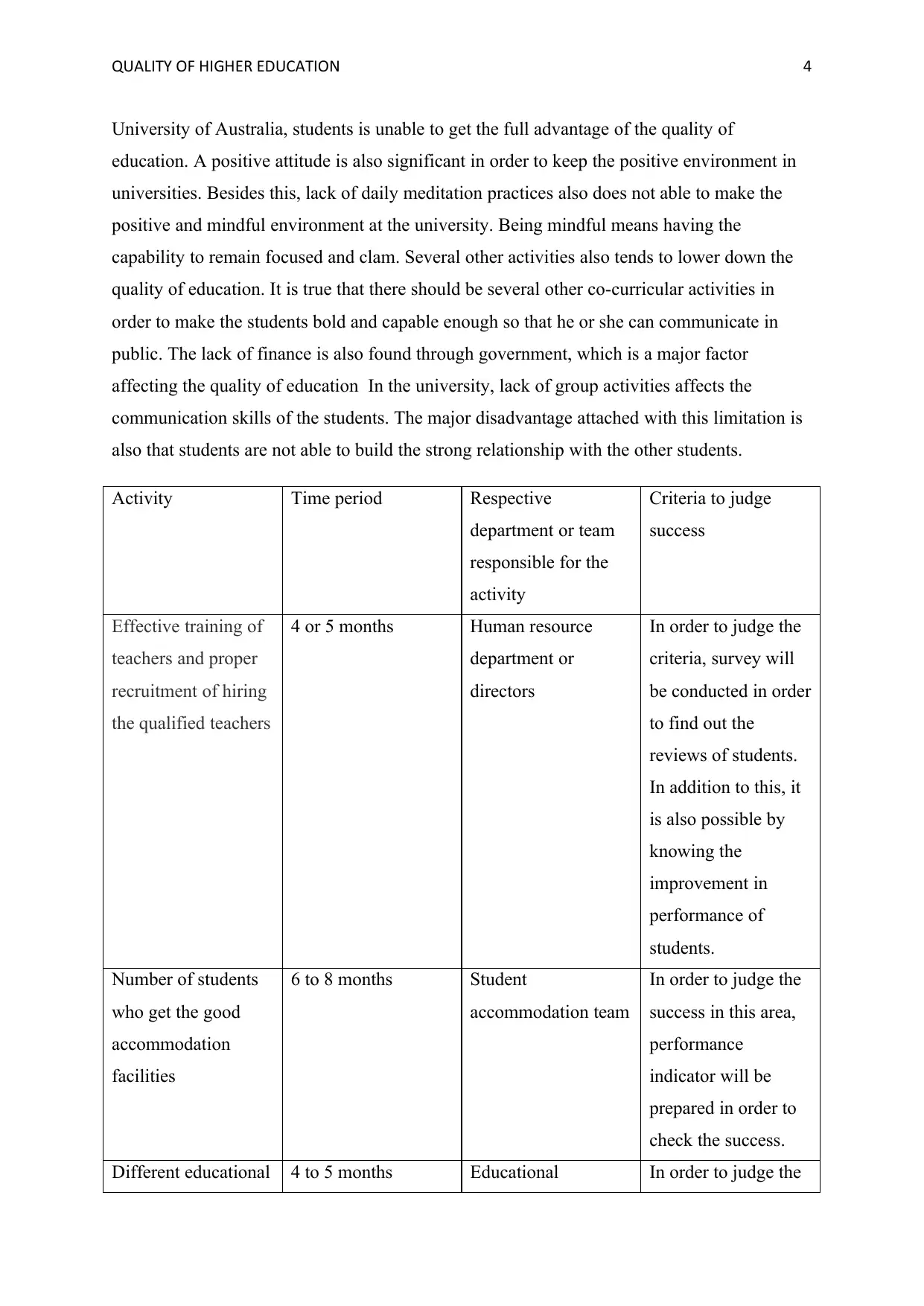
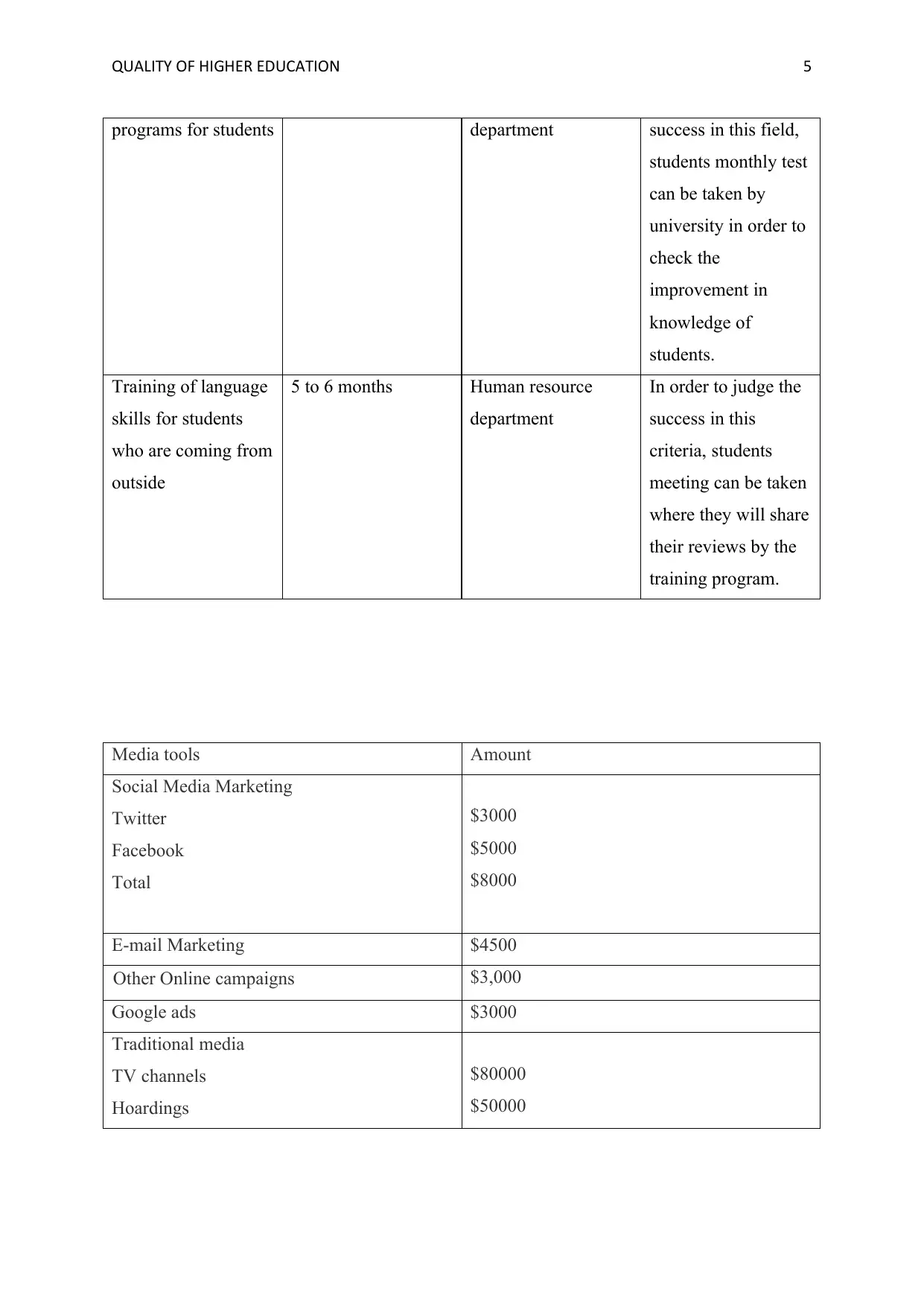
Activity Time period Respective
department or team
responsible for the
activity
Criteria to judge
success
Effective training of
teachers and proper
recruitment of hiring
the qualified teachers
4 or 5 months Human resource
department or
directors
In order to judge the
criteria, survey will
be conducted in order
to find out the
reviews of students.
In addition to this, it
is also possible by
knowing the
improvement in
performance of
students.
Number of students
who get the good
accommodation
facilities
6 to 8 months Student
accommodation team
In order to judge the
success in this area,
performance
indicator will be
prepared in order to
check the success.
Different educational 4 to 5 months Educational In order to judge the
University of Australia, students is unable to get the full advantage of the quality of
education. A positive attitude is also significant in order to keep the positive environment in
universities. Besides this, lack of daily meditation practices also does not able to make the
positive and mindful environment at the university. Being mindful means having the
capability to remain focused and clam. Several other activities also tends to lower down the
quality of education. It is true that there should be several other co-curricular activities in
order to make the students bold and capable enough so that he or she can communicate in
public. The lack of finance is also found through government, which is a major factor
affecting the quality of education In the university, lack of group activities affects the
communication skills of the students. The major disadvantage attached with this limitation is
also that students are not able to build the strong relationship with the other students.
Activity Time period Respective
department or team
responsible for the
activity
Criteria to judge
success
Effective training of
teachers and proper
recruitment of hiring
the qualified teachers
4 or 5 months Human resource
department or
directors
In order to judge the
criteria, survey will
be conducted in order
to find out the
reviews of students.
In addition to this, it
is also possible by
knowing the
improvement in
performance of
students.
Number of students
who get the good
accommodation
facilities
6 to 8 months Student
accommodation team
In order to judge the
success in this area,
performance
indicator will be
prepared in order to
check the success.
Different educational 4 to 5 months Educational In order to judge the
QUALITY OF HIGHER EDUCATION 5
programs for students department success in this field,
students monthly test
can be taken by
university in order to
check the
improvement in
knowledge of
students.
Training of language
skills for students
who are coming from
outside
5 to 6 months Human resource
department
In order to judge the
success in this
criteria, students
meeting can be taken
where they will share
their reviews by the
training program.
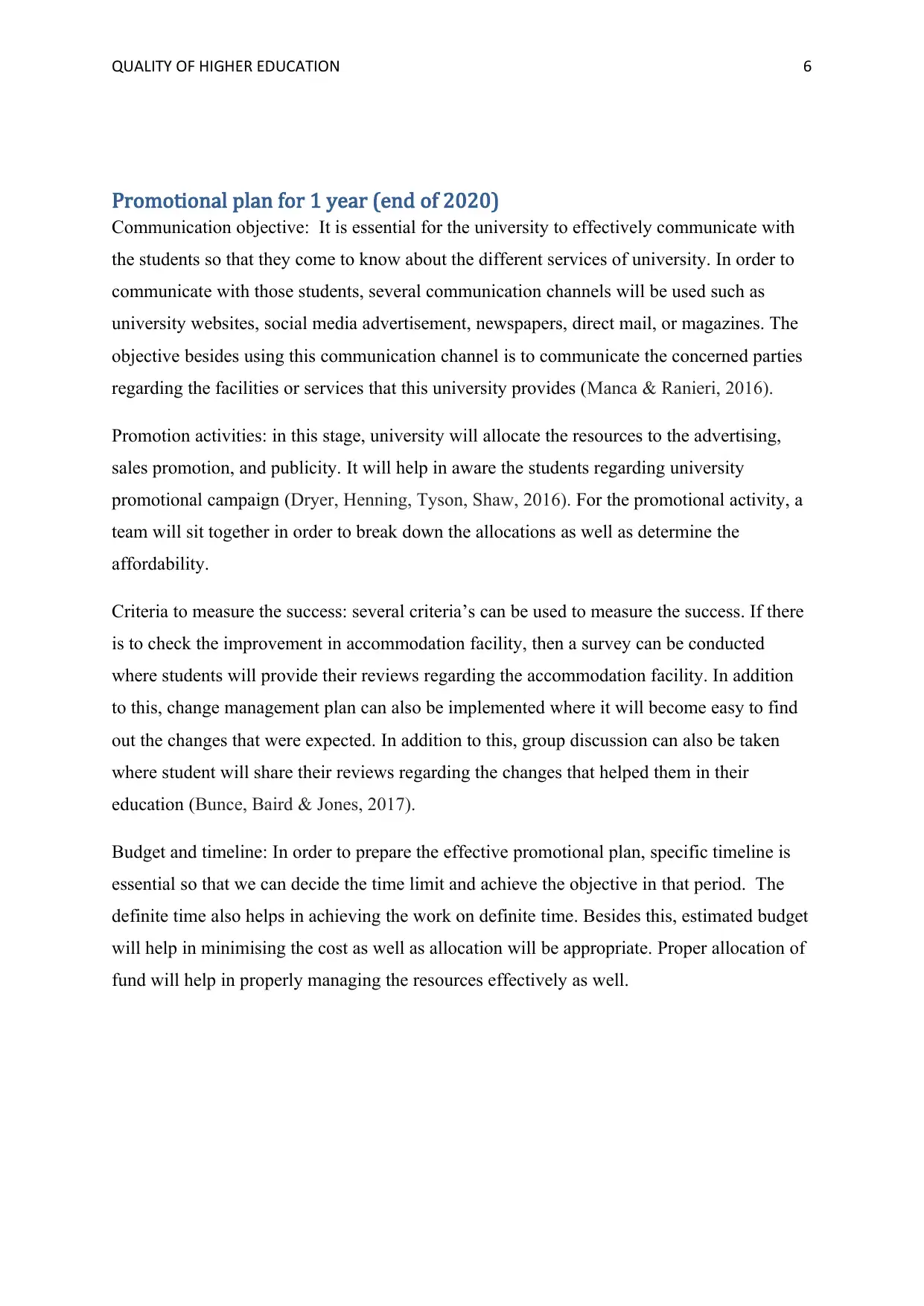
Media tools Amount
Social Media Marketing
Twitter
Facebook
Total
$3000
$5000
$8000
E-mail Marketing $4500
Other Online campaigns $3,000
Google ads $3000
Traditional media
TV channels
Hoardings
$80000
$50000
programs for students department success in this field,
students monthly test
can be taken by
university in order to
check the
improvement in
knowledge of
students.
Training of language
skills for students
who are coming from
outside
5 to 6 months Human resource
department
In order to judge the
success in this
criteria, students
meeting can be taken
where they will share
their reviews by the
training program.
Media tools Amount
Social Media Marketing
Total
$3000
$5000
$8000
E-mail Marketing $4500
Other Online campaigns $3,000
Google ads $3000
Traditional media
TV channels
Hoardings
$80000
$50000
⊘ This is a preview!⊘
Do you want full access?
Subscribe today to unlock all pages.
Trusted by 1+ million students worldwide
QUALITY OF HIGHER EDUCATION 6
Promotional plan for 1 year (end of 2020)
Communication objective: It is essential for the university to effectively communicate with
the students so that they come to know about the different services of university. In order to
communicate with those students, several communication channels will be used such as
university websites, social media advertisement, newspapers, direct mail, or magazines. The
objective besides using this communication channel is to communicate the concerned parties
regarding the facilities or services that this university provides (Manca & Ranieri, 2016).
Promotion activities: in this stage, university will allocate the resources to the advertising,
sales promotion, and publicity. It will help in aware the students regarding university
promotional campaign (Dryer, Henning, Tyson, Shaw, 2016). For the promotional activity, a
team will sit together in order to break down the allocations as well as determine the
affordability.
Criteria to measure the success: several criteria’s can be used to measure the success. If there
is to check the improvement in accommodation facility, then a survey can be conducted
where students will provide their reviews regarding the accommodation facility. In addition
to this, change management plan can also be implemented where it will become easy to find
out the changes that were expected. In addition to this, group discussion can also be taken
where student will share their reviews regarding the changes that helped them in their
education (Bunce, Baird & Jones, 2017).
Budget and timeline: In order to prepare the effective promotional plan, specific timeline is
essential so that we can decide the time limit and achieve the objective in that period. The
definite time also helps in achieving the work on definite time. Besides this, estimated budget
will help in minimising the cost as well as allocation will be appropriate. Proper allocation of
fund will help in properly managing the resources effectively as well.
Promotional plan for 1 year (end of 2020)
Communication objective: It is essential for the university to effectively communicate with
the students so that they come to know about the different services of university. In order to
communicate with those students, several communication channels will be used such as
university websites, social media advertisement, newspapers, direct mail, or magazines. The
objective besides using this communication channel is to communicate the concerned parties
regarding the facilities or services that this university provides (Manca & Ranieri, 2016).
Promotion activities: in this stage, university will allocate the resources to the advertising,
sales promotion, and publicity. It will help in aware the students regarding university
promotional campaign (Dryer, Henning, Tyson, Shaw, 2016). For the promotional activity, a
team will sit together in order to break down the allocations as well as determine the
affordability.
Criteria to measure the success: several criteria’s can be used to measure the success. If there
is to check the improvement in accommodation facility, then a survey can be conducted
where students will provide their reviews regarding the accommodation facility. In addition
to this, change management plan can also be implemented where it will become easy to find
out the changes that were expected. In addition to this, group discussion can also be taken
where student will share their reviews regarding the changes that helped them in their
education (Bunce, Baird & Jones, 2017).
Budget and timeline: In order to prepare the effective promotional plan, specific timeline is
essential so that we can decide the time limit and achieve the objective in that period. The
definite time also helps in achieving the work on definite time. Besides this, estimated budget
will help in minimising the cost as well as allocation will be appropriate. Proper allocation of
fund will help in properly managing the resources effectively as well.
Paraphrase This Document
Need a fresh take? Get an instant paraphrase of this document with our AI Paraphraser
QUALITY OF HIGHER EDUCATION 7
References
Akareem, H. S., & Hossain, S. S. (2016). Determinants of education quality: what makes
students’ perception different? Open Review of Educational Research, 3(1), 52-67.
Arkorful, V., & Abaidoo, N. (2015). The role of e-learning, advantages and disadvantages of
its adoption in higher education. International Journal of Instructional Technology and
Distance Learning, 12(1), 29-42.
Bunce, L., Baird, A., & Jones, S. E. (2017). The student-as-consumer approach in higher
education and its effects on academic performance. Studies in Higher
Education, 42(11), 1958-1978.
Bunce, L., Baird, A., & Jones, S. E. (2017). The student-as-consumer approach in higher
education and its effects on academic performance. Studies in Higher
Education, 42(11), 1958-1978.
Cooper, G., Baglin, J., & Strathdee, R. (2017). Access to higher education: Does distance
impact students’ intentions to attend university. National Centre for Student Equity in
Higher Education (NCSEHE), Perth: Curtin University.
Dryer, R., Henning, M. A., Tyson, G. A. & Shaw, R. (2016). Academic achievement
performance of university students with disability: Exploring the influence of non-
academic factors. International Journal of Disability, Development and
Education, 63(4), 419-430.
Kauffman, H. (2015). A review of predictive factors of student success in and satisfaction
with online learning. Research in Learning Technology, 23.
Manca, S., & Ranieri, M. (2016). Facebook and the others. Potentials and obstacles of social
media for teaching in higher education. Computers & Education, 95, 216-230.
Norton, L. (2018). Action research in teaching and learning: A practical guide to conducting
pedagogical research in universities. United Kingdom: Routledge.
Ruben, B. D. (2018). Quality in higher education. United Kingdom: Routledge.
References
Akareem, H. S., & Hossain, S. S. (2016). Determinants of education quality: what makes
students’ perception different? Open Review of Educational Research, 3(1), 52-67.
Arkorful, V., & Abaidoo, N. (2015). The role of e-learning, advantages and disadvantages of
its adoption in higher education. International Journal of Instructional Technology and
Distance Learning, 12(1), 29-42.
Bunce, L., Baird, A., & Jones, S. E. (2017). The student-as-consumer approach in higher
education and its effects on academic performance. Studies in Higher
Education, 42(11), 1958-1978.
Bunce, L., Baird, A., & Jones, S. E. (2017). The student-as-consumer approach in higher
education and its effects on academic performance. Studies in Higher
Education, 42(11), 1958-1978.
Cooper, G., Baglin, J., & Strathdee, R. (2017). Access to higher education: Does distance
impact students’ intentions to attend university. National Centre for Student Equity in
Higher Education (NCSEHE), Perth: Curtin University.
Dryer, R., Henning, M. A., Tyson, G. A. & Shaw, R. (2016). Academic achievement
performance of university students with disability: Exploring the influence of non-
academic factors. International Journal of Disability, Development and
Education, 63(4), 419-430.
Kauffman, H. (2015). A review of predictive factors of student success in and satisfaction
with online learning. Research in Learning Technology, 23.
Manca, S., & Ranieri, M. (2016). Facebook and the others. Potentials and obstacles of social
media for teaching in higher education. Computers & Education, 95, 216-230.
Norton, L. (2018). Action research in teaching and learning: A practical guide to conducting
pedagogical research in universities. United Kingdom: Routledge.
Ruben, B. D. (2018). Quality in higher education. United Kingdom: Routledge.
QUALITY OF HIGHER EDUCATION 8
Ryan, Y. & Zuber-Skerritt, O. (2017). Quality in postgraduate education. United Kingdom:
Routledge.
Shams, S. R., & Belyaeva, Z. (2017). Quality assurance driving factors as antecedents of
knowledge management: a stakeholder-focussed perspective in higher
education. Journal of the Knowledge Economy, 1-14.
Sharma, S. K., Joshi, A., & Sharma, H. (2016). A multi-analytical approach to predict the
Facebook usage in higher education. Computers in Human Behavior, 55, 340-353.
Valentine, B., Bowles, W. & McKinnon, J. (2016). A developmental approach to recognition
of prior learning in social work field education. Australian Social Work, 69(4), 495-
502.
van den Bogaard, M. E. D., Howlin, C., Lindsay, E. & Morgan, J. R. (2018). Patterns of
student's curriculum engagement in an on-demand online curriculum: An exploration
study at Charles Sturt University. In 46th SEFI Annual Conference (pp. 487-494).
Wilkins, S. & Huisman, J. (2015). Factors affecting university image formation among
prospective higher education students: The case of international branch
campuses. Studies in Higher Education, 40(7), 1256-1272.
Ryan, Y. & Zuber-Skerritt, O. (2017). Quality in postgraduate education. United Kingdom:
Routledge.
Shams, S. R., & Belyaeva, Z. (2017). Quality assurance driving factors as antecedents of
knowledge management: a stakeholder-focussed perspective in higher
education. Journal of the Knowledge Economy, 1-14.
Sharma, S. K., Joshi, A., & Sharma, H. (2016). A multi-analytical approach to predict the
Facebook usage in higher education. Computers in Human Behavior, 55, 340-353.
Valentine, B., Bowles, W. & McKinnon, J. (2016). A developmental approach to recognition
of prior learning in social work field education. Australian Social Work, 69(4), 495-
502.
van den Bogaard, M. E. D., Howlin, C., Lindsay, E. & Morgan, J. R. (2018). Patterns of
student's curriculum engagement in an on-demand online curriculum: An exploration
study at Charles Sturt University. In 46th SEFI Annual Conference (pp. 487-494).
Wilkins, S. & Huisman, J. (2015). Factors affecting university image formation among
prospective higher education students: The case of international branch
campuses. Studies in Higher Education, 40(7), 1256-1272.
⊘ This is a preview!⊘
Do you want full access?
Subscribe today to unlock all pages.
Trusted by 1+ million students worldwide

1 out of 9


Related Documents


Your All-in-One AI-Powered Toolkit for Academic Success.
+13062052269
info@desklib.com
Available 24*7 on WhatsApp / Email
![[object Object]](/_next/static/media/star-bottom.7253800d.svg)
Unlock your academic potential
Copyright © 2020–2026 A2Z Services. All Rights Reserved. Developed and managed by ZUCOL.