The Hijab/Veil/Headscarf Debate: A Gender Studies Perspective

Verified

Added on  2023/06/12

|7
|1842
|311
Essay
AI Summary
This essay delves into the complex and often contentious debate surrounding the hijab, veil, and headscarf within the field of Gender Studies. It examines the diverse perspectives of feminists, both those who view it as a symbol of empowerment and resistance and those who see it as a tool of oppression. The essay further explores the historical and religious contexts of these garments, highlighting the varying interpretations of Islamic texts and the impact of cultural norms. It also addresses the experiences of women in Muslim-majority countries where wearing the hijab is often mandatory, contrasting them with the experiences of Muslim women in Western societies. The essay concludes by advocating for a broader discussion that moves beyond the symbolism of the dress code to address the underlying issues of gender inequality and religious indoctrination, particularly within the framework of Sharia law and its implications for women's rights. This essay is available on Desklib, along with other solved assignments.
Document Page
Running head: Gender Studies
Gender Studies
Name of the Student
Name of the University
Author Note
tabler-icon-diamond-filled.svg

Paraphrase This Document

Need a fresh take? Get an instant paraphrase of this document with our AI Paraphraser
Document Page
1Gender Studies
Hijab/Headscarf/Veil refers to the traditional is a traditional dress code among
Muslim women, which is used to cover the head and face of the women. Traditionally, this is
to be worn by the women especially if there is any male outside of their immediate family is
present. The term ‘hijab’ is mentioned in the Quran as a form of spatial partition or curtain,
referring to the seclusion of women from the public. According to traditional belief, these
dresses are used to preserve the modesty of a woman, protecting them from the gaze from
other men. However there are disagreements in the various interpretations of the Quran and
the Hadith regarding the requirement of women to wear such dresses. Some believe that such
is a matter of choice, while other believes that Quran and Hadith mandate all Muslim women
to wear such dress to cover their modesty.
As such, the concept of wearing the hijab/veil/headscarf has been debated a lot, with
some believing such dress is a symbol of oppression of women, while others believing it the
symbol of freedom of choice and liberty. The feminists who supports the concept of wearing
hijab/veil/headscarf, considers such a dress being a symbol of empowerment, and even
resistance (Al Wazni 2015). They also believe that western women who wear these dresses
show a form of solidarity with the women from other countries in the world, and therefore
feel to be a part of a global community. Some considers wearing this dress as a part of the
religious duties, and helps them being closer to god, others feel it shows their power to make
their own choices, and therefore is an important aspect for them (Abbasi 2017). However
several feminists believe that such code is a symbol of female oppression, and that the entire
concept stems from the belief that women, if uncovered can be a distraction for men, and
therefore requires women to be covered up in public places. These highlights a form of
objectification of women, and as a form of ‘distraction’ or an encumbrance, instead of them
being considered as equal part in the society (Nomani and Arafa 2015; 2016). Such attitudes
are further strengthened by laws in many of the Muslim majority countries in the Middle East
Document Page
2Gender Studies
(like Iran, Saudi Arabia, Afghanistan or Iraq), wearing these traditional overalls is mandatory
for the women, and penalties are imposed on women who refuses to wear them in public
places. There have been several instances where women from many of these countries were
seriously rebuked and criticized for not wearing their traditional overalls on the public media,
claiming that their acts will lead to discord in their society. This clearly shows that the
women in these countries lack the freedom to choose whether they really want to wear any
particular type of dress (Gould 2014; Gabriel 2015). Many have criticized that the Muslim
Feminists, who are vocal about their consideration of these traditional dresses as liberating,
are ‘quiet’ regarding the oppression faced by women in countries like Iran, where
sportswomen have been banned from the national team in lieu of failure to wear the
traditional headscarf. On 2017, Dorsa Derakhshani, a female chess master was banned from
the national team, as she appeared in a tournament without wearing the headscarf (Ozanick
2017; Watson 2017). Many feel that Muslim feminists living in western countries
experiences more liberty and freedom to choose their own lifestyle and make their own career
decisions. In such context, they are never made to feel any mandating to wear any particular
type of dress. Due to this, they often fail to recognize the oppressive history of this tradition,
and also prevent them to see the oppression women from these Muslim countries face.
Several feminists have expressed their concerns over the apparent lack of understanding of
the plights of the women in the oppressive countries, and how religious traditions and
customers are used to implement oppression on women (Byng 2010). Authors like Aayan
Hirsi Ali, Wafa Sultan and Tasleema Nasreen have described in great lengths how oppression
of women was an inherent part of the Muslim religious belief system, and that the traditional
wears were a symbol of that oppression. Aayan Hirsi Ali, who was born in Somalia, was
herself subjected to extreme prejudice and oppression, where she grew up believing the
traditional dresses were necessary to be worn by women as otherwise a woman not decently
Document Page
3Gender Studies
covered can cause chaos in the society. Such concepts stuck with her until she was able to
escape the oppressive regime of Somalia, and get refugee in Netherlands, where she later
became a member of the parliament, and became a strong voice against female oppression in
Africa and Middle East . Wafa Sultan, a psychologist by profession, from Syria has also been
a strong critique of Islam, and its inherent nature of female oppression, have also protested
against the use of these traditional dresses (Sultan 2011). Similarly, Tasleema Nasreen from
Bangladesh also shared similar views regarding oppression of women in the name of tradition
and culture, and how such aspects take away the freedom of women to make their own
choices (Nasrin 2014).
Several arguments given by different feminists exist both for and against the tradition
of wearing hijab/veil/headscarf. However, it is important to look beyond the mere context of
the issue: whether Muslim women should wear the traditional dress or whether such
traditional dress is oppressive, and should try to understand the history of such traditions and
analyze in greater detail any aspects in the religion which might used as a tool of oppression
against women, as well as infringe the freedom of expression and rights. In such context, the
debate can be moved beyond the context of whether hijab is a symbol of oppression of
women, to whether the religion itself propagates the ideology of oppression of women and
curbing the rights of expression and individuality (Ali 2008, Sultan 2011). Changing the
discourse of the debate can be done by considering certain key events such as the murder of
Theo-Van Gough and death threat for Aayan Hirsi Ali in response to their short film called
“submissions”, where they criticize the position of women in Islam or the religious riots that
occurred due to cartoons posted by the Danish newspaper Jyllands-Posten, which resulted in
several deaths (Burke 2004; Telegraph.co.uk 2018). Such examples have been cited by many
journalists and authors to be the proof that at a fundamental level, Islam propagates and
fosters intolerance and inequalities. According to many scholars, the Sharia law encourages
tabler-icon-diamond-filled.svg

Paraphrase This Document

Need a fresh take? Get an instant paraphrase of this document with our AI Paraphraser
Document Page
4Gender Studies
domestic violence against women, and a husband has the authority to punish his wife if found
to be rebellious. The Sharia law also ignores the rights of the women who suffer from
domestic abuse, instead legitimizing such acts. The discrimination is further propagated by
unequal rights given to men and women in context of property rights and their value of their
testimony, compared to that of a man. As per Sharia law, the testimony of a woman is worth
half of that of a man, and has lesser rights to family property, and generally can be half of
that of her siblings (Sultan 2011).This highlights a deep seated aspect within the religious
constructs which allows inequalities towards women to be propagated and fostered. It is
therefore a high time that feminists, humanists, and human rights activists should focus away
from the symbolisms of the dress code, and actually address the overt and covert inequalities
faced by women in these Muslim countries, and identify how such atrocities have been
legitimized and rationalized by the religious indoctrination. It is therefore essential to identify
the real demon of religious indoctrination and dogma that undermines human equality, and
breeds the grounds for oppression for women.
Document Page
5Gender Studies
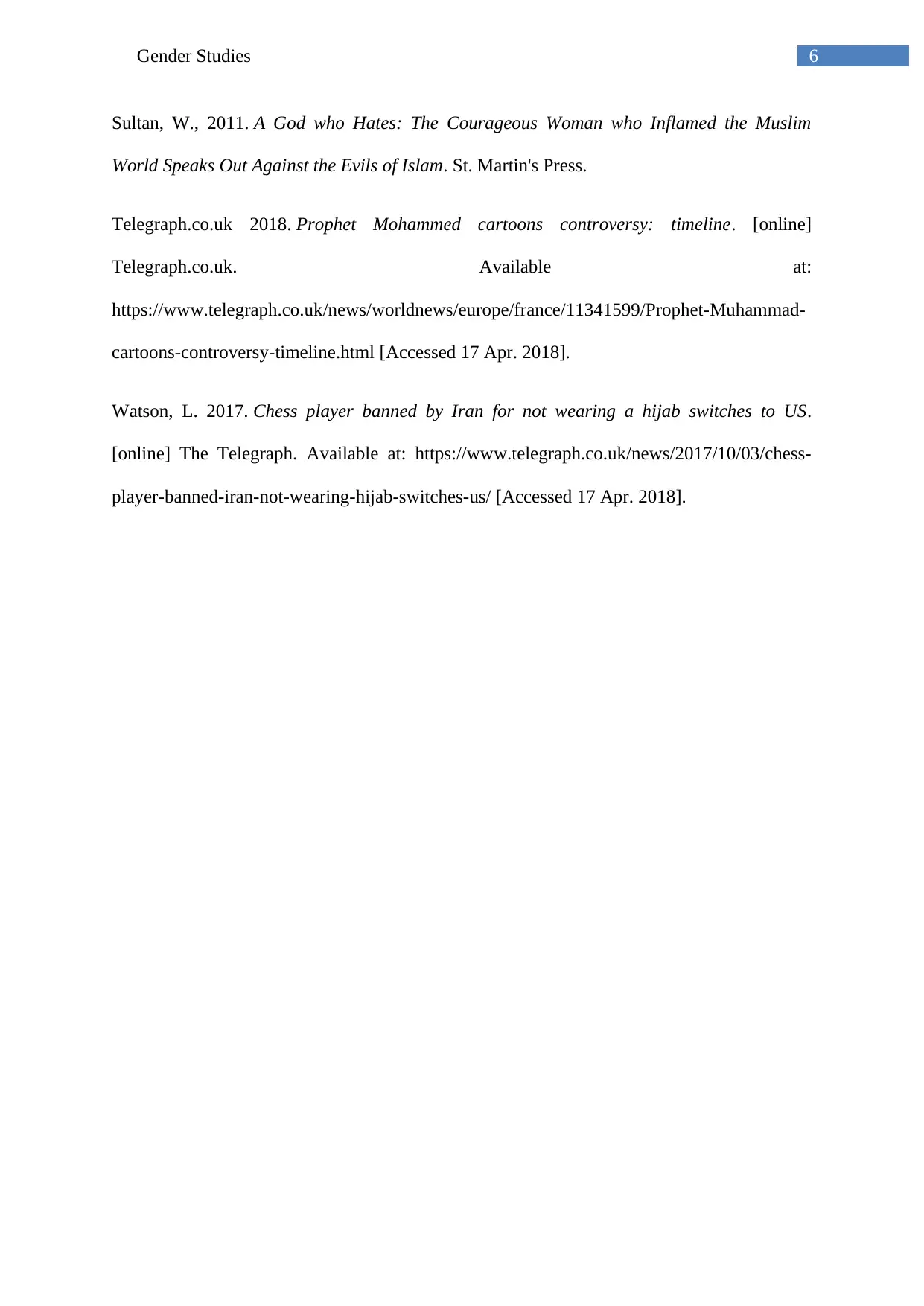
References:
Abbasi, W. 2017. Hijab becomes symbol of resistance, feminism in the age of Trump.
[online] USA TODAY. Available at:
https://www.usatoday.com/story/news/nation-now/2017/03/15/hijab-becomes-symbol-
resistance-feminism-age-trump/98475212/ [Accessed 17 Apr. 2018].
Al Wazni, A.B., 2015. Muslim women in America and hijab: A study of empowerment,
feminist identity, and body image. Social work, 60(4), pp.325-333.
Byng, M.D., 2010. Symbolically Muslim: media, hijab, and the West. Critical
Sociology, 36(1), pp.109-129.
Gabriel, M.A., 2015. Islam and Terrorism (Revised and Updated Edition): The Truth about
Isis, the Middle East and Islamic Jihad. Charisma Media.
Gould, R., 2014. Hijab as commodity form: Veiling, unveiling, and misveiling in
contemporary Iran. Feminist Theory, 15(3), pp.221-240.
Nasrin, T., 2014. Lajja. Penguin UK.
Nomani, A. Q., & Arafa, H. 2016. Wearing the hijab in solidarity perpetuates
oppression. Retrieved February, 26, 2017.
Nomani, A.Q. and Arafa, H., 2015. As Muslim women, we actually ask you not to wear the
hijab in the name of interfaith solidarity. The Washington Post.
Ozanick, B. 2017. Feminism, Hijabs and Hypocrisy | Clarion Project. [online] Clarion
Project. Available at: https://clarionproject.org/feminism-hijabs-and-hypocrisy/ [Accessed 17
Apr. 2018].
Document Page
6Gender Studies
Sultan, W., 2011. A God who Hates: The Courageous Woman who Inflamed the Muslim
World Speaks Out Against the Evils of Islam. St. Martin's Press.
Telegraph.co.uk 2018. Prophet Mohammed cartoons controversy: timeline. [online]
Telegraph.co.uk. Available at:
https://www.telegraph.co.uk/news/worldnews/europe/france/11341599/Prophet-Muhammad-
cartoons-controversy-timeline.html [Accessed 17 Apr. 2018].
Watson, L. 2017. Chess player banned by Iran for not wearing a hijab switches to US.
[online] The Telegraph. Available at: https://www.telegraph.co.uk/news/2017/10/03/chess-
player-banned-iran-not-wearing-hijab-switches-us/ [Accessed 17 Apr. 2018].
chevron_up_icon
1 out of 7
circle_padding
hide_on_mobile
zoom_out_icon
[object Object]