Case Study: Knowledge Management Strategy at Hikma Pharmaceuticals
VerifiedAdded on 2023/06/15
|12
|3893
|135
Case Study
AI Summary
This case study analyzes Hikma Pharmaceuticals' current business model and proposes a new business model centered on patient-centricity and knowledge management. It highlights the challenges faced by Hikma, including cost pressures, rising customer expectations, and regulatory guidelines, and suggests a shift from volume production to value production by fostering collaboration between Hikma and various healthcare providers. The suggested model emphasizes leveraging knowledge management and technology to improve healthcare outcomes. The case study further details the dimensions of a knowledge management strategy, including people, culture, leadership, processes, and technology, within key functions like R&D, manufacturing, supply chain, marketing, and sales. It advocates for a Chief Knowledge Officer role to drive strategic change and ensure the sustainability of knowledge management effectiveness, ultimately aiming to enhance Hikma's competitive advantage and achieve its patient-centric goals.
Strategy Implementation – IE Business School – GXMBA May
2017
Knowledge Management in Hikma
Pharmaceuticals – MENA Region
Samer Jalal – 22nd of February 2018
2017
Knowledge Management in Hikma
Pharmaceuticals – MENA Region
Samer Jalal – 22nd of February 2018

Paraphrase This Document
Need a fresh take? Get an instant paraphrase of this document with our AI Paraphraser
1. Introduction: Hikma Pharmaceutical in MENA
Hikma Pharmaceuticals (www.hikma.com) is a generic pharmaceutical company; founded in
1978 in Jordan and became public shareholding company in 2005.
Hikma develops, manufactures and markets a broad range of branded and Injectable
pharmaceutical products across Middle East and North Africa (MENA). Hikma is also a leading
licensing partner and its operations span all MENA countries. The revenues of Hikma in MENA
represent 33% of Group revenue and it has nearly 5,000 employees in the MENA region. Hikma
has local manufacturing facilities in seven markets and sales and marketing teams detailing
doctors and pharmacists across 17 markets.
The size of the Pharma market in MENA is 18 billion USD with 8% annual growth rate fueled by
aging population in addition to rising incomes in certain MENA countries raises the expectations
and opportunities to higher quality healthcare.
Hikma’s key competitors are originators (such as GSK, Pfizer, Novartis, Sanofi) and generic
companies (such as Tabuk Pharma, MS Pharma, Al-Kendi, Ammoun Pharma) and the sales
mechanism is achieved through strong relationships with Physicians and key consultants in the
healthcare facilities in addition to good prices and bonuses. Brand loyalty for all Pharma
companies is weak and this is why Hikma needs to consider business model transformation.
1.1 Business Challenges
There are certain key challenges that Hikma need to consider in its strategy:
- Cost pressures on the industry arising from less number of new molecules/products in
addition to several new economical/political and social factors in MENA.
- Rising customers’ expectations: Health care payers are expecting new treatments that
economically and clinically optimal leading to better healthcare outcomes.
- The need for more responsive supply chain to accommodate the increasing complexity
and in adaptation to changing patients’ and healthcare providers’ expectations.
- Information and visibility as Hikma needs to change from black-box system to
information highway
- New and frequent regulatory guidelines
These challenges require amendments on the strategy and business model by zooming in
towards patients’ and payers’ expectations and increasing the agility of the organization
towards adaptation and more importantly to lead the clinical transformation in MENA.
2. Current Business Model vs. New Business Model
2.1 Current Business Model
Similar to other generic pharma (GX), Hikma business model is characterized by the production
and selling generic drugs that are comparable to branded drug product in dosage form,
strength, route of administration, performance and intended use. This is achieved through
reverse engineering of the drugs invented by the big Pharmaceutical companies and sold at
2
Hikma Pharmaceuticals (www.hikma.com) is a generic pharmaceutical company; founded in
1978 in Jordan and became public shareholding company in 2005.
Hikma develops, manufactures and markets a broad range of branded and Injectable
pharmaceutical products across Middle East and North Africa (MENA). Hikma is also a leading
licensing partner and its operations span all MENA countries. The revenues of Hikma in MENA
represent 33% of Group revenue and it has nearly 5,000 employees in the MENA region. Hikma
has local manufacturing facilities in seven markets and sales and marketing teams detailing
doctors and pharmacists across 17 markets.
The size of the Pharma market in MENA is 18 billion USD with 8% annual growth rate fueled by
aging population in addition to rising incomes in certain MENA countries raises the expectations
and opportunities to higher quality healthcare.
Hikma’s key competitors are originators (such as GSK, Pfizer, Novartis, Sanofi) and generic
companies (such as Tabuk Pharma, MS Pharma, Al-Kendi, Ammoun Pharma) and the sales
mechanism is achieved through strong relationships with Physicians and key consultants in the
healthcare facilities in addition to good prices and bonuses. Brand loyalty for all Pharma
companies is weak and this is why Hikma needs to consider business model transformation.
1.1 Business Challenges
There are certain key challenges that Hikma need to consider in its strategy:
- Cost pressures on the industry arising from less number of new molecules/products in
addition to several new economical/political and social factors in MENA.
- Rising customers’ expectations: Health care payers are expecting new treatments that
economically and clinically optimal leading to better healthcare outcomes.
- The need for more responsive supply chain to accommodate the increasing complexity
and in adaptation to changing patients’ and healthcare providers’ expectations.
- Information and visibility as Hikma needs to change from black-box system to
information highway
- New and frequent regulatory guidelines
These challenges require amendments on the strategy and business model by zooming in
towards patients’ and payers’ expectations and increasing the agility of the organization
towards adaptation and more importantly to lead the clinical transformation in MENA.
2. Current Business Model vs. New Business Model
2.1 Current Business Model
Similar to other generic pharma (GX), Hikma business model is characterized by the production
and selling generic drugs that are comparable to branded drug product in dosage form,
strength, route of administration, performance and intended use. This is achieved through
reverse engineering of the drugs invented by the big Pharmaceutical companies and sold at
2
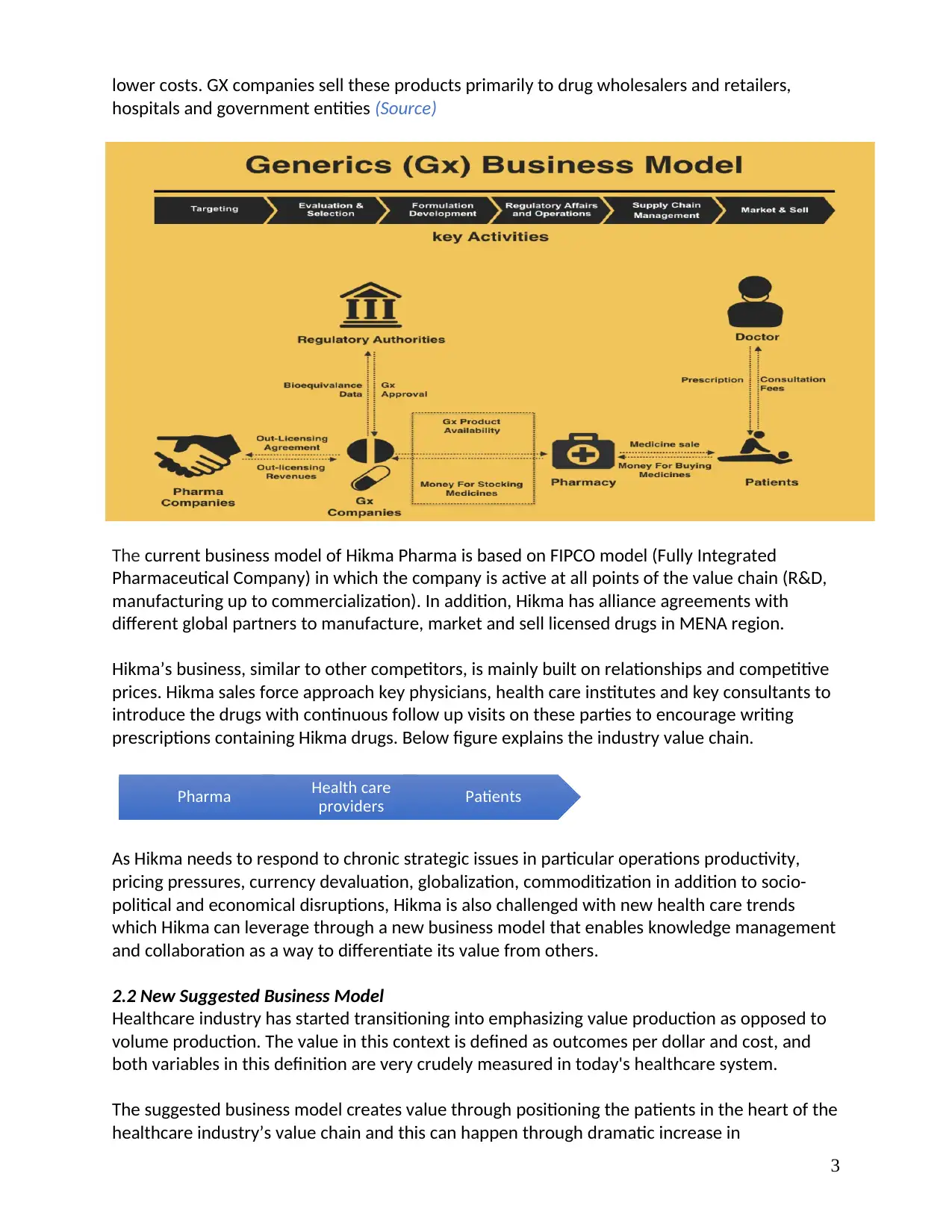
lower costs. GX companies sell these products primarily to drug wholesalers and retailers,
hospitals and government entities (Source)
The current business model of Hikma Pharma is based on FIPCO model (Fully Integrated
Pharmaceutical Company) in which the company is active at all points of the value chain (R&D,
manufacturing up to commercialization). In addition, Hikma has alliance agreements with
different global partners to manufacture, market and sell licensed drugs in MENA region.
Hikma’s business, similar to other competitors, is mainly built on relationships and competitive
prices. Hikma sales force approach key physicians, health care institutes and key consultants to
introduce the drugs with continuous follow up visits on these parties to encourage writing
prescriptions containing Hikma drugs. Below figure explains the industry value chain.
As Hikma needs to respond to chronic strategic issues in particular operations productivity,
pricing pressures, currency devaluation, globalization, commoditization in addition to socio-
political and economical disruptions, Hikma is also challenged with new health care trends
which Hikma can leverage through a new business model that enables knowledge management
and collaboration as a way to differentiate its value from others.
2.2 New Suggested Business Model
Healthcare industry has started transitioning into emphasizing value production as opposed to
volume production. The value in this context is defined as outcomes per dollar and cost, and
both variables in this definition are very crudely measured in today's healthcare system.
The suggested business model creates value through positioning the patients in the heart of the
healthcare industry’s value chain and this can happen through dramatic increase in
Pharma Health care
providers Patients
3
hospitals and government entities (Source)
The current business model of Hikma Pharma is based on FIPCO model (Fully Integrated
Pharmaceutical Company) in which the company is active at all points of the value chain (R&D,
manufacturing up to commercialization). In addition, Hikma has alliance agreements with
different global partners to manufacture, market and sell licensed drugs in MENA region.
Hikma’s business, similar to other competitors, is mainly built on relationships and competitive
prices. Hikma sales force approach key physicians, health care institutes and key consultants to
introduce the drugs with continuous follow up visits on these parties to encourage writing
prescriptions containing Hikma drugs. Below figure explains the industry value chain.
As Hikma needs to respond to chronic strategic issues in particular operations productivity,
pricing pressures, currency devaluation, globalization, commoditization in addition to socio-
political and economical disruptions, Hikma is also challenged with new health care trends
which Hikma can leverage through a new business model that enables knowledge management
and collaboration as a way to differentiate its value from others.
2.2 New Suggested Business Model
Healthcare industry has started transitioning into emphasizing value production as opposed to
volume production. The value in this context is defined as outcomes per dollar and cost, and
both variables in this definition are very crudely measured in today's healthcare system.
The suggested business model creates value through positioning the patients in the heart of the
healthcare industry’s value chain and this can happen through dramatic increase in
Pharma Health care
providers Patients
3
⊘ This is a preview!⊘
Do you want full access?
Subscribe today to unlock all pages.

Trusted by 1+ million students worldwide
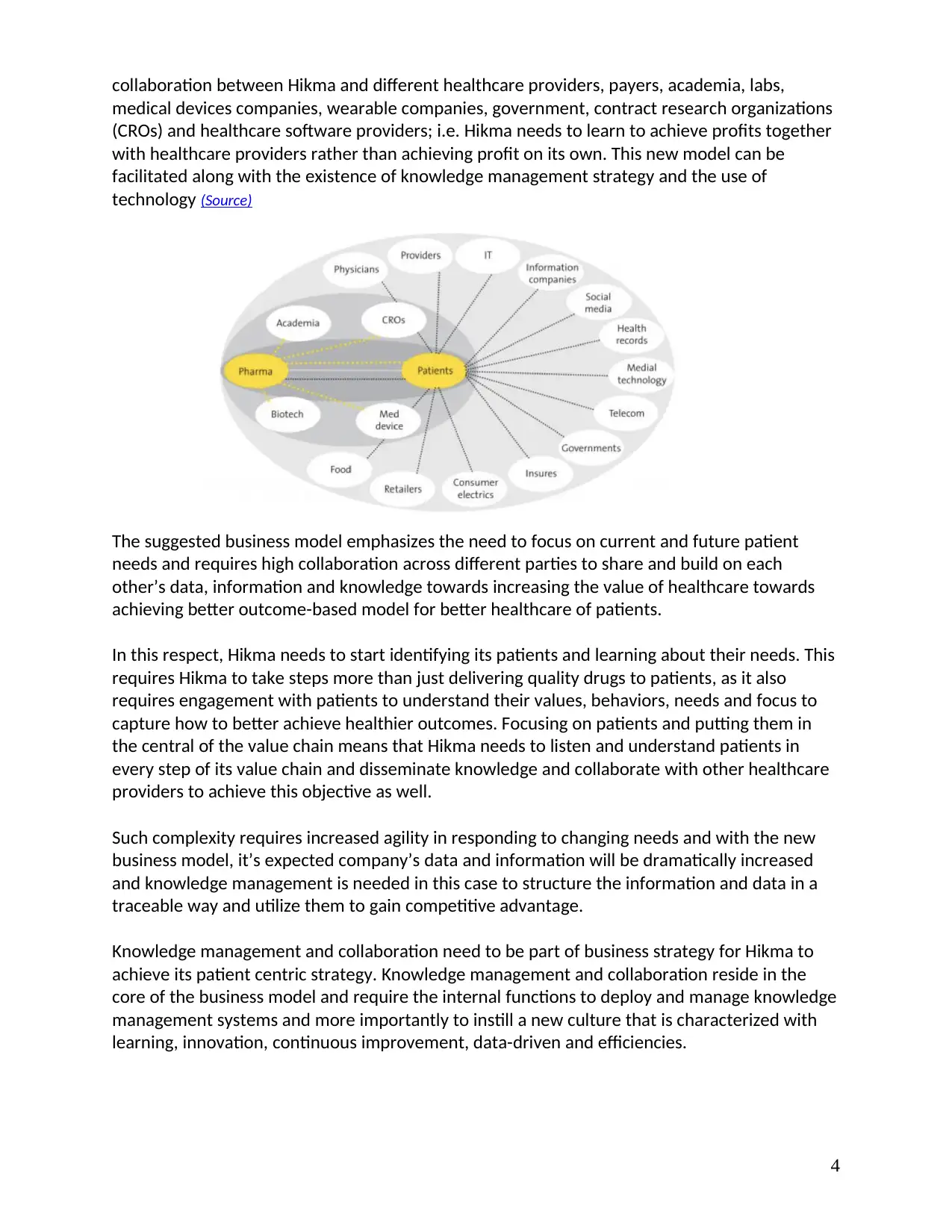
collaboration between Hikma and different healthcare providers, payers, academia, labs,
medical devices companies, wearable companies, government, contract research organizations
(CROs) and healthcare software providers; i.e. Hikma needs to learn to achieve profits together
with healthcare providers rather than achieving profit on its own. This new model can be
facilitated along with the existence of knowledge management strategy and the use of
technology (Source)
The suggested business model emphasizes the need to focus on current and future patient
needs and requires high collaboration across different parties to share and build on each
other’s data, information and knowledge towards increasing the value of healthcare towards
achieving better outcome-based model for better healthcare of patients.
In this respect, Hikma needs to start identifying its patients and learning about their needs. This
requires Hikma to take steps more than just delivering quality drugs to patients, as it also
requires engagement with patients to understand their values, behaviors, needs and focus to
capture how to better achieve healthier outcomes. Focusing on patients and putting them in
the central of the value chain means that Hikma needs to listen and understand patients in
every step of its value chain and disseminate knowledge and collaborate with other healthcare
providers to achieve this objective as well.
Such complexity requires increased agility in responding to changing needs and with the new
business model, it’s expected company’s data and information will be dramatically increased
and knowledge management is needed in this case to structure the information and data in a
traceable way and utilize them to gain competitive advantage.
Knowledge management and collaboration need to be part of business strategy for Hikma to
achieve its patient centric strategy. Knowledge management and collaboration reside in the
core of the business model and require the internal functions to deploy and manage knowledge
management systems and more importantly to instill a new culture that is characterized with
learning, innovation, continuous improvement, data-driven and efficiencies.
4
medical devices companies, wearable companies, government, contract research organizations
(CROs) and healthcare software providers; i.e. Hikma needs to learn to achieve profits together
with healthcare providers rather than achieving profit on its own. This new model can be
facilitated along with the existence of knowledge management strategy and the use of
technology (Source)
The suggested business model emphasizes the need to focus on current and future patient
needs and requires high collaboration across different parties to share and build on each
other’s data, information and knowledge towards increasing the value of healthcare towards
achieving better outcome-based model for better healthcare of patients.
In this respect, Hikma needs to start identifying its patients and learning about their needs. This
requires Hikma to take steps more than just delivering quality drugs to patients, as it also
requires engagement with patients to understand their values, behaviors, needs and focus to
capture how to better achieve healthier outcomes. Focusing on patients and putting them in
the central of the value chain means that Hikma needs to listen and understand patients in
every step of its value chain and disseminate knowledge and collaborate with other healthcare
providers to achieve this objective as well.
Such complexity requires increased agility in responding to changing needs and with the new
business model, it’s expected company’s data and information will be dramatically increased
and knowledge management is needed in this case to structure the information and data in a
traceable way and utilize them to gain competitive advantage.
Knowledge management and collaboration need to be part of business strategy for Hikma to
achieve its patient centric strategy. Knowledge management and collaboration reside in the
core of the business model and require the internal functions to deploy and manage knowledge
management systems and more importantly to instill a new culture that is characterized with
learning, innovation, continuous improvement, data-driven and efficiencies.
4
Paraphrase This Document
Need a fresh take? Get an instant paraphrase of this document with our AI Paraphraser
Knowledge Management can be defined as the process of creating, sharing, using and
managing the knowledge and information of an organization. It refers to a multidisciplinary
approach to achieving organizational objectives by making the best use of knowledge1
Hikma needs to capitalize on Knowledge Management throughout its business model and value
chain in fulfilment of the mission of achieving patients’ centricity.
3. Knowledge Management Strategy
In order to achieve integrating the Knowledge Management into the business strategy, Hikma
needs to consider the following dimensions:
1- People, culture and leadership
2- Processes
3- Technology
3.1 People and Culture
Knowledge management strategy is a people strategy as people is the key to implement it;
processes and technologies are the tools for the effective implementation. Hikma needs to have
the buy-in from its people towards adoption, participation, sharing and utilizing knowledge. In
order to gain the buy-in, Hikma needs to manage this knowledge management project as
transformation/chain management project which and its suggested to follow the Knowledge
Management Strategy Implementation Plan (Point #5)
The people in Hikma are talented and have very good understanding for the need of learning
and sharing; these people are coming from diverse cultures and backgrounds which will enable
achieving greater results and solutions once we enable the knowledge management strategy.
Currently these people are using their functional systems to manage their own processes in
their own departments. In order to activate the collaboration and sharing mode; Hikma needs
to start encouraging cross functional and cross-country projects to enable processes and data
standardization in addition to solving common business problems.
Motivation and incentives are key in this part and Hikma needs to redesign its objectives and
incentives to reward the good results of cross functional/geographical sharing of work.
Leadership
As knowledge management dimensions need to be integrated within Hikma strategy and
business model and because such new strategy requires hands-on and high-level
empowerment, it’s imperative Hikma creates a Chief Knowledge Officer role (reporting to
Group CEO) (Exhibit 1) to effectively implement the integration strategy and govern the
continuous sustainability of the knowledge management effectiveness.
The Chief Knowledge Officer role is important to lead the strategic change and give enough
time to make sure the change is happening, and the benefits are realized.
1 https://en.wikipedia.org/wiki/Knowledge_management
5
managing the knowledge and information of an organization. It refers to a multidisciplinary
approach to achieving organizational objectives by making the best use of knowledge1
Hikma needs to capitalize on Knowledge Management throughout its business model and value
chain in fulfilment of the mission of achieving patients’ centricity.
3. Knowledge Management Strategy
In order to achieve integrating the Knowledge Management into the business strategy, Hikma
needs to consider the following dimensions:
1- People, culture and leadership
2- Processes
3- Technology
3.1 People and Culture
Knowledge management strategy is a people strategy as people is the key to implement it;
processes and technologies are the tools for the effective implementation. Hikma needs to have
the buy-in from its people towards adoption, participation, sharing and utilizing knowledge. In
order to gain the buy-in, Hikma needs to manage this knowledge management project as
transformation/chain management project which and its suggested to follow the Knowledge
Management Strategy Implementation Plan (Point #5)
The people in Hikma are talented and have very good understanding for the need of learning
and sharing; these people are coming from diverse cultures and backgrounds which will enable
achieving greater results and solutions once we enable the knowledge management strategy.
Currently these people are using their functional systems to manage their own processes in
their own departments. In order to activate the collaboration and sharing mode; Hikma needs
to start encouraging cross functional and cross-country projects to enable processes and data
standardization in addition to solving common business problems.
Motivation and incentives are key in this part and Hikma needs to redesign its objectives and
incentives to reward the good results of cross functional/geographical sharing of work.
Leadership
As knowledge management dimensions need to be integrated within Hikma strategy and
business model and because such new strategy requires hands-on and high-level
empowerment, it’s imperative Hikma creates a Chief Knowledge Officer role (reporting to
Group CEO) (Exhibit 1) to effectively implement the integration strategy and govern the
continuous sustainability of the knowledge management effectiveness.
The Chief Knowledge Officer role is important to lead the strategic change and give enough
time to make sure the change is happening, and the benefits are realized.
1 https://en.wikipedia.org/wiki/Knowledge_management
5
Of course, as much as this role is important, also, the head of departments roles are important
as well and much of the CKO time need to be with the head of departments to get their buy in
and implement the necessary process/technology changes in these departments.
3.2 Processes and Technology
The following is explanation for the processes and technology dimensions in each of key
functions that need to be transformed in order to achieve the knowledge management
strategy:
3.2.1 R&D
- R&D needs to manage data and information captured from clinical trials and patients to
better understand current and future needs. Such information and data need to be shared
with concerned employees with a purpose of creating new knowledge to support speeding
up the R&D process and developing more personalized drugs. In order to implement this and
with the use of available technology, R&D can utilize digital platform with end to end drug
research and development to share knowledge internally and to collaborate with different
contract research organizations (CROs) which can substantially lower its R&D fixed costs and
increase the speed of R&D process towards developing new products.
3.2.2 Manufacturing and Supply Chain
- Tier 1 and 2 supply chain visibility: Developing supply chain solution with a primary purpose
of capturing Hikma drugs inventory data at distributors and pharmacies (below figure).
Through analyzing inventory data, Hikma can benefit in improving sales forecasts and
adjusting sales strategies to optimize revenue and reduce the return of expired goods at
each point of sales. This solution will need new processes in place that will tackle forecasting
the demand, ordering and delivery, monitoring market trends and advising the
marketing/sales for necessary actions. The Knowledge and information that are captured
from such solution is enormous and can benefit in reducing the expenses and improving the
working capital for Hikma and the customers as well.
- On the manufacturing part, currently there are variances in the manufacturing processes
between Hikma plants and this is leading to loss of opportunities in sharing efficiencies and
synergy. Also, the key performance indicators are not standardized which can lead to
inconsistency in decision making. In this regard, Hikma can utilize its current ERP system
(SAP) to standardize the processes and key performance indicators. Cross functional teams
can be created and work on this project and all information and data can be stored in the
6
as well and much of the CKO time need to be with the head of departments to get their buy in
and implement the necessary process/technology changes in these departments.
3.2 Processes and Technology
The following is explanation for the processes and technology dimensions in each of key
functions that need to be transformed in order to achieve the knowledge management
strategy:
3.2.1 R&D
- R&D needs to manage data and information captured from clinical trials and patients to
better understand current and future needs. Such information and data need to be shared
with concerned employees with a purpose of creating new knowledge to support speeding
up the R&D process and developing more personalized drugs. In order to implement this and
with the use of available technology, R&D can utilize digital platform with end to end drug
research and development to share knowledge internally and to collaborate with different
contract research organizations (CROs) which can substantially lower its R&D fixed costs and
increase the speed of R&D process towards developing new products.
3.2.2 Manufacturing and Supply Chain
- Tier 1 and 2 supply chain visibility: Developing supply chain solution with a primary purpose
of capturing Hikma drugs inventory data at distributors and pharmacies (below figure).
Through analyzing inventory data, Hikma can benefit in improving sales forecasts and
adjusting sales strategies to optimize revenue and reduce the return of expired goods at
each point of sales. This solution will need new processes in place that will tackle forecasting
the demand, ordering and delivery, monitoring market trends and advising the
marketing/sales for necessary actions. The Knowledge and information that are captured
from such solution is enormous and can benefit in reducing the expenses and improving the
working capital for Hikma and the customers as well.
- On the manufacturing part, currently there are variances in the manufacturing processes
between Hikma plants and this is leading to loss of opportunities in sharing efficiencies and
synergy. Also, the key performance indicators are not standardized which can lead to
inconsistency in decision making. In this regard, Hikma can utilize its current ERP system
(SAP) to standardize the processes and key performance indicators. Cross functional teams
can be created and work on this project and all information and data can be stored in the
6
⊘ This is a preview!⊘
Do you want full access?
Subscribe today to unlock all pages.
Trusted by 1+ million students worldwide
ERP. It’s also important to create a process of continuous improvement through incentivizing
people for ideas they come up with. A database of these ideas can also be shared between
sites through the SharePoint platform leading to sharing experiences and opening up
communication channels between plants in different countries to collaborate on solving
problems. Knowledge visibility is the key to let people improve on the current processes and
attain higher levels of business improvements.
- Hikma can also focus on data analysis and synthesis and design predictive solutions for new
products or machines to optimize and streamline manufacturing processes which opens up
the door for increased innovation.
3.2.3 Marketing and Sales
As Hikma needs to be closer to understanding the complete healthcare process in addition to
payers’ expectations, the marketing and sales departments and through adopting the
knowledge management strategy can introduce the following suggestions:
- Management of Antibiotic Stewardship Program: Hikma’s estimates that 20%-50% of the
antibiotics prescribed in the region are either unnecessary or inappropriate. Developing such
program will guide all health care providers towards the best use of the antibiotics which
guarantees better patient safety and reduces payers’ costs. Achieving this program requires
agreements and collaboration between different health care providers, medical insurers and
medical laboratories and having this as cloud solution (SaaS) can achieve mobility, ubiquity
and connectivity to all concerned. Such information will support Hikma as being key
contributor as health care provider and enable Hikma to obtain the necessary information to
only produce the effective antibiotics for each country. Such information can be shared with
the supply chain departments to help in their demand forecasts and to utilize the plants’
capacity in the best optimal way.
- Physicians knowledge and learning: Hikma needs to be closer to Physicians and provide them
with up to date clinical data and information along with drug benefits and continuous
updated information about drug interactions and adverse effects to support their treatment
options. Also, Hikma can benefit from the physicians’ feedback on the use and efficacy of
these drugs. Utilizing a mobile application, Hikma can implement this idea and update it
through Hikma’s marketing and medical affairs departments existing in all our regions; thus,
bringing different insights into the literature. This would bring competitive advantages to
Hikma by leveraging on the intangible differentiation to gain the emotional branding.
Moreover, and through the feedback received, the sales and marketing department can
learn clinical insights into the best methodology to use the drugs in the most efficient way.
- Patients feedback: Hikma needs to start capturing the patients’ feedback on its products and
nowadays this case can easily happen through mobile application which can also be
connected with products inventory database to provide online inventory availability of the
drug in nearby pharmacies in relation to the GPS location of the patient. Patients’ feedback is
important to be shared with marketing and medical affairs departments which can be
considered in continuous product development and in the communication with the
physicians.
- Fitness wearables can also be utilized to encourage healthy lifestyle and Hikma can benefit
from the data logged in these applications and collaborate with the patient and the
Physicians to provide better treatment options for these patients.
- Hikma needs to collaborate with “Hakeem” in Jordan. “Hakeem” (www.ehs.com.jo) is an
electronic health records solution that is initially implemented in Jordan in which all
7
people for ideas they come up with. A database of these ideas can also be shared between
sites through the SharePoint platform leading to sharing experiences and opening up
communication channels between plants in different countries to collaborate on solving
problems. Knowledge visibility is the key to let people improve on the current processes and
attain higher levels of business improvements.
- Hikma can also focus on data analysis and synthesis and design predictive solutions for new
products or machines to optimize and streamline manufacturing processes which opens up
the door for increased innovation.
3.2.3 Marketing and Sales
As Hikma needs to be closer to understanding the complete healthcare process in addition to
payers’ expectations, the marketing and sales departments and through adopting the
knowledge management strategy can introduce the following suggestions:
- Management of Antibiotic Stewardship Program: Hikma’s estimates that 20%-50% of the
antibiotics prescribed in the region are either unnecessary or inappropriate. Developing such
program will guide all health care providers towards the best use of the antibiotics which
guarantees better patient safety and reduces payers’ costs. Achieving this program requires
agreements and collaboration between different health care providers, medical insurers and
medical laboratories and having this as cloud solution (SaaS) can achieve mobility, ubiquity
and connectivity to all concerned. Such information will support Hikma as being key
contributor as health care provider and enable Hikma to obtain the necessary information to
only produce the effective antibiotics for each country. Such information can be shared with
the supply chain departments to help in their demand forecasts and to utilize the plants’
capacity in the best optimal way.
- Physicians knowledge and learning: Hikma needs to be closer to Physicians and provide them
with up to date clinical data and information along with drug benefits and continuous
updated information about drug interactions and adverse effects to support their treatment
options. Also, Hikma can benefit from the physicians’ feedback on the use and efficacy of
these drugs. Utilizing a mobile application, Hikma can implement this idea and update it
through Hikma’s marketing and medical affairs departments existing in all our regions; thus,
bringing different insights into the literature. This would bring competitive advantages to
Hikma by leveraging on the intangible differentiation to gain the emotional branding.
Moreover, and through the feedback received, the sales and marketing department can
learn clinical insights into the best methodology to use the drugs in the most efficient way.
- Patients feedback: Hikma needs to start capturing the patients’ feedback on its products and
nowadays this case can easily happen through mobile application which can also be
connected with products inventory database to provide online inventory availability of the
drug in nearby pharmacies in relation to the GPS location of the patient. Patients’ feedback is
important to be shared with marketing and medical affairs departments which can be
considered in continuous product development and in the communication with the
physicians.
- Fitness wearables can also be utilized to encourage healthy lifestyle and Hikma can benefit
from the data logged in these applications and collaborate with the patient and the
Physicians to provide better treatment options for these patients.
- Hikma needs to collaborate with “Hakeem” in Jordan. “Hakeem” (www.ehs.com.jo) is an
electronic health records solution that is initially implemented in Jordan in which all
7
Paraphrase This Document
Need a fresh take? Get an instant paraphrase of this document with our AI Paraphraser
treatments, tests and medications data and information are recorded in it. In effect,
healthcare providers are able to access the medical records of patients and provide better
and more suitable treatment options. Hikma needs this information, especially the one
related to medications, to be able to do analytics and trending to better understand patients’
preferences which would help the marketing department in communicating the right
messages to the right physicians in addition to developing the required products for the
future. “Hakeem” system is only available in Jordan for now and Hikma needs to check the
availability of similar systems in other MENA countries.
3.2.4 Regulatory Information Management System
This system is a repository for all information and documentation necessary for products,
patents, quality and regulatory checks and approvals. This information need to be shared with
all regulatory departments in the region and continuously updated reflecting the new
regulations in each country. Such information can help to compare the different regulations
between different countries which will help in lobbying the needed regulatory changes to
streamline the product registration approval cycle.
3.2.5 Human Capital Information System (People Connect)
Hikma can utilize this system to connect people (employees) together. People would be able to
search for any necessary information about their peers in other departments and countries and
find the best way to communicate with them to share the tacit knowledge and experiences.
3.2.6 Learning Management System
Hikma can also utilize this system to publish learning and experiences necessary to increase
people effectiveness and productivity. Such learning can be targeted and linked with the
performance management system to make sure the right people get the right learning
experiences at the right time.
4. How Hikma can gain competitive advantages through the Knowledge
Management Strategy?
In this section, we explain how key stakeholders will benefit from this strategy which would
reflect back to Hikma as competitive advantages that will be differentiated with:
4.1 Patients
Through being patient centric company, patients would be recognizing Hikma as their partner in
their healthcare journey. Through Hikma’s collaboration with physicians and healthcare
providers, Hikma is able to provide the necessary knowledge, information and data to support
optimal outcome-based process leading to effective treatment with lowest possible cost.
This strategy would reflect intangible differentiation on Hikma in terms of stakeholders’
perception, connections, attachment and emotional branding. Such differentiation will increase
the demand for more engagement; thus, more information and data can be captured by Hikma
towards better and healthier outcomes.
4.2 Physicians
Through providing the physicians with up to date clinical information, Physicians will have more
updated knowledge towards achieving the outcome-based objectives. As patients are becoming
more informed on the treatments, a good portion of physicians’ time will be diverted into the
8
healthcare providers are able to access the medical records of patients and provide better
and more suitable treatment options. Hikma needs this information, especially the one
related to medications, to be able to do analytics and trending to better understand patients’
preferences which would help the marketing department in communicating the right
messages to the right physicians in addition to developing the required products for the
future. “Hakeem” system is only available in Jordan for now and Hikma needs to check the
availability of similar systems in other MENA countries.
3.2.4 Regulatory Information Management System
This system is a repository for all information and documentation necessary for products,
patents, quality and regulatory checks and approvals. This information need to be shared with
all regulatory departments in the region and continuously updated reflecting the new
regulations in each country. Such information can help to compare the different regulations
between different countries which will help in lobbying the needed regulatory changes to
streamline the product registration approval cycle.
3.2.5 Human Capital Information System (People Connect)
Hikma can utilize this system to connect people (employees) together. People would be able to
search for any necessary information about their peers in other departments and countries and
find the best way to communicate with them to share the tacit knowledge and experiences.
3.2.6 Learning Management System
Hikma can also utilize this system to publish learning and experiences necessary to increase
people effectiveness and productivity. Such learning can be targeted and linked with the
performance management system to make sure the right people get the right learning
experiences at the right time.
4. How Hikma can gain competitive advantages through the Knowledge
Management Strategy?
In this section, we explain how key stakeholders will benefit from this strategy which would
reflect back to Hikma as competitive advantages that will be differentiated with:
4.1 Patients
Through being patient centric company, patients would be recognizing Hikma as their partner in
their healthcare journey. Through Hikma’s collaboration with physicians and healthcare
providers, Hikma is able to provide the necessary knowledge, information and data to support
optimal outcome-based process leading to effective treatment with lowest possible cost.
This strategy would reflect intangible differentiation on Hikma in terms of stakeholders’
perception, connections, attachment and emotional branding. Such differentiation will increase
the demand for more engagement; thus, more information and data can be captured by Hikma
towards better and healthier outcomes.
4.2 Physicians
Through providing the physicians with up to date clinical information, Physicians will have more
updated knowledge towards achieving the outcome-based objectives. As patients are becoming
more informed on the treatments, a good portion of physicians’ time will be diverted into the
8
social element; guiding and supporting the patients and their families into the different
treatment options. New clinical knowledge will be important for them for proper guidance and
treatment options. Hikma can also enable data trends and reporting for the physicians with up
to date patient trends and insights that can help the physician provide the best alternative
treatments for the patients. Physicians would consider Hikma as their best partner for care
towards their evolving patients.
4.3 Medical Insurance Companies
Hikma’s power of information and data through its new knowledge management strategy,
which is focused on sharing knowledge to optimize health outcomes, will attract medical
insurance companies to collaborate with Hikma for the key purpose of reducing their costs.
Medical insurance companies’ data can be analyzed in correlation with Hikma data to come up
with better guidance to physicians towards cost effective treatments of their patients. Medical
insurance companies, and due to the transformation, will be in much better position to link
medical insurance guidelines with the outcome-based model to achieve increased cost
effectiveness along with increased patient safety and optimal treatment options.
4.4 Regulators
By having information and data shared and analyzed on different regulators, Hikma can build a
collaborative relationship with all regulatory bodies towards achieving knowledge and
information integration strategies with the aim to improve patient treatments and health
outcomes.
4.5 Industry implications
This new strategy has all the characteristics to differentiate Hikma from other players in the
market. As the knowledge and collaboration model grows, the speed of collaboration and the
intensity of knowledge sharing will increase between different health care entities and thanks
to this model the lines among pharma, payers and providers will keep blurring which requires
more mature and strategic collaborative mindset to keep up the trend towards more
collaboration and knowledge sharing leading to more efficient health care treatments and more
profits for all parties.
5. Knowledge Management Strategy Implementation Plan
In order to implement this strategy, there are several frameworks (e.g. exhibit 2 and exhibit 3)
that we can adapt from. The suggested new role (CKO) would be the one to lead this strategic
approach and the suggested key phases are:
5.1 Awareness Creation
- Define and agree with top functional heads (CFO, CIO, CHRO…etc) on value proposition
for improving the flow of knowledge within Hikma for the purpose of differentiating
Hikma from its industry rivals
- Align knowledge strategy with department heads’ goals to gain the commitment from
heads of departments and top management
- The aligned Knowledge Management strategy need to be communicated with the Board
of Directors to gain commitment and momentum for implementation
9
treatment options. New clinical knowledge will be important for them for proper guidance and
treatment options. Hikma can also enable data trends and reporting for the physicians with up
to date patient trends and insights that can help the physician provide the best alternative
treatments for the patients. Physicians would consider Hikma as their best partner for care
towards their evolving patients.
4.3 Medical Insurance Companies
Hikma’s power of information and data through its new knowledge management strategy,
which is focused on sharing knowledge to optimize health outcomes, will attract medical
insurance companies to collaborate with Hikma for the key purpose of reducing their costs.
Medical insurance companies’ data can be analyzed in correlation with Hikma data to come up
with better guidance to physicians towards cost effective treatments of their patients. Medical
insurance companies, and due to the transformation, will be in much better position to link
medical insurance guidelines with the outcome-based model to achieve increased cost
effectiveness along with increased patient safety and optimal treatment options.
4.4 Regulators
By having information and data shared and analyzed on different regulators, Hikma can build a
collaborative relationship with all regulatory bodies towards achieving knowledge and
information integration strategies with the aim to improve patient treatments and health
outcomes.
4.5 Industry implications
This new strategy has all the characteristics to differentiate Hikma from other players in the
market. As the knowledge and collaboration model grows, the speed of collaboration and the
intensity of knowledge sharing will increase between different health care entities and thanks
to this model the lines among pharma, payers and providers will keep blurring which requires
more mature and strategic collaborative mindset to keep up the trend towards more
collaboration and knowledge sharing leading to more efficient health care treatments and more
profits for all parties.
5. Knowledge Management Strategy Implementation Plan
In order to implement this strategy, there are several frameworks (e.g. exhibit 2 and exhibit 3)
that we can adapt from. The suggested new role (CKO) would be the one to lead this strategic
approach and the suggested key phases are:
5.1 Awareness Creation
- Define and agree with top functional heads (CFO, CIO, CHRO…etc) on value proposition
for improving the flow of knowledge within Hikma for the purpose of differentiating
Hikma from its industry rivals
- Align knowledge strategy with department heads’ goals to gain the commitment from
heads of departments and top management
- The aligned Knowledge Management strategy need to be communicated with the Board
of Directors to gain commitment and momentum for implementation
9
⊘ This is a preview!⊘
Do you want full access?
Subscribe today to unlock all pages.
Trusted by 1+ million students worldwide
5.2 Strategy Development
- Determine current resources and capabilities to enable knowledge flow. This step is
important to understand the gaps and set up the priorities
- Establish Knowledge Management governance steering committee consisting of top
management functional leaders
- Develop Business case, plans and budgets required to formally implement the
Knowledge Management strategy including objectives, performance measures,
resources needed and expected benefits and costs along with actions and timelines with
key milestones defined for necessary approvals
5.3 Strategy Implementation
- Form design and operations multi-functional and diversified teams to design, develop
and deploy the new processes.
- Design knowledge process flow; how knowledge will be created, captured, reviewed,
shared and used
- Integrate IT into the implementation: Technology, applications and systems are key
parts of the knowledge management strategy and IT need to be part of the design and
operations teams to achieve successful implementation
- Develop Performance measures along with implementation roadmap: Initial measures
can focus on participation and employee satisfaction. With time, these measures shift to
assessments of impacts on costs, quality, delivery, safety, cycle times and other
important business indicators
- Implement the plans and acquire feedback from different stakeholders along the
process
5.4 Evolvement and Sustainability
- Continuous evolvement of knowledge management capabilities: regular evaluation of
knowledge management capabilities and the level of adoption and taking action
accordingly
- Continuous alignment with business priorities and goals
- Sustain awareness and engagement through regular training, communication, sharing
stories of success in addition to rewards and recognitions
- Linking between knowledge management participation with career advancement
10
- Determine current resources and capabilities to enable knowledge flow. This step is
important to understand the gaps and set up the priorities
- Establish Knowledge Management governance steering committee consisting of top
management functional leaders
- Develop Business case, plans and budgets required to formally implement the
Knowledge Management strategy including objectives, performance measures,
resources needed and expected benefits and costs along with actions and timelines with
key milestones defined for necessary approvals
5.3 Strategy Implementation
- Form design and operations multi-functional and diversified teams to design, develop
and deploy the new processes.
- Design knowledge process flow; how knowledge will be created, captured, reviewed,
shared and used
- Integrate IT into the implementation: Technology, applications and systems are key
parts of the knowledge management strategy and IT need to be part of the design and
operations teams to achieve successful implementation
- Develop Performance measures along with implementation roadmap: Initial measures
can focus on participation and employee satisfaction. With time, these measures shift to
assessments of impacts on costs, quality, delivery, safety, cycle times and other
important business indicators
- Implement the plans and acquire feedback from different stakeholders along the
process
5.4 Evolvement and Sustainability
- Continuous evolvement of knowledge management capabilities: regular evaluation of
knowledge management capabilities and the level of adoption and taking action
accordingly
- Continuous alignment with business priorities and goals
- Sustain awareness and engagement through regular training, communication, sharing
stories of success in addition to rewards and recognitions
- Linking between knowledge management participation with career advancement
10
Paraphrase This Document
Need a fresh take? Get an instant paraphrase of this document with our AI Paraphraser
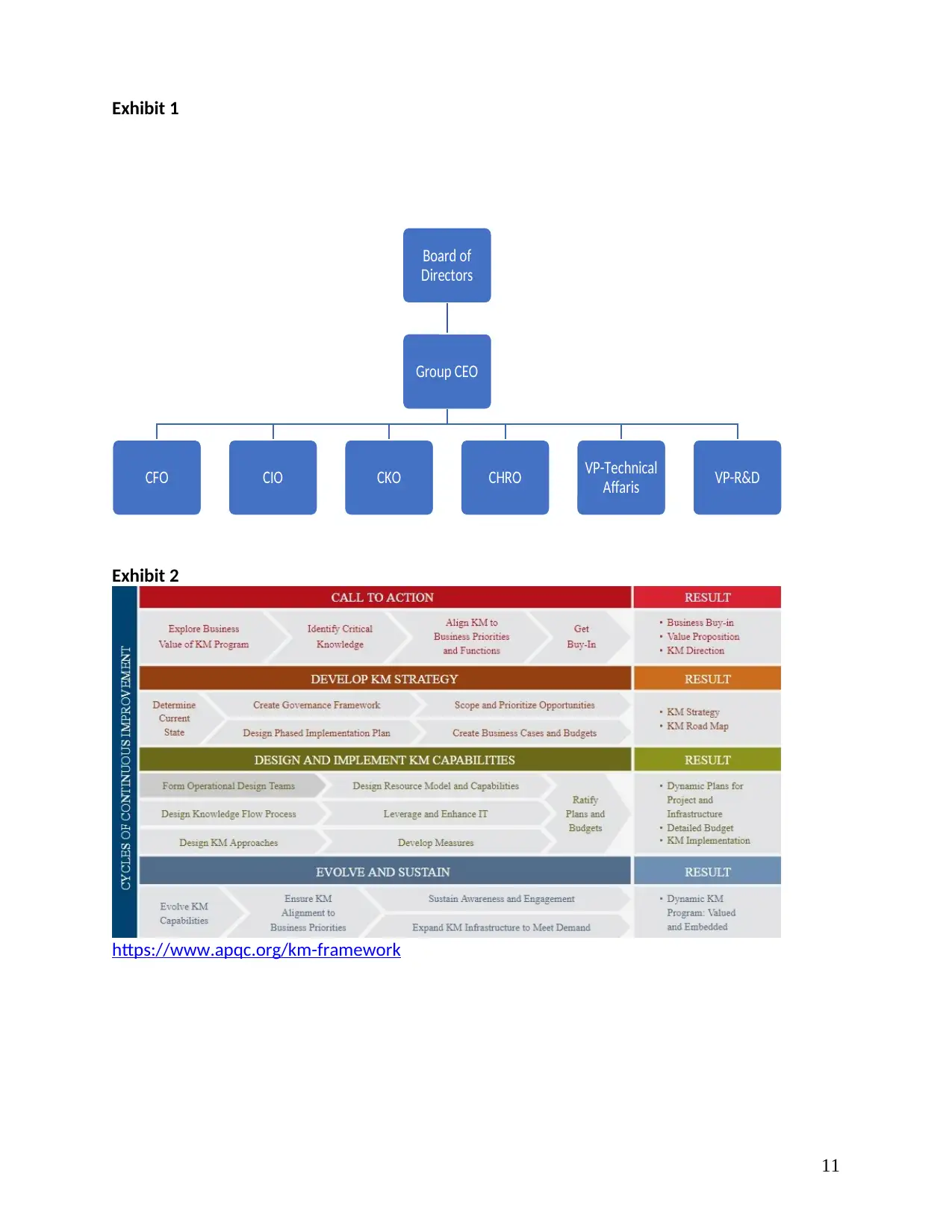
Exhibit 1
Exhibit 2
https://www.apqc.org/km-framework
Board of
Directors
Group CEO
CFO CIO CKO CHRO VP-Technical
Affaris VP-R&D
11
Exhibit 2
https://www.apqc.org/km-framework
Board of
Directors
Group CEO
CFO CIO CKO CHRO VP-Technical
Affaris VP-R&D
11
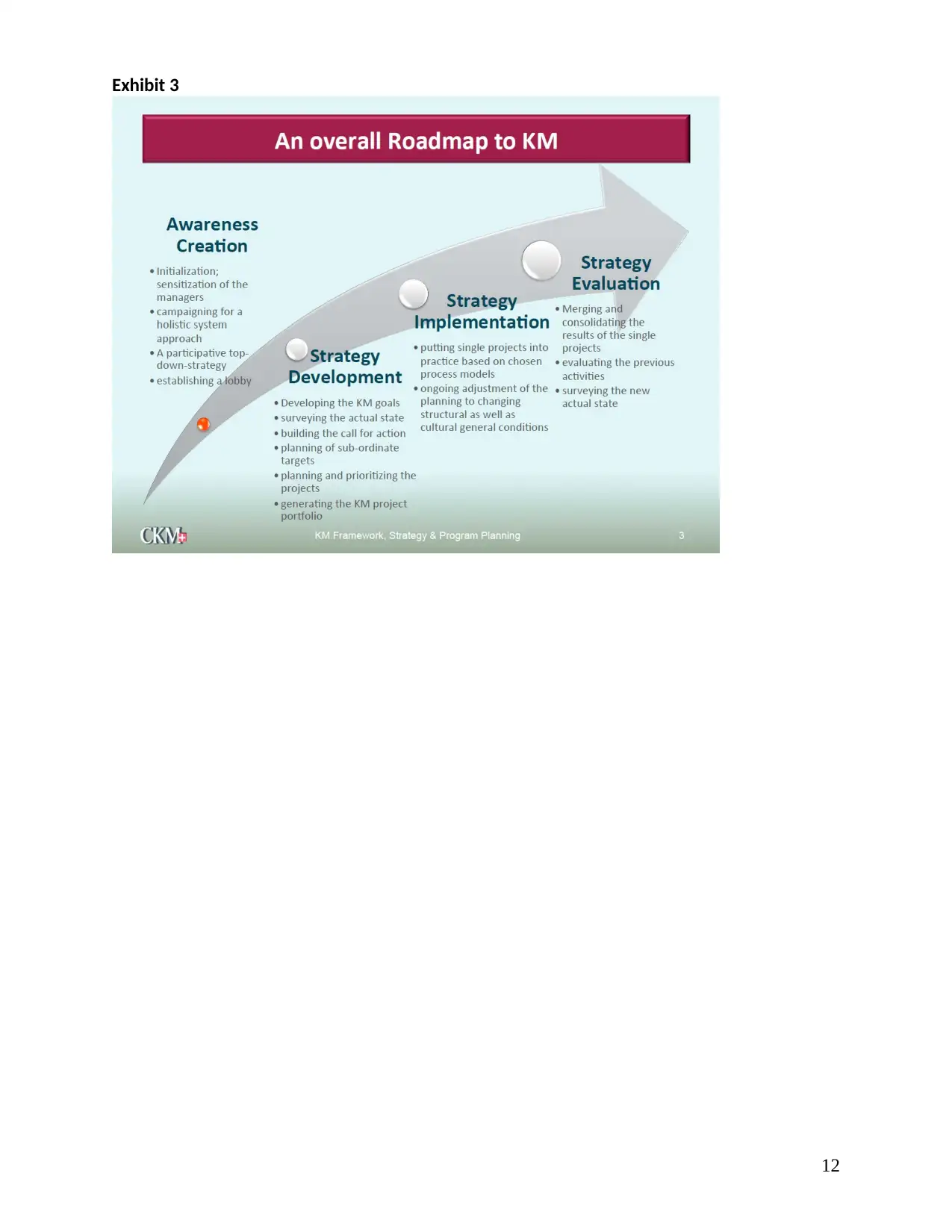
Exhibit 3
12
12
⊘ This is a preview!⊘
Do you want full access?
Subscribe today to unlock all pages.
Trusted by 1+ million students worldwide

1 out of 12


Related Documents


Your All-in-One AI-Powered Toolkit for Academic Success.
+13062052269
info@desklib.com
Available 24*7 on WhatsApp / Email
![[object Object]](/_next/static/media/star-bottom.7253800d.svg)
Unlock your academic potential
Copyright © 2020–2026 A2Z Services. All Rights Reserved. Developed and managed by ZUCOL.