Financial Management: Analysis of Hillside Company's Finances
VerifiedAdded on 2022/08/17
|11
|2440
|13
Report
AI Summary
This report presents a financial analysis of Hillside Company, a publicly traded firm considering expansion through investment in a new plant. It delves into working capital management, capital budgeting, and capital structure. The analysis includes calculations for cash conversion cycles, break-even points, and the application of Net Present Value (NPV) and Internal Rate of Return (IRR) to evaluate project profitability. It also explores financing options, comparing the costs of equity and debt, and provides recommendations for the board of management regarding the proposed project, suggesting acceptance of the investment plan with equity financing to optimize financial risk and increase firm value. The report emphasizes the importance of financial planning and its impact on the firm's future.

Running head: FINANCIAL MANAGEMENT
Financial Management
Name of the Student:
Name of the University:
Author’s Note:
Financial Management
Name of the Student:
Name of the University:
Author’s Note:

Paraphrase This Document
Need a fresh take? Get an instant paraphrase of this document with our AI Paraphraser

1FINANCIAL MANAGEMENT
Table of Contents
Introduction......................................................................................................................................2
Discussion and Analysis..................................................................................................................2
Working Capital Requirements...................................................................................................2
Cash and Break-Even Point.........................................................................................................3
Capital Budgeting........................................................................................................................4
Financing.....................................................................................................................................6
Recommendations............................................................................................................................8
References........................................................................................................................................9
Table of Contents
Introduction......................................................................................................................................2
Discussion and Analysis..................................................................................................................2
Working Capital Requirements...................................................................................................2
Cash and Break-Even Point.........................................................................................................3
Capital Budgeting........................................................................................................................4
Financing.....................................................................................................................................6
Recommendations............................................................................................................................8
References........................................................................................................................................9
2FINANCIAL MANAGEMENT
Introduction
The financial analysis has been done for Hillside Company that operates as a public
traded company which is well considering expanding its business operations with the help of
investment in a new plant. There were various techniques and concepts that were introduced in
particular which were related to Working Capital Management, Capital Budgeting and Capital
Structure of a Firm. The business and operational analysis has been specifically considered for
the firm for the purpose of well forecasting the future projections and operational analysis of the
firm for the future period of time period (Levin and Hallgren 2017). In particular, it is important
to note that Net Present Value and Internal Rate of Return were used to evaluate the overall
profitability of the project. While the various financing sources that a firm can in turn use for the
purpose of well financing the project were discussed. Finally the recommendation was given to
the Board of Management considering the project that has been proposed by the firm.
Discussion and Analysis
Working Capital Requirements
The working capital requirement that the firm would be requiring in turn would be
dependent on the amount that is available for the firm for the purpose of investment in the
operations of the firm and that is probably in the form of working capital. The management of
the firm in specific has proposed to increase the payment period of the firm by increasing the
average collection period from 15 days to around 30 days (Su et al., 2018). The same would be
resulting in the decrease in the collection period thereby increasing the cash conversion cycle of
the firm. In order to well analyze the changes that would be observed in the cash conversion
Introduction
The financial analysis has been done for Hillside Company that operates as a public
traded company which is well considering expanding its business operations with the help of
investment in a new plant. There were various techniques and concepts that were introduced in
particular which were related to Working Capital Management, Capital Budgeting and Capital
Structure of a Firm. The business and operational analysis has been specifically considered for
the firm for the purpose of well forecasting the future projections and operational analysis of the
firm for the future period of time period (Levin and Hallgren 2017). In particular, it is important
to note that Net Present Value and Internal Rate of Return were used to evaluate the overall
profitability of the project. While the various financing sources that a firm can in turn use for the
purpose of well financing the project were discussed. Finally the recommendation was given to
the Board of Management considering the project that has been proposed by the firm.
Discussion and Analysis
Working Capital Requirements
The working capital requirement that the firm would be requiring in turn would be
dependent on the amount that is available for the firm for the purpose of investment in the
operations of the firm and that is probably in the form of working capital. The management of
the firm in specific has proposed to increase the payment period of the firm by increasing the
average collection period from 15 days to around 30 days (Su et al., 2018). The same would be
resulting in the decrease in the collection period thereby increasing the cash conversion cycle of
the firm. In order to well analyze the changes that would be observed in the cash conversion
⊘ This is a preview!⊘
Do you want full access?
Subscribe today to unlock all pages.

Trusted by 1+ million students worldwide

3FINANCIAL MANAGEMENT
cycle of the firm has been analyzed before the initiation of the project which has been well
calculated with the help of the following formula:
Cash Conversion Cycle: Days in Inventory + Days Sales Outstanding – Days Payable
Outstanding
The cash conversion cycle for the firm initially was around 18 days which has been well
calculated as follows:
Old Cash Conversion Cycle: 15+15-12: 18 Days
New Cash Conversion Cycle: 30+15-12: 33 Days.
So, it could be well analyzed that if the firm change their receivable period from 15 days to 30
days then then the cash conversion cycle of the firm would be increasing which well says that the
firm can face liquidity issues in terms of lower working capital that in turn can influence the
daily operations of the firm and the ability of the firm i0n well paying off the current obligations
of the firm. The same could also financially affect the firm in the form of higher cost of
borrowing as the firm have to do the same for the purpose of paying off its current liabilities of
the firm.
Cash and Break-Even Point
The cash and break-even point for the firm has been well calculated with the help of the
given formula:
Breakeven Point: Fixed Cost/(Sale Price -Cost of Raw Material)
The breakeven point for the firm has been well calculated from the given set of data that was
provided whereby the management of the firm are well undertaking for expanding their current
cycle of the firm has been analyzed before the initiation of the project which has been well
calculated with the help of the following formula:
Cash Conversion Cycle: Days in Inventory + Days Sales Outstanding – Days Payable
Outstanding
The cash conversion cycle for the firm initially was around 18 days which has been well
calculated as follows:
Old Cash Conversion Cycle: 15+15-12: 18 Days
New Cash Conversion Cycle: 30+15-12: 33 Days.
So, it could be well analyzed that if the firm change their receivable period from 15 days to 30
days then then the cash conversion cycle of the firm would be increasing which well says that the
firm can face liquidity issues in terms of lower working capital that in turn can influence the
daily operations of the firm and the ability of the firm i0n well paying off the current obligations
of the firm. The same could also financially affect the firm in the form of higher cost of
borrowing as the firm have to do the same for the purpose of paying off its current liabilities of
the firm.
Cash and Break-Even Point
The cash and break-even point for the firm has been well calculated with the help of the
given formula:
Breakeven Point: Fixed Cost/(Sale Price -Cost of Raw Material)
The breakeven point for the firm has been well calculated from the given set of data that was
provided whereby the management of the firm are well undertaking for expanding their current
Paraphrase This Document
Need a fresh take? Get an instant paraphrase of this document with our AI Paraphraser
4FINANCIAL MANAGEMENT
operations by investing into new plants which in turn would be increasing the cash flows of the
firm (Siziba and Hall 2019). The marketing team of the firm would be undertaking an aggressive
marketing campaign in which they believe that the same would be allowing them to increase the
sales revenue of the firm around 5,000 products on an annual basis. The same would be done if
the firm is well willing to spend around $40,000 as an marketing expenses, however it is
important to note the amount of units that needs to be well sold for well covering the fixed cost
of the firm which is well shown below. It is estimated that around 571.43 units needs to be well
sold for well covering the fixed cost of the firm and the same can be easily done as the increase
in the units sold will be around 5,000 units, so the management of the firm must go ahead with
the launching of marketing campaign.
Capital Budgeting
In order to well evaluate the project, the net present value approach has been specifically
applied for the purpose of valuation of the project considered. All the considerable amount of
cash flows that would be flowing to the firm has been specifically considered for analysis
purpose (Al-Mutairi, Naser and Saeid 2018). The discounting rate that has been specifically
considered for analysis purpose is the Cost of Capital which well undertakes both the cost of
equity that has been evaluated with the help of models like Capital Asset Pricing Model and the
key set of formula that is applied is as follows:
Required Return: Risk Free Rate (Rf) + Beta*(Return on Market- Risk Free Rate).
The cost of equity for the firm was calculated to be 11.00% and the same well shows that the
equity shareholders are requiring around 11% on any capital that they would be investing based
on the risk and return that is associated for investment purpose.
operations by investing into new plants which in turn would be increasing the cash flows of the
firm (Siziba and Hall 2019). The marketing team of the firm would be undertaking an aggressive
marketing campaign in which they believe that the same would be allowing them to increase the
sales revenue of the firm around 5,000 products on an annual basis. The same would be done if
the firm is well willing to spend around $40,000 as an marketing expenses, however it is
important to note the amount of units that needs to be well sold for well covering the fixed cost
of the firm which is well shown below. It is estimated that around 571.43 units needs to be well
sold for well covering the fixed cost of the firm and the same can be easily done as the increase
in the units sold will be around 5,000 units, so the management of the firm must go ahead with
the launching of marketing campaign.
Capital Budgeting
In order to well evaluate the project, the net present value approach has been specifically
applied for the purpose of valuation of the project considered. All the considerable amount of
cash flows that would be flowing to the firm has been specifically considered for analysis
purpose (Al-Mutairi, Naser and Saeid 2018). The discounting rate that has been specifically
considered for analysis purpose is the Cost of Capital which well undertakes both the cost of
equity that has been evaluated with the help of models like Capital Asset Pricing Model and the
key set of formula that is applied is as follows:
Required Return: Risk Free Rate (Rf) + Beta*(Return on Market- Risk Free Rate).
The cost of equity for the firm was calculated to be 11.00% and the same well shows that the
equity shareholders are requiring around 11% on any capital that they would be investing based
on the risk and return that is associated for investment purpose.
5FINANCIAL MANAGEMENT
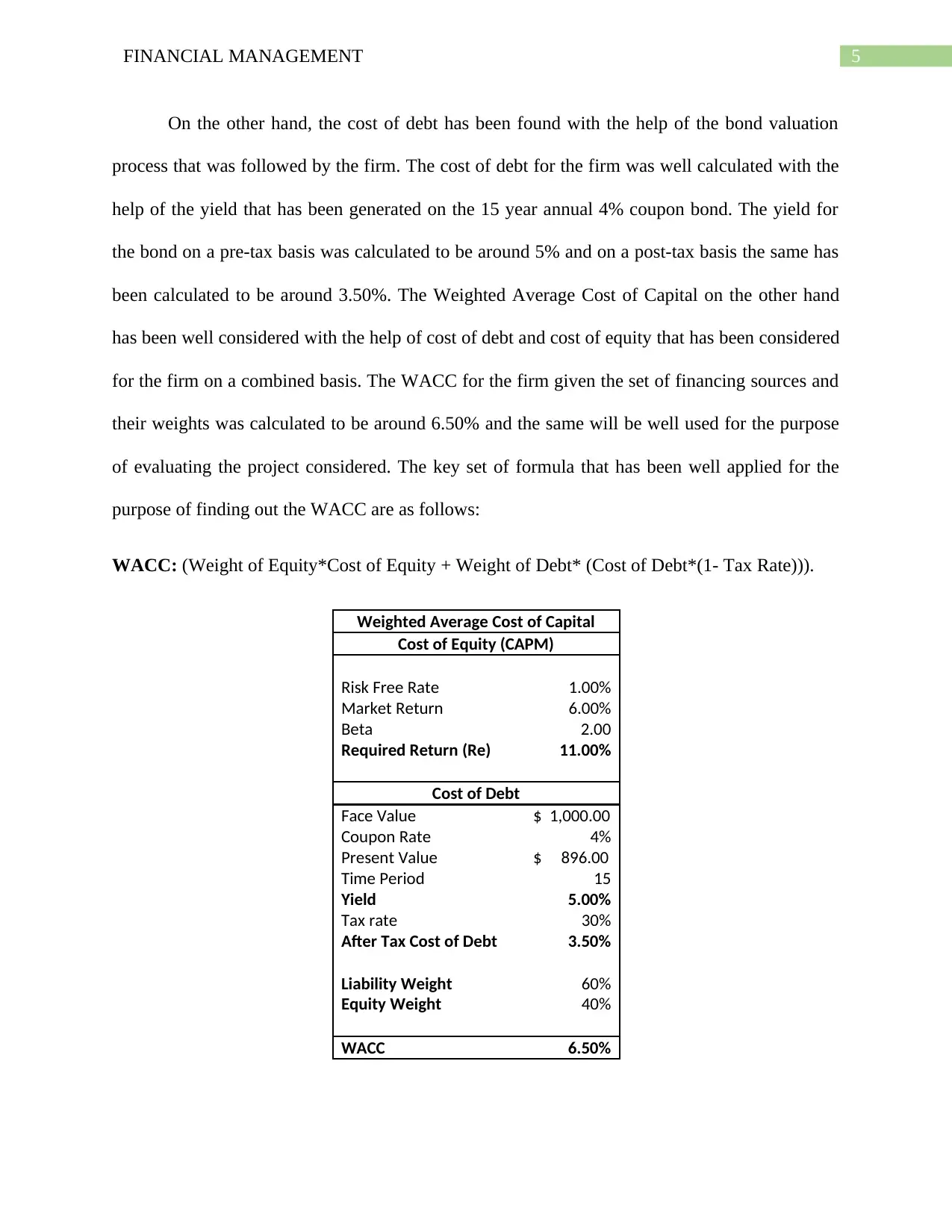
On the other hand, the cost of debt has been found with the help of the bond valuation
process that was followed by the firm. The cost of debt for the firm was well calculated with the
help of the yield that has been generated on the 15 year annual 4% coupon bond. The yield for
the bond on a pre-tax basis was calculated to be around 5% and on a post-tax basis the same has
been calculated to be around 3.50%. The Weighted Average Cost of Capital on the other hand
has been well considered with the help of cost of debt and cost of equity that has been considered
for the firm on a combined basis. The WACC for the firm given the set of financing sources and
their weights was calculated to be around 6.50% and the same will be well used for the purpose
of evaluating the project considered. The key set of formula that has been well applied for the
purpose of finding out the WACC are as follows:
WACC: (Weight of Equity*Cost of Equity + Weight of Debt* (Cost of Debt*(1- Tax Rate))).
Weighted Average Cost of Capital
Cost of Equity (CAPM)
Risk Free Rate 1.00%
Market Return 6.00%
Beta 2.00
Required Return (Re) 11.00%
Cost of Debt
Face Value $ 1,000.00
Coupon Rate 4%
Present Value $ 896.00
Time Period 15
Yield 5.00%
Tax rate 30%
After Tax Cost of Debt 3.50%
Liability Weight 60%
Equity Weight 40%
WACC 6.50%
On the other hand, the cost of debt has been found with the help of the bond valuation
process that was followed by the firm. The cost of debt for the firm was well calculated with the
help of the yield that has been generated on the 15 year annual 4% coupon bond. The yield for
the bond on a pre-tax basis was calculated to be around 5% and on a post-tax basis the same has
been calculated to be around 3.50%. The Weighted Average Cost of Capital on the other hand
has been well considered with the help of cost of debt and cost of equity that has been considered
for the firm on a combined basis. The WACC for the firm given the set of financing sources and
their weights was calculated to be around 6.50% and the same will be well used for the purpose
of evaluating the project considered. The key set of formula that has been well applied for the
purpose of finding out the WACC are as follows:
WACC: (Weight of Equity*Cost of Equity + Weight of Debt* (Cost of Debt*(1- Tax Rate))).
Weighted Average Cost of Capital
Cost of Equity (CAPM)
Risk Free Rate 1.00%
Market Return 6.00%
Beta 2.00
Required Return (Re) 11.00%
Cost of Debt
Face Value $ 1,000.00
Coupon Rate 4%
Present Value $ 896.00
Time Period 15
Yield 5.00%
Tax rate 30%
After Tax Cost of Debt 3.50%
Liability Weight 60%
Equity Weight 40%
WACC 6.50%
⊘ This is a preview!⊘
Do you want full access?
Subscribe today to unlock all pages.
Trusted by 1+ million students worldwide
6FINANCIAL MANAGEMENT
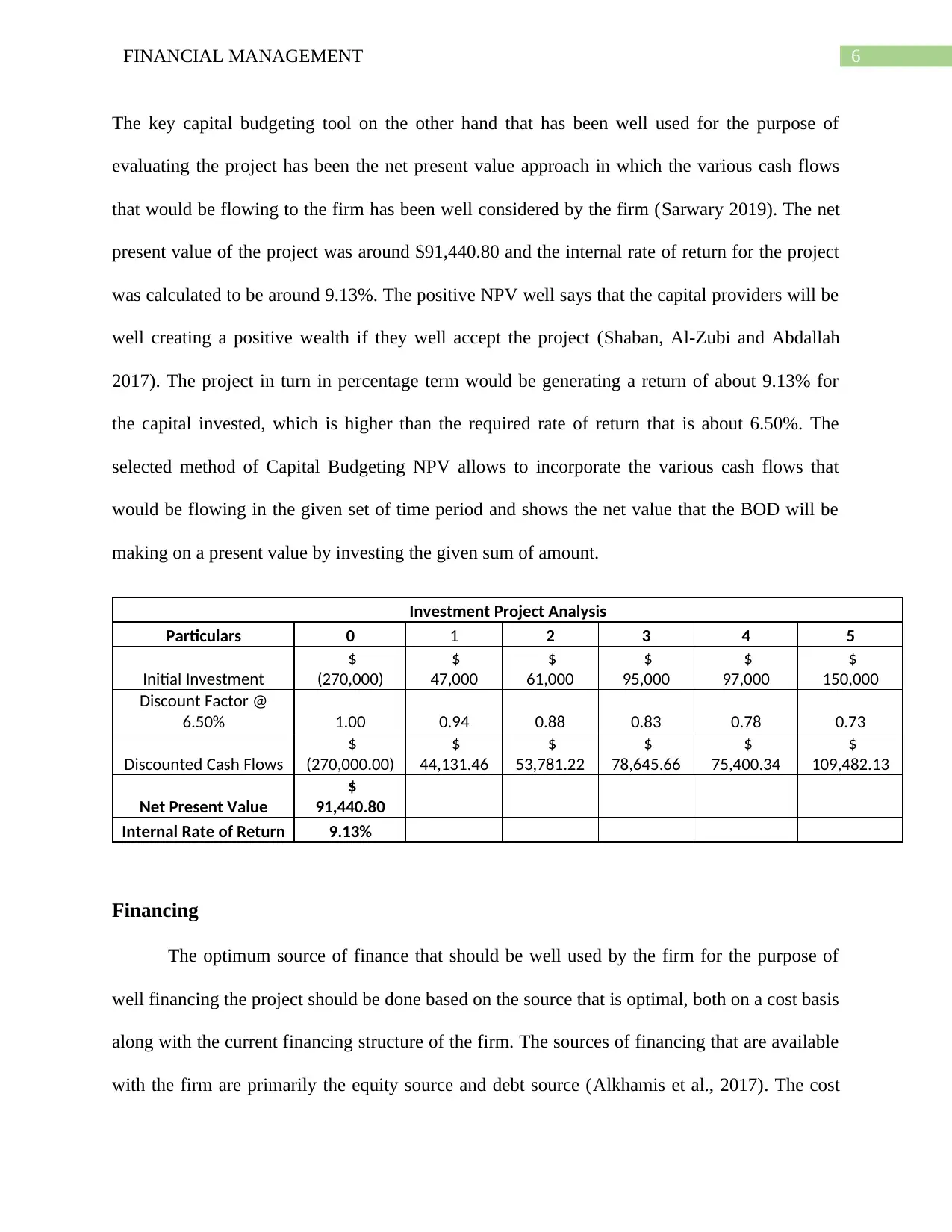
The key capital budgeting tool on the other hand that has been well used for the purpose of
evaluating the project has been the net present value approach in which the various cash flows
that would be flowing to the firm has been well considered by the firm (Sarwary 2019). The net
present value of the project was around $91,440.80 and the internal rate of return for the project
was calculated to be around 9.13%. The positive NPV well says that the capital providers will be
well creating a positive wealth if they well accept the project (Shaban, Al-Zubi and Abdallah
2017). The project in turn in percentage term would be generating a return of about 9.13% for
the capital invested, which is higher than the required rate of return that is about 6.50%. The
selected method of Capital Budgeting NPV allows to incorporate the various cash flows that
would be flowing in the given set of time period and shows the net value that the BOD will be
making on a present value by investing the given sum of amount.
Investment Project Analysis
Particulars 0 1 2 3 4 5
Initial Investment
$
(270,000)
$
47,000
$
61,000
$
95,000
$
97,000
$
150,000
Discount Factor @
6.50% 1.00 0.94 0.88 0.83 0.78 0.73
Discounted Cash Flows
$
(270,000.00)
$
44,131.46
$
53,781.22
$
78,645.66
$
75,400.34
$
109,482.13
Net Present Value
$
91,440.80
Internal Rate of Return 9.13%
Financing
The optimum source of finance that should be well used by the firm for the purpose of
well financing the project should be done based on the source that is optimal, both on a cost basis
along with the current financing structure of the firm. The sources of financing that are available
with the firm are primarily the equity source and debt source (Alkhamis et al., 2017). The cost
The key capital budgeting tool on the other hand that has been well used for the purpose of
evaluating the project has been the net present value approach in which the various cash flows
that would be flowing to the firm has been well considered by the firm (Sarwary 2019). The net
present value of the project was around $91,440.80 and the internal rate of return for the project
was calculated to be around 9.13%. The positive NPV well says that the capital providers will be
well creating a positive wealth if they well accept the project (Shaban, Al-Zubi and Abdallah
2017). The project in turn in percentage term would be generating a return of about 9.13% for
the capital invested, which is higher than the required rate of return that is about 6.50%. The
selected method of Capital Budgeting NPV allows to incorporate the various cash flows that
would be flowing in the given set of time period and shows the net value that the BOD will be
making on a present value by investing the given sum of amount.
Investment Project Analysis
Particulars 0 1 2 3 4 5
Initial Investment
$
(270,000)
$
47,000
$
61,000
$
95,000
$
97,000
$
150,000
Discount Factor @
6.50% 1.00 0.94 0.88 0.83 0.78 0.73
Discounted Cash Flows
$
(270,000.00)
$
44,131.46
$
53,781.22
$
78,645.66
$
75,400.34
$
109,482.13
Net Present Value
$
91,440.80
Internal Rate of Return 9.13%
Financing
The optimum source of finance that should be well used by the firm for the purpose of
well financing the project should be done based on the source that is optimal, both on a cost basis
along with the current financing structure of the firm. The sources of financing that are available
with the firm are primarily the equity source and debt source (Alkhamis et al., 2017). The cost
Paraphrase This Document
Need a fresh take? Get an instant paraphrase of this document with our AI Paraphraser
7FINANCIAL MANAGEMENT
associated with the equity sources was found out to be around 11.00% and on the other hand the
cost of debt for the firm on a post-tax basis has been around 3.50% for the firm given the set of
examples and assumptions that has been placed down for the firm. However, it is important to
note that it was observed from the financials of the Hillside Firm that the liabilities of the firm
currently comprise about 60% of the balance sheet stating that the equity fund for the firm stands
at 40%. The proportion of equity finance on a considerable basis for the firm has been very low
and that can be because of the high cost that is associated with the firm. On the other hand, the
cost of debt for the firm has been comparatively lower for the firm and along with that the firm is
also getting a tax shield for the interest payments that it would be doing which on a further note
would be reducing the effective cost of debt. Debt financing increases the financial risk of the
firm and in the case of Hillside Firm the debt funds is greater than, which could have well
reduced the total cost of borrowings but in turn would have increased the financial risk of the
firm. It was also observed that with the proposed investment project, the liquidity stricture or the
amount of working capital available would be reducing and further addition of debt in the total
financing structure would be degrading the financial situation of the firm. On the other hand, the
equity finance are on a comparative basis a safer source of finance whereby the firm would not
be liable to pay any fixed amount of return or could potentially increase the financial risk of the
business. Even, if the expected future free cash flows for the investment project does not
materializes well for the firm, even then the firm would not be facing any problem with the
same.
associated with the equity sources was found out to be around 11.00% and on the other hand the
cost of debt for the firm on a post-tax basis has been around 3.50% for the firm given the set of
examples and assumptions that has been placed down for the firm. However, it is important to
note that it was observed from the financials of the Hillside Firm that the liabilities of the firm
currently comprise about 60% of the balance sheet stating that the equity fund for the firm stands
at 40%. The proportion of equity finance on a considerable basis for the firm has been very low
and that can be because of the high cost that is associated with the firm. On the other hand, the
cost of debt for the firm has been comparatively lower for the firm and along with that the firm is
also getting a tax shield for the interest payments that it would be doing which on a further note
would be reducing the effective cost of debt. Debt financing increases the financial risk of the
firm and in the case of Hillside Firm the debt funds is greater than, which could have well
reduced the total cost of borrowings but in turn would have increased the financial risk of the
firm. It was also observed that with the proposed investment project, the liquidity stricture or the
amount of working capital available would be reducing and further addition of debt in the total
financing structure would be degrading the financial situation of the firm. On the other hand, the
equity finance are on a comparative basis a safer source of finance whereby the firm would not
be liable to pay any fixed amount of return or could potentially increase the financial risk of the
business. Even, if the expected future free cash flows for the investment project does not
materializes well for the firm, even then the firm would not be facing any problem with the
same.
8FINANCIAL MANAGEMENT
Recommendations
The recommended plan for investment and increasing the capacity of the plant should be
well accepted by the management of the firm as the same would be positively increasing the
wealth and value of the firm for the defined period of five years. The increase in the sales
revenue and profitability basis would also be helping the firm in covering the amount of
marketing expenses which it would be incurring on a yearly basis. The cash and breakeven point
was also found out to be minimal given the additional set of increase that it would be seeing in
the increase in the products sold. Finally it was also recommended that the management of the
firm should well go ahead with equity fiancé for the purpose of funding the project so that the
financial risk for the firm stays at an optimal set of rate.
Recommendations
The recommended plan for investment and increasing the capacity of the plant should be
well accepted by the management of the firm as the same would be positively increasing the
wealth and value of the firm for the defined period of five years. The increase in the sales
revenue and profitability basis would also be helping the firm in covering the amount of
marketing expenses which it would be incurring on a yearly basis. The cash and breakeven point
was also found out to be minimal given the additional set of increase that it would be seeing in
the increase in the products sold. Finally it was also recommended that the management of the
firm should well go ahead with equity fiancé for the purpose of funding the project so that the
financial risk for the firm stays at an optimal set of rate.
⊘ This is a preview!⊘
Do you want full access?
Subscribe today to unlock all pages.
Trusted by 1+ million students worldwide
9FINANCIAL MANAGEMENT
References
Alkhamis, N., Noreen, U., Ghonaim, L., Alghonaim, S., Ibrahim, S. and Alturki, R.A.A., 2017.
Capital Budgeting and Capital Structure Decisions in Saudi Arabia. Advanced Science
Letters, 23(1), pp.330-332.
Al-Mutairi, A., Naser, K. and Saeid, M., 2018. Capital budgeting practices by non-financial
companies listed on Kuwait Stock Exchange (KSE). Cogent Economics & Finance, 6(1),
p.1468232.
Hall, J.H. and Sibanda, T., 2016. Capital Budgeting Practices: An Empirical Study of Listed
Small en Medium Enterprises. Corporate Ownership & Control, p.200.
Levin, V. and Hallgren, A., 2017. The choice of capital budgeting techniques: a human capital
approach.
Sarwary, Z., 2019. Capital Budgeting Techniques in SMEs: A Literature Review. Journal of
Accounting and Finance, 19(3).
Shaban, O.S., Al-Zubi, Z. and Abdallah, A.A., 2017. The Extent of Using Capital Budgeting
Techniques in Evaluating Manager¡¯ s Investments Projects Decisions (A Case Study on
Jordanian Industrial Companies). International Journal of Economics and Finance, 9(12),
pp.175-179.
Siziba, S. and Hall, J.H., 2019. The evolution of the application of capital budgeting techniques
in enterprises. Global Finance Journal, p.100504.
References
Alkhamis, N., Noreen, U., Ghonaim, L., Alghonaim, S., Ibrahim, S. and Alturki, R.A.A., 2017.
Capital Budgeting and Capital Structure Decisions in Saudi Arabia. Advanced Science
Letters, 23(1), pp.330-332.
Al-Mutairi, A., Naser, K. and Saeid, M., 2018. Capital budgeting practices by non-financial
companies listed on Kuwait Stock Exchange (KSE). Cogent Economics & Finance, 6(1),
p.1468232.
Hall, J.H. and Sibanda, T., 2016. Capital Budgeting Practices: An Empirical Study of Listed
Small en Medium Enterprises. Corporate Ownership & Control, p.200.
Levin, V. and Hallgren, A., 2017. The choice of capital budgeting techniques: a human capital
approach.
Sarwary, Z., 2019. Capital Budgeting Techniques in SMEs: A Literature Review. Journal of
Accounting and Finance, 19(3).
Shaban, O.S., Al-Zubi, Z. and Abdallah, A.A., 2017. The Extent of Using Capital Budgeting
Techniques in Evaluating Manager¡¯ s Investments Projects Decisions (A Case Study on
Jordanian Industrial Companies). International Journal of Economics and Finance, 9(12),
pp.175-179.
Siziba, S. and Hall, J.H., 2019. The evolution of the application of capital budgeting techniques
in enterprises. Global Finance Journal, p.100504.
Paraphrase This Document
Need a fresh take? Get an instant paraphrase of this document with our AI Paraphraser

10FINANCIAL MANAGEMENT
Su, S.H., Lee, H.L., Chou, J.J., Yeh, J.Y. and Thi, M.H.V., 2018. Application and effects of
capital budgeting among the manufacturing companies in Vietnam. International Journal of
Organizational Innovation (Online), 10(4), pp.111-120.
Winfree, J.A., Rosentraub, M.S., Mills, B.M. and Zondlak, M.P., 2018. Capital Budgeting and
Team Investments. In Sports Finance and Management (pp. 343-374). Taylor & Francis.
Su, S.H., Lee, H.L., Chou, J.J., Yeh, J.Y. and Thi, M.H.V., 2018. Application and effects of
capital budgeting among the manufacturing companies in Vietnam. International Journal of
Organizational Innovation (Online), 10(4), pp.111-120.
Winfree, J.A., Rosentraub, M.S., Mills, B.M. and Zondlak, M.P., 2018. Capital Budgeting and
Team Investments. In Sports Finance and Management (pp. 343-374). Taylor & Francis.

1 out of 11


Related Documents


Your All-in-One AI-Powered Toolkit for Academic Success.
+13062052269
info@desklib.com
Available 24*7 on WhatsApp / Email
![[object Object]](/_next/static/media/star-bottom.7253800d.svg)
Unlock your academic potential
Copyright © 2020–2026 A2Z Services. All Rights Reserved. Developed and managed by ZUCOL.