Financial Management Report: Hillside Industries Case Study Analysis
VerifiedAdded on 2022/08/17
|12
|2733
|14
Report
AI Summary
This report provides a comprehensive financial analysis of Hillside Industries, focusing on its potential expansion plan. It delves into key financial management concepts, including working capital requirements, break-even point analysis, and the calculation of Net Present Value (NPV) to assess project feasibility. The report examines various sources of funds, with a particular emphasis on the advantages of debt financing for the company. It concludes with a recommended plan, suggesting the acceptance of the expansion proposal based on a positive NPV and the strategic use of debt to optimize the company's financial position. The analysis considers the importance of managing working capital effectively to ensure smooth business operations and maintain financial stability, highlighting the need for careful consideration of factors such as cash conversion cycles and credit terms. The report provides an overview of the financial concepts, calculations, and strategic recommendations relevant to the case study.

Running head: FINANCIAL MANAGEMENT 1
FINANCIAL MANAGEMENT
FINANCIAL MANAGEMENT

Paraphrase This Document
Need a fresh take? Get an instant paraphrase of this document with our AI Paraphraser
FINANCIAL MANAGEMENT
Executive summary
The term financing is a broad concept and every company has different agendas when it comes
to understanding the concepts of finance. In this report a detailed analysis has been carried out
for Hill Side Industries, to understand the relevance of the concepts like capital budgeting and its
importance, the management of the working capital and usage of the cost of the funds. The
acceptance of the proposal and the use of the debt finance have been understood in detail in this
report.
Executive summary
The term financing is a broad concept and every company has different agendas when it comes
to understanding the concepts of finance. In this report a detailed analysis has been carried out
for Hill Side Industries, to understand the relevance of the concepts like capital budgeting and its
importance, the management of the working capital and usage of the cost of the funds. The
acceptance of the proposal and the use of the debt finance have been understood in detail in this
report.
FINANCIAL MANAGEMENT
Table of Contents
Introduction.................................................................................................................................................4
Working capital requirements......................................................................................................................4
Breakeven Point..........................................................................................................................................6
Net Present value.........................................................................................................................................7
Sources of funds..........................................................................................................................................8
Recommended plan.....................................................................................................................................9
References.................................................................................................................................................11
Table of Contents
Introduction.................................................................................................................................................4
Working capital requirements......................................................................................................................4
Breakeven Point..........................................................................................................................................6
Net Present value.........................................................................................................................................7
Sources of funds..........................................................................................................................................8
Recommended plan.....................................................................................................................................9
References.................................................................................................................................................11
⊘ This is a preview!⊘
Do you want full access?
Subscribe today to unlock all pages.

Trusted by 1+ million students worldwide
FINANCIAL MANAGEMENT
Introduction
Financing as a term is inclusive of lots of techniques that can be applied by the management to
analyze different aspects of the performance. Capital budgeting is one of the special techniques
that are used to understand the profitability and overall shareholder’s value. In the subject like
finance, these terms play a vital role as majority of the decisions are taken using this particular
methodology.
Working capital requirements
The working capital requirements are one of the core factors in running the operations of the
business. It is calculated by calculating the difference between the current assets and the current
liabilities. In this section a detailed analysis of the working capital management has been
undertaken to analyze the position of working capital with respect to Hillside Industries. The
working capital requirement model can be understood best with the help of the image below
(Lyngstadaas and Berg, 2016.) Working capital is also required for purchase of raw materials to
run the normal business operations, and for meeting the day-to-day expenses and operations such
as salaries, wages, cost to maintain fixed assets, advertising and rents.
Introduction
Financing as a term is inclusive of lots of techniques that can be applied by the management to
analyze different aspects of the performance. Capital budgeting is one of the special techniques
that are used to understand the profitability and overall shareholder’s value. In the subject like
finance, these terms play a vital role as majority of the decisions are taken using this particular
methodology.
Working capital requirements
The working capital requirements are one of the core factors in running the operations of the
business. It is calculated by calculating the difference between the current assets and the current
liabilities. In this section a detailed analysis of the working capital management has been
undertaken to analyze the position of working capital with respect to Hillside Industries. The
working capital requirement model can be understood best with the help of the image below
(Lyngstadaas and Berg, 2016.) Working capital is also required for purchase of raw materials to
run the normal business operations, and for meeting the day-to-day expenses and operations such
as salaries, wages, cost to maintain fixed assets, advertising and rents.
Paraphrase This Document
Need a fresh take? Get an instant paraphrase of this document with our AI Paraphraser
FINANCIAL MANAGEMENT
(Source: BBA Mantra, (2019)
The working capital is required majorly to strengthen the solvency of the business without
creating any hassle in the financial aspect of the company. The goodwill off the business is also
one of element which is extended when the working capital management is strong as all the
expenses are paid off efficiently and effectively. To have a sound goodwill and debt capacity
working capital helps the management in arrangement of the cash easily.
When there is a balance between the assets and the liabilities, it becomes easy for the company to
acquire loan and other financial obligations to expand the business. It acts as a life blood which
also helps to maintain the alignment between the demand and the supply. In order to run the
business smoothly, it is necessary to have right amount of the working capital requirements and
at the right place.
Cash conversion cycle is the cycle that is an attempt that is used to measure the time taken by
the company to convert the investment in the inventory and the receivables into cash to pay back
the creditors. The cash conversion cycle always differs by the nature and the types of the
business operations. If the cash conversion cycle is high it means the time is taken more by the
company to recover the cash. Cash conversion cycle is a process of three stage process such as
inventory turnover ratio, receivables turnover ratio and accounts payables ratio where, if cash is
available it can be easily used to generate more sales out of profits. These three elements and if
anyone tosses or there is any kind of the mismanagement, ultimately the business will suffer
(Detzer, et al 2017).
In the present scenario if the average collection period is increased from 15 to 30 days, the direct
effect will be on cash conversion cycle of the company. The rotation of the cash is necessary for
(Source: BBA Mantra, (2019)
The working capital is required majorly to strengthen the solvency of the business without
creating any hassle in the financial aspect of the company. The goodwill off the business is also
one of element which is extended when the working capital management is strong as all the
expenses are paid off efficiently and effectively. To have a sound goodwill and debt capacity
working capital helps the management in arrangement of the cash easily.
When there is a balance between the assets and the liabilities, it becomes easy for the company to
acquire loan and other financial obligations to expand the business. It acts as a life blood which
also helps to maintain the alignment between the demand and the supply. In order to run the
business smoothly, it is necessary to have right amount of the working capital requirements and
at the right place.
Cash conversion cycle is the cycle that is an attempt that is used to measure the time taken by
the company to convert the investment in the inventory and the receivables into cash to pay back
the creditors. The cash conversion cycle always differs by the nature and the types of the
business operations. If the cash conversion cycle is high it means the time is taken more by the
company to recover the cash. Cash conversion cycle is a process of three stage process such as
inventory turnover ratio, receivables turnover ratio and accounts payables ratio where, if cash is
available it can be easily used to generate more sales out of profits. These three elements and if
anyone tosses or there is any kind of the mismanagement, ultimately the business will suffer
(Detzer, et al 2017).
In the present scenario if the average collection period is increased from 15 to 30 days, the direct
effect will be on cash conversion cycle of the company. The rotation of the cash is necessary for
FINANCIAL MANAGEMENT
running the operations smoothly. Hence, the credit terms shall be shortened rather than
extending. The gain is majorly for the customers as they can get extra time to pay back to the
Hill Side. Similarly if the payment period has been extended to 30 days, the company has an
opportunity to get more time to pay to pay back to suppliers but this will reduce the credibility of
the company. Delay in payments is not a good sign and the suppliers may have a wrong
impression about the company, which can affect the cordial relations. Therefore, it can be
concluded that delay can result in a loss to the company from both the sides (Batra and Verma,
2017).
Breakeven Point
Break-even point is a stage at which the revenue is equal to expenses. At this stage there is no
profit and no loss. Originally the break-even point is a concept that was tied with the term of
point of indifference. It is a quantitative tool for the managers as they can take the strategic
business decisions (Kampf, Majerčák and Švagr, 2016).
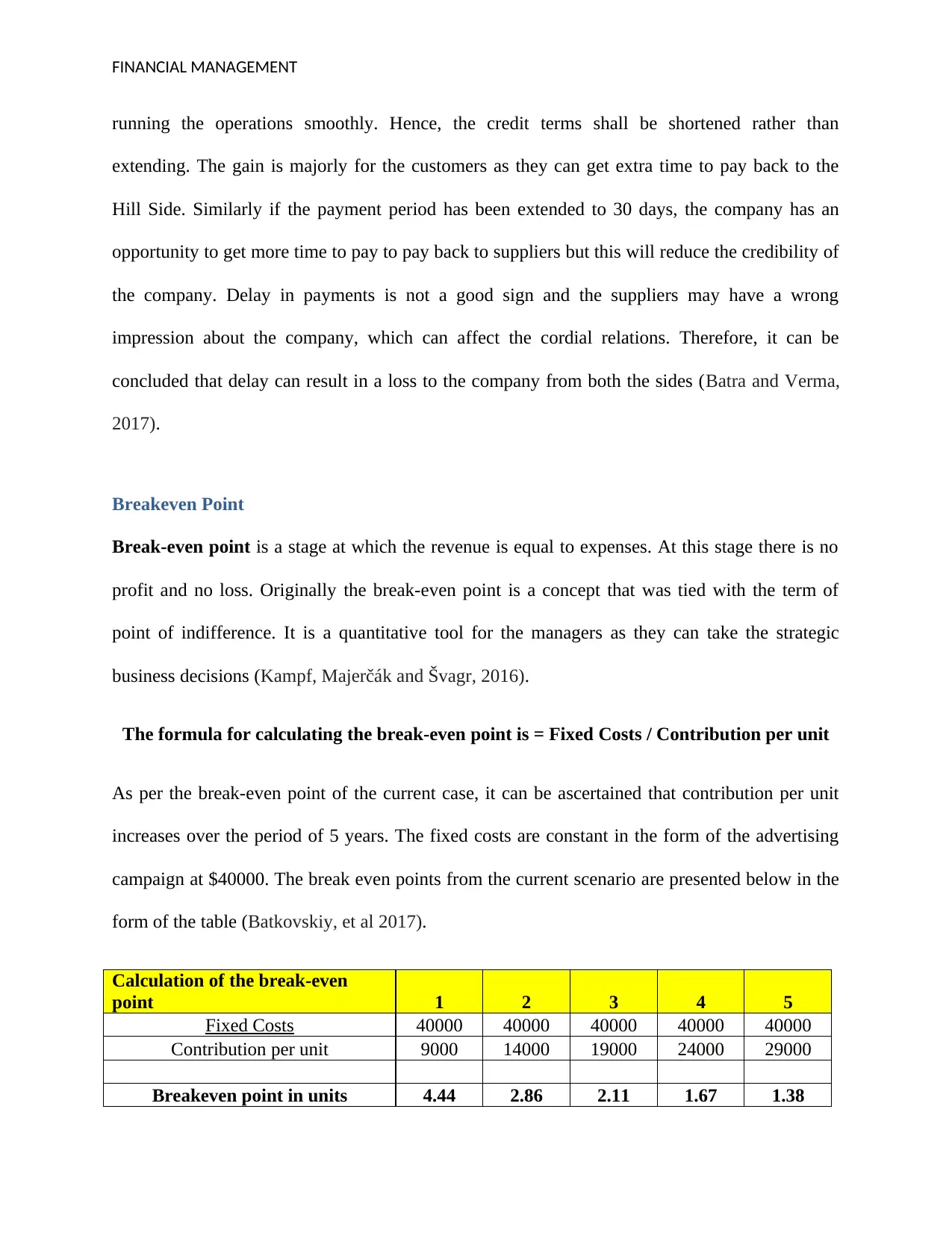
The formula for calculating the break-even point is = Fixed Costs / Contribution per unit
As per the break-even point of the current case, it can be ascertained that contribution per unit
increases over the period of 5 years. The fixed costs are constant in the form of the advertising
campaign at $40000. The break even points from the current scenario are presented below in the
form of the table (Batkovskiy, et al 2017).
Calculation of the break-even
point 1 2 3 4 5
Fixed Costs 40000 40000 40000 40000 40000
Contribution per unit 9000 14000 19000 24000 29000
Breakeven point in units 4.44 2.86 2.11 1.67 1.38
running the operations smoothly. Hence, the credit terms shall be shortened rather than
extending. The gain is majorly for the customers as they can get extra time to pay back to the
Hill Side. Similarly if the payment period has been extended to 30 days, the company has an
opportunity to get more time to pay to pay back to suppliers but this will reduce the credibility of
the company. Delay in payments is not a good sign and the suppliers may have a wrong
impression about the company, which can affect the cordial relations. Therefore, it can be
concluded that delay can result in a loss to the company from both the sides (Batra and Verma,
2017).
Breakeven Point
Break-even point is a stage at which the revenue is equal to expenses. At this stage there is no
profit and no loss. Originally the break-even point is a concept that was tied with the term of
point of indifference. It is a quantitative tool for the managers as they can take the strategic
business decisions (Kampf, Majerčák and Švagr, 2016).
The formula for calculating the break-even point is = Fixed Costs / Contribution per unit
As per the break-even point of the current case, it can be ascertained that contribution per unit
increases over the period of 5 years. The fixed costs are constant in the form of the advertising
campaign at $40000. The break even points from the current scenario are presented below in the
form of the table (Batkovskiy, et al 2017).
Calculation of the break-even
point 1 2 3 4 5
Fixed Costs 40000 40000 40000 40000 40000
Contribution per unit 9000 14000 19000 24000 29000
Breakeven point in units 4.44 2.86 2.11 1.67 1.38
⊘ This is a preview!⊘
Do you want full access?
Subscribe today to unlock all pages.
Trusted by 1+ million students worldwide
FINANCIAL MANAGEMENT
Initially the company has to keep the break even units at 4.44 and thereafter it decreases
gradually as the business sets up. This also indicates that initially the contribution will be lower
due to lower sales units and thereafter it will increase gradually. The break-even point is also
helpful in making the bifurcation of the debt as well as equity. One of the key components of
business plan is break-even analysis and it is usually a requirement if the other debt and investors
of the business are required to be taken into consideration.
Net Present value
NPV is the value that is termed as the variance between the cash inflows and cash outflows. The
net present value is one of the important capital budgeting techniques that are used to determine
the current values of the cash flows. This technique is used to find out the feasibility of the
project (Juhász, 2011). This method is the most common method that is used and it has been
associated with lots of advantages such as that it considers the present value more worthy instead
of the future value. This method also reflects whether the investment is feasible or not. As per
the current case study the current NPV of the project is $104514.10. This implies that the NPV is
positive and the expansion shall take place. The positive NPV means the positive returns from
the project in the near future. Apart from net present value there are other several techniques that
are used by the management to get a clear understanding. The different methodologies are IRR,
ARR and the profitability index (Malenko, 2019).
Internal rate of return is the return which is expected by the investing some of the funds in the
project. The IRR must be higher than the cost of the capital such as in the present scenario, IRR
is 16%. The several benefits of using IRR are that since it considers the concept of time value of
Initially the company has to keep the break even units at 4.44 and thereafter it decreases
gradually as the business sets up. This also indicates that initially the contribution will be lower
due to lower sales units and thereafter it will increase gradually. The break-even point is also
helpful in making the bifurcation of the debt as well as equity. One of the key components of
business plan is break-even analysis and it is usually a requirement if the other debt and investors
of the business are required to be taken into consideration.
Net Present value
NPV is the value that is termed as the variance between the cash inflows and cash outflows. The
net present value is one of the important capital budgeting techniques that are used to determine
the current values of the cash flows. This technique is used to find out the feasibility of the
project (Juhász, 2011). This method is the most common method that is used and it has been
associated with lots of advantages such as that it considers the present value more worthy instead
of the future value. This method also reflects whether the investment is feasible or not. As per
the current case study the current NPV of the project is $104514.10. This implies that the NPV is
positive and the expansion shall take place. The positive NPV means the positive returns from
the project in the near future. Apart from net present value there are other several techniques that
are used by the management to get a clear understanding. The different methodologies are IRR,
ARR and the profitability index (Malenko, 2019).
Internal rate of return is the return which is expected by the investing some of the funds in the
project. The IRR must be higher than the cost of the capital such as in the present scenario, IRR
is 16%. The several benefits of using IRR are that since it considers the concept of time value of
Paraphrase This Document
Need a fresh take? Get an instant paraphrase of this document with our AI Paraphraser
FINANCIAL MANAGEMENT
money. The internal rate of return is one of the simplest methods that are used and it is easy to
calculate as well. While calculating IRR there is no requirement of the hurdle rate or any other
accounting rate of return (Bornholt, 2017).
Another method that can be applied while making the capital budgeting decisions is payback
period. The payback period is one of the methods used to define the number of years that are
required to recover the cost of the investment incurred initially. For example in the present case
study, the initial cost is $270000 and it will take 3.68 years (Gallo, 2016). Though time period is
less than the project term of 5 years, yet too much time taken will result in reduced feasibility of
the project as well. While this method is also associated with some benefits such as it is
considered as the reliable technique as it is easy to understand and implement. It helps in taking
the decisions as early payback can also help in enhancing the liquidity (Levin and Hallgren,
2017).
Sources of funds
There is a need of funds in the business to run the operations of the business are termed as
sources of funds. These funds are generally bifurcated into few categories such as basis of time
period, ownership and control. Further the sources are also termed as long term, short term and
medium term in nature (Zativita and Chumaidiyah, 2019).
When the financial requirements are needed for the business for a period of more than 5 years, it
includes various sources and the examples of such sources are debentures, long term borrowings
and long term financial institutions.
money. The internal rate of return is one of the simplest methods that are used and it is easy to
calculate as well. While calculating IRR there is no requirement of the hurdle rate or any other
accounting rate of return (Bornholt, 2017).
Another method that can be applied while making the capital budgeting decisions is payback
period. The payback period is one of the methods used to define the number of years that are
required to recover the cost of the investment incurred initially. For example in the present case
study, the initial cost is $270000 and it will take 3.68 years (Gallo, 2016). Though time period is
less than the project term of 5 years, yet too much time taken will result in reduced feasibility of
the project as well. While this method is also associated with some benefits such as it is
considered as the reliable technique as it is easy to understand and implement. It helps in taking
the decisions as early payback can also help in enhancing the liquidity (Levin and Hallgren,
2017).
Sources of funds
There is a need of funds in the business to run the operations of the business are termed as
sources of funds. These funds are generally bifurcated into few categories such as basis of time
period, ownership and control. Further the sources are also termed as long term, short term and
medium term in nature (Zativita and Chumaidiyah, 2019).
When the financial requirements are needed for the business for a period of more than 5 years, it
includes various sources and the examples of such sources are debentures, long term borrowings
and long term financial institutions.
FINANCIAL MANAGEMENT
The medium term sources rely from more than one year but less 5 years. The different sources
of the funds in the category of medium term sources are commercial banks, public deposits and
lease financing (Campbell, 2017).
The short terms sources are which must not exceed one year are called short term sources.
Some of the examples of the short term sources are trade credit, loans from commercial banks
and commercial papers (Singh, Kumar and Colombage, 2017). The short term sources are
helpful to pay back the current obligations instantly. Some of the examples of the short term
sources are accounts payables, customer advances, credit cards, factoring.
From the current analysis the debt can be utilized as an option to raise the funds for the
expansion plan because of the following reasons. The debt financing is suitable as the debt cost
is very low and the cost of the equity has been more than 10% already. If the debt financing is
adopted, the ownership of the business remains in the hands of the debt holders. The nest best
feature of the debt financing is the facility of the tax deduction. The debt financing lets the
exemption of the tax so that it can help in the reduction of the tax. Since the tax deductions are
availed, it also helps down in lowering the interests. The debt financing also helps in planning
the budgets for each month. Hillside must make use of debt financing as already the equity has
the interest expense is only 40 whereas the company can opt for debt to get the benefits stated
above. If the cost of debt is increased it will also increase the efficiency and there shall be a
balance between the debt and equity to keep the overall weighted cost of capital lower. The
lower the WACC, the lower will be the risk and it becomes cheaper for the company to invest in
the other on-going projects if any (Singh, Kumar and Colombage, 2017).
The medium term sources rely from more than one year but less 5 years. The different sources
of the funds in the category of medium term sources are commercial banks, public deposits and
lease financing (Campbell, 2017).
The short terms sources are which must not exceed one year are called short term sources.
Some of the examples of the short term sources are trade credit, loans from commercial banks
and commercial papers (Singh, Kumar and Colombage, 2017). The short term sources are
helpful to pay back the current obligations instantly. Some of the examples of the short term
sources are accounts payables, customer advances, credit cards, factoring.
From the current analysis the debt can be utilized as an option to raise the funds for the
expansion plan because of the following reasons. The debt financing is suitable as the debt cost
is very low and the cost of the equity has been more than 10% already. If the debt financing is
adopted, the ownership of the business remains in the hands of the debt holders. The nest best
feature of the debt financing is the facility of the tax deduction. The debt financing lets the
exemption of the tax so that it can help in the reduction of the tax. Since the tax deductions are
availed, it also helps down in lowering the interests. The debt financing also helps in planning
the budgets for each month. Hillside must make use of debt financing as already the equity has
the interest expense is only 40 whereas the company can opt for debt to get the benefits stated
above. If the cost of debt is increased it will also increase the efficiency and there shall be a
balance between the debt and equity to keep the overall weighted cost of capital lower. The
lower the WACC, the lower will be the risk and it becomes cheaper for the company to invest in
the other on-going projects if any (Singh, Kumar and Colombage, 2017).
⊘ This is a preview!⊘
Do you want full access?
Subscribe today to unlock all pages.
Trusted by 1+ million students worldwide
FINANCIAL MANAGEMENT
Recommended plan
After the deep analysis and understanding it can be concluded that the proposal shall be accepted
by the business as the net present value of the company is positive. A positive indicates that the
projects are going to be potential and helpful for the business. Apart from this the working
capital requirements also play a major role; hence the proper requirements shall be set down by
the management in advance, with respect to the proposal of the expansion. The sources of the
funds will be required to run the business and the debt component can be utilized as one of the
efficient capital material. The working capital is one of the core important elements that can help
in balancing the funds and its potential investment areas. This case simply entails the knowledge
that investment made shall be only when the NPV is positive. It is recommended to the company
to use the correct strategy to implement the expansion plan as this would provide future benefits
to the organization.
Recommended plan
After the deep analysis and understanding it can be concluded that the proposal shall be accepted
by the business as the net present value of the company is positive. A positive indicates that the
projects are going to be potential and helpful for the business. Apart from this the working
capital requirements also play a major role; hence the proper requirements shall be set down by
the management in advance, with respect to the proposal of the expansion. The sources of the
funds will be required to run the business and the debt component can be utilized as one of the
efficient capital material. The working capital is one of the core important elements that can help
in balancing the funds and its potential investment areas. This case simply entails the knowledge
that investment made shall be only when the NPV is positive. It is recommended to the company
to use the correct strategy to implement the expansion plan as this would provide future benefits
to the organization.
Paraphrase This Document
Need a fresh take? Get an instant paraphrase of this document with our AI Paraphraser
FINANCIAL MANAGEMENT
References
Batkovskiy, A.M., Semenova, E.G., Trofimets, E.N., Trofimets, V.Y. and Fomina, A.V., 2017.
Statistical simulation of the break-even point in the margin analysis of the company. Journal of
Applied Economic Sciences, Romania: European Research Centre of Managerial Studies in
Business Administration, 12(2), p.558.
Batra, R. and Verma, S., 2017. Capital budgeting practices in Indian companies. IIMB
Management Review, 29(1), pp.29-44.
BBA Mantra, (2019) Working Capital Requirement [online] Available from
https://bbamantra.com/working-capital-requirement/ [Accessed on 18th February 2020]
Bornholt, G., 2017. What is an investment project's implied rate of return?. Abacus, 53(4),
pp.513-526.
Campbell, B., 2017. Why Such a Focus on External Sources of Funds to Finance
Development?. Mondes en développement, (2), pp.77-92.
Cuervo-Cazurra, A., Nieto, M.J. and Rodríguez, A., 2018. The impact of R&D sources on new
product development: Sources of funds and the diversity versus control of knowledge
debate. Long Range Planning, 51(5), pp.649-665.
Detzer, D., Dodig, N., Evans, T., Hein, E., Herr, H. and Prante, F.J., 2017. Sources of Funds for
Business Investments: Non-financial Corporate Sector and Small and Medium-sized Enterprises
(SMEs). In The German Financial System and the Financial and Economic Crisis (pp. 155-173).
Springer, Cham.
References
Batkovskiy, A.M., Semenova, E.G., Trofimets, E.N., Trofimets, V.Y. and Fomina, A.V., 2017.
Statistical simulation of the break-even point in the margin analysis of the company. Journal of
Applied Economic Sciences, Romania: European Research Centre of Managerial Studies in
Business Administration, 12(2), p.558.
Batra, R. and Verma, S., 2017. Capital budgeting practices in Indian companies. IIMB
Management Review, 29(1), pp.29-44.
BBA Mantra, (2019) Working Capital Requirement [online] Available from
https://bbamantra.com/working-capital-requirement/ [Accessed on 18th February 2020]
Bornholt, G., 2017. What is an investment project's implied rate of return?. Abacus, 53(4),
pp.513-526.
Campbell, B., 2017. Why Such a Focus on External Sources of Funds to Finance
Development?. Mondes en développement, (2), pp.77-92.
Cuervo-Cazurra, A., Nieto, M.J. and Rodríguez, A., 2018. The impact of R&D sources on new
product development: Sources of funds and the diversity versus control of knowledge
debate. Long Range Planning, 51(5), pp.649-665.
Detzer, D., Dodig, N., Evans, T., Hein, E., Herr, H. and Prante, F.J., 2017. Sources of Funds for
Business Investments: Non-financial Corporate Sector and Small and Medium-sized Enterprises
(SMEs). In The German Financial System and the Financial and Economic Crisis (pp. 155-173).
Springer, Cham.
FINANCIAL MANAGEMENT
Gallo, A., 2016. A refresher on internal rate of return. Harvard Business Review Digital
Articles, 2.
Juhász, L., 2011. Net present value versus internal rate of return. Economics & Sociology, 4(1),
pp.46-53.
Kampf, R., Majerčák, P. and Švagr, P., 2016. Application of break-even point analysis. NAŠE
MORE: znanstveno-stručni časopis za more i pomorstvo, 63(3 Special Issue), pp.126-128.
Levin, V. and Hallgren, A., 2017. The choice of capital budgeting techniques: a human capital
approach.
Lyngstadaas, H. and Berg, T., 2016. Working capital management: evidence from
Norway. International Journal of Managerial Finance.
Malenko, A., 2019. Optimal dynamic capital budgeting. The Review of Economic Studies, 86(4),
pp.1747-1778.
Singh, H.P., Kumar, S. and Colombage, S., 2017. Working capital management and firm
profitability: a meta-analysis. Qualitative Research in Financial Markets.
Zativita, F.I. and Chumaidiyah, E., 2019. Feasibility analysis of Rumah Tempe Zanada
establishment in Bandung using net present value, internal rate of return, and payback period.
In IOP Conference Series: Materials Science and Engineering (Vol. 505, No. 1, p. 012007). IOP
Publishing.
Gallo, A., 2016. A refresher on internal rate of return. Harvard Business Review Digital
Articles, 2.
Juhász, L., 2011. Net present value versus internal rate of return. Economics & Sociology, 4(1),
pp.46-53.
Kampf, R., Majerčák, P. and Švagr, P., 2016. Application of break-even point analysis. NAŠE
MORE: znanstveno-stručni časopis za more i pomorstvo, 63(3 Special Issue), pp.126-128.
Levin, V. and Hallgren, A., 2017. The choice of capital budgeting techniques: a human capital
approach.
Lyngstadaas, H. and Berg, T., 2016. Working capital management: evidence from
Norway. International Journal of Managerial Finance.
Malenko, A., 2019. Optimal dynamic capital budgeting. The Review of Economic Studies, 86(4),
pp.1747-1778.
Singh, H.P., Kumar, S. and Colombage, S., 2017. Working capital management and firm
profitability: a meta-analysis. Qualitative Research in Financial Markets.
Zativita, F.I. and Chumaidiyah, E., 2019. Feasibility analysis of Rumah Tempe Zanada
establishment in Bandung using net present value, internal rate of return, and payback period.
In IOP Conference Series: Materials Science and Engineering (Vol. 505, No. 1, p. 012007). IOP
Publishing.
⊘ This is a preview!⊘
Do you want full access?
Subscribe today to unlock all pages.
Trusted by 1+ million students worldwide

1 out of 12


Related Documents


Your All-in-One AI-Powered Toolkit for Academic Success.
+13062052269
info@desklib.com
Available 24*7 on WhatsApp / Email
![[object Object]](/_next/static/media/star-bottom.7253800d.svg)
Unlock your academic potential
Copyright © 2020–2026 A2Z Services. All Rights Reserved. Developed and managed by ZUCOL.