Advanced Project Management Strategies in Hilti Group's IT Project
VerifiedAdded on 2023/06/18
|9
|1385
|304
Report
AI Summary
This report examines Hilti Group's IT platform modernization project, initiated to transition from SAP to Salesforce. It delves into project selection, aligning with strategic goals of market penetration and differentiation through direct sales. The analysis includes a TOWS matrix, revealing strengths, weaknesses, opportunities, and threats, and discusses the organizational structure, advocating for a flat structure to enhance accountability and communication. Furthermore, the report evaluates project governance, comparing waterfall and critical chain project management methodologies, ultimately suggesting waterfall is better suited for projects with well-defined scope and budget. This document is available on Desklib, a platform offering a wide range of study resources for students.
Advanced Project
Management
Management
Paraphrase This Document
Need a fresh take? Get an instant paraphrase of this document with our AI Paraphraser


Contents
INTRODUCTION...........................................................................................................................................3
MAIN BODY.................................................................................................................................................3
(A) Project selection and portfolio management.....................................................................................3
(B) The organizational context.................................................................................................................3
(C) Project Governance............................................................................................................................5
REFERENCES................................................................................................................................................8
INTRODUCTION...........................................................................................................................................3
MAIN BODY.................................................................................................................................................3
(A) Project selection and portfolio management.....................................................................................3
(B) The organizational context.................................................................................................................3
(C) Project Governance............................................................................................................................5
REFERENCES................................................................................................................................................8
⊘ This is a preview!⊘
Do you want full access?
Subscribe today to unlock all pages.

Trusted by 1+ million students worldwide

INTRODUCTION
Following twenty years, the Hilti Group chose to modernize the IT platform used among its
marketing and advertising staff and transfer from SAP to Sales force in 2018. (i.e., a new could-
based CRM system). This transition necessitates the conversion of all data from the older SAP to
the new Service platform, as well as the retraining of all IT, advertising and sales personnel. The
work is still ongoing, and by the time it is finished, over 20.000 workers from 23 countries will
have been participated in and/or impacted either by change.
MAIN BODY
(A) Project selection and portfolio management
Strategic goals: The goal of the company to Marketing strategy in respect of penetration power,
and distinction through the direct selling of our portfolios, are two ways we may create long-term
value.
Strategic directions: We work hard to produce ecstatic clients and a brighter future." This
mission statement is built on the belief that we develop in tandem with both the people in our
lives our clients, staff, and partnerships.
Type of project: Company conduct different types of project and it are estimated to conduct sales
model for company because they are related to construction activities.
Manage project portfolio:
Determine the company's leading principles.
Suggestions and ideas are captured and researched.
Choose the best projects.
Validate the portfolio's viability and get started on tasks.
Maintain and keep track of the investment.
(B) The organizational context
TOWS matrix of Hilti group
Threats Opportunities
Following twenty years, the Hilti Group chose to modernize the IT platform used among its
marketing and advertising staff and transfer from SAP to Sales force in 2018. (i.e., a new could-
based CRM system). This transition necessitates the conversion of all data from the older SAP to
the new Service platform, as well as the retraining of all IT, advertising and sales personnel. The
work is still ongoing, and by the time it is finished, over 20.000 workers from 23 countries will
have been participated in and/or impacted either by change.
MAIN BODY
(A) Project selection and portfolio management
Strategic goals: The goal of the company to Marketing strategy in respect of penetration power,
and distinction through the direct selling of our portfolios, are two ways we may create long-term
value.
Strategic directions: We work hard to produce ecstatic clients and a brighter future." This
mission statement is built on the belief that we develop in tandem with both the people in our
lives our clients, staff, and partnerships.
Type of project: Company conduct different types of project and it are estimated to conduct sales
model for company because they are related to construction activities.
Manage project portfolio:
Determine the company's leading principles.
Suggestions and ideas are captured and researched.
Choose the best projects.
Validate the portfolio's viability and get started on tasks.
Maintain and keep track of the investment.
(B) The organizational context
TOWS matrix of Hilti group
Threats Opportunities
Paraphrase This Document
Need a fresh take? Get an instant paraphrase of this document with our AI Paraphraser

Depreciation of the currency
Domestic & global rivalry is fierce.
Theme park attendance is on the rise.
Internet usage is widespread.
Increasing use of mobile phones
Weakness Strength
Financial and technological capabilities
are in short supply.
Mexican currency depreciation.
Inability to operate in US markets due
to a lack of experience
Market Dominance is Good.
Concept that is unique.
Revenue streams that work
Geographical Reach and a Large
Customer Base
Organizational structure: A flat structure refers to a business system with only a few tiers. In a
flat organisation, supervisors have a broad range of authority over a larger number of staff, and
the command staff is generally short.
Domestic & global rivalry is fierce.
Theme park attendance is on the rise.
Internet usage is widespread.
Increasing use of mobile phones
Weakness Strength
Financial and technological capabilities
are in short supply.
Mexican currency depreciation.
Inability to operate in US markets due
to a lack of experience
Market Dominance is Good.
Concept that is unique.
Revenue streams that work
Geographical Reach and a Large
Customer Base
Organizational structure: A flat structure refers to a business system with only a few tiers. In a
flat organisation, supervisors have a broad range of authority over a larger number of staff, and
the command staff is generally short.

It increases the share of accountability held by people inside the business.
It reduces the number of layers of leadership and promotes staff cooperation and
communication.
Decisions by providing are made simpler when there are fewer tiers of management.
Flat organizational structure
Strength:
Labor is one of the most expensive items in a company's yearly budget. A flat
organisational structure may save corporations hundreds and thousands, if not huge
amounts of money, by removing numerous levels of management positions. While larger
companies may difficulty to adapt this structure due to scale characteristics, SMBs that
successfully implement a flat organisational structure may save a lot of money.
Another benefit of a flat organizational structure is that there are fewer decision-making
hurdles to go through. Fewer individuals must be consulted while making a decision, help
managers to respond quickly to any objections or concerns. It establishes a direct channel
of contact between both the individual while behind desk (the owner or CEO) and front
employees.
Weakness:
Adjustment is frequently tough and fraught with what-if scenarios. As a consequence,
administration may opt against fresh prospects in order to preserve the framework, which
may hinder the important role in the long development.
Workers typically lack a single supervisor to submit to under this organisation culture,
particularly whenever the proprietor or CEO is not present. This might lead to
misunderstandings and power disputes between top management.
(C) Project Governance
A project's organization and guidance are provided by the project management plan.
Regarding project management approaches, therefore, it is neither too thorough nor very
rigorous. Platforms allow organizations achieve their goals while remaining adaptable to
changing circumstances.
It reduces the number of layers of leadership and promotes staff cooperation and
communication.
Decisions by providing are made simpler when there are fewer tiers of management.
Flat organizational structure
Strength:
Labor is one of the most expensive items in a company's yearly budget. A flat
organisational structure may save corporations hundreds and thousands, if not huge
amounts of money, by removing numerous levels of management positions. While larger
companies may difficulty to adapt this structure due to scale characteristics, SMBs that
successfully implement a flat organisational structure may save a lot of money.
Another benefit of a flat organizational structure is that there are fewer decision-making
hurdles to go through. Fewer individuals must be consulted while making a decision, help
managers to respond quickly to any objections or concerns. It establishes a direct channel
of contact between both the individual while behind desk (the owner or CEO) and front
employees.
Weakness:
Adjustment is frequently tough and fraught with what-if scenarios. As a consequence,
administration may opt against fresh prospects in order to preserve the framework, which
may hinder the important role in the long development.
Workers typically lack a single supervisor to submit to under this organisation culture,
particularly whenever the proprietor or CEO is not present. This might lead to
misunderstandings and power disputes between top management.
(C) Project Governance
A project's organization and guidance are provided by the project management plan.
Regarding project management approaches, therefore, it is neither too thorough nor very
rigorous. Platforms allow organizations achieve their goals while remaining adaptable to
changing circumstances.
⊘ This is a preview!⊘
Do you want full access?
Subscribe today to unlock all pages.

Trusted by 1+ million students worldwide

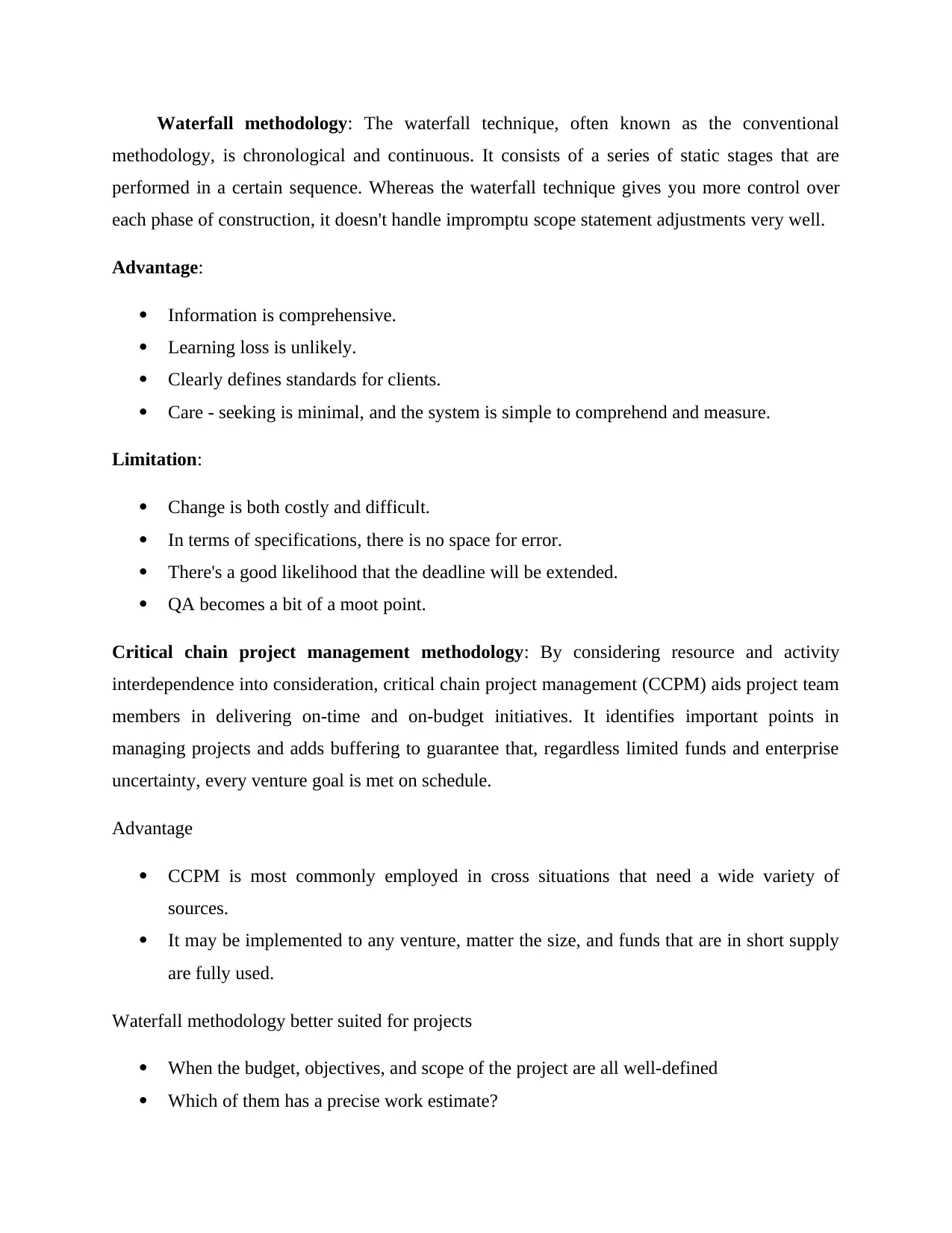
Waterfall methodology: The waterfall technique, often known as the conventional
methodology, is chronological and continuous. It consists of a series of static stages that are
performed in a certain sequence. Whereas the waterfall technique gives you more control over
each phase of construction, it doesn't handle impromptu scope statement adjustments very well.
Advantage:
Information is comprehensive.
Learning loss is unlikely.
Clearly defines standards for clients.
Care - seeking is minimal, and the system is simple to comprehend and measure.
Limitation:
Change is both costly and difficult.
In terms of specifications, there is no space for error.
There's a good likelihood that the deadline will be extended.
QA becomes a bit of a moot point.
Critical chain project management methodology: By considering resource and activity
interdependence into consideration, critical chain project management (CCPM) aids project team
members in delivering on-time and on-budget initiatives. It identifies important points in
managing projects and adds buffering to guarantee that, regardless limited funds and enterprise
uncertainty, every venture goal is met on schedule.
Advantage
CCPM is most commonly employed in cross situations that need a wide variety of
sources.
It may be implemented to any venture, matter the size, and funds that are in short supply
are fully used.
Waterfall methodology better suited for projects
When the budget, objectives, and scope of the project are all well-defined
Which of them has a precise work estimate?
methodology, is chronological and continuous. It consists of a series of static stages that are
performed in a certain sequence. Whereas the waterfall technique gives you more control over
each phase of construction, it doesn't handle impromptu scope statement adjustments very well.
Advantage:
Information is comprehensive.
Learning loss is unlikely.
Clearly defines standards for clients.
Care - seeking is minimal, and the system is simple to comprehend and measure.
Limitation:
Change is both costly and difficult.
In terms of specifications, there is no space for error.
There's a good likelihood that the deadline will be extended.
QA becomes a bit of a moot point.
Critical chain project management methodology: By considering resource and activity
interdependence into consideration, critical chain project management (CCPM) aids project team
members in delivering on-time and on-budget initiatives. It identifies important points in
managing projects and adds buffering to guarantee that, regardless limited funds and enterprise
uncertainty, every venture goal is met on schedule.
Advantage
CCPM is most commonly employed in cross situations that need a wide variety of
sources.
It may be implemented to any venture, matter the size, and funds that are in short supply
are fully used.
Waterfall methodology better suited for projects
When the budget, objectives, and scope of the project are all well-defined
Which of them has a precise work estimate?
Paraphrase This Document
Need a fresh take? Get an instant paraphrase of this document with our AI Paraphraser

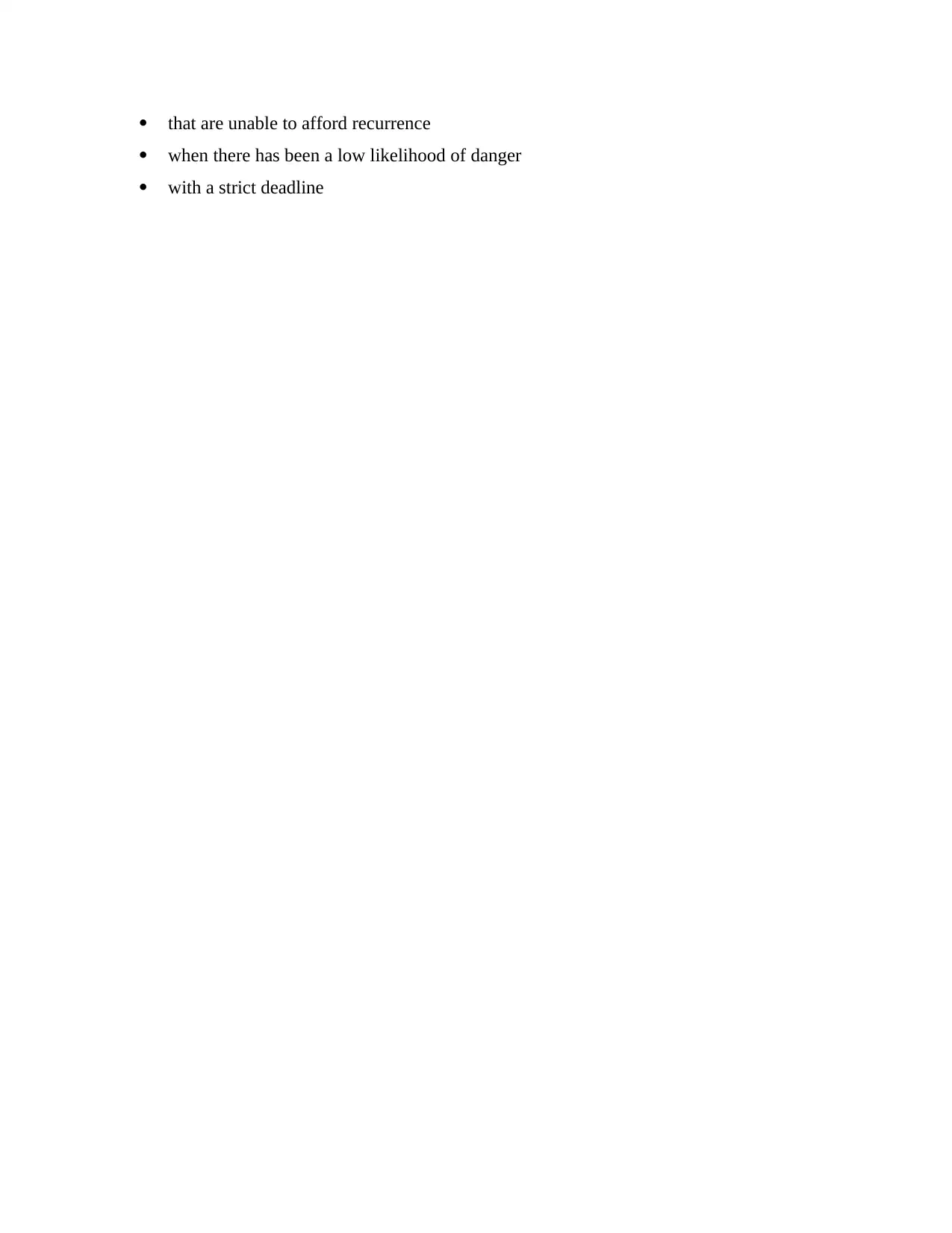
that are unable to afford recurrence
when there has been a low likelihood of danger
with a strict deadline
when there has been a low likelihood of danger
with a strict deadline

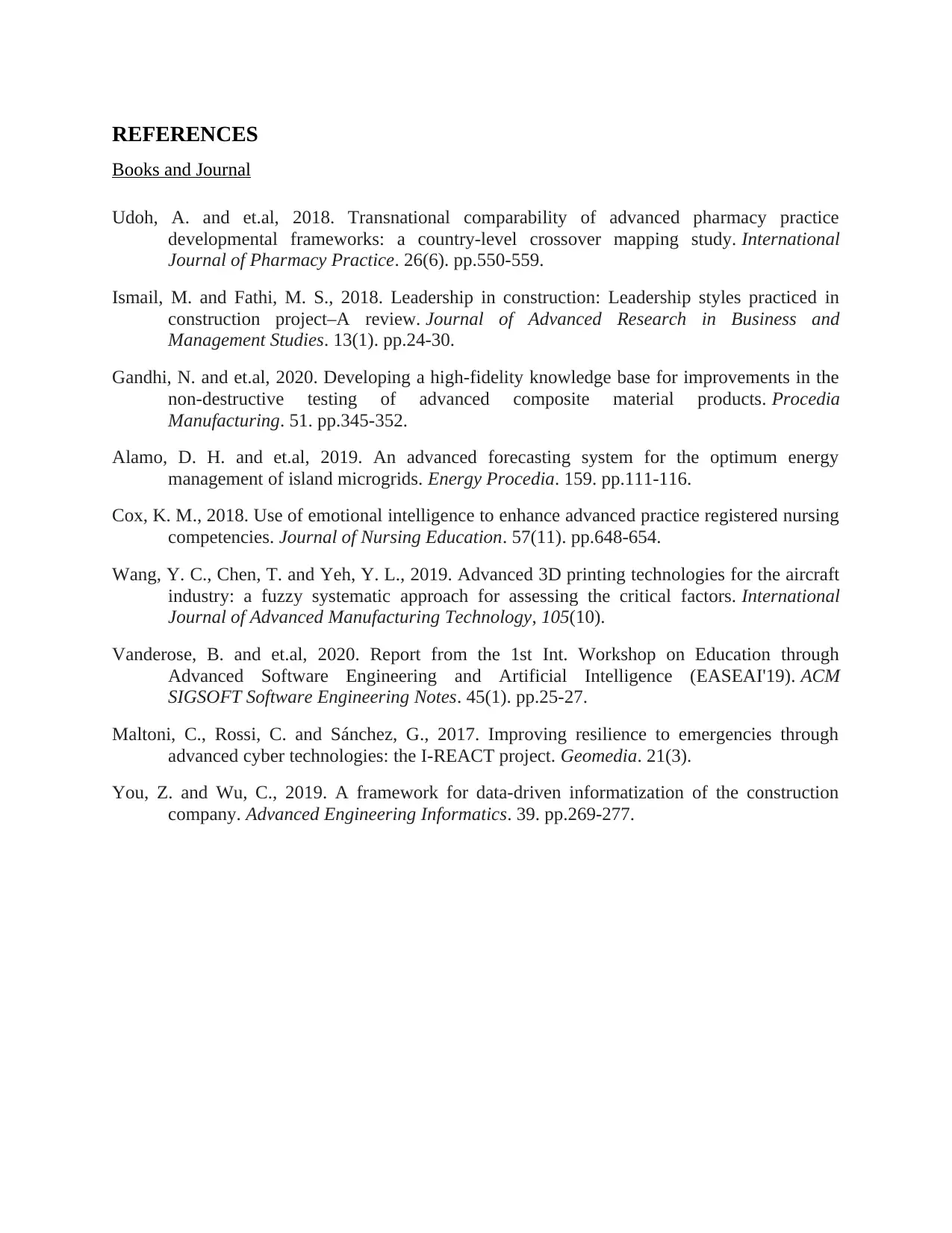
REFERENCES
Books and Journal
Udoh, A. and et.al, 2018. Transnational comparability of advanced pharmacy practice
developmental frameworks: a country-level crossover mapping study. International
Journal of Pharmacy Practice. 26(6). pp.550-559.
Ismail, M. and Fathi, M. S., 2018. Leadership in construction: Leadership styles practiced in
construction project–A review. Journal of Advanced Research in Business and
Management Studies. 13(1). pp.24-30.
Gandhi, N. and et.al, 2020. Developing a high-fidelity knowledge base for improvements in the
non-destructive testing of advanced composite material products. Procedia
Manufacturing. 51. pp.345-352.
Alamo, D. H. and et.al, 2019. An advanced forecasting system for the optimum energy
management of island microgrids. Energy Procedia. 159. pp.111-116.
Cox, K. M., 2018. Use of emotional intelligence to enhance advanced practice registered nursing
competencies. Journal of Nursing Education. 57(11). pp.648-654.
Wang, Y. C., Chen, T. and Yeh, Y. L., 2019. Advanced 3D printing technologies for the aircraft
industry: a fuzzy systematic approach for assessing the critical factors. International
Journal of Advanced Manufacturing Technology, 105(10).
Vanderose, B. and et.al, 2020. Report from the 1st Int. Workshop on Education through
Advanced Software Engineering and Artificial Intelligence (EASEAI'19). ACM
SIGSOFT Software Engineering Notes. 45(1). pp.25-27.
Maltoni, C., Rossi, C. and Sánchez, G., 2017. Improving resilience to emergencies through
advanced cyber technologies: the I-REACT project. Geomedia. 21(3).
You, Z. and Wu, C., 2019. A framework for data-driven informatization of the construction
company. Advanced Engineering Informatics. 39. pp.269-277.
Books and Journal
Udoh, A. and et.al, 2018. Transnational comparability of advanced pharmacy practice
developmental frameworks: a country-level crossover mapping study. International
Journal of Pharmacy Practice. 26(6). pp.550-559.
Ismail, M. and Fathi, M. S., 2018. Leadership in construction: Leadership styles practiced in
construction project–A review. Journal of Advanced Research in Business and
Management Studies. 13(1). pp.24-30.
Gandhi, N. and et.al, 2020. Developing a high-fidelity knowledge base for improvements in the
non-destructive testing of advanced composite material products. Procedia
Manufacturing. 51. pp.345-352.
Alamo, D. H. and et.al, 2019. An advanced forecasting system for the optimum energy
management of island microgrids. Energy Procedia. 159. pp.111-116.
Cox, K. M., 2018. Use of emotional intelligence to enhance advanced practice registered nursing
competencies. Journal of Nursing Education. 57(11). pp.648-654.
Wang, Y. C., Chen, T. and Yeh, Y. L., 2019. Advanced 3D printing technologies for the aircraft
industry: a fuzzy systematic approach for assessing the critical factors. International
Journal of Advanced Manufacturing Technology, 105(10).
Vanderose, B. and et.al, 2020. Report from the 1st Int. Workshop on Education through
Advanced Software Engineering and Artificial Intelligence (EASEAI'19). ACM
SIGSOFT Software Engineering Notes. 45(1). pp.25-27.
Maltoni, C., Rossi, C. and Sánchez, G., 2017. Improving resilience to emergencies through
advanced cyber technologies: the I-REACT project. Geomedia. 21(3).
You, Z. and Wu, C., 2019. A framework for data-driven informatization of the construction
company. Advanced Engineering Informatics. 39. pp.269-277.
⊘ This is a preview!⊘
Do you want full access?
Subscribe today to unlock all pages.

Trusted by 1+ million students worldwide
1 out of 9
Your All-in-One AI-Powered Toolkit for Academic Success.
+13062052269
info@desklib.com
Available 24*7 on WhatsApp / Email
Unlock your academic potential
Copyright © 2020–2025 A2Z Services. All Rights Reserved. Developed and managed by ZUCOL.