Hilton Worldwide: Optimizing Revenue Through Hospitality Operations
VerifiedAdded on 2024/05/14
|17
|4244
|335
Report
AI Summary
This report examines Hilton Worldwide's revenue management strategies within its hospitality operations. It highlights the financial contributions of room revenue, emphasizing the importance of occupancy rate, RevPAR, and ADR. The report analyzes Hilton's pricing principles, including premium pricing and demand pricing, and evaluates their potential benefits to profitability. It also discusses methods to optimize profitability under fixed capacity inventory, considering the dynamic growth in the hospitality sector. The impact of codes of conduct and customer expectations are addressed, followed by recommendations for enhancing Hilton's revenue management practices. The report concludes by summarizing the key findings and suggesting further areas for improvement, emphasizing the need for a balanced approach to pricing, occupancy, and customer satisfaction to ensure sustainable business growth.
Hospitality Operations and Revenue Management
1
1

Paraphrase This Document
Need a fresh take? Get an instant paraphrase of this document with our AI Paraphraser
Executive Summary
This report has analysed the scope and significance of revenue management in regards to
cases scenario of Hilton Worldwide. Hotel owners or managers have to maintain proper
pricing strategy towards perishable inventory for meeting demand. In this landscape, Hilton
hoteliers are also responsible to incorporate such strategic movement for revenue
management. Report has highlighted financial contribution and its impact, where approx 56%
system wide occupancy helps the organisation to gain revenue over $17 billion in the year
2016. Based on the increase and decrease in hotel room, occupancy level in room rates are
recognised by the hotel owners through economic cycle. Code of conduct has been mentioned
to maintain ethics in pricing as well as accommodation. Conclusion has been evaluated based
on the provided recommendation.
2
This report has analysed the scope and significance of revenue management in regards to
cases scenario of Hilton Worldwide. Hotel owners or managers have to maintain proper
pricing strategy towards perishable inventory for meeting demand. In this landscape, Hilton
hoteliers are also responsible to incorporate such strategic movement for revenue
management. Report has highlighted financial contribution and its impact, where approx 56%
system wide occupancy helps the organisation to gain revenue over $17 billion in the year
2016. Based on the increase and decrease in hotel room, occupancy level in room rates are
recognised by the hotel owners through economic cycle. Code of conduct has been mentioned
to maintain ethics in pricing as well as accommodation. Conclusion has been evaluated based
on the provided recommendation.
2
Table of Contents
1.0 Introduction..........................................................................................................................4
2.0 Financial contribution within room’s revenue producing areas for making sustainable
business unit...............................................................................................................................5
3.0 Demonstrate and apply principles of pricing to the room’s product and evaluate the
potential benefits of effective practices to profitability.............................................................7
4.0 Method to optimize profitability under fixed capacity inventory for recognizing dynamic
growth........................................................................................................................................9
5.0 Impact of ‘codes of conduct’, legislation and best practice on accommodation Procedures
..................................................................................................................................................11
6.0 Expectations of customers from diverse markets and explanation on accommodation
service approach in regards to quality management................................................................12
7.0 Recommendation................................................................................................................13
8.0 Conclusion..........................................................................................................................14
Reference list............................................................................................................................15
Appendices...............................................................................................................................17
3
1.0 Introduction..........................................................................................................................4
2.0 Financial contribution within room’s revenue producing areas for making sustainable
business unit...............................................................................................................................5
3.0 Demonstrate and apply principles of pricing to the room’s product and evaluate the
potential benefits of effective practices to profitability.............................................................7
4.0 Method to optimize profitability under fixed capacity inventory for recognizing dynamic
growth........................................................................................................................................9
5.0 Impact of ‘codes of conduct’, legislation and best practice on accommodation Procedures
..................................................................................................................................................11
6.0 Expectations of customers from diverse markets and explanation on accommodation
service approach in regards to quality management................................................................12
7.0 Recommendation................................................................................................................13
8.0 Conclusion..........................................................................................................................14
Reference list............................................................................................................................15
Appendices...............................................................................................................................17
3
⊘ This is a preview!⊘
Do you want full access?
Subscribe today to unlock all pages.

Trusted by 1+ million students worldwide
1.0 Introduction
In this globalised business platform, organisations are not only prioritised their focus on
synchronised administrative system but also in revenue management for maintaining
sustainable growth. For any hotel operation, revenue management is a vital part to maximise
the overall profit. Various key factors such as sales price, occupancy and capacity in terms of
availability are concerned within the elasticity of consumer demand. Therefore, hotel owners
or managers have to maintain proper pricing strategy towards perishable inventory for
meeting demand. In this landscape, Hilton hoteliers are also responsible to incorporate such
strategic movement for revenue management. They are known as global brand of full service
hotels and resorts. Due to their innovative approach to amenities, products and services they
are become leader of hospitality in global perimeter. The current report will enlighten their
financial contribution on room revenue as per the principle of pricing. Legal obligation as
well as supervision will also be addressed to maintain overall accommodation or services as
per customer’s expectation.
4
In this globalised business platform, organisations are not only prioritised their focus on
synchronised administrative system but also in revenue management for maintaining
sustainable growth. For any hotel operation, revenue management is a vital part to maximise
the overall profit. Various key factors such as sales price, occupancy and capacity in terms of
availability are concerned within the elasticity of consumer demand. Therefore, hotel owners
or managers have to maintain proper pricing strategy towards perishable inventory for
meeting demand. In this landscape, Hilton hoteliers are also responsible to incorporate such
strategic movement for revenue management. They are known as global brand of full service
hotels and resorts. Due to their innovative approach to amenities, products and services they
are become leader of hospitality in global perimeter. The current report will enlighten their
financial contribution on room revenue as per the principle of pricing. Legal obligation as
well as supervision will also be addressed to maintain overall accommodation or services as
per customer’s expectation.
4
Paraphrase This Document
Need a fresh take? Get an instant paraphrase of this document with our AI Paraphraser
2.0 Financial contribution within room’s revenue producing areas for making
sustainable business unit
Hilton Worldwide generates their revenue from their overall business operation. In this scale,
their performance metrics for the organisation is occupancy rate, Revenue per available room
or RevPAR and average daily rate or ADR.
Occupancy
Occupancy rate is measured through representation of total number of room night sold
divided by total number of available room. In the scale of financial contribution, occupancy
can measure the utilisation of overall available capacity. In managerial perspective, Hilton
managers use occupancy for gauging demand within specific hotel group.aws commented by
occupancy level is also supportive to determine the availability of ADR levels, while demand
increases well as decreases. In case of Hilton, this occupancy rate is based on the point of
change in price or earned per stay. As per the current report, approx 56% system wide
occupancy helps the organisation to gain revenue over $17 billion in the year 2016. Based on
the increase and decrease in hotel room, occupancy level in room rates are recognised by the
hotel owners through economic cycle (hilton.com, 2016). In case of franchisee management,
room occupancy changes the growth demand in response to overall capacity. In this case,
owned and leased represent revenues from the hotel operation, where food sales and room
rates are included. A majority of sales and other ancillary services are provided to consumers,
who are occupying the rooms. Therefore, occupancy affects all the components of rooms well
as hotel leas revenues.
5
sustainable business unit
Hilton Worldwide generates their revenue from their overall business operation. In this scale,
their performance metrics for the organisation is occupancy rate, Revenue per available room
or RevPAR and average daily rate or ADR.
Occupancy
Occupancy rate is measured through representation of total number of room night sold
divided by total number of available room. In the scale of financial contribution, occupancy
can measure the utilisation of overall available capacity. In managerial perspective, Hilton
managers use occupancy for gauging demand within specific hotel group.aws commented by
occupancy level is also supportive to determine the availability of ADR levels, while demand
increases well as decreases. In case of Hilton, this occupancy rate is based on the point of
change in price or earned per stay. As per the current report, approx 56% system wide
occupancy helps the organisation to gain revenue over $17 billion in the year 2016. Based on
the increase and decrease in hotel room, occupancy level in room rates are recognised by the
hotel owners through economic cycle (hilton.com, 2016). In case of franchisee management,
room occupancy changes the growth demand in response to overall capacity. In this case,
owned and leased represent revenues from the hotel operation, where food sales and room
rates are included. A majority of sales and other ancillary services are provided to consumers,
who are occupying the rooms. Therefore, occupancy affects all the components of rooms well
as hotel leas revenues.
5
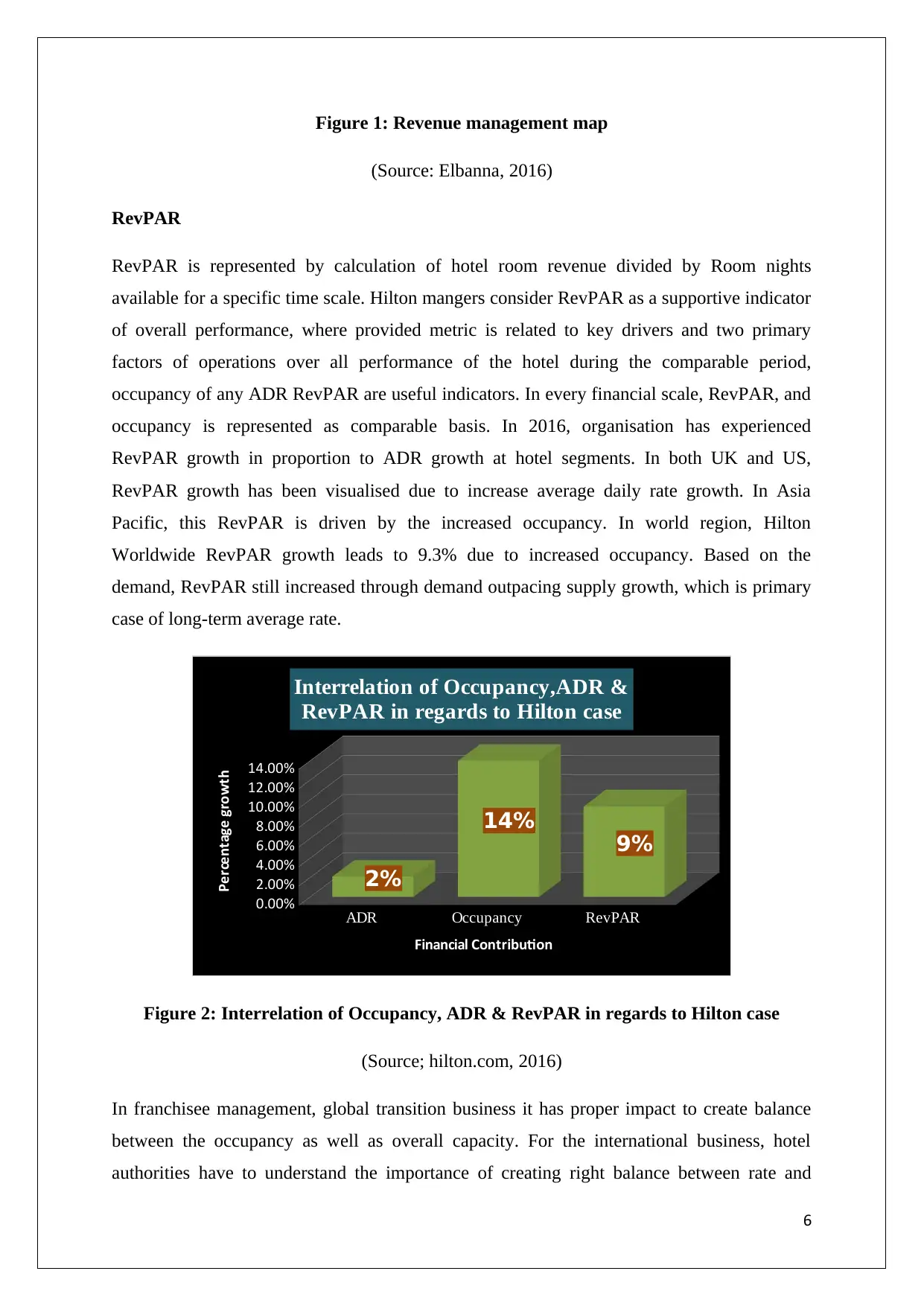
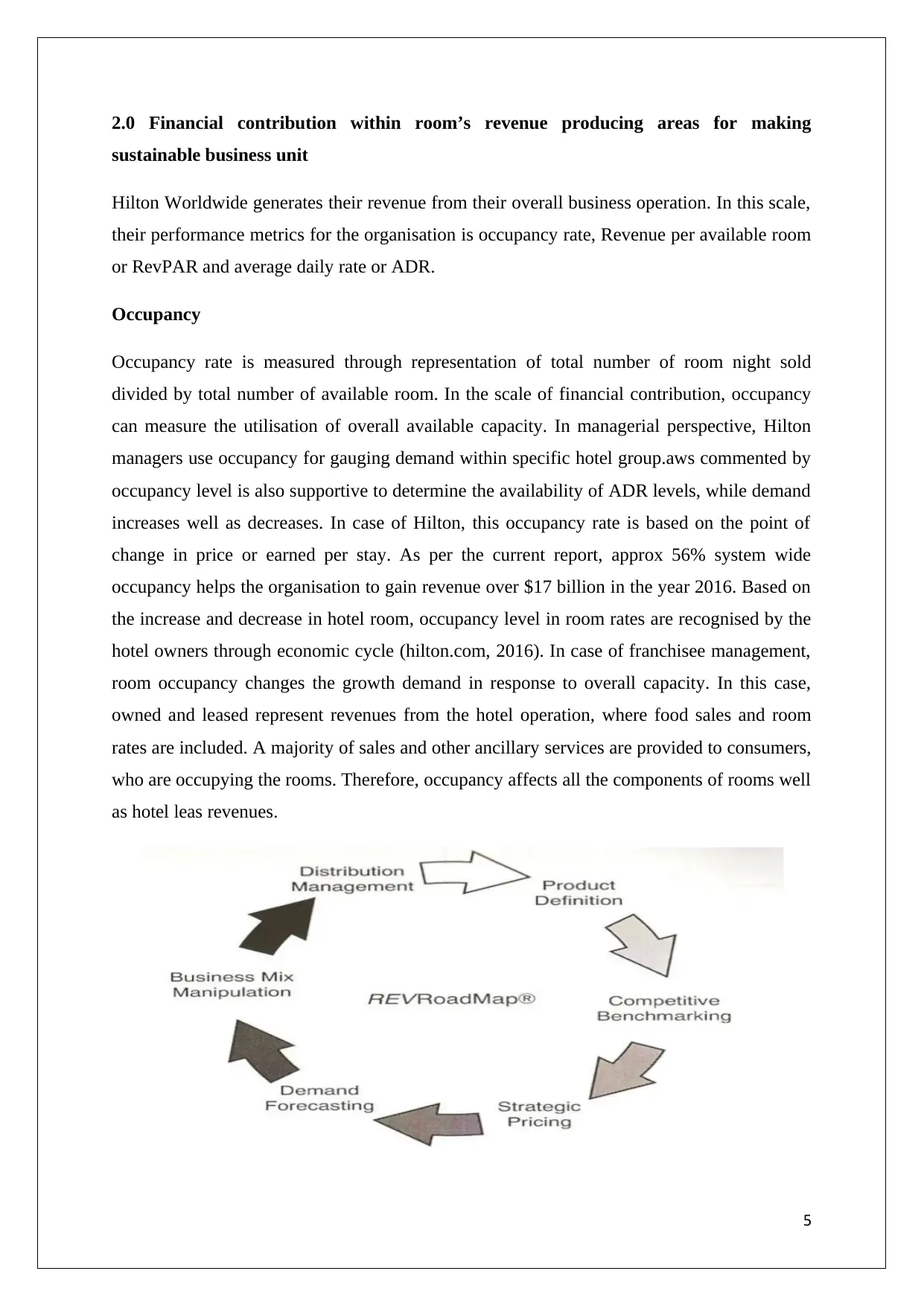
Figure 1: Revenue management map
(Source: Elbanna, 2016)
RevPAR
RevPAR is represented by calculation of hotel room revenue divided by Room nights
available for a specific time scale. Hilton mangers consider RevPAR as a supportive indicator
of overall performance, where provided metric is related to key drivers and two primary
factors of operations over all performance of the hotel during the comparable period,
occupancy of any ADR RevPAR are useful indicators. In every financial scale, RevPAR, and
occupancy is represented as comparable basis. In 2016, organisation has experienced
RevPAR growth in proportion to ADR growth at hotel segments. In both UK and US,
RevPAR growth has been visualised due to increase average daily rate growth. In Asia
Pacific, this RevPAR is driven by the increased occupancy. In world region, Hilton
Worldwide RevPAR growth leads to 9.3% due to increased occupancy. Based on the
demand, RevPAR still increased through demand outpacing supply growth, which is primary
case of long-term average rate.
ADR Occupancy RevPAR
0.00%
2.00%
4.00%
6.00%
8.00%
10.00%
12.00%
14.00%
2%
14%
9%
Interrelation of Occupancy,ADR &
RevPAR in regards to Hilton case
Financial Contribution
Percentage growth
Figure 2: Interrelation of Occupancy, ADR & RevPAR in regards to Hilton case
(Source; hilton.com, 2016)
In franchisee management, global transition business it has proper impact to create balance
between the occupancy as well as overall capacity. For the international business, hotel
authorities have to understand the importance of creating right balance between rate and
6
(Source: Elbanna, 2016)
RevPAR
RevPAR is represented by calculation of hotel room revenue divided by Room nights
available for a specific time scale. Hilton mangers consider RevPAR as a supportive indicator
of overall performance, where provided metric is related to key drivers and two primary
factors of operations over all performance of the hotel during the comparable period,
occupancy of any ADR RevPAR are useful indicators. In every financial scale, RevPAR, and
occupancy is represented as comparable basis. In 2016, organisation has experienced
RevPAR growth in proportion to ADR growth at hotel segments. In both UK and US,
RevPAR growth has been visualised due to increase average daily rate growth. In Asia
Pacific, this RevPAR is driven by the increased occupancy. In world region, Hilton
Worldwide RevPAR growth leads to 9.3% due to increased occupancy. Based on the
demand, RevPAR still increased through demand outpacing supply growth, which is primary
case of long-term average rate.
ADR Occupancy RevPAR
0.00%
2.00%
4.00%
6.00%
8.00%
10.00%
12.00%
14.00%
2%
14%
9%
Interrelation of Occupancy,ADR &
RevPAR in regards to Hilton case
Financial Contribution
Percentage growth
Figure 2: Interrelation of Occupancy, ADR & RevPAR in regards to Hilton case
(Source; hilton.com, 2016)
In franchisee management, global transition business it has proper impact to create balance
between the occupancy as well as overall capacity. For the international business, hotel
authorities have to understand the importance of creating right balance between rate and
6
⊘ This is a preview!⊘
Do you want full access?
Subscribe today to unlock all pages.
Trusted by 1+ million students worldwide
occupancy. In this case, often hotel productivity is evaluated based on the on such factors
(Gray et al., 2015). In many cases, hoteliers have higher occupancy rate in response to their
operational target. However, such higher occupancy can lead to lower profit. RevPAR gives
accurate picture of the performance to enhance overall growth.
ADR
ADR or average daily rate can be calculated through reprinting the hotel room revenue
divided by the total number of room nights within a specific period. It primarily measures the
average room process, which are attained by the hotels. In Hilton, ADR trends provide proper
information is concerned with customer base as well as pricing environment. In order to
measuring the performance, ADR is utilised to assess the pricing level, where Hilton Group is
able to generate customer types for changing the rates. These rates are transformed based on
incremental profitability and overall revues rather than the changes in occupancy. As per the
report of 2016, ADR increase was up to 2.1% that is responsible for decreasing the
occupancy up to 14% points.
In the landscape of fixed capacity inventory program, safety and base stockes need to be
maintained for getting a measurement scale against the impact of uncertainty. This status can
be raised while occupancy rate is very high. Therefore, such factors in room revue area have
both positive and negative impact to maintain business sustainability for Hilton.
3.0 Demonstrate and apply principles of pricing to the room’s product and evaluate the
potential benefits of effective practices to profitability
Hilton authorities are primarily dependent on franchise pricing trends, which have created
adverse impact on maintaining existing management practice. Their pricing strategy is
determined by Black-Scholes-Merton option-pricing model. Embassy suites bundled pricing
of Hilton ensures that guest will receive all the amenities with proper affordable offer range.
In the scale of hospitality business, there are various pricing strategies such as premium
pricing, economy pricing, penetration, psychological pricing, price skimming as well as
bundle pricing. In case of room’s products, pricing has significant impact to maintain
competitive position.
Premium Price Products
7
(Gray et al., 2015). In many cases, hoteliers have higher occupancy rate in response to their
operational target. However, such higher occupancy can lead to lower profit. RevPAR gives
accurate picture of the performance to enhance overall growth.
ADR
ADR or average daily rate can be calculated through reprinting the hotel room revenue
divided by the total number of room nights within a specific period. It primarily measures the
average room process, which are attained by the hotels. In Hilton, ADR trends provide proper
information is concerned with customer base as well as pricing environment. In order to
measuring the performance, ADR is utilised to assess the pricing level, where Hilton Group is
able to generate customer types for changing the rates. These rates are transformed based on
incremental profitability and overall revues rather than the changes in occupancy. As per the
report of 2016, ADR increase was up to 2.1% that is responsible for decreasing the
occupancy up to 14% points.
In the landscape of fixed capacity inventory program, safety and base stockes need to be
maintained for getting a measurement scale against the impact of uncertainty. This status can
be raised while occupancy rate is very high. Therefore, such factors in room revue area have
both positive and negative impact to maintain business sustainability for Hilton.
3.0 Demonstrate and apply principles of pricing to the room’s product and evaluate the
potential benefits of effective practices to profitability
Hilton authorities are primarily dependent on franchise pricing trends, which have created
adverse impact on maintaining existing management practice. Their pricing strategy is
determined by Black-Scholes-Merton option-pricing model. Embassy suites bundled pricing
of Hilton ensures that guest will receive all the amenities with proper affordable offer range.
In the scale of hospitality business, there are various pricing strategies such as premium
pricing, economy pricing, penetration, psychological pricing, price skimming as well as
bundle pricing. In case of room’s products, pricing has significant impact to maintain
competitive position.
Premium Price Products
7
Paraphrase This Document
Need a fresh take? Get an instant paraphrase of this document with our AI Paraphraser
Premium price products are ranged in high scale than that of other competitors. In hotel
industry, Hilton generally recognises the advantages of pricing based on profitability, pricing
ability as well as higher demand. Primarily hotels are engaged in price competition through
revenue management. While demand is strong, Hilton has applied their pricing strategy.
Hilton supported a dual effect on their room rates. Hotels primarily see higher premium
during the peak season. Due to strong demands this premium, pricing scales are effective.
Organisational aim is to maintain as wells establish long-term as well as positive relationship
with the third party property owners. Hotel owners are able to terminate the agreement under
any circumstances (Schwartz et al., 2016).
In this landscape, premium compete pricing strategy is effective to gain high occupancy
rather than that of other competitors. However, it could crate issue to maintain overall
capacity in the market. This capacity is related to availability of products such as room or
other value added services (Jhamb and Singh, 2016). Therefore, proper pricing strategy is
required to accelerate entire service with alignment of consumer’s perception.
Demand pricing: the Hilton authorities to offer right price to the customer with best
available rate structure apply dynamic pricing. This strategy is first introduced in Hilton,
where hotel will not change the room rate in a day if up-to-the minute market information can
reveal the requirement of adjustments. However, other strategies are applied due to
emergence of rate integrity issues.
Strategic Pricing: Hilton primarily apply this strategy in response to short term issues, where
long term goals are to increase revenue within growing market share.
Other competitors are primarily dependent on the pricing strategy, where Hilton applies
foundational pricing tactics, which is important for sustaining the pricing strategy as well as
driving revenue. In this prospect, potential benefits are related with three foundational pricing
principles, which are as follows:-
Measuring price sensitivity: This factor is focused on the scale, where demand
changes are related with the price. This price is measured from competitive position
as an integral to growth. Understanding on the terms of price sensitivity is required to
structure good pricing decisions (Tovmasyan, 2017). For instance, hospitality industry
is prone to extreme price sensitivity. If hoteliers too aggressive with incentives overall
profit will suffer dramatically. In the dynamic market relation between price and
8
industry, Hilton generally recognises the advantages of pricing based on profitability, pricing
ability as well as higher demand. Primarily hotels are engaged in price competition through
revenue management. While demand is strong, Hilton has applied their pricing strategy.
Hilton supported a dual effect on their room rates. Hotels primarily see higher premium
during the peak season. Due to strong demands this premium, pricing scales are effective.
Organisational aim is to maintain as wells establish long-term as well as positive relationship
with the third party property owners. Hotel owners are able to terminate the agreement under
any circumstances (Schwartz et al., 2016).
In this landscape, premium compete pricing strategy is effective to gain high occupancy
rather than that of other competitors. However, it could crate issue to maintain overall
capacity in the market. This capacity is related to availability of products such as room or
other value added services (Jhamb and Singh, 2016). Therefore, proper pricing strategy is
required to accelerate entire service with alignment of consumer’s perception.
Demand pricing: the Hilton authorities to offer right price to the customer with best
available rate structure apply dynamic pricing. This strategy is first introduced in Hilton,
where hotel will not change the room rate in a day if up-to-the minute market information can
reveal the requirement of adjustments. However, other strategies are applied due to
emergence of rate integrity issues.
Strategic Pricing: Hilton primarily apply this strategy in response to short term issues, where
long term goals are to increase revenue within growing market share.
Other competitors are primarily dependent on the pricing strategy, where Hilton applies
foundational pricing tactics, which is important for sustaining the pricing strategy as well as
driving revenue. In this prospect, potential benefits are related with three foundational pricing
principles, which are as follows:-
Measuring price sensitivity: This factor is focused on the scale, where demand
changes are related with the price. This price is measured from competitive position
as an integral to growth. Understanding on the terms of price sensitivity is required to
structure good pricing decisions (Tovmasyan, 2017). For instance, hospitality industry
is prone to extreme price sensitivity. If hoteliers too aggressive with incentives overall
profit will suffer dramatically. In the dynamic market relation between price and
8
demand is difficult, where Hilton mages their revenue isolating sensitivity along with
better pricing decisions. Measuring demand vs. inventory/capacity: in this scale, hoteliers have to understand
that room product or services are always dependent on the demand. Higher premium
price point can give scope to competitor to reduce the price for retailing consumers
with maximum number (Molina-Azorín et al., 2015). Hoteliers also need to sell
remaining inventory at higher price points. Therefore, capacity vs demand field is
critical. If organisation increase their price, occupancy rate will be high but it will
give a scope to other companies to lower the occupancy and avail more inventory or
capacity.
Measuring competitor price positioning: In the context of price transparency, Hilton
has made easy for the consumers. They have applied it as function for competitive
charging rather than seeing the price in a vacuum. Through competitive pricing,
Hilton can maintain the transparency for creating market that is more dynamic while
competition level is high at all level.
Therefore, pricing strategy has been properly applied to gain higher profitability at all level.
If the hotel applied this three dimensional factors, they can utilise both manual and advanced
approach to pricing.
4.0 Method to optimize profitability under fixed capacity inventory for recognizing
dynamic growth
In the hospitality business, fixed capacity is related to create balance within the demand as
well as overall capacity, which is dependent on occupancy and RevPER. In the following
section a short scenario of Hilton is displayed for creating the balance between occupancy,
profit and capacity.
Hilton case Room rate calculation in terms of Revenue management
% Revenue Achieved = Actual revenue/Potential revenue
As per the Hilton, case study
Average Room Rates = $ 1155.10
Revenue achieved = 8,477,890
9
better pricing decisions. Measuring demand vs. inventory/capacity: in this scale, hoteliers have to understand
that room product or services are always dependent on the demand. Higher premium
price point can give scope to competitor to reduce the price for retailing consumers
with maximum number (Molina-Azorín et al., 2015). Hoteliers also need to sell
remaining inventory at higher price points. Therefore, capacity vs demand field is
critical. If organisation increase their price, occupancy rate will be high but it will
give a scope to other companies to lower the occupancy and avail more inventory or
capacity.
Measuring competitor price positioning: In the context of price transparency, Hilton
has made easy for the consumers. They have applied it as function for competitive
charging rather than seeing the price in a vacuum. Through competitive pricing,
Hilton can maintain the transparency for creating market that is more dynamic while
competition level is high at all level.
Therefore, pricing strategy has been properly applied to gain higher profitability at all level.
If the hotel applied this three dimensional factors, they can utilise both manual and advanced
approach to pricing.
4.0 Method to optimize profitability under fixed capacity inventory for recognizing
dynamic growth
In the hospitality business, fixed capacity is related to create balance within the demand as
well as overall capacity, which is dependent on occupancy and RevPER. In the following
section a short scenario of Hilton is displayed for creating the balance between occupancy,
profit and capacity.
Hilton case Room rate calculation in terms of Revenue management
% Revenue Achieved = Actual revenue/Potential revenue
As per the Hilton, case study
Average Room Rates = $ 1155.10
Revenue achieved = 8,477,890
9
⊘ This is a preview!⊘
Do you want full access?
Subscribe today to unlock all pages.
Trusted by 1+ million students worldwide
Occupancy Rates = 64.4%
Therefore, to calculate the REVPAR we need to put the variables in the given formulas.
Calculation of RevPar = Average rate × Occupancy %
$1155.10 X 64.4%= $ 46.43
These activities are made to calculate the budget and the forecasted budget of the hotel in
order to make proper implementation of the budget in the future. These activities can enhance
the financial strategy used by the hotel management to generate revenue and the minimize
wastage of resources.
Yield Management is a toll for capacity-constrained activity to get profit in revenue
management. Hilton primarily sells their seats for the variety of different fares. Low room
rate is available if customers make reservations early (Tussyadiah, 2016). However, last
minute reservation is process; the offer will not be available. In this case, yield management
is effective method to management capacity profitability. Through this process, hoteliers can
get proper support to sell the inventory to right type of customers. In this scale, proper
methods are applied through understanding the myriad of problems such as demand patters,
demand elasticity, overbooking policy as well as information system. There are various
methods to get dynamic growth in fixed capacity inventory.
Dynamic Programming
Due to sequential, repetitive and probabilistic nature of yield management, often researcher
expressed their view to use model through stochastic dynamic programming. This method
can maximise the expected revenue through resolving operating constraints (Prayag and
Hosany, 2015). Therefore, it is effective to maintain demand with hand of service
availability. Often transitional probabilities are based on the probability distribution in
regards to reservation, service offerings and other factors. Through this method, proper
inventory can be managed.
Economics Approaches
Marginal revenue model is effective approach to maintain the balance between occupancy
and service capacity. During potential high fare demand, Hilton can protect a certain number
of services in terms of capacity or availability (Pereira-Moliner et al., 2016). The optimal
10
Therefore, to calculate the REVPAR we need to put the variables in the given formulas.
Calculation of RevPar = Average rate × Occupancy %
$1155.10 X 64.4%= $ 46.43
These activities are made to calculate the budget and the forecasted budget of the hotel in
order to make proper implementation of the budget in the future. These activities can enhance
the financial strategy used by the hotel management to generate revenue and the minimize
wastage of resources.
Yield Management is a toll for capacity-constrained activity to get profit in revenue
management. Hilton primarily sells their seats for the variety of different fares. Low room
rate is available if customers make reservations early (Tussyadiah, 2016). However, last
minute reservation is process; the offer will not be available. In this case, yield management
is effective method to management capacity profitability. Through this process, hoteliers can
get proper support to sell the inventory to right type of customers. In this scale, proper
methods are applied through understanding the myriad of problems such as demand patters,
demand elasticity, overbooking policy as well as information system. There are various
methods to get dynamic growth in fixed capacity inventory.
Dynamic Programming
Due to sequential, repetitive and probabilistic nature of yield management, often researcher
expressed their view to use model through stochastic dynamic programming. This method
can maximise the expected revenue through resolving operating constraints (Prayag and
Hosany, 2015). Therefore, it is effective to maintain demand with hand of service
availability. Often transitional probabilities are based on the probability distribution in
regards to reservation, service offerings and other factors. Through this method, proper
inventory can be managed.
Economics Approaches
Marginal revenue model is effective approach to maintain the balance between occupancy
and service capacity. During potential high fare demand, Hilton can protect a certain number
of services in terms of capacity or availability (Pereira-Moliner et al., 2016). The optimal
10
Paraphrase This Document
Need a fresh take? Get an instant paraphrase of this document with our AI Paraphraser
room allocation is determined, while the marginal revenue model address both dynamic as
well as static nested room allocation problem. Through this process organisation can afford
both low cost and higher cost services with maximum availability. As result, profit margined
can be maintained in sequential way.
Threshold curve model
Another method in this yield management is threshold curve, where organisation can
understand both existing and current consumer behaviour in terms of capacity as well as
demand. Through this process, hoteliers can adopt a specific as well as suitable pricing tactics
to aggregate the demand.
Stay control
Stay control is one most positive method for both profit and revue control. It involves highest
yield reservation to manage the availability of any product. Stay control is related to
conditional offer on room during booking. In this scale departure date, duration rule is critical
factor. As per the viewpoint of Denizci Guillet and Mohammed (2015) place, several stay
control method cam on the inventory for optimising revenue potential in future sale. If there
is no restrictions, inventory can be opened for sale. If inventories are closed, then all should
be reserved, where no reservation can be processed. In case of Hilton, hotel capacity control
follows the traditional nested allocation, where more modification is required on such
inventory management.
5.0 Impact of ‘codes of conduct’, legislation and best practice on accommodation
Procedures
The primary purpose of the Hilton’s vision is to fill the customer with the light as well as
warmth of hospitality. In this case, values are prioritised on hospitality, ownership, integrity
as well as teamwork. In this case, culture of integrity is maintained to foster positive
reputation of the organisation. Code of conduct here applied to maintain highest ethical
standards in hospitality business. This code of conduct is applicable for all stakeholders,
shareholders and others. Code of conduct also applied for pricing, occupancy rates as well as
promotional strategies. In this case, terms and structure of Hilton’s customer contract as well
as financing agreements are maintained. In addition, various US federal, foreign and state
laws are incorporated to maintain consumer as well as internal business ethics. However,
11
well as static nested room allocation problem. Through this process organisation can afford
both low cost and higher cost services with maximum availability. As result, profit margined
can be maintained in sequential way.
Threshold curve model
Another method in this yield management is threshold curve, where organisation can
understand both existing and current consumer behaviour in terms of capacity as well as
demand. Through this process, hoteliers can adopt a specific as well as suitable pricing tactics
to aggregate the demand.
Stay control
Stay control is one most positive method for both profit and revue control. It involves highest
yield reservation to manage the availability of any product. Stay control is related to
conditional offer on room during booking. In this scale departure date, duration rule is critical
factor. As per the viewpoint of Denizci Guillet and Mohammed (2015) place, several stay
control method cam on the inventory for optimising revenue potential in future sale. If there
is no restrictions, inventory can be opened for sale. If inventories are closed, then all should
be reserved, where no reservation can be processed. In case of Hilton, hotel capacity control
follows the traditional nested allocation, where more modification is required on such
inventory management.
5.0 Impact of ‘codes of conduct’, legislation and best practice on accommodation
Procedures
The primary purpose of the Hilton’s vision is to fill the customer with the light as well as
warmth of hospitality. In this case, values are prioritised on hospitality, ownership, integrity
as well as teamwork. In this case, culture of integrity is maintained to foster positive
reputation of the organisation. Code of conduct here applied to maintain highest ethical
standards in hospitality business. This code of conduct is applicable for all stakeholders,
shareholders and others. Code of conduct also applied for pricing, occupancy rates as well as
promotional strategies. In this case, terms and structure of Hilton’s customer contract as well
as financing agreements are maintained. In addition, various US federal, foreign and state
laws are incorporated to maintain consumer as well as internal business ethics. However,
11
such laws supervision has reduced the revenue as well as profitability growth. Law and
restrictions are imposed through Foreign Corrupt Practices Act (hilton.com, 2016).
UK’s Bribery Act 2010 has been applied for maintain restriction on corrupt business
activities. In case of business in UK, hoteliers have to abide by Data Protection Act 1998 and
Credit Card Order 1990 (hilton.com, 2016). Therefore, in both accommodation and pricing
strategies this ‘Code of Conduct’ has effective role. It is not only required for ethical booking
and service transparency but also it is important to foster standardised component for pricing
principles. It has been mentioned earlier that organisation objective is create proper balance
between occupancy and capacity. Here Hilton managers have to maintain code of ethics to
provide discounts, inventory allocation and other operational factors. In the scale of fiduciary
standard and principles of agency law, organisation has applied proper standard. However, in
case of promotional offers consumers cannot get equal service if they not achieve that within
specific time. Therefore, in accommodation service, their code of conduct has been
maintained properly to structure the pricing principles. However, legal obligations are still
eating issue to maintain standard revenue.
6.0 Expectations of customers from diverse markets and explanation on accommodation
service approach in regards to quality management
Hilton is now a largest global hospitality company and they have applied various strategies to
innovate customers quickly. They have applied tech innovation to improve the consumer’s
experience. The organisation now prioritised on broader set of demand. Through putting the
tight price point, organisation has fulfilled their consumer’s expectation in a disciplinary
manner. In case of accommodation, emotion, service quality expectation and pricing is
playing important role is customer’s assessments. However, little attention on such factor can
create issue in capacity inventory allocation.
In Hilton, based on the proper code of conduct they are applying the structural equation
modelling. They are sincere to maintain consumer’s emotions, higher predictive expectations
in regards to service quality. However, currently organisation is facing trouble to structure
this pricing strategy due to misbalance in occupancy rate and RevPER. It affects the overall
capacity, where consumers cannot afford the service, while the demand rate is too high
(Tuntirattanasoontorn, 2018). In this case, high occupancy rate can reduce the availability
12
restrictions are imposed through Foreign Corrupt Practices Act (hilton.com, 2016).
UK’s Bribery Act 2010 has been applied for maintain restriction on corrupt business
activities. In case of business in UK, hoteliers have to abide by Data Protection Act 1998 and
Credit Card Order 1990 (hilton.com, 2016). Therefore, in both accommodation and pricing
strategies this ‘Code of Conduct’ has effective role. It is not only required for ethical booking
and service transparency but also it is important to foster standardised component for pricing
principles. It has been mentioned earlier that organisation objective is create proper balance
between occupancy and capacity. Here Hilton managers have to maintain code of ethics to
provide discounts, inventory allocation and other operational factors. In the scale of fiduciary
standard and principles of agency law, organisation has applied proper standard. However, in
case of promotional offers consumers cannot get equal service if they not achieve that within
specific time. Therefore, in accommodation service, their code of conduct has been
maintained properly to structure the pricing principles. However, legal obligations are still
eating issue to maintain standard revenue.
6.0 Expectations of customers from diverse markets and explanation on accommodation
service approach in regards to quality management
Hilton is now a largest global hospitality company and they have applied various strategies to
innovate customers quickly. They have applied tech innovation to improve the consumer’s
experience. The organisation now prioritised on broader set of demand. Through putting the
tight price point, organisation has fulfilled their consumer’s expectation in a disciplinary
manner. In case of accommodation, emotion, service quality expectation and pricing is
playing important role is customer’s assessments. However, little attention on such factor can
create issue in capacity inventory allocation.
In Hilton, based on the proper code of conduct they are applying the structural equation
modelling. They are sincere to maintain consumer’s emotions, higher predictive expectations
in regards to service quality. However, currently organisation is facing trouble to structure
this pricing strategy due to misbalance in occupancy rate and RevPER. It affects the overall
capacity, where consumers cannot afford the service, while the demand rate is too high
(Tuntirattanasoontorn, 2018). In this case, high occupancy rate can reduce the availability
12
⊘ This is a preview!⊘
Do you want full access?
Subscribe today to unlock all pages.
Trusted by 1+ million students worldwide

1 out of 17


Related Documents


Your All-in-One AI-Powered Toolkit for Academic Success.
+13062052269
info@desklib.com
Available 24*7 on WhatsApp / Email
![[object Object]](/_next/static/media/star-bottom.7253800d.svg)
Unlock your academic potential
Copyright © 2020–2026 A2Z Services. All Rights Reserved. Developed and managed by ZUCOL.