Introduction to World Religions: Hinduism and Nursing Implications

Verified

Added on  2022/08/26

|4
|791
|38
Homework Assignment
AI Summary
This assignment explores the implications of Hindu faith within the context of nursing practice. It begins by defining faith within Hinduism, emphasizing concepts such as 'Shraddha' and 'Vishwas', and how devotion and belief in Dharma, liberation, and God are central to the faith. The paper then discusses how these beliefs influence nursing ethics, patient care, and treatment preferences. The author highlights how a patient's faith impacts their approach to medical treatments and the importance of nurses demonstrating respect and dignity. The assignment also includes peer reviews, one discussing compassion in Buddhism and its role in nursing, and another focusing on engaged Buddhism and its application to social activism within a nursing context, further enriching the understanding of faith's impact on healthcare practices.
Document Page
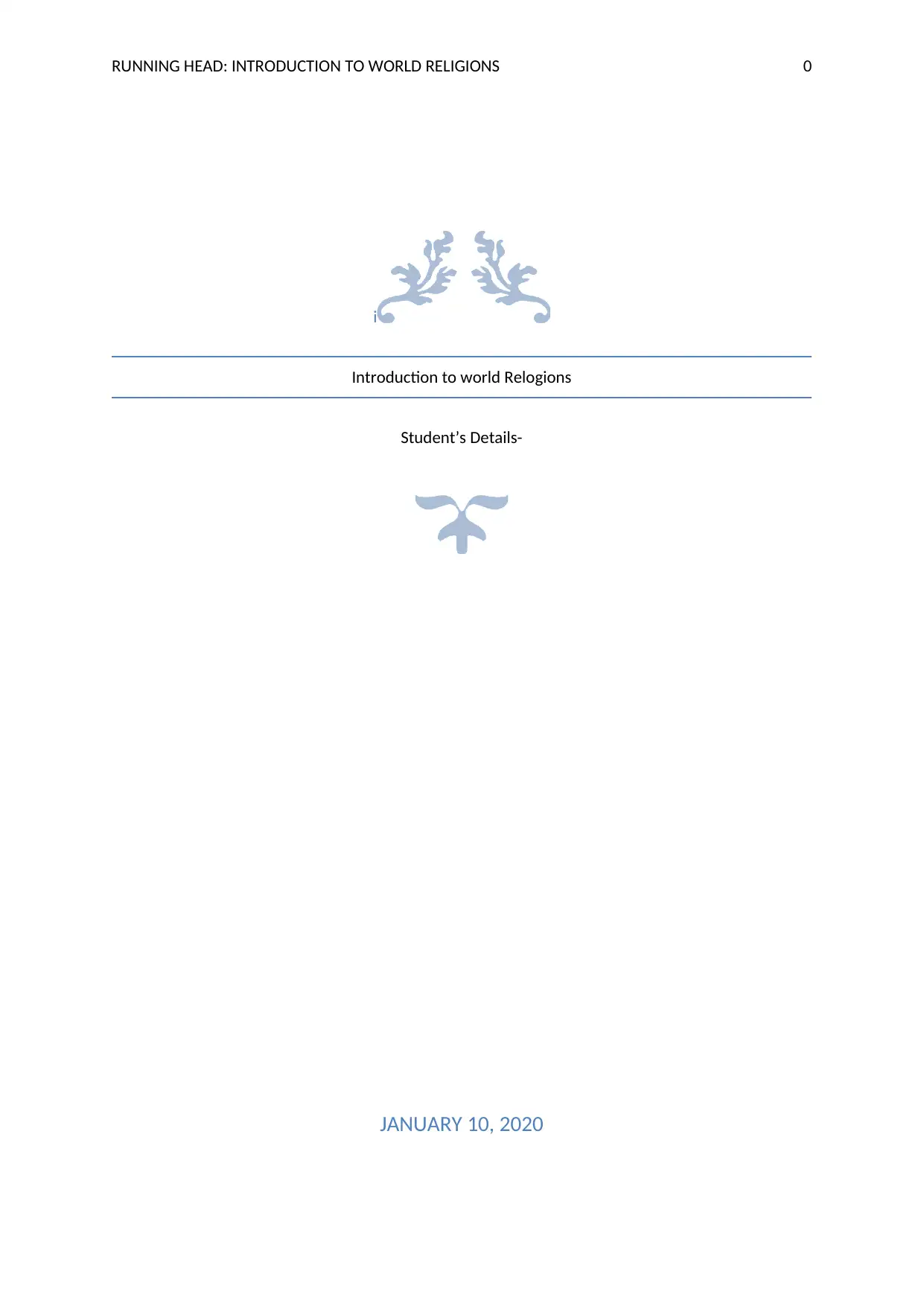
RUNNING HEAD: INTRODUCTION TO WORLD RELIGIONS 0
i
Introduction to world Relogions
Student’s Details-
JANUARY 10, 2020
tabler-icon-diamond-filled.svg

Paraphrase This Document

Need a fresh take? Get an instant paraphrase of this document with our AI Paraphraser
Document Page
INTRODUCTION TO WORLD RELIGIONS 1
Implications of Faith of Hindus in Nursing Practice
Hindus defines faith as ‘Shraddha or Vishwas’ which are Sanskrit terms. Hindus
believe that faith is derived to be the devotion which is regarded as central to the spiritual
practice (Sen R., 2018). Hindus explore the faiths through devotion and worship of God
which are the main virtues of Hinduism. It includes the faith in Dharma, faith in the
possibilities of liberation and faith in the God which are the explicit forms of faith. Hindus
define faith not only in terms of the religion but also defined as the basis of the achievement
of the goal which is only be achieve when one has faith in himself. Faith is considered to be
the conviction and devotion that leads to the commitment, dedication and the assurance in the
religious practices.
There are implications of the Hinduism faiths in the nursing ethics and practices as the
beliefs and practices of the religion affects the faith of the person which influences the
nursing practices. Patient’s values and the faiths affects their selection of the medical
treatments and the procedure of getting care. Nursing ethics are important for the medical
professionals in which the professionals have faith in increasing the quality of care and
ensure the patient’s safety (Butts & Rich , 2019). Moreover, it can be noted that faith in the
patients for getting the treatments affects their trust and commitment towards the doctors.
Specifically, when patients have faith in getting the right treatments from the doctors and
they share their pain and disease information in more detail which increases the tendency of
getting more accurate treatments and the medications as per the problem identified and
improving the patient’s outcomes simultaneously. Beliefs of Hindus are based on the
‘Shraddha’ in which nursing practice can get affected when they treat every patient with the
values as they have faith on the patients and treat them with respect and dignity that shows
their ‘gunas’
Peer Review #1
After reviewing the post of Bailey Wilson, it can be said that compassion is primary
quality to be considered in Buddhism and plays a vital role in the nursing practice. The post
has stated that compassion is related with the practice of helping others. Moreover,
compassion in Buddhism is related with ‘karuna’ which is related with the act of helping
others and remove harm and sufferings (Harris-Birtill, 2019). I agree with the opinion of
Bailey that nurses have the ability to provide care as they have the tendency of helping
others. Besides, I disagree with the opinion of Bailey regarding the fact that compassion is
Document Page
INTRODUCTION TO WORLD RELIGIONS 2
hard to be exercised. I think anyone can show compassion towards others and is not difficult.
Moreover, nurses have to balance their compassion and nursing practice to improve the
patient’s outcome.
Peer Review #2
When I reviewed the post of Cortney King, I noted that engaged Buddhism can
express the ideals of Buddhism in the sense that it can make the nursing practice to be related
with social activism. Moreover, engaged Buddhist in today’s world are applying the
teachings of the ‘dharma’ for the social activism and the activities for social injustice
(Sivaraksa, 2015). I agree with the opinion of Cortney that these kinds of people are having
new emphasis to reduce or eliminate ‘dukha’ or pain from the human society or promoting
welfare. By acknowledging the views of Cortney, it can be said that engaged Buddhism is not
only eliminating the ‘dukhas’ but also finding ways that can reduce the human suffering and
using of similar efforts for improving the situation.
Document Page
INTRODUCTION TO WORLD RELIGIONS 3
References
Butts, J., & Rich , K. (2019). Nursing ethics. Jones & Bartlett Learning.
Harris-Birtill, R. (2019). David Mitchell's Post-secular World: Buddhism, Belief and the
Urgency of Compassion. Bloomsbury Publishing.
Sen R. (2018). Articles of faith: religion, secularism, and the Indian Supreme Court. Oxford
University Press.
Sivaraksa, S. (2015). Conflict, culture, change: Engaged Buddhism in a globalizing world.
Simon and Schuster.
chevron_up_icon
1 out of 4
circle_padding
hide_on_mobile
zoom_out_icon
[object Object]