Climate Change and Polynesian Migration: A Historical Analysis

Verified

Added on  2022/08/29

|4
|1100
|19
Homework Assignment
AI Summary
This assignment delves into the historical impact of climate change on Polynesian migration, focusing on the analysis of voyaging routes and marine climates. The study examines the role of the Medieval Climate Anomaly (MCA) in facilitating or hindering Polynesian voyages to New Zealand and Easter Island. It explores how shifts in wind patterns, sea levels, and the expansion of the Hadley Cell influenced the ability of Polynesians to navigate and colonize new territories. The assignment references historical records and paleoclimate data to reconstruct past climate conditions and understand their effects on human migration patterns. It highlights the importance of off-wind sailing routes and the climate windows that allowed for the colonization of the Polynesian Triangle. The assignment includes a summary of a blog that discusses the relationship between climate change and human migration, and the use of technology. It explores the impact of climate change in the human migration and discusses Polynesian drifting to the New Zealand as well as Easter Island. Furthermore, it explores the role of the Maori Community and the “historicist approach”. The assignment also provides the assignment brief, which includes the task of finding additional readings related to the topic, writing a blog based on the readings, and creating a PowerPoint presentation summarizing the blog's content.
Document Page
Climate change in the human migration
There is a debate regarding the human migration in the large part of the East Polynesia. It is totally
concentrated on the seafaring technology. Both are totally related to the navigation and canon
capabilities. Temporary change in the sailing conditions via the modification of the climate. But it is
received lesser attention (Goodwin, S.A. and A.J. 2014: 111 (41)). A model of the Polynesian trip
highlights that tradewind easterlies are governing within central Pacific. It also governs colonization of
canoes travelling towards the eastward. It can be done via central East Polynesia. Similar arguments
can be implemented to perform journey from CEP to New Zealand. Alternate observation is that
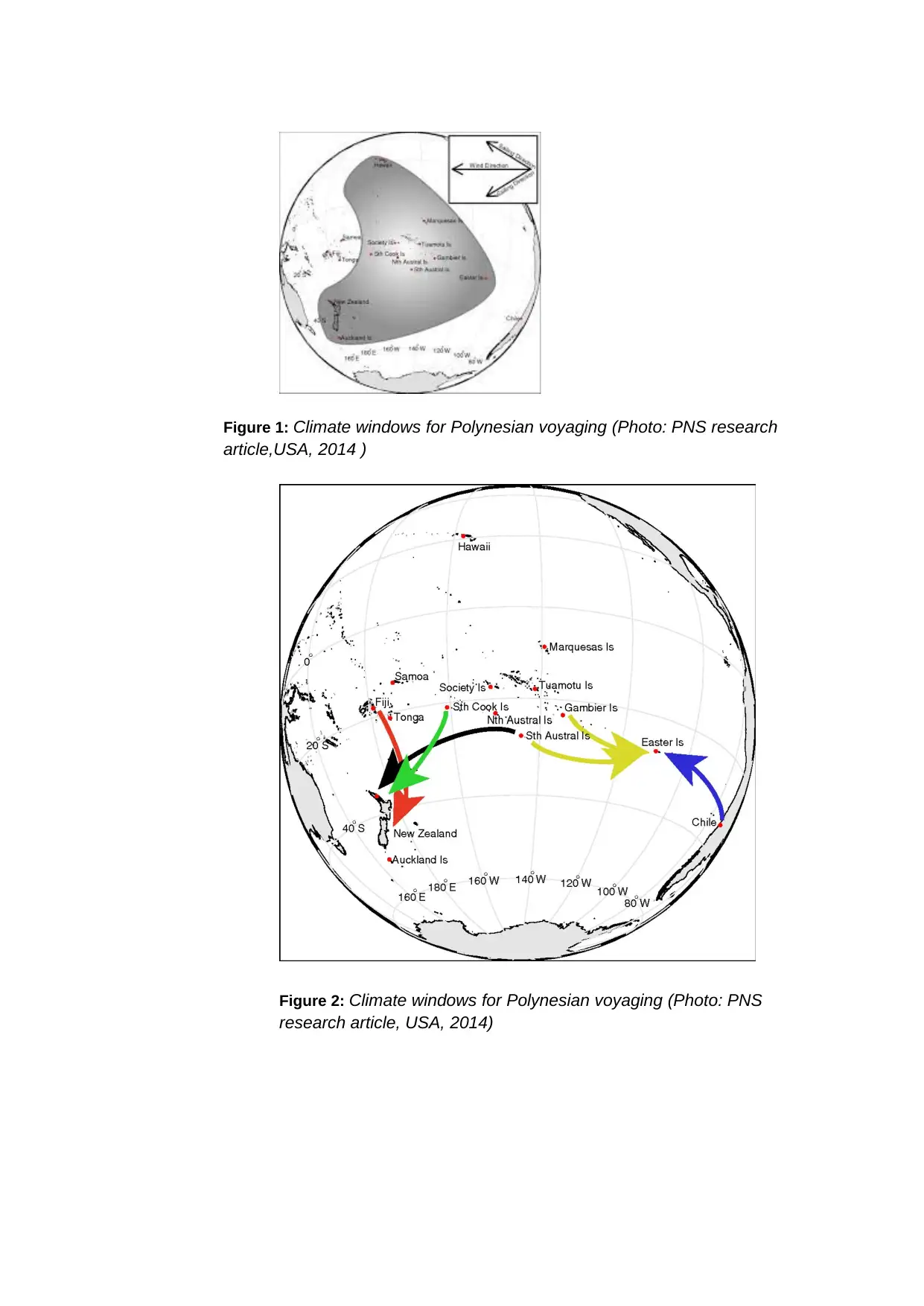
relocation is needed some trusty off-wind sailing routes. In this article, authors also explore regarding
the potential voyaging routes and marine climates. It is occurred at the time of Medieval Climate
Anomaly. Paleoclimate data collection is used to rebuild seal level pressure of Pacific Ocean. MCA
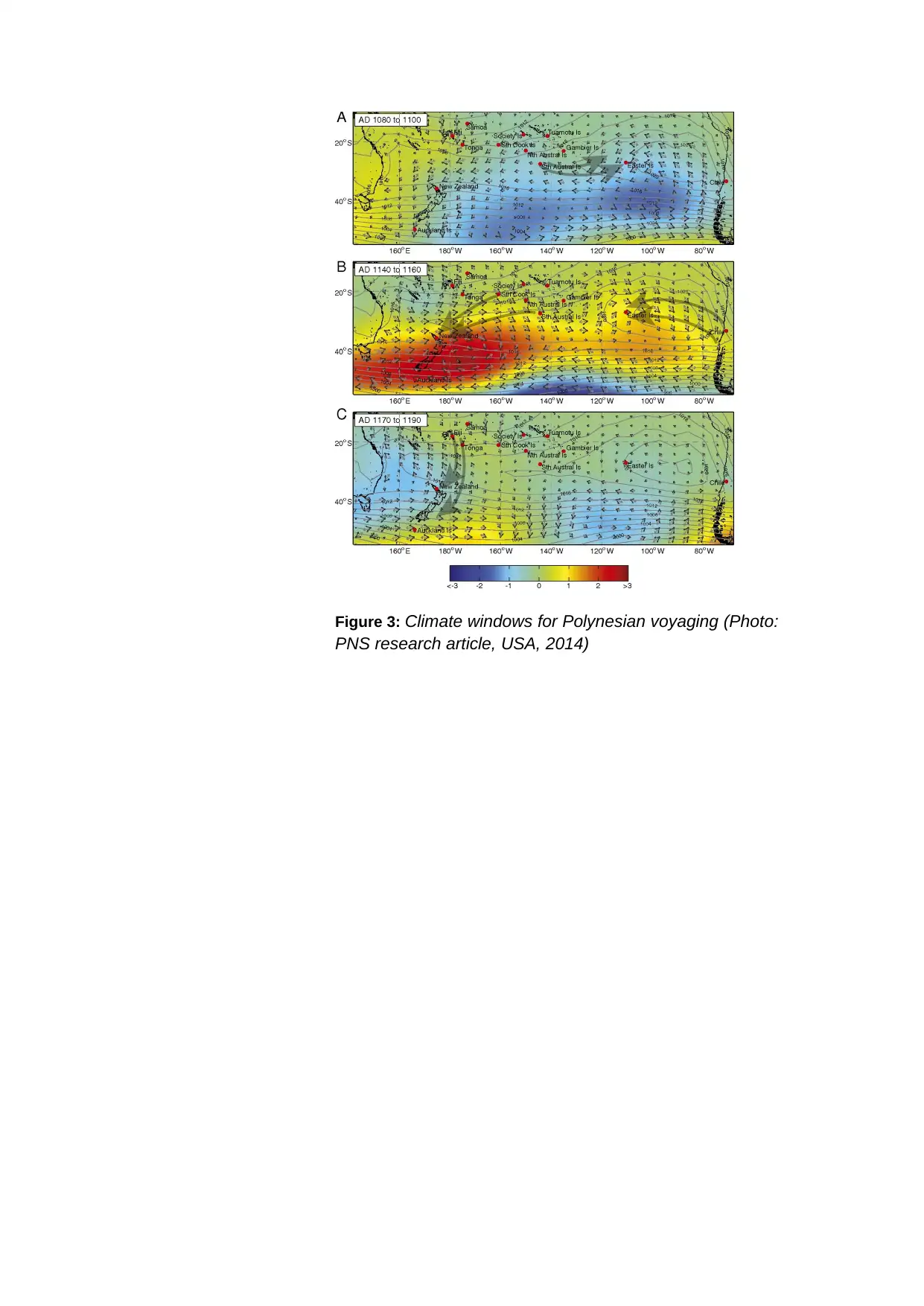
provides a clear idea regarding the modification of the wind field pattern. In A.D 11401260,
poleward expansion and intensification unlocked a climate window for the off-sailing
routes from South-Australian, Tonga and South Cook Islands to New Zealand.
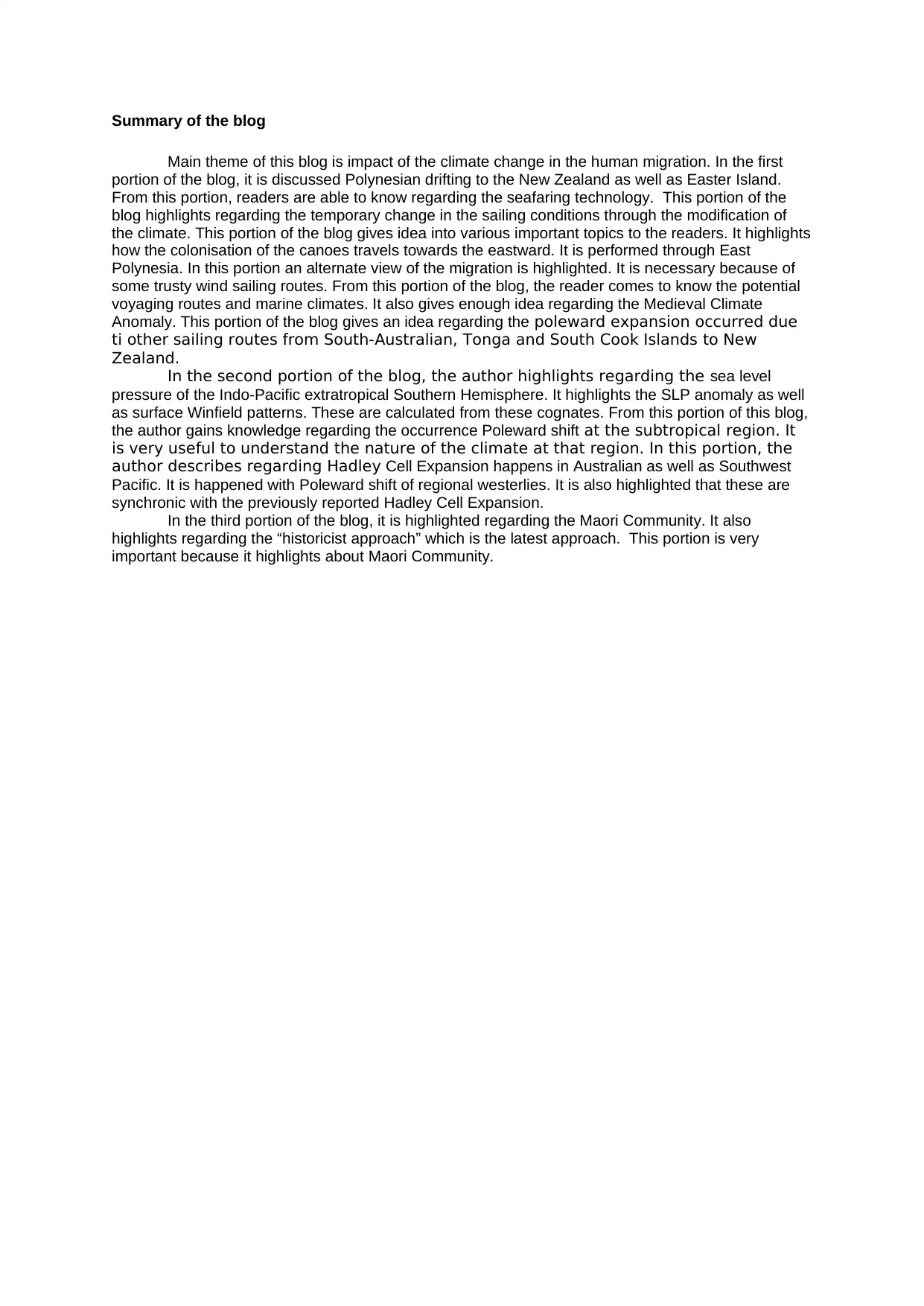
The sea level pressure of the Indo-Pacific extratropical Southern Hemisphere is represented for the
previous millennium. A complicated data from the Australia, New Zealand, South Africa and Antarctica
were examined with respect to the global climate outcome for identifying the climate state analogies.
These are very accurate with most of the proxy data. SLP anomaly as well surface Winfield patterns
are calculated from these cognates for describing lower modification of frequency. Poleward shift
occurred at the subtropical had a very strong impact of Southern Hemisphere from 900 to 1300 CE
(Ian D 2015: 32). It was occurred at the time of Medieval Climate Anomaly. There is a huge impact of
South Pacific windfield as well as ocean wave field which may have some modification attached with
the tropical expansion. Hadley Cell Expansion happens in Australian as well as Southwest Pacific. It
is occurred with Poleward shift of regional westerlies. These are synchronic with earlier highlighted
Hadley Cell Expansion in North Pacific region as well as Atlantic regions. These suggest the bipolar
climate symmetry. It was a characteristic of MCA. Poleward expansion of Pacific subtropical
anticyclone happened in A.D 1140 to 1260, opened a cognate climate window for the off-window
drifting for the colonisation of Polynesians which is concerned with the Polynesian Triangle of New
Zealand, Hawaii as well as Easter Island.
In late nineteenth century, scholars accepted that colonisation of Maori Community happened at six
hundred years before (Anderson 2017: 223). It was performed by some systematic voyaging within
more than one canoes. In the early twentieth century, a traditionalist hypotheses was generated which
performed the navigation and return voyaging in a faster rate. The “historicist approach” is considered
as the most recent approach. It helps to analyse the historical records of Polynesian drifting
automation inside the Indo-Pacific region. Voyaging to the New Zealand was eased by a normal
turnaround of the direction of the wind in AD 1100-1300 within easterlies.
Name of the author
Goodwin, I.A, S.A. Browning and A.J. Anderson 2014. Climate windows for Polynesian voyaging to
New Zealand and Easter Island, Proceedings of the National Academy of Sciences of the United
States of America 111(41):14716–14721.
Ian D Goodwin, Stuart A Browning and Thomas Mortlock, Macquarie University, Sydney, Australia.
Retrieved 28 July 2015 from https://agu.confex.com/agu/15chapman2/webprogram/Paper37511.html
Anderson, A., 2017. Changing perspectives upon Māori colonisation voyaging. Journal of the Royal
Society of New Zealand, 47(3), pp.222-231.
tabler-icon-diamond-filled.svg

Paraphrase This Document

Need a fresh take? Get an instant paraphrase of this document with our AI Paraphraser
Document Page
Figure 1: Climate windows for Polynesian voyaging (Photo: PNS research
article,USA, 2014 )
Figure 2: Climate windows for Polynesian voyaging (Photo: PNS
research article, USA, 2014)
Document Page
Figure 3: Climate windows for Polynesian voyaging (Photo:
PNS research article, USA, 2014)
Document Page
Summary of the blog
Main theme of this blog is impact of the climate change in the human migration. In the first
portion of the blog, it is discussed Polynesian drifting to the New Zealand as well as Easter Island.
From this portion, readers are able to know regarding the seafaring technology. This portion of the
blog highlights regarding the temporary change in the sailing conditions through the modification of
the climate. This portion of the blog gives idea into various important topics to the readers. It highlights
how the colonisation of the canoes travels towards the eastward. It is performed through East
Polynesia. In this portion an alternate view of the migration is highlighted. It is necessary because of
some trusty wind sailing routes. From this portion of the blog, the reader comes to know the potential
voyaging routes and marine climates. It also gives enough idea regarding the Medieval Climate
Anomaly. This portion of the blog gives an idea regarding the poleward expansion occurred due
ti other sailing routes from South-Australian, Tonga and South Cook Islands to New
Zealand.
In the second portion of the blog, the author highlights regarding the sea level
pressure of the Indo-Pacific extratropical Southern Hemisphere. It highlights the SLP anomaly as well
as surface Winfield patterns. These are calculated from these cognates. From this portion of this blog,
the author gains knowledge regarding the occurrence Poleward shift at the subtropical region. It
is very useful to understand the nature of the climate at that region. In this portion, the
author describes regarding Hadley Cell Expansion happens in Australian as well as Southwest
Pacific. It is happened with Poleward shift of regional westerlies. It is also highlighted that these are
synchronic with the previously reported Hadley Cell Expansion.
In the third portion of the blog, it is highlighted regarding the Maori Community. It also
highlights regarding the “historicist approach” which is the latest approach. This portion is very
important because it highlights about Maori Community.
chevron_up_icon
1 out of 4
circle_padding
hide_on_mobile
zoom_out_icon
[object Object]