Historical Aspect of Policing Research Paper - CJS 241
VerifiedAdded on 2022/08/17
|6
|1214
|12
Report
AI Summary
This research paper provides a comprehensive historical analysis of policing, beginning with the foundational contributions of Robert Peel and the establishment of the London Metropolitan Police Force. It explores the Political Era of Policing, examining its characteristics and lasting impacts on modern law enforcement. The paper then delves into the Professional Era, highlighting its significance in shaping ethical standards and professional training. It also addresses the police crises of the 1960s, discussing the civil unrest and social issues that influenced policing practices. Finally, the paper examines developments in policing since 1970, including changes in hiring practices, patrol strategies, and investigative techniques. The paper uses various sources to support its arguments and adheres to APA guidelines.
Running Head: HISTORICAL ASPECT OF POLICING RESEARCH PAPER
HISTORICAL ASPECT OF POLICING RESEARCH PAPER
Name of the Student
Name of the University
Author’s Note
HISTORICAL ASPECT OF POLICING RESEARCH PAPER
Name of the Student
Name of the University
Author’s Note
Paraphrase This Document
Need a fresh take? Get an instant paraphrase of this document with our AI Paraphraser

1
HISTORICAL ASPECT OF POLICING RESEARCH PAPER
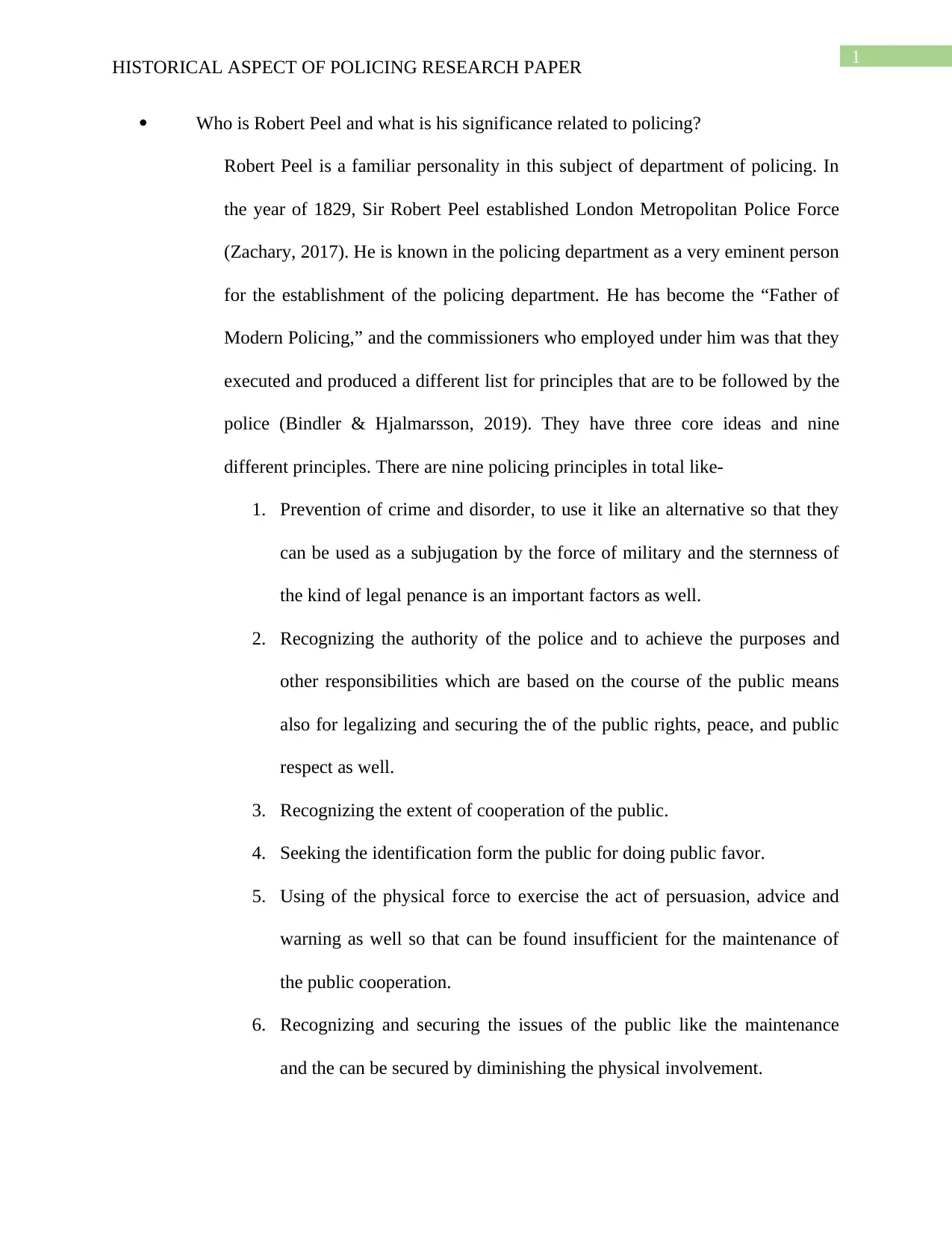
Who is Robert Peel and what is his significance related to policing?
Robert Peel is a familiar personality in this subject of department of policing. In
the year of 1829, Sir Robert Peel established London Metropolitan Police Force
(Zachary, 2017). He is known in the policing department as a very eminent person
for the establishment of the policing department. He has become the “Father of
Modern Policing,” and the commissioners who employed under him was that they
executed and produced a different list for principles that are to be followed by the
police (Bindler & Hjalmarsson, 2019). They have three core ideas and nine
different principles. There are nine policing principles in total like-
1. Prevention of crime and disorder, to use it like an alternative so that they
can be used as a subjugation by the force of military and the sternness of
the kind of legal penance is an important factors as well.
2. Recognizing the authority of the police and to achieve the purposes and
other responsibilities which are based on the course of the public means
also for legalizing and securing the of the public rights, peace, and public
respect as well.
3. Recognizing the extent of cooperation of the public.
4. Seeking the identification form the public for doing public favor.
5. Using of the physical force to exercise the act of persuasion, advice and
warning as well so that can be found insufficient for the maintenance of
the public cooperation.
6. Recognizing and securing the issues of the public like the maintenance
and the can be secured by diminishing the physical involvement.
HISTORICAL ASPECT OF POLICING RESEARCH PAPER
Who is Robert Peel and what is his significance related to policing?
Robert Peel is a familiar personality in this subject of department of policing. In
the year of 1829, Sir Robert Peel established London Metropolitan Police Force
(Zachary, 2017). He is known in the policing department as a very eminent person
for the establishment of the policing department. He has become the “Father of
Modern Policing,” and the commissioners who employed under him was that they
executed and produced a different list for principles that are to be followed by the
police (Bindler & Hjalmarsson, 2019). They have three core ideas and nine
different principles. There are nine policing principles in total like-
1. Prevention of crime and disorder, to use it like an alternative so that they
can be used as a subjugation by the force of military and the sternness of
the kind of legal penance is an important factors as well.
2. Recognizing the authority of the police and to achieve the purposes and
other responsibilities which are based on the course of the public means
also for legalizing and securing the of the public rights, peace, and public
respect as well.
3. Recognizing the extent of cooperation of the public.
4. Seeking the identification form the public for doing public favor.
5. Using of the physical force to exercise the act of persuasion, advice and
warning as well so that can be found insufficient for the maintenance of
the public cooperation.
6. Recognizing and securing the issues of the public like the maintenance
and the can be secured by diminishing the physical involvement.

2
HISTORICAL ASPECT OF POLICING RESEARCH PAPER
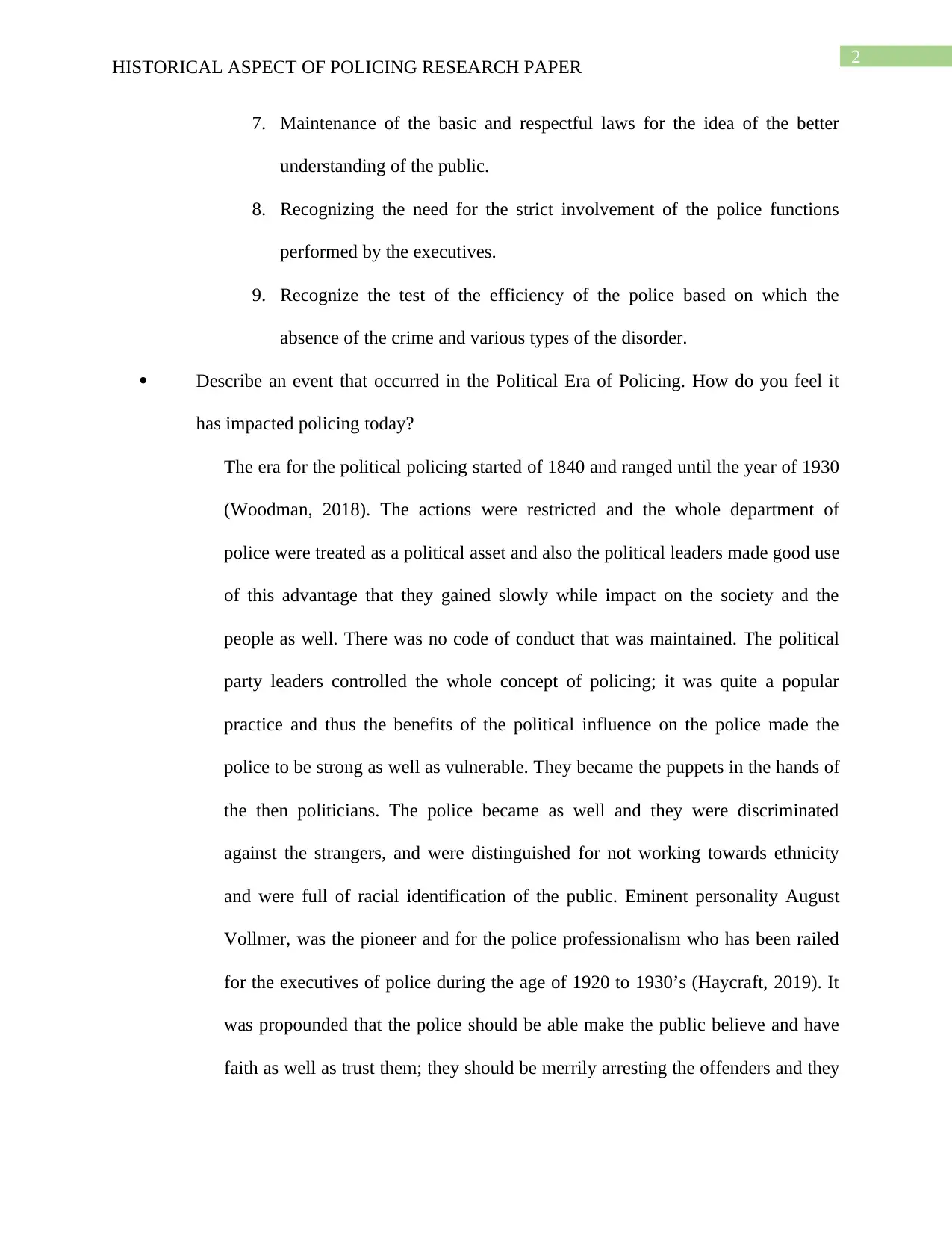
7. Maintenance of the basic and respectful laws for the idea of the better
understanding of the public.
8. Recognizing the need for the strict involvement of the police functions
performed by the executives.
9. Recognize the test of the efficiency of the police based on which the
absence of the crime and various types of the disorder.
Describe an event that occurred in the Political Era of Policing. How do you feel it
has impacted policing today?
The era for the political policing started of 1840 and ranged until the year of 1930
(Woodman, 2018). The actions were restricted and the whole department of
police were treated as a political asset and also the political leaders made good use
of this advantage that they gained slowly while impact on the society and the
people as well. There was no code of conduct that was maintained. The political
party leaders controlled the whole concept of policing; it was quite a popular
practice and thus the benefits of the political influence on the police made the
police to be strong as well as vulnerable. They became the puppets in the hands of
the then politicians. The police became as well and they were discriminated
against the strangers, and were distinguished for not working towards ethnicity
and were full of racial identification of the public. Eminent personality August
Vollmer, was the pioneer and for the police professionalism who has been railed
for the executives of police during the age of 1920 to 1930’s (Haycraft, 2019). It
was propounded that the police should be able make the public believe and have
faith as well as trust them; they should be merrily arresting the offenders and they
HISTORICAL ASPECT OF POLICING RESEARCH PAPER
7. Maintenance of the basic and respectful laws for the idea of the better
understanding of the public.
8. Recognizing the need for the strict involvement of the police functions
performed by the executives.
9. Recognize the test of the efficiency of the police based on which the
absence of the crime and various types of the disorder.
Describe an event that occurred in the Political Era of Policing. How do you feel it
has impacted policing today?
The era for the political policing started of 1840 and ranged until the year of 1930
(Woodman, 2018). The actions were restricted and the whole department of
police were treated as a political asset and also the political leaders made good use
of this advantage that they gained slowly while impact on the society and the
people as well. There was no code of conduct that was maintained. The political
party leaders controlled the whole concept of policing; it was quite a popular
practice and thus the benefits of the political influence on the police made the
police to be strong as well as vulnerable. They became the puppets in the hands of
the then politicians. The police became as well and they were discriminated
against the strangers, and were distinguished for not working towards ethnicity
and were full of racial identification of the public. Eminent personality August
Vollmer, was the pioneer and for the police professionalism who has been railed
for the executives of police during the age of 1920 to 1930’s (Haycraft, 2019). It
was propounded that the police should be able make the public believe and have
faith as well as trust them; they should be merrily arresting the offenders and they
⊘ This is a preview!⊘
Do you want full access?
Subscribe today to unlock all pages.

Trusted by 1+ million students worldwide

3
HISTORICAL ASPECT OF POLICING RESEARCH PAPER
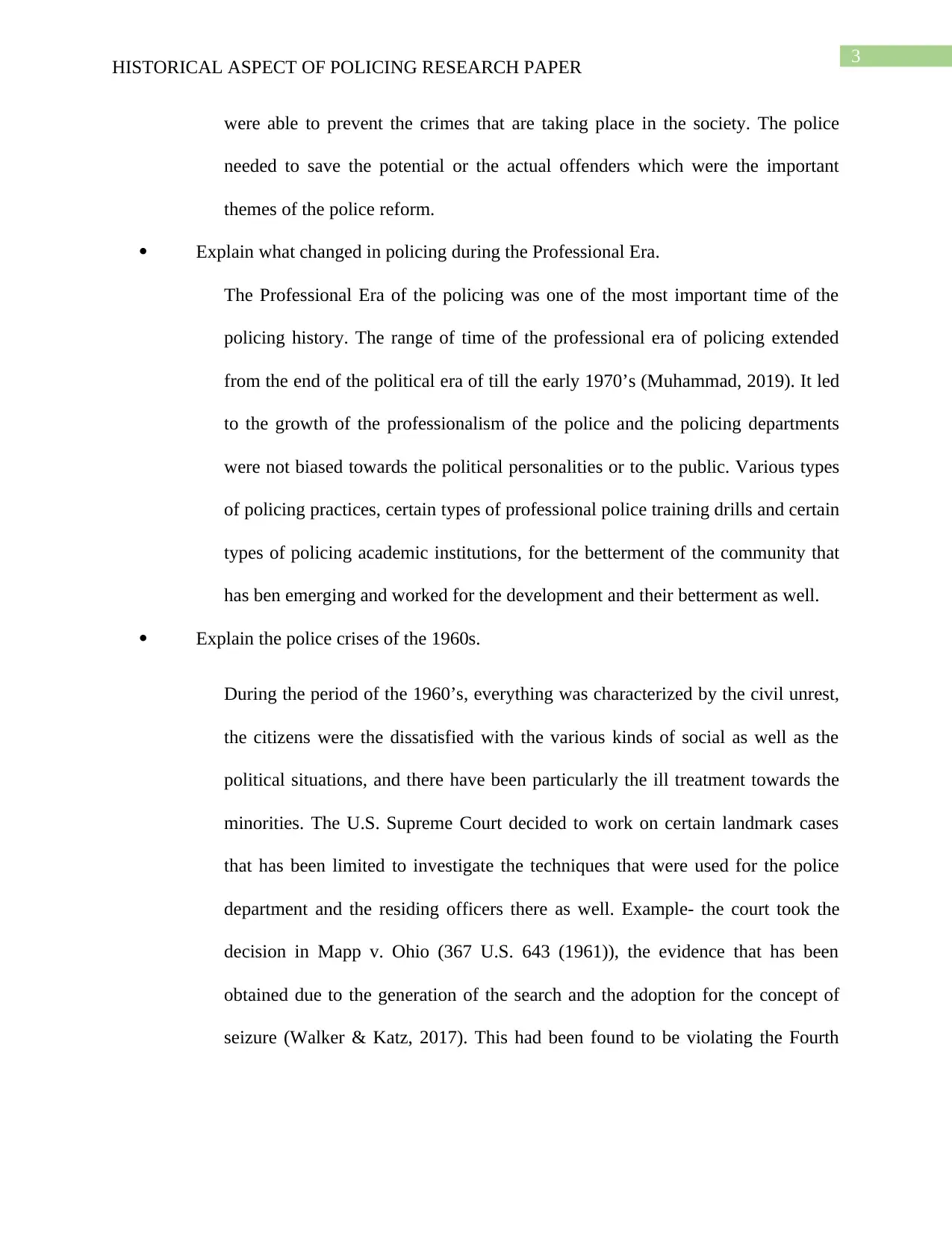
were able to prevent the crimes that are taking place in the society. The police
needed to save the potential or the actual offenders which were the important
themes of the police reform.
Explain what changed in policing during the Professional Era.
The Professional Era of the policing was one of the most important time of the
policing history. The range of time of the professional era of policing extended
from the end of the political era of till the early 1970’s (Muhammad, 2019). It led
to the growth of the professionalism of the police and the policing departments
were not biased towards the political personalities or to the public. Various types
of policing practices, certain types of professional police training drills and certain
types of policing academic institutions, for the betterment of the community that
has ben emerging and worked for the development and their betterment as well.
Explain the police crises of the 1960s.
During the period of the 1960’s, everything was characterized by the civil unrest,
the citizens were the dissatisfied with the various kinds of social as well as the
political situations, and there have been particularly the ill treatment towards the
minorities. The U.S. Supreme Court decided to work on certain landmark cases
that has been limited to investigate the techniques that were used for the police
department and the residing officers there as well. Example- the court took the
decision in Mapp v. Ohio (367 U.S. 643 (1961)), the evidence that has been
obtained due to the generation of the search and the adoption for the concept of
seizure (Walker & Katz, 2017). This had been found to be violating the Fourth
HISTORICAL ASPECT OF POLICING RESEARCH PAPER
were able to prevent the crimes that are taking place in the society. The police
needed to save the potential or the actual offenders which were the important
themes of the police reform.
Explain what changed in policing during the Professional Era.
The Professional Era of the policing was one of the most important time of the
policing history. The range of time of the professional era of policing extended
from the end of the political era of till the early 1970’s (Muhammad, 2019). It led
to the growth of the professionalism of the police and the policing departments
were not biased towards the political personalities or to the public. Various types
of policing practices, certain types of professional police training drills and certain
types of policing academic institutions, for the betterment of the community that
has ben emerging and worked for the development and their betterment as well.
Explain the police crises of the 1960s.
During the period of the 1960’s, everything was characterized by the civil unrest,
the citizens were the dissatisfied with the various kinds of social as well as the
political situations, and there have been particularly the ill treatment towards the
minorities. The U.S. Supreme Court decided to work on certain landmark cases
that has been limited to investigate the techniques that were used for the police
department and the residing officers there as well. Example- the court took the
decision in Mapp v. Ohio (367 U.S. 643 (1961)), the evidence that has been
obtained due to the generation of the search and the adoption for the concept of
seizure (Walker & Katz, 2017). This had been found to be violating the Fourth
Paraphrase This Document
Need a fresh take? Get an instant paraphrase of this document with our AI Paraphraser

4
HISTORICAL ASPECT OF POLICING RESEARCH PAPER
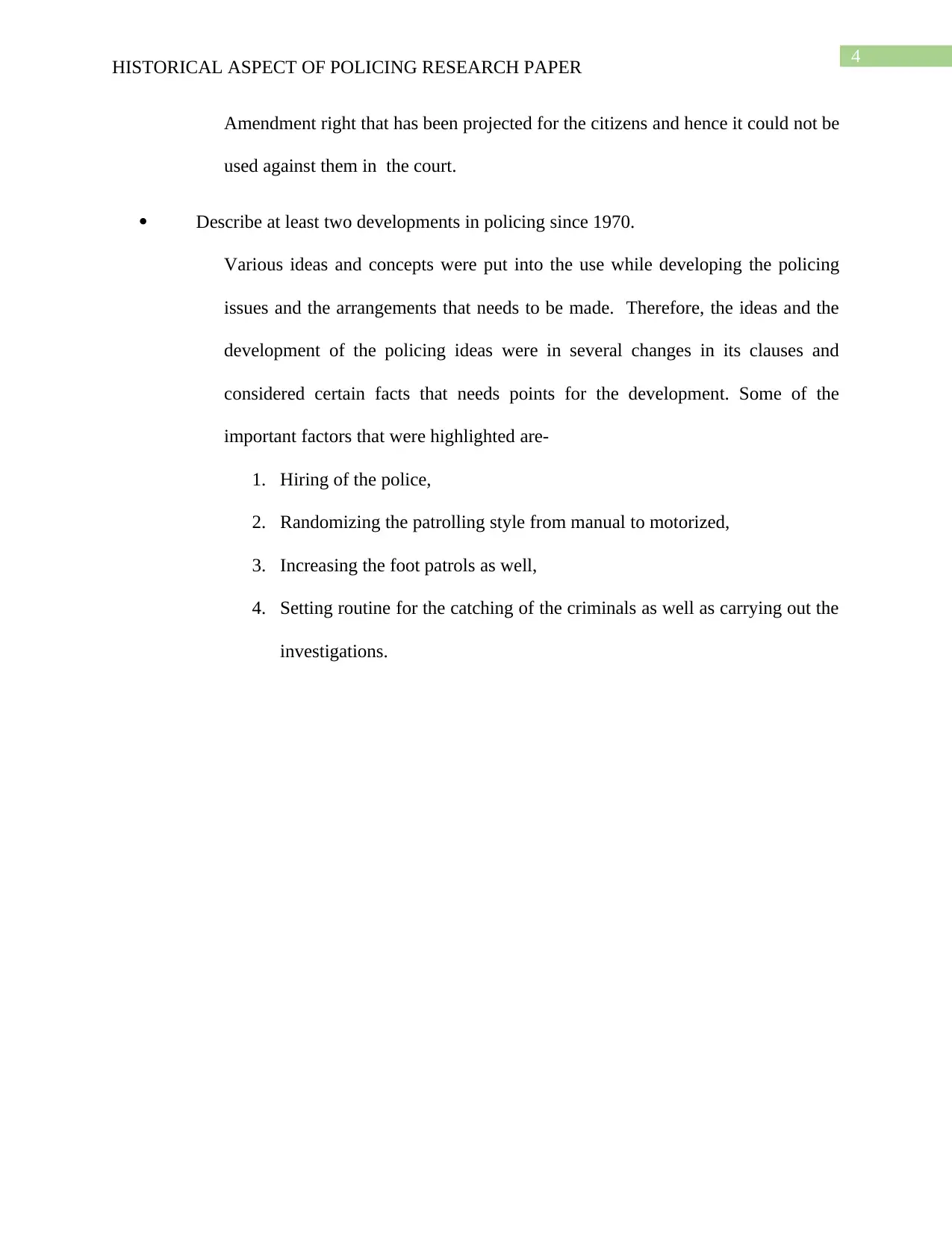
Amendment right that has been projected for the citizens and hence it could not be
used against them in the court.
Describe at least two developments in policing since 1970.
Various ideas and concepts were put into the use while developing the policing
issues and the arrangements that needs to be made. Therefore, the ideas and the
development of the policing ideas were in several changes in its clauses and
considered certain facts that needs points for the development. Some of the
important factors that were highlighted are-
1. Hiring of the police,
2. Randomizing the patrolling style from manual to motorized,
3. Increasing the foot patrols as well,
4. Setting routine for the catching of the criminals as well as carrying out the
investigations.
HISTORICAL ASPECT OF POLICING RESEARCH PAPER
Amendment right that has been projected for the citizens and hence it could not be
used against them in the court.
Describe at least two developments in policing since 1970.
Various ideas and concepts were put into the use while developing the policing
issues and the arrangements that needs to be made. Therefore, the ideas and the
development of the policing ideas were in several changes in its clauses and
considered certain facts that needs points for the development. Some of the
important factors that were highlighted are-
1. Hiring of the police,
2. Randomizing the patrolling style from manual to motorized,
3. Increasing the foot patrols as well,
4. Setting routine for the catching of the criminals as well as carrying out the
investigations.

5
HISTORICAL ASPECT OF POLICING RESEARCH PAPER
REFERENCES
Bindler, A., & Hjalmarsson, R. (2019). The impact of the first professional police forces on
crime.
Haycraft, H. (2019). Murder for Pleasure: the life and times of the detective story. Dover
Publications.
Muhammad, K. G. (2019). The Condemnation of Blackness: Race, Crime, and the Making of
Modern Urban America, With a New Preface. Harvard University Press.
Walker, S., Katz, C. The Police in America: An Introduction. [VitalSource Bookshelf]. Retrieved
from https://bookshelf.vitalsource.com/#/books/1260149773/
Woodman, C. (2018). Spycops in context: A brief history of political policing in Britain.
Zachary, M. C. (2017). Social Class and the Establishment of the London Metropolitan Police
Force.
HISTORICAL ASPECT OF POLICING RESEARCH PAPER
REFERENCES
Bindler, A., & Hjalmarsson, R. (2019). The impact of the first professional police forces on
crime.
Haycraft, H. (2019). Murder for Pleasure: the life and times of the detective story. Dover
Publications.
Muhammad, K. G. (2019). The Condemnation of Blackness: Race, Crime, and the Making of
Modern Urban America, With a New Preface. Harvard University Press.
Walker, S., Katz, C. The Police in America: An Introduction. [VitalSource Bookshelf]. Retrieved
from https://bookshelf.vitalsource.com/#/books/1260149773/
Woodman, C. (2018). Spycops in context: A brief history of political policing in Britain.
Zachary, M. C. (2017). Social Class and the Establishment of the London Metropolitan Police
Force.
⊘ This is a preview!⊘
Do you want full access?
Subscribe today to unlock all pages.

Trusted by 1+ million students worldwide
1 out of 6
Related Documents
Your All-in-One AI-Powered Toolkit for Academic Success.
+13062052269
info@desklib.com
Available 24*7 on WhatsApp / Email
Unlock your academic potential
Copyright © 2020–2026 A2Z Services. All Rights Reserved. Developed and managed by ZUCOL.