Assessing the Value of Historical Buildings in the Environment

Verified

Added on  2022/10/12

|7
|1161
|391
Report
AI Summary
This report analyzes the access and role of historical buildings within the built environment, with an emphasis on whether they add value to the surrounding area. The methodology employs both qualitative and quantitative research methods, utilizing data collection techniques and statistical analysis with tools like Excel and SPSS. The study investigates how historical buildings contribute to sustainability through resource conservation, cost efficiency, and design for human adaptation. It examines variables such as building characteristics, location, and economic factors to determine the value of these buildings. The report also reviews the role of historical buildings, heritage, regeneration, and sustainability, discussing preservation, treatment approaches, and value creation. The research aims to determine the impact of historical buildings on the environment.
Document Page
CHAPTER 2 - METHODOLOGY
1
tabler-icon-diamond-filled.svg

Paraphrase This Document

Need a fresh take? Get an instant paraphrase of this document with our AI Paraphraser
Document Page
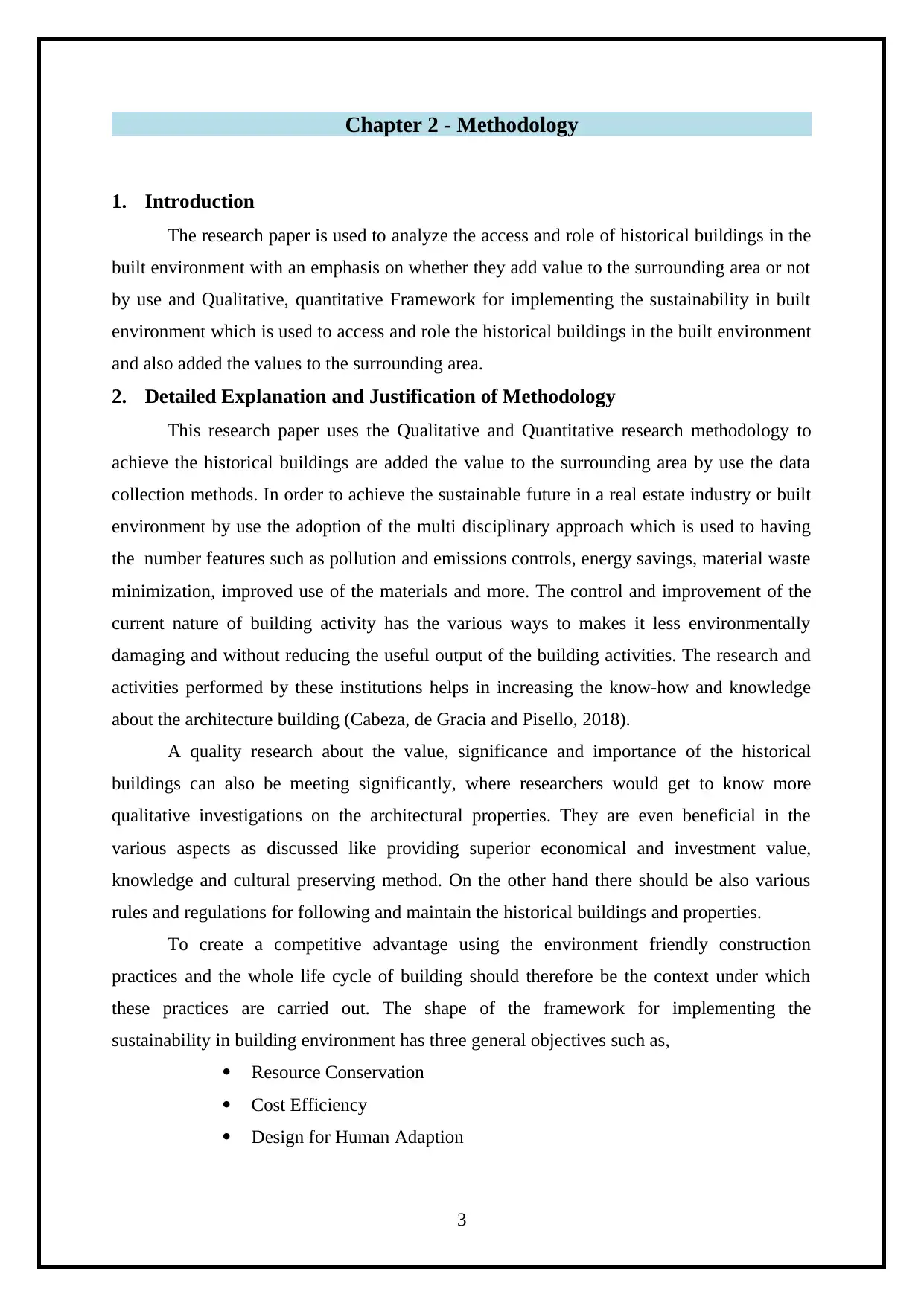
Table of Contents
Chapter 2 - Methodology...........................................................................................................3
1. Introduction.....................................................................................................................3
2. Detailed Explanation and Justification of Methodology.................................................3
3. Materials and Apparatus.................................................................................................4
3.1 General Description of the Materials.......................................................................4
3.2 Design......................................................................................................................4
3.3 Research Methods....................................................................................................6
3.4 Participants and Procedures.....................................................................................7
4. References.......................................................................................................................7
2
Document Page
Chapter 2 - Methodology
1. Introduction
The research paper is used to analyze the access and role of historical buildings in the
built environment with an emphasis on whether they add value to the surrounding area or not
by use and Qualitative, quantitative Framework for implementing the sustainability in built
environment which is used to access and role the historical buildings in the built environment
and also added the values to the surrounding area.
2. Detailed Explanation and Justification of Methodology
This research paper uses the Qualitative and Quantitative research methodology to
achieve the historical buildings are added the value to the surrounding area by use the data
collection methods. In order to achieve the sustainable future in a real estate industry or built
environment by use the adoption of the multi disciplinary approach which is used to having
the number features such as pollution and emissions controls, energy savings, material waste
minimization, improved use of the materials and more. The control and improvement of the
current nature of building activity has the various ways to makes it less environmentally
damaging and without reducing the useful output of the building activities. The research and
activities performed by these institutions helps in increasing the know-how and knowledge
about the architecture building (Cabeza, de Gracia and Pisello, 2018).
A quality research about the value, significance and importance of the historical
buildings can also be meeting significantly, where researchers would get to know more
qualitative investigations on the architectural properties. They are even beneficial in the
various aspects as discussed like providing superior economical and investment value,
knowledge and cultural preserving method. On the other hand there should be also various
rules and regulations for following and maintain the historical buildings and properties.
To create a competitive advantage using the environment friendly construction
practices and the whole life cycle of building should therefore be the context under which
these practices are carried out. The shape of the framework for implementing the
sustainability in building environment has three general objectives such as,
Resource Conservation
Cost Efficiency
Design for Human Adaption
3
Document Page
The resource conservation is used to achieving the more with less and it is the human
management use of the natural resources to provide the maximum advantages to current
generation while maintaining the capacity to meet the requirement of the future generations.
The cost efficiency is more important objectives for built environment because the
construction clients are demanding the assurance of their historical buildings long term
economic costs and performance. The historical buildings are representing a long lasting and
large investment in financial terms as well as in other resources. The improvements of the
cost effectiveness of historical buildings are consequently common interest of the user and
society. So, it is used to add the value the surrounding area (Pica, 2018).
3. Materials and Apparatus
This research paper uses the data collection methods to collect the data qualitative and
quantitative data to access and role the historical buildings in the built environment with an
emphasis on whether they add value to the surrounding area. And, this research paper uses
the two apparatus such as Excel and SPSS to do data analysis.
3.1 General Description of the Materials
The adaptation and reuse of historic buildings is an ongoing trend that has been
visibly and significance of this trend is that extending the useful life of already existing
buildings giving support to the key concepts of sustainability by contributing to lowering
material, energy consumption and pollution. Current Buildings can often be relatively energy
efficient with their use of robust materials along with good ventilation. . In addition, people
with specialized skills are needed to maintain the historical buildings. Cost of materials and
payment to people who do the maintenance will require a large amount of money. Durability
of the materials, proper and good ventilation and spatial relationship associated with the
historical buildings are some of the key and common features that allows the historical;
buildings more favourable. The materials, stuff and techniques used is also unique which
increases the value of the properties.
3.2 Design
In this research paper uses the data which contained historic building data. The data
collection is done by used the two types of data collection methods such as qualitative and
quantitative analysis. The collected data’s are used to do data analysis to determine if the
historic buildings are adding value to the surrounding area that is located in the surrounding
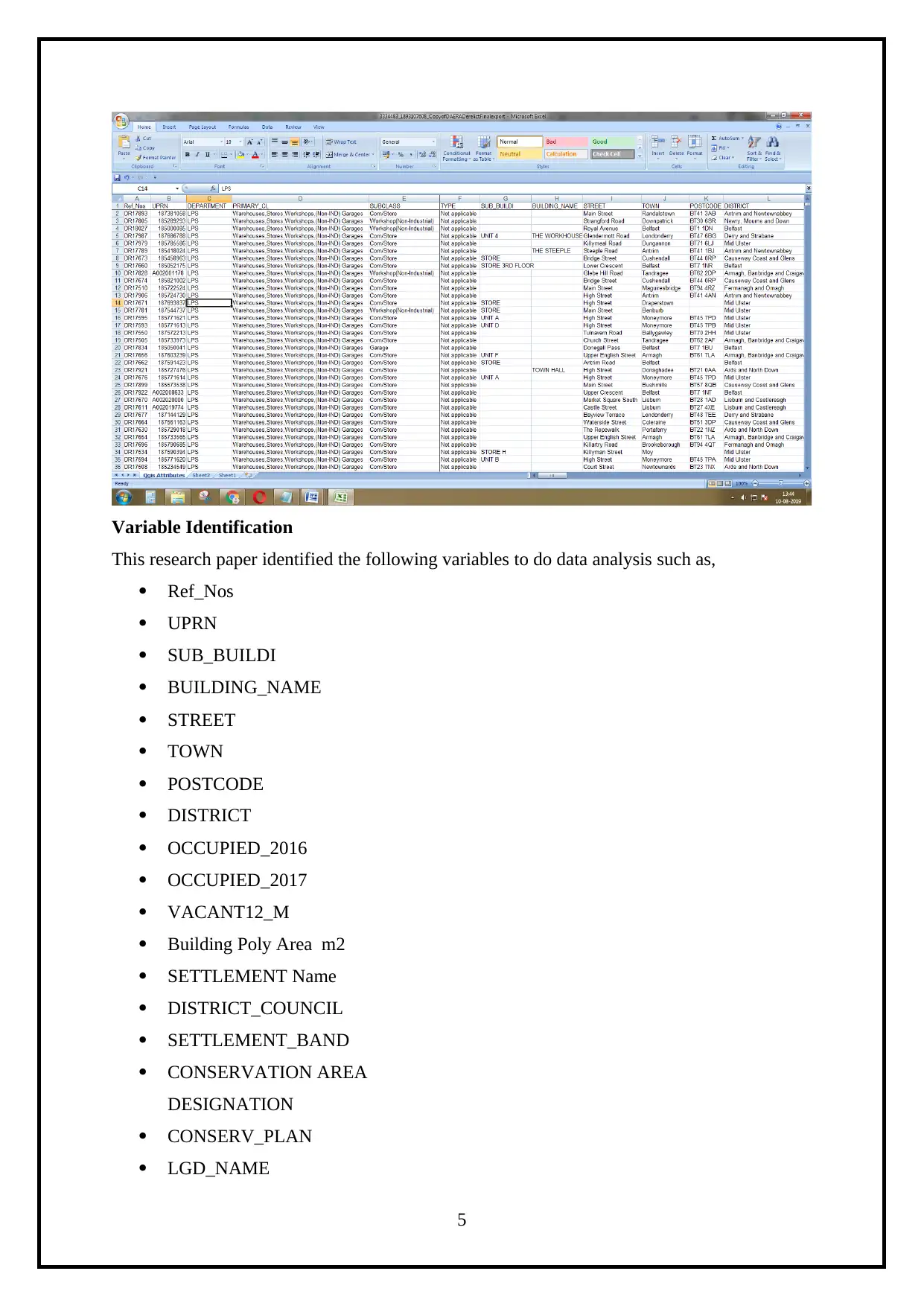
area by using the SPSS statistics tool. The collected data is illustrated as below.
4
tabler-icon-diamond-filled.svg

Paraphrase This Document

Need a fresh take? Get an instant paraphrase of this document with our AI Paraphraser
Document Page
Variable Identification
This research paper identified the following variables to do data analysis such as,
Ref_Nos
UPRN
SUB_BUILDI
BUILDING_NAME
STREET
TOWN
POSTCODE
DISTRICT
OCCUPIED_2016
OCCUPIED_2017
VACANT12_M
Building Poly Area m2
SETTLEMENT Name
DISTRICT_COUNCIL
SETTLEMENT_BAND
CONSERVATION AREA
DESIGNATION
CONSERV_PLAN
LGD_NAME
5
Document Page
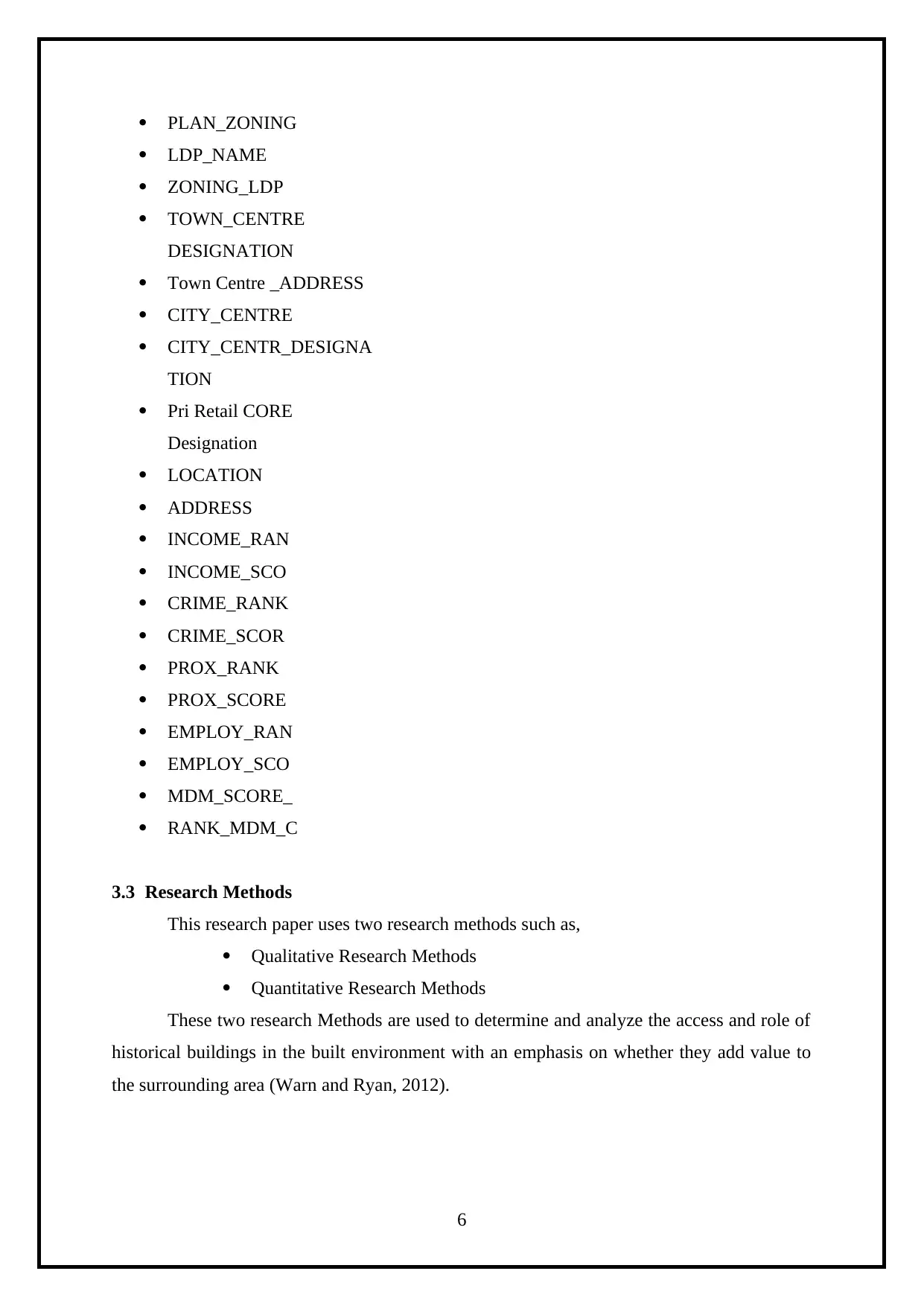
PLAN_ZONING
LDP_NAME
ZONING_LDP
TOWN_CENTRE
DESIGNATION
Town Centre _ADDRESS
CITY_CENTRE
CITY_CENTR_DESIGNA
TION
Pri Retail CORE
Designation
LOCATION
ADDRESS
INCOME_RAN
INCOME_SCO
CRIME_RANK
CRIME_SCOR
PROX_RANK
PROX_SCORE
EMPLOY_RAN
EMPLOY_SCO
MDM_SCORE_
RANK_MDM_C
3.3 Research Methods
This research paper uses two research methods such as,
Qualitative Research Methods
Quantitative Research Methods
These two research Methods are used to determine and analyze the access and role of
historical buildings in the built environment with an emphasis on whether they add value to
the surrounding area (Warn and Ryan, 2012).
6
Document Page
3.4 Participants and Procedures
This research paper uses the Participants and Procedures to analyze and determine the
access and role of historical buildings in the built environment with an emphasis on whether
they add value to the surrounding area. The Participants and procedures are identified by uses
the Quantitative and Qualitative methods and these are used to provide the data to determine
the historical buildings are added the value to the surrounding area.
4. References
Cabeza, L., de Gracia, A. and Pisello, A. (2018). Integration of renewable technologies in
historical and heritage buildings: A review. Energy and Buildings, 177, pp.96-111.
Pica, V. (2018). Beyond the Sendai Framework for Disaster Risk Reduction: Vulnerability
Reduction as a Challenge Involving Historical and Traditional Buildings. Buildings, 8(4),
p.50.
Warn, G. and Ryan, K. (2012). A Review of Seismic Isolation for Buildings: Historical
Development and Research Needs. Buildings, 2(3), pp.300-325.
7
chevron_up_icon
1 out of 7
circle_padding
hide_on_mobile
zoom_out_icon
[object Object]