Historical Analysis: Comparing the Reigns of Wu Zetian and Cleopatra
VerifiedAdded on 2021/12/29
|7
|1564
|31
Essay
AI Summary
This essay provides a comparative analysis of two prominent female rulers from ancient history: Wu Zetian, the only female emperor of China, and Cleopatra, the last pharaoh of Egypt. The essay explores their similarities, such as their intelligence, political acumen, and efforts to promote economic stability within their respective nations. It also highlights their differences, including their approaches to governance, cultural contexts, and the roles of women in their societies. The essay further examines the cultural differences between ancient China and Egypt, touching on aspects like art, architecture, and societal values. Modern-day examples of leadership are also discussed, drawing parallels between the ancient rulers and contemporary figures. Through this comparison, the essay offers insights into the complexities of leadership, the impact of gender on power, and the enduring legacies of these remarkable women. The essay concludes by emphasizing the significance of their reigns and their contributions to history.
Ancient Female Rulers
Paraphrase This Document
Need a fresh take? Get an instant paraphrase of this document with our AI Paraphraser

1
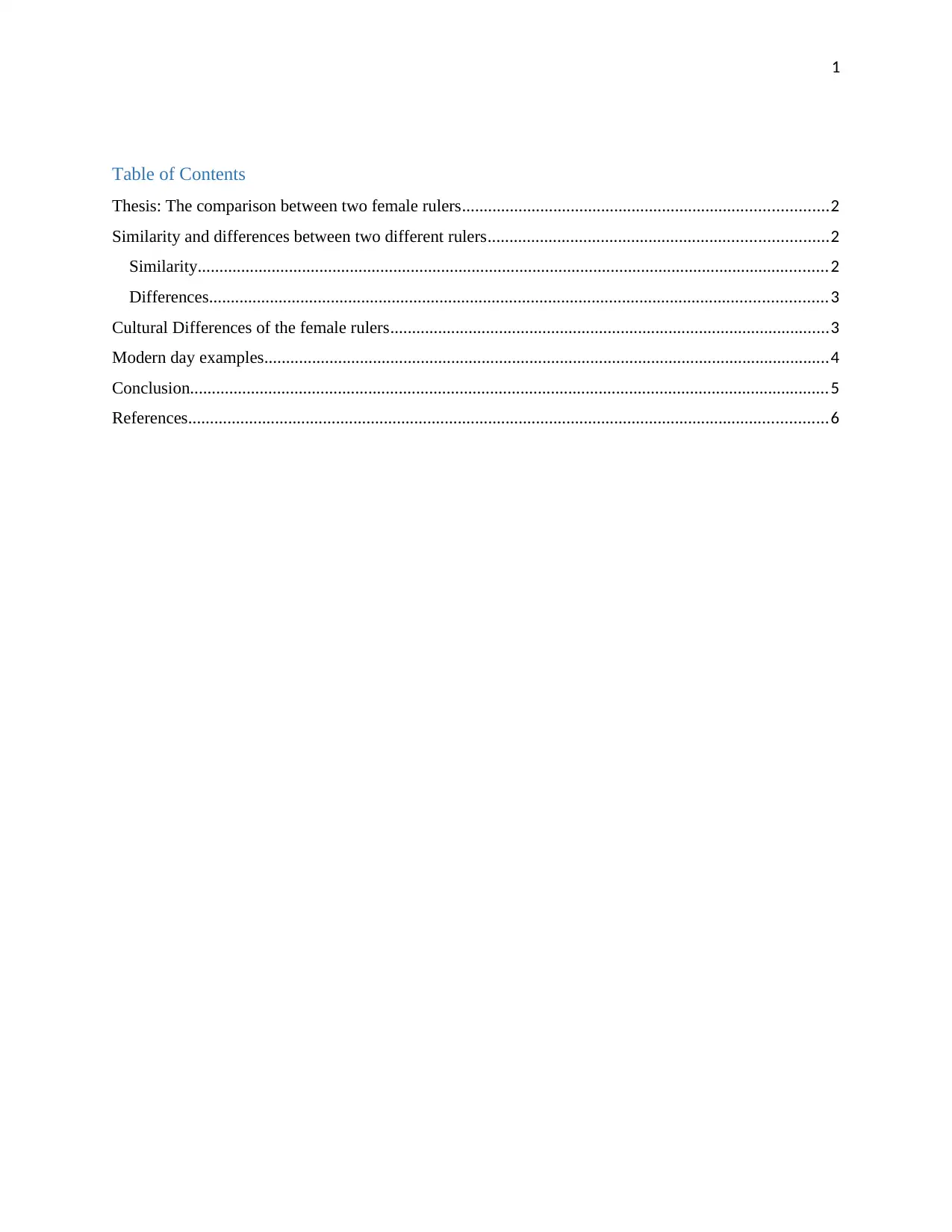
Table of Contents
Thesis: The comparison between two female rulers....................................................................................2
Similarity and differences between two different rulers..............................................................................2
Similarity.................................................................................................................................................2
Differences..............................................................................................................................................3
Cultural Differences of the female rulers.....................................................................................................3
Modern day examples..................................................................................................................................4
Conclusion...................................................................................................................................................5
References...................................................................................................................................................6
Table of Contents
Thesis: The comparison between two female rulers....................................................................................2
Similarity and differences between two different rulers..............................................................................2
Similarity.................................................................................................................................................2
Differences..............................................................................................................................................3
Cultural Differences of the female rulers.....................................................................................................3
Modern day examples..................................................................................................................................4
Conclusion...................................................................................................................................................5
References...................................................................................................................................................6

2
Thesis: The comparison between two female rulers
The comparative analysis is about two female rulers Tang Empress Wu Zetian also
known to be Wu Zhao and Pharaoh Cleopatra. Wu Zhao belonged to China, and she ruled around
690-705 AD, and on the other side Pharaoh Cleopatra belongs to Egypt, and she ruled around 51-
31 BC (Zhao, 2015). At that ancient time, nobody could even think that a female ruler can order,
but this two women initially did it even successfully.
The Tang Empress Wu Zetian was the first female ruler in 3000 years of Chinese history.
Even more amazing the fact that she was the most effective ruler of the Tang Dynasty and which
is also known as the golden era of Chinese history. Whereas Pharaoh Cleopatra was born in a
royal family and she was a part of Ptolemy Dynasty of Egypt (Didier, 2016). Cleopatra handed
power after the reign of her father Ptolemy XII. Pharaoh Cleopatra was the last Pharaoh ruler of
ancient Egypt.
Similarity and differences between two different rulers
Similarity
Both Wu Zhao and Pharaoh Cleopatra were powerful rulers of their time, Cleopatra was
in a royal family since her childhood, and on the same side, Queen Empress Wu also belonged to
the royal family. Cleopatra was more than a diplomat, an expert royal administrator, fluency of
different languages (Parthian and the language of Syrians, Arabs, Medes, and Ethiopian). As
same on the other side Wu Zetian was also mastered in writing, playing music and specialized in
the skills of conversation and interaction, this seems that both were socialistic and educated in
nature (Doran, 2017). Both have worked toward the public well-fare and establishing the
economic stability within their nation.
Wu Zhao improved the education system by bringing dedicated and highly educated
teacher and changing the bureaucracy and teaching methods. On the same side, Cleopatra’s reign
had a flourishing and smooth running economy and much more internal stability.
Both the female rulers Cleopatra and Wu Zhao expanded their territory and tackled many
wars, various internal problems and issues. Empress Wu Zhao gained territory to the south,
Thesis: The comparison between two female rulers
The comparative analysis is about two female rulers Tang Empress Wu Zetian also
known to be Wu Zhao and Pharaoh Cleopatra. Wu Zhao belonged to China, and she ruled around
690-705 AD, and on the other side Pharaoh Cleopatra belongs to Egypt, and she ruled around 51-
31 BC (Zhao, 2015). At that ancient time, nobody could even think that a female ruler can order,
but this two women initially did it even successfully.
The Tang Empress Wu Zetian was the first female ruler in 3000 years of Chinese history.
Even more amazing the fact that she was the most effective ruler of the Tang Dynasty and which
is also known as the golden era of Chinese history. Whereas Pharaoh Cleopatra was born in a
royal family and she was a part of Ptolemy Dynasty of Egypt (Didier, 2016). Cleopatra handed
power after the reign of her father Ptolemy XII. Pharaoh Cleopatra was the last Pharaoh ruler of
ancient Egypt.
Similarity and differences between two different rulers
Similarity
Both Wu Zhao and Pharaoh Cleopatra were powerful rulers of their time, Cleopatra was
in a royal family since her childhood, and on the same side, Queen Empress Wu also belonged to
the royal family. Cleopatra was more than a diplomat, an expert royal administrator, fluency of
different languages (Parthian and the language of Syrians, Arabs, Medes, and Ethiopian). As
same on the other side Wu Zetian was also mastered in writing, playing music and specialized in
the skills of conversation and interaction, this seems that both were socialistic and educated in
nature (Doran, 2017). Both have worked toward the public well-fare and establishing the
economic stability within their nation.
Wu Zhao improved the education system by bringing dedicated and highly educated
teacher and changing the bureaucracy and teaching methods. On the same side, Cleopatra’s reign
had a flourishing and smooth running economy and much more internal stability.
Both the female rulers Cleopatra and Wu Zhao expanded their territory and tackled many
wars, various internal problems and issues. Empress Wu Zhao gained territory to the south,
⊘ This is a preview!⊘
Do you want full access?
Subscribe today to unlock all pages.

Trusted by 1+ million students worldwide

3
north, and west but she did not lose any one of her territories. Same like Chinese Empress,
Cleopatra also acquired new territories, and she won against the Persian Empire.
Differences
The very similar difference was their nature of the ruling, Wu Zhao worked more on the
socialist problems like Education and land reforms whereas Cleopatra being expert administrator
more probably stabled the economic condition of their region. The difference was freedom of the
women to participate in the administrative work. During the reign, Wu's all female members
were not allowed in administrative work. Further Wu Zhao abolished all these beliefs and faiths
(Lu, 2014). On the other side, Egyptian women were given the right to participate in both the
political and administrative function.
There is no abidance in the history of Cleopatra being a tyrannical ruler, on the other side,
Empress Wu Zhao was an oppressor. Under the rule of Wu Zhao, everyone will have to appear
in exams for various superior and political position (Yu, Mills & Peng, 2018).
Wu died a natural and a peaceful death whereas Cleopatra died from suicide by the bite
of a cobra. After the death of Cleopatra Roman’s took her emperor whereas Chinese empire
stayed with their generation only.
Cultural Differences of the female rulers
Ancient Chinese culture is one of the oldest cultures about more than 5000 years older,
the Chinese culture is mainly diverse with lots of variety. The flourishing Chinese culture was
very rich in the Arts and science with high-class painting technique and excellent pottery and
sculpture. Whereas Egyptian culture is one of the earliest culture and also ancient Egypt was the
earliest civilization of the world (Peng, Yu & Mills, 2015). Egyptian culture is a mixed culture as
it was ruled by various rulers and influenced by Hellenism, Christianity and Islamic culture
which gives an idea about diversity in culture.
Both the culture differs in various aspects:
Renaissance
Art and architecture
north, and west but she did not lose any one of her territories. Same like Chinese Empress,
Cleopatra also acquired new territories, and she won against the Persian Empire.
Differences
The very similar difference was their nature of the ruling, Wu Zhao worked more on the
socialist problems like Education and land reforms whereas Cleopatra being expert administrator
more probably stabled the economic condition of their region. The difference was freedom of the
women to participate in the administrative work. During the reign, Wu's all female members
were not allowed in administrative work. Further Wu Zhao abolished all these beliefs and faiths
(Lu, 2014). On the other side, Egyptian women were given the right to participate in both the
political and administrative function.
There is no abidance in the history of Cleopatra being a tyrannical ruler, on the other side,
Empress Wu Zhao was an oppressor. Under the rule of Wu Zhao, everyone will have to appear
in exams for various superior and political position (Yu, Mills & Peng, 2018).
Wu died a natural and a peaceful death whereas Cleopatra died from suicide by the bite
of a cobra. After the death of Cleopatra Roman’s took her emperor whereas Chinese empire
stayed with their generation only.
Cultural Differences of the female rulers
Ancient Chinese culture is one of the oldest cultures about more than 5000 years older,
the Chinese culture is mainly diverse with lots of variety. The flourishing Chinese culture was
very rich in the Arts and science with high-class painting technique and excellent pottery and
sculpture. Whereas Egyptian culture is one of the earliest culture and also ancient Egypt was the
earliest civilization of the world (Peng, Yu & Mills, 2015). Egyptian culture is a mixed culture as
it was ruled by various rulers and influenced by Hellenism, Christianity and Islamic culture
which gives an idea about diversity in culture.
Both the culture differs in various aspects:
Renaissance
Art and architecture
Paraphrase This Document
Need a fresh take? Get an instant paraphrase of this document with our AI Paraphraser

4
Literature
Music
Festivals
Modern day examples
First choice (For male rulers)
Among the American heroes, Abraham Lincoln the 16th president of United States of
America and a self-taught lawyer, legislator, and vocal assistant. He was the best president
according to Historian Survey of President Leadership. He has the best presidential leadership
qualities like crisis leadership, economic management, and moral qualities. He is an inspiration
for me all the time.
Second choice (For female rulers)
Talking about the ancient female rulers and it has been seen that how they have ruled
their kingdom and manages their political, social, and administrative responsibility. In the
modern example Michelle Obama, she was the best example as she served the society in various
causes, notably supporting the military families and ending childhood obesity (Ropp, 2015). She
also promoted a healthy eating environment among the people.
For sculptures
Tajmahal, one of the world's seven wonders which inspires me all the time as being the
symbol of love and gives the rich historical idea of Mughal Dynasty. That monument was made
by Shah-Jahan a Mughal emperor in remembrance of his wife Mumtaz (Woodside, 2018).
Since all the given examples are the brief detail of modern-day examples that inspire me
in every single time.
Literature
Music
Festivals
Modern day examples
First choice (For male rulers)
Among the American heroes, Abraham Lincoln the 16th president of United States of
America and a self-taught lawyer, legislator, and vocal assistant. He was the best president
according to Historian Survey of President Leadership. He has the best presidential leadership
qualities like crisis leadership, economic management, and moral qualities. He is an inspiration
for me all the time.
Second choice (For female rulers)
Talking about the ancient female rulers and it has been seen that how they have ruled
their kingdom and manages their political, social, and administrative responsibility. In the
modern example Michelle Obama, she was the best example as she served the society in various
causes, notably supporting the military families and ending childhood obesity (Ropp, 2015). She
also promoted a healthy eating environment among the people.
For sculptures
Tajmahal, one of the world's seven wonders which inspires me all the time as being the
symbol of love and gives the rich historical idea of Mughal Dynasty. That monument was made
by Shah-Jahan a Mughal emperor in remembrance of his wife Mumtaz (Woodside, 2018).
Since all the given examples are the brief detail of modern-day examples that inspire me
in every single time.

5
Conclusion
The comparison critically gives a brief idea about both Empress Wu Zhao, and Queen
Cleopatra's names will live on forever. At the time when the nation needed their best ruler, they
chose to rise at that occasion. They removed the gender comparison and gives the equal rights
for every citizen, both the Empress were a spark for the nation. The Chinese empress abolished
many such traditions like "a husband can marry twice, but after his death, the society stopped her
wife to remarry." Wu Zhao marked a climax which almost impossible to reach again. Both the
culture shows the variance in term of diversity and complexity, Egypt is the most ancient
civilization with the different mixed culture like Christianity and Islam but whereas Chinese
being very rich in term of art, culture, and music. So, both nations have different culture and
tradition and some immense rich historic culture.
Conclusion
The comparison critically gives a brief idea about both Empress Wu Zhao, and Queen
Cleopatra's names will live on forever. At the time when the nation needed their best ruler, they
chose to rise at that occasion. They removed the gender comparison and gives the equal rights
for every citizen, both the Empress were a spark for the nation. The Chinese empress abolished
many such traditions like "a husband can marry twice, but after his death, the society stopped her
wife to remarry." Wu Zhao marked a climax which almost impossible to reach again. Both the
culture shows the variance in term of diversity and complexity, Egypt is the most ancient
civilization with the different mixed culture like Christianity and Islam but whereas Chinese
being very rich in term of art, culture, and music. So, both nations have different culture and
tradition and some immense rich historic culture.
⊘ This is a preview!⊘
Do you want full access?
Subscribe today to unlock all pages.

Trusted by 1+ million students worldwide

6
References
Didier, J. C. (2016). Response to Michael Saso's Review of In and Outside the Square: The Sky
and the Power of Belief in Ancient China and the World, c. 4500 bc-ad 200, 3 Volumes,
Sino-Platonic Papers, No. 192, in China Review International vol. 16, no. 4
(2009). China Review International, 23(1), 41-50.
Doran, R. (2017). How the Yue Yi lun Was Lost: Calligraphy, the Cultural Legacy, and Tang
Women Rulers. Frontiers of Literary Studies in China, 11(3), 427-461.
Lu, L. U. (2014). On the Social Ethics and Reality During the Reign of Empress Wu——From
the Perspective of Women, Society, and Family. Journal of Kaifeng University, 1, 011.
Peng, N., Yu, T., & Mills, A. (2015). Feminist thinking in late seventh-century China: A critical
hermeneutics analysis of the case of Wu Zetian. Equality, Diversity, and Inclusion: An
International Journal, 34(1), 67-83.
Ropp, P. S. (2015). China's Palace Women through the Dynasties. China Review
International, 22(1), 1-16.
Woodside, A. (2018). Territorial order and collective-identity tensions in Confucian Asia: China,
Vietnam, Korea. In Public spheres and collective identities (pp. 191-220). Routledge.
Yu, T., Mills, A. J., & Peng, N. (2018). A reflexive critique of a critical hermeneutics analysis of
Wu Zetian. Qualitative Research in Organizations and Management: An International
Journal, 13(3), 250-260.
Zhao, S. (2015). Rethinking the Chinese World Order: the imperial cycle and the rise of
China. Journal of contemporary China, 24(96), 961-982.
References
Didier, J. C. (2016). Response to Michael Saso's Review of In and Outside the Square: The Sky
and the Power of Belief in Ancient China and the World, c. 4500 bc-ad 200, 3 Volumes,
Sino-Platonic Papers, No. 192, in China Review International vol. 16, no. 4
(2009). China Review International, 23(1), 41-50.
Doran, R. (2017). How the Yue Yi lun Was Lost: Calligraphy, the Cultural Legacy, and Tang
Women Rulers. Frontiers of Literary Studies in China, 11(3), 427-461.
Lu, L. U. (2014). On the Social Ethics and Reality During the Reign of Empress Wu——From
the Perspective of Women, Society, and Family. Journal of Kaifeng University, 1, 011.
Peng, N., Yu, T., & Mills, A. (2015). Feminist thinking in late seventh-century China: A critical
hermeneutics analysis of the case of Wu Zetian. Equality, Diversity, and Inclusion: An
International Journal, 34(1), 67-83.
Ropp, P. S. (2015). China's Palace Women through the Dynasties. China Review
International, 22(1), 1-16.
Woodside, A. (2018). Territorial order and collective-identity tensions in Confucian Asia: China,
Vietnam, Korea. In Public spheres and collective identities (pp. 191-220). Routledge.
Yu, T., Mills, A. J., & Peng, N. (2018). A reflexive critique of a critical hermeneutics analysis of
Wu Zetian. Qualitative Research in Organizations and Management: An International
Journal, 13(3), 250-260.
Zhao, S. (2015). Rethinking the Chinese World Order: the imperial cycle and the rise of
China. Journal of contemporary China, 24(96), 961-982.
1 out of 7
Your All-in-One AI-Powered Toolkit for Academic Success.
+13062052269
info@desklib.com
Available 24*7 on WhatsApp / Email
Unlock your academic potential
Copyright © 2020–2026 A2Z Services. All Rights Reserved. Developed and managed by ZUCOL.