Essay on Historical Globalization: Readings, Analysis, and Discussion

Verified

Added on  2023/03/17

|4
|439
|21
Essay
AI Summary
This essay provides an analysis of historical globalization, drawing on readings by Jervis, Appiah, and Bin Laden, along with insights into the Cold War and the rise of ideologies like Bolshevism and fascism. The essay explores the role of the United States in shaping global democracy, the impact of cultural integration, and the perspectives of different actors on global events. It examines the concepts of hegemonic power and the dynamics of ideological violence, including the emergence of western liberal democracy and economic liberalism. The essay further delves into the context of Al Qaeda's fatwa in 1998 and discusses the historical events. The student has provided a comprehensive overview of the topic, citing relevant references and demonstrating an understanding of the complex forces that have shaped the global landscape since 1500.
Document Page
Historical Globalization1
Students’ Name
Professor
Course
Date
Historical Globalization
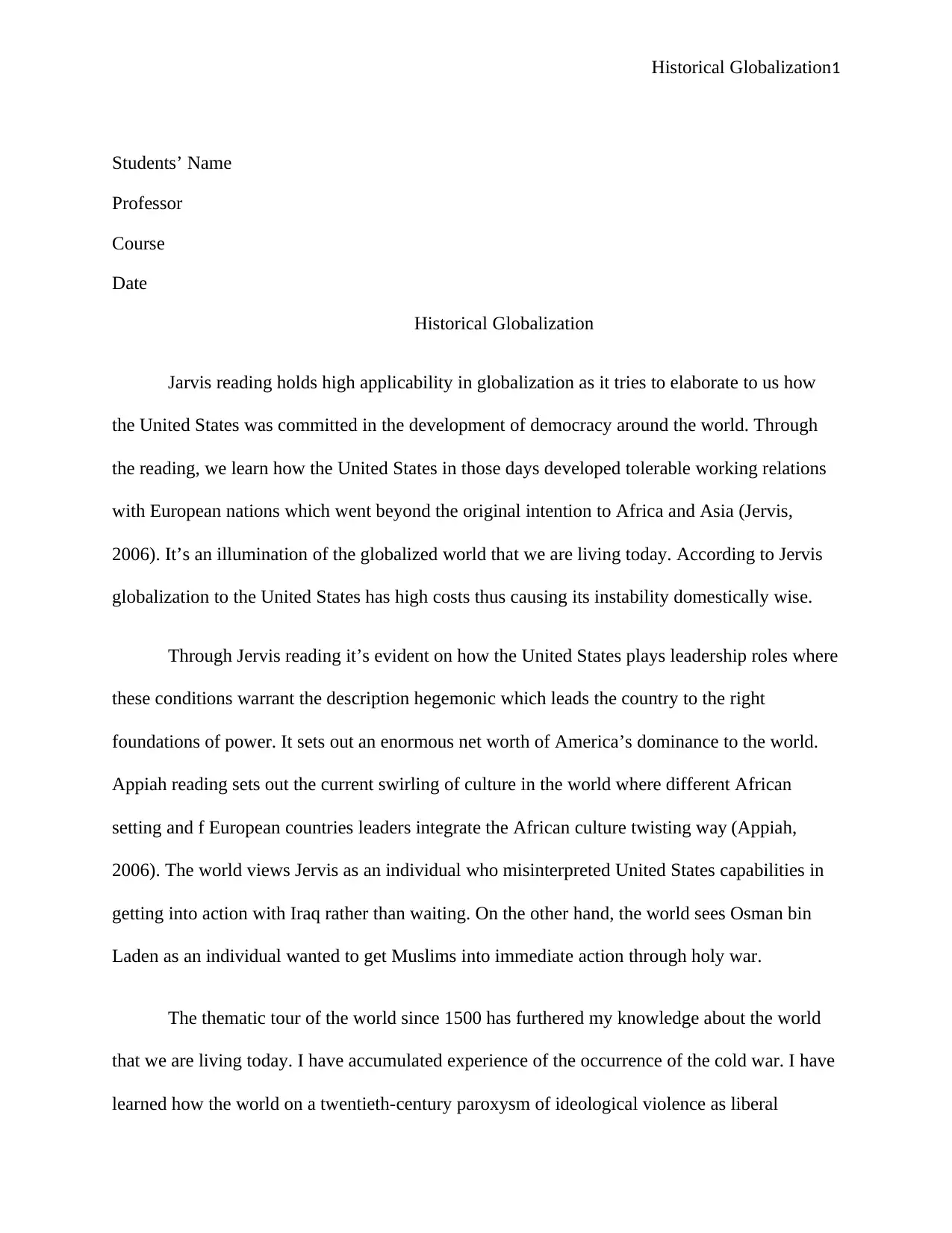
Jarvis reading holds high applicability in globalization as it tries to elaborate to us how
the United States was committed in the development of democracy around the world. Through
the reading, we learn how the United States in those days developed tolerable working relations
with European nations which went beyond the original intention to Africa and Asia (Jervis,
2006). It’s an illumination of the globalized world that we are living today. According to Jervis
globalization to the United States has high costs thus causing its instability domestically wise.
Through Jervis reading it’s evident on how the United States plays leadership roles where
these conditions warrant the description hegemonic which leads the country to the right
foundations of power. It sets out an enormous net worth of America’s dominance to the world.
Appiah reading sets out the current swirling of culture in the world where different African
setting and f European countries leaders integrate the African culture twisting way (Appiah,
2006). The world views Jervis as an individual who misinterpreted United States capabilities in
getting into action with Iraq rather than waiting. On the other hand, the world sees Osman bin
Laden as an individual wanted to get Muslims into immediate action through holy war.
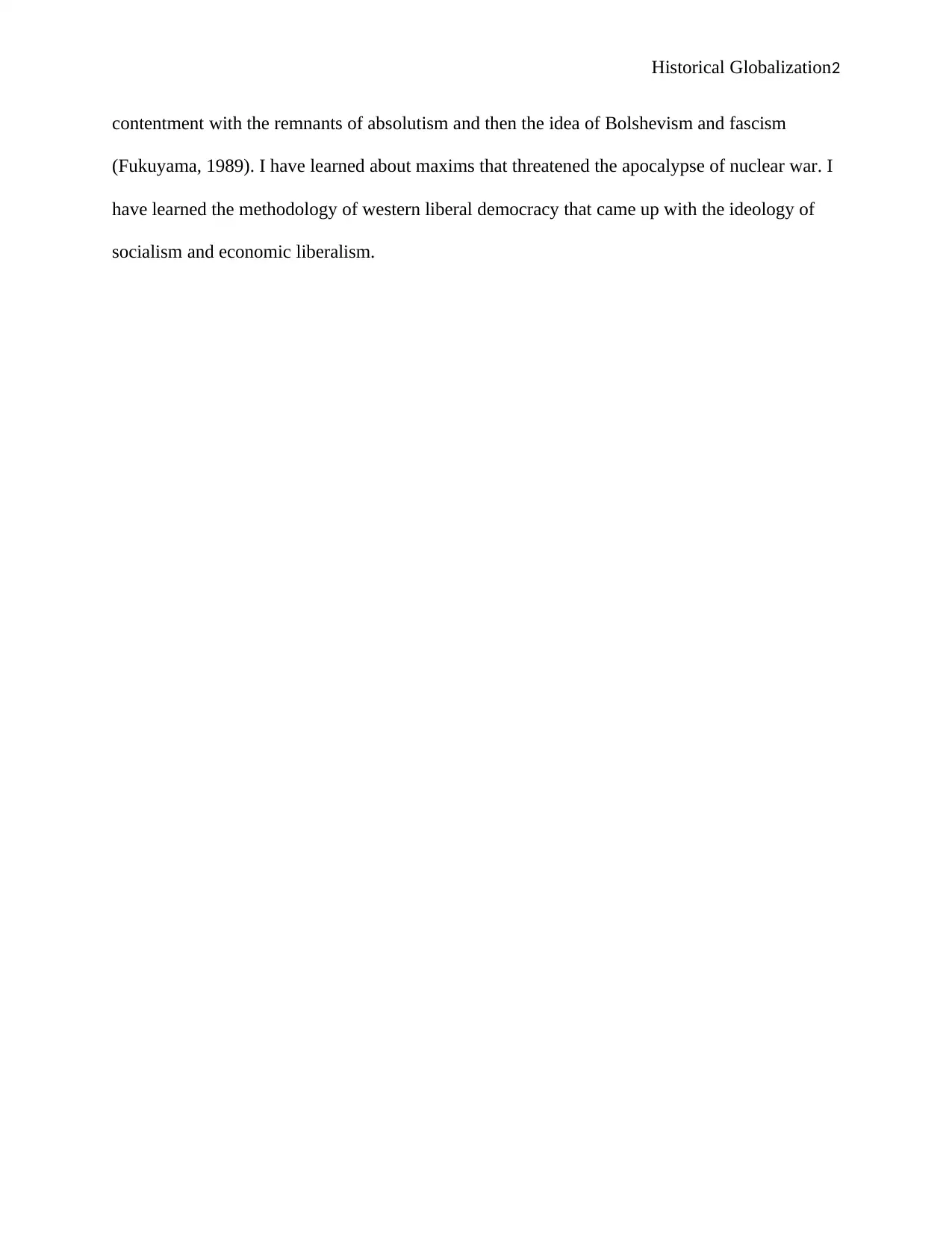
The thematic tour of the world since 1500 has furthered my knowledge about the world
that we are living today. I have accumulated experience of the occurrence of the cold war. I have
learned how the world on a twentieth-century paroxysm of ideological violence as liberal
tabler-icon-diamond-filled.svg

Paraphrase This Document

Need a fresh take? Get an instant paraphrase of this document with our AI Paraphraser
Document Page
Historical Globalization2
contentment with the remnants of absolutism and then the idea of Bolshevism and fascism
(Fukuyama, 1989). I have learned about maxims that threatened the apocalypse of nuclear war. I
have learned the methodology of western liberal democracy that came up with the ideology of
socialism and economic liberalism.
Document Page
Historical Globalization3
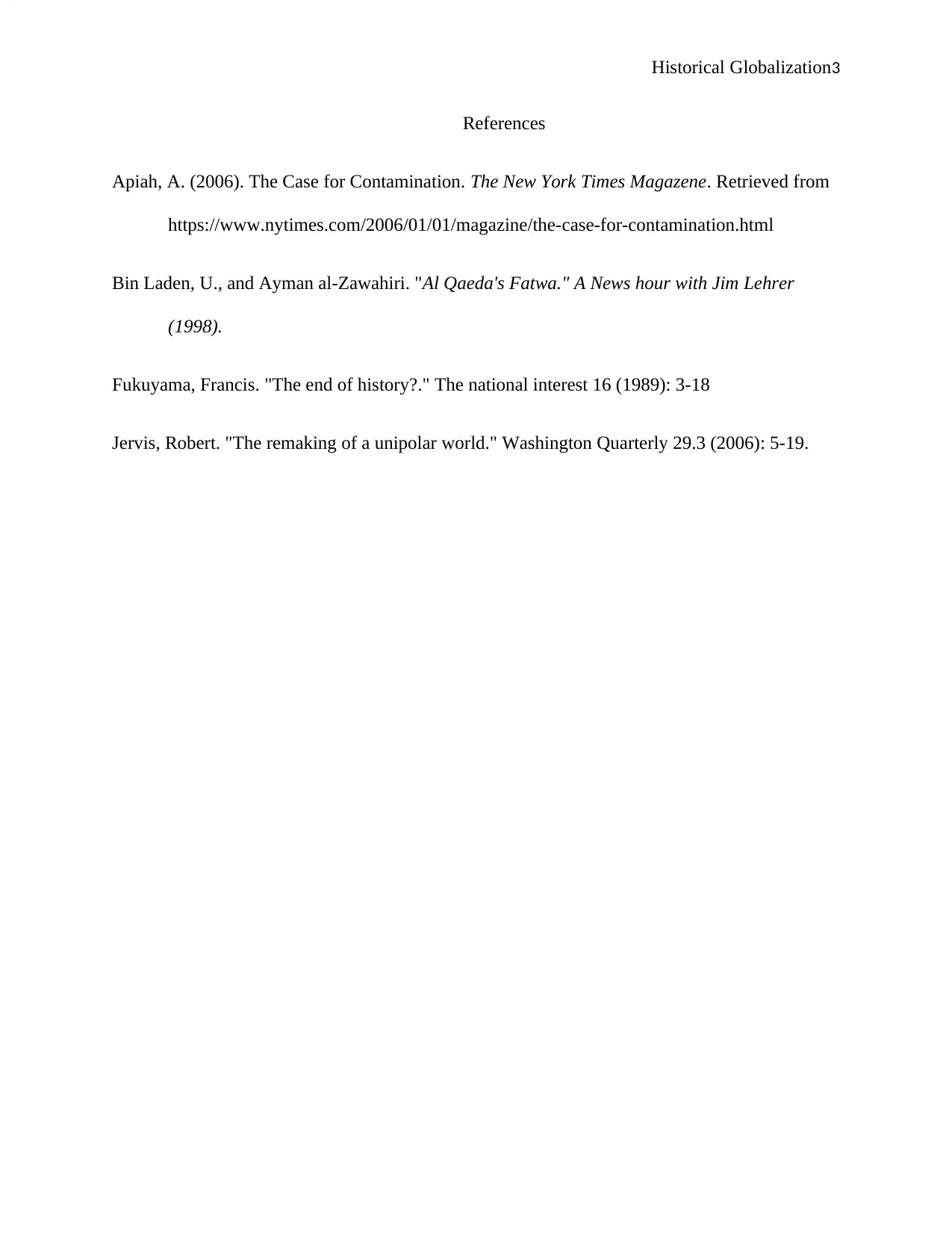
References
Apiah, A. (2006). The Case for Contamination. The New York Times Magazene. Retrieved from
https://www.nytimes.com/2006/01/01/magazine/the-case-for-contamination.html
Bin Laden, U., and Ayman al-Zawahiri. "Al Qaeda's Fatwa." A News hour with Jim Lehrer
(1998).
Fukuyama, Francis. "The end of history?." The national interest 16 (1989): 3-18
Jervis, Robert. "The remaking of a unipolar world." Washington Quarterly 29.3 (2006): 5-19.
Document Page
Historical Globalization4
chevron_up_icon
1 out of 4
circle_padding
hide_on_mobile
zoom_out_icon
[object Object]