University History 10: Medieval Europe Social Relations and Feudalism
VerifiedAdded on 2022/09/05
|12
|2623
|30
Report
AI Summary
This report delves into the social dynamics of medieval Europe, with a primary focus on the profound influence of feudalism. It explores how feudalism reshaped social relationships, created hierarchies, and impacted political structures. The report investigates key research questions, including the effects of political divisions and urbanization on social relations. A comprehensive literature review examines the evolution of these relations, drawing upon historical texts and scholarly works. The methodology involves a semi-experimental design, utilizing qualitative data from secondary sources such as books, journals, and historical records. Ethical considerations and potential challenges in the research process are also discussed. The expected outcome is to reveal how feudalism dismantled the medieval European social structure, providing insights into the rise and growth of this system. The report aims to contribute to a deeper understanding of medieval society and its internal conflicts, supported by a timeline outlining the research process.
Running head: HISTORY
History
Name of the Student
Name of the University
Author Note
History
Name of the Student
Name of the University
Author Note

Paraphrase This Document
Need a fresh take? Get an instant paraphrase of this document with our AI Paraphraser
1HISTORY
Table of Contents
Introduction......................................................................................................................................2
Research Questions..........................................................................................................................2
Literature Review............................................................................................................................2
Research Methodology....................................................................................................................6
Timeline...........................................................................................................................................7
Ethical considerations......................................................................................................................8
Expected Outcome...........................................................................................................................8
Bibliography..................................................................................................................................10
Table of Contents
Introduction......................................................................................................................................2
Research Questions..........................................................................................................................2
Literature Review............................................................................................................................2
Research Methodology....................................................................................................................6
Timeline...........................................................................................................................................7
Ethical considerations......................................................................................................................8
Expected Outcome...........................................................................................................................8
Bibliography..................................................................................................................................10
2HISTORY
Introduction
Social relations have always been a central part of the European society in the medieval
age where the most dominant factor was the feudalism. It has gained momentum for the research
works in the recent times. The background of this research lies in the impact of the feudalism on
the social relationships between the people. The feudal states dominated the social structure for a
long period of time and the kind of social relations kept on changing under the leading qualities
of the different feudal lords (Ward, 2016). The research will aim at revealing the different types
of the social relationships that existed in the medieval times and how the social relationships had
differed compared to the ancient times. It is also important to note in this research work that the
instability and fragmentation in the social relations occurred due to political divisions between
people.
Research Questions
How did the feudalism change the entire structure of the social relations in medieval
Europe?
Did the political divisions play a major role in the change of social relationships after the
advent of feudalism?
Did the social factors influence the growth and dominance of feudalism in the society?
Were the feudal lords responsible for dictating the social relationships?
Did the urbanization in medieval Europe improve the nature of the social relations?
Literature Review
The discussion on the social relations during the medieval period in Europe goes through
many points. According to the critics, this was the time when the entire nature of the social
Introduction
Social relations have always been a central part of the European society in the medieval
age where the most dominant factor was the feudalism. It has gained momentum for the research
works in the recent times. The background of this research lies in the impact of the feudalism on
the social relationships between the people. The feudal states dominated the social structure for a
long period of time and the kind of social relations kept on changing under the leading qualities
of the different feudal lords (Ward, 2016). The research will aim at revealing the different types
of the social relationships that existed in the medieval times and how the social relationships had
differed compared to the ancient times. It is also important to note in this research work that the
instability and fragmentation in the social relations occurred due to political divisions between
people.
Research Questions
How did the feudalism change the entire structure of the social relations in medieval
Europe?
Did the political divisions play a major role in the change of social relationships after the
advent of feudalism?
Did the social factors influence the growth and dominance of feudalism in the society?
Were the feudal lords responsible for dictating the social relationships?
Did the urbanization in medieval Europe improve the nature of the social relations?
Literature Review
The discussion on the social relations during the medieval period in Europe goes through
many points. According to the critics, this was the time when the entire nature of the social
⊘ This is a preview!⊘
Do you want full access?
Subscribe today to unlock all pages.

Trusted by 1+ million students worldwide
3HISTORY
relations began to evolve in Europe (Ward, 2016). In this context, it must be said that the
urbanization was the first thing that was done in the European society. Many scholars have said
that the medievalism has been one of the most important factors that changed the complete
scenario in the society. There are several reasons as to why feudalism had a very deep impact on
the society (Pirenne, 2015). These things are basically the economic and political reasons. Due to
the feudal system, the levels of production began to increase but it did not favor the farmers at
all. The scenario changed furthermore after the industrial revolution took place in England. Still.
The question comes round again regarding the impact of the feudalism on society (Reynolds,
2015).
This research proposal will look to find how why the structure of feudalism was able to
create such a vast impact on the entire social structure. Critics have researched and found out in
the earlier times that feudal system in the European society brought a drastic change in the social
relations. In the earlier times, people used to mix freely and there was very little concept of
social hierarchy present. As a matter of fact it was almost unthinkable for people to work under
one another and get limited access to the social productivity. The research will seek to find how
the feudal lords created a hierarchy in the society that had existed for a long time (Pirenne,
2015). This research will also expose the complications that had existed in the society and
determined the various types of social relations (Bachrach & Bachrach, 2016). It will be better to
explain the meaning of the term ‘feudalism’ before the remaining parts of the research are
conducted. As per the historians have recorded, the term feudalism has derived from the word
fief. The conditional services are granted through contracts within the feudal society.
Various sources have found that political divisions had been very critical in deciding the
role of the feudal lords in shaping the society properly. This was the basic way of leading the
relations began to evolve in Europe (Ward, 2016). In this context, it must be said that the
urbanization was the first thing that was done in the European society. Many scholars have said
that the medievalism has been one of the most important factors that changed the complete
scenario in the society. There are several reasons as to why feudalism had a very deep impact on
the society (Pirenne, 2015). These things are basically the economic and political reasons. Due to
the feudal system, the levels of production began to increase but it did not favor the farmers at
all. The scenario changed furthermore after the industrial revolution took place in England. Still.
The question comes round again regarding the impact of the feudalism on society (Reynolds,
2015).
This research proposal will look to find how why the structure of feudalism was able to
create such a vast impact on the entire social structure. Critics have researched and found out in
the earlier times that feudal system in the European society brought a drastic change in the social
relations. In the earlier times, people used to mix freely and there was very little concept of
social hierarchy present. As a matter of fact it was almost unthinkable for people to work under
one another and get limited access to the social productivity. The research will seek to find how
the feudal lords created a hierarchy in the society that had existed for a long time (Pirenne,
2015). This research will also expose the complications that had existed in the society and
determined the various types of social relations (Bachrach & Bachrach, 2016). It will be better to
explain the meaning of the term ‘feudalism’ before the remaining parts of the research are
conducted. As per the historians have recorded, the term feudalism has derived from the word
fief. The conditional services are granted through contracts within the feudal society.
Various sources have found that political divisions had been very critical in deciding the
role of the feudal lords in shaping the society properly. This was the basic way of leading the
Paraphrase This Document
Need a fresh take? Get an instant paraphrase of this document with our AI Paraphraser
4HISTORY
society, politics and economy in the society. Critics have confirmed that the social structure in
ancient Europe did not have such type of organized hierarchical system (Hadley, 2015).
Therefore, this gradual shift had created a huge impact on the relations between people and the
government. The government was also influenced by the political systems. Through the research
work, the natures of these political influences will be studied (Davis, 2014). The political
influences are immense since the lords and barons were the most powerful people in the system.
The power and control of the society was in their hands. They shaped the social relations
properly. However, the feudal system had completely broken down but the social relations took
some time to change and evolve in the modern times (Lepage, 2014).
In the words of the critics, the social relations were diversified because the feudal lords
never wanted to form the government in the unified way (Gilsdorf, 2014). As the lands had been
divided into smaller sections, lords gave very little power for the knights and other people lower
than them in the ranks. The social relations between these barons, feudal lords, knights and
others were not at all friendly at different points (Hadley, 2015). Through this research work, it
will also be found out how the social systems had been designed by the feudal lords in a planned
manner so the conflicts between people will help them. On the other hand, some critics have
contradicted on this point. They opine that this feudal structure brought parity in the society and
gave a new meaning to social relations (Goodich, 2015). The financial conditions of the
medieval Europe were somewhat devastated and local customs were abolished by the pressures
of the lords and barons in this feudal system.
According to the critics, the impact of the urbanization must be discussed in this context.
The urban regions began to flourish but it was all because of the influences from the barons. The
barons did all the things for their interest only (Brown & Górecki, 2017). Another problem that
society, politics and economy in the society. Critics have confirmed that the social structure in
ancient Europe did not have such type of organized hierarchical system (Hadley, 2015).
Therefore, this gradual shift had created a huge impact on the relations between people and the
government. The government was also influenced by the political systems. Through the research
work, the natures of these political influences will be studied (Davis, 2014). The political
influences are immense since the lords and barons were the most powerful people in the system.
The power and control of the society was in their hands. They shaped the social relations
properly. However, the feudal system had completely broken down but the social relations took
some time to change and evolve in the modern times (Lepage, 2014).
In the words of the critics, the social relations were diversified because the feudal lords
never wanted to form the government in the unified way (Gilsdorf, 2014). As the lands had been
divided into smaller sections, lords gave very little power for the knights and other people lower
than them in the ranks. The social relations between these barons, feudal lords, knights and
others were not at all friendly at different points (Hadley, 2015). Through this research work, it
will also be found out how the social systems had been designed by the feudal lords in a planned
manner so the conflicts between people will help them. On the other hand, some critics have
contradicted on this point. They opine that this feudal structure brought parity in the society and
gave a new meaning to social relations (Goodich, 2015). The financial conditions of the
medieval Europe were somewhat devastated and local customs were abolished by the pressures
of the lords and barons in this feudal system.
According to the critics, the impact of the urbanization must be discussed in this context.
The urban regions began to flourish but it was all because of the influences from the barons. The
barons did all the things for their interest only (Brown & Górecki, 2017). Another problem that
5HISTORY
was associated with feudalism was that the ranks became hereditary. It was because of feudalism
that social relations between people deteriorated. A nobleman of lesser rank had to show the
loyalty to his seniors for his entire life. All these systems had worked as a large barrier for the
economic growth in the society. The noblemen could not change their occupations without
permission from their barons. Thus, it was completely a hammer blow to construct a friendly
atmosphere in the social relations (Lynch, 2019). The allegiance and loyalty of the knights did
not provide any favor to them in the future. The farmers or the serfs did not have any facilities
being provided to them. They were left very poor and sometimes they had to work very hard to
earn and serve two dukes simultaneously. In turn, this kind of situation resulted in the conflicts
between the two dukes (Frank, 2016).
Some critics are of the opinion that people showed no loyalty towards any specific
geographic region (Brown & Górecki, 2017). They had to be loyal to one person only. The
absence of the unified or centralized government structure gave rise to the regional conflicts
during the medieval society. The method of social relations is now arranged between the citizens
of a country and the nation-state itself. On the contrary the kind of social relations that existed
through the government of the region where it was arranged only between the individuals. It was
a commonplace tradition in the region that the conflicts between dukes, barons and earls would
occur for their ownership over the lands. The data will be collected in this research work from
the historical texts that will support the claims in this literature review.
The political influence was also very critical in the works of the clergymen. The medieval
scholars have clarified that there were three types of categories among people in the society.
These were bellatores, labores and oratores (Lynch, 2019). When studied about this matter very
closely, one would definitely found the disparity in the social hierarchy. The religious orators or
was associated with feudalism was that the ranks became hereditary. It was because of feudalism
that social relations between people deteriorated. A nobleman of lesser rank had to show the
loyalty to his seniors for his entire life. All these systems had worked as a large barrier for the
economic growth in the society. The noblemen could not change their occupations without
permission from their barons. Thus, it was completely a hammer blow to construct a friendly
atmosphere in the social relations (Lynch, 2019). The allegiance and loyalty of the knights did
not provide any favor to them in the future. The farmers or the serfs did not have any facilities
being provided to them. They were left very poor and sometimes they had to work very hard to
earn and serve two dukes simultaneously. In turn, this kind of situation resulted in the conflicts
between the two dukes (Frank, 2016).
Some critics are of the opinion that people showed no loyalty towards any specific
geographic region (Brown & Górecki, 2017). They had to be loyal to one person only. The
absence of the unified or centralized government structure gave rise to the regional conflicts
during the medieval society. The method of social relations is now arranged between the citizens
of a country and the nation-state itself. On the contrary the kind of social relations that existed
through the government of the region where it was arranged only between the individuals. It was
a commonplace tradition in the region that the conflicts between dukes, barons and earls would
occur for their ownership over the lands. The data will be collected in this research work from
the historical texts that will support the claims in this literature review.
The political influence was also very critical in the works of the clergymen. The medieval
scholars have clarified that there were three types of categories among people in the society.
These were bellatores, labores and oratores (Lynch, 2019). When studied about this matter very
closely, one would definitely found the disparity in the social hierarchy. The religious orators or
⊘ This is a preview!⊘
Do you want full access?
Subscribe today to unlock all pages.
Trusted by 1+ million students worldwide
6HISTORY
clergymen had no voice of their own (Njenga, 2015). They were controlled by the aristocratic
people or barons. In the mid level, laborers and farmers did not share a good social relation with
the aristocrats. They were trampled by the power of the barons and dukes. These three sections
of the society were called the Three Estates of Feudalism (Walsham, 2016). The mentions of
the social relations and social hierarchy have been found in the medieval literature as well.
Various authors of the medieval period have described about the characteristic features of
feudalism and its impact on the social relations in Europe. This research work will definitely
contribute to understanding the society that existed during medieval period and internal conflicts
that were associated with it (Naismith, 2014). It is well justified that the research objectives will
be achieved through consulting the effective resources.
Research Methodology
The research design to this proposal will be done in the semi-experimental types. The
experiments will be done on the different types of social structures that existed in Europe during
the medieval times. The qualitative data will be collected from the various secondary sources.
These secondary sources will include the books, magazines on medieval Europe, journals and
articles, historical records. Some books that will be consulted in regards to the method of
research are Chaucer’s Canterbury Tales and other books named Vox Clamantis and Confessio
Amantis.
Different types of academic journals will be consulted to support the claims already made
in the literature review section. The above mentioned books will serve as the primary sources in
this research work. The questionnaires will be made to understand the opinions of the modern
historians and what they think about the entire scenario. The pictures from the museum will also
clergymen had no voice of their own (Njenga, 2015). They were controlled by the aristocratic
people or barons. In the mid level, laborers and farmers did not share a good social relation with
the aristocrats. They were trampled by the power of the barons and dukes. These three sections
of the society were called the Three Estates of Feudalism (Walsham, 2016). The mentions of
the social relations and social hierarchy have been found in the medieval literature as well.
Various authors of the medieval period have described about the characteristic features of
feudalism and its impact on the social relations in Europe. This research work will definitely
contribute to understanding the society that existed during medieval period and internal conflicts
that were associated with it (Naismith, 2014). It is well justified that the research objectives will
be achieved through consulting the effective resources.
Research Methodology
The research design to this proposal will be done in the semi-experimental types. The
experiments will be done on the different types of social structures that existed in Europe during
the medieval times. The qualitative data will be collected from the various secondary sources.
These secondary sources will include the books, magazines on medieval Europe, journals and
articles, historical records. Some books that will be consulted in regards to the method of
research are Chaucer’s Canterbury Tales and other books named Vox Clamantis and Confessio
Amantis.
Different types of academic journals will be consulted to support the claims already made
in the literature review section. The above mentioned books will serve as the primary sources in
this research work. The questionnaires will be made to understand the opinions of the modern
historians and what they think about the entire scenario. The pictures from the museum will also
Paraphrase This Document
Need a fresh take? Get an instant paraphrase of this document with our AI Paraphraser
7HISTORY
serve as the important primary sources to realize the negative impacts of feudalism on the social
relations in Europe. The periodicals, pamphlets and peer reviewed articles will also be used as
the secondary materials for this project. The opinions of the reputable authors and historians will
also be sought as well.
Timeline
Task Week
1
Week
2
Week
3
Week
4
Week
5
Week
6
Week
7
Week
8
Week
9
Topic selection for
research work
Conducting
literature review
Selection of the
proper methods
Collecting the data
Analyzing the data
to analyze and
interpret
Exploring the
research outcomes
Conclusion
Submission of the
project draft
serve as the important primary sources to realize the negative impacts of feudalism on the social
relations in Europe. The periodicals, pamphlets and peer reviewed articles will also be used as
the secondary materials for this project. The opinions of the reputable authors and historians will
also be sought as well.
Timeline
Task Week
1
Week
2
Week
3
Week
4
Week
5
Week
6
Week
7
Week
8
Week
9
Topic selection for
research work
Conducting
literature review
Selection of the
proper methods
Collecting the data
Analyzing the data
to analyze and
interpret
Exploring the
research outcomes
Conclusion
Submission of the
project draft
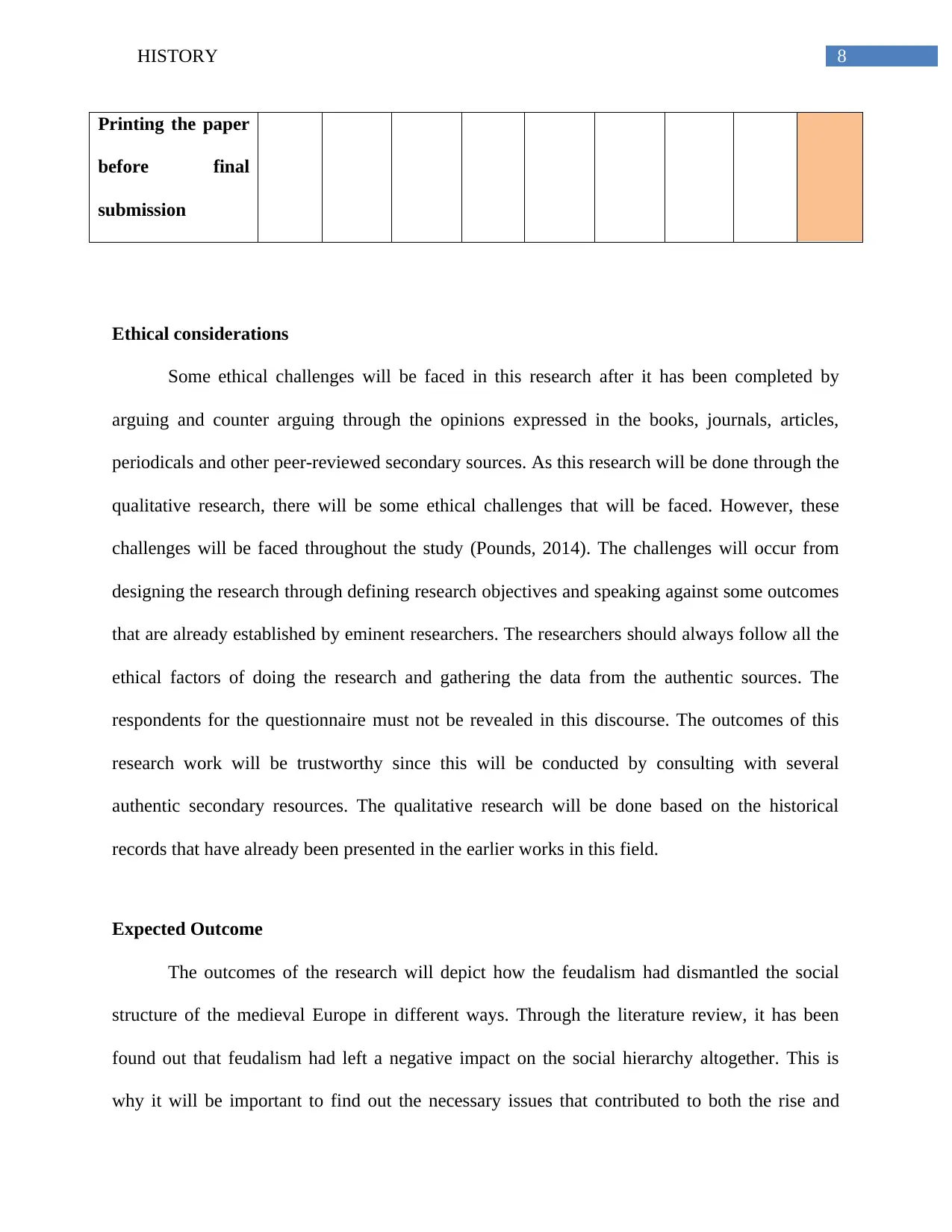
8HISTORY
Printing the paper
before final
submission
Ethical considerations
Some ethical challenges will be faced in this research after it has been completed by
arguing and counter arguing through the opinions expressed in the books, journals, articles,
periodicals and other peer-reviewed secondary sources. As this research will be done through the
qualitative research, there will be some ethical challenges that will be faced. However, these
challenges will be faced throughout the study (Pounds, 2014). The challenges will occur from
designing the research through defining research objectives and speaking against some outcomes
that are already established by eminent researchers. The researchers should always follow all the
ethical factors of doing the research and gathering the data from the authentic sources. The
respondents for the questionnaire must not be revealed in this discourse. The outcomes of this
research work will be trustworthy since this will be conducted by consulting with several
authentic secondary resources. The qualitative research will be done based on the historical
records that have already been presented in the earlier works in this field.
Expected Outcome
The outcomes of the research will depict how the feudalism had dismantled the social
structure of the medieval Europe in different ways. Through the literature review, it has been
found out that feudalism had left a negative impact on the social hierarchy altogether. This is
why it will be important to find out the necessary issues that contributed to both the rise and
Printing the paper
before final
submission
Ethical considerations
Some ethical challenges will be faced in this research after it has been completed by
arguing and counter arguing through the opinions expressed in the books, journals, articles,
periodicals and other peer-reviewed secondary sources. As this research will be done through the
qualitative research, there will be some ethical challenges that will be faced. However, these
challenges will be faced throughout the study (Pounds, 2014). The challenges will occur from
designing the research through defining research objectives and speaking against some outcomes
that are already established by eminent researchers. The researchers should always follow all the
ethical factors of doing the research and gathering the data from the authentic sources. The
respondents for the questionnaire must not be revealed in this discourse. The outcomes of this
research work will be trustworthy since this will be conducted by consulting with several
authentic secondary resources. The qualitative research will be done based on the historical
records that have already been presented in the earlier works in this field.
Expected Outcome
The outcomes of the research will depict how the feudalism had dismantled the social
structure of the medieval Europe in different ways. Through the literature review, it has been
found out that feudalism had left a negative impact on the social hierarchy altogether. This is
why it will be important to find out the necessary issues that contributed to both the rise and
⊘ This is a preview!⊘
Do you want full access?
Subscribe today to unlock all pages.
Trusted by 1+ million students worldwide
9HISTORY
growth of this feudal system. The conceptual framework for historical analysis will be a crucial
instrument to show how the labour class in the society had been affected by the deteriorating
social relations. The practices in the medieval times of disseminating and taking away the rights
of the poor people will be found out in the research work. Therefore, the outcomes will be
concrete enough to show that the feudal system was the primary reason behind the failure of
social relationships in different countries of Europe.
growth of this feudal system. The conceptual framework for historical analysis will be a crucial
instrument to show how the labour class in the society had been affected by the deteriorating
social relations. The practices in the medieval times of disseminating and taking away the rights
of the poor people will be found out in the research work. Therefore, the outcomes will be
concrete enough to show that the feudal system was the primary reason behind the failure of
social relationships in different countries of Europe.
Paraphrase This Document
Need a fresh take? Get an instant paraphrase of this document with our AI Paraphraser
10HISTORY
Bibliography
Bachrach, B. S., & Bachrach, D. (2016). Warfare in Medieval Europe 400-1453. Routledge.
Brown, W. C., & Górecki, P. (2017). Conflict in medieval Europe: changing perspectives on
society and culture. Routledge.
Davis, A. J. (2014). The social and religious meanings of charity in medieval Europe. History
Compass, 12(12), 935-950.
Frank, A. G. (2016). Transitional ideological modes: Feudalism, capitalism, socialism.
In Critical Anthropology (pp. 93-110). Routledge.
Gilsdorf, S. J. (2014). The favor of friends: Intercession and aristocratic politics in Carolingian
and Ottonian Europe. Brill.
Goodich, M. (2015). Other Middle Ages: witnesses at the margins of medieval society.
University of Pennsylvania Press.
Hadley, D., 2015. Masculinity in medieval Europe. Routledge.
Lepage, J. D. G. (2014). Medieval Armies and Weapons in Western Europe: An Illustrated
History. McFarland.
Lynch, J. H. (2019). Godparents and kinship in early medieval Europe (Vol. 5310). Princeton
University Press.
Naismith, R. (2014). The social significance of monetization in the early Middle Ages. Past &
Present, 223(1), 3-39.
Njenga, G. (2015). The Feudal system in Medieval Europe (7th-14th Century AD).
Bibliography
Bachrach, B. S., & Bachrach, D. (2016). Warfare in Medieval Europe 400-1453. Routledge.
Brown, W. C., & Górecki, P. (2017). Conflict in medieval Europe: changing perspectives on
society and culture. Routledge.
Davis, A. J. (2014). The social and religious meanings of charity in medieval Europe. History
Compass, 12(12), 935-950.
Frank, A. G. (2016). Transitional ideological modes: Feudalism, capitalism, socialism.
In Critical Anthropology (pp. 93-110). Routledge.
Gilsdorf, S. J. (2014). The favor of friends: Intercession and aristocratic politics in Carolingian
and Ottonian Europe. Brill.
Goodich, M. (2015). Other Middle Ages: witnesses at the margins of medieval society.
University of Pennsylvania Press.
Hadley, D., 2015. Masculinity in medieval Europe. Routledge.
Lepage, J. D. G. (2014). Medieval Armies and Weapons in Western Europe: An Illustrated
History. McFarland.
Lynch, J. H. (2019). Godparents and kinship in early medieval Europe (Vol. 5310). Princeton
University Press.
Naismith, R. (2014). The social significance of monetization in the early Middle Ages. Past &
Present, 223(1), 3-39.
Njenga, G. (2015). The Feudal system in Medieval Europe (7th-14th Century AD).
11HISTORY
Pirenne, H. (2015). Economic and social history of medieval Europe. Routledge.
Pounds, N. J. G. (2014). An economic history of medieval Europe. Routledge.
Reynolds, S. (2015). Tenure and property in medieval England. Historical Research, 88(242),
563-576.
Walsham, A. (2016). The social history of the archive: record-keeping in early modern Europe.
Ward, J. (2016). Women in Medieval Europe 1200-1500. Routledge.
Pirenne, H. (2015). Economic and social history of medieval Europe. Routledge.
Pounds, N. J. G. (2014). An economic history of medieval Europe. Routledge.
Reynolds, S. (2015). Tenure and property in medieval England. Historical Research, 88(242),
563-576.
Walsham, A. (2016). The social history of the archive: record-keeping in early modern Europe.
Ward, J. (2016). Women in Medieval Europe 1200-1500. Routledge.
⊘ This is a preview!⊘
Do you want full access?
Subscribe today to unlock all pages.
Trusted by 1+ million students worldwide

1 out of 12


Related Documents


Your All-in-One AI-Powered Toolkit for Academic Success.
+13062052269
info@desklib.com
Available 24*7 on WhatsApp / Email
![[object Object]](/_next/static/media/star-bottom.7253800d.svg)
Unlock your academic potential
Copyright © 2020–2026 A2Z Services. All Rights Reserved. Developed and managed by ZUCOL.