History of Photography Assignment: Chapter 7 Exam Prep

Verified

Added on  2022/09/14

|4
|1006
|77
Homework Assignment
AI Summary
This assignment analyzes key concepts in the history of photography, focusing on the depiction of the female body. The first section compares and contrasts Stieglitz's portrayal of Georgia O'Keeffe with other depictions of women from the same era, examining how Stieglitz challenged societal norms through images like 'Torso' and contrasting them with Clarence White's 'The Chiffonier'. The second section explores scopophilia and Cindy Sherman's work, specifically 'Untitled, 1992,' to show how the female body is understood as a sexual object and the male gaze, also referencing David Seymour's work. The final section discusses Barbara Cole, a Canadian photographer known for her underwater photography, her unique style, and her inspirations from art history and modern paintings. The assignment demonstrates critical analysis of photographic techniques, artistic intent, and the socio-cultural contexts of the images.
Document Page
Surname 1
Name of Student
Name of Professor
Course
Date
History of Photography
Question 1
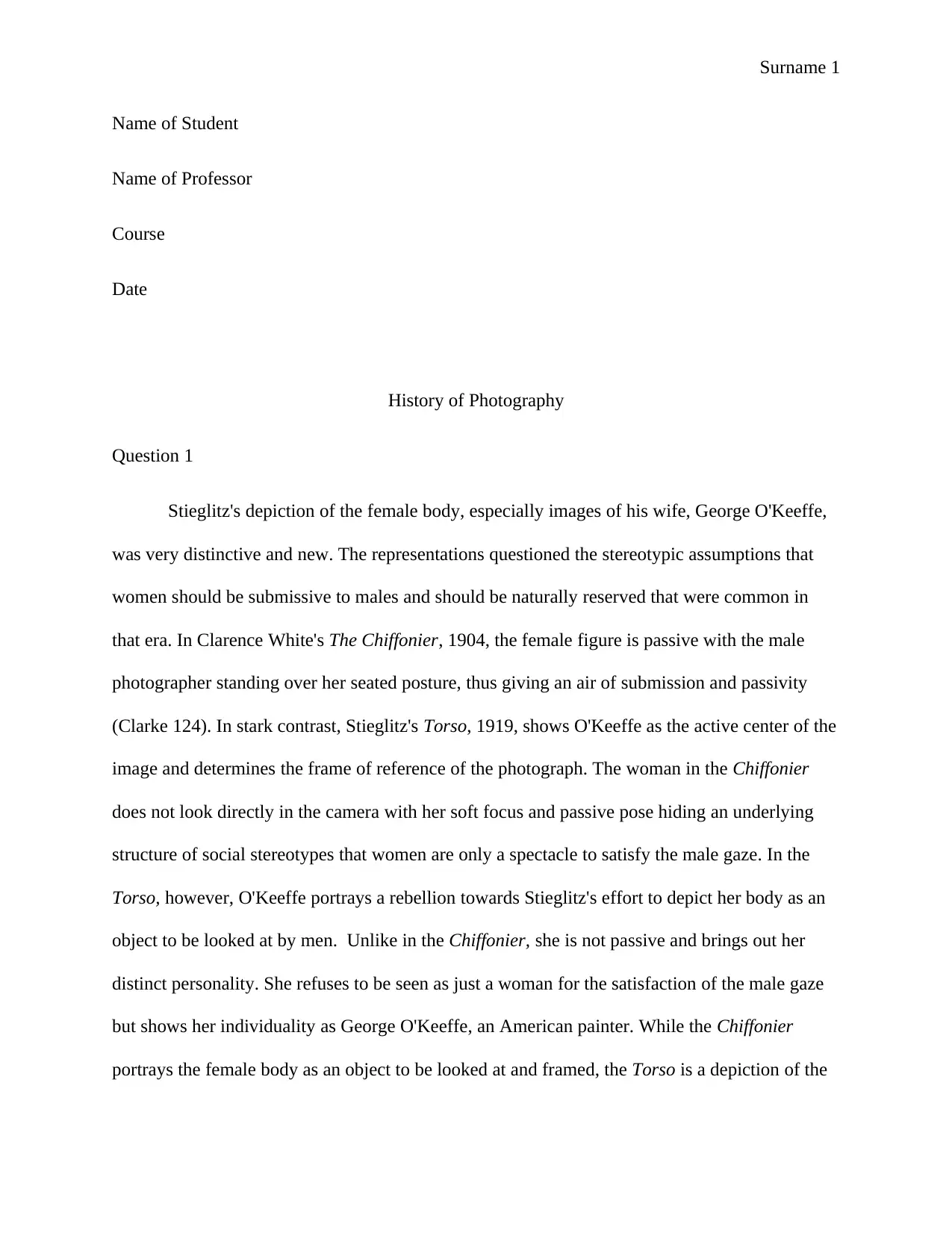
Stieglitz's depiction of the female body, especially images of his wife, George O'Keeffe,
was very distinctive and new. The representations questioned the stereotypic assumptions that
women should be submissive to males and should be naturally reserved that were common in
that era. In Clarence White's The Chiffonier, 1904, the female figure is passive with the male
photographer standing over her seated posture, thus giving an air of submission and passivity
(Clarke 124). In stark contrast, Stieglitz's Torso, 1919, shows O'Keeffe as the active center of the
image and determines the frame of reference of the photograph. The woman in the Chiffonier
does not look directly in the camera with her soft focus and passive pose hiding an underlying
structure of social stereotypes that women are only a spectacle to satisfy the male gaze. In the
Torso, however, O'Keeffe portrays a rebellion towards Stieglitz's effort to depict her body as an
object to be looked at by men. Unlike in the Chiffonier, she is not passive and brings out her
distinct personality. She refuses to be seen as just a woman for the satisfaction of the male gaze
but shows her individuality as George O'Keeffe, an American painter. While the Chiffonier
portrays the female body as an object to be looked at and framed, the Torso is a depiction of the
tabler-icon-diamond-filled.svg

Paraphrase This Document

Need a fresh take? Get an instant paraphrase of this document with our AI Paraphraser
Document Page
Surname 2
resistance towards such depictions. O'Keefe's face, arms, and feet are not seen in the Torso, thus
making her markedly absent from the image (Clarke 126). Through the picture, O'Keeffe
challenges the objectification of the female body, a question that has become popular in
photography and art.
Question 2
Scopophilia refers to the derivation of pleasure, usually sexual, from looking at images of
nude people. In the Untitled, 1992, Cindy Sherman uses a new language of photography to show
how the female body is understood as a sexual object. The entire field of photography is
concerned with portraying the female body in a sexual context, which Sherman pays ironic
homage in the Untitled, 1992 (Clarke 131). She uses color to emphasize the crude terms.
Sherman also puts the female body as the center of focus of the image with emphasis on the
breasts and vaginal area, which are arguably the parts that are most appealing to the male gaze.
However, Untitled, 1992 does not just define the female body but also portrays the ideological
assumptions such as how sexuality and personality are defined by aspects like gender, age, and
physicality. David Seymour's Bernard Berenson at the Borghese Gallery, Rome, 1955 is a
portrayal of the female body relative to the male gaze. In the image, Bernard Berenson, who is a
representation of the male gaze, is surrounded by female figures in a way that suggests that they
are there for his visual satisfaction, which represents male dominance (Clarke 133). Sherman
ridicules male power in the Untitled, 1992 by portraying the vagina of the female figure with a
salami sausage in it. She depicts the male gaze through an aging male face which is positioned in
such a way that his eyes seem to look upon the female figure, She also uses a doll to create the
figure to show how the male gaze only sees the female body as a plaything. The female presence
in the image is portrayed through frozen objects, which suggests female submission. Female
Document Page
Surname 3
submission is also represented in Untitled, 1992, through the pose of the female figure, which is
resting on wigs.
Question 3
Barbara Cole is a Canadian photographer whose preferred subject matter underwater
photography which is a result of her love of swimming. She describes the swimming pool as her
office. To her, the feeling of being underwater is mesmerizing and gives her the required
stimulation to work on her projects. She describes her water-based style as being in between
photography and painting. She gets the idea for a project and then tries to figure out the best way
to implement it. Her journey to photography is fascinating because she did harbor any such
thoughts while she was young. However, she dropped out of school, became a model, and then
was hired later as a fashion writer. Photographers used to ask for her opinion on their works, and
this was when she realized that she could pursue photography. She, therefore, started teaching
herself the art. She believes that becoming a photographer was transformative for her because it
enabled her to discover herself. Her art is usually inspired by the costume and wardrobe of the
models, as well as the location of the shoot. Her work has been described as being mysterious
and romantic. They are also unique and different from the artwork of other photographers. She
usually collaborates with fashion designers and models for her pieces with her work comprising
of purely in-camera work. She uses water as a lens to portray colors and figures with references
to art history and modern paintings (My Veoh). She is known as a passionate, hard worker
bordering on being obsessed who looks at unusual ways of photography. She is not afraid of
experimenting new techniques that would give her audience a new visual experience.
Document Page
Surname 4
Works cited
Clarke, Graham. The photograph. Oxford History of Art (Paperba, 1997.
"My Veoh." My Veoh, www.veoh.com/watch/v907872767JBSzQCc.
chevron_up_icon
1 out of 4
circle_padding
hide_on_mobile
zoom_out_icon
[object Object]