Exploring the History of Photography: David Doubilet's Impact

Verified

Added on  2022/09/12

|7
|1326
|21
Report
AI Summary
This report provides an in-depth analysis of the life and career of David Doubilet, a celebrated underwater photographer known for his stunning images of marine life and shipwrecks. The report examines his early life, his passion for the ocean, and how he developed his unique photographic style. It explores his long-standing relationship with National Geographic, his innovative use of technology, and his contributions to underwater journalism. The report also discusses his artistic perspective, his experiences documenting climate change, and his prestigious awards. Additionally, the report outlines the context of his work, including the cultural and technological advancements that influenced his photography. The assignment highlights the importance of his work in educating and influencing people's perception of the underwater world, and his role as a conservation advocate.
Document Page
Running head: HISTORY OF PHOTOGRAPHY
HISTORY OF PHOTOGRAPHY
Name of the Student
Name of the University
Authors note
tabler-icon-diamond-filled.svg

Paraphrase This Document

Need a fresh take? Get an instant paraphrase of this document with our AI Paraphraser
Document Page
1
HISTORY OF PHOTOGRAPHY
‘Audubon of the sea’ is what the photographer David Doubilet has been called. He is a
master craftsman who syndicates art and technology in to order to create profligate and
extravagantly attractive photographs of shipwrecks, sharks and coral reefs to make people see the
oceans with a new vision. At recent, he is one of the most well-renowned and published
photographer functioning for the channel National Geographic with above 75 features under his
account. He entered the world of the sea firstly as an explorer, journalist and artist to document
the devastation along with the beauty of the oceans. According to David’s believe, the notion of
photography has the supremacy to honour, educate, irradiate, influence and manipulate
amendment (Kaler). He stated that, “The molecular the skin of the sea is the dividing line
between two different parts of the planet. A portal; a door. To combine those two things is
something I love to do.” (Doubilet). In the verge of reconnoitring the ecosphere’s water, he has
snapped in the nadirs of many places, such as Scotland, New Zealand and Southwest Pacific and
also freshwater ecologies such as Botswana’s Okavango Delta and Canada’s St. Lawrence River.
He has also photographed many under water creatures like, sponges, sharks and stingrays in the
Caribbean along with Pearl Harbour shipwrecks. He is recently documenting the climate change
and state of coral including the solutions and science (Bendavid).
He shared in an interview that, when he was only nine years old, as a New York city
child, he was sent on a summer camp in the place called, Adirondacks, which he hated, as he had
asthma. He even said that he never wanted to climb mountains, also he did not find interest
towards archery or riding, so he was sent to the lake side, where he saw two counsellors of
around fourteen years of age, planned to make fun of him and told him to go under the dock and
move out some of the fallen branches in order to clean it, knowing that there was a gigantic
spider under there which will scare him. They gave a French squale mask which he wore on his
Document Page
2
HISTORY OF PHOTOGRAPHY
face, and he put his head under the water and that is when right at that moment his life has
changed completely. Beneath the surface he noticed the turning of the light reflecting from the
under water surface and the dancing of the light rays through the green algae and other under
water plants, has transfixed him. Then after going back to New Jersey, he started to perform
diving there. David was born in the 1946, in the year New York, where after this incident, he for
the very first time put his Brownie Hawkeye camera in a bag of neoprene anaesthesiologist when
he was only 12 years old (Doubilet). His splendid passion about his photography field made him
spent above 26000 hours in the ocean just in order to create a way through the hidden world,
which is underneath the surface of the earth (Blackwell).
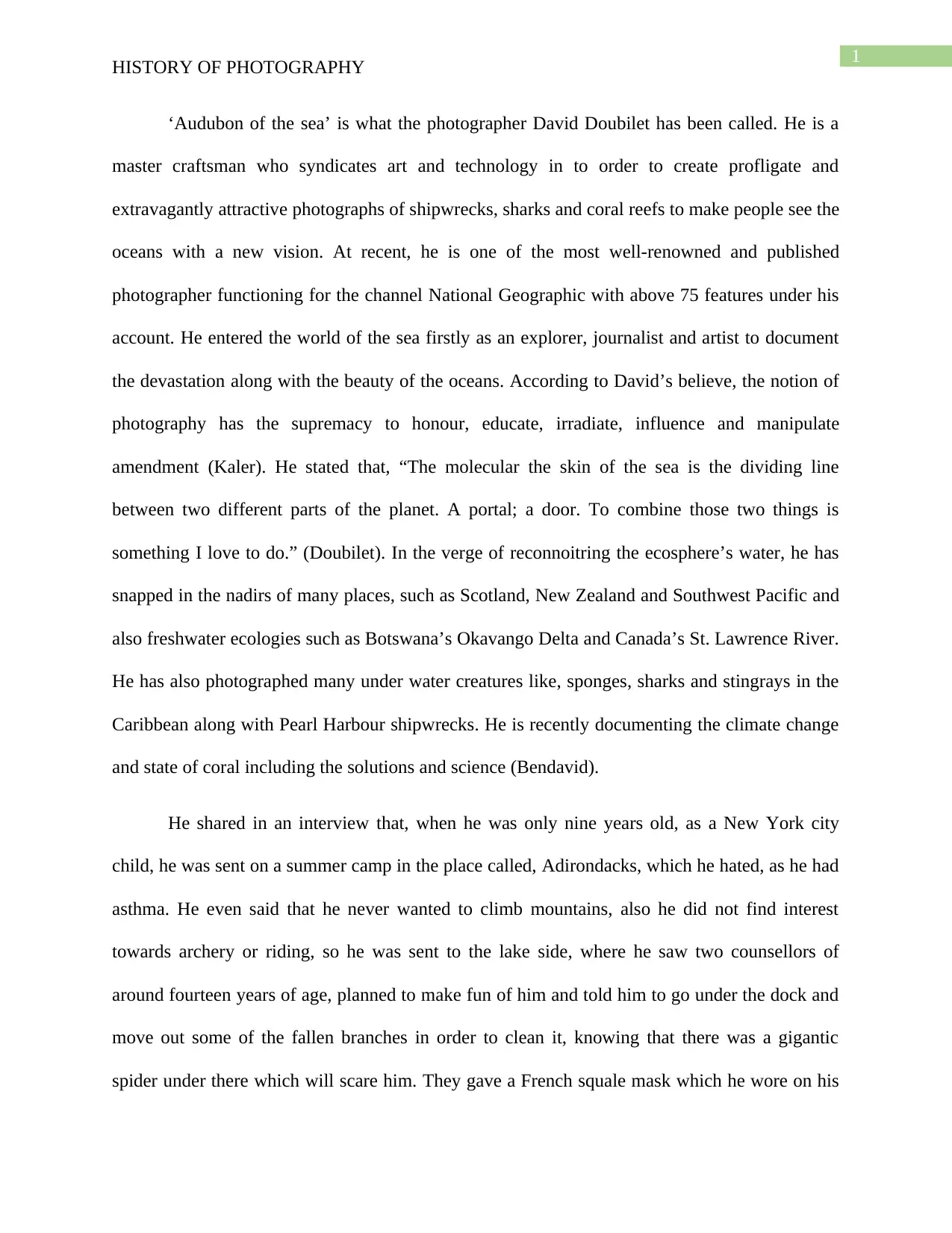
Doubilet, National Geograpgic, 2018
David has recurrently working for National Geographic with his parallel marine
photographers named Jennifer Hayes and his wife; and sharing the lows and highs of their job
from struggling with diseases like malaria to luminous coral reefs and exploding batteries
(Nichols). He is also a highlighted spokesperson for the series of National Geographic Live; also
he is a contributing editor, a columnist and an author of around twelve books which includes,
Fish Face, The Kingdom of Coral and Light in the Sea. Is his photography career he has got
many prestigious awards, like, The Lennart Nilsson Award in Scientific Photography and the
Document Page
3
HISTORY OF PHOTOGRAPHY
Academy of Achievement Award. There is one coral reef photographs from his many
photographs, which has been sent to the space long with the Voyager Mission. David was also
given the name of a Contributing Photographer in residence at the NOGI Fellow and the
National Geographic. He is the associate of the both International Diving Hall of Fame and
Royal Photographic Society, and one of the founders of the International League of Conservation
Photographers (Doubilet).
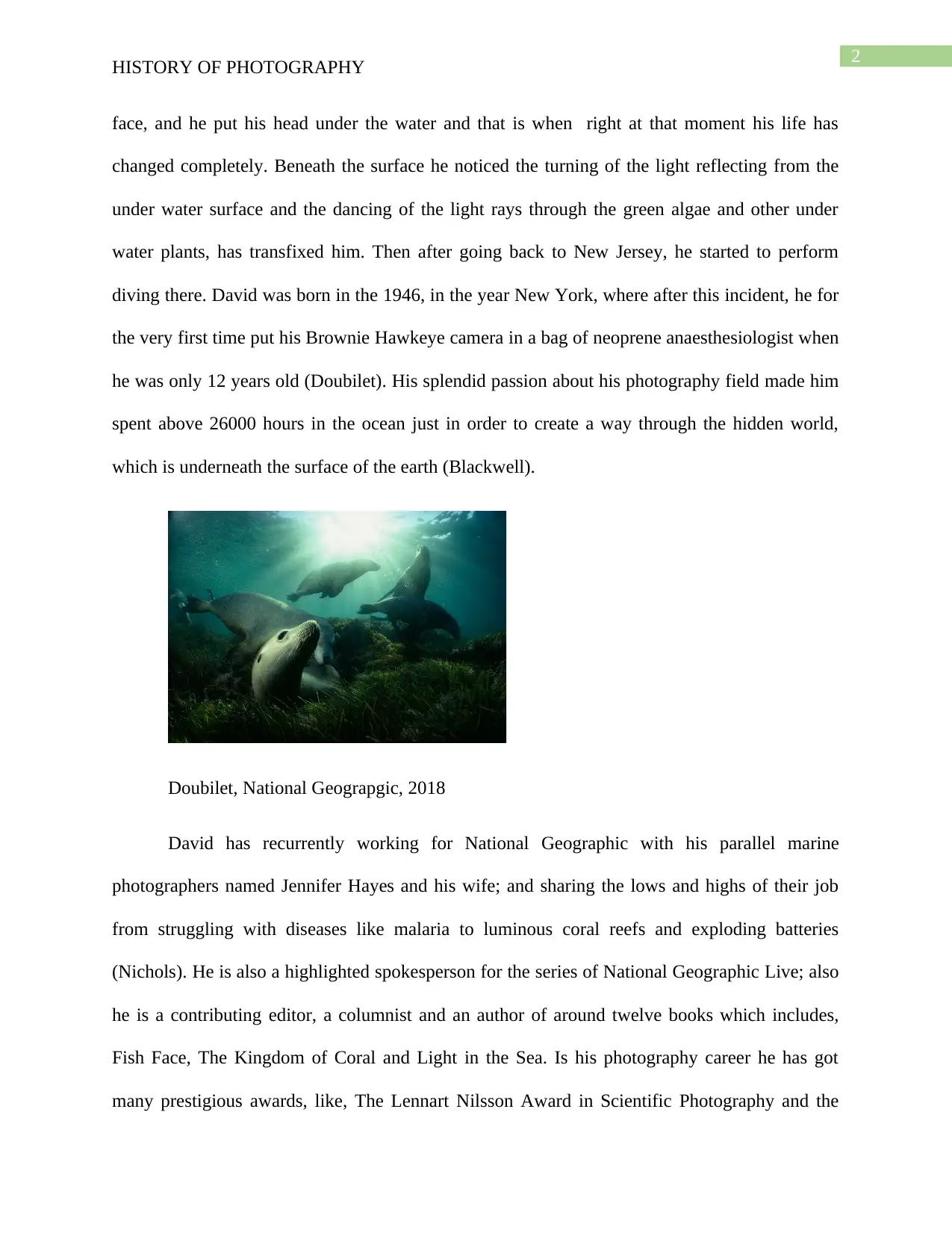
Doubilet, National Geographic, 2016
He establishes on an artistic perspective that, these days photography is all about a
product of an irreplaceable and incredible digital revolution; and that it was a great opportunity
in terms of experimenting with different digital sources in order to deliver the world the most
realistic view of the under water world. From using the Brownie Hawkeye to the using the digital
camera, it was a great evolution of photography as well as technology in general. At the
beginning when he started working with Nat Geo with a story on garden eel, he used a remote
camera that time, then he started to develop language of photography which has later been
translated into under water journalism. He was the inheritor of the work of Louis Marden, and
Bates Littlehales, who developed the ocean-eye camera (Doubilet).
tabler-icon-diamond-filled.svg

Paraphrase This Document

Need a fresh take? Get an instant paraphrase of this document with our AI Paraphraser
Document Page
4
HISTORY OF PHOTOGRAPHY
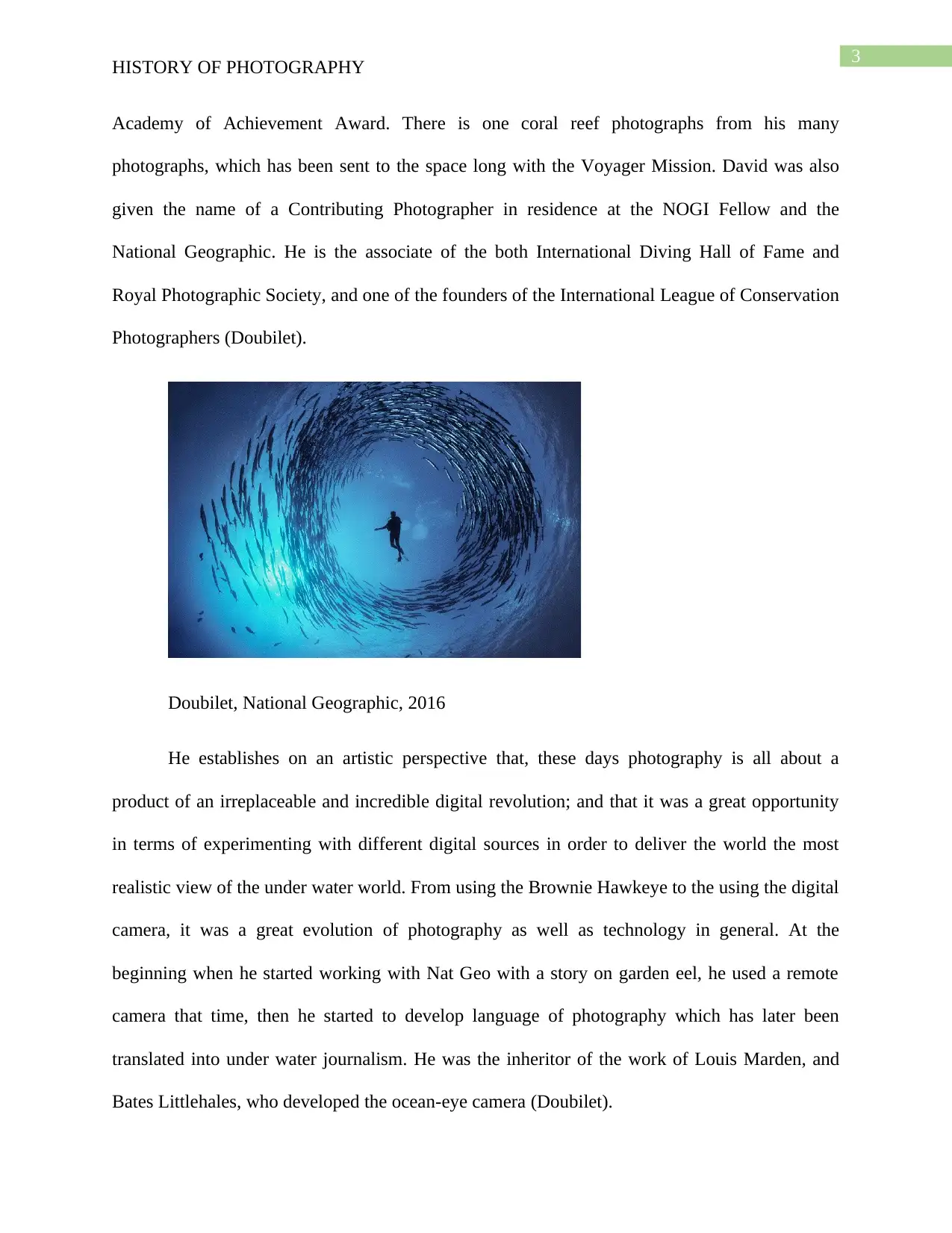
Doubilet, National Geographic, 2016
Along with all the good experiences of the under-water journey, he even shares some of
his devastating experiences, such as, the heating of the planet due to global climate change and
his witnessing experiencing of the shrinking Arctic ocean and starvation of the polar bears, with
his fellow photographer and wife. He also experienced the tropics, and extremely fluctuating
temperature and highest biodiversity of coral reef and, all this has many threats like, acidification
of the ocean, which negatively affects the polyps, the tiny creature, which constructs the house
calcium carbonate house; rising sea level along with the rising temperature. By saying all this he
means that, we all are in situation of time when the world is changing rapidly, which will have
mostly negative impact over the living creatures. That is something, which drives him crazy, as
he is a combination of photographer and an environmentalist, working with light and art; and his
only motif is to open people’s eyes regarding the world and regarding under-water world (Van
den Thillart, et al.).
Document Page
5
HISTORY OF PHOTOGRAPHY
Referencing:
Bendavid-Val, Leah. National Geographic: the photographs. National Geographic Books, 2008.
Blackwell, Lewis. Photo-wisdom. 2009.
Doubilet, Anne. Under the Sea from A to Z. Scholastic, 1991.
Doubilet, David. "Light in the Sea." World Literature Today 87.2 (2013): 94-97.
Doubilet, David. Pacific: An Undersea Journey. Little, Brown, 1992.
https://i.pinimg.com/originals/ca/38/09/ca38094ee430bdb488fd8478b026536d.jpg
https://www.nationalgeographic.com/content/dam/photography/PROOF/2016/06/david-doubilet-
oceans-day/doubilet-Circling-Barracuda.jpg
https://www.nationalgeographic.com/content/dam/photography/PROOF/2018/May/david-
doubilet-retrospective-rolex/david-doubilet-photographic-retrospective-11-sea-lions.jpg
Kaler, Eric. "David Doubilet." (2006).
Nichols, Robin. Mastering Adobe Photoshop Elements: Excel in digital photography and image
editing for print and web using Photoshop Elements 2019. Packt Publishing Ltd, 2019.
Van den Thillart, Guido, Sylvie Dufour, and J. Cliff Rankin. "Spawning migration of the
European eel." Fish and Fisheries Series 30 (2009).
Document Page
6
HISTORY OF PHOTOGRAPHY
chevron_up_icon
1 out of 7
circle_padding
hide_on_mobile
zoom_out_icon
[object Object]