Analysis of Scribes and Books in Ancient Times: A Historical Report
VerifiedAdded on 2022/09/18
|6
|1846
|18
Report
AI Summary
This report analyzes the role of scribes and their 'books' in ancient civilizations, from Mesopotamia and Egypt to classical Greece, Rome, and early Christianity. It applies Frederic Kilgour's model of 'punctuations of equilibria' to understand how written communication evolved. The report examines the historical context of scribes, the materials they used, and the impact of their work on society. It explores Kilgour's thesis by evaluating whether the evidence supports his view of the evolution of written communication. The report includes an analysis of the bibliography and the process of production, economic and politic content, and critical reception. It also discusses the significance of books and scribes for society, the issue of survival, and the evolution of written communication. The document uses the provided assignment solution to illustrate the role of scribes and books in ancient times.
Section 3:
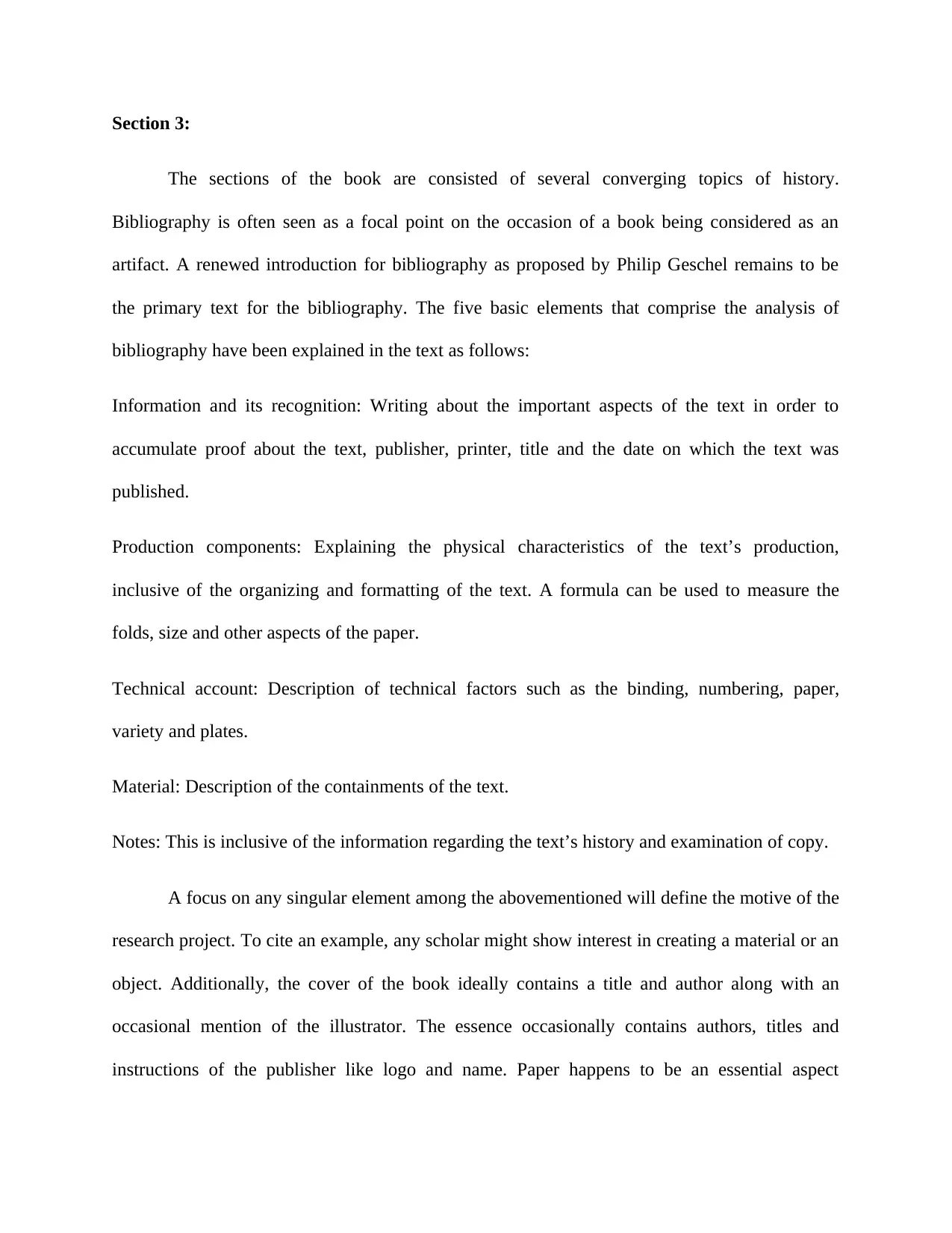
The sections of the book are consisted of several converging topics of history.
Bibliography is often seen as a focal point on the occasion of a book being considered as an
artifact. A renewed introduction for bibliography as proposed by Philip Geschel remains to be
the primary text for the bibliography. The five basic elements that comprise the analysis of
bibliography have been explained in the text as follows:
Information and its recognition: Writing about the important aspects of the text in order to
accumulate proof about the text, publisher, printer, title and the date on which the text was
published.
Production components: Explaining the physical characteristics of the text’s production,
inclusive of the organizing and formatting of the text. A formula can be used to measure the
folds, size and other aspects of the paper.
Technical account: Description of technical factors such as the binding, numbering, paper,
variety and plates.
Material: Description of the containments of the text.
Notes: This is inclusive of the information regarding the text’s history and examination of copy.
A focus on any singular element among the abovementioned will define the motive of the
research project. To cite an example, any scholar might show interest in creating a material or an
object. Additionally, the cover of the book ideally contains a title and author along with an
occasional mention of the illustrator. The essence occasionally contains authors, titles and
instructions of the publisher like logo and name. Paper happens to be an essential aspect
The sections of the book are consisted of several converging topics of history.
Bibliography is often seen as a focal point on the occasion of a book being considered as an
artifact. A renewed introduction for bibliography as proposed by Philip Geschel remains to be
the primary text for the bibliography. The five basic elements that comprise the analysis of
bibliography have been explained in the text as follows:
Information and its recognition: Writing about the important aspects of the text in order to
accumulate proof about the text, publisher, printer, title and the date on which the text was
published.
Production components: Explaining the physical characteristics of the text’s production,
inclusive of the organizing and formatting of the text. A formula can be used to measure the
folds, size and other aspects of the paper.
Technical account: Description of technical factors such as the binding, numbering, paper,
variety and plates.
Material: Description of the containments of the text.
Notes: This is inclusive of the information regarding the text’s history and examination of copy.
A focus on any singular element among the abovementioned will define the motive of the
research project. To cite an example, any scholar might show interest in creating a material or an
object. Additionally, the cover of the book ideally contains a title and author along with an
occasional mention of the illustrator. The essence occasionally contains authors, titles and
instructions of the publisher like logo and name. Paper happens to be an essential aspect
Paraphrase This Document
Need a fresh take? Get an instant paraphrase of this document with our AI Paraphraser

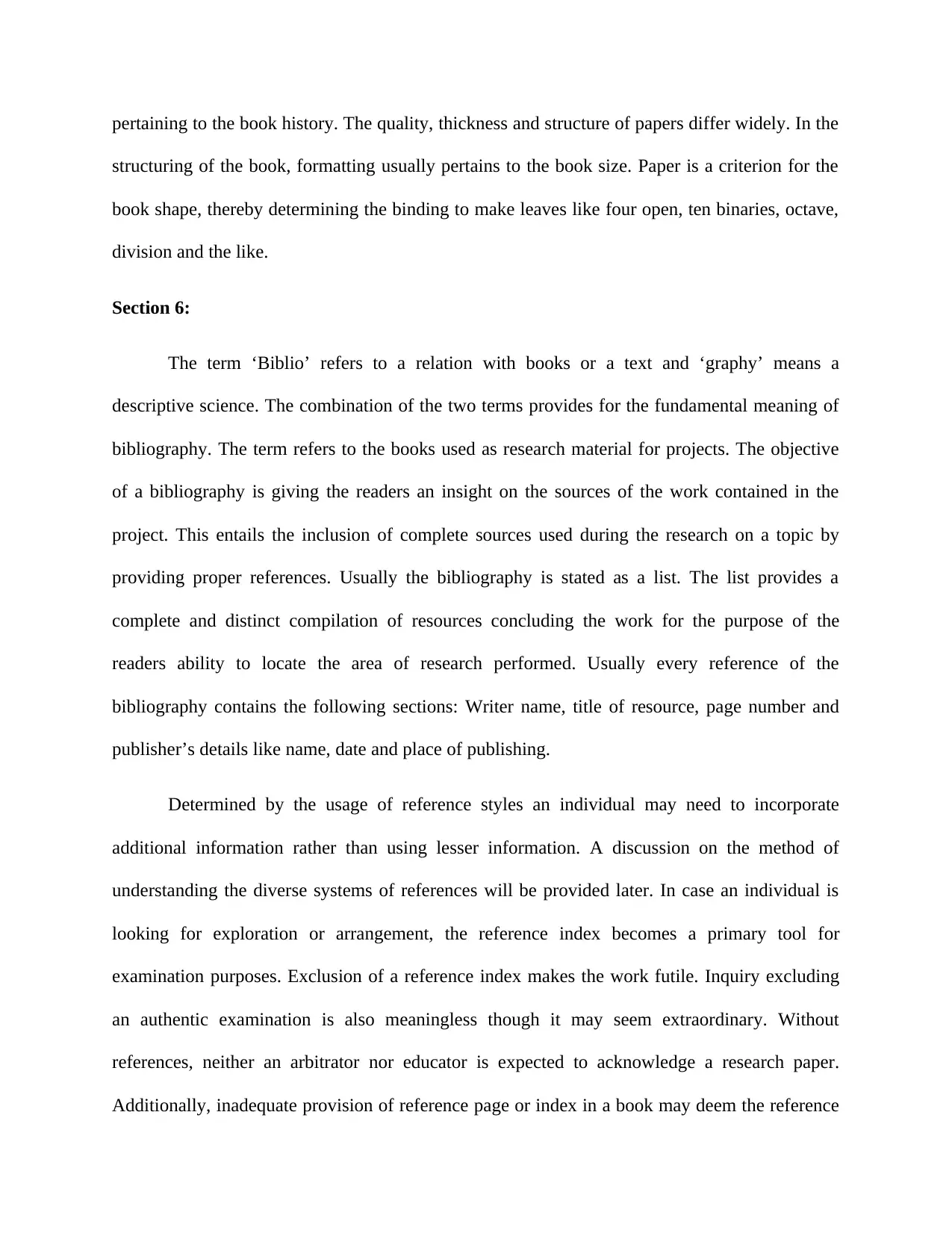
pertaining to the book history. The quality, thickness and structure of papers differ widely. In the
structuring of the book, formatting usually pertains to the book size. Paper is a criterion for the
book shape, thereby determining the binding to make leaves like four open, ten binaries, octave,
division and the like.
Section 6:
The term ‘Biblio’ refers to a relation with books or a text and ‘graphy’ means a
descriptive science. The combination of the two terms provides for the fundamental meaning of
bibliography. The term refers to the books used as research material for projects. The objective
of a bibliography is giving the readers an insight on the sources of the work contained in the
project. This entails the inclusion of complete sources used during the research on a topic by
providing proper references. Usually the bibliography is stated as a list. The list provides a
complete and distinct compilation of resources concluding the work for the purpose of the
readers ability to locate the area of research performed. Usually every reference of the
bibliography contains the following sections: Writer name, title of resource, page number and
publisher’s details like name, date and place of publishing.
Determined by the usage of reference styles an individual may need to incorporate
additional information rather than using lesser information. A discussion on the method of
understanding the diverse systems of references will be provided later. In case an individual is
looking for exploration or arrangement, the reference index becomes a primary tool for
examination purposes. Exclusion of a reference index makes the work futile. Inquiry excluding
an authentic examination is also meaningless though it may seem extraordinary. Without
references, neither an arbitrator nor educator is expected to acknowledge a research paper.
Additionally, inadequate provision of reference page or index in a book may deem the reference
structuring of the book, formatting usually pertains to the book size. Paper is a criterion for the
book shape, thereby determining the binding to make leaves like four open, ten binaries, octave,
division and the like.
Section 6:
The term ‘Biblio’ refers to a relation with books or a text and ‘graphy’ means a
descriptive science. The combination of the two terms provides for the fundamental meaning of
bibliography. The term refers to the books used as research material for projects. The objective
of a bibliography is giving the readers an insight on the sources of the work contained in the
project. This entails the inclusion of complete sources used during the research on a topic by
providing proper references. Usually the bibliography is stated as a list. The list provides a
complete and distinct compilation of resources concluding the work for the purpose of the
readers ability to locate the area of research performed. Usually every reference of the
bibliography contains the following sections: Writer name, title of resource, page number and
publisher’s details like name, date and place of publishing.
Determined by the usage of reference styles an individual may need to incorporate
additional information rather than using lesser information. A discussion on the method of
understanding the diverse systems of references will be provided later. In case an individual is
looking for exploration or arrangement, the reference index becomes a primary tool for
examination purposes. Exclusion of a reference index makes the work futile. Inquiry excluding
an authentic examination is also meaningless though it may seem extraordinary. Without
references, neither an arbitrator nor educator is expected to acknowledge a research paper.
Additionally, inadequate provision of reference page or index in a book may deem the reference

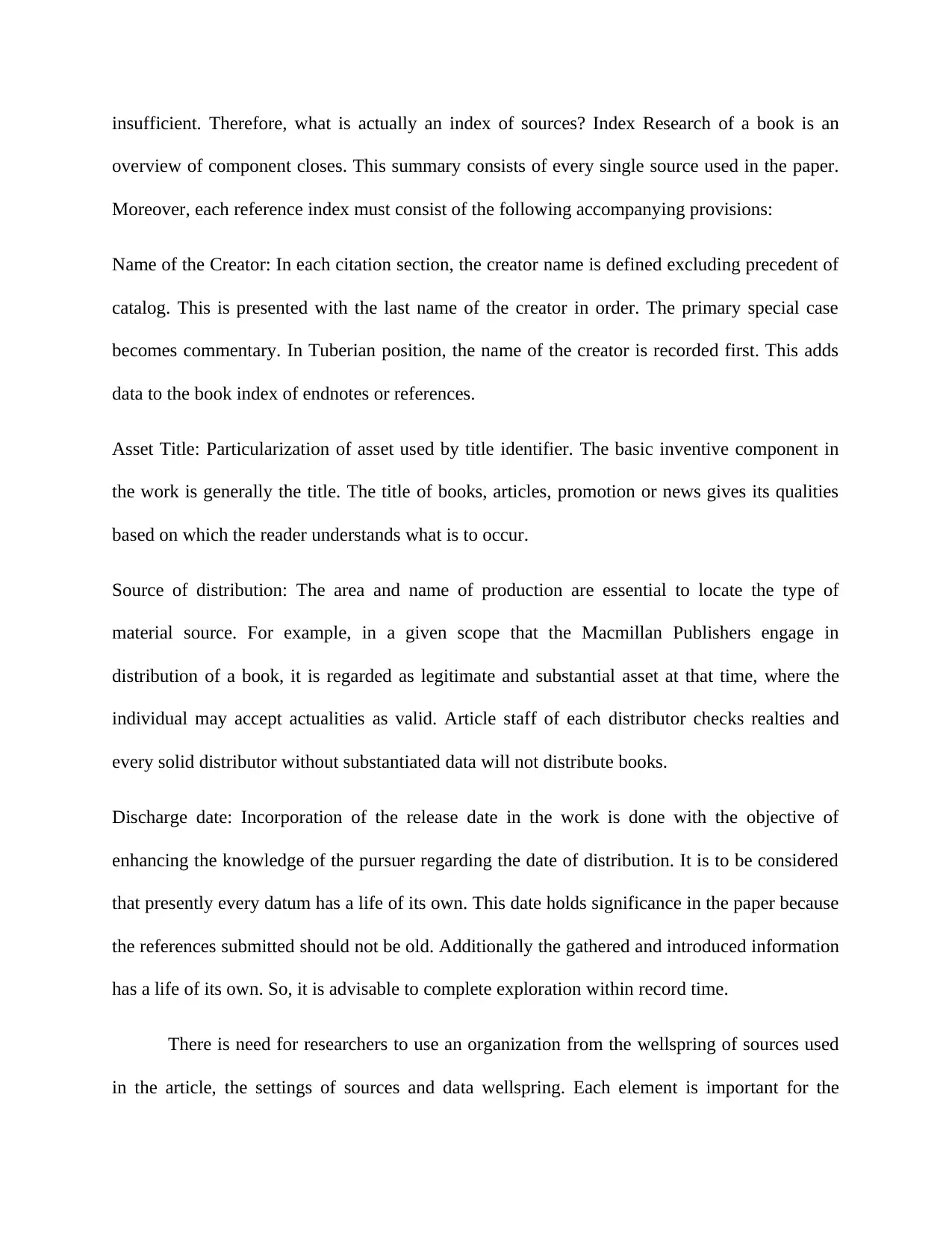
insufficient. Therefore, what is actually an index of sources? Index Research of a book is an
overview of component closes. This summary consists of every single source used in the paper.
Moreover, each reference index must consist of the following accompanying provisions:
Name of the Creator: In each citation section, the creator name is defined excluding precedent of
catalog. This is presented with the last name of the creator in order. The primary special case
becomes commentary. In Tuberian position, the name of the creator is recorded first. This adds
data to the book index of endnotes or references.
Asset Title: Particularization of asset used by title identifier. The basic inventive component in
the work is generally the title. The title of books, articles, promotion or news gives its qualities
based on which the reader understands what is to occur.
Source of distribution: The area and name of production are essential to locate the type of
material source. For example, in a given scope that the Macmillan Publishers engage in
distribution of a book, it is regarded as legitimate and substantial asset at that time, where the
individual may accept actualities as valid. Article staff of each distributor checks realties and
every solid distributor without substantiated data will not distribute books.
Discharge date: Incorporation of the release date in the work is done with the objective of
enhancing the knowledge of the pursuer regarding the date of distribution. It is to be considered
that presently every datum has a life of its own. This date holds significance in the paper because
the references submitted should not be old. Additionally the gathered and introduced information
has a life of its own. So, it is advisable to complete exploration within record time.
There is need for researchers to use an organization from the wellspring of sources used
in the article, the settings of sources and data wellspring. Each element is important for the
overview of component closes. This summary consists of every single source used in the paper.
Moreover, each reference index must consist of the following accompanying provisions:
Name of the Creator: In each citation section, the creator name is defined excluding precedent of
catalog. This is presented with the last name of the creator in order. The primary special case
becomes commentary. In Tuberian position, the name of the creator is recorded first. This adds
data to the book index of endnotes or references.
Asset Title: Particularization of asset used by title identifier. The basic inventive component in
the work is generally the title. The title of books, articles, promotion or news gives its qualities
based on which the reader understands what is to occur.
Source of distribution: The area and name of production are essential to locate the type of
material source. For example, in a given scope that the Macmillan Publishers engage in
distribution of a book, it is regarded as legitimate and substantial asset at that time, where the
individual may accept actualities as valid. Article staff of each distributor checks realties and
every solid distributor without substantiated data will not distribute books.
Discharge date: Incorporation of the release date in the work is done with the objective of
enhancing the knowledge of the pursuer regarding the date of distribution. It is to be considered
that presently every datum has a life of its own. This date holds significance in the paper because
the references submitted should not be old. Additionally the gathered and introduced information
has a life of its own. So, it is advisable to complete exploration within record time.
There is need for researchers to use an organization from the wellspring of sources used
in the article, the settings of sources and data wellspring. Each element is important for the
⊘ This is a preview!⊘
Do you want full access?
Subscribe today to unlock all pages.

Trusted by 1+ million students worldwide

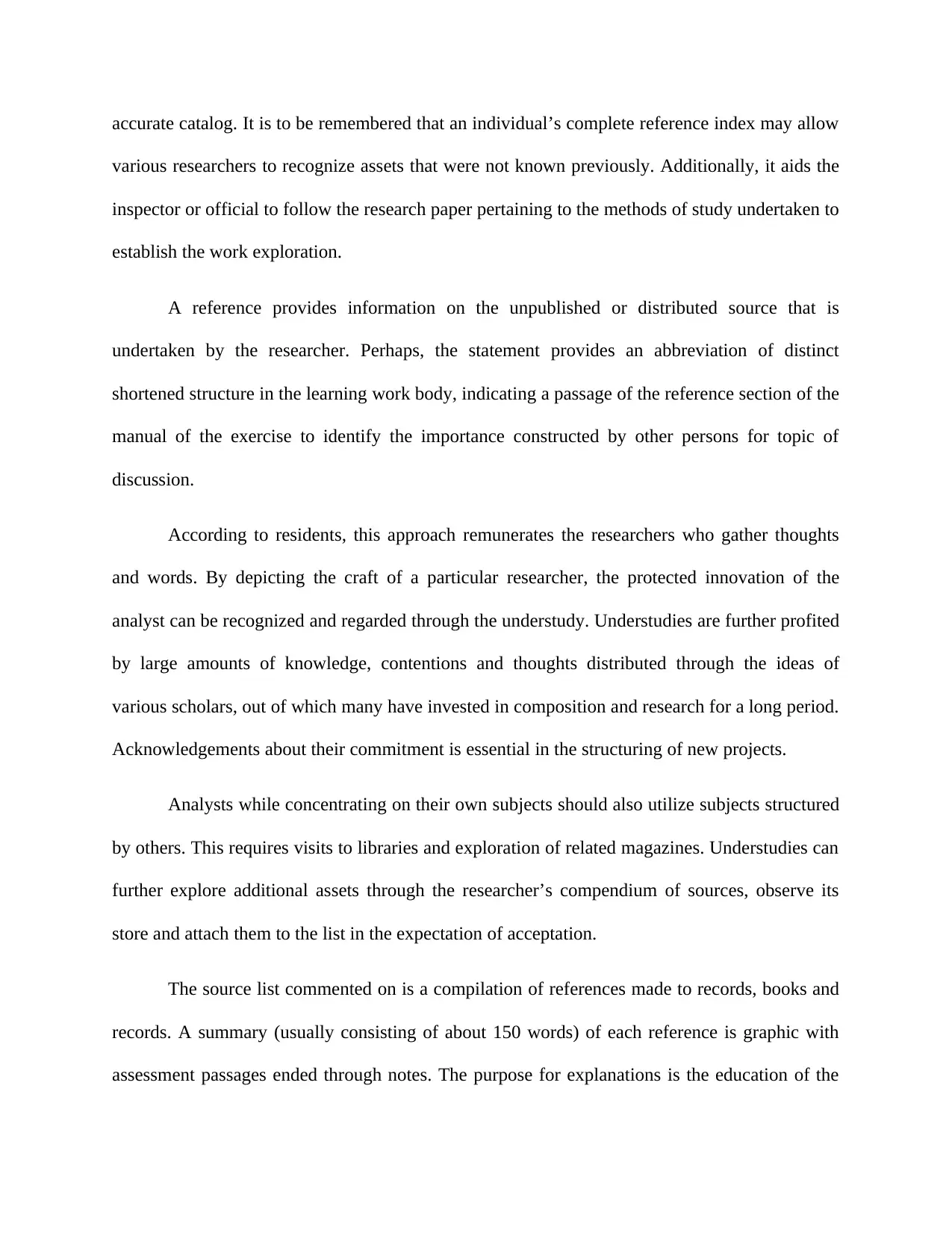
accurate catalog. It is to be remembered that an individual’s complete reference index may allow
various researchers to recognize assets that were not known previously. Additionally, it aids the
inspector or official to follow the research paper pertaining to the methods of study undertaken to
establish the work exploration.
A reference provides information on the unpublished or distributed source that is
undertaken by the researcher. Perhaps, the statement provides an abbreviation of distinct
shortened structure in the learning work body, indicating a passage of the reference section of the
manual of the exercise to identify the importance constructed by other persons for topic of
discussion.
According to residents, this approach remunerates the researchers who gather thoughts
and words. By depicting the craft of a particular researcher, the protected innovation of the
analyst can be recognized and regarded through the understudy. Understudies are further profited
by large amounts of knowledge, contentions and thoughts distributed through the ideas of
various scholars, out of which many have invested in composition and research for a long period.
Acknowledgements about their commitment is essential in the structuring of new projects.
Analysts while concentrating on their own subjects should also utilize subjects structured
by others. This requires visits to libraries and exploration of related magazines. Understudies can
further explore additional assets through the researcher’s compendium of sources, observe its
store and attach them to the list in the expectation of acceptation.
The source list commented on is a compilation of references made to records, books and
records. A summary (usually consisting of about 150 words) of each reference is graphic with
assessment passages ended through notes. The purpose for explanations is the education of the
various researchers to recognize assets that were not known previously. Additionally, it aids the
inspector or official to follow the research paper pertaining to the methods of study undertaken to
establish the work exploration.
A reference provides information on the unpublished or distributed source that is
undertaken by the researcher. Perhaps, the statement provides an abbreviation of distinct
shortened structure in the learning work body, indicating a passage of the reference section of the
manual of the exercise to identify the importance constructed by other persons for topic of
discussion.
According to residents, this approach remunerates the researchers who gather thoughts
and words. By depicting the craft of a particular researcher, the protected innovation of the
analyst can be recognized and regarded through the understudy. Understudies are further profited
by large amounts of knowledge, contentions and thoughts distributed through the ideas of
various scholars, out of which many have invested in composition and research for a long period.
Acknowledgements about their commitment is essential in the structuring of new projects.
Analysts while concentrating on their own subjects should also utilize subjects structured
by others. This requires visits to libraries and exploration of related magazines. Understudies can
further explore additional assets through the researcher’s compendium of sources, observe its
store and attach them to the list in the expectation of acceptation.
The source list commented on is a compilation of references made to records, books and
records. A summary (usually consisting of about 150 words) of each reference is graphic with
assessment passages ended through notes. The purpose for explanations is the education of the
Paraphrase This Document
Need a fresh take? Get an instant paraphrase of this document with our AI Paraphraser

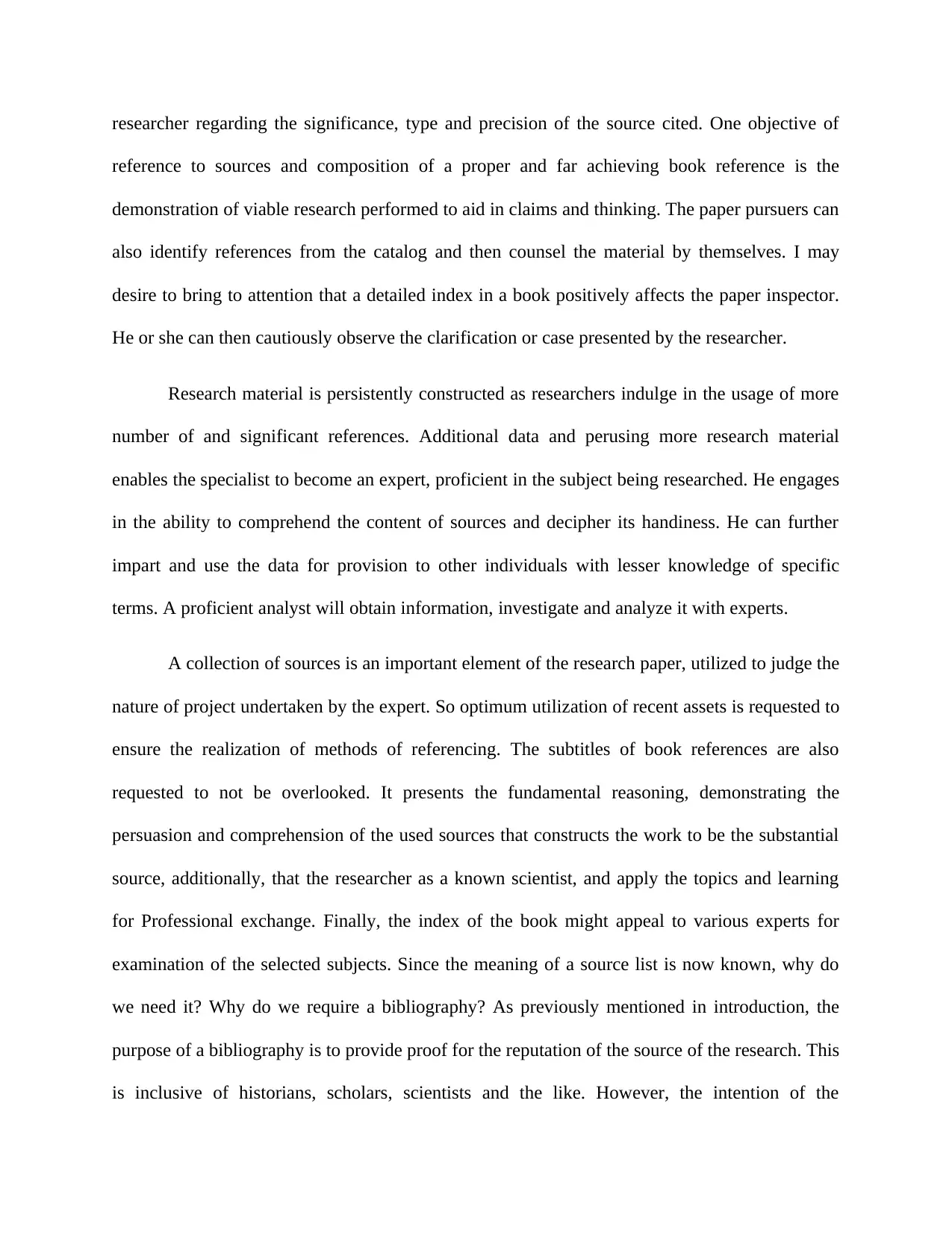
researcher regarding the significance, type and precision of the source cited. One objective of
reference to sources and composition of a proper and far achieving book reference is the
demonstration of viable research performed to aid in claims and thinking. The paper pursuers can
also identify references from the catalog and then counsel the material by themselves. I may
desire to bring to attention that a detailed index in a book positively affects the paper inspector.
He or she can then cautiously observe the clarification or case presented by the researcher.
Research material is persistently constructed as researchers indulge in the usage of more
number of and significant references. Additional data and perusing more research material
enables the specialist to become an expert, proficient in the subject being researched. He engages
in the ability to comprehend the content of sources and decipher its handiness. He can further
impart and use the data for provision to other individuals with lesser knowledge of specific
terms. A proficient analyst will obtain information, investigate and analyze it with experts.
A collection of sources is an important element of the research paper, utilized to judge the
nature of project undertaken by the expert. So optimum utilization of recent assets is requested to
ensure the realization of methods of referencing. The subtitles of book references are also
requested to not be overlooked. It presents the fundamental reasoning, demonstrating the
persuasion and comprehension of the used sources that constructs the work to be the substantial
source, additionally, that the researcher as a known scientist, and apply the topics and learning
for Professional exchange. Finally, the index of the book might appeal to various experts for
examination of the selected subjects. Since the meaning of a source list is now known, why do
we need it? Why do we require a bibliography? As previously mentioned in introduction, the
purpose of a bibliography is to provide proof for the reputation of the source of the research. This
is inclusive of historians, scholars, scientists and the like. However, the intention of the
reference to sources and composition of a proper and far achieving book reference is the
demonstration of viable research performed to aid in claims and thinking. The paper pursuers can
also identify references from the catalog and then counsel the material by themselves. I may
desire to bring to attention that a detailed index in a book positively affects the paper inspector.
He or she can then cautiously observe the clarification or case presented by the researcher.
Research material is persistently constructed as researchers indulge in the usage of more
number of and significant references. Additional data and perusing more research material
enables the specialist to become an expert, proficient in the subject being researched. He engages
in the ability to comprehend the content of sources and decipher its handiness. He can further
impart and use the data for provision to other individuals with lesser knowledge of specific
terms. A proficient analyst will obtain information, investigate and analyze it with experts.
A collection of sources is an important element of the research paper, utilized to judge the
nature of project undertaken by the expert. So optimum utilization of recent assets is requested to
ensure the realization of methods of referencing. The subtitles of book references are also
requested to not be overlooked. It presents the fundamental reasoning, demonstrating the
persuasion and comprehension of the used sources that constructs the work to be the substantial
source, additionally, that the researcher as a known scientist, and apply the topics and learning
for Professional exchange. Finally, the index of the book might appeal to various experts for
examination of the selected subjects. Since the meaning of a source list is now known, why do
we need it? Why do we require a bibliography? As previously mentioned in introduction, the
purpose of a bibliography is to provide proof for the reputation of the source of the research. This
is inclusive of historians, scholars, scientists and the like. However, the intention of the

bibliography is also to prevent false information to the readers. It additionally provides support
to the approaching researchers. It further protects the work from other researchers. If the ideas
provided in the article are regarded as the best of the times, is it advisable to plagiarize the
articles in other sides of countries claiming that those happen to be their own? So, a primary
objective of bibliography is to provide credit after the credit ends. Prevent plagiarism through the
inclusion of complete research subjects in the catalog of the paper. At the conclusion, allow the
readers to recognize you thoughts through a clear list. This will additionally aid future
researchers. After fifty year, as students study similar subjects the researcher’s work can be
consulted. A clear mention of the reference list can aid such students. The list should incorporate
the complete array of research materials utilized by you throughout the process of writing and
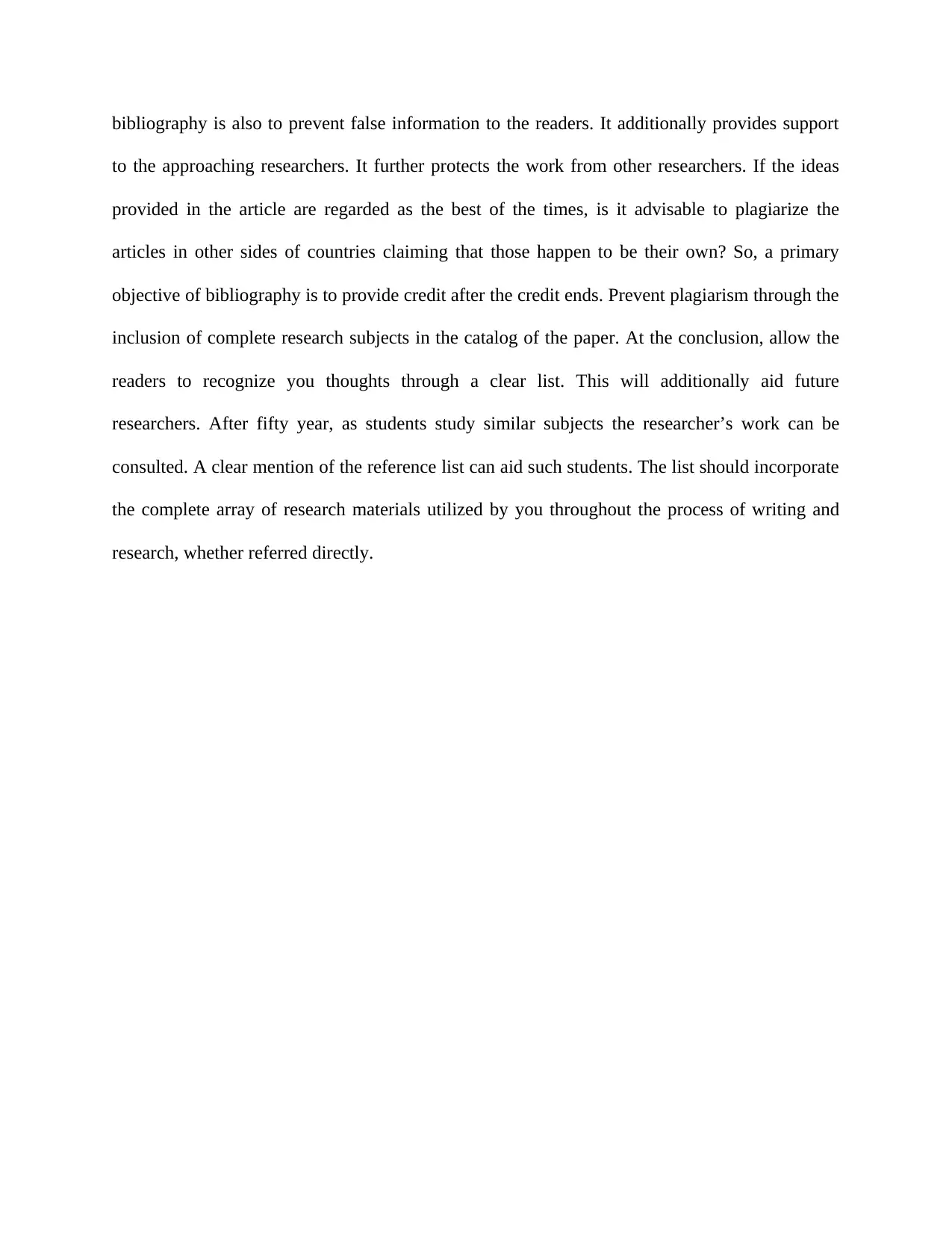
research, whether referred directly.
to the approaching researchers. It further protects the work from other researchers. If the ideas
provided in the article are regarded as the best of the times, is it advisable to plagiarize the
articles in other sides of countries claiming that those happen to be their own? So, a primary
objective of bibliography is to provide credit after the credit ends. Prevent plagiarism through the
inclusion of complete research subjects in the catalog of the paper. At the conclusion, allow the
readers to recognize you thoughts through a clear list. This will additionally aid future
researchers. After fifty year, as students study similar subjects the researcher’s work can be
consulted. A clear mention of the reference list can aid such students. The list should incorporate
the complete array of research materials utilized by you throughout the process of writing and
research, whether referred directly.
⊘ This is a preview!⊘
Do you want full access?
Subscribe today to unlock all pages.

Trusted by 1+ million students worldwide
1 out of 6
Related Documents
Your All-in-One AI-Powered Toolkit for Academic Success.
+13062052269
info@desklib.com
Available 24*7 on WhatsApp / Email
Unlock your academic potential
Copyright © 2020–2026 A2Z Services. All Rights Reserved. Developed and managed by ZUCOL.