Comprehensive Analysis of HIV: Stages, Myths, Education, and Stigma

Verified

Added on  2022/08/23

|8
|1829
|27
Homework Assignment
AI Summary
This assignment provides a detailed exploration of HIV, starting with an introduction to the virus and its impact on the human immune system, specifically targeting CD4 cells. It outlines the stages of HIV infection, from the asymptomatic stage to AIDS and death, including the symptoms associated with each stage. The assignment addresses common myths and misconceptions about HIV transmission, emphasizing the importance of safe sex practices. It also examines the societal stigma surrounding HIV and its impact on education, particularly for children and adolescents, and includes a comparison table of learning phases. Furthermore, it discusses the psychological distress and discrimination faced by HIV-positive individuals and suggests strategies for successful AIDS education, focusing on therapeutic relationships, health promotion programs, and the elimination of myths. The document references several research papers to support its findings and recommendations.

Document Page
Running head: HIV
HIV
Name of the Student
Name of the University
Author Note
tabler-icon-diamond-filled.svg

Paraphrase This Document

Need a fresh take? Get an instant paraphrase of this document with our AI Paraphraser
Document Page
1
HIV
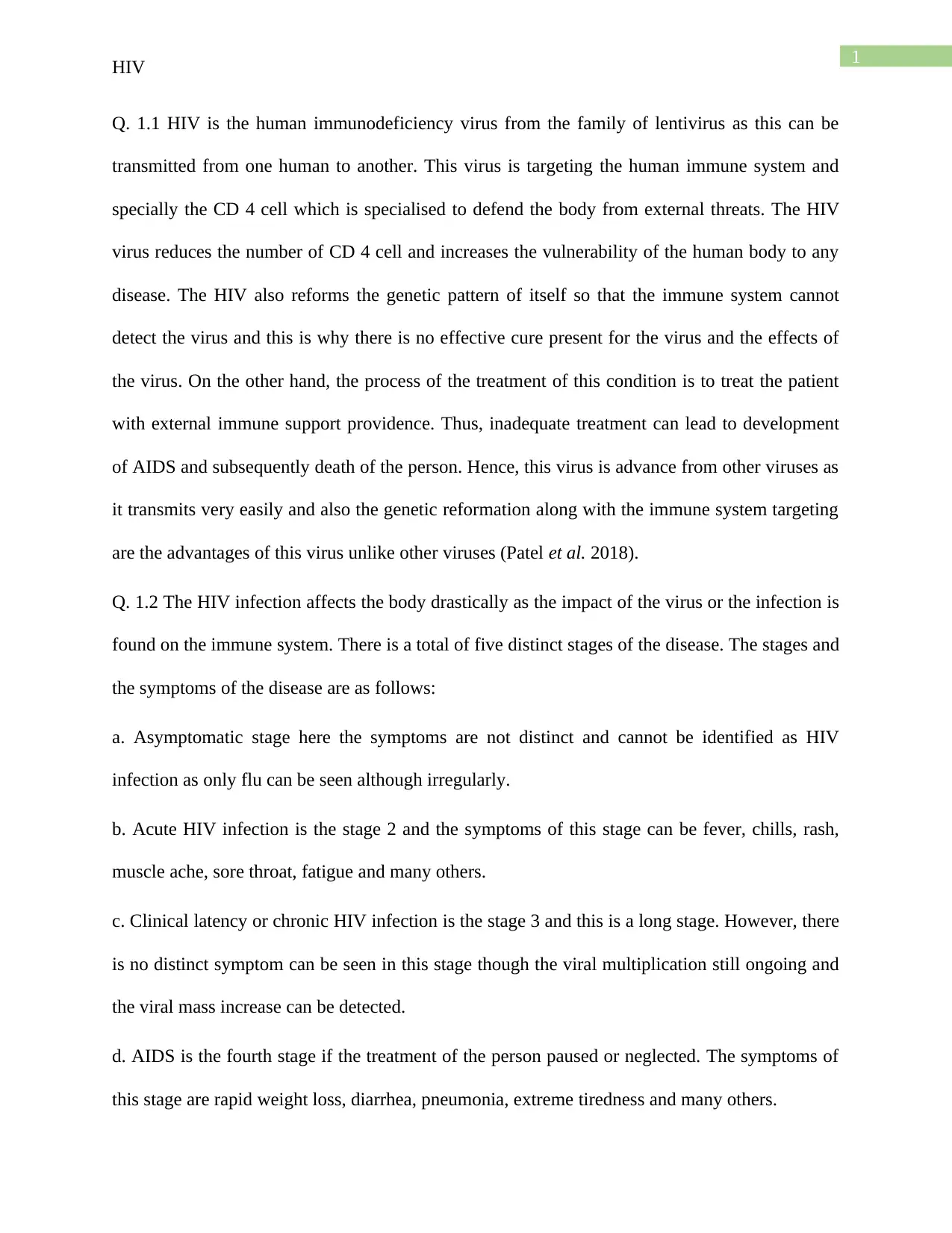
Q. 1.1 HIV is the human immunodeficiency virus from the family of lentivirus as this can be
transmitted from one human to another. This virus is targeting the human immune system and
specially the CD 4 cell which is specialised to defend the body from external threats. The HIV
virus reduces the number of CD 4 cell and increases the vulnerability of the human body to any
disease. The HIV also reforms the genetic pattern of itself so that the immune system cannot
detect the virus and this is why there is no effective cure present for the virus and the effects of
the virus. On the other hand, the process of the treatment of this condition is to treat the patient
with external immune support providence. Thus, inadequate treatment can lead to development
of AIDS and subsequently death of the person. Hence, this virus is advance from other viruses as
it transmits very easily and also the genetic reformation along with the immune system targeting
are the advantages of this virus unlike other viruses (Patel et al. 2018).
Q. 1.2 The HIV infection affects the body drastically as the impact of the virus or the infection is
found on the immune system. There is a total of five distinct stages of the disease. The stages and
the symptoms of the disease are as follows:
a. Asymptomatic stage here the symptoms are not distinct and cannot be identified as HIV
infection as only flu can be seen although irregularly.
b. Acute HIV infection is the stage 2 and the symptoms of this stage can be fever, chills, rash,
muscle ache, sore throat, fatigue and many others.
c. Clinical latency or chronic HIV infection is the stage 3 and this is a long stage. However, there
is no distinct symptom can be seen in this stage though the viral multiplication still ongoing and
the viral mass increase can be detected.
d. AIDS is the fourth stage if the treatment of the person paused or neglected. The symptoms of
this stage are rapid weight loss, diarrhea, pneumonia, extreme tiredness and many others.
Document Page
2
HIV
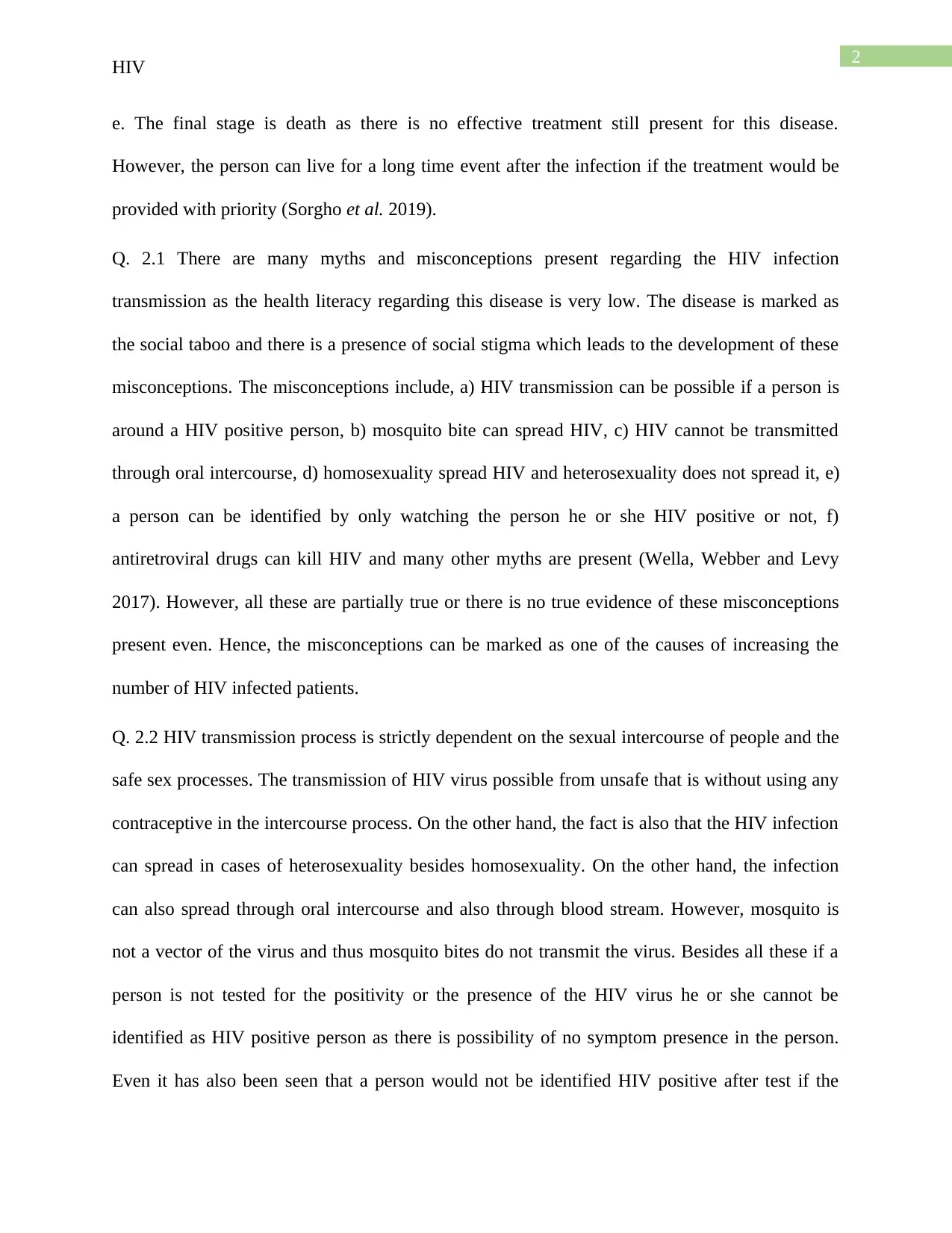
e. The final stage is death as there is no effective treatment still present for this disease.
However, the person can live for a long time event after the infection if the treatment would be
provided with priority (Sorgho et al. 2019).
Q. 2.1 There are many myths and misconceptions present regarding the HIV infection
transmission as the health literacy regarding this disease is very low. The disease is marked as
the social taboo and there is a presence of social stigma which leads to the development of these
misconceptions. The misconceptions include, a) HIV transmission can be possible if a person is
around a HIV positive person, b) mosquito bite can spread HIV, c) HIV cannot be transmitted
through oral intercourse, d) homosexuality spread HIV and heterosexuality does not spread it, e)
a person can be identified by only watching the person he or she HIV positive or not, f)
antiretroviral drugs can kill HIV and many other myths are present (Wella, Webber and Levy
2017). However, all these are partially true or there is no true evidence of these misconceptions
present even. Hence, the misconceptions can be marked as one of the causes of increasing the
number of HIV infected patients.
Q. 2.2 HIV transmission process is strictly dependent on the sexual intercourse of people and the
safe sex processes. The transmission of HIV virus possible from unsafe that is without using any
contraceptive in the intercourse process. On the other hand, the fact is also that the HIV infection
can spread in cases of heterosexuality besides homosexuality. On the other hand, the infection
can also spread through oral intercourse and also through blood stream. However, mosquito is
not a vector of the virus and thus mosquito bites do not transmit the virus. Besides all these if a
person is not tested for the positivity or the presence of the HIV virus he or she cannot be
identified as HIV positive person as there is possibility of no symptom presence in the person.
Even it has also been seen that a person would not be identified HIV positive after test if the
Document Page
3
HIV
person recently being affected with the virus. Hence, all these myths should be eliminated and
the severity of the condition should be considered with priority (Williams and Granich 2017).
Q. 3.1 There are presence of stigma in terms of HIV and AIDS in the society. Hence, in terms of
the education for the children from middle childhood years and adolescent people also found to
be restricted from this kind of education generally. However, the stigma and the negative
information regarding the disease and the infection from the media and social media would
impact on the cognitive development of the children from middle childhood (McHenry et al.
2017). On the other hand, the negative impact on the cognitive factor of the children will
subsequently affect their adolescent years and lead to the development of the negative practices
or negligence towards the factor which lead to increase in the stigma or the rate of disease.
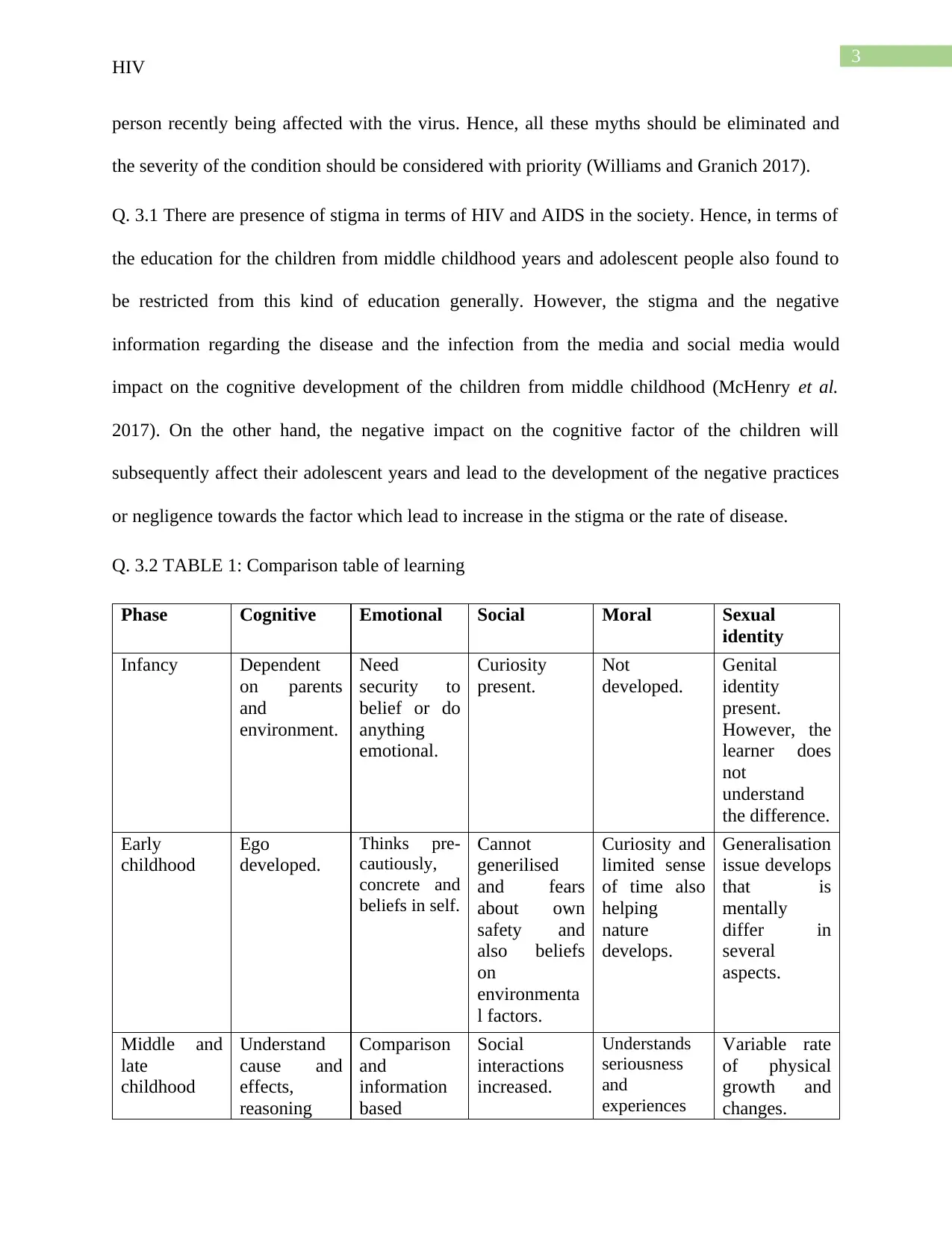
Q. 3.2 TABLE 1: Comparison table of learning
Phase Cognitive Emotional Social Moral Sexual
identity
Infancy Dependent
on parents
and
environment.
Need
security to
belief or do
anything
emotional.
Curiosity
present.
Not
developed.
Genital
identity
present.
However, the
learner does
not
understand
the difference.
Early
childhood
Ego
developed.
Thinks pre-
cautiously,
concrete and
beliefs in self.
Cannot
generilised
and fears
about own
safety and
also beliefs
on
environmenta
l factors.
Curiosity and
limited sense
of time also
helping
nature
develops.
Generalisation
issue develops
that is
mentally
differ in
several
aspects.
Middle and
late
childhood
Understand
cause and
effects,
reasoning
Comparison
and
information
based
Social
interactions
increased.
Understands
seriousness
and
experiences
Variable rate
of physical
growth and
changes.
tabler-icon-diamond-filled.svg

Paraphrase This Document

Need a fresh take? Get an instant paraphrase of this document with our AI Paraphraser
Document Page
4
HIV
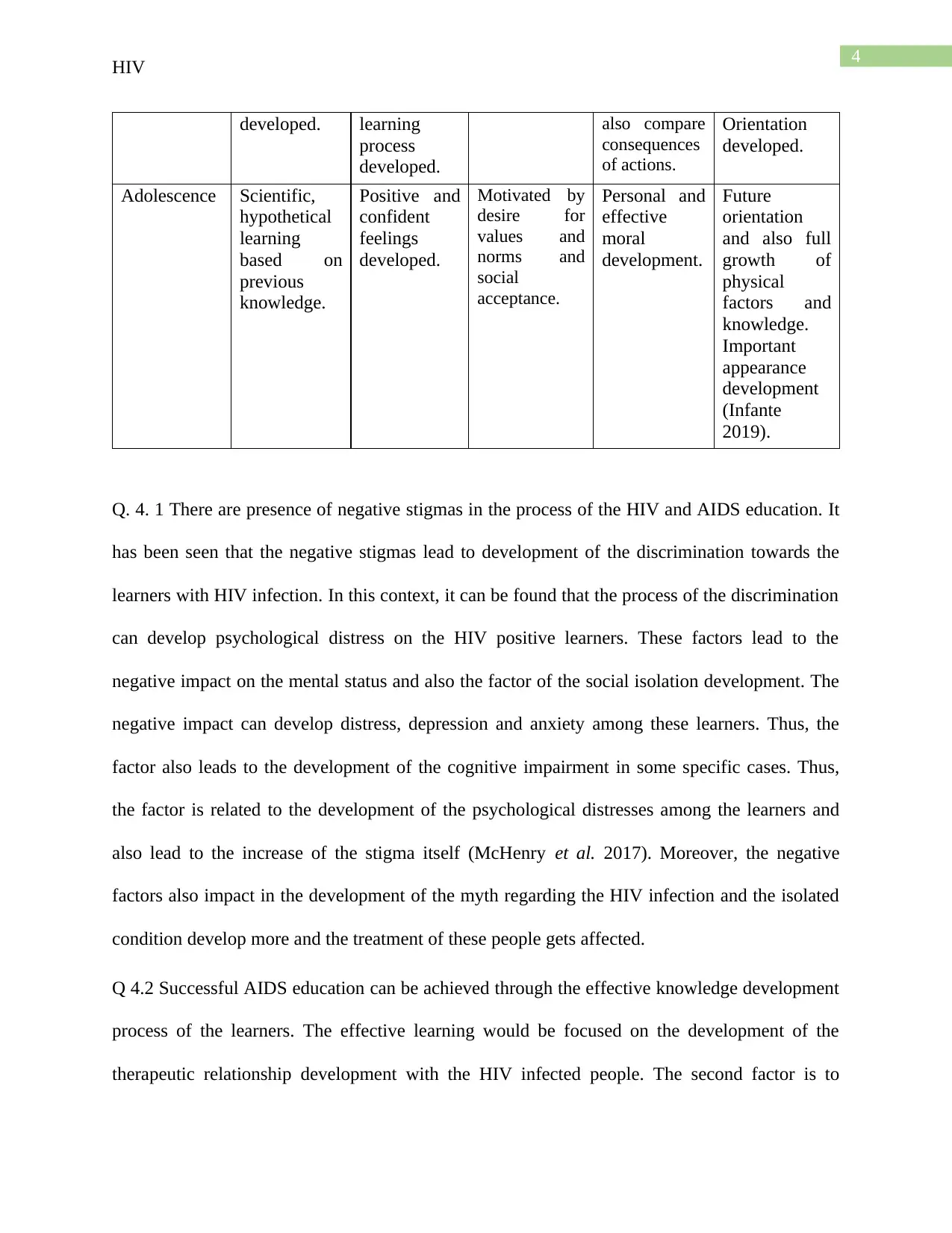
developed. learning
process
developed.
also compare
consequences
of actions.
Orientation
developed.
Adolescence Scientific,
hypothetical
learning
based on
previous
knowledge.
Positive and
confident
feelings
developed.
Motivated by
desire for
values and
norms and
social
acceptance.
Personal and
effective
moral
development.
Future
orientation
and also full
growth of
physical
factors and
knowledge.
Important
appearance
development
(Infante
2019).
Q. 4. 1 There are presence of negative stigmas in the process of the HIV and AIDS education. It
has been seen that the negative stigmas lead to development of the discrimination towards the
learners with HIV infection. In this context, it can be found that the process of the discrimination
can develop psychological distress on the HIV positive learners. These factors lead to the
negative impact on the mental status and also the factor of the social isolation development. The
negative impact can develop distress, depression and anxiety among these learners. Thus, the
factor also leads to the development of the cognitive impairment in some specific cases. Thus,
the factor is related to the development of the psychological distresses among the learners and
also lead to the increase of the stigma itself (McHenry et al. 2017). Moreover, the negative
factors also impact in the development of the myth regarding the HIV infection and the isolated
condition develop more and the treatment of these people gets affected.
Q 4.2 Successful AIDS education can be achieved through the effective knowledge development
process of the learners. The effective learning would be focused on the development of the
therapeutic relationship development with the HIV infected people. The second factor is to
Document Page
5
HIV
eliminate the rate of the myth or the misconception among the people from the community and
also other people. The factor of the reduction of the negative factors can be achieved through
proper health promotion program development and also focusing on the proper education
providence to all the people. The health promotion program should be developed with
appropriate factors related to the HIV transmission and treatment (Chikwiri and Musiyiwa 2017).
Document Page
6
HIV
References
Chikwiri, E. and Musiyiwa, J., 2017. An Analysis of the Student TeachersFacilitation of the
Development of Creative Expression and Aestheticism among Infant Learners in Art and Design.
International Journal of Engineering Research, 6(3), pp.193-198.
Infante, G.K.L., 2019. Psychosocial and Cognitive Stage Approach to Learning and Teaching in
Higher Education. Available at SSRN 3531504.
McHenry, M.S., Nyandiko, W.M., Scanlon, M.L., Fischer, L.J., McAteer, C.I., Aluoch, J.,
Naanyu, V. and Vreeman, R.C., 2017. HIV stigma: perspectives from Kenyan child caregivers
and adolescents living with HIV. Journal of the International Association of Providers of AIDS
Care (JIAPAC), 16(3), pp.215-225.
Patel, P., Rose, C.E., Collins, P.Y., Nuche-Berenguer, B., Sahasrabuddhe, V.V., Peprah, E.,
Vorkoper, S., Pastakia, S.D., Rausch, D., Levitt, N.S. and HIV, N., 2018. Noncommunicable
diseases among HIV-infected persons in low-income and middle-income countries: a systematic
review and meta-analysis. AIDS (London, England), 32(Suppl 1), p.S5.
Sorgho, P.A., Djigma, F.W., Martinson, J.J., Yonli, A.T., Nagalo, B.M., Compaore, T.R., Diarra,
B., Sombie, H.K., Simpore, A., Zongo, A.W. and Ouattara, A.K., 2019. Role of Killer cell
immunoglobulin-like receptors (KIR) genes in stages of HIV-1 infection among patients from
Burkina Faso. Biomolecular Concepts, 10(1), pp.226-236.
Wella, K., Webber, S. and Levy, P., 2017. Myths about HIV and AIDS among serodiscordant
couples in Malawi. Aslib Journal of Information Management.
Williams, B.G. and Granich, R., 2017. Ending AIDS: myth or reality?. The Lancet, 390(10092),
p.357.
tabler-icon-diamond-filled.svg

Paraphrase This Document

Need a fresh take? Get an instant paraphrase of this document with our AI Paraphraser
Document Page
7
HIV
chevron_up_icon
1 out of 8
circle_padding
hide_on_mobile
zoom_out_icon
[object Object]