HLTAAP002: Confirming Physical Health Status - A Detailed Case Study
VerifiedAdded on 2023/06/10
|14
|5856
|397
Case Study
AI Summary
This HLTAAP002 case study presents three scenarios focusing on confirming a patient's physical health status. The first scenario involves Mr. Frank Hardy, a 68-year-old patient admitted for hypertension and a possible stroke. The solution addresses questions related to normal and hypertensive blood pressure ranges, abnormal vital signs, the relationship between respiratory rate and temperature, the scope of practice for an Enrolled Nurse (EN) versus a Registered Nurse (RN), and the reporting hierarchy for an EN. It also explores the roles of a dietician, physiotherapist, and General Practitioner (GP) in Mr. Hardy's care, potential factors contributing to his stroke, potential deficits associated with his cerebrovascular accident (CVA), and complications caused by healthcare professionals. The assignment provides detailed answers and explanations, utilizing medical terminology and referencing relevant healthcare practices.
STUDENT
Practical– Case Study
HLTAAP002 Confirm Physical health status
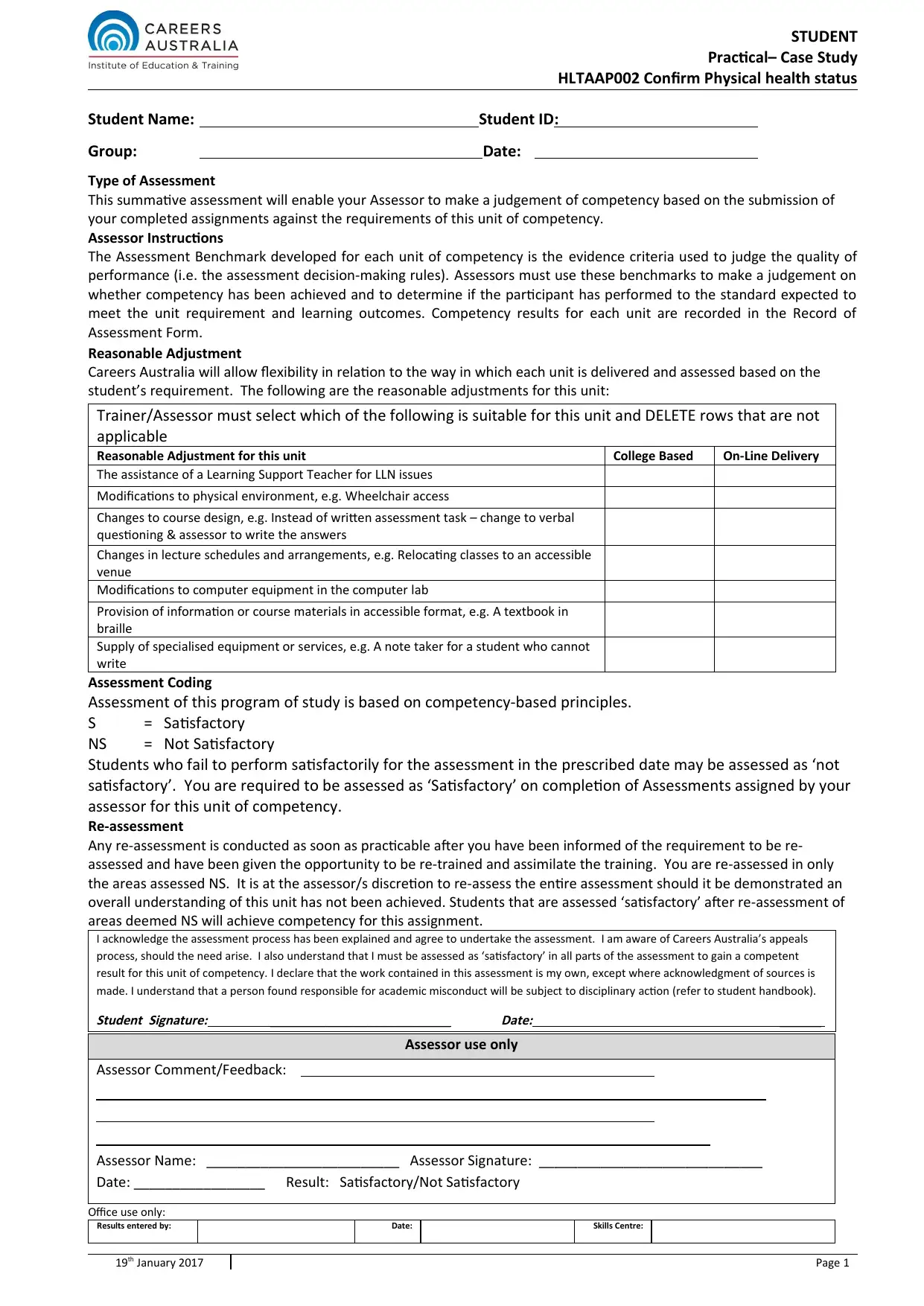
Student Name: Student ID:
Group: Date:
Type of Assessment
This summative assessment will enable your Assessor to make a judgement of competency based on the submission of
your completed assignments against the requirements of this unit of competency.
Assessor Instructions
The Assessment Benchmark developed for each unit of competency is the evidence criteria used to judge the quality of
performance (i.e. the assessment decision-making rules). Assessors must use these benchmarks to make a judgement on
whether competency has been achieved and to determine if the participant has performed to the standard expected to
meet the unit requirement and learning outcomes. Competency results for each unit are recorded in the Record of
Assessment Form.
Reasonable Adjustment
Careers Australia will allow flexibility in relation to the way in which each unit is delivered and assessed based on the
student’s requirement. The following are the reasonable adjustments for this unit:
Trainer/Assessor must select which of the following is suitable for this unit and DELETE rows that are not
applicable
Reasonable Adjustment for this unit College Based On-Line Delivery
The assistance of a Learning Support Teacher for LLN issues
Modifications to physical environment, e.g. Wheelchair access
Changes to course design, e.g. Instead of written assessment task – change to verbal
questioning & assessor to write the answers
Changes in lecture schedules and arrangements, e.g. Relocating classes to an accessible
venue
Modifications to computer equipment in the computer lab
Provision of information or course materials in accessible format, e.g. A textbook in
braille
Supply of specialised equipment or services, e.g. A note taker for a student who cannot
write
Assessment Coding
Assessment of this program of study is based on competency-based principles.
S = Satisfactory
NS = Not Satisfactory
Students who fail to perform satisfactorily for the assessment in the prescribed date may be assessed as ‘not
satisfactory’. You are required to be assessed as ‘Satisfactory’ on completion of Assessments assigned by your
assessor for this unit of competency.
Re-assessment
Any re-assessment is conducted as soon as practicable after you have been informed of the requirement to be re-
assessed and have been given the opportunity to be re-trained and assimilate the training. You are re-assessed in only
the areas assessed NS. It is at the assessor/s discretion to re-assess the entire assessment should it be demonstrated an
overall understanding of this unit has not been achieved. Students that are assessed ‘satisfactory’ after re-assessment of
areas deemed NS will achieve competency for this assignment.
I acknowledge the assessment process has been explained and agree to undertake the assessment. I am aware of Careers Australia’s appeals
process, should the need arise. I also understand that I must be assessed as ‘satisfactory’ in all parts of the assessment to gain a competent
result for this unit of competency. I declare that the work contained in this assessment is my own, except where acknowledgment of sources is
made. I understand that a person found responsible for academic misconduct will be subject to disciplinary action (refer to student handbook).Student Signature: __________________________
Date:
______
Assessor use only
Assessor Comment/Feedback:
Assessor Name: _________________________ Assessor Signature: _____________________________
Date: _________________ Result: Satisfactory/Not Satisfactory
Office use only:
Results entered by: Date: Skills Centre:
19th January 2017 Page 1
Practical– Case Study
HLTAAP002 Confirm Physical health status
Student Name: Student ID:
Group: Date:
Type of Assessment
This summative assessment will enable your Assessor to make a judgement of competency based on the submission of
your completed assignments against the requirements of this unit of competency.
Assessor Instructions
The Assessment Benchmark developed for each unit of competency is the evidence criteria used to judge the quality of
performance (i.e. the assessment decision-making rules). Assessors must use these benchmarks to make a judgement on
whether competency has been achieved and to determine if the participant has performed to the standard expected to
meet the unit requirement and learning outcomes. Competency results for each unit are recorded in the Record of
Assessment Form.
Reasonable Adjustment
Careers Australia will allow flexibility in relation to the way in which each unit is delivered and assessed based on the
student’s requirement. The following are the reasonable adjustments for this unit:
Trainer/Assessor must select which of the following is suitable for this unit and DELETE rows that are not
applicable
Reasonable Adjustment for this unit College Based On-Line Delivery
The assistance of a Learning Support Teacher for LLN issues
Modifications to physical environment, e.g. Wheelchair access
Changes to course design, e.g. Instead of written assessment task – change to verbal
questioning & assessor to write the answers
Changes in lecture schedules and arrangements, e.g. Relocating classes to an accessible
venue
Modifications to computer equipment in the computer lab
Provision of information or course materials in accessible format, e.g. A textbook in
braille
Supply of specialised equipment or services, e.g. A note taker for a student who cannot
write
Assessment Coding
Assessment of this program of study is based on competency-based principles.
S = Satisfactory
NS = Not Satisfactory
Students who fail to perform satisfactorily for the assessment in the prescribed date may be assessed as ‘not
satisfactory’. You are required to be assessed as ‘Satisfactory’ on completion of Assessments assigned by your
assessor for this unit of competency.
Re-assessment
Any re-assessment is conducted as soon as practicable after you have been informed of the requirement to be re-
assessed and have been given the opportunity to be re-trained and assimilate the training. You are re-assessed in only
the areas assessed NS. It is at the assessor/s discretion to re-assess the entire assessment should it be demonstrated an
overall understanding of this unit has not been achieved. Students that are assessed ‘satisfactory’ after re-assessment of
areas deemed NS will achieve competency for this assignment.
I acknowledge the assessment process has been explained and agree to undertake the assessment. I am aware of Careers Australia’s appeals
process, should the need arise. I also understand that I must be assessed as ‘satisfactory’ in all parts of the assessment to gain a competent
result for this unit of competency. I declare that the work contained in this assessment is my own, except where acknowledgment of sources is
made. I understand that a person found responsible for academic misconduct will be subject to disciplinary action (refer to student handbook).Student Signature: __________________________
Date:
______
Assessor use only
Assessor Comment/Feedback:
Assessor Name: _________________________ Assessor Signature: _____________________________
Date: _________________ Result: Satisfactory/Not Satisfactory
Office use only:
Results entered by: Date: Skills Centre:
19th January 2017 Page 1

Paraphrase This Document
Need a fresh take? Get an instant paraphrase of this document with our AI Paraphraser
STUDENT
Practical– Case Study
HLTAAP002 Confirm Physical health status
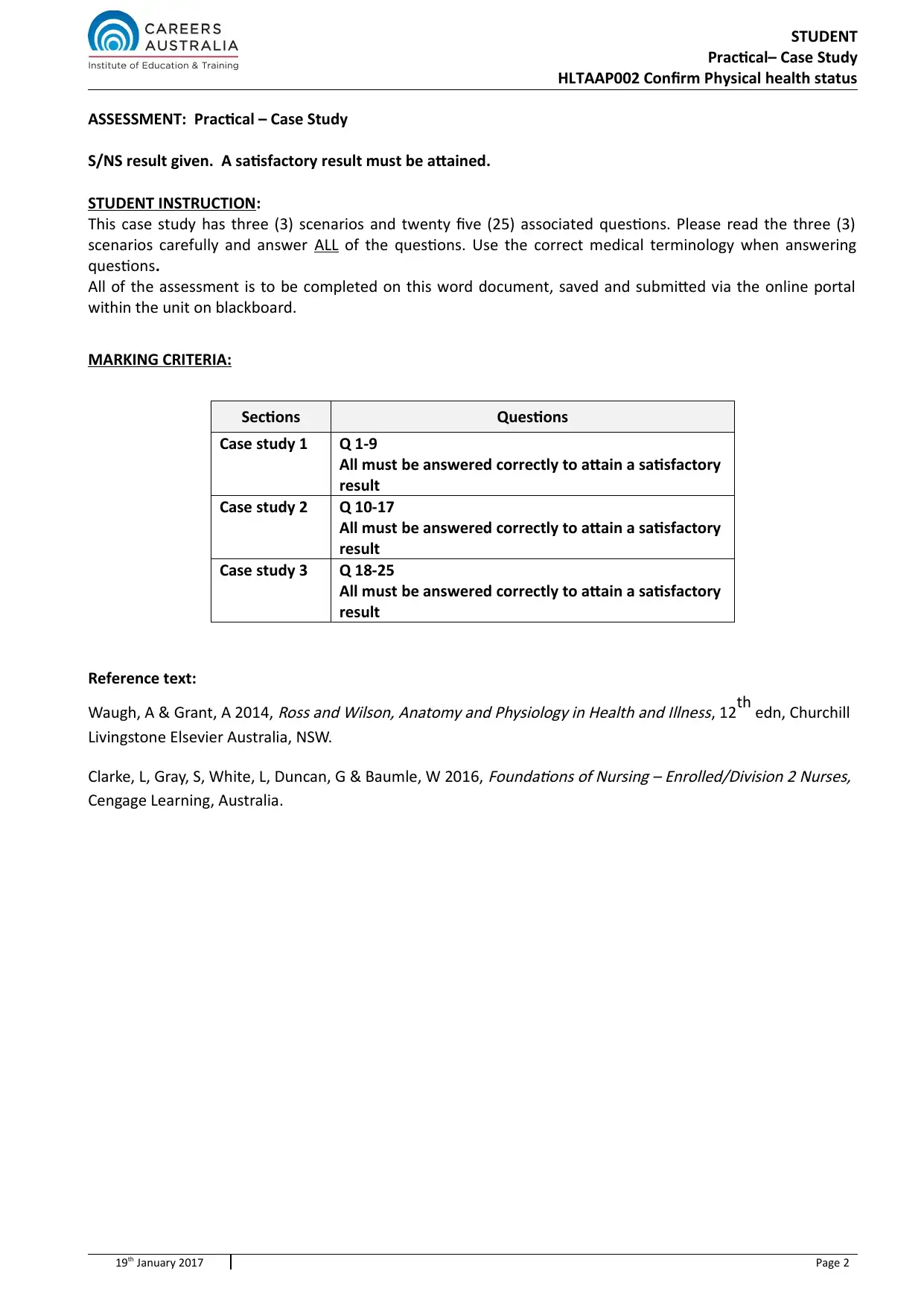
ASSESSMENT: Practical – Case Study
S/NS result given. A satisfactory result must be attained.
STUDENT INSTRUCTION:
This case study has three (3) scenarios and twenty five (25) associated questions. Please read the three (3)
scenarios carefully and answer ALL of the questions. Use the correct medical terminology when answering
questions.
All of the assessment is to be completed on this word document, saved and submitted via the online portal
within the unit on blackboard.
MARKING CRITERIA:
Sections Questions
Case study 1 Q 1-9
All must be answered correctly to attain a satisfactory
result
Case study 2 Q 10-17
All must be answered correctly to attain a satisfactory
result
Case study 3 Q 18-25
All must be answered correctly to attain a satisfactory
result
Reference text:
Waugh, A & Grant, A 2014,
Ross and Wilson, Anatomy and Physiology in Health and Illness, 12th edn, Churchill
Livingstone Elsevier Australia, NSW.
Clarke, L, Gray, S, White, L, Duncan, G & Baumle, W 2016,
Foundations of Nursing – Enrolled/Division 2 Nurses,
Cengage Learning, Australia.
19th January 2017 Page 2
Practical– Case Study
HLTAAP002 Confirm Physical health status
ASSESSMENT: Practical – Case Study
S/NS result given. A satisfactory result must be attained.
STUDENT INSTRUCTION:
This case study has three (3) scenarios and twenty five (25) associated questions. Please read the three (3)
scenarios carefully and answer ALL of the questions. Use the correct medical terminology when answering
questions.
All of the assessment is to be completed on this word document, saved and submitted via the online portal
within the unit on blackboard.
MARKING CRITERIA:
Sections Questions
Case study 1 Q 1-9
All must be answered correctly to attain a satisfactory
result
Case study 2 Q 10-17
All must be answered correctly to attain a satisfactory
result
Case study 3 Q 18-25
All must be answered correctly to attain a satisfactory
result
Reference text:
Waugh, A & Grant, A 2014,
Ross and Wilson, Anatomy and Physiology in Health and Illness, 12th edn, Churchill
Livingstone Elsevier Australia, NSW.
Clarke, L, Gray, S, White, L, Duncan, G & Baumle, W 2016,
Foundations of Nursing – Enrolled/Division 2 Nurses,
Cengage Learning, Australia.
19th January 2017 Page 2
STUDENT
Practical– Case Study
HLTAAP002 Confirm Physical health status
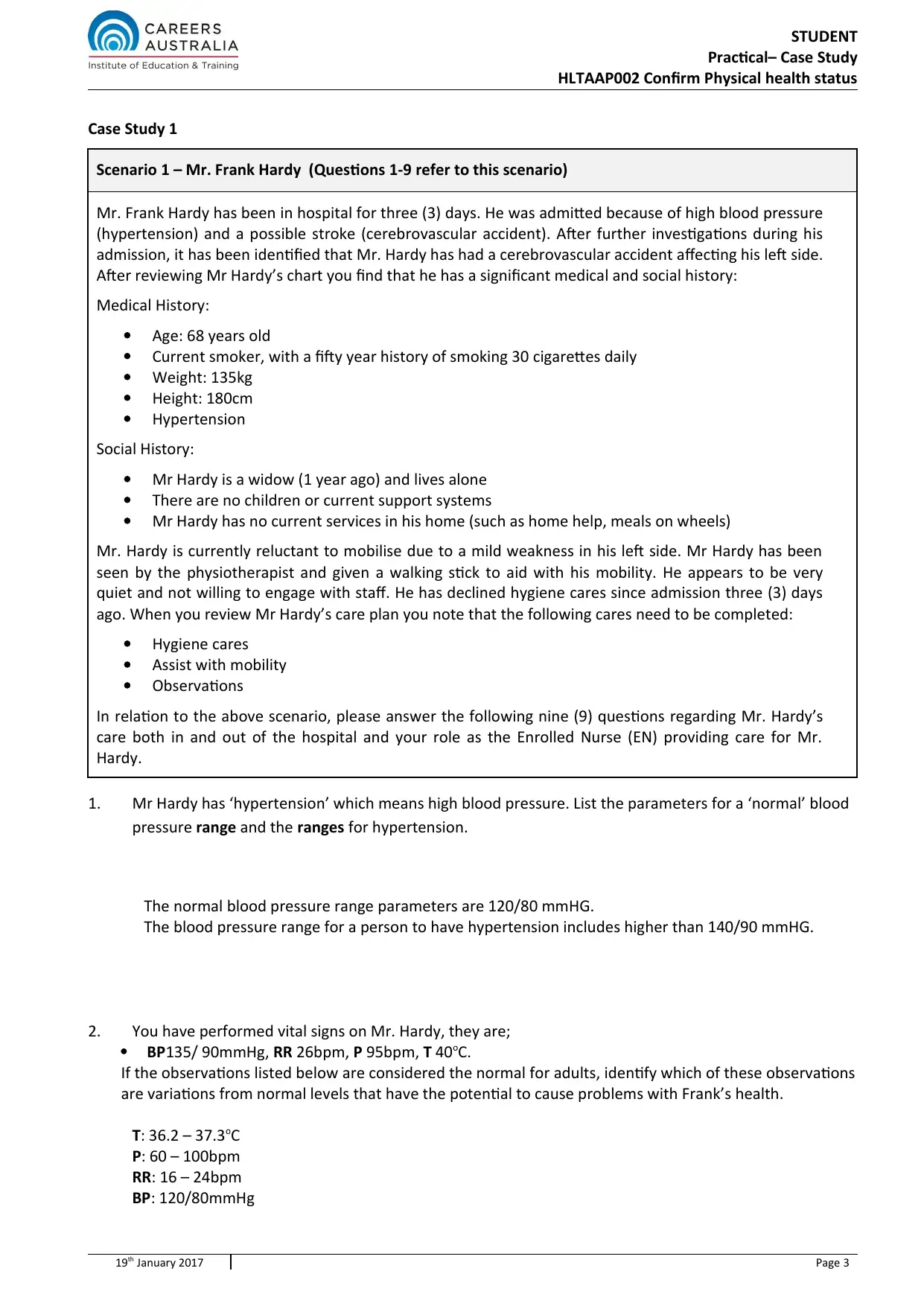
Case Study 1
Scenario 1 – Mr. Frank Hardy (Questions 1-9 refer to this scenario)
Mr. Frank Hardy has been in hospital for three (3) days. He was admitted because of high blood pressure
(hypertension) and a possible stroke (cerebrovascular accident). After further investigations during his
admission, it has been identified that Mr. Hardy has had a cerebrovascular accident affecting his left side.
After reviewing Mr Hardy’s chart you find that he has a significant medical and social history:
Medical History:
Age: 68 years old
Current smoker, with a fifty year history of smoking 30 cigarettes daily
Weight: 135kg
Height: 180cm
Hypertension
Social History:
Mr Hardy is a widow (1 year ago) and lives alone
There are no children or current support systems
Mr Hardy has no current services in his home (such as home help, meals on wheels)
Mr. Hardy is currently reluctant to mobilise due to a mild weakness in his left side. Mr Hardy has been
seen by the physiotherapist and given a walking stick to aid with his mobility. He appears to be very
quiet and not willing to engage with staff. He has declined hygiene cares since admission three (3) days
ago. When you review Mr Hardy’s care plan you note that the following cares need to be completed:
Hygiene cares
Assist with mobility
Observations
In relation to the above scenario, please answer the following nine (9) questions regarding Mr. Hardy’s
care both in and out of the hospital and your role as the Enrolled Nurse (EN) providing care for Mr.
Hardy.
1. Mr Hardy has ‘hypertension’ which means high blood pressure. List the parameters for a ‘normal’ blood
pressure range and the ranges for hypertension.
The normal blood pressure range parameters are 120/80 mmHG.
The blood pressure range for a person to have hypertension includes higher than 140/90 mmHG.
2. You have performed vital signs on Mr. Hardy, they are;
BP135/ 90mmHg, RR 26bpm, P 95bpm, T 40oC.
If the observations listed below are considered the normal for adults, identify which of these observations
are variations from normal levels that have the potential to cause problems with Frank’s health.
T: 36.2 – 37.3oC
P: 60 – 100bpm
RR: 16 – 24bpm
BP: 120/80mmHg
19th January 2017 Page 3
Practical– Case Study
HLTAAP002 Confirm Physical health status
Case Study 1
Scenario 1 – Mr. Frank Hardy (Questions 1-9 refer to this scenario)
Mr. Frank Hardy has been in hospital for three (3) days. He was admitted because of high blood pressure
(hypertension) and a possible stroke (cerebrovascular accident). After further investigations during his
admission, it has been identified that Mr. Hardy has had a cerebrovascular accident affecting his left side.
After reviewing Mr Hardy’s chart you find that he has a significant medical and social history:
Medical History:
Age: 68 years old
Current smoker, with a fifty year history of smoking 30 cigarettes daily
Weight: 135kg
Height: 180cm
Hypertension
Social History:
Mr Hardy is a widow (1 year ago) and lives alone
There are no children or current support systems
Mr Hardy has no current services in his home (such as home help, meals on wheels)
Mr. Hardy is currently reluctant to mobilise due to a mild weakness in his left side. Mr Hardy has been
seen by the physiotherapist and given a walking stick to aid with his mobility. He appears to be very
quiet and not willing to engage with staff. He has declined hygiene cares since admission three (3) days
ago. When you review Mr Hardy’s care plan you note that the following cares need to be completed:
Hygiene cares
Assist with mobility
Observations
In relation to the above scenario, please answer the following nine (9) questions regarding Mr. Hardy’s
care both in and out of the hospital and your role as the Enrolled Nurse (EN) providing care for Mr.
Hardy.
1. Mr Hardy has ‘hypertension’ which means high blood pressure. List the parameters for a ‘normal’ blood
pressure range and the ranges for hypertension.
The normal blood pressure range parameters are 120/80 mmHG.
The blood pressure range for a person to have hypertension includes higher than 140/90 mmHG.
2. You have performed vital signs on Mr. Hardy, they are;
BP135/ 90mmHg, RR 26bpm, P 95bpm, T 40oC.
If the observations listed below are considered the normal for adults, identify which of these observations
are variations from normal levels that have the potential to cause problems with Frank’s health.
T: 36.2 – 37.3oC
P: 60 – 100bpm
RR: 16 – 24bpm
BP: 120/80mmHg
19th January 2017 Page 3
⊘ This is a preview!⊘
Do you want full access?
Subscribe today to unlock all pages.

Trusted by 1+ million students worldwide
STUDENT
Practical– Case Study
HLTAAP002 Confirm Physical health status
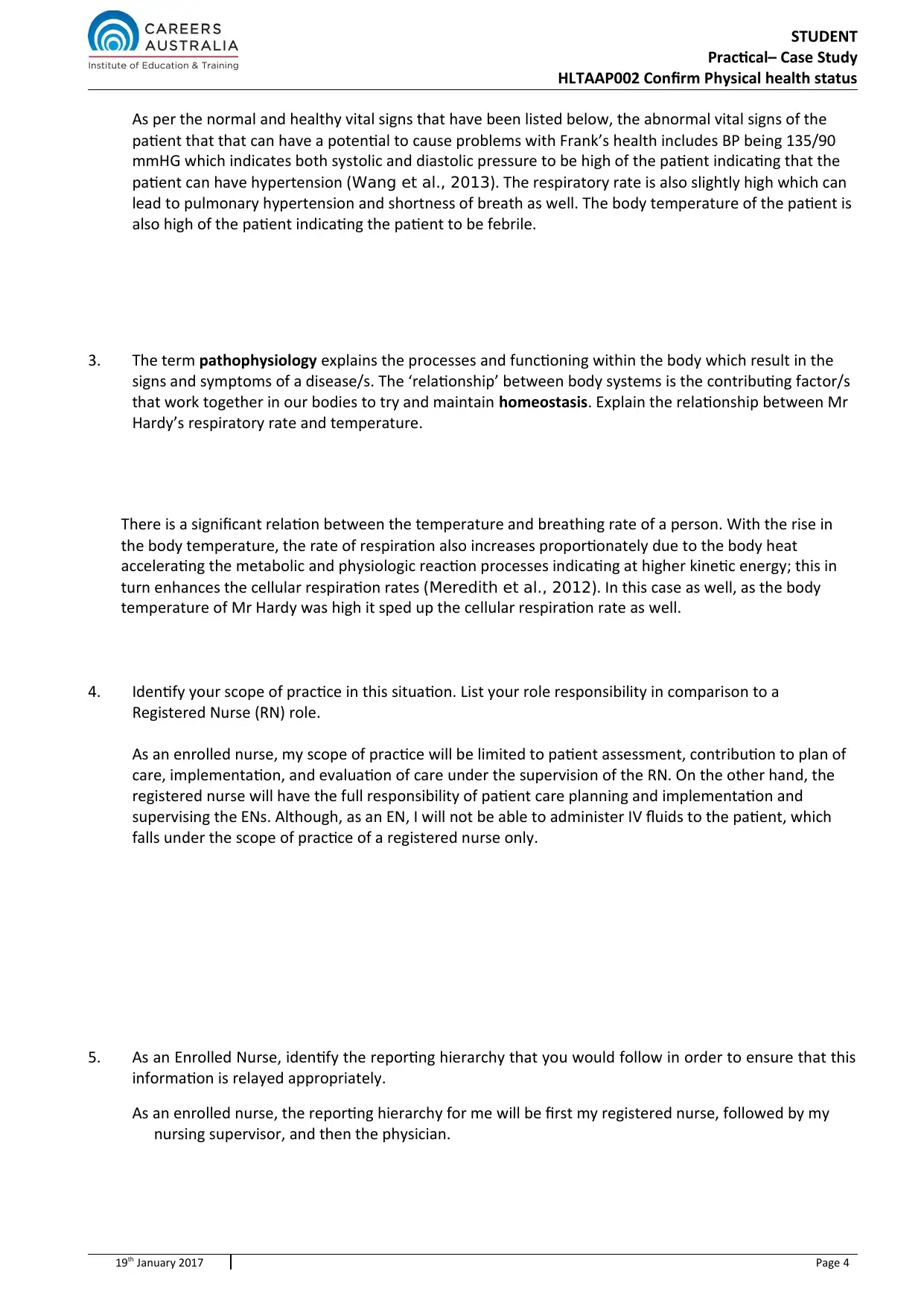
As per the normal and healthy vital signs that have been listed below, the abnormal vital signs of the
patient that that can have a potential to cause problems with Frank’s health includes BP being 135/90
mmHG which indicates both systolic and diastolic pressure to be high of the patient indicating that the
patient can have hypertension (Wang et al., 2013). The respiratory rate is also slightly high which can
lead to pulmonary hypertension and shortness of breath as well. The body temperature of the patient is
also high of the patient indicating the patient to be febrile.
3. The term pathophysiology explains the processes and functioning within the body which result in the
signs and symptoms of a disease/s. The ‘relationship’ between body systems is the contributing factor/s
that work together in our bodies to try and maintain homeostasis. Explain the relationship between Mr
Hardy’s respiratory rate and temperature.
There is a significant relation between the temperature and breathing rate of a person. With the rise in
the body temperature, the rate of respiration also increases proportionately due to the body heat
accelerating the metabolic and physiologic reaction processes indicating at higher kinetic energy; this in
turn enhances the cellular respiration rates (Meredith et al., 2012). In this case as well, as the body
temperature of Mr Hardy was high it sped up the cellular respiration rate as well.
4. Identify your scope of practice in this situation. List your role responsibility in comparison to a
Registered Nurse (RN) role.
As an enrolled nurse, my scope of practice will be limited to patient assessment, contribution to plan of
care, implementation, and evaluation of care under the supervision of the RN. On the other hand, the
registered nurse will have the full responsibility of patient care planning and implementation and
supervising the ENs. Although, as an EN, I will not be able to administer IV fluids to the patient, which
falls under the scope of practice of a registered nurse only.
5. As an Enrolled Nurse, identify the reporting hierarchy that you would follow in order to ensure that this
information is relayed appropriately.
As an enrolled nurse, the reporting hierarchy for me will be first my registered nurse, followed by my
nursing supervisor, and then the physician.
19th January 2017 Page 4
Practical– Case Study
HLTAAP002 Confirm Physical health status
As per the normal and healthy vital signs that have been listed below, the abnormal vital signs of the
patient that that can have a potential to cause problems with Frank’s health includes BP being 135/90
mmHG which indicates both systolic and diastolic pressure to be high of the patient indicating that the
patient can have hypertension (Wang et al., 2013). The respiratory rate is also slightly high which can
lead to pulmonary hypertension and shortness of breath as well. The body temperature of the patient is
also high of the patient indicating the patient to be febrile.
3. The term pathophysiology explains the processes and functioning within the body which result in the
signs and symptoms of a disease/s. The ‘relationship’ between body systems is the contributing factor/s
that work together in our bodies to try and maintain homeostasis. Explain the relationship between Mr
Hardy’s respiratory rate and temperature.
There is a significant relation between the temperature and breathing rate of a person. With the rise in
the body temperature, the rate of respiration also increases proportionately due to the body heat
accelerating the metabolic and physiologic reaction processes indicating at higher kinetic energy; this in
turn enhances the cellular respiration rates (Meredith et al., 2012). In this case as well, as the body
temperature of Mr Hardy was high it sped up the cellular respiration rate as well.
4. Identify your scope of practice in this situation. List your role responsibility in comparison to a
Registered Nurse (RN) role.
As an enrolled nurse, my scope of practice will be limited to patient assessment, contribution to plan of
care, implementation, and evaluation of care under the supervision of the RN. On the other hand, the
registered nurse will have the full responsibility of patient care planning and implementation and
supervising the ENs. Although, as an EN, I will not be able to administer IV fluids to the patient, which
falls under the scope of practice of a registered nurse only.
5. As an Enrolled Nurse, identify the reporting hierarchy that you would follow in order to ensure that this
information is relayed appropriately.
As an enrolled nurse, the reporting hierarchy for me will be first my registered nurse, followed by my
nursing supervisor, and then the physician.
19th January 2017 Page 4
Paraphrase This Document
Need a fresh take? Get an instant paraphrase of this document with our AI Paraphraser
STUDENT
Practical– Case Study
HLTAAP002 Confirm Physical health status
6. Explain and discuss the following three (3) health care professionals’ scope of practice/role in the care
and management when referred to Mr. Hardy.
Dietician
Physiotherapist
General Practitioner (GP)
Dietician: As the patient has a risk of stroke and hypertension, the dietician will be able to provide a
strict low fat and low sodium diet plan in collaboration with the patient to be able to control the high
blood pressure
Physiotherapist: The physiotherapist will be able to collaborate with the patient to help the patient
start a strict exercise regimen that will help the patient lose weight and keep his blood pressure in
check as well.
GP: The general practitioner will investigate the underlying reason behind the high blood pressure and
risk of stroke for the patient and decide both pharmacological and non-pharmacological treatment
options.
7. Mr. Hardy has a significant medical and social history. From the case study list four (4) potential factors
that could have been responsible for the CVA (stroke). In your answer ensure that for each factor you
provide a brief explanation of how/why it could have impacted on Mr. Hardy’s current condition.
1. Age: with older age, the risk for cerebrovascular accidents are higher, especially over the age of 55.
As the patient had been 68, it can be a significant risk for stroke to the patient
2. Gender: Stroke risk factors have been reported to be at least 1.25 times higher in the men which can
be for Mr hardy
3. Heredity: genetic predisposition is also a very significant risk factor for stroke (Bandemer et al.,
2014)
4. Smoking: a prolonged history of smoking has been identified as a string risk factor for stroke
5. Obesity: obesity is critically linked with coronary arterial diseases and is a significant risk factor for
stroke as well.
8. A functional deficit is a sign or a symptom associated with an illness in a body system or a variation from
normal. These functional deficits can also be identified as potential risk factors when performing an
intervention. Mr. Hardy has several of these risk factors. Using correct medical terminology, list two (2)
potential deficits associated with Mr Hardy’s CVA.
19th January 2017 Page 5
Practical– Case Study
HLTAAP002 Confirm Physical health status
6. Explain and discuss the following three (3) health care professionals’ scope of practice/role in the care
and management when referred to Mr. Hardy.
Dietician
Physiotherapist
General Practitioner (GP)
Dietician: As the patient has a risk of stroke and hypertension, the dietician will be able to provide a
strict low fat and low sodium diet plan in collaboration with the patient to be able to control the high
blood pressure
Physiotherapist: The physiotherapist will be able to collaborate with the patient to help the patient
start a strict exercise regimen that will help the patient lose weight and keep his blood pressure in
check as well.
GP: The general practitioner will investigate the underlying reason behind the high blood pressure and
risk of stroke for the patient and decide both pharmacological and non-pharmacological treatment
options.
7. Mr. Hardy has a significant medical and social history. From the case study list four (4) potential factors
that could have been responsible for the CVA (stroke). In your answer ensure that for each factor you
provide a brief explanation of how/why it could have impacted on Mr. Hardy’s current condition.
1. Age: with older age, the risk for cerebrovascular accidents are higher, especially over the age of 55.
As the patient had been 68, it can be a significant risk for stroke to the patient
2. Gender: Stroke risk factors have been reported to be at least 1.25 times higher in the men which can
be for Mr hardy
3. Heredity: genetic predisposition is also a very significant risk factor for stroke (Bandemer et al.,
2014)
4. Smoking: a prolonged history of smoking has been identified as a string risk factor for stroke
5. Obesity: obesity is critically linked with coronary arterial diseases and is a significant risk factor for
stroke as well.
8. A functional deficit is a sign or a symptom associated with an illness in a body system or a variation from
normal. These functional deficits can also be identified as potential risk factors when performing an
intervention. Mr. Hardy has several of these risk factors. Using correct medical terminology, list two (2)
potential deficits associated with Mr Hardy’s CVA.
19th January 2017 Page 5
STUDENT
Practical– Case Study
HLTAAP002 Confirm Physical health status
1. Mobility restriction
2. Lack of personal hygiene
9. As per organisational policy you are taking blood from Mr Hardy for his routine tests. When finished you
note that you leave his arm with a large contusion (bruise). Identify the term used to describe
complications that are caused by treatment from healthcare professionals.
Any complication to the patient that can be caused by the treatment received from the health
care professionals can be broadly classified as medical errors.
End of section one
19th January 2017 Page 6
Practical– Case Study
HLTAAP002 Confirm Physical health status
1. Mobility restriction
2. Lack of personal hygiene
9. As per organisational policy you are taking blood from Mr Hardy for his routine tests. When finished you
note that you leave his arm with a large contusion (bruise). Identify the term used to describe
complications that are caused by treatment from healthcare professionals.
Any complication to the patient that can be caused by the treatment received from the health
care professionals can be broadly classified as medical errors.
End of section one
19th January 2017 Page 6
⊘ This is a preview!⊘
Do you want full access?
Subscribe today to unlock all pages.
Trusted by 1+ million students worldwide
STUDENT
Practical– Case Study
HLTAAP002 Confirm Physical health status
Case Study 2
Scenario 2 – Mrs. Heather Bishop (Questions 10-17 refer to this scenario)
Mrs Heather Bishop is an eighty (80) year old woman who is living in the residential aged care facility you
are working in. Before meeting her you quickly review her chart for her medical and social history:
Medical History:
Weight 50Kg
Height 170cm
80 years old
Menopause at 38yrs of age
Osteoporosis
Social History:
Widowed (10 years ago)
1 Daughter that visits regularly
She is mobile with a walking frame and supervision, however has had difficulty hearing lately. Mrs Bishop is
orientated and alert, and she has no cognitive deficits. As Mrs Bishop walks to the shower, she states that
she is ‘dizzy’ and loses her grip on her walking frame. She falls on her right side, you call for help, make her
comfortable and take a set of observations;
BP: 110/60mmHg, T: 36.5oC, P: 100bpm, RR: 28bpm
You are assisted by colleagues to move her back to the bed, then the resident doctor arrives. The doctor
diagnoses a fractured hip, at the neck of femur (NOF). Mrs Bishop is transferred to a hospital for further
treatment and investigations.
10. If the observations listed below are considered the normal parameters (range) for adults, identify
Heather’s abnormal observations.
T: 36.2 – 37.3oC
P: 60 – 100bpm
RR: 16 – 24bpm
BP: 120/80mmHg
As per the vital signs that have been presented in the case study of Heather, her abnormal
observations include respiratory rate (high at 28 bpm) and blood pressure or BP (low at 110/60
mmHG indicating hypotension)
11. Consider Mrs Bishop’s recent hearing loss. Identify and briefly explain the pathophysiology of the
degenerative ear condition that commonly causes hearing loss.
The most common cause to degenerative hearing loss in the adult population is due to the presbycusis
which is facilitated by a degenerative series of changes or deterioration in the auditory system of the
elderly patients associated with age derived deformities observed in the body. This particular condition
19th January 2017 Page 7
Practical– Case Study
HLTAAP002 Confirm Physical health status
Case Study 2
Scenario 2 – Mrs. Heather Bishop (Questions 10-17 refer to this scenario)
Mrs Heather Bishop is an eighty (80) year old woman who is living in the residential aged care facility you
are working in. Before meeting her you quickly review her chart for her medical and social history:
Medical History:
Weight 50Kg
Height 170cm
80 years old
Menopause at 38yrs of age
Osteoporosis
Social History:
Widowed (10 years ago)
1 Daughter that visits regularly
She is mobile with a walking frame and supervision, however has had difficulty hearing lately. Mrs Bishop is
orientated and alert, and she has no cognitive deficits. As Mrs Bishop walks to the shower, she states that
she is ‘dizzy’ and loses her grip on her walking frame. She falls on her right side, you call for help, make her
comfortable and take a set of observations;
BP: 110/60mmHg, T: 36.5oC, P: 100bpm, RR: 28bpm
You are assisted by colleagues to move her back to the bed, then the resident doctor arrives. The doctor
diagnoses a fractured hip, at the neck of femur (NOF). Mrs Bishop is transferred to a hospital for further
treatment and investigations.
10. If the observations listed below are considered the normal parameters (range) for adults, identify
Heather’s abnormal observations.
T: 36.2 – 37.3oC
P: 60 – 100bpm
RR: 16 – 24bpm
BP: 120/80mmHg
As per the vital signs that have been presented in the case study of Heather, her abnormal
observations include respiratory rate (high at 28 bpm) and blood pressure or BP (low at 110/60
mmHG indicating hypotension)
11. Consider Mrs Bishop’s recent hearing loss. Identify and briefly explain the pathophysiology of the
degenerative ear condition that commonly causes hearing loss.
The most common cause to degenerative hearing loss in the adult population is due to the presbycusis
which is facilitated by a degenerative series of changes or deterioration in the auditory system of the
elderly patients associated with age derived deformities observed in the body. This particular condition
19th January 2017 Page 7
Paraphrase This Document
Need a fresh take? Get an instant paraphrase of this document with our AI Paraphraser
STUDENT
Practical– Case Study
HLTAAP002 Confirm Physical health status
generally affects the patients within the age group of 55 to 65 and deteriorates gradually further
reducing the hearing capacity of the patient with time (Rariy, Ratcliffe & Weinstein, 2012).
12. Mrs Bishop has a significant medical and social history. From the case study list four (4) potential risk
factors that could have been responsible her osteoporosis.
1. Age: Age can be considered the first risk factor associated with osteoporosis, as the patient had been
80 year old, the risk is extremely high
2. Gender: women over the age group of 50 are of extreme high risk to osteoporosis
3. Body weight: women with lesser body weight are more at risk with osteoporosis.
4. Early menopause is another great risk to osteoporosis and it is present in case of Heather as well.
13. Discuss the pathophysiology of osteoporosis and relate this to Mrs Bishop’s fractured Neck of Femur
(#NOF).
Reduced skeletal mass that has been facilitated by the imbalance between bone resorption and bone
formation is the main pathophysiology of osteoporosis. However, neck of femur or any femoral
neck fractures have been reported to be accelerating the development of osteoporosis as well
due to impairments in bone mass (Tufail et al., 2015).
14. Mrs Bishop must have a surgical repair of her fracture; this means some care will be referred to other
health carers. Explain and discuss the following three (3) health care professionals’ roles, within the
multidisciplinary team in regards to Heather’s care and management whilst in hospital.
Orthopaedic Surgeon
Physiotherapist
Radiologist
Orthopaedic surgeon:
The orthopaedic surgeon could help with further diagnosis and management of the condition of Mrs.
Bishop as she had fractured her femur. The method which could be followed by the surgeon over
here for treatment of the fractured femur is intermedullary nailing where specially designed metal
rod is inserted in the canal of the femur
19th January 2017 Page 8
Practical– Case Study
HLTAAP002 Confirm Physical health status
generally affects the patients within the age group of 55 to 65 and deteriorates gradually further
reducing the hearing capacity of the patient with time (Rariy, Ratcliffe & Weinstein, 2012).
12. Mrs Bishop has a significant medical and social history. From the case study list four (4) potential risk
factors that could have been responsible her osteoporosis.
1. Age: Age can be considered the first risk factor associated with osteoporosis, as the patient had been
80 year old, the risk is extremely high
2. Gender: women over the age group of 50 are of extreme high risk to osteoporosis
3. Body weight: women with lesser body weight are more at risk with osteoporosis.
4. Early menopause is another great risk to osteoporosis and it is present in case of Heather as well.
13. Discuss the pathophysiology of osteoporosis and relate this to Mrs Bishop’s fractured Neck of Femur
(#NOF).
Reduced skeletal mass that has been facilitated by the imbalance between bone resorption and bone
formation is the main pathophysiology of osteoporosis. However, neck of femur or any femoral
neck fractures have been reported to be accelerating the development of osteoporosis as well
due to impairments in bone mass (Tufail et al., 2015).
14. Mrs Bishop must have a surgical repair of her fracture; this means some care will be referred to other
health carers. Explain and discuss the following three (3) health care professionals’ roles, within the
multidisciplinary team in regards to Heather’s care and management whilst in hospital.
Orthopaedic Surgeon
Physiotherapist
Radiologist
Orthopaedic surgeon:
The orthopaedic surgeon could help with further diagnosis and management of the condition of Mrs.
Bishop as she had fractured her femur. The method which could be followed by the surgeon over
here for treatment of the fractured femur is intermedullary nailing where specially designed metal
rod is inserted in the canal of the femur
19th January 2017 Page 8
STUDENT
Practical– Case Study
HLTAAP002 Confirm Physical health status
Physiotherapist:
The physiotherapist could help in restoring the normal movement pattern within the patient after the
formative treatment has been provided to the patient.
Radiologist:
The radiologist helps in accessing bone position followed by dislocation with the help of techniques such as X-
rays. The position of the displaced bones or the extent of the fracture is accessed from the X-ray reports
15. A functional deficit is a sign or a symptom associated with an illness in a body system or a variation from
normal. These functional deficits can also be identified as potential risk factors when performing an
intervention. Using the correct medical terminology identify two (2) main functional deficits in Heather’s
body systems necessitating nursing care and or monitoring.
A: The two functional deficits which have been identified for Mrs. Bishop are- Osteoporosis and difficulty in
hearing. Therefore, before planning the best next step in the care planning the prevalent health conditions of
the patient needs to be taken into consideration.
1. Osteoporosis- The patient already had osteoporosis, which means that she had less bone density
along with brittle bones. Hence, the nurses should ensure that they apply sufficient safety features
while application of physiotherapy techniques to the patient.
2. Hearing difficulty- the patient also has hearing difficulties which could serve as a barrier in the
planning and implementation of the care process. Therefore, the nurses need to ensure that the family
members of the patient are involved in the care planning process (Jimenez-Herrera & Axelsson,
2015). This could help in ensuring that the specific loopholes are surpassed while designing the care
plan as well as the policies of informed decision making is practised.
16. You assess Heather’s reported pain level and note that it is a 9/10 and she is not due for medication.
This is an abnormal result and potentially a very serious issue. Consider your scope of practice as an EN
and within organisational requirements. Identify the reporting hierarchy that you would follow in order
to ensure that this information is relayed swiftly and action taken.
A: It was found that Mrs. Bishop was high on pain and required immediate medication strategies. She
recorded a 9/10 for pain, which was considered as a potentially serious issue. Therefore, as an
enrolled nurse I need to abide by the regulations as stated in the Nursing Midwifery Board of
Australia. Hence, before the administration of the prescribed medication to the patient I need to
ensure that the matter is followed up by a practising physician. Additionally, I need to ensure that the
19th January 2017 Page 9
Practical– Case Study
HLTAAP002 Confirm Physical health status
Physiotherapist:
The physiotherapist could help in restoring the normal movement pattern within the patient after the
formative treatment has been provided to the patient.
Radiologist:
The radiologist helps in accessing bone position followed by dislocation with the help of techniques such as X-
rays. The position of the displaced bones or the extent of the fracture is accessed from the X-ray reports
15. A functional deficit is a sign or a symptom associated with an illness in a body system or a variation from
normal. These functional deficits can also be identified as potential risk factors when performing an
intervention. Using the correct medical terminology identify two (2) main functional deficits in Heather’s
body systems necessitating nursing care and or monitoring.
A: The two functional deficits which have been identified for Mrs. Bishop are- Osteoporosis and difficulty in
hearing. Therefore, before planning the best next step in the care planning the prevalent health conditions of
the patient needs to be taken into consideration.
1. Osteoporosis- The patient already had osteoporosis, which means that she had less bone density
along with brittle bones. Hence, the nurses should ensure that they apply sufficient safety features
while application of physiotherapy techniques to the patient.
2. Hearing difficulty- the patient also has hearing difficulties which could serve as a barrier in the
planning and implementation of the care process. Therefore, the nurses need to ensure that the family
members of the patient are involved in the care planning process (Jimenez-Herrera & Axelsson,
2015). This could help in ensuring that the specific loopholes are surpassed while designing the care
plan as well as the policies of informed decision making is practised.
16. You assess Heather’s reported pain level and note that it is a 9/10 and she is not due for medication.
This is an abnormal result and potentially a very serious issue. Consider your scope of practice as an EN
and within organisational requirements. Identify the reporting hierarchy that you would follow in order
to ensure that this information is relayed swiftly and action taken.
A: It was found that Mrs. Bishop was high on pain and required immediate medication strategies. She
recorded a 9/10 for pain, which was considered as a potentially serious issue. Therefore, as an
enrolled nurse I need to abide by the regulations as stated in the Nursing Midwifery Board of
Australia. Hence, before the administration of the prescribed medication to the patient I need to
ensure that the matter is followed up by a practising physician. Additionally, I need to ensure that the
19th January 2017 Page 9
⊘ This is a preview!⊘
Do you want full access?
Subscribe today to unlock all pages.
Trusted by 1+ million students worldwide
STUDENT
Practical– Case Study
HLTAAP002 Confirm Physical health status
back history of the patient is taken into consideration for the presence of some form of allergies or
the other. This helps in the designing of the effective Medicare plan for the patient
17. Mrs Bishop is ordered a high dose of a strong pain killing medication to be given orally. Consider your
basic pharmacology and pharmacokinetics in Mrs Bishop’s situation. List three (3) factors specific to
Mrs Bishop that may affect therapeutic levels.
Some of the factors which could affect the therapeutic levels in Mrs. Bishop are low blood pressure, age,
presence of relevant drug allergies. The pharmacokinetics and pharmacodynamics of a medicine are hugely
dependent upon the age of the patient.
1. The dosages of the medicines are adjusted as per the age of the patient. Since the patient was an 80
years old lady, she may be having less resilience. Therefore, the pain could become aggrieved within
the patient, which calls for the administration of strong painkillers to the patient .
2. The patient also depicts a slightly low blood pressure over here, which could affect the
pharmacodynamics of the medicine. The low orthostatic pressure could result in improper
distribution of medicines (Jennings, Clifford, Fox, O’Connell & Gardner, 2015).
3. The enrolled nurse should also take into consideration the presence of any drug allergies
within the patient. As suggested by O’Beirne et al. (2018), the plausible reaction caused by
particular kind of drugs could initiate a negative feedback where some of the
pharmacokinetics of the some of the medications may be affected, as they may not reach full
potential.
End of section two
Case Study 3
Case study 3 – Mrs Jane Trenton (questions 18-25 refer to this scenario)
Mrs Jane Trenton is an 85 year old woman who has just returned to the residential care facility from a ten
(10) day hospital stay for dehydration caused by gastroenteritis (vomiting and diarrhoea).
You review her chart and find the following:
Medical History:
Weight 65 Kg
19th January 2017 Page 10
Practical– Case Study
HLTAAP002 Confirm Physical health status
back history of the patient is taken into consideration for the presence of some form of allergies or
the other. This helps in the designing of the effective Medicare plan for the patient
17. Mrs Bishop is ordered a high dose of a strong pain killing medication to be given orally. Consider your
basic pharmacology and pharmacokinetics in Mrs Bishop’s situation. List three (3) factors specific to
Mrs Bishop that may affect therapeutic levels.
Some of the factors which could affect the therapeutic levels in Mrs. Bishop are low blood pressure, age,
presence of relevant drug allergies. The pharmacokinetics and pharmacodynamics of a medicine are hugely
dependent upon the age of the patient.
1. The dosages of the medicines are adjusted as per the age of the patient. Since the patient was an 80
years old lady, she may be having less resilience. Therefore, the pain could become aggrieved within
the patient, which calls for the administration of strong painkillers to the patient .
2. The patient also depicts a slightly low blood pressure over here, which could affect the
pharmacodynamics of the medicine. The low orthostatic pressure could result in improper
distribution of medicines (Jennings, Clifford, Fox, O’Connell & Gardner, 2015).
3. The enrolled nurse should also take into consideration the presence of any drug allergies
within the patient. As suggested by O’Beirne et al. (2018), the plausible reaction caused by
particular kind of drugs could initiate a negative feedback where some of the
pharmacokinetics of the some of the medications may be affected, as they may not reach full
potential.
End of section two
Case Study 3
Case study 3 – Mrs Jane Trenton (questions 18-25 refer to this scenario)
Mrs Jane Trenton is an 85 year old woman who has just returned to the residential care facility from a ten
(10) day hospital stay for dehydration caused by gastroenteritis (vomiting and diarrhoea).
You review her chart and find the following:
Medical History:
Weight 65 Kg
19th January 2017 Page 10
Paraphrase This Document
Need a fresh take? Get an instant paraphrase of this document with our AI Paraphraser
STUDENT
Practical– Case Study
HLTAAP002 Confirm Physical health status
Height 150 cm
Age 85 yrs. old
Urinary incontinence
Social History:
Partner in care also in facility (different area, dementia ward)
Five (5) children in different states
Enjoys social activities at the facility
On admission you perform a full integumentary assessment and vital signs as per organisational policy. Her
vital signs are;
BP 110/80mmHg, P 65bpm, R 20bpm, T 36.5oC
Urinalysis pH- 5, SG- 1010, Glucose- Neg, Ketone- Neg, Protein- Neg, Leukocytes- Neg, Blood
(RBC’s)- Neg
On inspection of Jane’s skin you find an area of erythema (dark red in colour) that does not blanch (go
white) when gently pressed. The area, over her left hip is raised but the skin remains intact. This appears to
be a pressure injury. Jane appears to be in some pain as you move her and gently touch the red area. Mrs
Trenton is not usually independently mobile and requires assistance for transfers and a wheelchair to move
around in. When in bed she needs to be frequently turned to prevent pressure injuries.
In consultation with the RN you dress the area to prevent further pressure and Jane’s care plan
documentation is adjusted to reflect 2nd hourly turns. You ensure that Jane has a clean, dry continence pad
on before settling her into her chair.
18. The following are considered normal values for urinalysis:
pH 4.6- 8, SG-1.015- 1.030, Glucose- Neg, Ketone- Neg, Protein- Neg, Bilirubin- Neg, Nitrites- Neg,
Leukocytes- Neg, Blood (RBC’s)- 2-3HPF (Clarke et al, 2016)
Identify which of Mrs Trenton’s urinalysis results are considered a variation of normal and a potential
risk for poor skin integrity.
A: Some of the features which are highlighted from the urine analysis of the patient are the presence of
pressure injuries. The pressure injuries are mainly developed due to improper filtration of the kidneys.
There is an increased risk of the development of pressure injuries due to urine incontinence. The
pressure injuries can also results in poor skin integrity.
19. The skin is the largest organ in the body and has a surface area of 1.5 -2m2 in an adult. Identify four (4)
functions of the integumentary system.
A: The integumentary system consists of the following vital parts such as – skin, nails, glands and nerves. They
act as the preliminary line of defence which prevents the body from the outside world. It functions to retain
body fluids, protect against disease, regulate body temperature and eliminate waste products.
Some of the functions of the integumentary system are-
Protect the body’s internal tissues and organs
Prevention against dehydration
Prevents the body against abrupt changes in temperature
Helps dispose of waste materials through sebum.
20. When functioning normally the skin comprises of three layers, the epidermis, dermis and subcutaneous
tissue. Mrs Trenton has a pressure injury that threatens to progress into her dermal layer. Identify four
(4) structures found in the dermis.
19th January 2017 Page 11
Practical– Case Study
HLTAAP002 Confirm Physical health status
Height 150 cm
Age 85 yrs. old
Urinary incontinence
Social History:
Partner in care also in facility (different area, dementia ward)
Five (5) children in different states
Enjoys social activities at the facility
On admission you perform a full integumentary assessment and vital signs as per organisational policy. Her
vital signs are;
BP 110/80mmHg, P 65bpm, R 20bpm, T 36.5oC
Urinalysis pH- 5, SG- 1010, Glucose- Neg, Ketone- Neg, Protein- Neg, Leukocytes- Neg, Blood
(RBC’s)- Neg
On inspection of Jane’s skin you find an area of erythema (dark red in colour) that does not blanch (go
white) when gently pressed. The area, over her left hip is raised but the skin remains intact. This appears to
be a pressure injury. Jane appears to be in some pain as you move her and gently touch the red area. Mrs
Trenton is not usually independently mobile and requires assistance for transfers and a wheelchair to move
around in. When in bed she needs to be frequently turned to prevent pressure injuries.
In consultation with the RN you dress the area to prevent further pressure and Jane’s care plan
documentation is adjusted to reflect 2nd hourly turns. You ensure that Jane has a clean, dry continence pad
on before settling her into her chair.
18. The following are considered normal values for urinalysis:
pH 4.6- 8, SG-1.015- 1.030, Glucose- Neg, Ketone- Neg, Protein- Neg, Bilirubin- Neg, Nitrites- Neg,
Leukocytes- Neg, Blood (RBC’s)- 2-3HPF (Clarke et al, 2016)
Identify which of Mrs Trenton’s urinalysis results are considered a variation of normal and a potential
risk for poor skin integrity.
A: Some of the features which are highlighted from the urine analysis of the patient are the presence of
pressure injuries. The pressure injuries are mainly developed due to improper filtration of the kidneys.
There is an increased risk of the development of pressure injuries due to urine incontinence. The
pressure injuries can also results in poor skin integrity.
19. The skin is the largest organ in the body and has a surface area of 1.5 -2m2 in an adult. Identify four (4)
functions of the integumentary system.
A: The integumentary system consists of the following vital parts such as – skin, nails, glands and nerves. They
act as the preliminary line of defence which prevents the body from the outside world. It functions to retain
body fluids, protect against disease, regulate body temperature and eliminate waste products.
Some of the functions of the integumentary system are-
Protect the body’s internal tissues and organs
Prevention against dehydration
Prevents the body against abrupt changes in temperature
Helps dispose of waste materials through sebum.
20. When functioning normally the skin comprises of three layers, the epidermis, dermis and subcutaneous
tissue. Mrs Trenton has a pressure injury that threatens to progress into her dermal layer. Identify four
(4) structures found in the dermis.
19th January 2017 Page 11
STUDENT
Practical– Case Study
HLTAAP002 Confirm Physical health status
A: The four structures found in the dermis are- nerve endings; sweat glands, hair follicles and blood vessels.
1. Nerve endings- the nerve endings help in the reception and the transfer of the stimulus such as
touch, pain, heat etc
2. Sweat glands- the sweat glands help in the removal of toxic and nitrogenous waste through sebum
secretion.
3. Hair follicles- the hair follicles are rooted deep into the skin which serves as the growth point
4. Blood vessels- the blood vessels provide nutrients to the skin and helps regulate the temperature of
the body.
21. Pressure injuries can be caused by different factors. In Jane’s case the cause was likely to be pressure
from decreased mobility whilst in hospital. Identify two (2) other potential risk factors for Jane that
could be responsible for her pressure injury.
A: Some of the other potential risk factors which were responsible for the development of pressure injuries
within the patient are- poor blood circulation and kidney disease. For instance, the patient here reported low
blood pressure leading to poor blood circulation. In addition, the patient had reported urine incontinence
which could be due to poor performance of the kidneys (Rahmqvist Linnarsson, Benzein & Årestedt,
2015). Some of these could lead to increased chances for the development of pressure ulcers.
22. Mrs Trenton is 85 years old. As people age their bodies change and normal function can be
compromised. Explain the degenerative changes that occur to the skin as a result of ageing.
A: Due to ageing a number of changes may be brought about within the skin surface of the patient such as
thinning, drying, and wrinkling along with uneven pigmentation. The physiological changes brought about
within the skin surfaces include changes in permeability, biochemistry, vascularisation, neurosensory
perception may also be changed. With old age the tenacity and flexibity of the skin is also changed which
results in the development of wrinkles.
23. In order for wounds to heal certain conditions need to be met both locally and systemically. Identify two
(2) local and two (2) systemic conditions that would delay wound healing.
Local
1. Chemical stress- the chemical stress which is caused by prolonged use of iodine, peroxide, alcohol
and acetic acid has been shown to damage cells and tissues involved in wound repair.
2. Infection at the wound site- inflammation at the wound site arrests the healing process in the
inflammatory phase. The pathogenic microbes add to further tissue necrosis at wound site.
19th January 2017 Page 12
Practical– Case Study
HLTAAP002 Confirm Physical health status
A: The four structures found in the dermis are- nerve endings; sweat glands, hair follicles and blood vessels.
1. Nerve endings- the nerve endings help in the reception and the transfer of the stimulus such as
touch, pain, heat etc
2. Sweat glands- the sweat glands help in the removal of toxic and nitrogenous waste through sebum
secretion.
3. Hair follicles- the hair follicles are rooted deep into the skin which serves as the growth point
4. Blood vessels- the blood vessels provide nutrients to the skin and helps regulate the temperature of
the body.
21. Pressure injuries can be caused by different factors. In Jane’s case the cause was likely to be pressure
from decreased mobility whilst in hospital. Identify two (2) other potential risk factors for Jane that
could be responsible for her pressure injury.
A: Some of the other potential risk factors which were responsible for the development of pressure injuries
within the patient are- poor blood circulation and kidney disease. For instance, the patient here reported low
blood pressure leading to poor blood circulation. In addition, the patient had reported urine incontinence
which could be due to poor performance of the kidneys (Rahmqvist Linnarsson, Benzein & Årestedt,
2015). Some of these could lead to increased chances for the development of pressure ulcers.
22. Mrs Trenton is 85 years old. As people age their bodies change and normal function can be
compromised. Explain the degenerative changes that occur to the skin as a result of ageing.
A: Due to ageing a number of changes may be brought about within the skin surface of the patient such as
thinning, drying, and wrinkling along with uneven pigmentation. The physiological changes brought about
within the skin surfaces include changes in permeability, biochemistry, vascularisation, neurosensory
perception may also be changed. With old age the tenacity and flexibity of the skin is also changed which
results in the development of wrinkles.
23. In order for wounds to heal certain conditions need to be met both locally and systemically. Identify two
(2) local and two (2) systemic conditions that would delay wound healing.
Local
1. Chemical stress- the chemical stress which is caused by prolonged use of iodine, peroxide, alcohol
and acetic acid has been shown to damage cells and tissues involved in wound repair.
2. Infection at the wound site- inflammation at the wound site arrests the healing process in the
inflammatory phase. The pathogenic microbes add to further tissue necrosis at wound site.
19th January 2017 Page 12
⊘ This is a preview!⊘
Do you want full access?
Subscribe today to unlock all pages.
Trusted by 1+ million students worldwide

1 out of 14


Related Documents


Your All-in-One AI-Powered Toolkit for Academic Success.
+13062052269
info@desklib.com
Available 24*7 on WhatsApp / Email
![[object Object]](/_next/static/media/star-bottom.7253800d.svg)
Unlock your academic potential
Copyright © 2020–2026 A2Z Services. All Rights Reserved. Developed and managed by ZUCOL.