HLTENN002 - Apply Communication Skills in Nursing Practice Assessment
VerifiedAdded on 2021/02/20
|13
|4272
|26
Homework Assignment
AI Summary
This assignment assesses a student's ability to apply communication skills in nursing practice, specifically focusing on the unit HLTENN002. The assessment includes a written task involving scenario analysis, requiring the student to address various communication challenges within a healthcare setting. The scenarios cover topics such as effective communication with families, ethical responsibilities regarding social media use, conflict resolution strategies, and open disclosure processes. Students are expected to demonstrate their understanding of communication principles, ethical considerations, and organizational policies. The assessment also evaluates the student's ability to identify factors inhibiting communication, apply conflict resolution techniques, and document/report communication strategies. The scenarios involve a patient with terminal cancer, her family, and the healthcare team, providing a realistic context for the application of communication skills. Desklib provides a platform where students can access past papers and solved assignments to aid their learning and preparation for such assessments.
ASSESSMENT COVER SHEET + TASKS
NATIONAL UNIT NAME/S Apply communication skills in nursing practice
ASSESSMENT DETAILS
Trainer/assessor – Note each assessment task/s
included and the assessment method. Insert/delete
extra rows if required (right click add/delete).
TASK 1 Written Task – Scenarios
TASK 2 Participation in Basic OSCA page 63
TASK 3 Work Based
1. HOLISTIC assessment No 1 to be completed in Training Record Book page
66
TASK 4 Professional experience reflection activity page 56 TRB
TASK 5 Clinical skills assessments pages 30-32 and 70-72 TRB
· There are 5 assessment tasks for this
unit. The written assessment task is
contained within this document. Task
2, 3 4 and 5 are to be completed
in the Training Record Book.
· This task makes up 100% of the
assessment for this unit.
· You must achieve a satisfactory grade
in each task to achieve a result of
competent for the units.
DUE DATE:
STUDENT DECLARATION
1. I declare this assessment task to be solely my own work or, I have acknowledged within my assessment if this
work was completed with a peer
2. I have notified the trainer/assessor of any special needs or requirements I have in relation to the assessment
3. I understand that my assessment will not be returned to me and I have kept a copy of my own work
4. I have read and understood the Assessment Policy provided in Every Student’s Guide to Assessment in TAFE
NSW. https://www.tafewestern.edu.au/files/dmfile/everystudentsguidetoassessment.pdf
STUDENT NAME STUDENT SIGNATURE DATE
.2016
NATIONAL UNIT NAME/S Apply communication skills in nursing practice
ASSESSMENT DETAILS
Trainer/assessor – Note each assessment task/s
included and the assessment method. Insert/delete
extra rows if required (right click add/delete).
TASK 1 Written Task – Scenarios
TASK 2 Participation in Basic OSCA page 63
TASK 3 Work Based
1. HOLISTIC assessment No 1 to be completed in Training Record Book page
66
TASK 4 Professional experience reflection activity page 56 TRB
TASK 5 Clinical skills assessments pages 30-32 and 70-72 TRB
· There are 5 assessment tasks for this
unit. The written assessment task is
contained within this document. Task
2, 3 4 and 5 are to be completed
in the Training Record Book.
· This task makes up 100% of the
assessment for this unit.
· You must achieve a satisfactory grade
in each task to achieve a result of
competent for the units.
DUE DATE:
STUDENT DECLARATION
1. I declare this assessment task to be solely my own work or, I have acknowledged within my assessment if this
work was completed with a peer
2. I have notified the trainer/assessor of any special needs or requirements I have in relation to the assessment
3. I understand that my assessment will not be returned to me and I have kept a copy of my own work
4. I have read and understood the Assessment Policy provided in Every Student’s Guide to Assessment in TAFE
NSW. https://www.tafewestern.edu.au/files/dmfile/everystudentsguidetoassessment.pdf
STUDENT NAME STUDENT SIGNATURE DATE
.2016

Paraphrase This Document
Need a fresh take? Get an instant paraphrase of this document with our AI Paraphraser
RTO
DECLARATIO
N
I declare that any
workplace
information
contained in this
assessment will
remain
confidential
within TAFE
NSW.
TRAINER/ASSESSOR NAME TRAINER/ASSESSOR SIGNATURE DATE
1.
ASSESSMENT INSTRUCTIONS
· This assessment is to determine your competency in relation to the unit HLTENN002 – Apply
communication skills in nursing practice.
· The assessments require you to:
o Complete the following tasks
o It must be completed and submitted in a professional, work processed format.
· ALWAYS keep a copy of the assessment submitted.
· Written Assessment Event is to be completed individually.
· Your assessment needs to have accurate spelling and grammar, in-text referencing, reference list
using the TAFE approved referencing system and relevant appendices
· Should you have any concerns about this assessment, please contact your trainer/assessor before
beginning the tasks.
DECLARATIO
N
I declare that any
workplace
information
contained in this
assessment will
remain
confidential
within TAFE
NSW.
TRAINER/ASSESSOR NAME TRAINER/ASSESSOR SIGNATURE DATE
1.
ASSESSMENT INSTRUCTIONS
· This assessment is to determine your competency in relation to the unit HLTENN002 – Apply
communication skills in nursing practice.
· The assessments require you to:
o Complete the following tasks
o It must be completed and submitted in a professional, work processed format.
· ALWAYS keep a copy of the assessment submitted.
· Written Assessment Event is to be completed individually.
· Your assessment needs to have accurate spelling and grammar, in-text referencing, reference list
using the TAFE approved referencing system and relevant appendices
· Should you have any concerns about this assessment, please contact your trainer/assessor before
beginning the tasks.
ASSESSMENT TASK 1: Written task - Scenarios
Instructions
You will need to complete the following questions in the case scenario 1.
As a guide, each answer should be 100 - 200 words in length.
Scenario 1
Julia Fitzsimmons is a 23 year old female who has been admitted to a health care facility following the
diagnosis of terminal ovarian cancer.
Julia has been living with her partner, Jason for over 12 months. Jason is 48 years of age which has been the
issue of conflict between Julia and her parents Bob and Shirley. This conflict has led to a breakdown in their
relationship and Julia and her parents have had very little contact in the last 6 months.
Bob and Shirley are very angry about their daughter’s decision to be involved with someone as old as Jason.
They believe that Jason has turned their daughter against them and is responsible for the decline of their
relationship. This has led to the relationship between Julia’s parents and Jason to be aggressive and non-
functional.
Julia has verbally stated that she wants contact with her parents. Jason is opposing this decision as he feels
that they have not been supportive of their daughter and do not deserve to have the contact with her.
Julia has an older sister, Sonia, who is a Registered Nurse. She is very protective of Julia and has been relied
on by the family to interpret the status of Julia’s health. Sonia works in an Intensive Care Unit which is 600
kilometres away.
Analyse this scenario and respond to the questions below:
INTRODUCTION
Communication is defined as the process with the help of which ideas, facts and
feelings are transferred from one person to another in an effective and understandable
way. It helps in proper delivery of ideas and messages from one person to another
person in the same meaning and sense in which it is transferred. The following
assignment is also related to the importance of communication skills in an individual
dealing in health and social care organizations. It will provide answers to many questions
provided on behalf of the case study of Julia Fitzsimmons. On the basis of this case
study, answers will be provided to the questions provided below:
.2016
Instructions
You will need to complete the following questions in the case scenario 1.
As a guide, each answer should be 100 - 200 words in length.
Scenario 1
Julia Fitzsimmons is a 23 year old female who has been admitted to a health care facility following the
diagnosis of terminal ovarian cancer.
Julia has been living with her partner, Jason for over 12 months. Jason is 48 years of age which has been the
issue of conflict between Julia and her parents Bob and Shirley. This conflict has led to a breakdown in their
relationship and Julia and her parents have had very little contact in the last 6 months.
Bob and Shirley are very angry about their daughter’s decision to be involved with someone as old as Jason.
They believe that Jason has turned their daughter against them and is responsible for the decline of their
relationship. This has led to the relationship between Julia’s parents and Jason to be aggressive and non-
functional.
Julia has verbally stated that she wants contact with her parents. Jason is opposing this decision as he feels
that they have not been supportive of their daughter and do not deserve to have the contact with her.
Julia has an older sister, Sonia, who is a Registered Nurse. She is very protective of Julia and has been relied
on by the family to interpret the status of Julia’s health. Sonia works in an Intensive Care Unit which is 600
kilometres away.
Analyse this scenario and respond to the questions below:
INTRODUCTION
Communication is defined as the process with the help of which ideas, facts and
feelings are transferred from one person to another in an effective and understandable
way. It helps in proper delivery of ideas and messages from one person to another
person in the same meaning and sense in which it is transferred. The following
assignment is also related to the importance of communication skills in an individual
dealing in health and social care organizations. It will provide answers to many questions
provided on behalf of the case study of Julia Fitzsimmons. On the basis of this case
study, answers will be provided to the questions provided below:
.2016
⊘ This is a preview!⊘
Do you want full access?
Subscribe today to unlock all pages.

Trusted by 1+ million students worldwide
Questions Your answer
1. Communicate effectively
a) Describe the principles, processes and
resources required to communicate
effectively with all members of this
family.
b) List a minimum of (3) areas of self-
awareness that could affect your
communication with all members of the
family.
Communication is a complex process in which
feelings, thoughts, values, ideas and knowledge are
interpreted and shared (Koutoukidis, Stainton &
Hughson, 2017, p. 150). Its important that family
members use communication assertively (Koutoukidis
et al 2017, p. 158), with active listening, positive body
language and open ended questions. This with enable
each person to respect the feelings of others whilst
being able to express their own feelings.
1. Life values
2. Personal beliefs
3. Personal abilities or limitations
4. Inner conflict
5. Negative triggers and Stress
At the start of your shift, you receive a clinical handover for Julie from your colleague Gail. During the
handover your colleague Gail states “Boy, this is a doozy with lots of trouble!”
Questions Your answer
1. Describe how you would use the Open
Disclosure process in this scenario. It is outlined the in Australian Open Disclosure
Framework (2013), open disclosure is ‘an open
discussion with a patient about an incident(s) that
resulted in harm to that patient while they are
receiving health care. The elements of open
disclosure are an apology or expression of regret
(including the word ‘sorry’), a factual explanation of
what happened, an opportunity for the patient to
relate their experience, and an explanation of the
steps being taken to manage the event and prevent
recurrence. Open disclosure is a discussion and an
exchange of information that may take place over
several meetings.’ (Australian Commission on Safety
and Quality Health Care, 2013). In this instance I
would ensure Julia was involved in open disclosure if
required.
Later that day it is brought to your attention that Gail has posted a comment about the situation on social
media… “Glad that shift is over! I am sick of being a mediator today. #familyincrisis”
1. Communicate effectively
a) Describe the principles, processes and
resources required to communicate
effectively with all members of this
family.
b) List a minimum of (3) areas of self-
awareness that could affect your
communication with all members of the
family.
Communication is a complex process in which
feelings, thoughts, values, ideas and knowledge are
interpreted and shared (Koutoukidis, Stainton &
Hughson, 2017, p. 150). Its important that family
members use communication assertively (Koutoukidis
et al 2017, p. 158), with active listening, positive body
language and open ended questions. This with enable
each person to respect the feelings of others whilst
being able to express their own feelings.
1. Life values
2. Personal beliefs
3. Personal abilities or limitations
4. Inner conflict
5. Negative triggers and Stress
At the start of your shift, you receive a clinical handover for Julie from your colleague Gail. During the
handover your colleague Gail states “Boy, this is a doozy with lots of trouble!”
Questions Your answer
1. Describe how you would use the Open
Disclosure process in this scenario. It is outlined the in Australian Open Disclosure
Framework (2013), open disclosure is ‘an open
discussion with a patient about an incident(s) that
resulted in harm to that patient while they are
receiving health care. The elements of open
disclosure are an apology or expression of regret
(including the word ‘sorry’), a factual explanation of
what happened, an opportunity for the patient to
relate their experience, and an explanation of the
steps being taken to manage the event and prevent
recurrence. Open disclosure is a discussion and an
exchange of information that may take place over
several meetings.’ (Australian Commission on Safety
and Quality Health Care, 2013). In this instance I
would ensure Julia was involved in open disclosure if
required.
Later that day it is brought to your attention that Gail has posted a comment about the situation on social
media… “Glad that shift is over! I am sick of being a mediator today. #familyincrisis”
Paraphrase This Document
Need a fresh take? Get an instant paraphrase of this document with our AI Paraphraser
Questions Your answer
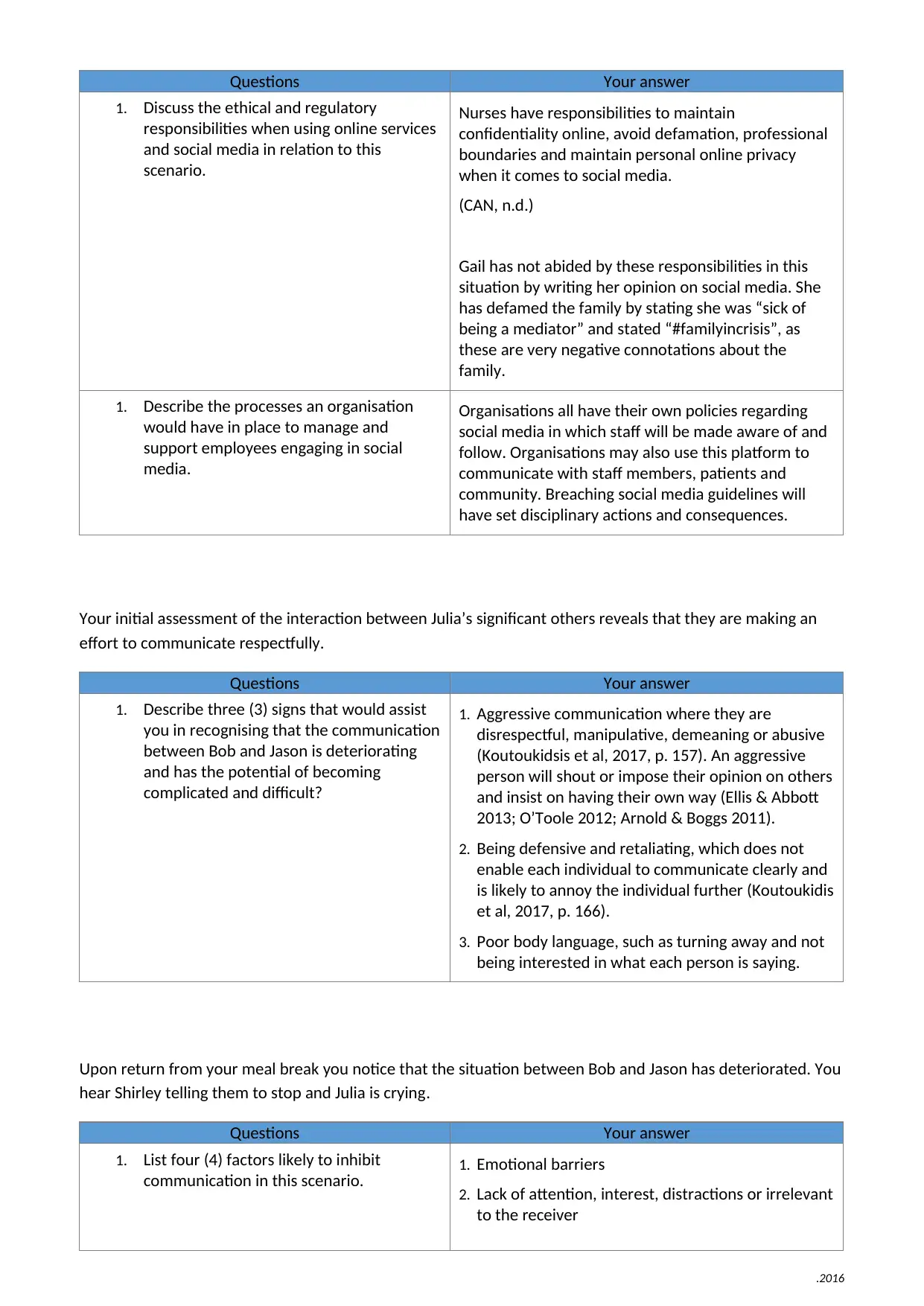
1. Discuss the ethical and regulatory
responsibilities when using online services
and social media in relation to this
scenario.
Nurses have responsibilities to maintain
confidentiality online, avoid defamation, professional
boundaries and maintain personal online privacy
when it comes to social media.
(CAN, n.d.)
Gail has not abided by these responsibilities in this
situation by writing her opinion on social media. She
has defamed the family by stating she was “sick of
being a mediator” and stated “#familyincrisis”, as
these are very negative connotations about the
family.
1. Describe the processes an organisation
would have in place to manage and
support employees engaging in social
media.
Organisations all have their own policies regarding
social media in which staff will be made aware of and
follow. Organisations may also use this platform to
communicate with staff members, patients and
community. Breaching social media guidelines will
have set disciplinary actions and consequences.
Your initial assessment of the interaction between Julia’s significant others reveals that they are making an
effort to communicate respectfully.
Questions Your answer
1. Describe three (3) signs that would assist
you in recognising that the communication
between Bob and Jason is deteriorating
and has the potential of becoming
complicated and difficult?
1. Aggressive communication where they are
disrespectful, manipulative, demeaning or abusive
(Koutoukidsis et al, 2017, p. 157). An aggressive
person will shout or impose their opinion on others
and insist on having their own way (Ellis & Abbott
2013; O’Toole 2012; Arnold & Boggs 2011).
2. Being defensive and retaliating, which does not
enable each individual to communicate clearly and
is likely to annoy the individual further (Koutoukidis
et al, 2017, p. 166).
3. Poor body language, such as turning away and not
being interested in what each person is saying.
Upon return from your meal break you notice that the situation between Bob and Jason has deteriorated. You
hear Shirley telling them to stop and Julia is crying.
Questions Your answer
1. List four (4) factors likely to inhibit
communication in this scenario. 1. Emotional barriers
2. Lack of attention, interest, distractions or irrelevant
to the receiver
.2016
1. Discuss the ethical and regulatory
responsibilities when using online services
and social media in relation to this
scenario.
Nurses have responsibilities to maintain
confidentiality online, avoid defamation, professional
boundaries and maintain personal online privacy
when it comes to social media.
(CAN, n.d.)
Gail has not abided by these responsibilities in this
situation by writing her opinion on social media. She
has defamed the family by stating she was “sick of
being a mediator” and stated “#familyincrisis”, as
these are very negative connotations about the
family.
1. Describe the processes an organisation
would have in place to manage and
support employees engaging in social
media.
Organisations all have their own policies regarding
social media in which staff will be made aware of and
follow. Organisations may also use this platform to
communicate with staff members, patients and
community. Breaching social media guidelines will
have set disciplinary actions and consequences.
Your initial assessment of the interaction between Julia’s significant others reveals that they are making an
effort to communicate respectfully.
Questions Your answer
1. Describe three (3) signs that would assist
you in recognising that the communication
between Bob and Jason is deteriorating
and has the potential of becoming
complicated and difficult?
1. Aggressive communication where they are
disrespectful, manipulative, demeaning or abusive
(Koutoukidsis et al, 2017, p. 157). An aggressive
person will shout or impose their opinion on others
and insist on having their own way (Ellis & Abbott
2013; O’Toole 2012; Arnold & Boggs 2011).
2. Being defensive and retaliating, which does not
enable each individual to communicate clearly and
is likely to annoy the individual further (Koutoukidis
et al, 2017, p. 166).
3. Poor body language, such as turning away and not
being interested in what each person is saying.
Upon return from your meal break you notice that the situation between Bob and Jason has deteriorated. You
hear Shirley telling them to stop and Julia is crying.
Questions Your answer
1. List four (4) factors likely to inhibit
communication in this scenario. 1. Emotional barriers
2. Lack of attention, interest, distractions or irrelevant
to the receiver
.2016
Questions Your answer
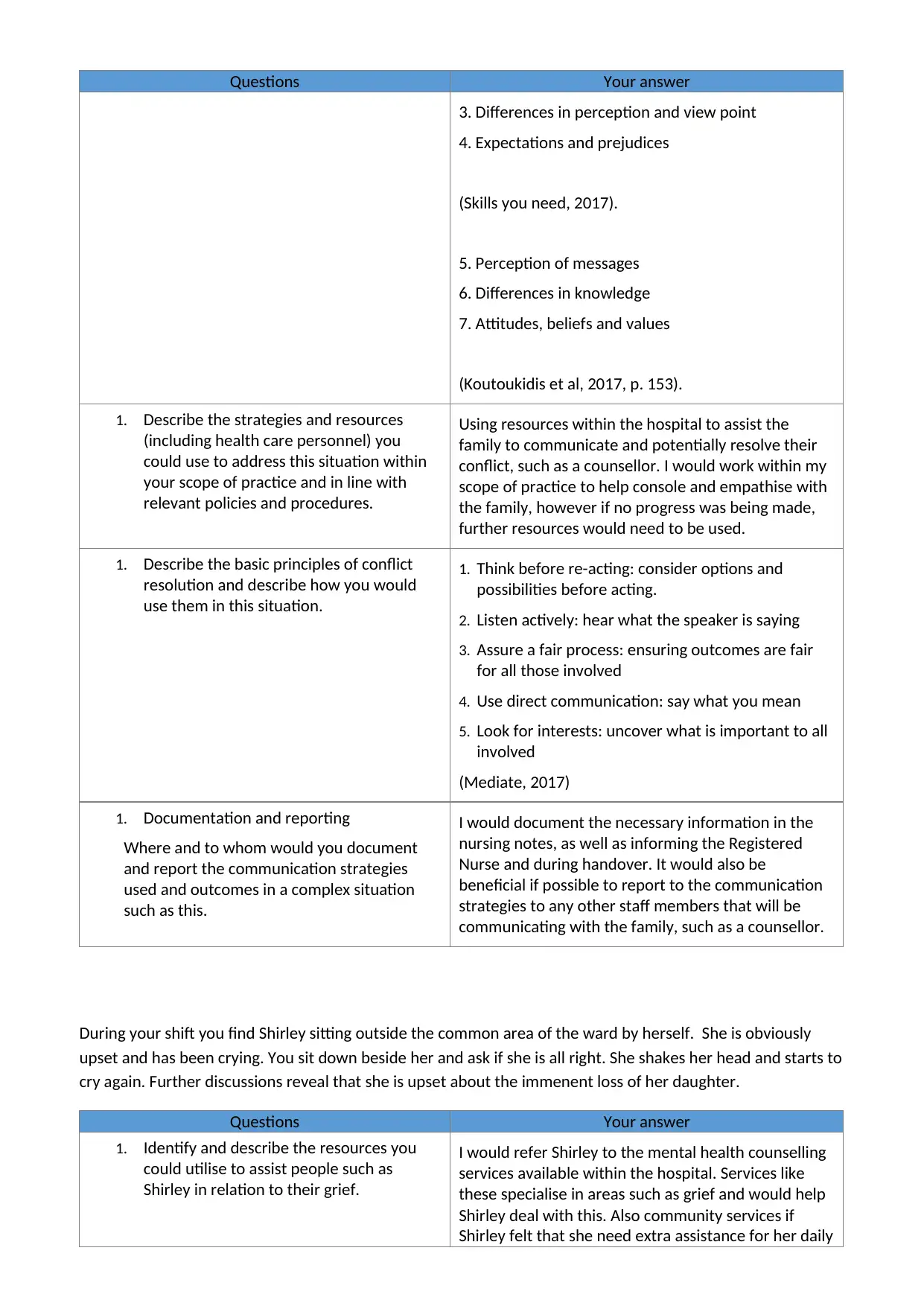
3. Differences in perception and view point
4. Expectations and prejudices
(Skills you need, 2017).
5. Perception of messages
6. Differences in knowledge
7. Attitudes, beliefs and values
(Koutoukidis et al, 2017, p. 153).
1. Describe the strategies and resources
(including health care personnel) you
could use to address this situation within
your scope of practice and in line with
relevant policies and procedures.
Using resources within the hospital to assist the
family to communicate and potentially resolve their
conflict, such as a counsellor. I would work within my
scope of practice to help console and empathise with
the family, however if no progress was being made,
further resources would need to be used.
1. Describe the basic principles of conflict
resolution and describe how you would
use them in this situation.
1. Think before re-acting: consider options and
possibilities before acting.
2. Listen actively: hear what the speaker is saying
3. Assure a fair process: ensuring outcomes are fair
for all those involved
4. Use direct communication: say what you mean
5. Look for interests: uncover what is important to all
involved
(Mediate, 2017)
1. Documentation and reporting
Where and to whom would you document
and report the communication strategies
used and outcomes in a complex situation
such as this.
I would document the necessary information in the
nursing notes, as well as informing the Registered
Nurse and during handover. It would also be
beneficial if possible to report to the communication
strategies to any other staff members that will be
communicating with the family, such as a counsellor.
During your shift you find Shirley sitting outside the common area of the ward by herself. She is obviously
upset and has been crying. You sit down beside her and ask if she is all right. She shakes her head and starts to
cry again. Further discussions reveal that she is upset about the immenent loss of her daughter.
Questions Your answer
1. Identify and describe the resources you
could utilise to assist people such as
Shirley in relation to their grief.
I would refer Shirley to the mental health counselling
services available within the hospital. Services like
these specialise in areas such as grief and would help
Shirley deal with this. Also community services if
Shirley felt that she need extra assistance for her daily
3. Differences in perception and view point
4. Expectations and prejudices
(Skills you need, 2017).
5. Perception of messages
6. Differences in knowledge
7. Attitudes, beliefs and values
(Koutoukidis et al, 2017, p. 153).
1. Describe the strategies and resources
(including health care personnel) you
could use to address this situation within
your scope of practice and in line with
relevant policies and procedures.
Using resources within the hospital to assist the
family to communicate and potentially resolve their
conflict, such as a counsellor. I would work within my
scope of practice to help console and empathise with
the family, however if no progress was being made,
further resources would need to be used.
1. Describe the basic principles of conflict
resolution and describe how you would
use them in this situation.
1. Think before re-acting: consider options and
possibilities before acting.
2. Listen actively: hear what the speaker is saying
3. Assure a fair process: ensuring outcomes are fair
for all those involved
4. Use direct communication: say what you mean
5. Look for interests: uncover what is important to all
involved
(Mediate, 2017)
1. Documentation and reporting
Where and to whom would you document
and report the communication strategies
used and outcomes in a complex situation
such as this.
I would document the necessary information in the
nursing notes, as well as informing the Registered
Nurse and during handover. It would also be
beneficial if possible to report to the communication
strategies to any other staff members that will be
communicating with the family, such as a counsellor.
During your shift you find Shirley sitting outside the common area of the ward by herself. She is obviously
upset and has been crying. You sit down beside her and ask if she is all right. She shakes her head and starts to
cry again. Further discussions reveal that she is upset about the immenent loss of her daughter.
Questions Your answer
1. Identify and describe the resources you
could utilise to assist people such as
Shirley in relation to their grief.
I would refer Shirley to the mental health counselling
services available within the hospital. Services like
these specialise in areas such as grief and would help
Shirley deal with this. Also community services if
Shirley felt that she need extra assistance for her daily
⊘ This is a preview!⊘
Do you want full access?
Subscribe today to unlock all pages.
Trusted by 1+ million students worldwide
Questions Your answer
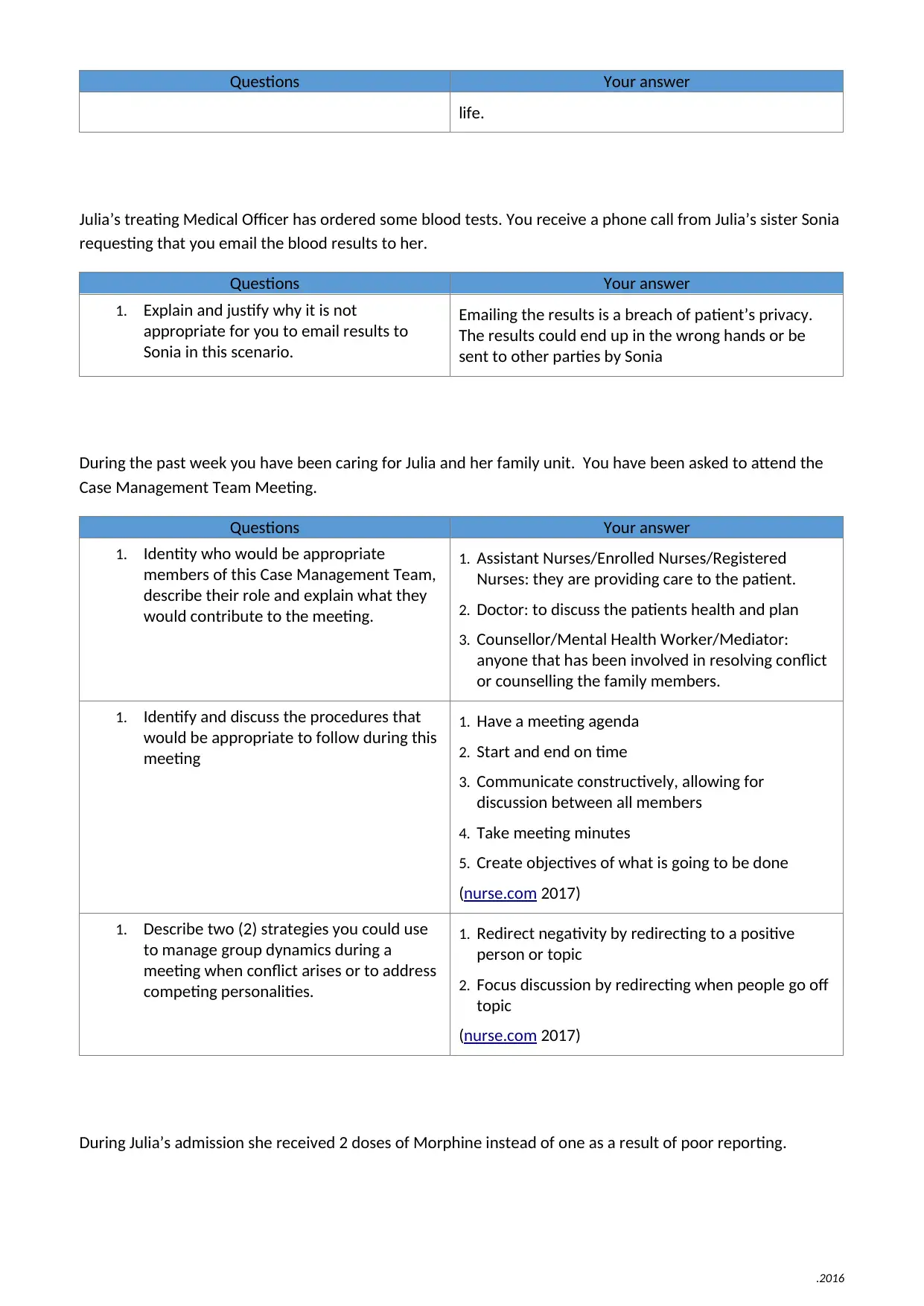
life.
Julia’s treating Medical Officer has ordered some blood tests. You receive a phone call from Julia’s sister Sonia
requesting that you email the blood results to her.
Questions Your answer
1. Explain and justify why it is not
appropriate for you to email results to
Sonia in this scenario.
Emailing the results is a breach of patient’s privacy.
The results could end up in the wrong hands or be
sent to other parties by Sonia
During the past week you have been caring for Julia and her family unit. You have been asked to attend the
Case Management Team Meeting.
Questions Your answer
1. Identity who would be appropriate
members of this Case Management Team,
describe their role and explain what they
would contribute to the meeting.
1. Assistant Nurses/Enrolled Nurses/Registered
Nurses: they are providing care to the patient.
2. Doctor: to discuss the patients health and plan
3. Counsellor/Mental Health Worker/Mediator:
anyone that has been involved in resolving conflict
or counselling the family members.
1. Identify and discuss the procedures that
would be appropriate to follow during this
meeting
1. Have a meeting agenda
2. Start and end on time
3. Communicate constructively, allowing for
discussion between all members
4. Take meeting minutes
5. Create objectives of what is going to be done
(nurse.com 2017)
1. Describe two (2) strategies you could use
to manage group dynamics during a
meeting when conflict arises or to address
competing personalities.
1. Redirect negativity by redirecting to a positive
person or topic
2. Focus discussion by redirecting when people go off
topic
(nurse.com 2017)
During Julia’s admission she received 2 doses of Morphine instead of one as a result of poor reporting.
.2016
life.
Julia’s treating Medical Officer has ordered some blood tests. You receive a phone call from Julia’s sister Sonia
requesting that you email the blood results to her.
Questions Your answer
1. Explain and justify why it is not
appropriate for you to email results to
Sonia in this scenario.
Emailing the results is a breach of patient’s privacy.
The results could end up in the wrong hands or be
sent to other parties by Sonia
During the past week you have been caring for Julia and her family unit. You have been asked to attend the
Case Management Team Meeting.
Questions Your answer
1. Identity who would be appropriate
members of this Case Management Team,
describe their role and explain what they
would contribute to the meeting.
1. Assistant Nurses/Enrolled Nurses/Registered
Nurses: they are providing care to the patient.
2. Doctor: to discuss the patients health and plan
3. Counsellor/Mental Health Worker/Mediator:
anyone that has been involved in resolving conflict
or counselling the family members.
1. Identify and discuss the procedures that
would be appropriate to follow during this
meeting
1. Have a meeting agenda
2. Start and end on time
3. Communicate constructively, allowing for
discussion between all members
4. Take meeting minutes
5. Create objectives of what is going to be done
(nurse.com 2017)
1. Describe two (2) strategies you could use
to manage group dynamics during a
meeting when conflict arises or to address
competing personalities.
1. Redirect negativity by redirecting to a positive
person or topic
2. Focus discussion by redirecting when people go off
topic
(nurse.com 2017)
During Julia’s admission she received 2 doses of Morphine instead of one as a result of poor reporting.
.2016
Paraphrase This Document
Need a fresh take? Get an instant paraphrase of this document with our AI Paraphraser
Questions Your answer
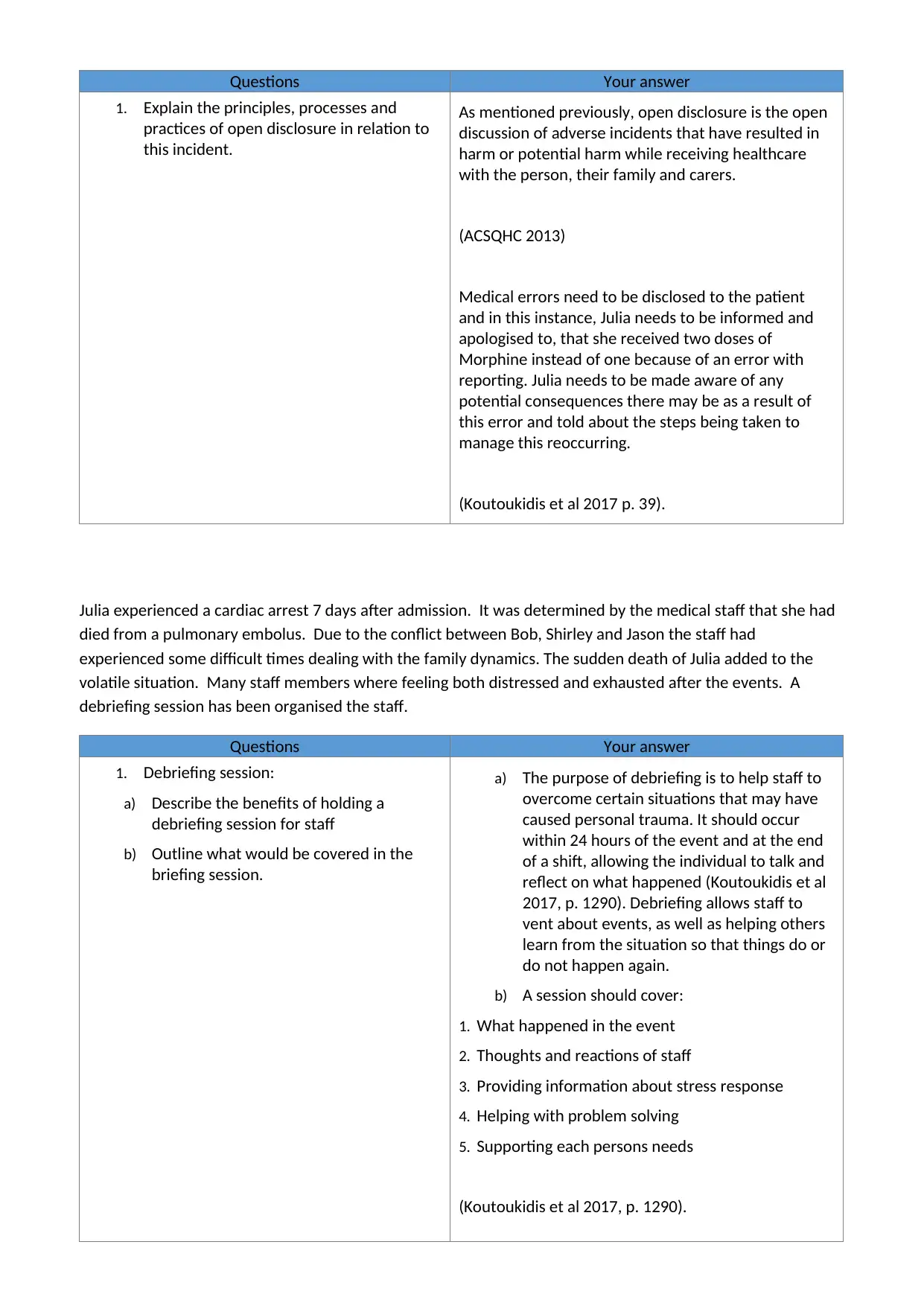
1. Explain the principles, processes and
practices of open disclosure in relation to
this incident.
As mentioned previously, open disclosure is the open
discussion of adverse incidents that have resulted in
harm or potential harm while receiving healthcare
with the person, their family and carers.
(ACSQHC 2013)
Medical errors need to be disclosed to the patient
and in this instance, Julia needs to be informed and
apologised to, that she received two doses of
Morphine instead of one because of an error with
reporting. Julia needs to be made aware of any
potential consequences there may be as a result of
this error and told about the steps being taken to
manage this reoccurring.
(Koutoukidis et al 2017 p. 39).
Julia experienced a cardiac arrest 7 days after admission. It was determined by the medical staff that she had
died from a pulmonary embolus. Due to the conflict between Bob, Shirley and Jason the staff had
experienced some difficult times dealing with the family dynamics. The sudden death of Julia added to the
volatile situation. Many staff members where feeling both distressed and exhausted after the events. A
debriefing session has been organised the staff.
Questions Your answer
1. Debriefing session:
a) Describe the benefits of holding a
debriefing session for staff
b) Outline what would be covered in the
briefing session.
a) The purpose of debriefing is to help staff to
overcome certain situations that may have
caused personal trauma. It should occur
within 24 hours of the event and at the end
of a shift, allowing the individual to talk and
reflect on what happened (Koutoukidis et al
2017, p. 1290). Debriefing allows staff to
vent about events, as well as helping others
learn from the situation so that things do or
do not happen again.
b) A session should cover:
1. What happened in the event
2. Thoughts and reactions of staff
3. Providing information about stress response
4. Helping with problem solving
5. Supporting each persons needs
(Koutoukidis et al 2017, p. 1290).
1. Explain the principles, processes and
practices of open disclosure in relation to
this incident.
As mentioned previously, open disclosure is the open
discussion of adverse incidents that have resulted in
harm or potential harm while receiving healthcare
with the person, their family and carers.
(ACSQHC 2013)
Medical errors need to be disclosed to the patient
and in this instance, Julia needs to be informed and
apologised to, that she received two doses of
Morphine instead of one because of an error with
reporting. Julia needs to be made aware of any
potential consequences there may be as a result of
this error and told about the steps being taken to
manage this reoccurring.
(Koutoukidis et al 2017 p. 39).
Julia experienced a cardiac arrest 7 days after admission. It was determined by the medical staff that she had
died from a pulmonary embolus. Due to the conflict between Bob, Shirley and Jason the staff had
experienced some difficult times dealing with the family dynamics. The sudden death of Julia added to the
volatile situation. Many staff members where feeling both distressed and exhausted after the events. A
debriefing session has been organised the staff.
Questions Your answer
1. Debriefing session:
a) Describe the benefits of holding a
debriefing session for staff
b) Outline what would be covered in the
briefing session.
a) The purpose of debriefing is to help staff to
overcome certain situations that may have
caused personal trauma. It should occur
within 24 hours of the event and at the end
of a shift, allowing the individual to talk and
reflect on what happened (Koutoukidis et al
2017, p. 1290). Debriefing allows staff to
vent about events, as well as helping others
learn from the situation so that things do or
do not happen again.
b) A session should cover:
1. What happened in the event
2. Thoughts and reactions of staff
3. Providing information about stress response
4. Helping with problem solving
5. Supporting each persons needs
(Koutoukidis et al 2017, p. 1290).
Questions Your answer
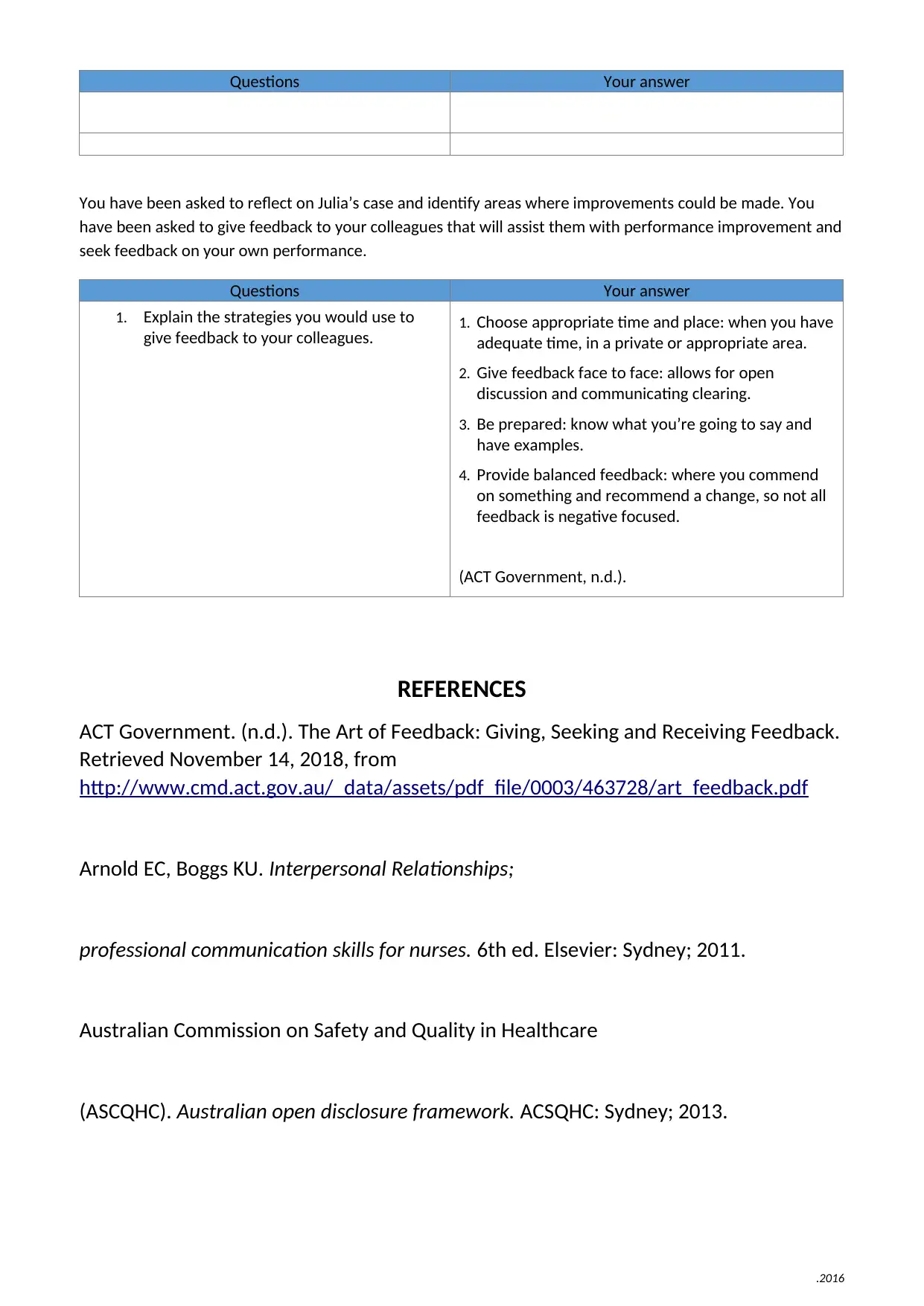
You have been asked to reflect on Julia’s case and identify areas where improvements could be made. You
have been asked to give feedback to your colleagues that will assist them with performance improvement and
seek feedback on your own performance.
Questions Your answer
1. Explain the strategies you would use to
give feedback to your colleagues. 1. Choose appropriate time and place: when you have
adequate time, in a private or appropriate area.
2. Give feedback face to face: allows for open
discussion and communicating clearing.
3. Be prepared: know what you’re going to say and
have examples.
4. Provide balanced feedback: where you commend
on something and recommend a change, so not all
feedback is negative focused.
(ACT Government, n.d.).
REFERENCES
ACT Government. (n.d.). The Art of Feedback: Giving, Seeking and Receiving Feedback.
Retrieved November 14, 2018, from
http://www.cmd.act.gov.au/_data/assets/pdf_file/0003/463728/art_feedback.pdf
Arnold EC, Boggs KU. Interpersonal Relationships;
professional communication skills for nurses. 6th ed. Elsevier: Sydney; 2011.
Australian Commission on Safety and Quality in Healthcare
(ASCQHC). Australian open disclosure framework. ACSQHC: Sydney; 2013.
.2016
You have been asked to reflect on Julia’s case and identify areas where improvements could be made. You
have been asked to give feedback to your colleagues that will assist them with performance improvement and
seek feedback on your own performance.
Questions Your answer
1. Explain the strategies you would use to
give feedback to your colleagues. 1. Choose appropriate time and place: when you have
adequate time, in a private or appropriate area.
2. Give feedback face to face: allows for open
discussion and communicating clearing.
3. Be prepared: know what you’re going to say and
have examples.
4. Provide balanced feedback: where you commend
on something and recommend a change, so not all
feedback is negative focused.
(ACT Government, n.d.).
REFERENCES
ACT Government. (n.d.). The Art of Feedback: Giving, Seeking and Receiving Feedback.
Retrieved November 14, 2018, from
http://www.cmd.act.gov.au/_data/assets/pdf_file/0003/463728/art_feedback.pdf
Arnold EC, Boggs KU. Interpersonal Relationships;
professional communication skills for nurses. 6th ed. Elsevier: Sydney; 2011.
Australian Commission on Safety and Quality in Healthcare
(ASCQHC). Australian open disclosure framework. ACSQHC: Sydney; 2013.
.2016
⊘ This is a preview!⊘
Do you want full access?
Subscribe today to unlock all pages.
Trusted by 1+ million students worldwide
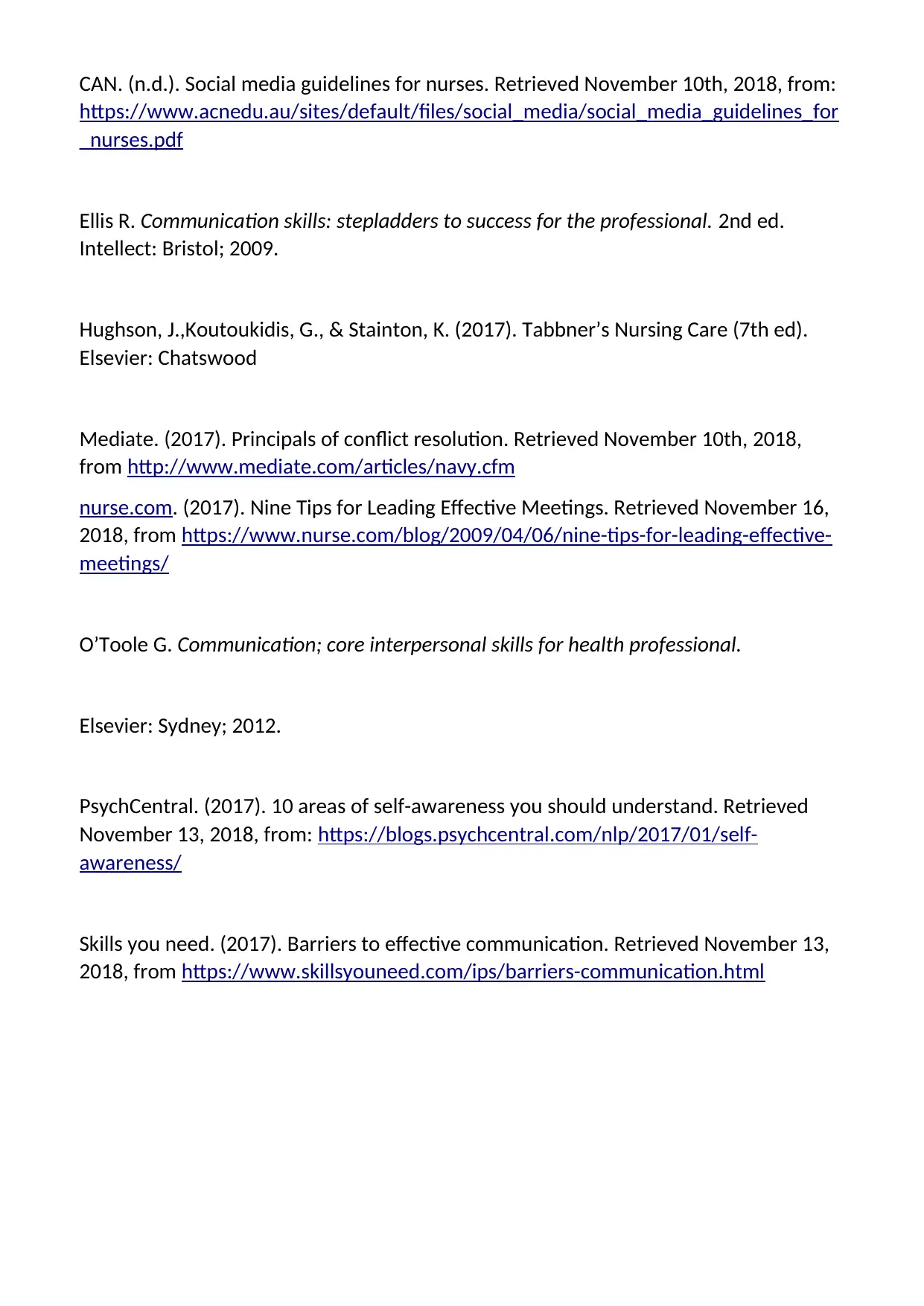
CAN. (n.d.). Social media guidelines for nurses. Retrieved November 10th, 2018, from:
https://www.acnedu.au/sites/default/files/social_media/social_media_guidelines_for
_nurses.pdf
Ellis R. Communication skills: stepladders to success for the professional. 2nd ed.
Intellect: Bristol; 2009.
Hughson, J.,Koutoukidis, G., & Stainton, K. (2017). Tabbner’s Nursing Care (7th ed).
Elsevier: Chatswood
Mediate. (2017). Principals of conflict resolution. Retrieved November 10th, 2018,
from http://www.mediate.com/articles/navy.cfm
nurse.com. (2017). Nine Tips for Leading Effective Meetings. Retrieved November 16,
2018, from https://www.nurse.com/blog/2009/04/06/nine-tips-for-leading-effective-
meetings/
O’Toole G. Communication; core interpersonal skills for health professional.
Elsevier: Sydney; 2012.
PsychCentral. (2017). 10 areas of self-awareness you should understand. Retrieved
November 13, 2018, from: https://blogs.psychcentral.com/nlp/2017/01/self-
awareness/
Skills you need. (2017). Barriers to effective communication. Retrieved November 13,
2018, from https://www.skillsyouneed.com/ips/barriers-communication.html
https://www.acnedu.au/sites/default/files/social_media/social_media_guidelines_for
_nurses.pdf
Ellis R. Communication skills: stepladders to success for the professional. 2nd ed.
Intellect: Bristol; 2009.
Hughson, J.,Koutoukidis, G., & Stainton, K. (2017). Tabbner’s Nursing Care (7th ed).
Elsevier: Chatswood
Mediate. (2017). Principals of conflict resolution. Retrieved November 10th, 2018,
from http://www.mediate.com/articles/navy.cfm
nurse.com. (2017). Nine Tips for Leading Effective Meetings. Retrieved November 16,
2018, from https://www.nurse.com/blog/2009/04/06/nine-tips-for-leading-effective-
meetings/
O’Toole G. Communication; core interpersonal skills for health professional.
Elsevier: Sydney; 2012.
PsychCentral. (2017). 10 areas of self-awareness you should understand. Retrieved
November 13, 2018, from: https://blogs.psychcentral.com/nlp/2017/01/self-
awareness/
Skills you need. (2017). Barriers to effective communication. Retrieved November 13,
2018, from https://www.skillsyouneed.com/ips/barriers-communication.html
Paraphrase This Document
Need a fresh take? Get an instant paraphrase of this document with our AI Paraphraser
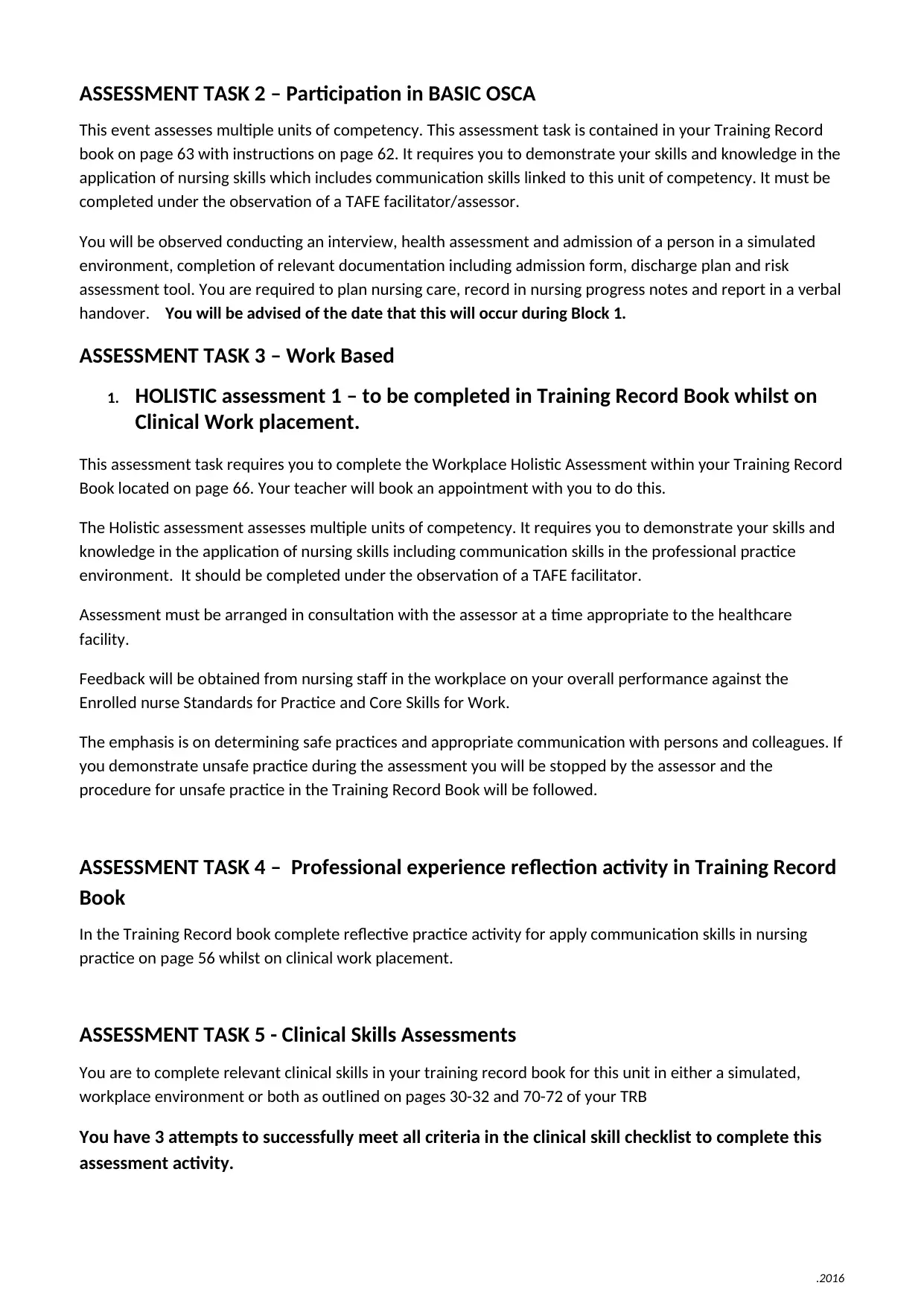
ASSESSMENT TASK 2 – Participation in BASIC OSCA
This event assesses multiple units of competency. This assessment task is contained in your Training Record
book on page 63 with instructions on page 62. It requires you to demonstrate your skills and knowledge in the
application of nursing skills which includes communication skills linked to this unit of competency. It must be
completed under the observation of a TAFE facilitator/assessor.
You will be observed conducting an interview, health assessment and admission of a person in a simulated
environment, completion of relevant documentation including admission form, discharge plan and risk
assessment tool. You are required to plan nursing care, record in nursing progress notes and report in a verbal
handover. You will be advised of the date that this will occur during Block 1.
ASSESSMENT TASK 3 – Work Based
1. HOLISTIC assessment 1 – to be completed in Training Record Book whilst on
Clinical Work placement.
This assessment task requires you to complete the Workplace Holistic Assessment within your Training Record
Book located on page 66. Your teacher will book an appointment with you to do this.
The Holistic assessment assesses multiple units of competency. It requires you to demonstrate your skills and
knowledge in the application of nursing skills including communication skills in the professional practice
environment. It should be completed under the observation of a TAFE facilitator.
Assessment must be arranged in consultation with the assessor at a time appropriate to the healthcare
facility.
Feedback will be obtained from nursing staff in the workplace on your overall performance against the
Enrolled nurse Standards for Practice and Core Skills for Work.
The emphasis is on determining safe practices and appropriate communication with persons and colleagues. If
you demonstrate unsafe practice during the assessment you will be stopped by the assessor and the
procedure for unsafe practice in the Training Record Book will be followed.
ASSESSMENT TASK 4 – Professional experience reflection activity in Training Record
Book
In the Training Record book complete reflective practice activity for apply communication skills in nursing
practice on page 56 whilst on clinical work placement.
ASSESSMENT TASK 5 - Clinical Skills Assessments
You are to complete relevant clinical skills in your training record book for this unit in either a simulated,
workplace environment or both as outlined on pages 30-32 and 70-72 of your TRB
You have 3 attempts to successfully meet all criteria in the clinical skill checklist to complete this
assessment activity.
.2016
This event assesses multiple units of competency. This assessment task is contained in your Training Record
book on page 63 with instructions on page 62. It requires you to demonstrate your skills and knowledge in the
application of nursing skills which includes communication skills linked to this unit of competency. It must be
completed under the observation of a TAFE facilitator/assessor.
You will be observed conducting an interview, health assessment and admission of a person in a simulated
environment, completion of relevant documentation including admission form, discharge plan and risk
assessment tool. You are required to plan nursing care, record in nursing progress notes and report in a verbal
handover. You will be advised of the date that this will occur during Block 1.
ASSESSMENT TASK 3 – Work Based
1. HOLISTIC assessment 1 – to be completed in Training Record Book whilst on
Clinical Work placement.
This assessment task requires you to complete the Workplace Holistic Assessment within your Training Record
Book located on page 66. Your teacher will book an appointment with you to do this.
The Holistic assessment assesses multiple units of competency. It requires you to demonstrate your skills and
knowledge in the application of nursing skills including communication skills in the professional practice
environment. It should be completed under the observation of a TAFE facilitator.
Assessment must be arranged in consultation with the assessor at a time appropriate to the healthcare
facility.
Feedback will be obtained from nursing staff in the workplace on your overall performance against the
Enrolled nurse Standards for Practice and Core Skills for Work.
The emphasis is on determining safe practices and appropriate communication with persons and colleagues. If
you demonstrate unsafe practice during the assessment you will be stopped by the assessor and the
procedure for unsafe practice in the Training Record Book will be followed.
ASSESSMENT TASK 4 – Professional experience reflection activity in Training Record
Book
In the Training Record book complete reflective practice activity for apply communication skills in nursing
practice on page 56 whilst on clinical work placement.
ASSESSMENT TASK 5 - Clinical Skills Assessments
You are to complete relevant clinical skills in your training record book for this unit in either a simulated,
workplace environment or both as outlined on pages 30-32 and 70-72 of your TRB
You have 3 attempts to successfully meet all criteria in the clinical skill checklist to complete this
assessment activity.
.2016
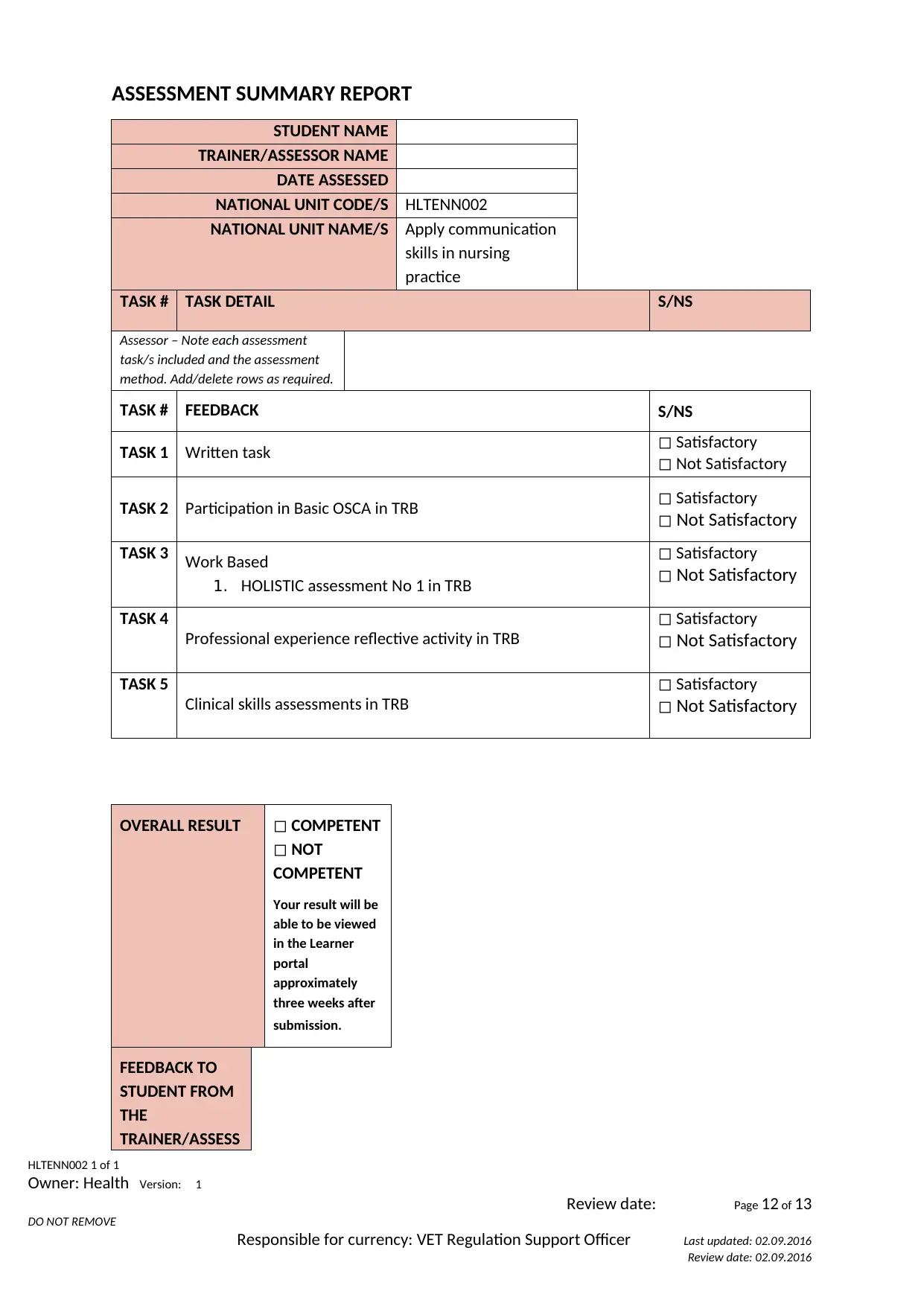
ASSESSMENT SUMMARY REPORT
STUDENT NAME
TRAINER/ASSESSOR NAME
DATE ASSESSED
NATIONAL UNIT CODE/S HLTENN002
NATIONAL UNIT NAME/S Apply communication
skills in nursing
practice
TASK # TASK DETAIL S/NS
Assessor – Note each assessment
task/s included and the assessment
method. Add/delete rows as required.
TASK # FEEDBACK S/NS
TASK 1 Written task ◻ Satisfactory
◻ Not Satisfactory
TASK 2 Participation in Basic OSCA in TRB ◻ Satisfactory
◻ Not Satisfactory
TASK 3 Work Based
1. HOLISTIC assessment No 1 in TRB
◻ Satisfactory
◻ Not Satisfactory
TASK 4
Professional experience reflective activity in TRB
◻ Satisfactory
◻ Not Satisfactory
TASK 5
Clinical skills assessments in TRB
◻ Satisfactory
◻ Not Satisfactory
OVERALL RESULT ◻ COMPETENT
◻ NOT
COMPETENT
Your result will be
able to be viewed
in the Learner
portal
approximately
three weeks after
submission.
FEEDBACK TO
STUDENT FROM
THE
TRAINER/ASSESS
HLTENN002 1 of 1
Owner: Health Version: 1
Review date: Page 12 of 13
DO NOT REMOVE
Responsible for currency: VET Regulation Support Officer Last updated: 02.09.2016
Review date: 02.09.2016
STUDENT NAME
TRAINER/ASSESSOR NAME
DATE ASSESSED
NATIONAL UNIT CODE/S HLTENN002
NATIONAL UNIT NAME/S Apply communication
skills in nursing
practice
TASK # TASK DETAIL S/NS
Assessor – Note each assessment
task/s included and the assessment
method. Add/delete rows as required.
TASK # FEEDBACK S/NS
TASK 1 Written task ◻ Satisfactory
◻ Not Satisfactory
TASK 2 Participation in Basic OSCA in TRB ◻ Satisfactory
◻ Not Satisfactory
TASK 3 Work Based
1. HOLISTIC assessment No 1 in TRB
◻ Satisfactory
◻ Not Satisfactory
TASK 4
Professional experience reflective activity in TRB
◻ Satisfactory
◻ Not Satisfactory
TASK 5
Clinical skills assessments in TRB
◻ Satisfactory
◻ Not Satisfactory
OVERALL RESULT ◻ COMPETENT
◻ NOT
COMPETENT
Your result will be
able to be viewed
in the Learner
portal
approximately
three weeks after
submission.
FEEDBACK TO
STUDENT FROM
THE
TRAINER/ASSESS
HLTENN002 1 of 1
Owner: Health Version: 1
Review date: Page 12 of 13
DO NOT REMOVE
Responsible for currency: VET Regulation Support Officer Last updated: 02.09.2016
Review date: 02.09.2016
⊘ This is a preview!⊘
Do you want full access?
Subscribe today to unlock all pages.
Trusted by 1+ million students worldwide

1 out of 13


Related Documents


Your All-in-One AI-Powered Toolkit for Academic Success.
+13062052269
info@desklib.com
Available 24*7 on WhatsApp / Email
![[object Object]](/_next/static/media/star-bottom.7253800d.svg)
Unlock your academic potential
Copyright © 2020–2026 A2Z Services. All Rights Reserved. Developed and managed by ZUCOL.