HLTWHS001/CHCECE002/CHCECE004/CHCECE016: Health and Safety Assessment

Verified

Added on  2023/06/13

|91
|11362
|78
Homework Assignment
AI Summary
This assignment solution provides answers to knowledge questions related to health and safety in an early childhood education and care setting, in accordance with Australian standards and frameworks. It covers accessing and applying the National Quality Framework (NQF), National Quality Standards (NQS), and the Early Years Learning Framework (EYLF) to ensure children's health and safety. The solution details risk analysis procedures for toys and equipment, outlines steps to address WHS hazards, and discusses relevant policies and reporting procedures. Furthermore, it emphasizes the importance of maintaining clean and healthy environments in various areas of a childcare center, including the kitchen, outdoor and indoor spaces, and toilets, identifying associated risks. The assignment also references specific sections within the Education and Care Services National Regulations, NQS, EYLF, and Framework for School Age Care in Australia (FSAC) that provide guidance on WHS and hazard management. Desklib provides this document and many more to aid students in their studies.
Document Page
HLTWHS001_CHCECE002_CHCECE004_CHCECE016 RTO No: 21595 | CRICOS Code:
02634E
Topic 1 Knowledge Questions Version 2 Page 0 of 92
©copyright Academia International Approved
by: B.Wade
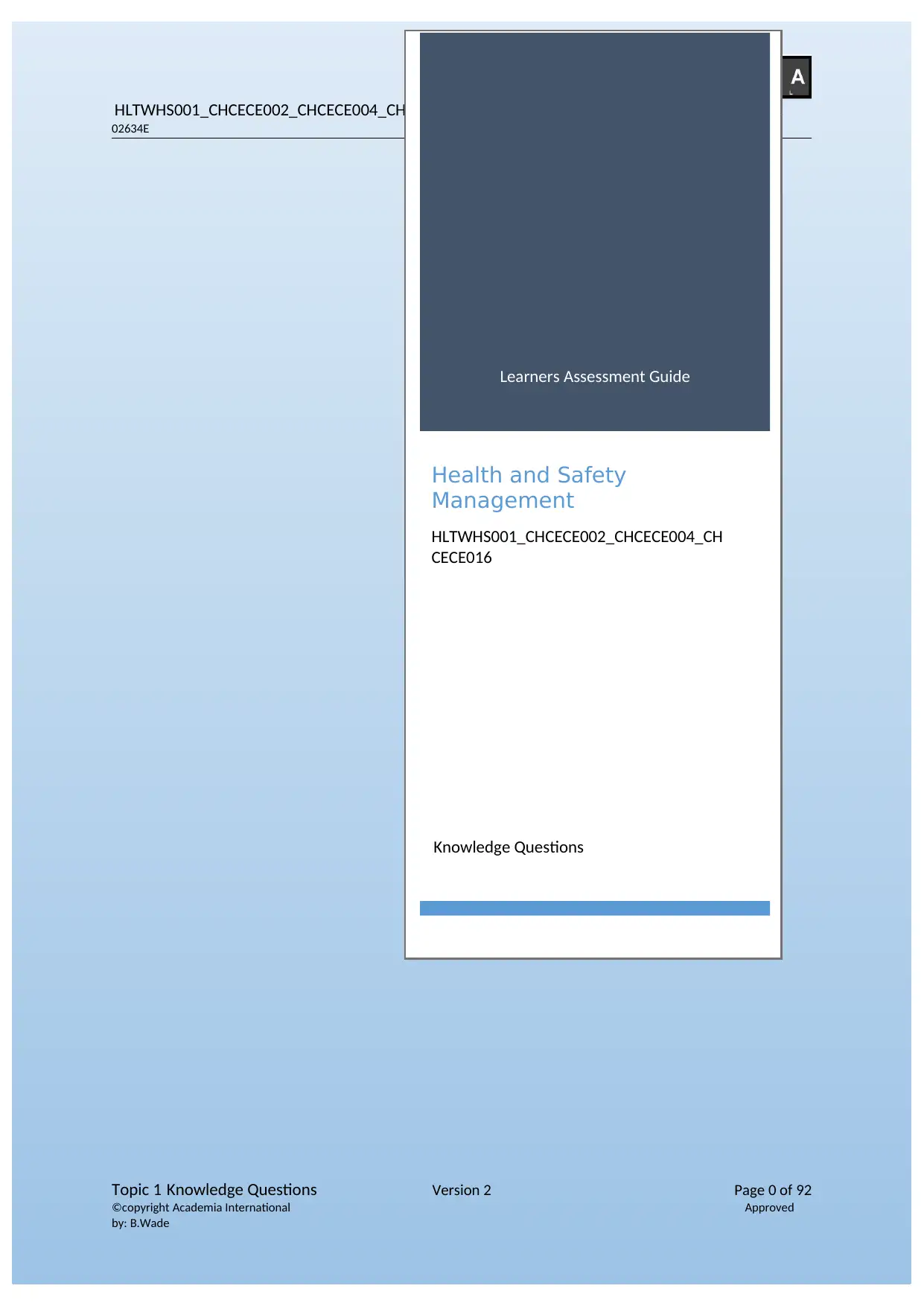
Learners Assessment Guide
Health and Safety
Management
HLTWHS001_CHCECE002_CHCECE004_CH
CECE016
Knowledge Questions
tabler-icon-diamond-filled.svg

Paraphrase This Document

Need a fresh take? Get an instant paraphrase of this document with our AI Paraphraser
Document Page
HLTWHS001_CHCECE002_CHCECE004_CHCECE016
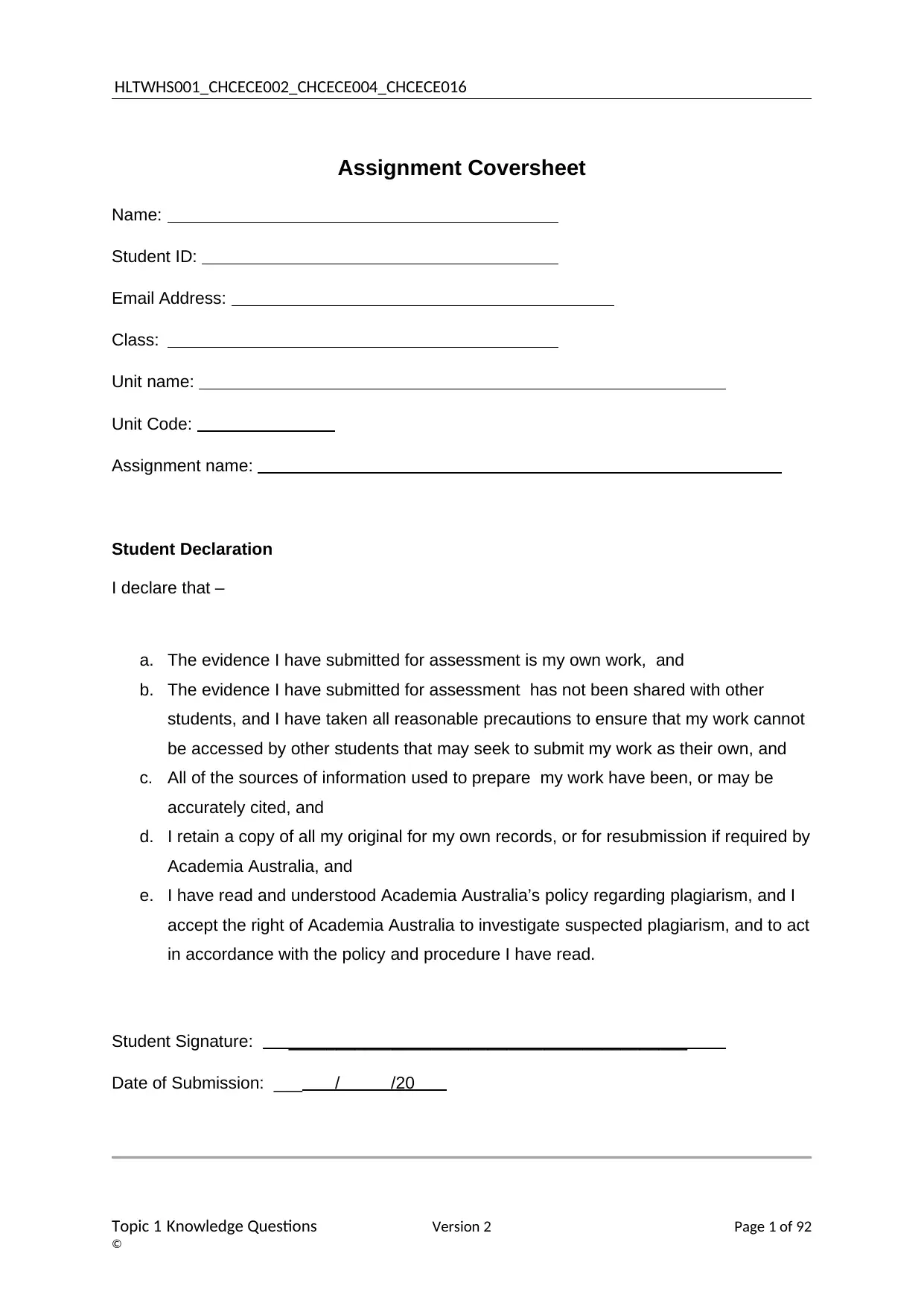
Assignment Coversheet
Name:
Student ID:
Email Address:
Class:
Unit name:
Unit Code:
Assignment name:
Student Declaration
I declare that –
a. The evidence I have submitted for assessment is my own work, and
b. The evidence I have submitted for assessment has not been shared with other
students, and I have taken all reasonable precautions to ensure that my work cannot
be accessed by other students that may seek to submit my work as their own, and
c. All of the sources of information used to prepare my work have been, or may be
accurately cited, and
d. I retain a copy of all my original for my own records, or for resubmission if required by
Academia Australia, and
e. I have read and understood Academia Australia’s policy regarding plagiarism, and I
accept the right of Academia Australia to investigate suspected plagiarism, and to act
in accordance with the policy and procedure I have read.
Student Signature: __________________________________________
Date of Submission: ___ / /20
Topic 1 Knowledge Questions Version 2 Page 1 of 92
©
Document Page
HLTWHS001_CHCECE002_CHCECE004_CHCECE016
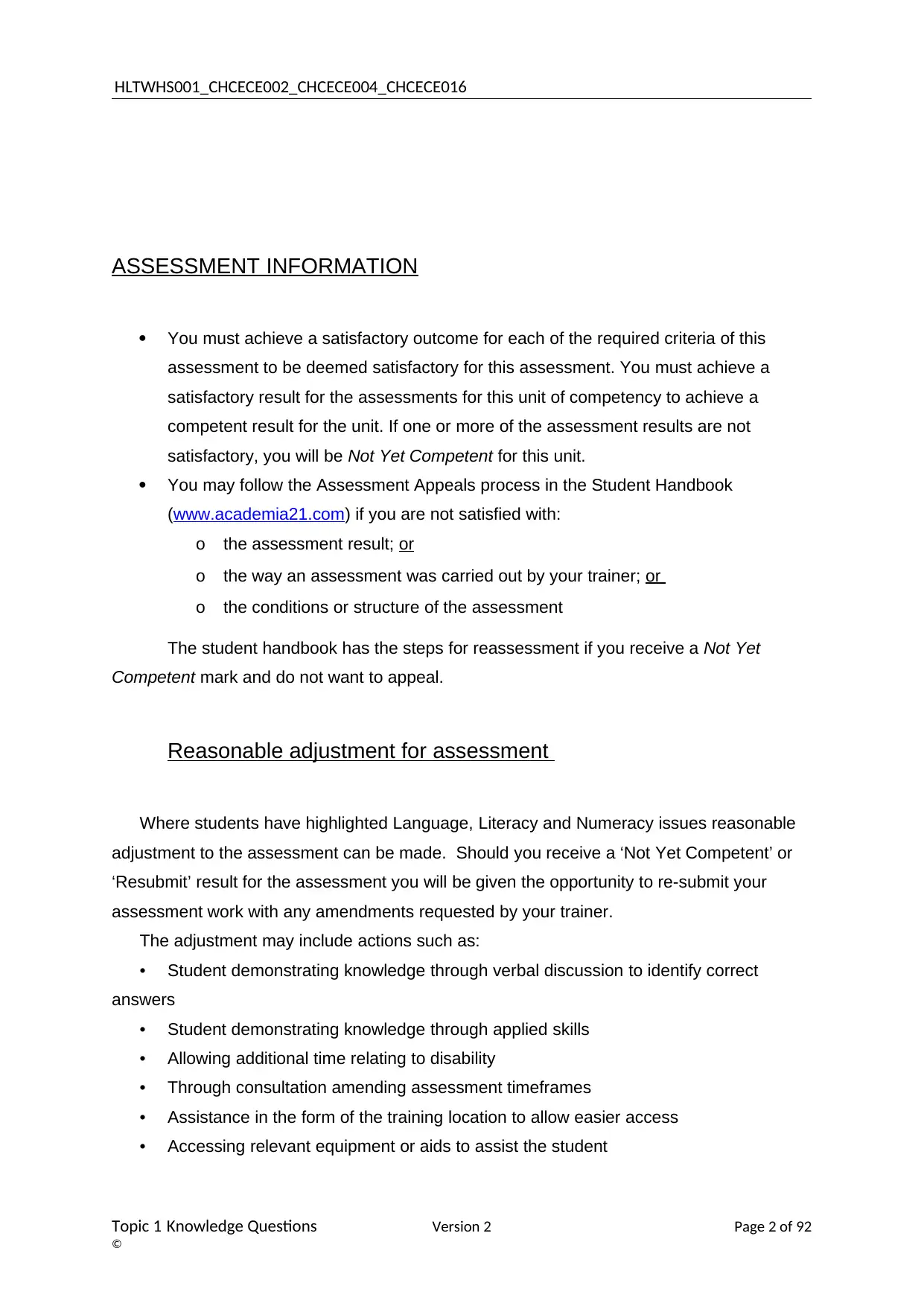
ASSESSMENT INFORMATION
You must achieve a satisfactory outcome for each of the required criteria of this
assessment to be deemed satisfactory for this assessment. You must achieve a
satisfactory result for the assessments for this unit of competency to achieve a
competent result for the unit. If one or more of the assessment results are not
satisfactory, you will be Not Yet Competent for this unit.
You may follow the Assessment Appeals process in the Student Handbook
(www.academia21.com) if you are not satisfied with:
o the assessment result; or
o the way an assessment was carried out by your trainer; or
o the conditions or structure of the assessment
The student handbook has the steps for reassessment if you receive a Not Yet
Competent mark and do not want to appeal.
Reasonable adjustment for assessment
Where students have highlighted Language, Literacy and Numeracy issues reasonable
adjustment to the assessment can be made. Should you receive a ‘Not Yet Competent’ or
‘Resubmit’ result for the assessment you will be given the opportunity to re-submit your
assessment work with any amendments requested by your trainer.
The adjustment may include actions such as:
Student demonstrating knowledge through verbal discussion to identify correct
answers
Student demonstrating knowledge through applied skills
Allowing additional time relating to disability
Through consultation amending assessment timeframes
Assistance in the form of the training location to allow easier access
Accessing relevant equipment or aids to assist the student
Topic 1 Knowledge Questions Version 2 Page 2 of 92
©
Document Page
HLTWHS001_CHCECE002_CHCECE004_CHCECE016
Adjustments to the assessment methods to cater for any special needs (without
effecting the integrity of the outcome)
If a student requests or is identified as requiring reasonable adjustment to the training
and assessment process a detailed training and assessment plan including timetables, notes
regarding the required adjustments, and any related communications regarding the
adjustments must be maintained in the students file.
The RTO Manager must review and authorise any request for ‘reasonable adjustment’ to
ensure that any adjustments and resulting outcomes are not affecting the integrity of the
training and assessment process.
Location of and completion timeframes for assessment
The location of the assessment will depend upon the nature of the assessment. Direct
observation of student’s skills will be assessed in the practical commercial kitchens at
Academia, the timeframes for these assessments will be related to the scheduled times of
the practical classes. Other assessments such as; role plays, in class activities,
presentations and written tests will be conducting in the classroom. The timeframes and due
dates for these assessments, as well as any reports, projects or research assignments, are
documented in the stage outlines. Stage outlines are handed out at the beginning of each
term.
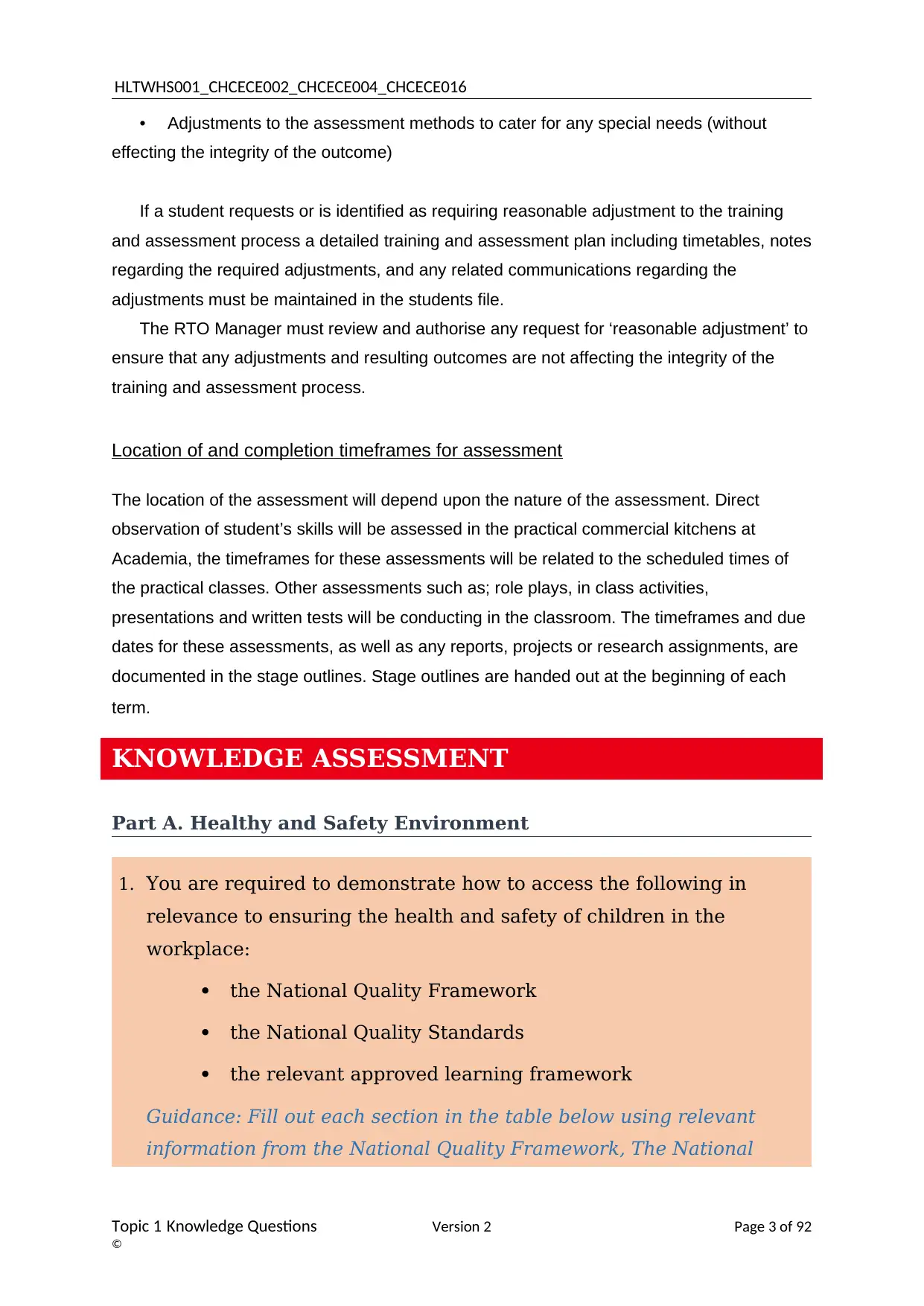
KNOWLEDGE ASSESSMENT
Part A. Healthy and Safety Environment
1. You are required to demonstrate how to access the following in
relevance to ensuring the health and safety of children in the
workplace:
the National Quality Framework
the National Quality Standards
the relevant approved learning framework
Guidance: Fill out each section in the table below using relevant
information from the National Quality Framework, The National
Topic 1 Knowledge Questions Version 2 Page 3 of 92
©
tabler-icon-diamond-filled.svg

Paraphrase This Document

Need a fresh take? Get an instant paraphrase of this document with our AI Paraphraser
Document Page
HLTWHS001_CHCECE002_CHCECE004_CHCECE016
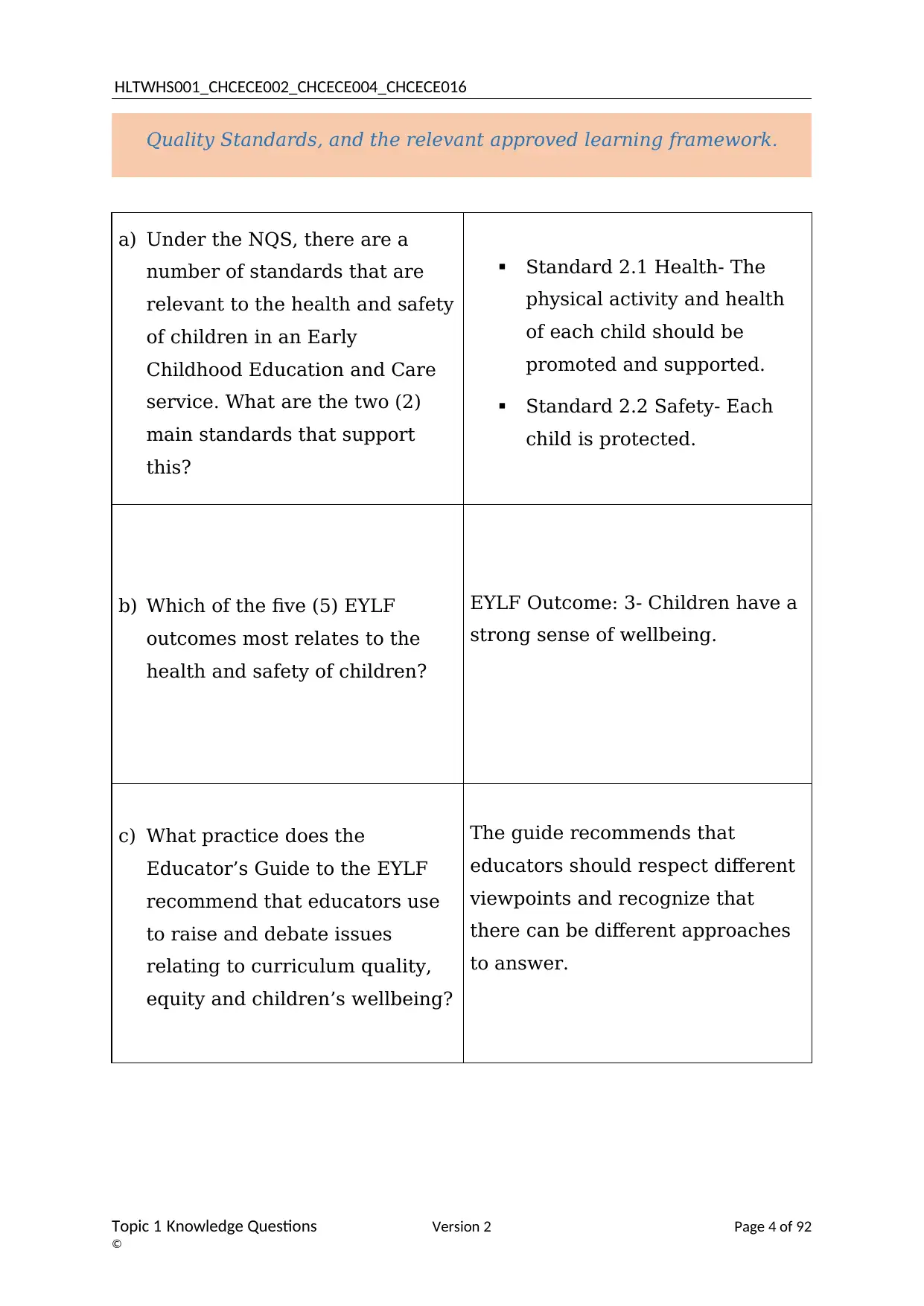
Quality Standards, and the relevant approved learning framework.
a) Under the NQS, there are a
number of standards that are
relevant to the health and safety
of children in an Early
Childhood Education and Care
service. What are the two (2)
main standards that support
this?
Standard 2.1 Health- The
physical activity and health
of each child should be
promoted and supported.
Standard 2.2 Safety- Each
child is protected.
b) Which of the five (5) EYLF
outcomes most relates to the
health and safety of children?
EYLF Outcome: 3- Children have a
strong sense of wellbeing.
c) What practice does the
Educator’s Guide to the EYLF
recommend that educators use
to raise and debate issues
relating to curriculum quality,
equity and children’s wellbeing?
The guide recommends that
educators should respect different
viewpoints and recognize that
there can be different approaches
to answer.
Topic 1 Knowledge Questions Version 2 Page 4 of 92
©
Document Page
HLTWHS001_CHCECE002_CHCECE004_CHCECE016
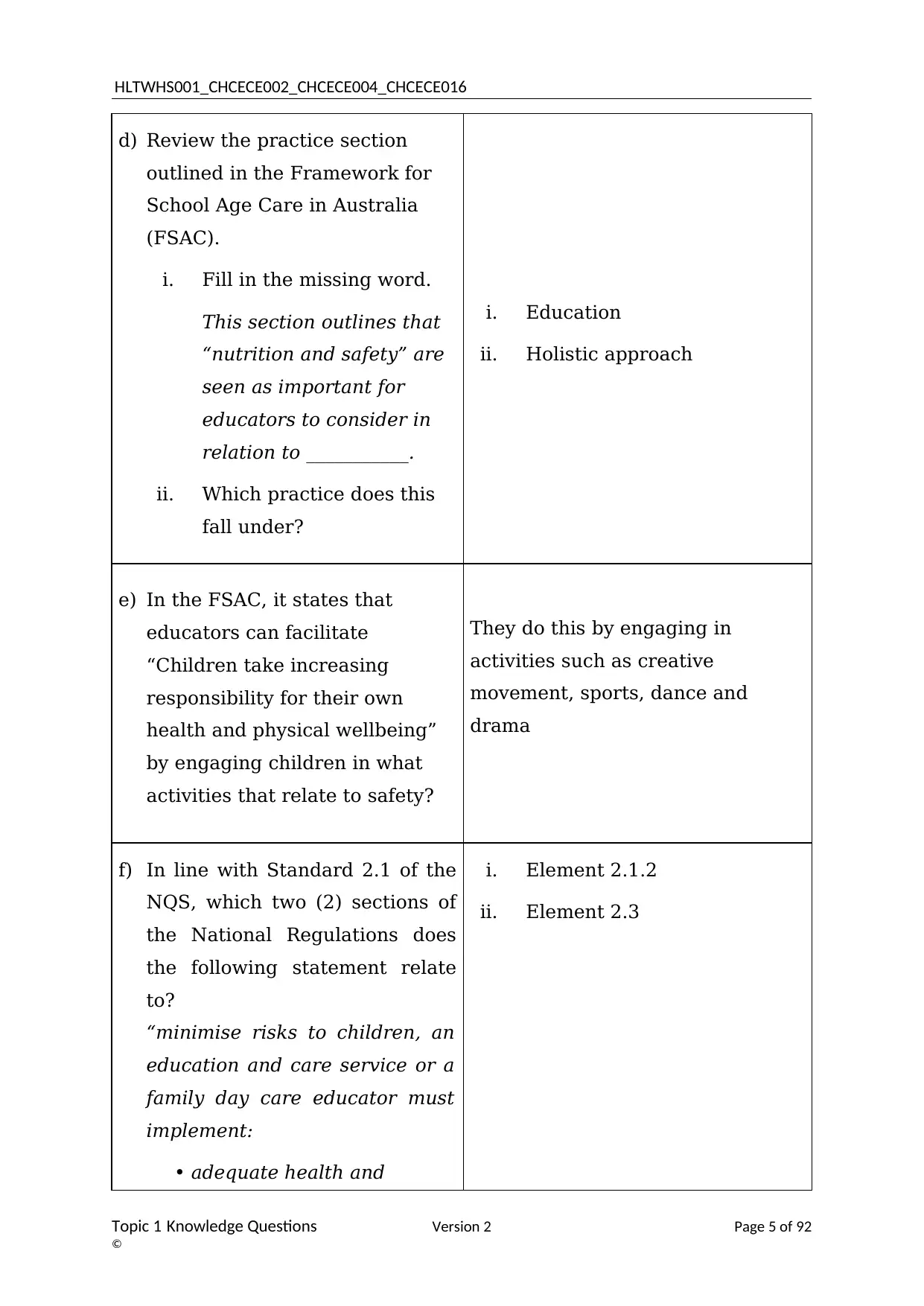
d) Review the practice section
outlined in the Framework for
School Age Care in Australia
(FSAC).
i. Fill in the missing word.
This section outlines that
“nutrition and safety” are
seen as important for
educators to consider in
relation to ___________.
ii. Which practice does this
fall under?
i. Education
ii. Holistic approach
e) In the FSAC, it states that
educators can facilitate
“Children take increasing
responsibility for their own
health and physical wellbeing”
by engaging children in what
activities that relate to safety?
They do this by engaging in
activities such as creative
movement, sports, dance and
drama
f) In line with Standard 2.1 of the
NQS, which two (2) sections of
the National Regulations does
the following statement relate
to?
“minimise risks to children, an
education and care service or a
family day care educator must
implement:
adequate health and
i. Element 2.1.2
ii. Element 2.3
Topic 1 Knowledge Questions Version 2 Page 5 of 92
©
Document Page
HLTWHS001_CHCECE002_CHCECE004_CHCECE016
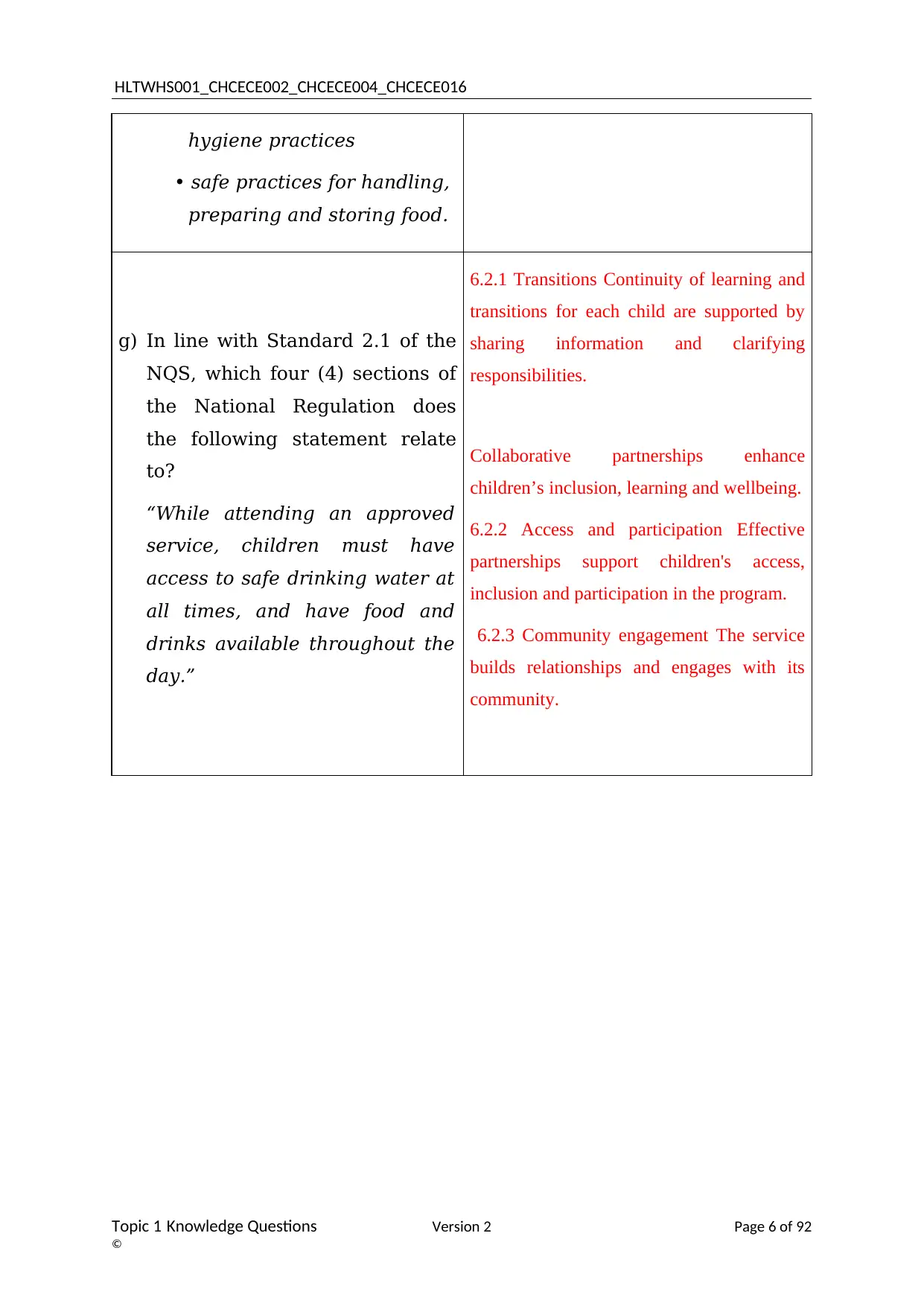
hygiene practices
safe practices for handling,
preparing and storing food.
g) In line with Standard 2.1 of the
NQS, which four (4) sections of
the National Regulation does
the following statement relate
to?
“While attending an approved
service, children must have
access to safe drinking water at
all times, and have food and
drinks available throughout the
day.”
6.2.1 Transitions Continuity of learning and
transitions for each child are supported by
sharing information and clarifying
responsibilities.
Collaborative partnerships enhance
children’s inclusion, learning and wellbeing.
6.2.2 Access and participation Effective
partnerships support children's access,
inclusion and participation in the program.
6.2.3 Community engagement The service
builds relationships and engages with its
community.
Topic 1 Knowledge Questions Version 2 Page 6 of 92
©
tabler-icon-diamond-filled.svg

Paraphrase This Document

Need a fresh take? Get an instant paraphrase of this document with our AI Paraphraser
Document Page
HLTWHS001_CHCECE002_CHCECE004_CHCECE016
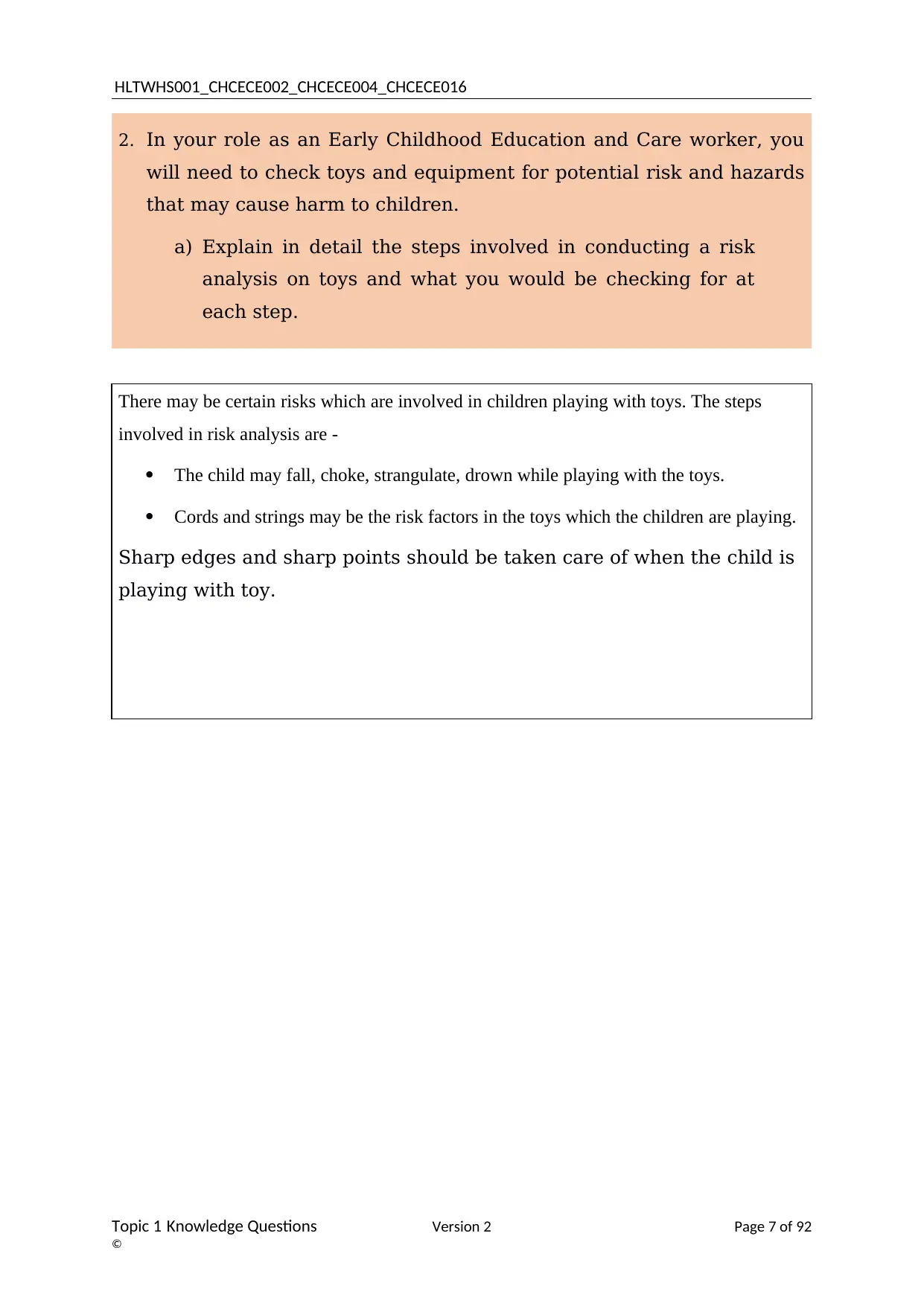
2. In your role as an Early Childhood Education and Care worker, you
will need to check toys and equipment for potential risk and hazards
that may cause harm to children.
a) Explain in detail the steps involved in conducting a risk
analysis on toys and what you would be checking for at
each step.
There may be certain risks which are involved in children playing with toys. The steps
involved in risk analysis are -
The child may fall, choke, strangulate, drown while playing with the toys.
Cords and strings may be the risk factors in the toys which the children are playing.
Sharp edges and sharp points should be taken care of when the child is
playing with toy.
Topic 1 Knowledge Questions Version 2 Page 7 of 92
©
Document Page
HLTWHS001_CHCECE002_CHCECE004_CHCECE016
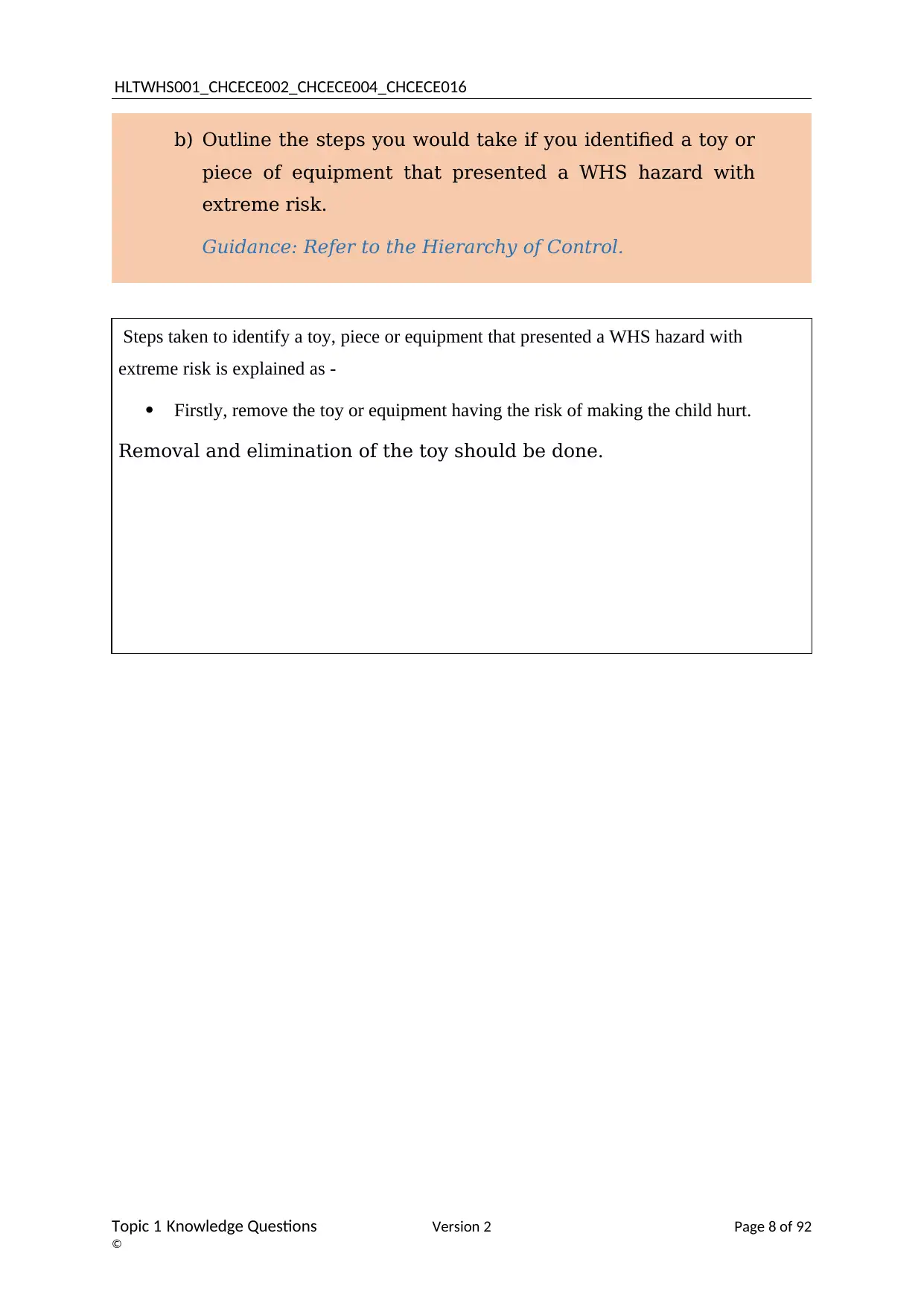
b) Outline the steps you would take if you identified a toy or
piece of equipment that presented a WHS hazard with
extreme risk.
Guidance: Refer to the Hierarchy of Control.
Steps taken to identify a toy, piece or equipment that presented a WHS hazard with
extreme risk is explained as -
Firstly, remove the toy or equipment having the risk of making the child hurt.
Removal and elimination of the toy should be done.
Topic 1 Knowledge Questions Version 2 Page 8 of 92
©
Document Page
HLTWHS001_CHCECE002_CHCECE004_CHCECE016
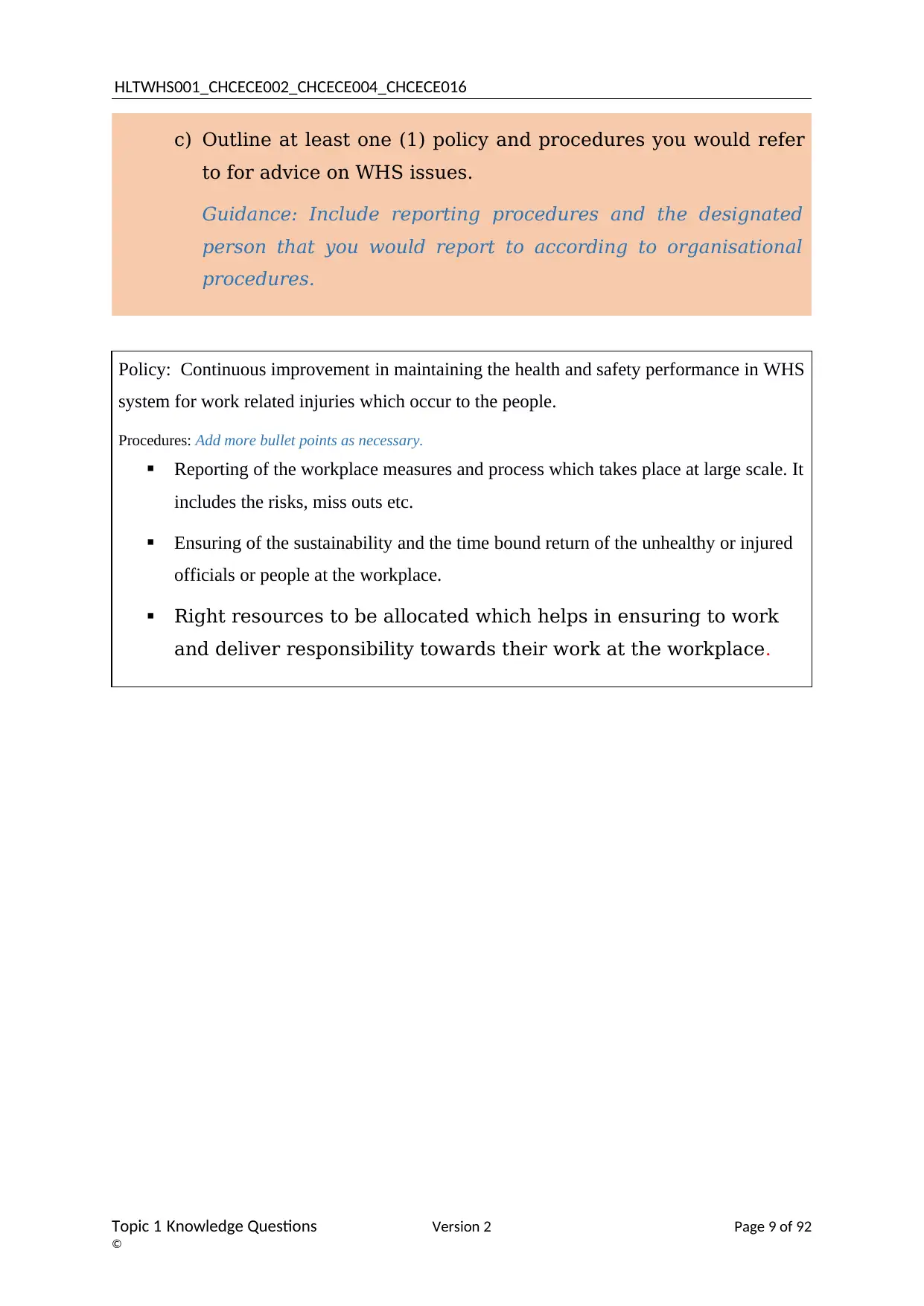
c) Outline at least one (1) policy and procedures you would refer
to for advice on WHS issues.
Guidance: Include reporting procedures and the designated
person that you would report to according to organisational
procedures.
Policy: Continuous improvement in maintaining the health and safety performance in WHS
system for work related injuries which occur to the people.
Procedures: Add more bullet points as necessary.
Reporting of the workplace measures and process which takes place at large scale. It
includes the risks, miss outs etc.
Ensuring of the sustainability and the time bound return of the unhealthy or injured
officials or people at the workplace.
Right resources to be allocated which helps in ensuring to work
and deliver responsibility towards their work at the workplace.
Topic 1 Knowledge Questions Version 2 Page 9 of 92
©
tabler-icon-diamond-filled.svg

Paraphrase This Document

Need a fresh take? Get an instant paraphrase of this document with our AI Paraphraser
Document Page
HLTWHS001_CHCECE002_CHCECE004_CHCECE016
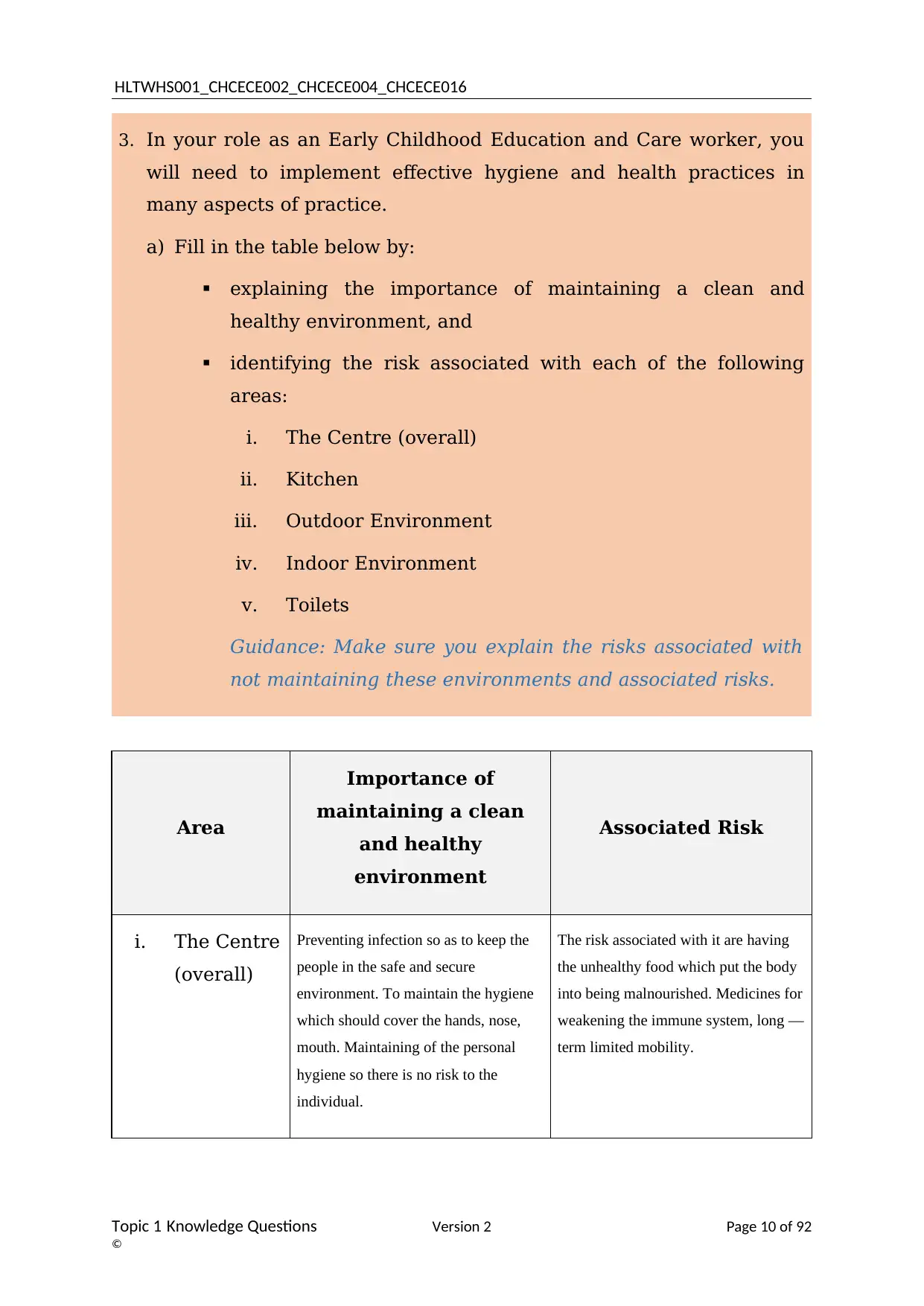
3. In your role as an Early Childhood Education and Care worker, you
will need to implement effective hygiene and health practices in
many aspects of practice.
a) Fill in the table below by:
explaining the importance of maintaining a clean and
healthy environment, and
identifying the risk associated with each of the following
areas:
i. The Centre (overall)
ii. Kitchen
iii. Outdoor Environment
iv. Indoor Environment
v. Toilets
Guidance: Make sure you explain the risks associated with
not maintaining these environments and associated risks.
Area
Importance of
maintaining a clean
and healthy
environment
Associated Risk
i. The Centre
(overall)
Preventing infection so as to keep the
people in the safe and secure
environment. To maintain the hygiene
which should cover the hands, nose,
mouth. Maintaining of the personal
hygiene so there is no risk to the
individual.
The risk associated with it are having
the unhealthy food which put the body
into being malnourished. Medicines for
weakening the immune system, long —
term limited mobility.
Topic 1 Knowledge Questions Version 2 Page 10 of 92
©
Document Page
HLTWHS001_CHCECE002_CHCECE004_CHCECE016
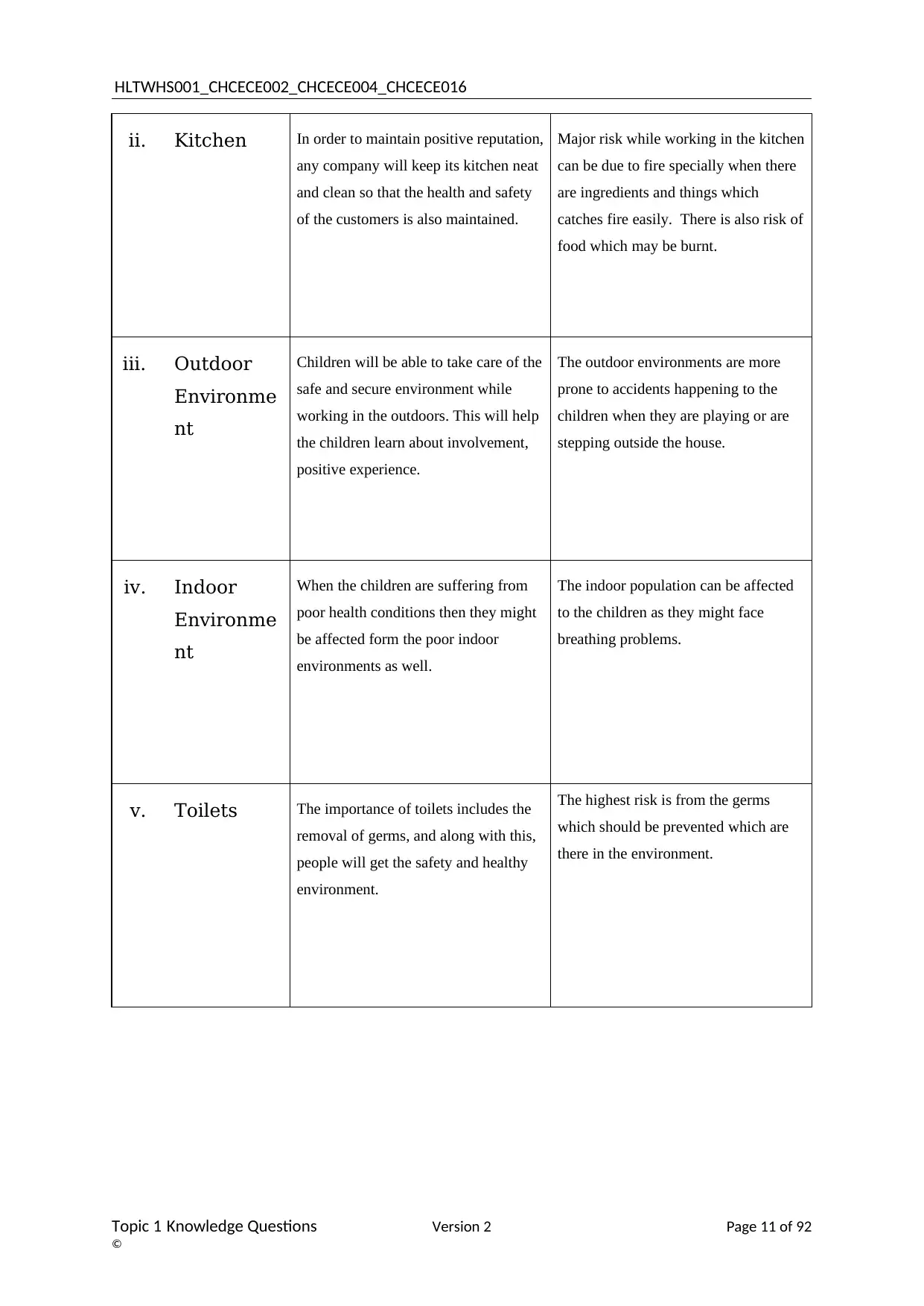
ii. Kitchen In order to maintain positive reputation,
any company will keep its kitchen neat
and clean so that the health and safety
of the customers is also maintained.
Major risk while working in the kitchen
can be due to fire specially when there
are ingredients and things which
catches fire easily. There is also risk of
food which may be burnt.
iii. Outdoor
Environme
nt
Children will be able to take care of the
safe and secure environment while
working in the outdoors. This will help
the children learn about involvement,
positive experience.
The outdoor environments are more
prone to accidents happening to the
children when they are playing or are
stepping outside the house.
iv. Indoor
Environme
nt
When the children are suffering from
poor health conditions then they might
be affected form the poor indoor
environments as well.
The indoor population can be affected
to the children as they might face
breathing problems.
v. Toilets The importance of toilets includes the
removal of germs, and along with this,
people will get the safety and healthy
environment.
The highest risk is from the germs
which should be prevented which are
there in the environment.
Topic 1 Knowledge Questions Version 2 Page 11 of 92
©
chevron_up_icon
1 out of 91
circle_padding
hide_on_mobile
zoom_out_icon
[object Object]