HLTWHS003 Assessment: WHS in Early Childhood Education & Care
VerifiedAdded on 2023/06/18
|19
|3351
|480
Homework Assignment
AI Summary
This assignment provides solutions to the HLTWHS003 Maintain Work Health and Safety assessment, focusing on its application within early childhood education and care services. It covers key areas such as identifying State and Territory WHS regulators, detailing the roles of SafeWork NSW, and listing essential WHS records that childcare services must maintain. The assignment addresses common workplace hazards and suggests relevant policies and procedures to mitigate risks, including a discussion on risk management and the steps involved in risk assessment. Furthermore, it explains the hierarchy of controls and defines key terms from the WHS Act 2011 and SafeWork NSW glossary, such as 'person conducting a business or undertaking,' 'worker,' 'reasonably practicable,' and 'notifiable incident.' The solution also covers hazardous manual tasks, infection control measures, and the basic rights of employees according to SafeWork NSW, providing a comprehensive overview of WHS principles and practices in the context of early childhood education.
Maintain Work Health and Safety
ASSESSMENT 1 (of 3)
Qualification/Course code, name and release number
CHC50113 Diploma of Early Childhood Education and Care (4)
Units of competency
HLTWHS003 Maintain Work Health and Safety (3)
Student name Student number
Assessment declaration
This assessment is my original work and no part of it has been copied from any other source except where
due acknowledgement is made.
No part of this assessment has been written for me by any other person except where such collaboration
has been authorised by the assessor concerned.
I understand that plagiarism is the presentation of the work, idea or creation of another person as though
it is your own. Plagiarism occurs when the origin of the material used is not appropriately cited. No part
of this assessment is plagiarised.
Student signature and date
(if you are submitting this assessment online, your online submission will be deemed your digital signature)
ASSESSMENT 1 (of 3)
Qualification/Course code, name and release number
CHC50113 Diploma of Early Childhood Education and Care (4)
Units of competency
HLTWHS003 Maintain Work Health and Safety (3)
Student name Student number
Assessment declaration
This assessment is my original work and no part of it has been copied from any other source except where
due acknowledgement is made.
No part of this assessment has been written for me by any other person except where such collaboration
has been authorised by the assessor concerned.
I understand that plagiarism is the presentation of the work, idea or creation of another person as though
it is your own. Plagiarism occurs when the origin of the material used is not appropriately cited. No part
of this assessment is plagiarised.
Student signature and date
(if you are submitting this assessment online, your online submission will be deemed your digital signature)

Paraphrase This Document
Need a fresh take? Get an instant paraphrase of this document with our AI Paraphraser
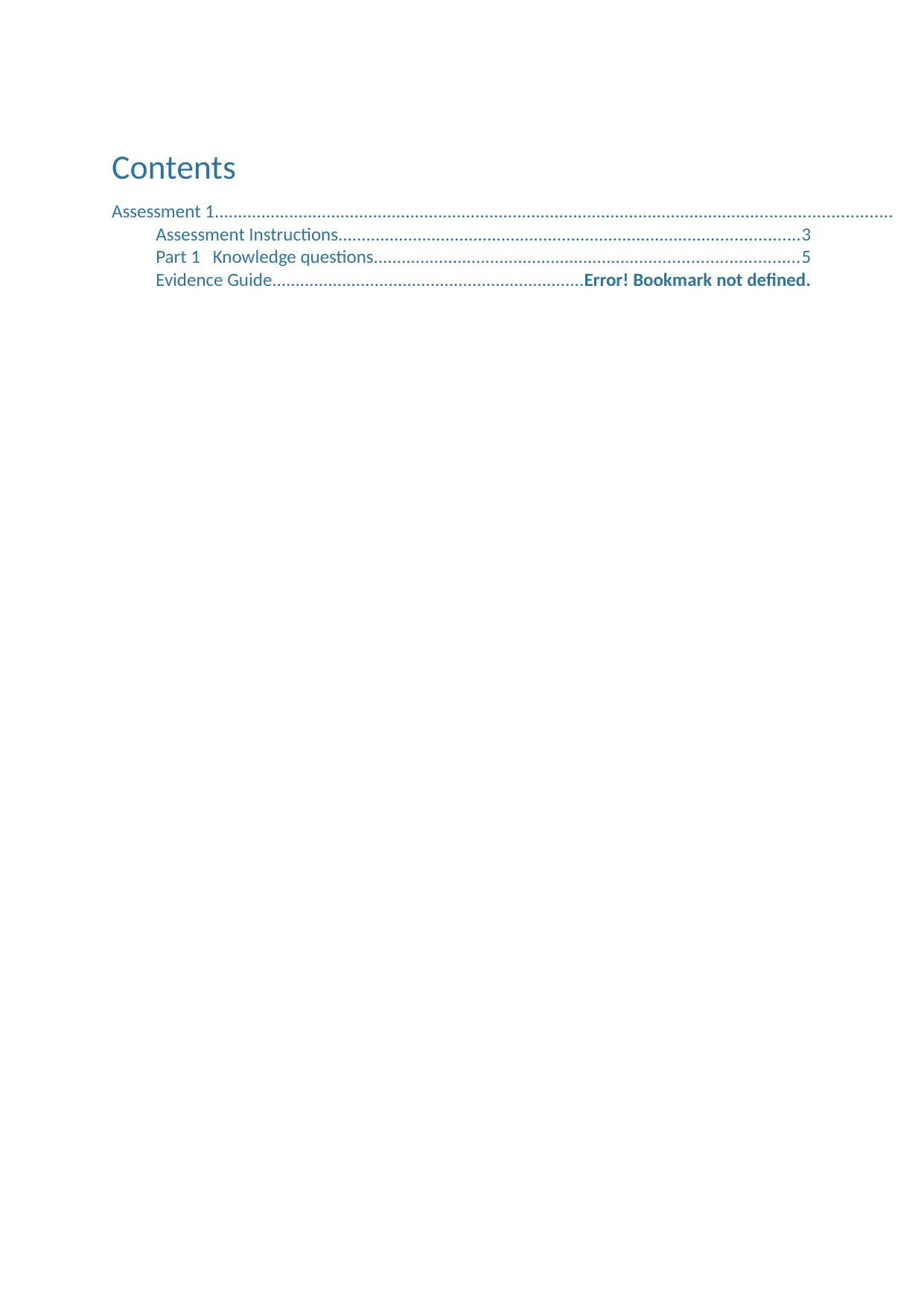
Contents
Assessment 1.................................................................................................................................................
Assessment Instructions...................................................................................................3
Part 1 Knowledge questions...........................................................................................5
Evidence Guide...................................................................Error! Bookmark not defined.
Assessment 1.................................................................................................................................................
Assessment Instructions...................................................................................................3
Part 1 Knowledge questions...........................................................................................5
Evidence Guide...................................................................Error! Bookmark not defined.
Assessment 1
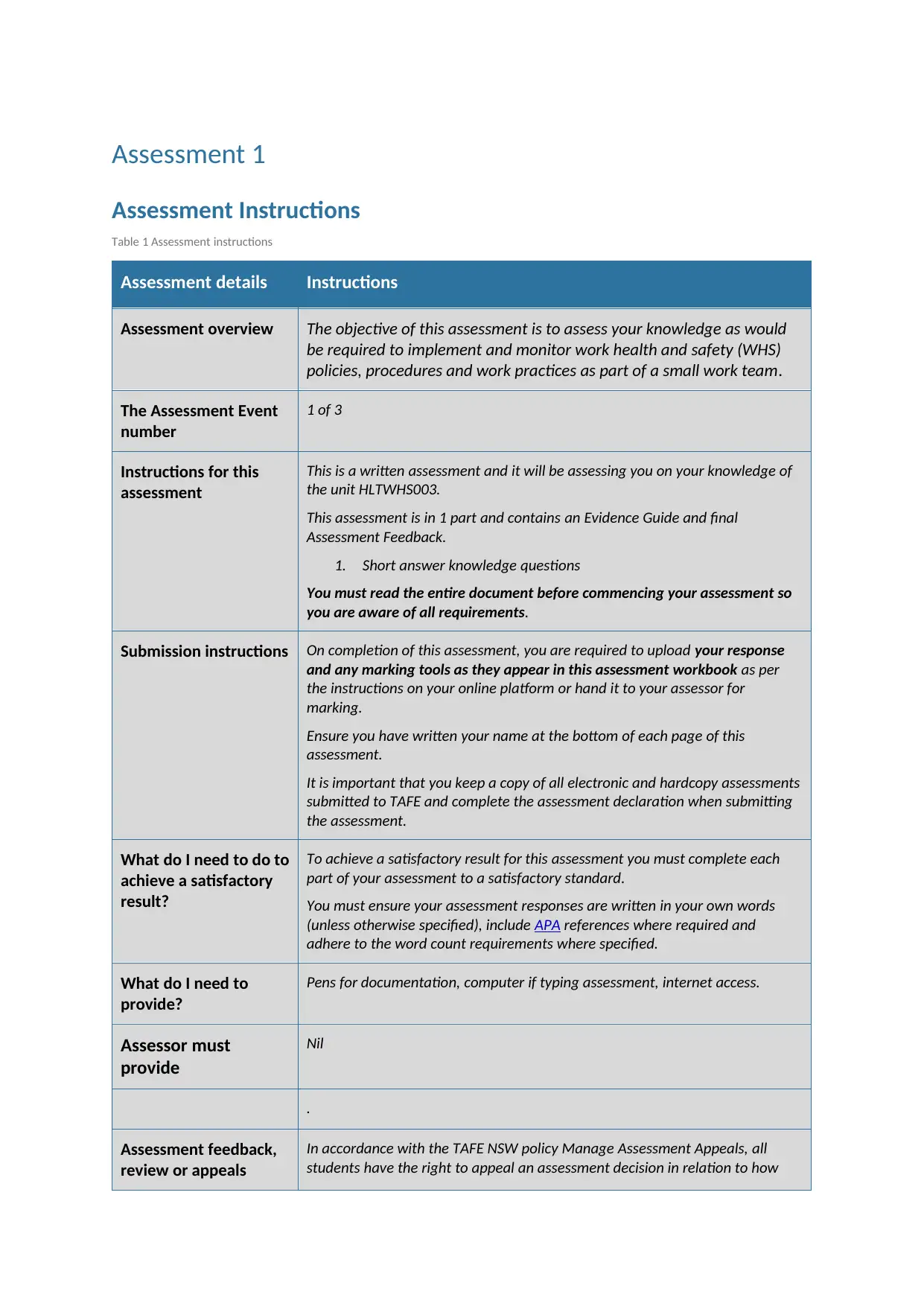
Assessment Instructions
Table 1 Assessment instructions
Assessment details Instructions
Assessment overview The objective of this assessment is to assess your knowledge as would
be required to implement and monitor work health and safety (WHS)
policies, procedures and work practices as part of a small work team.
The Assessment Event
number
1 of 3
Instructions for this
assessment
This is a written assessment and it will be assessing you on your knowledge of
the unit HLTWHS003.
This assessment is in 1 part and contains an Evidence Guide and final
Assessment Feedback.
1. Short answer knowledge questions
You must read the entire document before commencing your assessment so
you are aware of all requirements.
Submission instructions On completion of this assessment, you are required to upload your response
and any marking tools as they appear in this assessment workbook as per
the instructions on your online platform or hand it to your assessor for
marking.
Ensure you have written your name at the bottom of each page of this
assessment.
It is important that you keep a copy of all electronic and hardcopy assessments
submitted to TAFE and complete the assessment declaration when submitting
the assessment.
What do I need to do to
achieve a satisfactory
result?
To achieve a satisfactory result for this assessment you must complete each
part of your assessment to a satisfactory standard.
You must ensure your assessment responses are written in your own words
(unless otherwise specified), include APA references where required and
adhere to the word count requirements where specified.
What do I need to
provide?
Pens for documentation, computer if typing assessment, internet access.
Assessor must
provide
Nil
.
Assessment feedback,
review or appeals
In accordance with the TAFE NSW policy Manage Assessment Appeals, all
students have the right to appeal an assessment decision in relation to how
Assessment Instructions
Table 1 Assessment instructions
Assessment details Instructions
Assessment overview The objective of this assessment is to assess your knowledge as would
be required to implement and monitor work health and safety (WHS)
policies, procedures and work practices as part of a small work team.
The Assessment Event
number
1 of 3
Instructions for this
assessment
This is a written assessment and it will be assessing you on your knowledge of
the unit HLTWHS003.
This assessment is in 1 part and contains an Evidence Guide and final
Assessment Feedback.
1. Short answer knowledge questions
You must read the entire document before commencing your assessment so
you are aware of all requirements.
Submission instructions On completion of this assessment, you are required to upload your response
and any marking tools as they appear in this assessment workbook as per
the instructions on your online platform or hand it to your assessor for
marking.
Ensure you have written your name at the bottom of each page of this
assessment.
It is important that you keep a copy of all electronic and hardcopy assessments
submitted to TAFE and complete the assessment declaration when submitting
the assessment.
What do I need to do to
achieve a satisfactory
result?
To achieve a satisfactory result for this assessment you must complete each
part of your assessment to a satisfactory standard.
You must ensure your assessment responses are written in your own words
(unless otherwise specified), include APA references where required and
adhere to the word count requirements where specified.
What do I need to
provide?
Pens for documentation, computer if typing assessment, internet access.
Assessor must
provide
Nil
.
Assessment feedback,
review or appeals
In accordance with the TAFE NSW policy Manage Assessment Appeals, all
students have the right to appeal an assessment decision in relation to how
⊘ This is a preview!⊘
Do you want full access?
Subscribe today to unlock all pages.

Trusted by 1+ million students worldwide
Assessment details Instructions
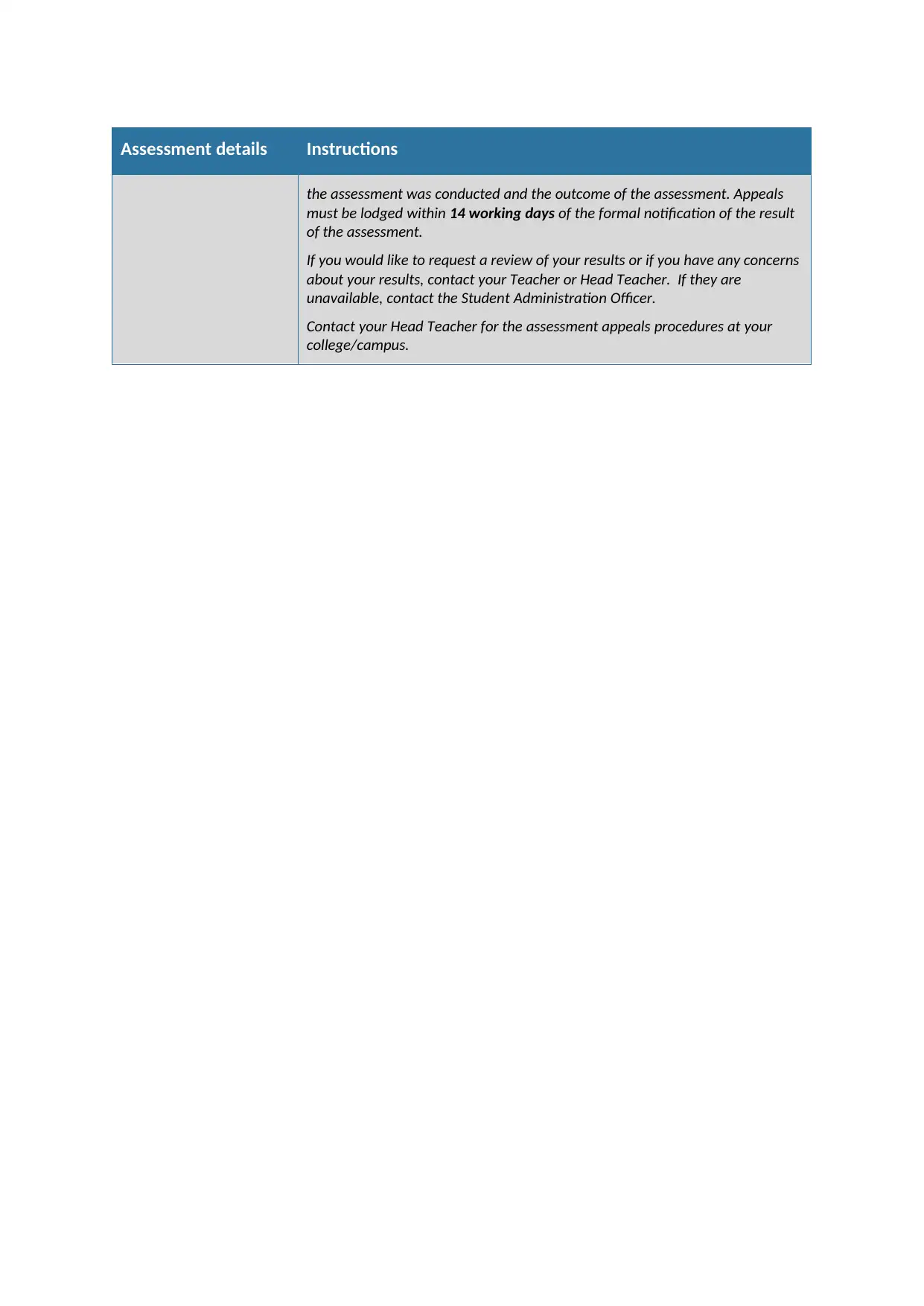
the assessment was conducted and the outcome of the assessment. Appeals
must be lodged within 14 working days of the formal notification of the result
of the assessment.
If you would like to request a review of your results or if you have any concerns
about your results, contact your Teacher or Head Teacher. If they are
unavailable, contact the Student Administration Officer.
Contact your Head Teacher for the assessment appeals procedures at your
college/campus.
the assessment was conducted and the outcome of the assessment. Appeals
must be lodged within 14 working days of the formal notification of the result
of the assessment.
If you would like to request a review of your results or if you have any concerns
about your results, contact your Teacher or Head Teacher. If they are
unavailable, contact the Student Administration Officer.
Contact your Head Teacher for the assessment appeals procedures at your
college/campus.
Paraphrase This Document
Need a fresh take? Get an instant paraphrase of this document with our AI Paraphraser
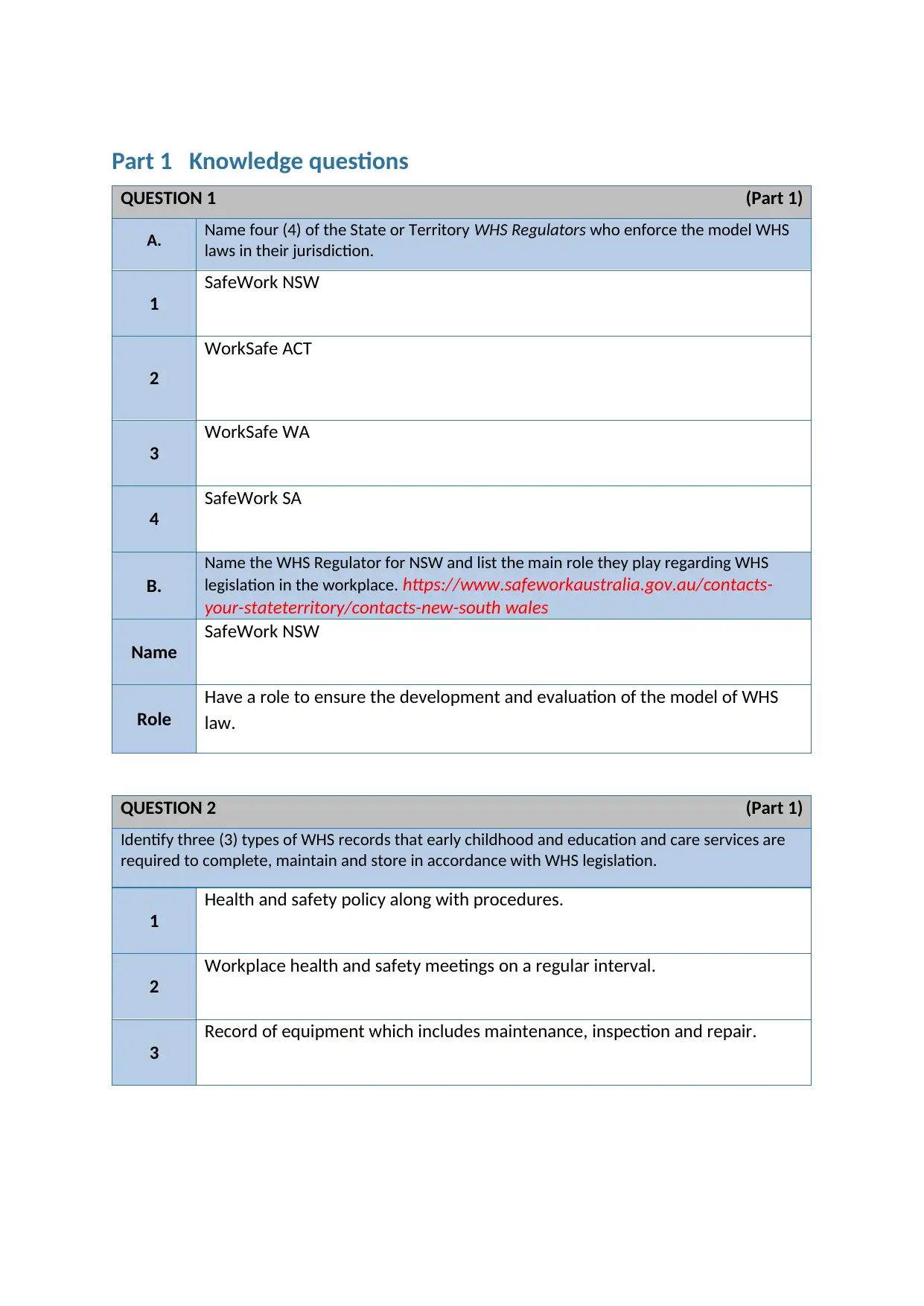
Part 1 Knowledge questions
QUESTION 1 (Part 1)
A. Name four (4) of the State or Territory WHS Regulators who enforce the model WHS
laws in their jurisdiction.
1
SafeWork NSW
2
WorkSafe ACT
3
WorkSafe WA
4
SafeWork SA
B.
Name the WHS Regulator for NSW and list the main role they play regarding WHS
legislation in the workplace. https://www.safeworkaustralia.gov.au/contacts-
your-stateterritory/contacts-new-south wales
Name
SafeWork NSW
Role
Have a role to ensure the development and evaluation of the model of WHS
law.
QUESTION 2 (Part 1)
Identify three (3) types of WHS records that early childhood and education and care services are
required to complete, maintain and store in accordance with WHS legislation.
1
Health and safety policy along with procedures.
2
Workplace health and safety meetings on a regular interval.
3
Record of equipment which includes maintenance, inspection and repair.
QUESTION 1 (Part 1)
A. Name four (4) of the State or Territory WHS Regulators who enforce the model WHS
laws in their jurisdiction.
1
SafeWork NSW
2
WorkSafe ACT
3
WorkSafe WA
4
SafeWork SA
B.
Name the WHS Regulator for NSW and list the main role they play regarding WHS
legislation in the workplace. https://www.safeworkaustralia.gov.au/contacts-
your-stateterritory/contacts-new-south wales
Name
SafeWork NSW
Role
Have a role to ensure the development and evaluation of the model of WHS
law.
QUESTION 2 (Part 1)
Identify three (3) types of WHS records that early childhood and education and care services are
required to complete, maintain and store in accordance with WHS legislation.
1
Health and safety policy along with procedures.
2
Workplace health and safety meetings on a regular interval.
3
Record of equipment which includes maintenance, inspection and repair.
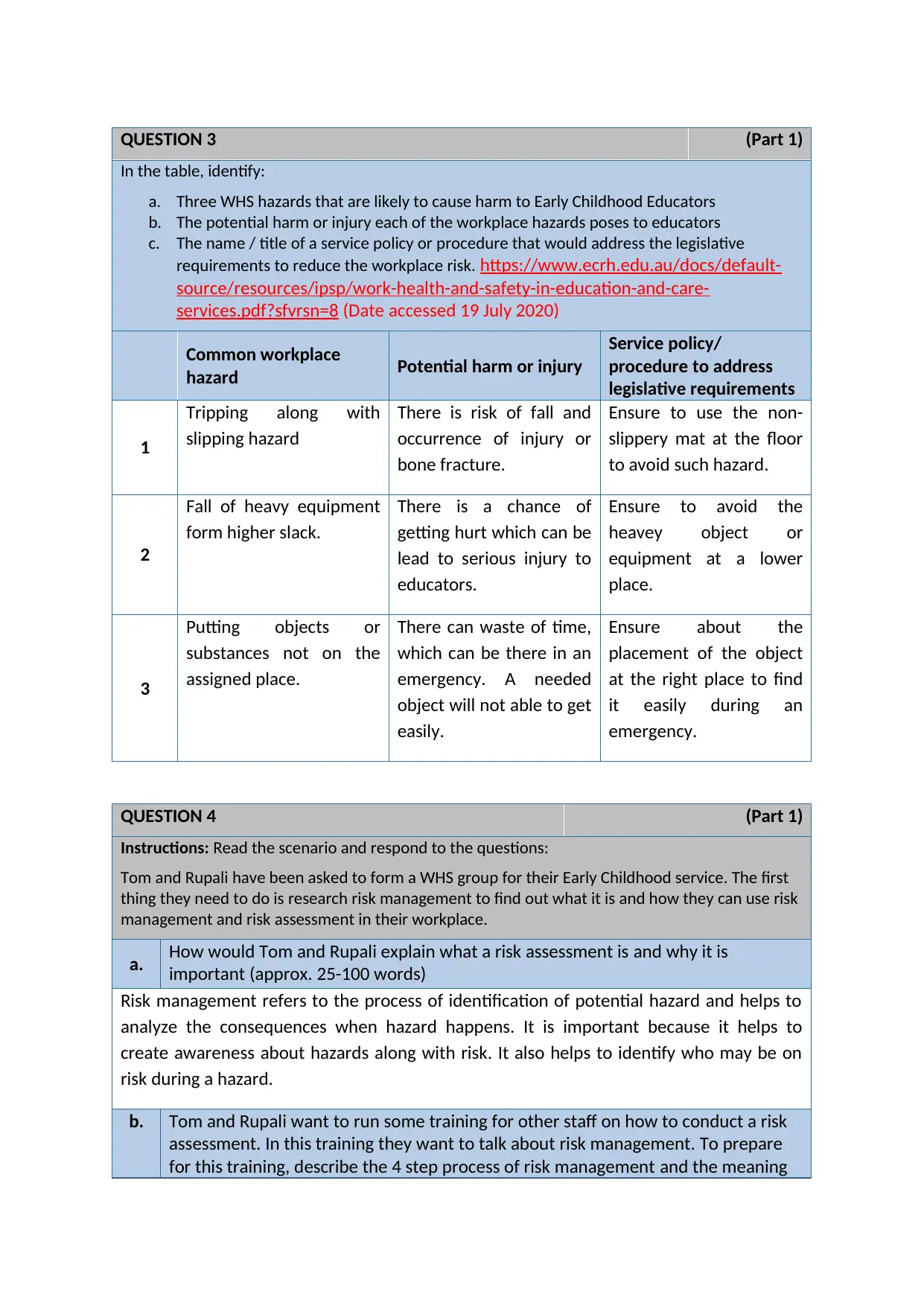
QUESTION 3 (Part 1)
In the table, identify:
a. Three WHS hazards that are likely to cause harm to Early Childhood Educators
b. The potential harm or injury each of the workplace hazards poses to educators
c. The name / title of a service policy or procedure that would address the legislative
requirements to reduce the workplace risk. https://www.ecrh.edu.au/docs/default-
source/resources/ipsp/work-health-and-safety-in-education-and-care-
services.pdf?sfvrsn=8 (Date accessed 19 July 2020)
Common workplace
hazard Potential harm or injury
Service policy/
procedure to address
legislative requirements
1
Tripping along with
slipping hazard
There is risk of fall and
occurrence of injury or
bone fracture.
Ensure to use the non-
slippery mat at the floor
to avoid such hazard.
2
Fall of heavy equipment
form higher slack.
There is a chance of
getting hurt which can be
lead to serious injury to
educators.
Ensure to avoid the
heavey object or
equipment at a lower
place.
3
Putting objects or
substances not on the
assigned place.
There can waste of time,
which can be there in an
emergency. A needed
object will not able to get
easily.
Ensure about the
placement of the object
at the right place to find
it easily during an
emergency.
QUESTION 4 (Part 1)
Instructions: Read the scenario and respond to the questions:
Tom and Rupali have been asked to form a WHS group for their Early Childhood service. The first
thing they need to do is research risk management to find out what it is and how they can use risk
management and risk assessment in their workplace.
a. How would Tom and Rupali explain what a risk assessment is and why it is
important (approx. 25-100 words)
Risk management refers to the process of identification of potential hazard and helps to
analyze the consequences when hazard happens. It is important because it helps to
create awareness about hazards along with risk. It also helps to identify who may be on
risk during a hazard.
b. Tom and Rupali want to run some training for other staff on how to conduct a risk
assessment. In this training they want to talk about risk management. To prepare
for this training, describe the 4 step process of risk management and the meaning
In the table, identify:
a. Three WHS hazards that are likely to cause harm to Early Childhood Educators
b. The potential harm or injury each of the workplace hazards poses to educators
c. The name / title of a service policy or procedure that would address the legislative
requirements to reduce the workplace risk. https://www.ecrh.edu.au/docs/default-
source/resources/ipsp/work-health-and-safety-in-education-and-care-
services.pdf?sfvrsn=8 (Date accessed 19 July 2020)
Common workplace
hazard Potential harm or injury
Service policy/
procedure to address
legislative requirements
1
Tripping along with
slipping hazard
There is risk of fall and
occurrence of injury or
bone fracture.
Ensure to use the non-
slippery mat at the floor
to avoid such hazard.
2
Fall of heavy equipment
form higher slack.
There is a chance of
getting hurt which can be
lead to serious injury to
educators.
Ensure to avoid the
heavey object or
equipment at a lower
place.
3
Putting objects or
substances not on the
assigned place.
There can waste of time,
which can be there in an
emergency. A needed
object will not able to get
easily.
Ensure about the
placement of the object
at the right place to find
it easily during an
emergency.
QUESTION 4 (Part 1)
Instructions: Read the scenario and respond to the questions:
Tom and Rupali have been asked to form a WHS group for their Early Childhood service. The first
thing they need to do is research risk management to find out what it is and how they can use risk
management and risk assessment in their workplace.
a. How would Tom and Rupali explain what a risk assessment is and why it is
important (approx. 25-100 words)
Risk management refers to the process of identification of potential hazard and helps to
analyze the consequences when hazard happens. It is important because it helps to
create awareness about hazards along with risk. It also helps to identify who may be on
risk during a hazard.
b. Tom and Rupali want to run some training for other staff on how to conduct a risk
assessment. In this training they want to talk about risk management. To prepare
for this training, describe the 4 step process of risk management and the meaning
⊘ This is a preview!⊘
Do you want full access?
Subscribe today to unlock all pages.
Trusted by 1+ million students worldwide
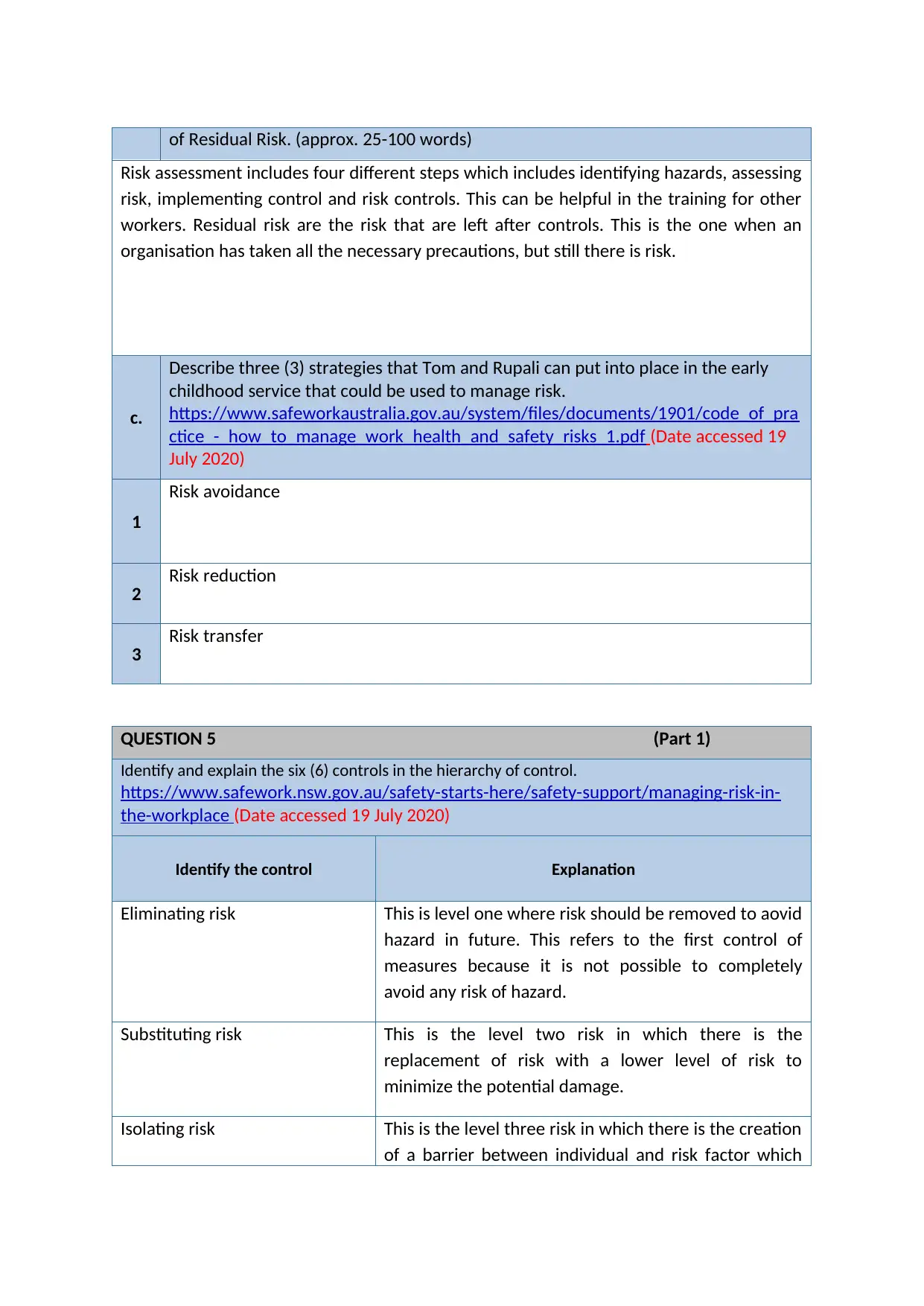
of Residual Risk. (approx. 25-100 words)
Risk assessment includes four different steps which includes identifying hazards, assessing
risk, implementing control and risk controls. This can be helpful in the training for other
workers. Residual risk are the risk that are left after controls. This is the one when an
organisation has taken all the necessary precautions, but still there is risk.
c.
Describe three (3) strategies that Tom and Rupali can put into place in the early
childhood service that could be used to manage risk.
https://www.safeworkaustralia.gov.au/system/files/documents/1901/code_of_pra
ctice_-_how_to_manage_work_health_and_safety_risks_1.pdf (Date accessed 19
July 2020)
1
Risk avoidance
2 Risk reduction
3 Risk transfer
QUESTION 5 (Part 1)
Identify and explain the six (6) controls in the hierarchy of control.
https://www.safework.nsw.gov.au/safety-starts-here/safety-support/managing-risk-in-
the-workplace (Date accessed 19 July 2020)
Identify the control Explanation
Eliminating risk This is level one where risk should be removed to aovid
hazard in future. This refers to the first control of
measures because it is not possible to completely
avoid any risk of hazard.
Substituting risk This is the level two risk in which there is the
replacement of risk with a lower level of risk to
minimize the potential damage.
Isolating risk This is the level three risk in which there is the creation
of a barrier between individual and risk factor which
Risk assessment includes four different steps which includes identifying hazards, assessing
risk, implementing control and risk controls. This can be helpful in the training for other
workers. Residual risk are the risk that are left after controls. This is the one when an
organisation has taken all the necessary precautions, but still there is risk.
c.
Describe three (3) strategies that Tom and Rupali can put into place in the early
childhood service that could be used to manage risk.
https://www.safeworkaustralia.gov.au/system/files/documents/1901/code_of_pra
ctice_-_how_to_manage_work_health_and_safety_risks_1.pdf (Date accessed 19
July 2020)
1
Risk avoidance
2 Risk reduction
3 Risk transfer
QUESTION 5 (Part 1)
Identify and explain the six (6) controls in the hierarchy of control.
https://www.safework.nsw.gov.au/safety-starts-here/safety-support/managing-risk-in-
the-workplace (Date accessed 19 July 2020)
Identify the control Explanation
Eliminating risk This is level one where risk should be removed to aovid
hazard in future. This refers to the first control of
measures because it is not possible to completely
avoid any risk of hazard.
Substituting risk This is the level two risk in which there is the
replacement of risk with a lower level of risk to
minimize the potential damage.
Isolating risk This is the level three risk in which there is the creation
of a barrier between individual and risk factor which
Paraphrase This Document
Need a fresh take? Get an instant paraphrase of this document with our AI Paraphraser
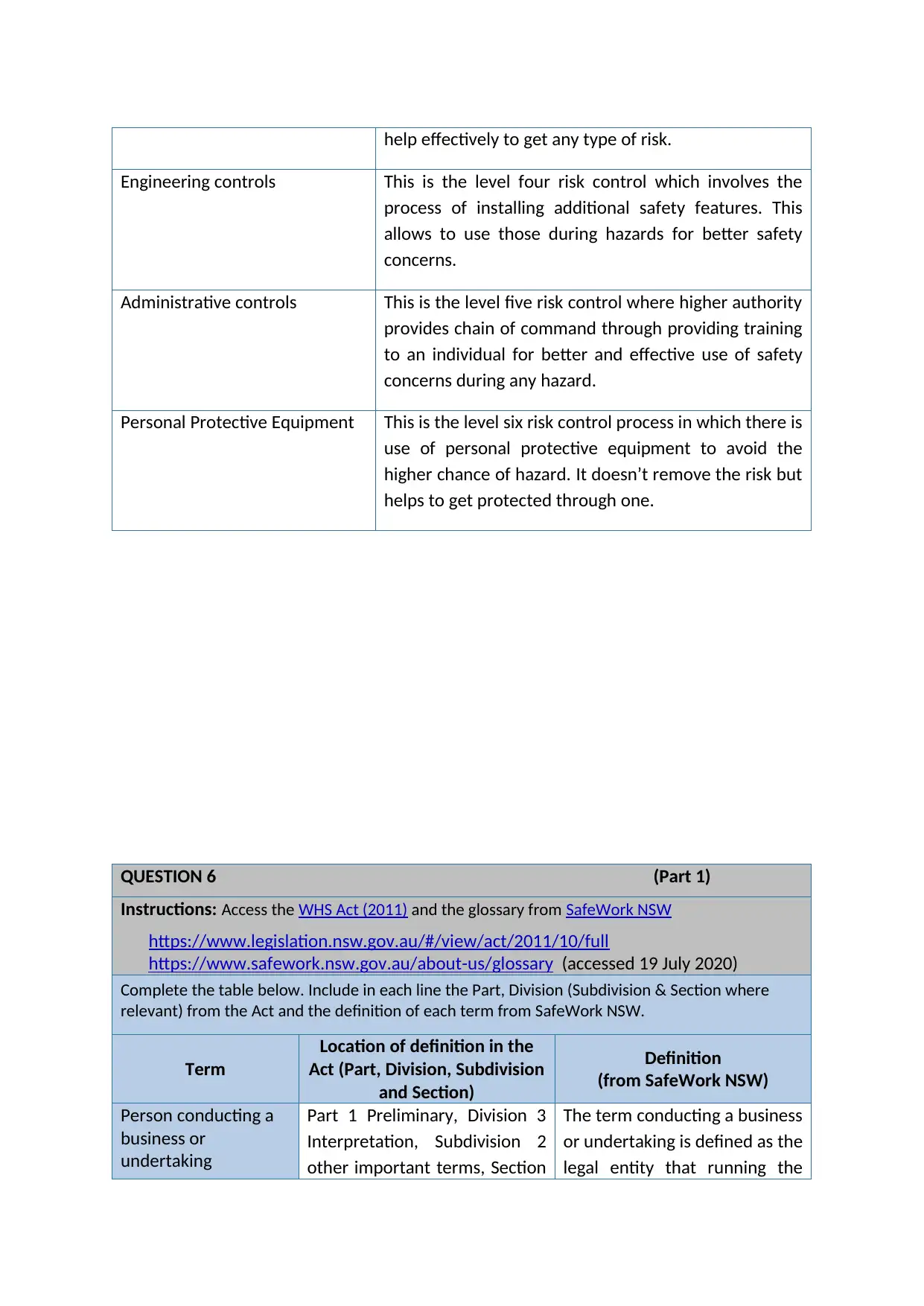
help effectively to get any type of risk.
Engineering controls This is the level four risk control which involves the
process of installing additional safety features. This
allows to use those during hazards for better safety
concerns.
Administrative controls This is the level five risk control where higher authority
provides chain of command through providing training
to an individual for better and effective use of safety
concerns during any hazard.
Personal Protective Equipment This is the level six risk control process in which there is
use of personal protective equipment to avoid the
higher chance of hazard. It doesn’t remove the risk but
helps to get protected through one.
QUESTION 6 (Part 1)
Instructions: Access the WHS Act (2011) and the glossary from SafeWork NSW
https://www.legislation.nsw.gov.au/#/view/act/2011/10/full
https://www.safework.nsw.gov.au/about-us/glossary (accessed 19 July 2020)
Complete the table below. Include in each line the Part, Division (Subdivision & Section where
relevant) from the Act and the definition of each term from SafeWork NSW.
Term
Location of definition in the
Act (Part, Division, Subdivision
and Section)
Definition
(from SafeWork NSW)
Person conducting a
business or
undertaking
Part 1 Preliminary, Division 3
Interpretation, Subdivision 2
other important terms, Section
The term conducting a business
or undertaking is defined as the
legal entity that running the
Engineering controls This is the level four risk control which involves the
process of installing additional safety features. This
allows to use those during hazards for better safety
concerns.
Administrative controls This is the level five risk control where higher authority
provides chain of command through providing training
to an individual for better and effective use of safety
concerns during any hazard.
Personal Protective Equipment This is the level six risk control process in which there is
use of personal protective equipment to avoid the
higher chance of hazard. It doesn’t remove the risk but
helps to get protected through one.
QUESTION 6 (Part 1)
Instructions: Access the WHS Act (2011) and the glossary from SafeWork NSW
https://www.legislation.nsw.gov.au/#/view/act/2011/10/full
https://www.safework.nsw.gov.au/about-us/glossary (accessed 19 July 2020)
Complete the table below. Include in each line the Part, Division (Subdivision & Section where
relevant) from the Act and the definition of each term from SafeWork NSW.
Term
Location of definition in the
Act (Part, Division, Subdivision
and Section)
Definition
(from SafeWork NSW)
Person conducting a
business or
undertaking
Part 1 Preliminary, Division 3
Interpretation, Subdivision 2
other important terms, Section
The term conducting a business
or undertaking is defined as the
legal entity that running the
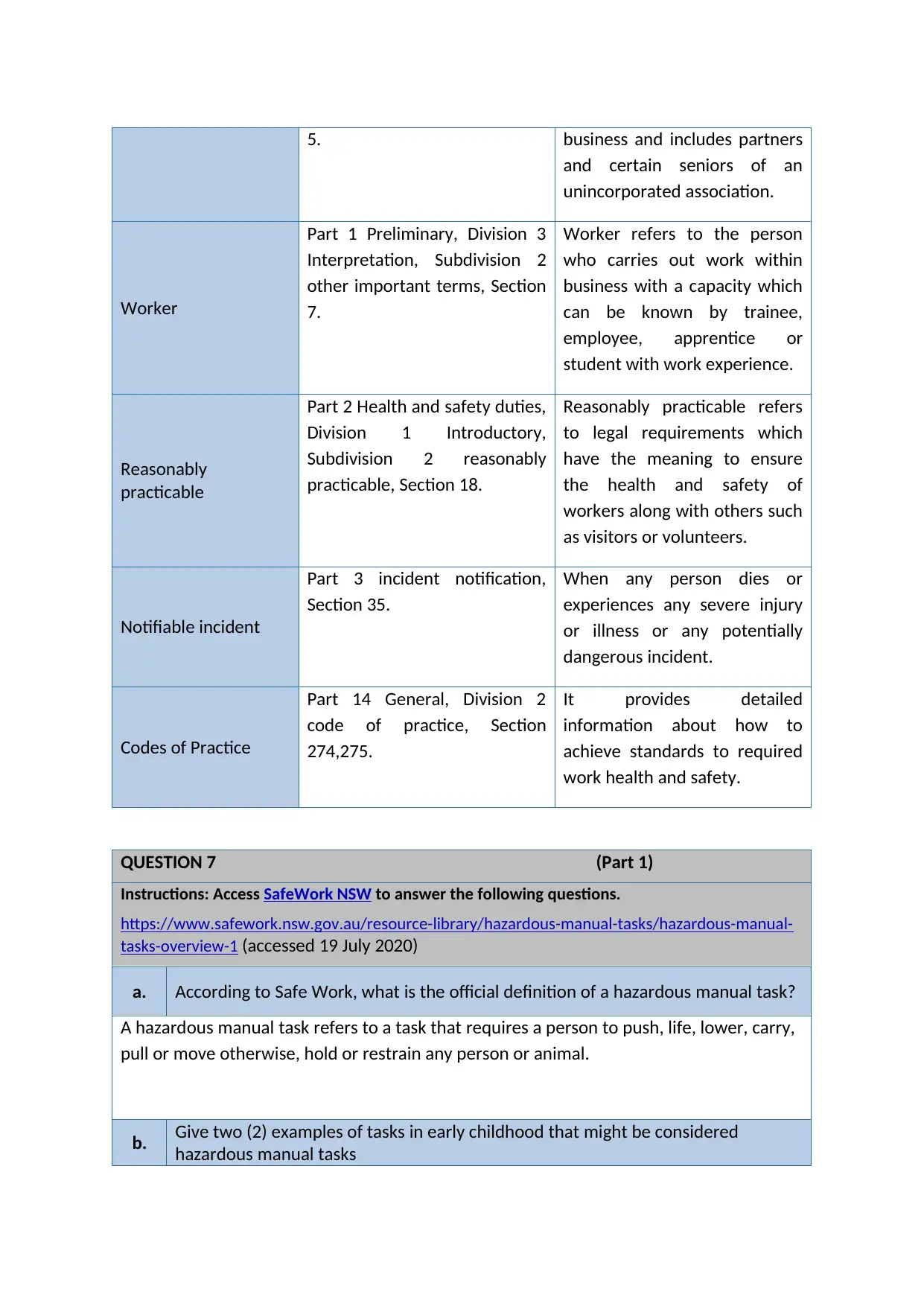
5. business and includes partners
and certain seniors of an
unincorporated association.
Worker
Part 1 Preliminary, Division 3
Interpretation, Subdivision 2
other important terms, Section
7.
Worker refers to the person
who carries out work within
business with a capacity which
can be known by trainee,
employee, apprentice or
student with work experience.
Reasonably
practicable
Part 2 Health and safety duties,
Division 1 Introductory,
Subdivision 2 reasonably
practicable, Section 18.
Reasonably practicable refers
to legal requirements which
have the meaning to ensure
the health and safety of
workers along with others such
as visitors or volunteers.
Notifiable incident
Part 3 incident notification,
Section 35.
When any person dies or
experiences any severe injury
or illness or any potentially
dangerous incident.
Codes of Practice
Part 14 General, Division 2
code of practice, Section
274,275.
It provides detailed
information about how to
achieve standards to required
work health and safety.
QUESTION 7 (Part 1)
Instructions: Access SafeWork NSW to answer the following questions.
https://www.safework.nsw.gov.au/resource-library/hazardous-manual-tasks/hazardous-manual-
tasks-overview-1 (accessed 19 July 2020)
a. According to Safe Work, what is the official definition of a hazardous manual task?
A hazardous manual task refers to a task that requires a person to push, life, lower, carry,
pull or move otherwise, hold or restrain any person or animal.
b. Give two (2) examples of tasks in early childhood that might be considered
hazardous manual tasks
and certain seniors of an
unincorporated association.
Worker
Part 1 Preliminary, Division 3
Interpretation, Subdivision 2
other important terms, Section
7.
Worker refers to the person
who carries out work within
business with a capacity which
can be known by trainee,
employee, apprentice or
student with work experience.
Reasonably
practicable
Part 2 Health and safety duties,
Division 1 Introductory,
Subdivision 2 reasonably
practicable, Section 18.
Reasonably practicable refers
to legal requirements which
have the meaning to ensure
the health and safety of
workers along with others such
as visitors or volunteers.
Notifiable incident
Part 3 incident notification,
Section 35.
When any person dies or
experiences any severe injury
or illness or any potentially
dangerous incident.
Codes of Practice
Part 14 General, Division 2
code of practice, Section
274,275.
It provides detailed
information about how to
achieve standards to required
work health and safety.
QUESTION 7 (Part 1)
Instructions: Access SafeWork NSW to answer the following questions.
https://www.safework.nsw.gov.au/resource-library/hazardous-manual-tasks/hazardous-manual-
tasks-overview-1 (accessed 19 July 2020)
a. According to Safe Work, what is the official definition of a hazardous manual task?
A hazardous manual task refers to a task that requires a person to push, life, lower, carry,
pull or move otherwise, hold or restrain any person or animal.
b. Give two (2) examples of tasks in early childhood that might be considered
hazardous manual tasks
⊘ This is a preview!⊘
Do you want full access?
Subscribe today to unlock all pages.
Trusted by 1+ million students worldwide
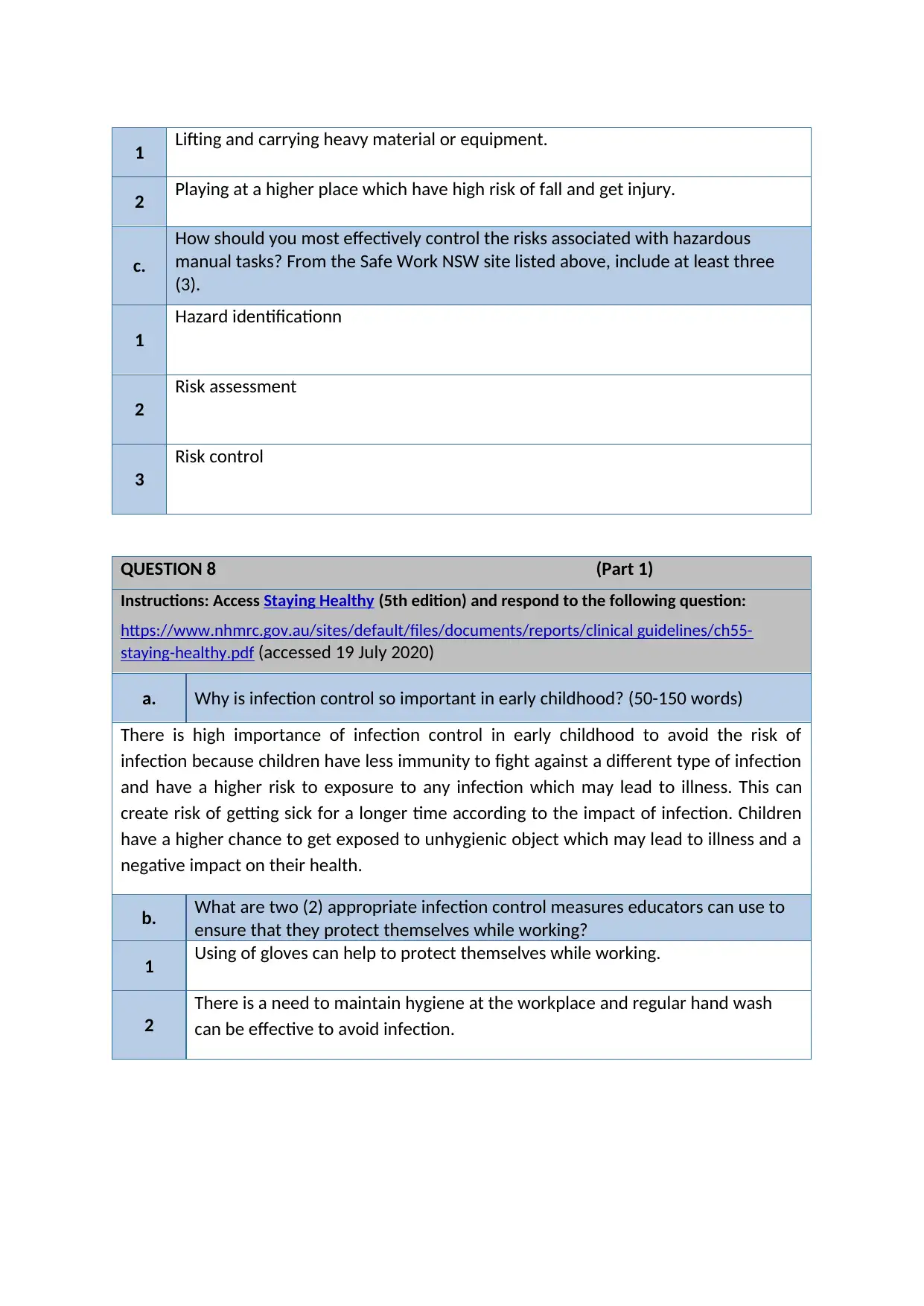
1 Lifting and carrying heavy material or equipment.
2 Playing at a higher place which have high risk of fall and get injury.
c.
How should you most effectively control the risks associated with hazardous
manual tasks? From the Safe Work NSW site listed above, include at least three
(3).
1
Hazard identificationn
2
Risk assessment
3
Risk control
QUESTION 8 (Part 1)
Instructions: Access Staying Healthy (5th edition) and respond to the following question:
https://www.nhmrc.gov.au/sites/default/files/documents/reports/clinical guidelines/ch55-
staying-healthy.pdf (accessed 19 July 2020)
a. Why is infection control so important in early childhood? (50-150 words)
There is high importance of infection control in early childhood to avoid the risk of
infection because children have less immunity to fight against a different type of infection
and have a higher risk to exposure to any infection which may lead to illness. This can
create risk of getting sick for a longer time according to the impact of infection. Children
have a higher chance to get exposed to unhygienic object which may lead to illness and a
negative impact on their health.
b. What are two (2) appropriate infection control measures educators can use to
ensure that they protect themselves while working?
1 Using of gloves can help to protect themselves while working.
2
There is a need to maintain hygiene at the workplace and regular hand wash
can be effective to avoid infection.
2 Playing at a higher place which have high risk of fall and get injury.
c.
How should you most effectively control the risks associated with hazardous
manual tasks? From the Safe Work NSW site listed above, include at least three
(3).
1
Hazard identificationn
2
Risk assessment
3
Risk control
QUESTION 8 (Part 1)
Instructions: Access Staying Healthy (5th edition) and respond to the following question:
https://www.nhmrc.gov.au/sites/default/files/documents/reports/clinical guidelines/ch55-
staying-healthy.pdf (accessed 19 July 2020)
a. Why is infection control so important in early childhood? (50-150 words)
There is high importance of infection control in early childhood to avoid the risk of
infection because children have less immunity to fight against a different type of infection
and have a higher risk to exposure to any infection which may lead to illness. This can
create risk of getting sick for a longer time according to the impact of infection. Children
have a higher chance to get exposed to unhygienic object which may lead to illness and a
negative impact on their health.
b. What are two (2) appropriate infection control measures educators can use to
ensure that they protect themselves while working?
1 Using of gloves can help to protect themselves while working.
2
There is a need to maintain hygiene at the workplace and regular hand wash
can be effective to avoid infection.
Paraphrase This Document
Need a fresh take? Get an instant paraphrase of this document with our AI Paraphraser
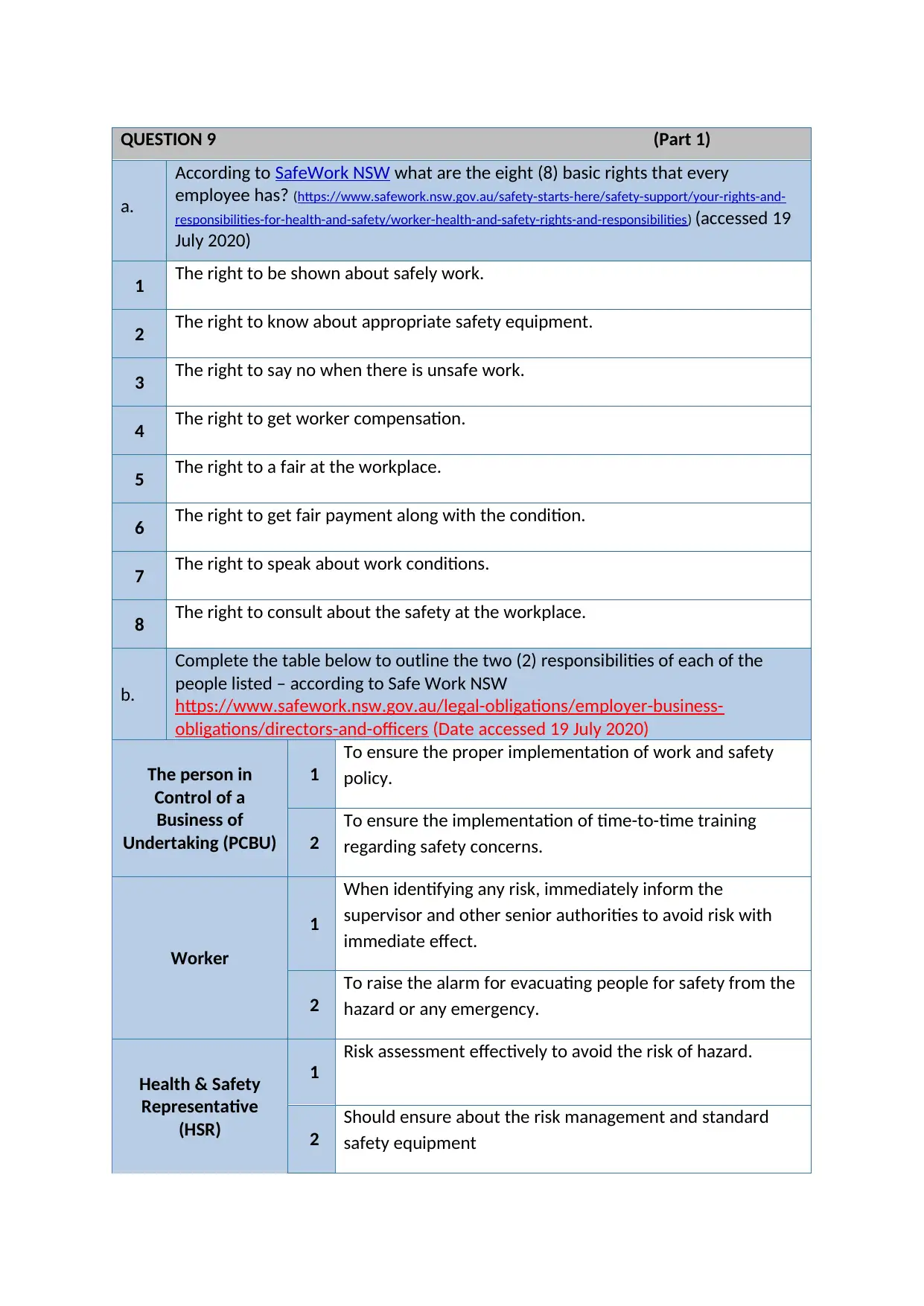
QUESTION 9 (Part 1)
a.
According to SafeWork NSW what are the eight (8) basic rights that every
employee has? (https://www.safework.nsw.gov.au/safety-starts-here/safety-support/your-rights-and-
responsibilities-for-health-and-safety/worker-health-and-safety-rights-and-responsibilities) (accessed 19
July 2020)
1 The right to be shown about safely work.
2 The right to know about appropriate safety equipment.
3 The right to say no when there is unsafe work.
4 The right to get worker compensation.
5 The right to a fair at the workplace.
6 The right to get fair payment along with the condition.
7 The right to speak about work conditions.
8 The right to consult about the safety at the workplace.
b.
Complete the table below to outline the two (2) responsibilities of each of the
people listed – according to Safe Work NSW
https://www.safework.nsw.gov.au/legal-obligations/employer-business-
obligations/directors-and-officers (Date accessed 19 July 2020)
The person in
Control of a
Business of
Undertaking (PCBU)
1
To ensure the proper implementation of work and safety
policy.
2
To ensure the implementation of time-to-time training
regarding safety concerns.
Worker
1
When identifying any risk, immediately inform the
supervisor and other senior authorities to avoid risk with
immediate effect.
2
To raise the alarm for evacuating people for safety from the
hazard or any emergency.
Health & Safety
Representative
(HSR)
1
Risk assessment effectively to avoid the risk of hazard.
2
Should ensure about the risk management and standard
safety equipment
a.
According to SafeWork NSW what are the eight (8) basic rights that every
employee has? (https://www.safework.nsw.gov.au/safety-starts-here/safety-support/your-rights-and-
responsibilities-for-health-and-safety/worker-health-and-safety-rights-and-responsibilities) (accessed 19
July 2020)
1 The right to be shown about safely work.
2 The right to know about appropriate safety equipment.
3 The right to say no when there is unsafe work.
4 The right to get worker compensation.
5 The right to a fair at the workplace.
6 The right to get fair payment along with the condition.
7 The right to speak about work conditions.
8 The right to consult about the safety at the workplace.
b.
Complete the table below to outline the two (2) responsibilities of each of the
people listed – according to Safe Work NSW
https://www.safework.nsw.gov.au/legal-obligations/employer-business-
obligations/directors-and-officers (Date accessed 19 July 2020)
The person in
Control of a
Business of
Undertaking (PCBU)
1
To ensure the proper implementation of work and safety
policy.
2
To ensure the implementation of time-to-time training
regarding safety concerns.
Worker
1
When identifying any risk, immediately inform the
supervisor and other senior authorities to avoid risk with
immediate effect.
2
To raise the alarm for evacuating people for safety from the
hazard or any emergency.
Health & Safety
Representative
(HSR)
1
Risk assessment effectively to avoid the risk of hazard.
2
Should ensure about the risk management and standard
safety equipment

⊘ This is a preview!⊘
Do you want full access?
Subscribe today to unlock all pages.
Trusted by 1+ million students worldwide

1 out of 19


Related Documents


Your All-in-One AI-Powered Toolkit for Academic Success.
+13062052269
info@desklib.com
Available 24*7 on WhatsApp / Email
![[object Object]](/_next/static/media/star-bottom.7253800d.svg)
Unlock your academic potential
Copyright © 2020–2026 A2Z Services. All Rights Reserved. Developed and managed by ZUCOL.