H&M's Innovation in the Global Fashion Retail Industry Analysis
VerifiedAdded on 2023/06/12
|18
|3705
|410
Essay
AI Summary
This essay explores the strategic landscape of the fashion retail industry, focusing on H&M's approach to innovation. It examines the impact of both the external environment, using PESTLE analysis (Political, Economic, Social, Technological, Legal, and Environmental factors), and the internal environment, through Porter's Five Forces (Threat of New Entrants, Threat of Substitutes, Bargaining Power of Consumers, Bargaining Power of Suppliers, and Industry Rivalry). The analysis considers key aspects of industry development and concludes with recommendations. The essay highlights how H&M leverages innovation to meet dynamic consumer demands, adapt to fashion trends, and maintain a competitive edge in the global market, emphasizing the importance of strategic planning and understanding both internal and external factors for sustained success. This document is available on Desklib, a platform offering a wealth of academic resources for students.
Running Head: Innovation and Fashion Retail Industry
H&M Group
Innovation and Global Fashion Retail Industry
H&M Group
Innovation and Global Fashion Retail Industry

Paraphrase This Document
Need a fresh take? Get an instant paraphrase of this document with our AI Paraphraser
Innovation and Fashion Retail Industry 1
Table of Contents
Introduction......................................................................................................................................2
Strategic Landscape of Fashion Retail Industry..............................................................................2
Impact of External Environment on Innovation..............................................................................3
PESTLE analysis..........................................................................................................................3
Impact of Internal Environment on Innovation...............................................................................5
Porter’s five forces.......................................................................................................................5
Threats of new entrants............................................................................................................5
Threats of Substitutes...............................................................................................................5
Bargaining power of consumers...............................................................................................5
Bargaining power of suppliers.................................................................................................6
Industry rivalry.........................................................................................................................6
Key Aspects of Industry Development............................................................................................7
Recommendations & Conclusion....................................................................................................7
References........................................................................................................................................9
Table of Contents
Introduction......................................................................................................................................2
Strategic Landscape of Fashion Retail Industry..............................................................................2
Impact of External Environment on Innovation..............................................................................3
PESTLE analysis..........................................................................................................................3
Impact of Internal Environment on Innovation...............................................................................5
Porter’s five forces.......................................................................................................................5
Threats of new entrants............................................................................................................5
Threats of Substitutes...............................................................................................................5
Bargaining power of consumers...............................................................................................5
Bargaining power of suppliers.................................................................................................6
Industry rivalry.........................................................................................................................6
Key Aspects of Industry Development............................................................................................7
Recommendations & Conclusion....................................................................................................7
References........................................................................................................................................9
Innovation and Fashion Retail Industry 2
Introduction
The term fashion indicates the trending style mainly in apparels, footwear, accessories, lifestyle
products, hairstyle products, makeup, etc. Fashion industry is growing rapidly across the globe
and the major reason behind is the dynamic behaviour and constant changing demands of
consumers. Unlike other industries, whole fashion industry along with some popular brands
which are directly linked with fast fashion and direct-to-consumer model are growing at very
impressive rate. This is because they are constantly adopting innovative strategies and advanced
methodologies in order to fulfil the dynamic needs of consumers. Innovation is simply a new
idea to execute the functions in more effective and appropriate manner. Set of effective
techniques to resolve the problems as well as to meet new requirements, existing marketing
trends or tacit consumer’s needs. Global fashion retail industry is adopting innovative techniques
in order to meet with the dynamic needs of target audience as well as to match up with the latest
fashion trends along with fulfilling the unarticulated demands of consumers. According to
McKinsey’s report of State of Fashion (2018), “sales of the traditional fast fashion industry have
grown rapidly, by 20% over the last three years approximately. Major fast fashion brands are
Zara, H&M and ASOS and all of these have disrupted the industry by fulfilling the untapped
customers’ needs. Along with this, these brands are also popular for providing trending apparels
and accessories for lower prices. In 2018, most of the fashion retail companies have prioritised
the innovation in order to stay competitive in the industry. This strategy has also helped the
companies to meet with the trendy demands of the consumers. The best way to attract apparel
and fashion clients, it is necessary to increase efficiency and productivity within the supply chain
and inventory management (H&M, 2018).
Primary aim of this essay is to analyse the effect of innovation over H&M which is a significant
part of global fashion retail industry, impact of internal and external environmental factors and
strategic landscape will also be discussed to analyse the development of fashion industry.
PESTLE analysis will be implemented in this essay in order to determine the impact of external
environmental factors’ over the growth and success of fashion retail industry along with H&M
group.
Introduction
The term fashion indicates the trending style mainly in apparels, footwear, accessories, lifestyle
products, hairstyle products, makeup, etc. Fashion industry is growing rapidly across the globe
and the major reason behind is the dynamic behaviour and constant changing demands of
consumers. Unlike other industries, whole fashion industry along with some popular brands
which are directly linked with fast fashion and direct-to-consumer model are growing at very
impressive rate. This is because they are constantly adopting innovative strategies and advanced
methodologies in order to fulfil the dynamic needs of consumers. Innovation is simply a new
idea to execute the functions in more effective and appropriate manner. Set of effective
techniques to resolve the problems as well as to meet new requirements, existing marketing
trends or tacit consumer’s needs. Global fashion retail industry is adopting innovative techniques
in order to meet with the dynamic needs of target audience as well as to match up with the latest
fashion trends along with fulfilling the unarticulated demands of consumers. According to
McKinsey’s report of State of Fashion (2018), “sales of the traditional fast fashion industry have
grown rapidly, by 20% over the last three years approximately. Major fast fashion brands are
Zara, H&M and ASOS and all of these have disrupted the industry by fulfilling the untapped
customers’ needs. Along with this, these brands are also popular for providing trending apparels
and accessories for lower prices. In 2018, most of the fashion retail companies have prioritised
the innovation in order to stay competitive in the industry. This strategy has also helped the
companies to meet with the trendy demands of the consumers. The best way to attract apparel
and fashion clients, it is necessary to increase efficiency and productivity within the supply chain
and inventory management (H&M, 2018).
Primary aim of this essay is to analyse the effect of innovation over H&M which is a significant
part of global fashion retail industry, impact of internal and external environmental factors and
strategic landscape will also be discussed to analyse the development of fashion industry.
PESTLE analysis will be implemented in this essay in order to determine the impact of external
environmental factors’ over the growth and success of fashion retail industry along with H&M
group.
⊘ This is a preview!⊘
Do you want full access?
Subscribe today to unlock all pages.

Trusted by 1+ million students worldwide
Innovation and Fashion Retail Industry 3
Strategic Landscape of Fashion Retail Industry
Strategic planning is the technique of development of plan under which all strategies are
discussed to attain organizational long-term objectives and goals. While determining the strategic
process model, it has been found that there is not model which describes the procedure of
making strategies. In order to execute the strategic planning process, situational analysis should
be included with the objective of making strategic planning process effective enough. Under
situational analysis, appropriate external and internal environmental factors are considered while
executing strategic planning process with the aim of developing an effective strategic plan so that
the organizational goals and objectives could easily be attained (De Chernatony, 2010). Under
the strategic process model, main steps are:
Analysis of current organizational state;
Defining the future state;
Analysis of organizational objectives and goals; and
Implementation and evaluation.
Business of making clothes is the major function of fashion industry but the difference amongst
the apparel and fashion cannot be neglected. On one side where apparel could be described as the
clothing which is one of the humanity’s basic needs but on the other side, fashion incorporates an
individual’s own style, taste and cultural evaluation. Initially, focus of apparel industry was to
fulfil consumer’s one of the basic needs which is clothing (Wang & Chan, 2010). Development
of fashion retailing is a result of application of information and communication technology (ICT)
by the companies engaged in this fashion industry. Fashion industry is a part of clothing industry
and under this; different types of cloths are included such as from fashion to uniforms and
workwear to textiles. Main aim of fashion industry is to set the fashion trends and then supply
relevant cloths to fulfil consumer’s tapped and untapped needs.
Thus, it has been observed that strategic processing model should be implemented by H&M
before developing the appropriate strategies for attaining the desired goals and objectives. The
primary part of this model is evaluation of external and internal business environmental factors.
Under fashion retail industry, primary factors are customer’s demand, taste, preferences and the
latest fashion trends. Along with this, H&M should also adopt some crucial strategies through
Strategic Landscape of Fashion Retail Industry
Strategic planning is the technique of development of plan under which all strategies are
discussed to attain organizational long-term objectives and goals. While determining the strategic
process model, it has been found that there is not model which describes the procedure of
making strategies. In order to execute the strategic planning process, situational analysis should
be included with the objective of making strategic planning process effective enough. Under
situational analysis, appropriate external and internal environmental factors are considered while
executing strategic planning process with the aim of developing an effective strategic plan so that
the organizational goals and objectives could easily be attained (De Chernatony, 2010). Under
the strategic process model, main steps are:
Analysis of current organizational state;
Defining the future state;
Analysis of organizational objectives and goals; and
Implementation and evaluation.
Business of making clothes is the major function of fashion industry but the difference amongst
the apparel and fashion cannot be neglected. On one side where apparel could be described as the
clothing which is one of the humanity’s basic needs but on the other side, fashion incorporates an
individual’s own style, taste and cultural evaluation. Initially, focus of apparel industry was to
fulfil consumer’s one of the basic needs which is clothing (Wang & Chan, 2010). Development
of fashion retailing is a result of application of information and communication technology (ICT)
by the companies engaged in this fashion industry. Fashion industry is a part of clothing industry
and under this; different types of cloths are included such as from fashion to uniforms and
workwear to textiles. Main aim of fashion industry is to set the fashion trends and then supply
relevant cloths to fulfil consumer’s tapped and untapped needs.
Thus, it has been observed that strategic processing model should be implemented by H&M
before developing the appropriate strategies for attaining the desired goals and objectives. The
primary part of this model is evaluation of external and internal business environmental factors.
Under fashion retail industry, primary factors are customer’s demand, taste, preferences and the
latest fashion trends. Along with this, H&M should also adopt some crucial strategies through
Paraphrase This Document
Need a fresh take? Get an instant paraphrase of this document with our AI Paraphraser
Innovation and Fashion Retail Industry 4
which innovation could take place. With the help of innovation, organization would be able to
attract tapped as well as untapped audience (Wang, Chan, Yee & Diaz-Rainey, 2012).
which innovation could take place. With the help of innovation, organization would be able to
attract tapped as well as untapped audience (Wang, Chan, Yee & Diaz-Rainey, 2012).

Innovation and Fashion Retail Industry 5
Impact of External Environment on Innovation
PESTLE analysis
Factors Impact on innovation
Political Generally, H&M introduce new stocks in
regular internal of six weeks and every stock is
based over unique fashion designs and trends.
In relation to this, political factors are
governmental rules, regulations; laws, policies,
etc. should be considered.
Economic H&M launches same apparels in every country
but to some economic factors such as interest
rate, inflation rate, economic conditions of the
country, etc., organization is not able to
maintain same price of their cloths in all
country.
Social Every country has its own cultures, values,
beliefs and preferences. There are some
countries which are not yet so modernised and
still follow their own cultures. In order to
maintain an effective position in those
countries, it is required for the organization to
introduce apparels as per their choices and
demands (Zott & Amit, 2013). This will help
the organization to enhance its customer base
along with maintaining an effective image of
being a crucial part of innovative fashion retail
industry.
Technological Technological factors plays crucial role in
Impact of External Environment on Innovation
PESTLE analysis
Factors Impact on innovation
Political Generally, H&M introduce new stocks in
regular internal of six weeks and every stock is
based over unique fashion designs and trends.
In relation to this, political factors are
governmental rules, regulations; laws, policies,
etc. should be considered.
Economic H&M launches same apparels in every country
but to some economic factors such as interest
rate, inflation rate, economic conditions of the
country, etc., organization is not able to
maintain same price of their cloths in all
country.
Social Every country has its own cultures, values,
beliefs and preferences. There are some
countries which are not yet so modernised and
still follow their own cultures. In order to
maintain an effective position in those
countries, it is required for the organization to
introduce apparels as per their choices and
demands (Zott & Amit, 2013). This will help
the organization to enhance its customer base
along with maintaining an effective image of
being a crucial part of innovative fashion retail
industry.
Technological Technological factors plays crucial role in
⊘ This is a preview!⊘
Do you want full access?
Subscribe today to unlock all pages.
Trusted by 1+ million students worldwide
Innovation and Fashion Retail Industry 6
innovation process. With the help of
technological factors such as ICT, organization
could analyse its target audience’s demand.
This will help the organization to introduce
innovative and appropriate apparels to target
the articulated and unarticulated demands of its
customers (Huizingh, 2011).
Legal Legal factors of every country differs from
each other and it majorly impact over the
import and export related activities of
organization. Thus, it is the duty of the
organization to ensure that all the legal aspects
have been fulfilled in order to accomplish its
tasks.
Environmental Organization is required to consider
environmental factors in its practices to avoid
glitches in its operations.
innovation process. With the help of
technological factors such as ICT, organization
could analyse its target audience’s demand.
This will help the organization to introduce
innovative and appropriate apparels to target
the articulated and unarticulated demands of its
customers (Huizingh, 2011).
Legal Legal factors of every country differs from
each other and it majorly impact over the
import and export related activities of
organization. Thus, it is the duty of the
organization to ensure that all the legal aspects
have been fulfilled in order to accomplish its
tasks.
Environmental Organization is required to consider
environmental factors in its practices to avoid
glitches in its operations.
Paraphrase This Document
Need a fresh take? Get an instant paraphrase of this document with our AI Paraphraser
Innovation and Fashion Retail Industry 7
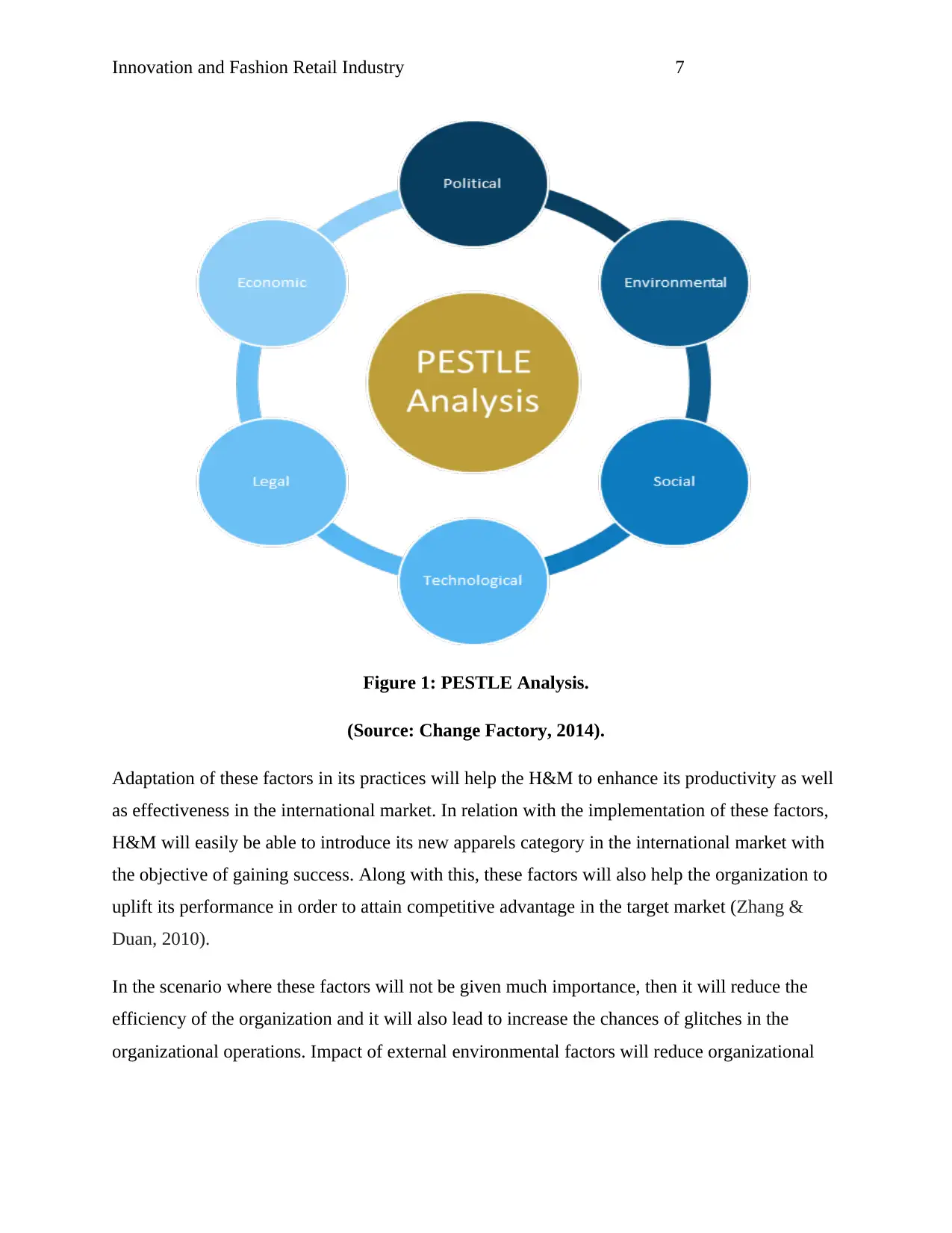
Figure 1: PESTLE Analysis.
(Source: Change Factory, 2014).
Adaptation of these factors in its practices will help the H&M to enhance its productivity as well
as effectiveness in the international market. In relation with the implementation of these factors,
H&M will easily be able to introduce its new apparels category in the international market with
the objective of gaining success. Along with this, these factors will also help the organization to
uplift its performance in order to attain competitive advantage in the target market (Zhang &
Duan, 2010).
In the scenario where these factors will not be given much importance, then it will reduce the
efficiency of the organization and it will also lead to increase the chances of glitches in the
organizational operations. Impact of external environmental factors will reduce organizational
Figure 1: PESTLE Analysis.
(Source: Change Factory, 2014).
Adaptation of these factors in its practices will help the H&M to enhance its productivity as well
as effectiveness in the international market. In relation with the implementation of these factors,
H&M will easily be able to introduce its new apparels category in the international market with
the objective of gaining success. Along with this, these factors will also help the organization to
uplift its performance in order to attain competitive advantage in the target market (Zhang &
Duan, 2010).
In the scenario where these factors will not be given much importance, then it will reduce the
efficiency of the organization and it will also lead to increase the chances of glitches in the
organizational operations. Impact of external environmental factors will reduce organizational
Innovation and Fashion Retail Industry 8
efficiency to introduce new ideas and new style products in the market which will ultimately
affect organizational image in the international fashion industry (Mann & Byun, 2011).
efficiency to introduce new ideas and new style products in the market which will ultimately
affect organizational image in the international fashion industry (Mann & Byun, 2011).
⊘ This is a preview!⊘
Do you want full access?
Subscribe today to unlock all pages.
Trusted by 1+ million students worldwide

Innovation and Fashion Retail Industry 9
Impact of Internal Environment on Innovation
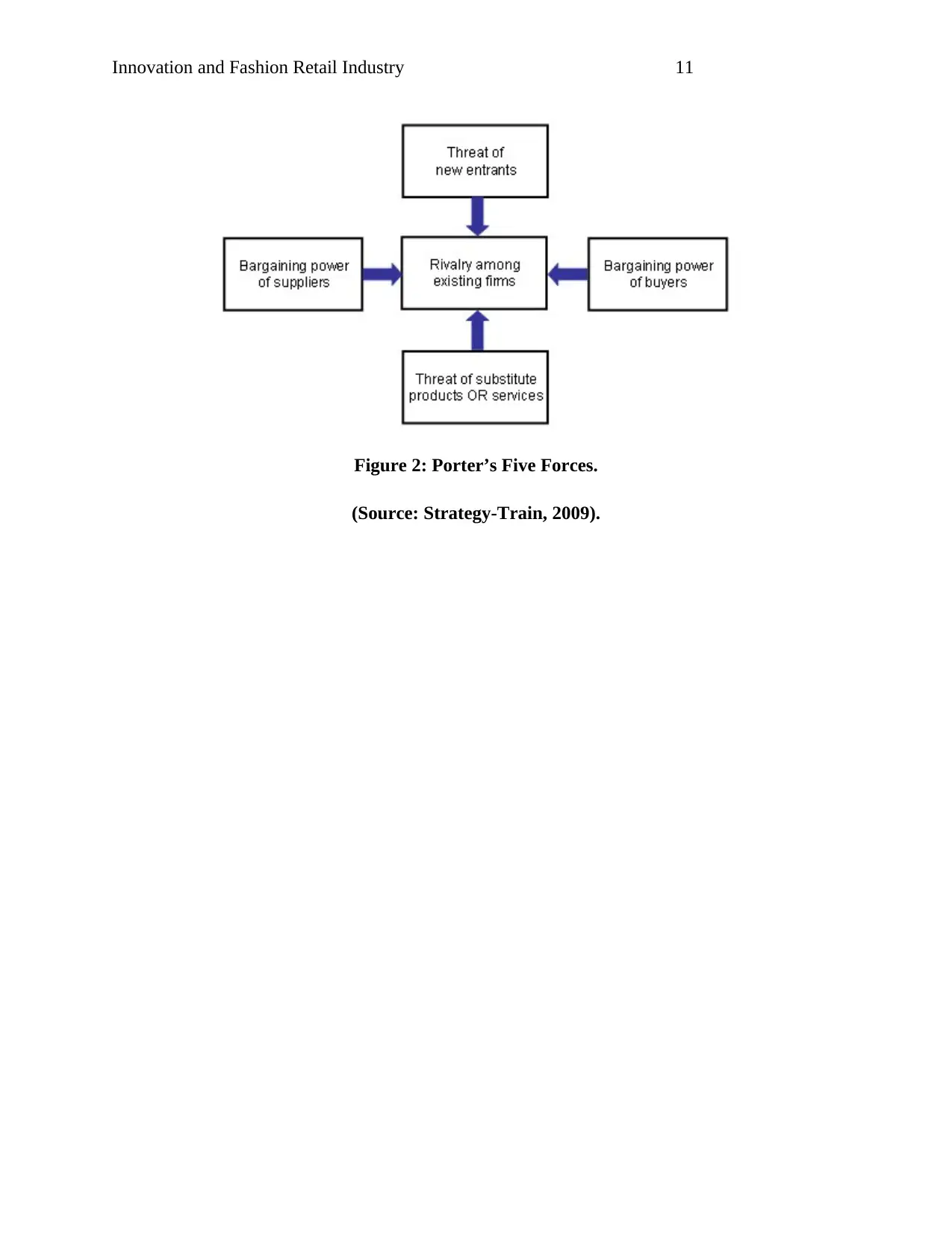
Porter’s five forces
Threats of new entrants
H&M is an established brand in the global fast fashion industry. Thus, it could be considered that
the impact of this factor is bit weak over the performance of H&M. New entrants will try to set
up its position in the market by introducing lower rates apparels and in order to neglect their
competition; H&M should constantly introduce new products as per the customer’s demands.
Maintaining quality would also help the organization to enhance its efficiency along with
maintaining the acquired position in the target market (Parida, Westerberg & Frishammar, 2012).
Threats of Substitutes
Initially, cloths were used to fulfil the humanity’s basic needs but with the introduction of
fashion in apparel industry, apparel, accessories and other products involved in this industry are
apparels are known for style, and for matching with the latest trends. There are not much
substitutes are available in the market in relation with apparels, thus, this factor has also weak
impact over innovation in fast fashion retail industry (Wirtz, Schilke & Ullrich, 2010).
Bargaining power of consumers
Due to low switching costs and intense competition amongst the companies involved in the
fashion industry, purchasing power of consumers is bit high. In relevance with gaining
competitive advantage in the market, it is necessary for the organization to fulfil its customer’s
demands along with introducing new and innovative apparels in regular time intervals. This will
help the organization to uplift its image, reliability, and goodwill amongst the target audience.
With this effect, consumer will only switch H&M only in uncertain conditions (Jiménez-Jiménez
& Sanz-Valle, 2011).
Bargaining power of suppliers
Suppliers have relatively weak power in comparison to other factors of internal environment.
This is because there are lot of suppliers available in the international fast fashion industry.
Switching cost for suppliers is also less. In order to perform in an effective manner as well as to
Impact of Internal Environment on Innovation
Porter’s five forces
Threats of new entrants
H&M is an established brand in the global fast fashion industry. Thus, it could be considered that
the impact of this factor is bit weak over the performance of H&M. New entrants will try to set
up its position in the market by introducing lower rates apparels and in order to neglect their
competition; H&M should constantly introduce new products as per the customer’s demands.
Maintaining quality would also help the organization to enhance its efficiency along with
maintaining the acquired position in the target market (Parida, Westerberg & Frishammar, 2012).
Threats of Substitutes
Initially, cloths were used to fulfil the humanity’s basic needs but with the introduction of
fashion in apparel industry, apparel, accessories and other products involved in this industry are
apparels are known for style, and for matching with the latest trends. There are not much
substitutes are available in the market in relation with apparels, thus, this factor has also weak
impact over innovation in fast fashion retail industry (Wirtz, Schilke & Ullrich, 2010).
Bargaining power of consumers
Due to low switching costs and intense competition amongst the companies involved in the
fashion industry, purchasing power of consumers is bit high. In relevance with gaining
competitive advantage in the market, it is necessary for the organization to fulfil its customer’s
demands along with introducing new and innovative apparels in regular time intervals. This will
help the organization to uplift its image, reliability, and goodwill amongst the target audience.
With this effect, consumer will only switch H&M only in uncertain conditions (Jiménez-Jiménez
& Sanz-Valle, 2011).
Bargaining power of suppliers
Suppliers have relatively weak power in comparison to other factors of internal environment.
This is because there are lot of suppliers available in the international fast fashion industry.
Switching cost for suppliers is also less. In order to perform in an effective manner as well as to
Paraphrase This Document
Need a fresh take? Get an instant paraphrase of this document with our AI Paraphraser
Innovation and Fashion Retail Industry 10
maintain the quality of products, H&M is required maintain effective relations with its suppliers.
Suppliers have the capability to enhance an organizational efficiency and they could also
decrease the same organizational efficiency, thus, it is necessary to maintain effective
relationship with the suppliers (Walker, Damanpour & Devece, 2010).
Industry rivalry
Rivalry amongst the fashion industry is intense, major players of fast fashion industry are Zara,
H&M, ASOS, etc. With this effect, every organization performs its operations with the objective
of enhancing the effectiveness of organization in order to gain competitive advantage. This is the
major reason behind launching of new apparels in regular time intervals. This helps the
organization to gain competitive advantage as well as to enlarge its customer base along with the
market share (De Marchi, 2012).
Internal environmental factors have huge impact over the organizational performance and this is
the major reason they should be considered positively in order to achieve desired goals and
objectives. Apart from this, it is bit difficult for new entrants to develop an effective position in
the dynamic business environment. Existing companies should also adopt and implemented
certain strategies so that the acquired position could be maintained. Customer’s preferences
should be considered as the priority as it plays crucial role in order to develop reliability amongst
them which is a positive indicator for sustainable growth and development (Hung & Chou,
2013).
maintain the quality of products, H&M is required maintain effective relations with its suppliers.
Suppliers have the capability to enhance an organizational efficiency and they could also
decrease the same organizational efficiency, thus, it is necessary to maintain effective
relationship with the suppliers (Walker, Damanpour & Devece, 2010).
Industry rivalry
Rivalry amongst the fashion industry is intense, major players of fast fashion industry are Zara,
H&M, ASOS, etc. With this effect, every organization performs its operations with the objective
of enhancing the effectiveness of organization in order to gain competitive advantage. This is the
major reason behind launching of new apparels in regular time intervals. This helps the
organization to gain competitive advantage as well as to enlarge its customer base along with the
market share (De Marchi, 2012).
Internal environmental factors have huge impact over the organizational performance and this is
the major reason they should be considered positively in order to achieve desired goals and
objectives. Apart from this, it is bit difficult for new entrants to develop an effective position in
the dynamic business environment. Existing companies should also adopt and implemented
certain strategies so that the acquired position could be maintained. Customer’s preferences
should be considered as the priority as it plays crucial role in order to develop reliability amongst
them which is a positive indicator for sustainable growth and development (Hung & Chou,
2013).
Innovation and Fashion Retail Industry 11
Figure 2: Porter’s Five Forces.
(Source: Strategy-Train, 2009).
Figure 2: Porter’s Five Forces.
(Source: Strategy-Train, 2009).
⊘ This is a preview!⊘
Do you want full access?
Subscribe today to unlock all pages.
Trusted by 1+ million students worldwide

1 out of 18


Related Documents


Your All-in-One AI-Powered Toolkit for Academic Success.
+13062052269
info@desklib.com
Available 24*7 on WhatsApp / Email
![[object Object]](/_next/static/media/star-bottom.7253800d.svg)
Unlock your academic potential
Copyright © 2020–2026 A2Z Services. All Rights Reserved. Developed and managed by ZUCOL.