H&M: PESTEL Analysis, Marketing Mix, and Recommendations Report

Verified

Added on  2022/12/28

|2
|1637
|26
Report
AI Summary
This report offers a comprehensive analysis of H&M, a prominent international fast-fashion retailer. It begins with an introduction to the company and its global presence, followed by an in-depth PESTEL analysis to identify political, economic, social, technological, environmental, and legal factors influencing H&M's operations. The report highlights key marketing challenges, such as political instability, economic fluctuations, changing consumer behavior, technological advancements, legal compliance, and environmental concerns within the textile industry. Recommendations are provided to address these challenges, focusing on effective leadership, consumer engagement, sales target achievement, and brand value creation. The report also examines the marketing mix elements—product, place, price, and promotion—and concludes with a comparative analysis of H&M, Zara, and M&S based on financial strength, R&D, international marketing, and culture. References to academic sources support the analysis and recommendations.
Document Page
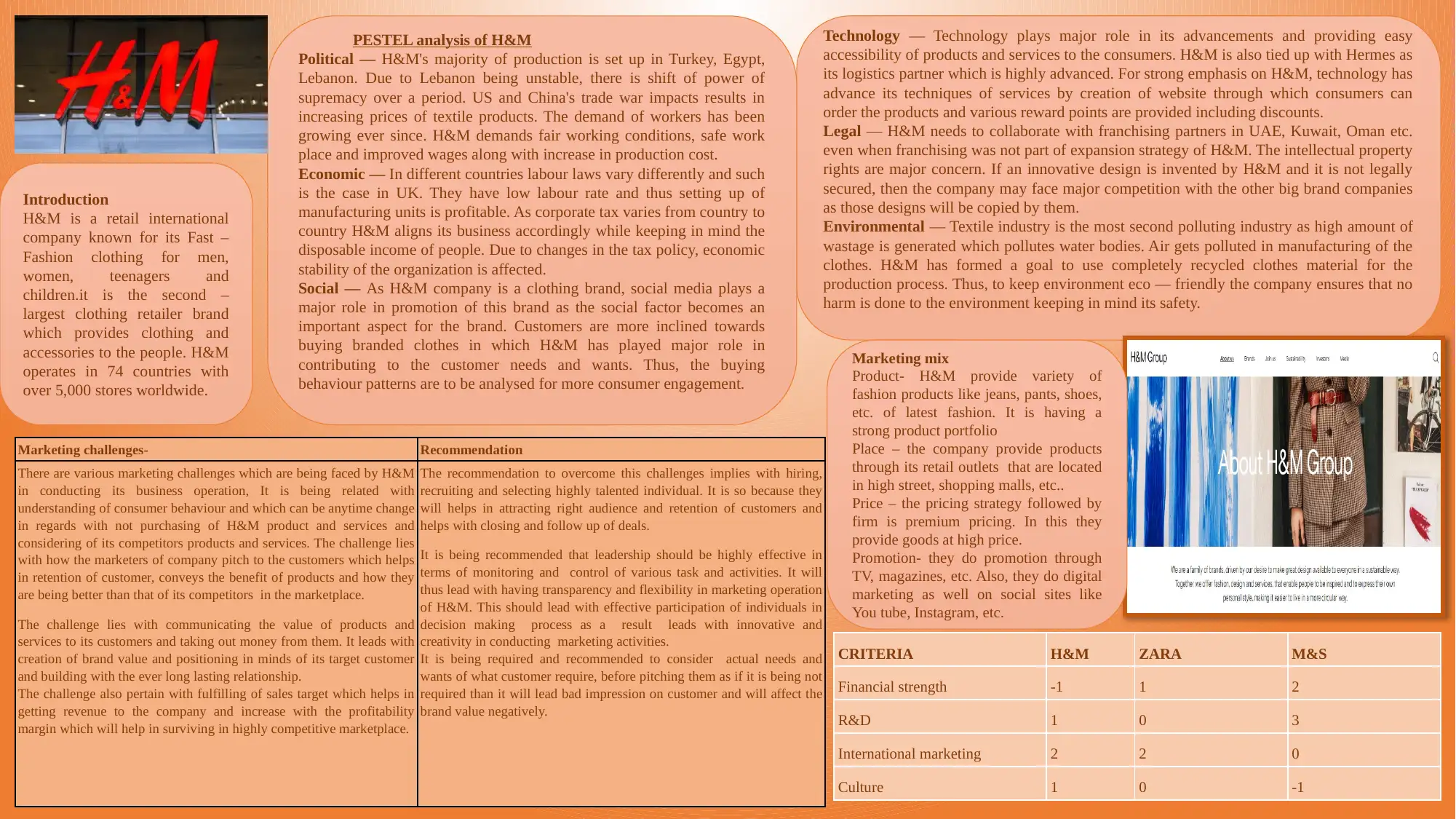
Technology — Technology plays major role in its advancements and providing easy
accessibility of products and services to the consumers. H&M is also tied up with Hermes as
its logistics partner which is highly advanced. For strong emphasis on H&M, technology has
advance its techniques of services by creation of website through which consumers can
order the products and various reward points are provided including discounts.
Legal — H&M needs to collaborate with franchising partners in UAE, Kuwait, Oman etc.
even when franchising was not part of expansion strategy of H&M. The intellectual property
rights are major concern. If an innovative design is invented by H&M and it is not legally
secured, then the company may face major competition with the other big brand companies
as those designs will be copied by them.
Environmental — Textile industry is the most second polluting industry as high amount of
wastage is generated which pollutes water bodies. Air gets polluted in manufacturing of the
clothes. H&M has formed a goal to use completely recycled clothes material for the
production process. Thus, to keep environment eco — friendly the company ensures that no
harm is done to the environment keeping in mind its safety.
Marketing challenges- Recommendation
There are various marketing challenges which are being faced by H&M
in conducting its business operation, It is being related with
understanding of consumer behaviour and which can be anytime change
in regards with not purchasing of H&M product and services and
considering of its competitors products and services. The challenge lies
with how the marketers of company pitch to the customers which helps
in retention of customer, conveys the benefit of products and how they
are being better than that of its competitors in the marketplace.
The challenge lies with communicating the value of products and
services to its customers and taking out money from them. It leads with
creation of brand value and positioning in minds of its target customer
and building with the ever long lasting relationship.
The challenge also pertain with fulfilling of sales target which helps in
getting revenue to the company and increase with the profitability
margin which will help in surviving in highly competitive marketplace.
The recommendation to overcome this challenges implies with hiring,
recruiting and selecting highly talented individual. It is so because they
will helps in attracting right audience and retention of customers and
helps with closing and follow up of deals.
It is being recommended that leadership should be highly effective in
terms of monitoring and control of various task and activities. It will
thus lead with having transparency and flexibility in marketing operation
of H&M. This should lead with effective participation of individuals in
decision making process as a result leads with innovative and
creativity in conducting marketing activities.
It is being required and recommended to consider actual needs and
wants of what customer require, before pitching them as if it is being not
required than it will lead bad impression on customer and will affect the
brand value negatively.
PESTEL analysis of H&M
Political — H&M's majority of production is set up in Turkey, Egypt,
Lebanon. Due to Lebanon being unstable, there is shift of power of
supremacy over a period. US and China's trade war impacts results in
increasing prices of textile products. The demand of workers has been
growing ever since. H&M demands fair working conditions, safe work
place and improved wages along with increase in production cost.
Economic — In different countries labour laws vary differently and such
is the case in UK. They have low labour rate and thus setting up of
manufacturing units is profitable. As corporate tax varies from country to
country H&M aligns its business accordingly while keeping in mind the
disposable income of people. Due to changes in the tax policy, economic
stability of the organization is affected.
Social — As H&M company is a clothing brand, social media plays a
major role in promotion of this brand as the social factor becomes an
important aspect for the brand. Customers are more inclined towards
buying branded clothes in which H&M has played major role in
contributing to the customer needs and wants. Thus, the buying
behaviour patterns are to be analysed for more consumer engagement.
CRITERIA H&M ZARA M&S
Financial strength -1 1 2
R&D 1 0 3
International marketing 2 2 0
Culture 1 0 -1
Introduction
H&M is a retail international
company known for its Fast –
Fashion clothing for men,
women, teenagers and
children.it is the second
largest clothing retailer brand
which provides clothing and
accessories to the people. H&M
operates in 74 countries with
over 5,000 stores worldwide.
Marketing mix
Product- H&M provide variety of
fashion products like jeans, pants, shoes,
etc. of latest fashion. It is having a
strong product portfolio
Place – the company provide products
through its retail outlets that are located
in high street, shopping malls, etc..
Price – the pricing strategy followed by
firm is premium pricing. In this they
provide goods at high price.
Promotion- they do promotion through
TV, magazines, etc. Also, they do digital
marketing as well on social sites like
You tube, Instagram, etc.
tabler-icon-diamond-filled.svg

Paraphrase This Document

Need a fresh take? Get an instant paraphrase of this document with our AI Paraphraser
Document Page
REFERENCES
Books and journals
Çitilci, T. and Akbalık, M., 2020. The Importance of PESTEL Analysis for Environmental Scanning Process. In Handbook of Research on Decision-Making Techniques in Financial Marketing (pp. 336-357). IGI Global.
Thompson, J. and McLarney, C., 2017. What effects will the strategy changes undertaken by next Plc have on themselves and their competition in the UK Clothing Retail Market?. Journal of Commerce and Management
Thought.8(2).pp.234-264.
Yang, R., Sliusarenko, A. and Ferraro-Doucette, E., 2020. Ever lane: a ‘radically transparent’ fashion company disrupting the industry. International expansion strategy.
Morgan, N.A and Chari, S., 2019. Research in marketing strategy. Journal of the Academy of Marketing Science, 47(1), pp.4-29.
Lembrych-Furtak, R., 2017. Marketing challenges and opportunities in multi-channel distribution. Annales Universitatis Mariae Curie-Skłodowska, Sectio H Oeconomia, 51(2), pp.151-158.
Azam, M.S., Shaheen, M. and Narbariya, S., 2019. Marketing challenges and organic farming in India—Does farm size matter?. International Journal of Nonprofit and Voluntary Sector Marketing, 24(4), p.e1654.
Kumar, M.M. and Jincy, K.B., 2017. Digital marketing: challenges and opportunities. Paripex-Indian Journal of Research, 6(11), pp.117-119.
Leonidou, C.N. and Hultman, M., 2019. Global marketing in business-to-business contexts: Challenges, developments, and opportunities.
Hair, J.F., Harrison, D. and Risher, J.J., 2018. Marketing research in the 21st century: Opportunities and challenges. Brazilian Journal of Marketing-BJMkt, Revista Brasileira de Marketing–ReMark, Special Issue, 17.
Ingrasciotta, Y. and Trifirò, G., 2019. Challenges in post-marketing studies of biological drugs in the era of biosimilars: a report of the international society for pharmacoepidemiology 2019 mid-year meeting in Rome,
Italy.
Barbosa, B., Remondes, J. and Teixeira, S., 2018. Luxury Marketing Challenges and Opportunities in the Digital Era. International Journal of Marketing, Communication and New Media, (4).
Grönroos, C., 2017. Relationship marketing and service: An update. Journal of Global Scholars of Marketing Science, 27(3), pp.201-208.
Scott, P .and Ward, T., 2017. The consumer journey in the digital age: the challenges faced by destination and place marketing agencies. International Journal of Digital Culture and Electronic Tourism, 2(1),
Ćurko, K., Silović, T. and Merkaš, Z., 2018. Challenges of application of the big data in marketing: case study croatia. WSEAS transactions on business and economics, 15, pp.162-170. pp.28-45.
Gustavo, N., 2019. Trends in Hospitality Marketing and Management: facing the 21st century challenges. In Handbook of Research on Entrepreneurship and Marketing for Global Reach in the Digital Economy (pp. 311-
337). IGI Global.
Vilkaite-Vaitone, N. and Skackauskiene, I., 2019. Green marketing orientation: evolution, conceptualization and potential benefits. Open Economics, 2(1), pp.53-62.
Reddy, D.L., 2017. Challenges for Green Marketing in India. In National Conference on Marketing and Sustainable Developments (Vol. 13, p. 14).
Nadarajan, D.S. and Rangith, M.J., 2018. A Study on Strength, Weakness, Opportunities and Threats in Rural Marketing. Journal of Management, 5(1).
chevron_up_icon
1 out of 2
circle_padding
hide_on_mobile
zoom_out_icon
[object Object]