Business Operations Analysis of H&M: Challenges, Objectives, and KPIs

Verified

Added on  2020/01/28

|19
|3606
|538
Report
AI Summary
This report provides a comprehensive analysis of H&M's business operations. It begins with an overview of the company, including its history, employee count, product offerings, and financial performance. A Gantt chart illustrates project timelines. The report then delves into operational challenges using the 4V model (Volume, Variety, Variation, and Visibility), identifying issues related to transportation, inventory, and worker motion. Performance objectives are analyzed, focusing on low prices, high-quality organic cotton, wide product range, and flexibility. The evaluation of processes highlights communication gaps and supply chain complexities, supported by a Pareto chart. Key performance indicators, including market share, growth rate, and financial metrics, are presented. Finally, the report offers recommendations for process improvements, such as centralizing communication and implementing an inventory management system. The analysis covers both financial and non-financial aspects of H&M's business operations, aiming to provide insights into its performance and areas for enhancement.
Document Page
Business Operation Assignment
tabler-icon-diamond-filled.svg

Paraphrase This Document

Need a fresh take? Get an instant paraphrase of this document with our AI Paraphraser
Document Page
Table of Contents
1.Overview of the Company........................................................................................................3
2.Gantt Chart................................................................................................................................4
3.Operations challenges analysis of H&M Brand.......................................................................5
4.Performance objective analysis................................................................................................8
5.Evaluation of process..............................................................................................................10
6.Key performance indicators....................................................................................................12
7.Recommendations...................................................................................................................14
Conclusion.................................................................................................................................16
8.Refrences.................................................................................................................................18
Document Page
1.Overview of the Company
H&M is Swedish multinational retail clothing company that sells clothing for men, women,
teenagers and children. Other products sold by H&M are cosmetics, footwear, textile interiors
and accessories. H&M is driven by a desire to create customer offering according to the needs
and wants and to do so in sustainable way. H&M starts its operation in 1947 and since that time
H&M is trying to maintain same quality standard based on their long term approach guided by
shared values. H&M strategy based on fundamental respect of individual and people's belief. .
From the business operation point of view, it has important to manage and improve the process
and other business activities in the right manner. It has helped the organization to gain
competitive advantages in the marketplace and create more customers data base.
Figure 1H&M Logo
Hennes & Mauritz
Employees 148000
Number of locations 3716
Products Clothing and accessories
Revenue $21.73 billion
Operating income SCK 22.168 billion
Total assets $10.29 billion
Total equity SEK 45.248 billion
Production of goods on annual basis More than 11000
Document Page
H&M BRANDS
tabler-icon-diamond-filled.svg

Paraphrase This Document

Need a fresh take? Get an instant paraphrase of this document with our AI Paraphraser
Document Page
2.Gantt Chart
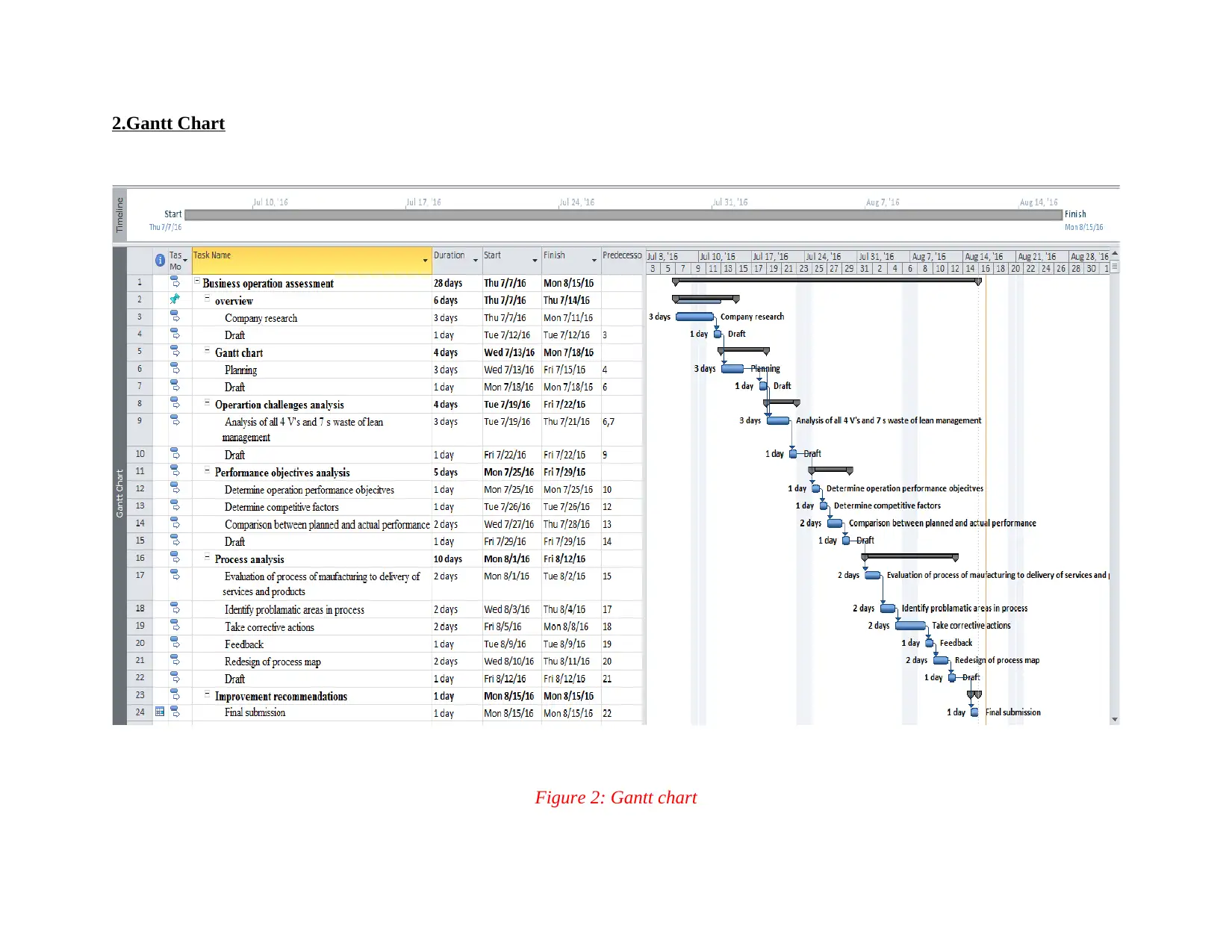
Figure 2: Gantt chart
Document Page
3.Operations challenges analysis of H&M Brand
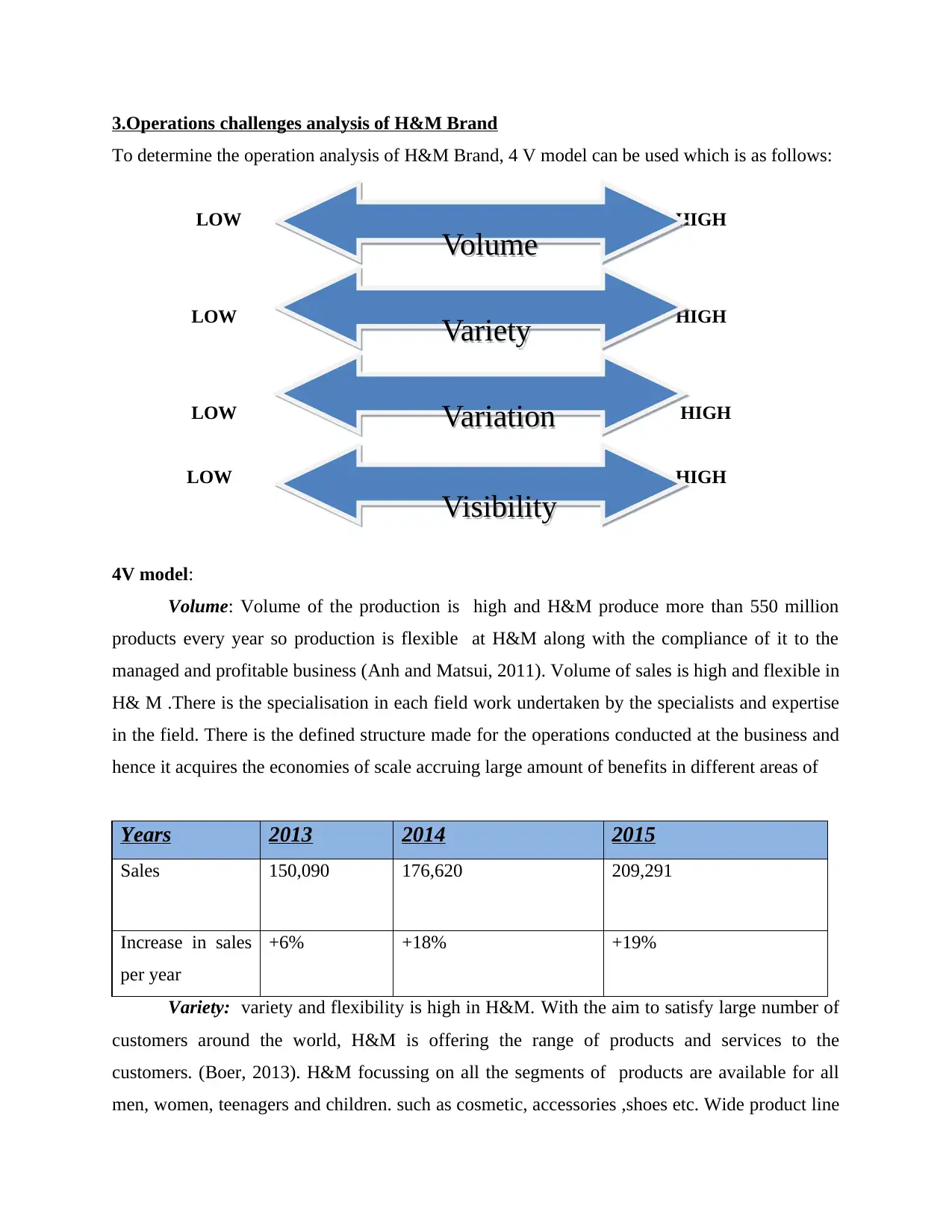
To determine the operation analysis of H&M Brand, 4 V model can be used which is as follows:
LOW HIGH
LOW HIGH
LOW HIGH
LOW HIGH
4V model:
Volume: Volume of the production is high and H&M produce more than 550 million
products every year so production is flexible at H&M along with the compliance of it to the
managed and profitable business (Anh and Matsui, 2011). Volume of sales is high and flexible in
H& M .There is the specialisation in each field work undertaken by the specialists and expertise
in the field. There is the defined structure made for the operations conducted at the business and
hence it acquires the economies of scale accruing large amount of benefits in different areas of
Years 2013 2014 2015
Sales 150,090 176,620 209,291
Increase in sales
per year
+6% +18% +19%
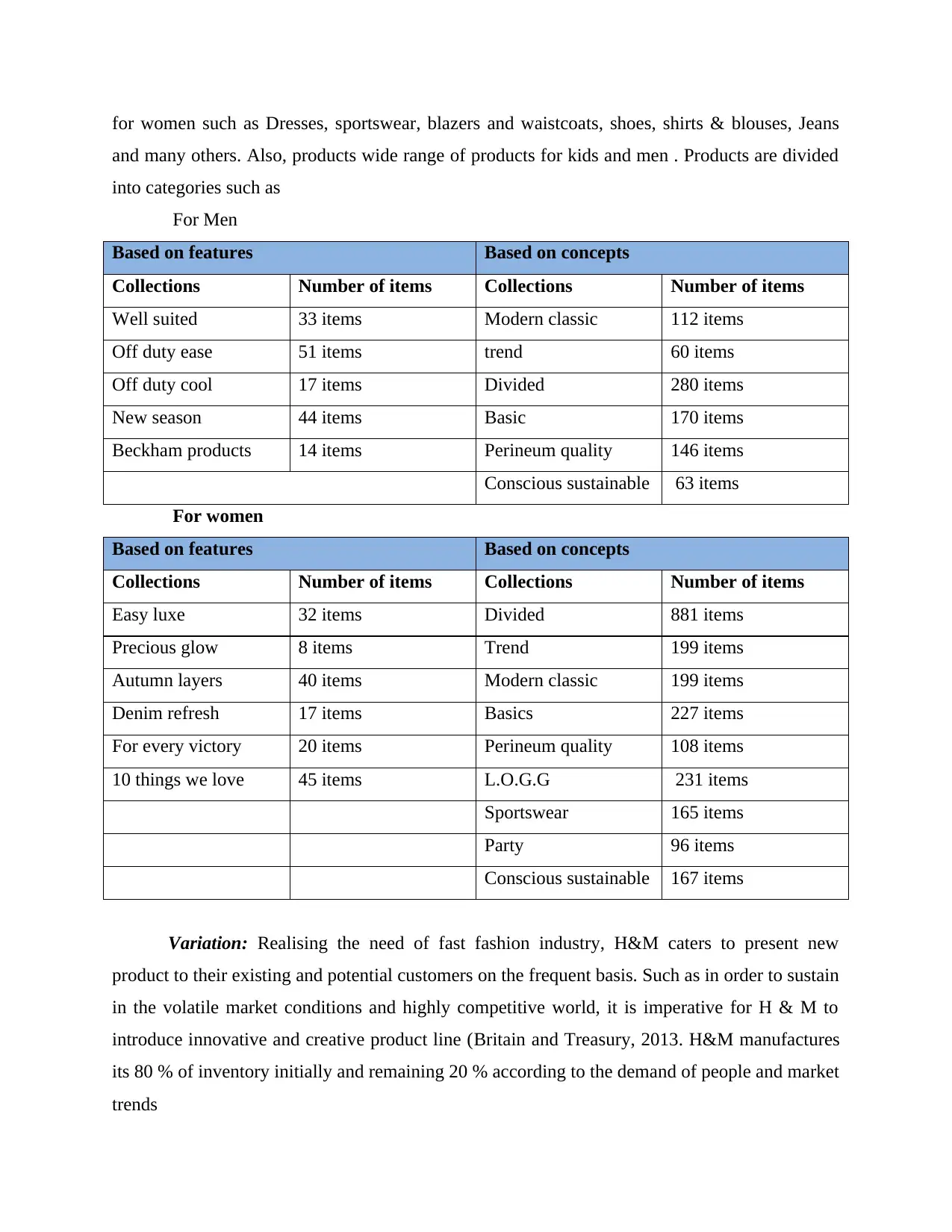
Variety: variety and flexibility is high in H&M. With the aim to satisfy large number of
customers around the world, H&M is offering the range of products and services to the
customers. (Boer, 2013). H&M focussing on all the segments of products are available for all
men, women, teenagers and children. such as cosmetic, accessories ,shoes etc. Wide product line
Volume
Variety
Variation
Visibility
Document Page
for women such as Dresses, sportswear, blazers and waistcoats, shoes, shirts & blouses, Jeans
and many others. Also, products wide range of products for kids and men . Products are divided
into categories such as
For Men
Based on features Based on concepts
Collections Number of items Collections Number of items
Well suited 33 items Modern classic 112 items
Off duty ease 51 items trend 60 items
Off duty cool 17 items Divided 280 items
New season 44 items Basic 170 items
Beckham products 14 items Perineum quality 146 items
Conscious sustainable 63 items
For women
Based on features Based on concepts
Collections Number of items Collections Number of items
Easy luxe 32 items Divided 881 items
Precious glow 8 items Trend 199 items
Autumn layers 40 items Modern classic 199 items
Denim refresh 17 items Basics 227 items
For every victory 20 items Perineum quality 108 items
10 things we love 45 items L.O.G.G 231 items
Sportswear 165 items
Party 96 items
Conscious sustainable 167 items
Variation: Realising the need of fast fashion industry, H&M caters to present new
product to their existing and potential customers on the frequent basis. Such as in order to sustain
in the volatile market conditions and highly competitive world, it is imperative for H & M to
introduce innovative and creative product line (Britain and Treasury, 2013. H&M manufactures
its 80 % of inventory initially and remaining 20 % according to the demand of people and market
trends
tabler-icon-diamond-filled.svg

Paraphrase This Document

Need a fresh take? Get an instant paraphrase of this document with our AI Paraphraser
Document Page
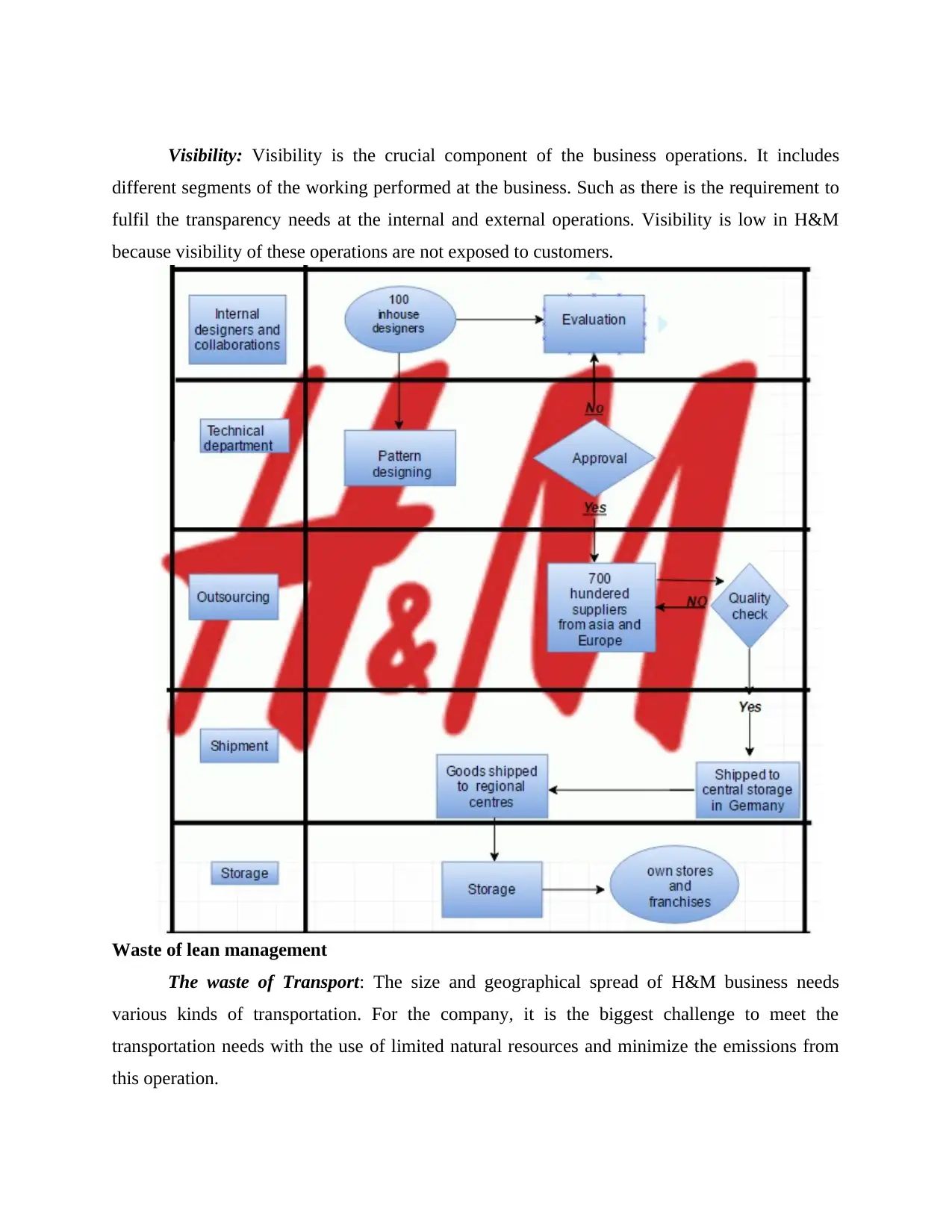
Visibility: Visibility is the crucial component of the business operations. It includes
different segments of the working performed at the business. Such as there is the requirement to
fulfil the transparency needs at the internal and external operations. Visibility is low in H&M
because visibility of these operations are not exposed to customers.
Waste of lean management
The waste of Transport: The size and geographical spread of H&M business needs
various kinds of transportation. For the company, it is the biggest challenge to meet the
transportation needs with the use of limited natural resources and minimize the emissions from
this operation.
Document Page
The Waste of Inventory: Although H&M Company use different types of medium for
communication such as social media, blogging, hauling etc to increase interaction with the
customers. The existing inventory management system of organization is efficient and
integrated. It gives the success to the firm to control over the stock and its management. So, there
is a no challenge face by M&S related to waste of inventory.
The waste of motion: It is one of the wastes which is the biggest challenge for H&M.
There are huge unnecessary motions by workers to bring the products from warehouse to stores.
For handling the commodities, manpower do not take help of machines. This increases the
unnecessary motion with the workplace and raises wastage of efforts and time as well.
4.Performance objective analysis
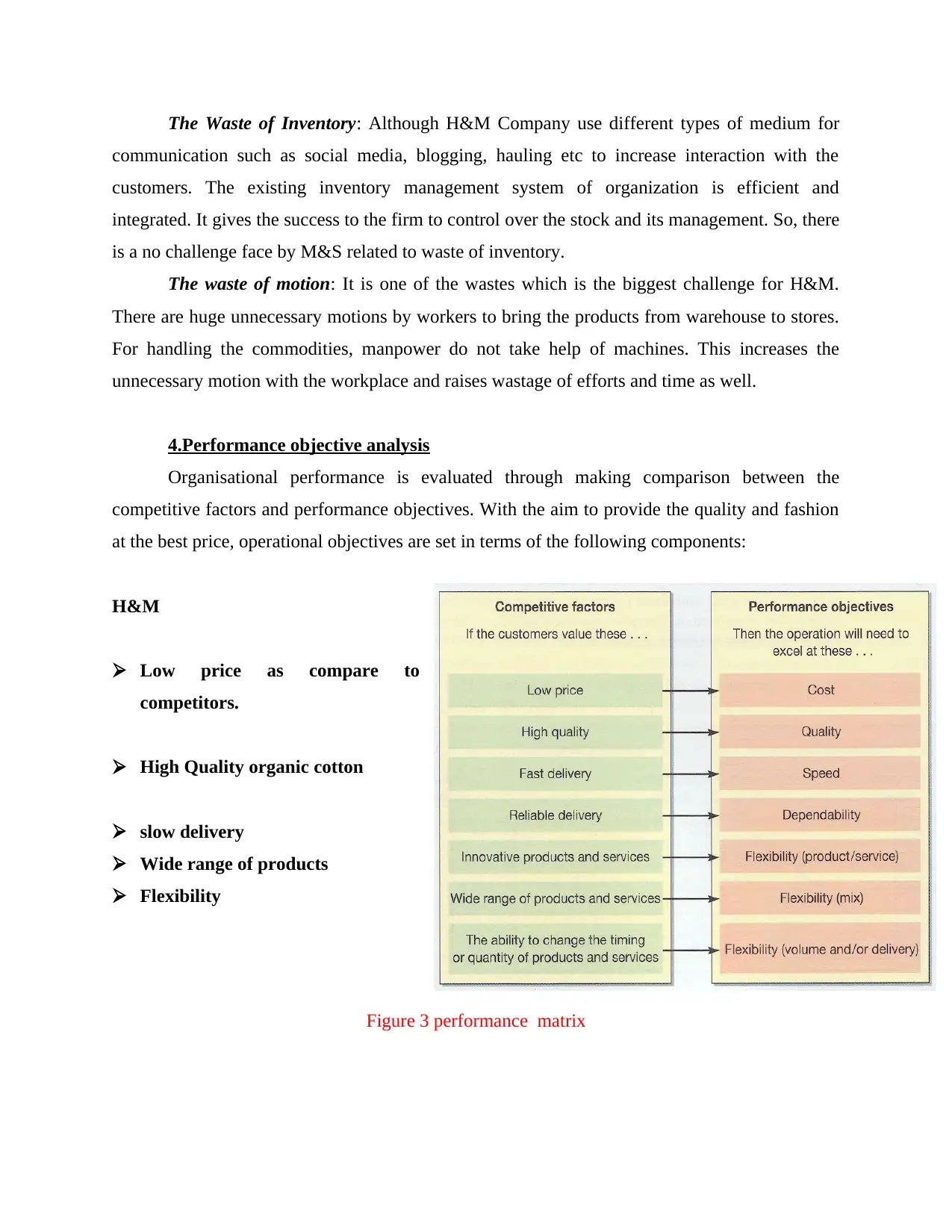
Organisational performance is evaluated through making comparison between the
competitive factors and performance objectives. With the aim to provide the quality and fashion
at the best price, operational objectives are set in terms of the following components:
H&M
Low price as compare to
competitors.
High Quality organic cotton
slow delivery
Wide range of products
Flexibility
Figure 3 performance matrix
Document Page
High Quality organic cotton: Company H&M is having competitive edge over the competitors
in terms of quality (Smith, Bruyns and Evans, 2011). Every year H&M use 200,000 tonnes of
cotton and out of which 31 % cotton used is organic and grown under better conditions.
wide range of products: Fashion industry is the dynamic industry with the continuous changes
in the wants and preferences from the demand side. (Mahadevan, 2009).H&M deals in clothing,
shoes, accessories, Undergarments and cosmetic.
Low price: Volatile economic conditions in world and rising inflation rate has enabled the cost
of production rising with the rate of 10-12% every year. H&M collects tonnes of recycled clothes
and reuse the fabric to create new collection. H&M produce 2.5 million pair of shoes by using
9.5 million plastic bottles.
Tonnes of clothes used to recycle in 2014 Tonnes of clothes used to recycle in 2015
7684tonnes of clothes collected for reuse 12341tonnes of clothes collected for reuse
Cost comparison with competitors:
H&M ZARA
Price span 1-291pounds Price span 5-322
Price point is 21.40 pounds Price point is 48 pounds
56% of offerings sit in price bracket 1-20
pounds
32% of offering sit in price bracket 20-40
pounds
so as compare to their competitor H&M deals in low price .
Slow speed:
Objective annually Outcome annually
H&M objective is to produce 13000 products H&M manage to produce more than 11000
products
Distribution time 11-15 days Distribution time 20-25 days
Flexibility:
H&M manufacture 80% of its inventory initially and remaining 20% inventory on the basis of
market trends so they have flexibility in changing the quality and time of product.
tabler-icon-diamond-filled.svg

Paraphrase This Document

Need a fresh take? Get an instant paraphrase of this document with our AI Paraphraser
Document Page
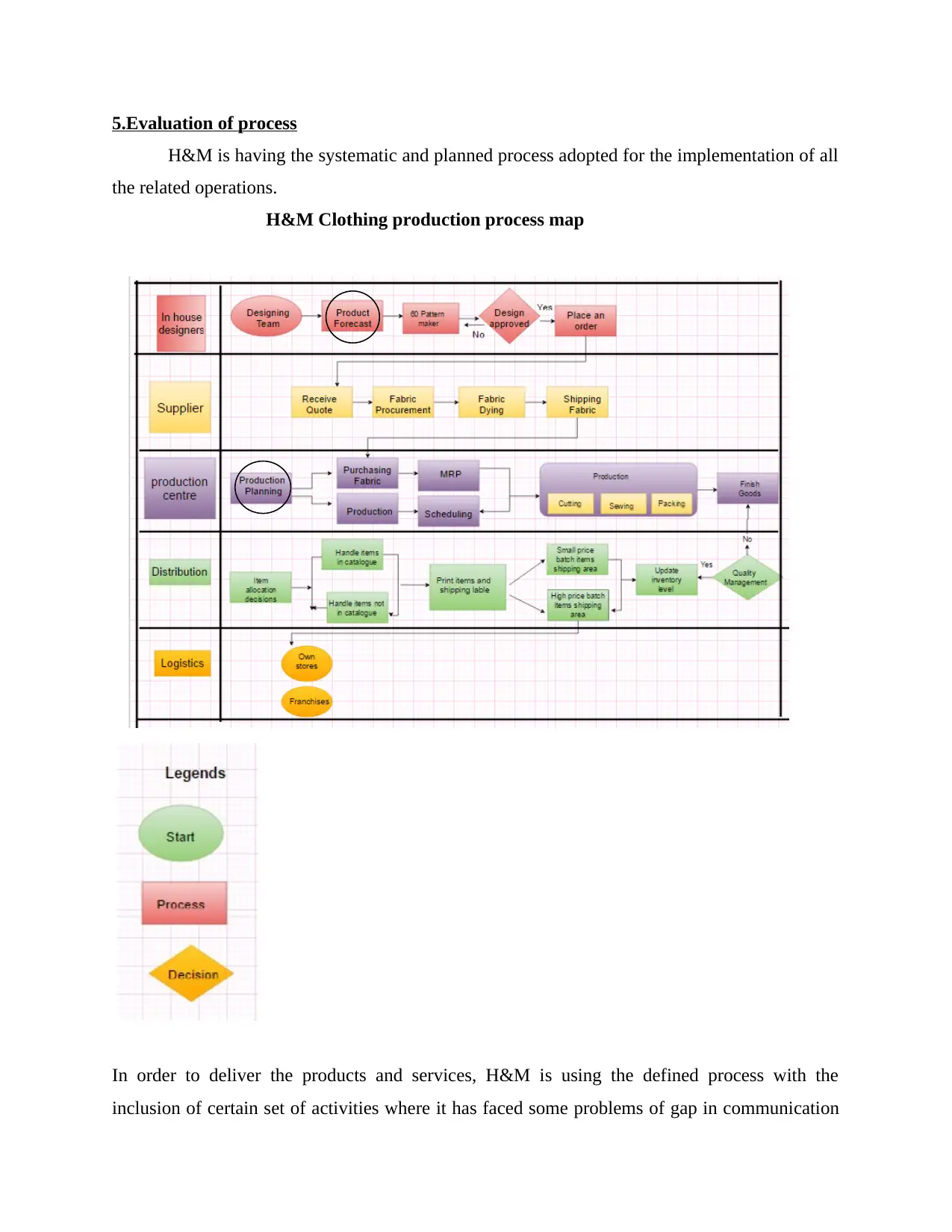
5.Evaluation of process
H&M is having the systematic and planned process adopted for the implementation of all
the related operations.
H&M Clothing production process map
In order to deliver the products and services, H&M is using the defined process with the
inclusion of certain set of activities where it has faced some problems of gap in communication
Document Page
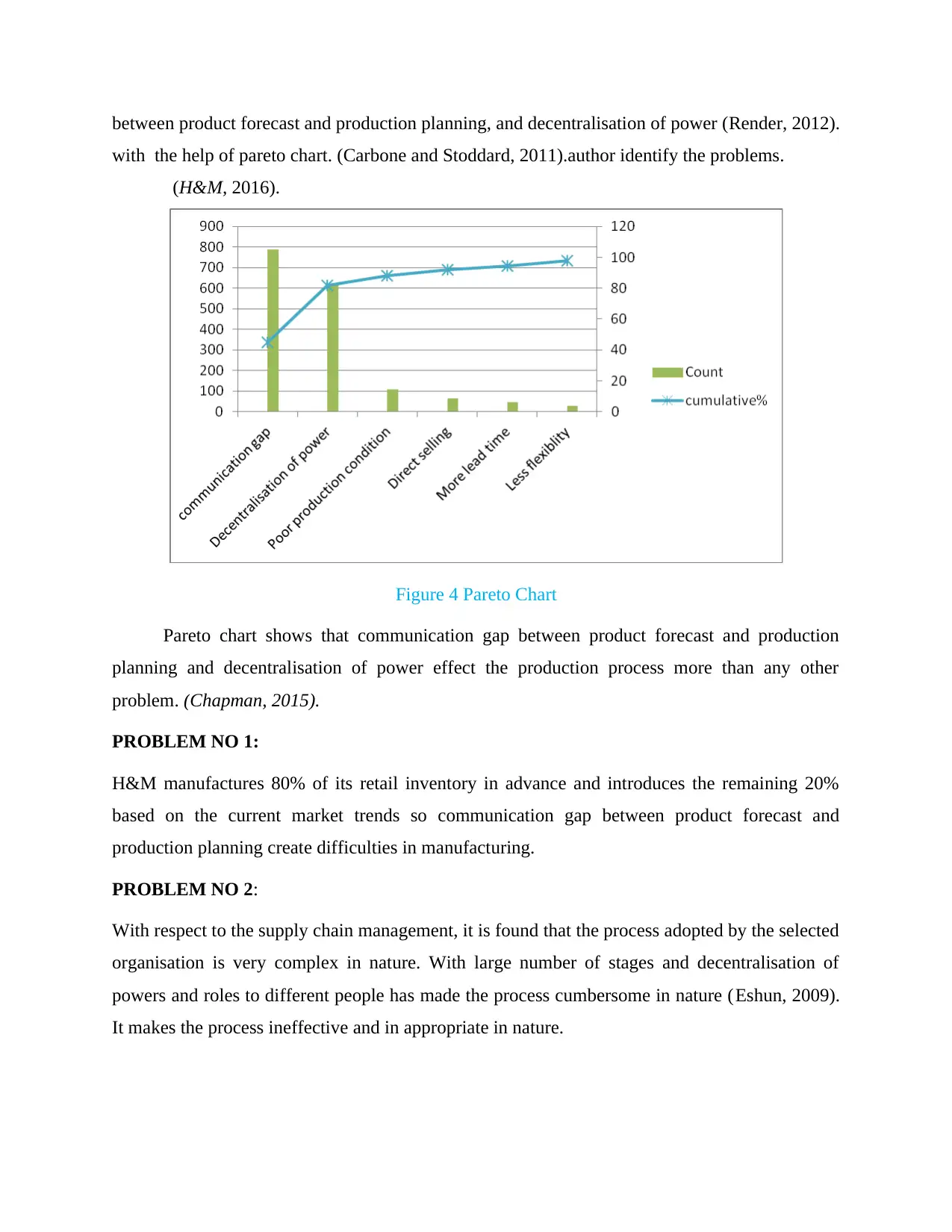
between product forecast and production planning, and decentralisation of power (Render, 2012).
with the help of pareto chart. (Carbone and Stoddard, 2011).author identify the problems.
(H&M, 2016).
Figure 4 Pareto Chart
Pareto chart shows that communication gap between product forecast and production
planning and decentralisation of power effect the production process more than any other
problem. (Chapman, 2015).
PROBLEM NO 1:
H&M manufactures 80% of its retail inventory in advance and introduces the remaining 20%
based on the current market trends so communication gap between product forecast and
production planning create difficulties in manufacturing.
PROBLEM NO 2:
With respect to the supply chain management, it is found that the process adopted by the selected
organisation is very complex in nature. With large number of stages and decentralisation of
powers and roles to different people has made the process cumbersome in nature (Eshun, 2009).
It makes the process ineffective and in appropriate in nature.
chevron_up_icon
1 out of 19
circle_padding
hide_on_mobile
zoom_out_icon
[object Object]