Marketing Assignment: SOSTAC Plan for H&M's UK Expansion
VerifiedAdded on 2020/05/28
|15
|3329
|1067
Report
AI Summary
This report presents a comprehensive marketing analysis of H&M, focusing on its potential expansion in the UK market. It employs the SOSTAC framework to outline a strategic marketing plan. The analysis begins with a situation analysis, encompassing market, competitor, and company analysis, including TOWS and PESTLE analyses to evaluate internal and external factors. The report establishes SMART objectives and outlines a marketing strategy using Ansoff's matrix and the 7Ps of the marketing mix. Furthermore, it covers the implementation, action, and control phases of the marketing plan, culminating in a conclusion that summarizes the key findings and recommendations for H&M's success in the UK market. The report demonstrates a strong understanding of marketing principles and their practical application in a real-world business context.
Running head: MARKETING ASSIGNMENT
Marketing Assignment
Name of the Student:
Name of the University:
Author Note:
Marketing Assignment
Name of the Student:
Name of the University:
Author Note:

Paraphrase This Document
Need a fresh take? Get an instant paraphrase of this document with our AI Paraphraser
2MARKETING ASSIGNMENT
Executive Summary
The main purpose of the assignment is to understand the concept of marketing by using the plan
of SOSTAC for defining the objectives. The present study explains about the situation analysis
that includes both internal and external factors. Internal environmental factors are explained in
the study about H & M Company and the factors are revealed by using tools like TOWS
analysis. External environmental factors are explained by using analysis such as PESTLE
analysis. The present study had been explained with the help of citing SMART objectives. The
overall study provides proper analysis about H & M Company and its expansion in UK.
Executive Summary
The main purpose of the assignment is to understand the concept of marketing by using the plan
of SOSTAC for defining the objectives. The present study explains about the situation analysis
that includes both internal and external factors. Internal environmental factors are explained in
the study about H & M Company and the factors are revealed by using tools like TOWS
analysis. External environmental factors are explained by using analysis such as PESTLE
analysis. The present study had been explained with the help of citing SMART objectives. The
overall study provides proper analysis about H & M Company and its expansion in UK.
3MARKETING ASSIGNMENT
Table of Contents
Introduction......................................................................................................................................3
Stage 1- Situation Analysis..............................................................................................................3
Market Analysis...........................................................................................................................3
Competitor Analysis....................................................................................................................3
Company Analysis.......................................................................................................................4
TOWS Analysis...........................................................................................................................4
PESTLE Analysis........................................................................................................................5
Porters Five Forces Model...........................................................................................................6
Value Chain Analysis..................................................................................................................7
Product Life Cycle.......................................................................................................................8
Segmentation, Targeting and Positioning....................................................................................8
Stage 2- Objectives..........................................................................................................................9
SMART objectives......................................................................................................................9
Other market objectives.............................................................................................................10
Stage 3- Strategy............................................................................................................................10
Ansoff’s matrix..........................................................................................................................10
Stage 4- Implementation or Tactics...............................................................................................11
7Ps of marketing mix.................................................................................................................11
Stage 5- Action..............................................................................................................................12
Stage 6- Control.............................................................................................................................13
Conclusion.....................................................................................................................................13
Reference List................................................................................................................................14
Table of Contents
Introduction......................................................................................................................................3
Stage 1- Situation Analysis..............................................................................................................3
Market Analysis...........................................................................................................................3
Competitor Analysis....................................................................................................................3
Company Analysis.......................................................................................................................4
TOWS Analysis...........................................................................................................................4
PESTLE Analysis........................................................................................................................5
Porters Five Forces Model...........................................................................................................6
Value Chain Analysis..................................................................................................................7
Product Life Cycle.......................................................................................................................8
Segmentation, Targeting and Positioning....................................................................................8
Stage 2- Objectives..........................................................................................................................9
SMART objectives......................................................................................................................9
Other market objectives.............................................................................................................10
Stage 3- Strategy............................................................................................................................10
Ansoff’s matrix..........................................................................................................................10
Stage 4- Implementation or Tactics...............................................................................................11
7Ps of marketing mix.................................................................................................................11
Stage 5- Action..............................................................................................................................12
Stage 6- Control.............................................................................................................................13
Conclusion.....................................................................................................................................13
Reference List................................................................................................................................14
⊘ This is a preview!⊘
Do you want full access?
Subscribe today to unlock all pages.

Trusted by 1+ million students worldwide
4MARKETING ASSIGNMENT
Introduction
The study deals with understanding the concept of marketing by using SOSTAC plan for
realizing the objectives of the marketing plan. In this particular assignment, proper emphasis has
been given on a company named as H & M (H&M, 2018). The current segment explains about
situation analysis that had been further divided into market analysis, competitor analysis and
company analysis. The next step in the SOSTAC plan is objectives that had been properly
explained by illustrating SMART objectives. Strategy had been set in accordance with the
objectives and tactics had been implemented in the study. Action plan and control plan had been
explained properly in the study with proper justification.
Stage 1- Situation Analysis
Market Analysis
On analyzing the market of fashion retail market, it is found that H & M is considered as
one of the most valuable fashion brands that are based in Europe. The main purpose of the
assignment is to expand the operations of H & M in United Kingdom. The company is currently
the most valuable retail brand with a brand value of 13 billion Euros (Yu, Ramanathan & Nath,
2014).
“Competitor Analysis”
H & M faces stiff competition from “Zara”, “Forever 21” and “Gap”. Competition in the
fashion industry had been always tough. H & M is one of the companies who have always been
competitor of Zara in this industry (Weinstein & Pohlman, 2015). H & M had been in the
business from the year 1947 whereas Zara started its operations from the year 1975. It reveals the
fact that experience plays vital role in industry but approach has been the periphery of Zara for
gaining competitive advantage in the industry. Furthermore, fresh inventory or stock is a key to
sale strategy adopted by Zara where they stock very little as well as believes in updating
collection frequently so that the stores gets stocked up with new designs twice a week. In this
way, Zara manage the business process from designing to production to shipping activities.
These strategies will help the business for focusing in each of the process that makes the overall
process vital. The products at Zara are customer-based. The strategy adopted by Zara in making
the products of the company more anticipated by customers.
Introduction
The study deals with understanding the concept of marketing by using SOSTAC plan for
realizing the objectives of the marketing plan. In this particular assignment, proper emphasis has
been given on a company named as H & M (H&M, 2018). The current segment explains about
situation analysis that had been further divided into market analysis, competitor analysis and
company analysis. The next step in the SOSTAC plan is objectives that had been properly
explained by illustrating SMART objectives. Strategy had been set in accordance with the
objectives and tactics had been implemented in the study. Action plan and control plan had been
explained properly in the study with proper justification.
Stage 1- Situation Analysis
Market Analysis
On analyzing the market of fashion retail market, it is found that H & M is considered as
one of the most valuable fashion brands that are based in Europe. The main purpose of the
assignment is to expand the operations of H & M in United Kingdom. The company is currently
the most valuable retail brand with a brand value of 13 billion Euros (Yu, Ramanathan & Nath,
2014).
“Competitor Analysis”
H & M faces stiff competition from “Zara”, “Forever 21” and “Gap”. Competition in the
fashion industry had been always tough. H & M is one of the companies who have always been
competitor of Zara in this industry (Weinstein & Pohlman, 2015). H & M had been in the
business from the year 1947 whereas Zara started its operations from the year 1975. It reveals the
fact that experience plays vital role in industry but approach has been the periphery of Zara for
gaining competitive advantage in the industry. Furthermore, fresh inventory or stock is a key to
sale strategy adopted by Zara where they stock very little as well as believes in updating
collection frequently so that the stores gets stocked up with new designs twice a week. In this
way, Zara manage the business process from designing to production to shipping activities.
These strategies will help the business for focusing in each of the process that makes the overall
process vital. The products at Zara are customer-based. The strategy adopted by Zara in making
the products of the company more anticipated by customers.
Paraphrase This Document
Need a fresh take? Get an instant paraphrase of this document with our AI Paraphraser
5MARKETING ASSIGNMENT
Company Analysis
H & M was established in the year 1947 in Sweden. The company now sells clothes as
well as cosmetics in more than 2200 stores in and across the world. The company offers fashion
at the best affordable price. In addition, the business offers fashion for women, men as well as
children and teenagers. Furthermore, the company sells own-brand cosmetics as well as footwear
and accessories (Wagner & Eggert, 2016). The stores of H & M are refreshed daily with new
fashion items. The company does not own any factories rather than they purchase its goods from
around 700 independent suppliers in countries like Asia and Europe. The company has about 16
production offices in and across the world and employs more than 87,000 people.
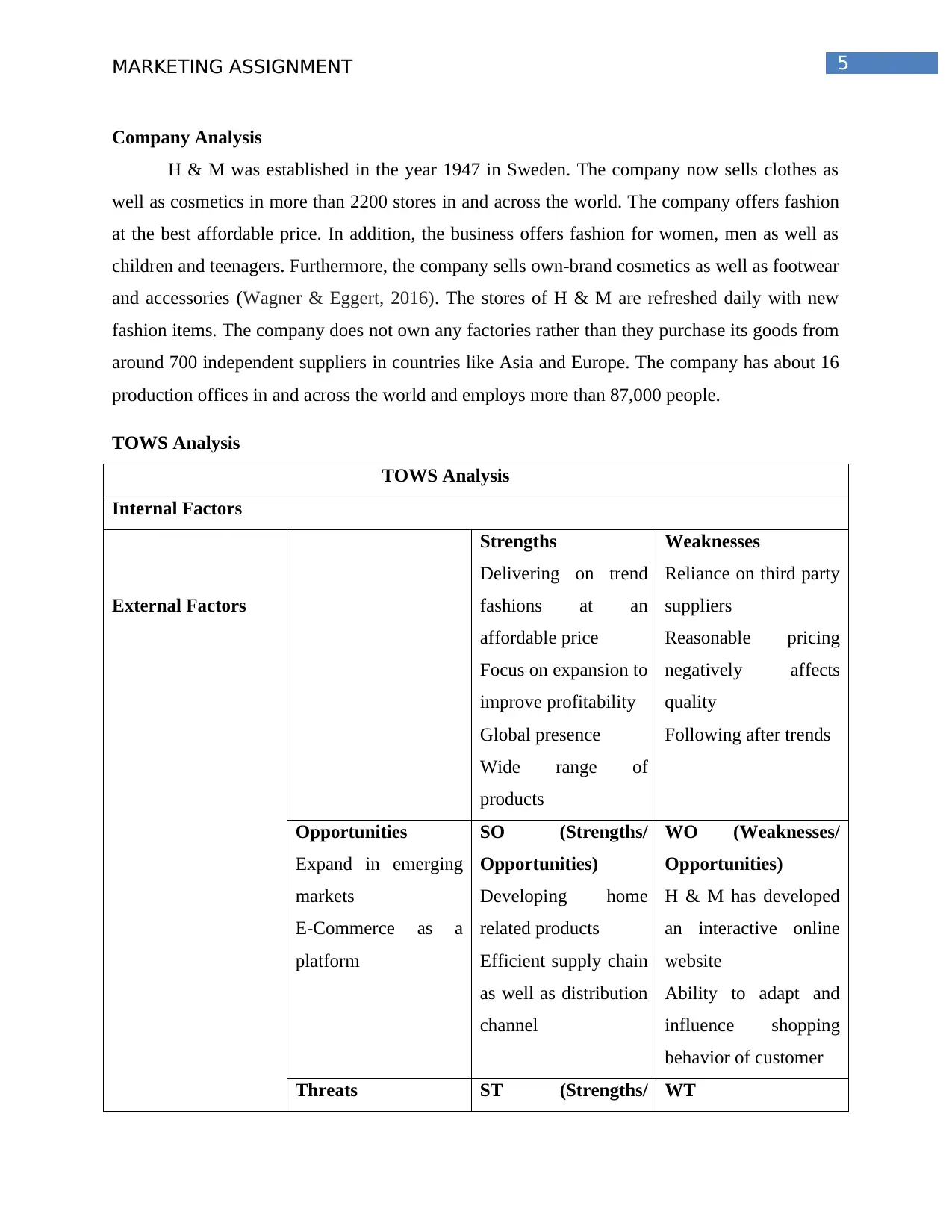
TOWS Analysis
TOWS Analysis
Internal Factors
External Factors
Strengths
Delivering on trend
fashions at an
affordable price
Focus on expansion to
improve profitability
Global presence
Wide range of
products
Weaknesses
Reliance on third party
suppliers
Reasonable pricing
negatively affects
quality
Following after trends
Opportunities
Expand in emerging
markets
E-Commerce as a
platform
SO (Strengths/
Opportunities)
Developing home
related products
Efficient supply chain
as well as distribution
channel
WO (Weaknesses/
Opportunities)
H & M has developed
an interactive online
website
Ability to adapt and
influence shopping
behavior of customer
Threats ST (Strengths/ WT
Company Analysis
H & M was established in the year 1947 in Sweden. The company now sells clothes as
well as cosmetics in more than 2200 stores in and across the world. The company offers fashion
at the best affordable price. In addition, the business offers fashion for women, men as well as
children and teenagers. Furthermore, the company sells own-brand cosmetics as well as footwear
and accessories (Wagner & Eggert, 2016). The stores of H & M are refreshed daily with new
fashion items. The company does not own any factories rather than they purchase its goods from
around 700 independent suppliers in countries like Asia and Europe. The company has about 16
production offices in and across the world and employs more than 87,000 people.
TOWS Analysis
TOWS Analysis
Internal Factors
External Factors
Strengths
Delivering on trend
fashions at an
affordable price
Focus on expansion to
improve profitability
Global presence
Wide range of
products
Weaknesses
Reliance on third party
suppliers
Reasonable pricing
negatively affects
quality
Following after trends
Opportunities
Expand in emerging
markets
E-Commerce as a
platform
SO (Strengths/
Opportunities)
Developing home
related products
Efficient supply chain
as well as distribution
channel
WO (Weaknesses/
Opportunities)
H & M has developed
an interactive online
website
Ability to adapt and
influence shopping
behavior of customer
Threats ST (Strengths/ WT
6MARKETING ASSIGNMENT
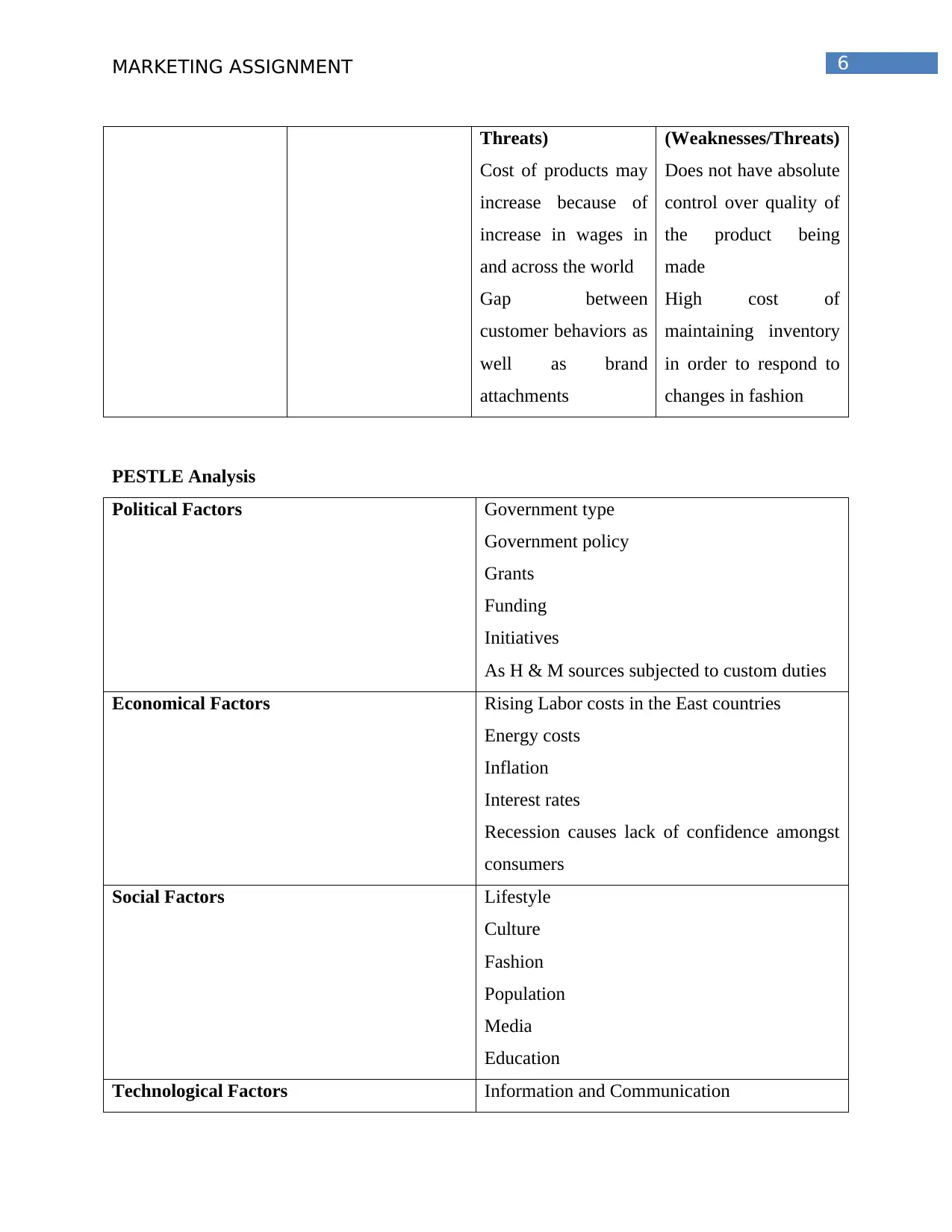
Threats)
Cost of products may
increase because of
increase in wages in
and across the world
Gap between
customer behaviors as
well as brand
attachments
(Weaknesses/Threats)
Does not have absolute
control over quality of
the product being
made
High cost of
maintaining inventory
in order to respond to
changes in fashion
PESTLE Analysis
Political Factors Government type
Government policy
Grants
Funding
Initiatives
As H & M sources subjected to custom duties
Economical Factors Rising Labor costs in the East countries
Energy costs
Inflation
Interest rates
Recession causes lack of confidence amongst
consumers
Social Factors Lifestyle
Culture
Fashion
Population
Media
Education
Technological Factors Information and Communication
Threats)
Cost of products may
increase because of
increase in wages in
and across the world
Gap between
customer behaviors as
well as brand
attachments
(Weaknesses/Threats)
Does not have absolute
control over quality of
the product being
made
High cost of
maintaining inventory
in order to respond to
changes in fashion
PESTLE Analysis
Political Factors Government type
Government policy
Grants
Funding
Initiatives
As H & M sources subjected to custom duties
Economical Factors Rising Labor costs in the East countries
Energy costs
Inflation
Interest rates
Recession causes lack of confidence amongst
consumers
Social Factors Lifestyle
Culture
Fashion
Population
Media
Education
Technological Factors Information and Communication
⊘ This is a preview!⊘
Do you want full access?
Subscribe today to unlock all pages.
Trusted by 1+ million students worldwide
7MARKETING ASSIGNMENT
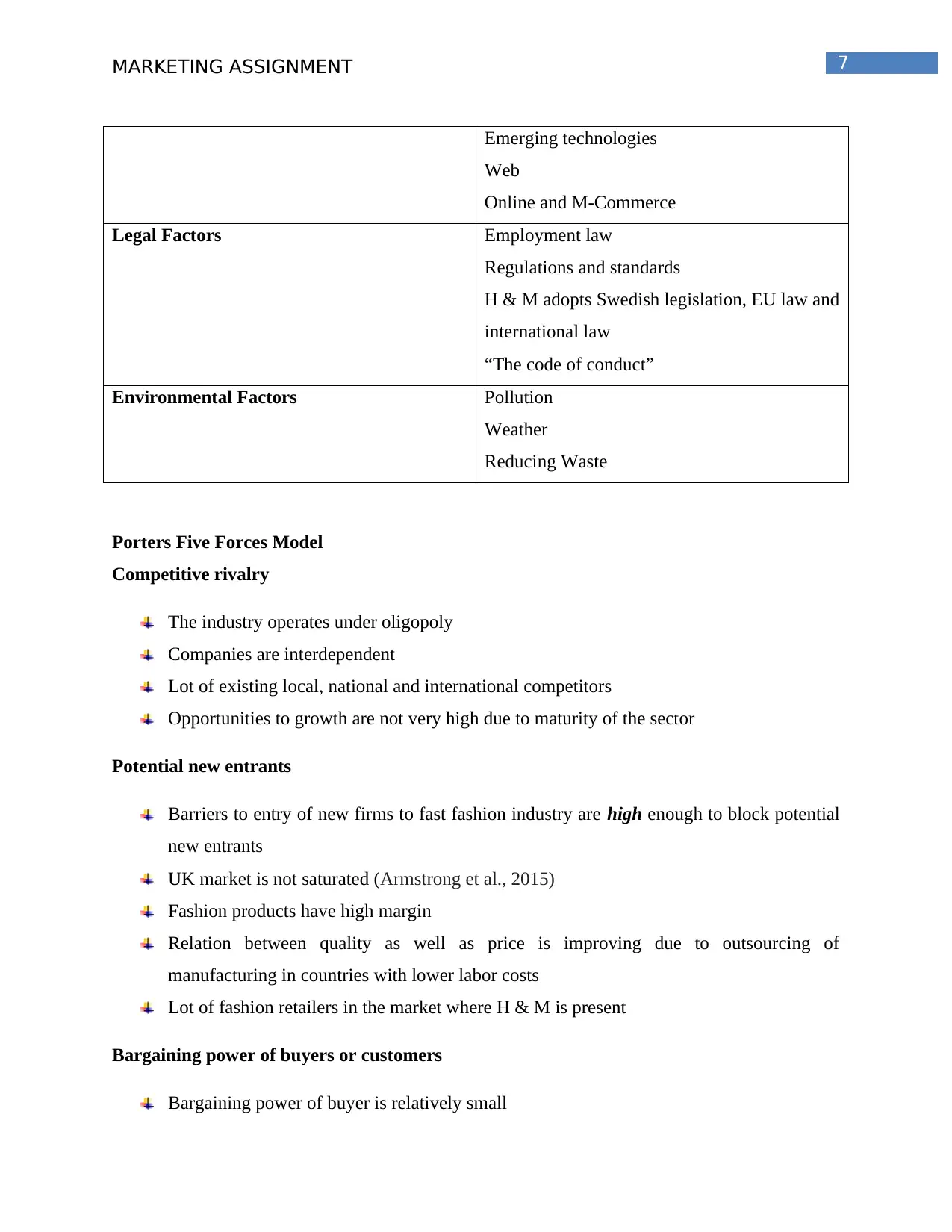
Emerging technologies
Web
Online and M-Commerce
Legal Factors Employment law
Regulations and standards
H & M adopts Swedish legislation, EU law and
international law
“The code of conduct”
Environmental Factors Pollution
Weather
Reducing Waste
Porters Five Forces Model
Competitive rivalry
The industry operates under oligopoly
Companies are interdependent
Lot of existing local, national and international competitors
Opportunities to growth are not very high due to maturity of the sector
Potential new entrants
Barriers to entry of new firms to fast fashion industry are high enough to block potential
new entrants
UK market is not saturated (Armstrong et al., 2015)
Fashion products have high margin
Relation between quality as well as price is improving due to outsourcing of
manufacturing in countries with lower labor costs
Lot of fashion retailers in the market where H & M is present
Bargaining power of buyers or customers
Bargaining power of buyer is relatively small
Emerging technologies
Web
Online and M-Commerce
Legal Factors Employment law
Regulations and standards
H & M adopts Swedish legislation, EU law and
international law
“The code of conduct”
Environmental Factors Pollution
Weather
Reducing Waste
Porters Five Forces Model
Competitive rivalry
The industry operates under oligopoly
Companies are interdependent
Lot of existing local, national and international competitors
Opportunities to growth are not very high due to maturity of the sector
Potential new entrants
Barriers to entry of new firms to fast fashion industry are high enough to block potential
new entrants
UK market is not saturated (Armstrong et al., 2015)
Fashion products have high margin
Relation between quality as well as price is improving due to outsourcing of
manufacturing in countries with lower labor costs
Lot of fashion retailers in the market where H & M is present
Bargaining power of buyers or customers
Bargaining power of buyer is relatively small
Paraphrase This Document
Need a fresh take? Get an instant paraphrase of this document with our AI Paraphraser
8MARKETING ASSIGNMENT
Low switching costs
Price is one of the significant variable for customers
Bargaining power of suppliers
The company is entirely reliant on suppliers where the labor to make the garments is
cheap (Baker, 2014)
Bargaining power of suppliers is not very high as there is lot of suppliers in countries
with low labor costs.
Threat from substitute products
There are many alternatives for spending money known as opportunity cost
There are no substitute products offered by other industries that can perform the same
function as clothing (Baker & Parkinson, 2016)
Value Chain Analysis
Value Chain of H & M is connected to countless people, ecosystems as well as
communities and other business in and across the world. H & M wants to create positive changes
along value chain from the farms as well as factories. The company can do this in own
operations and be a part of the value chain that lies outside of undeviating power. The approach
used by H & M is beached on the idea that they should use the size as well as scale of trade for
leveraging alteration and creating utmost constructive impact and least depressing impact.
Therefore, the focus areas are the protection as well as development of human rights along value
chain at H & M (Vargo, Wieland & Akaka, 2015).
Product Life Cycle
Low switching costs
Price is one of the significant variable for customers
Bargaining power of suppliers
The company is entirely reliant on suppliers where the labor to make the garments is
cheap (Baker, 2014)
Bargaining power of suppliers is not very high as there is lot of suppliers in countries
with low labor costs.
Threat from substitute products
There are many alternatives for spending money known as opportunity cost
There are no substitute products offered by other industries that can perform the same
function as clothing (Baker & Parkinson, 2016)
Value Chain Analysis
Value Chain of H & M is connected to countless people, ecosystems as well as
communities and other business in and across the world. H & M wants to create positive changes
along value chain from the farms as well as factories. The company can do this in own
operations and be a part of the value chain that lies outside of undeviating power. The approach
used by H & M is beached on the idea that they should use the size as well as scale of trade for
leveraging alteration and creating utmost constructive impact and least depressing impact.
Therefore, the focus areas are the protection as well as development of human rights along value
chain at H & M (Vargo, Wieland & Akaka, 2015).
Product Life Cycle
9MARKETING ASSIGNMENT
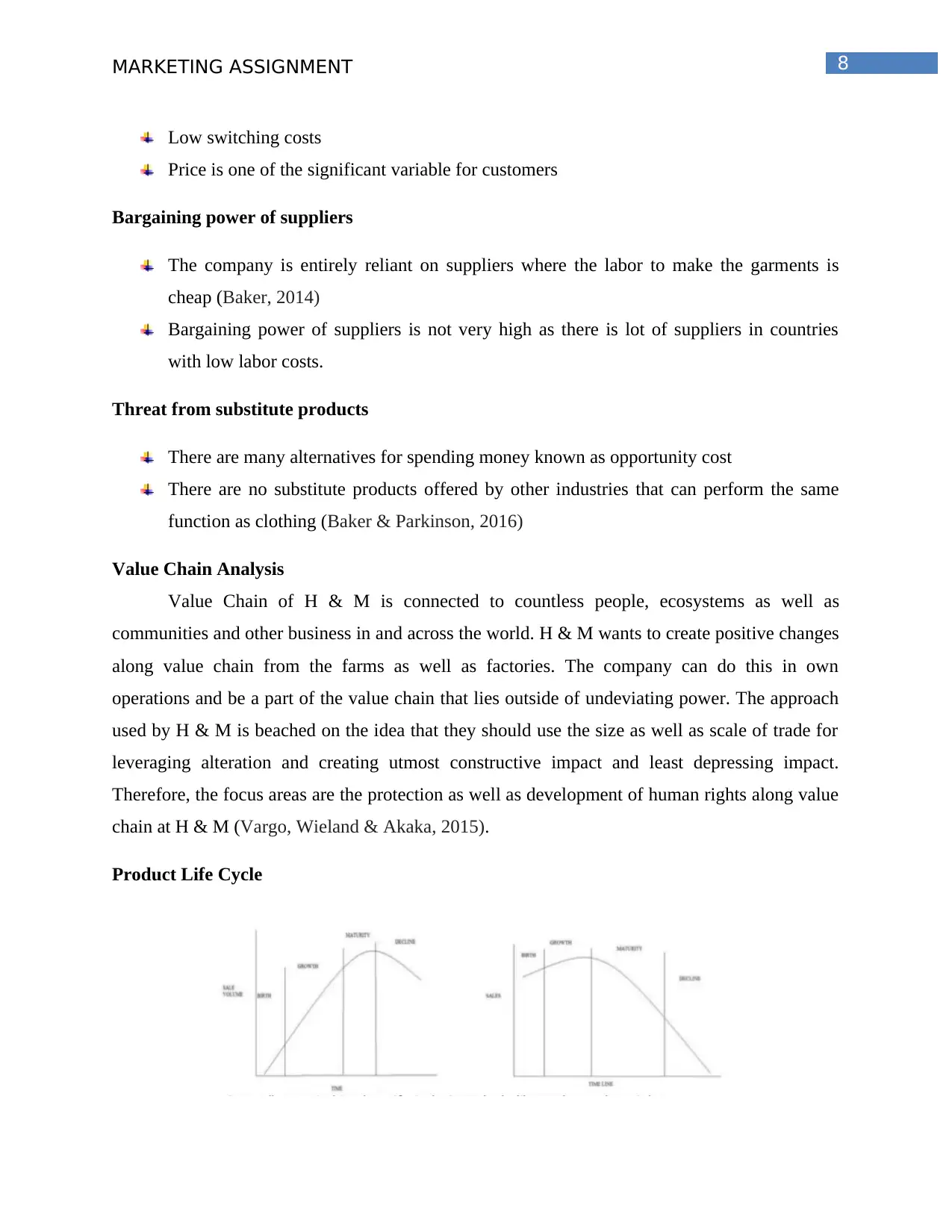
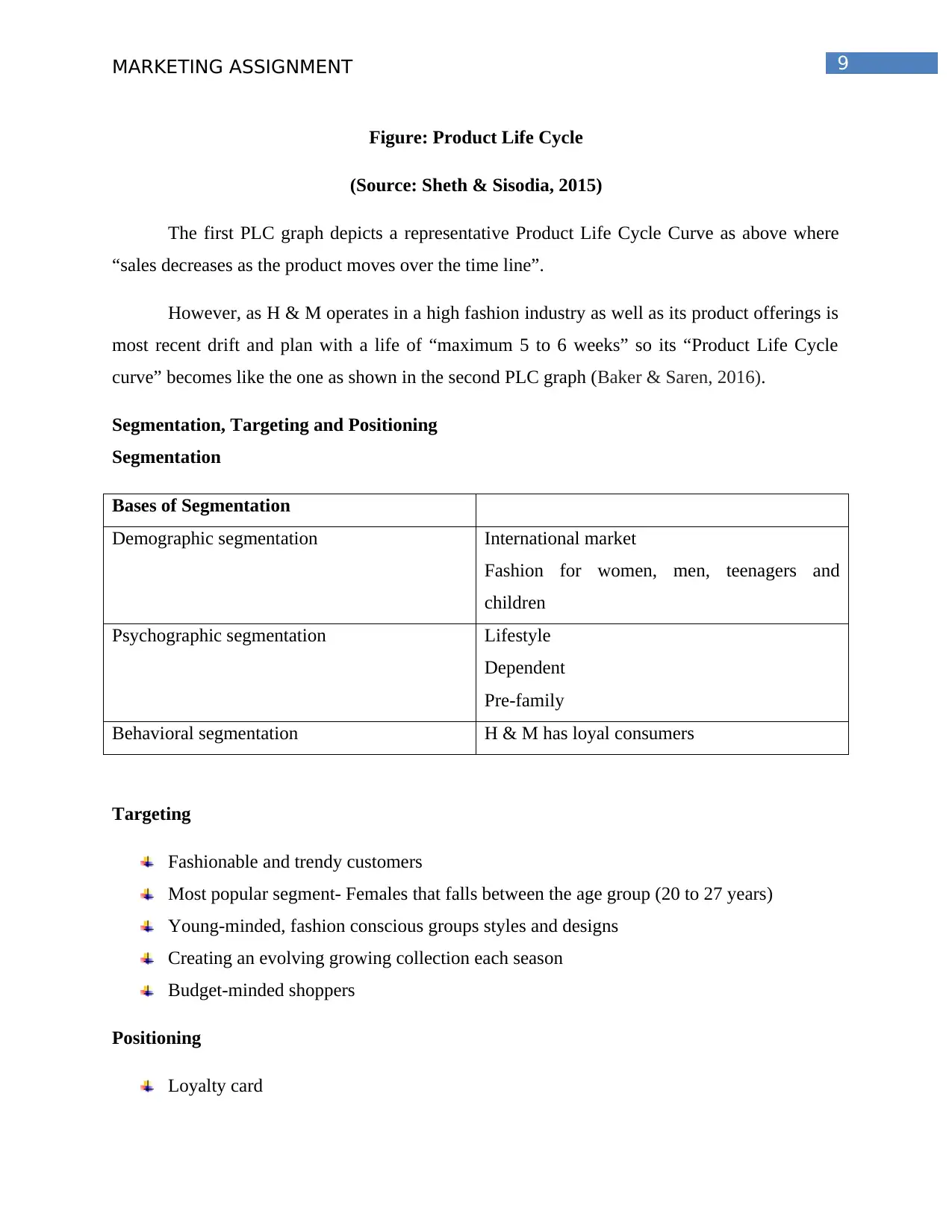
Figure: Product Life Cycle
(Source: Sheth & Sisodia, 2015)
The first PLC graph depicts a representative Product Life Cycle Curve as above where
“sales decreases as the product moves over the time line”.
However, as H & M operates in a high fashion industry as well as its product offerings is
most recent drift and plan with a life of “maximum 5 to 6 weeks” so its “Product Life Cycle
curve” becomes like the one as shown in the second PLC graph (Baker & Saren, 2016).
Segmentation, Targeting and Positioning
Segmentation
Bases of Segmentation
Demographic segmentation International market
Fashion for women, men, teenagers and
children
Psychographic segmentation Lifestyle
Dependent
Pre-family
Behavioral segmentation H & M has loyal consumers
Targeting
Fashionable and trendy customers
Most popular segment- Females that falls between the age group (20 to 27 years)
Young-minded, fashion conscious groups styles and designs
Creating an evolving growing collection each season
Budget-minded shoppers
Positioning
Loyalty card
Figure: Product Life Cycle
(Source: Sheth & Sisodia, 2015)
The first PLC graph depicts a representative Product Life Cycle Curve as above where
“sales decreases as the product moves over the time line”.
However, as H & M operates in a high fashion industry as well as its product offerings is
most recent drift and plan with a life of “maximum 5 to 6 weeks” so its “Product Life Cycle
curve” becomes like the one as shown in the second PLC graph (Baker & Saren, 2016).
Segmentation, Targeting and Positioning
Segmentation
Bases of Segmentation
Demographic segmentation International market
Fashion for women, men, teenagers and
children
Psychographic segmentation Lifestyle
Dependent
Pre-family
Behavioral segmentation H & M has loyal consumers
Targeting
Fashionable and trendy customers
Most popular segment- Females that falls between the age group (20 to 27 years)
Young-minded, fashion conscious groups styles and designs
Creating an evolving growing collection each season
Budget-minded shoppers
Positioning
Loyalty card
⊘ This is a preview!⊘
Do you want full access?
Subscribe today to unlock all pages.
Trusted by 1+ million students worldwide
10MARKETING ASSIGNMENT
Games and awards
Enhancement of marketing
Stage 2- Objectives
In this stage, H & M expect to achieve 10% market share in sections such as clothing and
home decoration products within 24 months.
SMART objectives
S means specific- It is important to understand the fact that H & M expect to achieve a 10%
market share and be recognized as one of the major retailers in sections such as home decoration,
clothing and accessories (Mahmood, Zubair & Salam, 2015).
M means measurable- The objective selected need to be measured by market research agency
who is employed in New York City and the research can be conducted by using customer
surveys. Both the tools (quantitative and qualitative) will be used by this agency so that the
objectives are achieved within stipulated period (Kerr & Patti, 2015).
A means achievable- H & M has a stable as well as large customer group. The company is
growing in popularity and hence the company has the prospect to feed to the accessible client
grouping. H & M has the main attributes of being affordable to the consumers as well as treated
as a main obstacle.
R means relevant- H & M should obtain significant market share to be treated as successful part
of the company.
T means time bound- H & M decides to achieve the objectives within 24 months of launching
clothing and home decoration collection in New York City (Chernev, 2014).
Other market objectives
To increase brand loyalty
To position H & M as a chic household brand
To expand on the existing customer base as well as gaining customers from competitors
Altering consumer attitude for increasing desire of home decoration items and clothing
and accessories items (Keller & Kotler, 2016)
Games and awards
Enhancement of marketing
Stage 2- Objectives
In this stage, H & M expect to achieve 10% market share in sections such as clothing and
home decoration products within 24 months.
SMART objectives
S means specific- It is important to understand the fact that H & M expect to achieve a 10%
market share and be recognized as one of the major retailers in sections such as home decoration,
clothing and accessories (Mahmood, Zubair & Salam, 2015).
M means measurable- The objective selected need to be measured by market research agency
who is employed in New York City and the research can be conducted by using customer
surveys. Both the tools (quantitative and qualitative) will be used by this agency so that the
objectives are achieved within stipulated period (Kerr & Patti, 2015).
A means achievable- H & M has a stable as well as large customer group. The company is
growing in popularity and hence the company has the prospect to feed to the accessible client
grouping. H & M has the main attributes of being affordable to the consumers as well as treated
as a main obstacle.
R means relevant- H & M should obtain significant market share to be treated as successful part
of the company.
T means time bound- H & M decides to achieve the objectives within 24 months of launching
clothing and home decoration collection in New York City (Chernev, 2014).
Other market objectives
To increase brand loyalty
To position H & M as a chic household brand
To expand on the existing customer base as well as gaining customers from competitors
Altering consumer attitude for increasing desire of home decoration items and clothing
and accessories items (Keller & Kotler, 2016)
Paraphrase This Document
Need a fresh take? Get an instant paraphrase of this document with our AI Paraphraser
11MARKETING ASSIGNMENT
To promote innovation
To drive transparency
To reward sustainable actions
To use renewable energy in value chain
Stage 3- Strategy
“Ansoff’s matrix”
Market Penetration- One of the vital key factor used for market penetration at H & M is to
offer fashionable clothing with cheaper prices as compared to its competitors such as Zara. H &
M has augmented its reputation wide reaching that is helped by globalization of fashion trends as
well as existence. H & M believes in comprehensive quality control methods that guarantee
customer satisfaction (Ingenbleek, Meulenberg & Van Trijp, 2015).
Market Development- H & M has launched Collection of Style with more luxurious as well as
smarter clothes as compared to common clothes offered by H & M. H & M initiate slight
disparity that can be modified in the new market society.
Product Development- H & M aims at developing through strategic alliances with famous
designers as well as famous icons to bring improvement in the prestige in and across the world.
Diversification- H & M believes in focusing in fashion items such as clothes, bags, jeweler as
well as shoes and accessories. The company had performed diversification strategy initially in
household items.
To promote innovation
To drive transparency
To reward sustainable actions
To use renewable energy in value chain
Stage 3- Strategy
“Ansoff’s matrix”
Market Penetration- One of the vital key factor used for market penetration at H & M is to
offer fashionable clothing with cheaper prices as compared to its competitors such as Zara. H &
M has augmented its reputation wide reaching that is helped by globalization of fashion trends as
well as existence. H & M believes in comprehensive quality control methods that guarantee
customer satisfaction (Ingenbleek, Meulenberg & Van Trijp, 2015).
Market Development- H & M has launched Collection of Style with more luxurious as well as
smarter clothes as compared to common clothes offered by H & M. H & M initiate slight
disparity that can be modified in the new market society.
Product Development- H & M aims at developing through strategic alliances with famous
designers as well as famous icons to bring improvement in the prestige in and across the world.
Diversification- H & M believes in focusing in fashion items such as clothes, bags, jeweler as
well as shoes and accessories. The company had performed diversification strategy initially in
household items.
12MARKETING ASSIGNMENT
Stage 4- Implementation or Tactics
7Ps of marketing mix
Product
Brand is innovating as well as developing all the time. H & M has its own innovation
model
Innovation on a reasonable price
Producing cheap products of reasonable quality as inspired by the latest trends
Shopping as a social activity that provide pleasure in their daily life
Price
The main strategy adopted by H & M is to keep their prices low in order to gain
momentum and people are clearly shopping at H & M rather at their competitors
H & M has kept prices low in Europe despite higher cotton costs
Promotion
Concept of E-marketing
Vide advertisements
Print advertisements
Place
New line has a special place
Prime store locations
Wide open spaces
Significant communication channel
Consistent as well as strong store image results in high store loyalty
People
The employees working at H & M are trained at each single level
Work culture is very modern as well as employees work on a rotation basis
Department are motivate to innovate as well as coming with the best clothing wear
Stage 4- Implementation or Tactics
7Ps of marketing mix
Product
Brand is innovating as well as developing all the time. H & M has its own innovation
model
Innovation on a reasonable price
Producing cheap products of reasonable quality as inspired by the latest trends
Shopping as a social activity that provide pleasure in their daily life
Price
The main strategy adopted by H & M is to keep their prices low in order to gain
momentum and people are clearly shopping at H & M rather at their competitors
H & M has kept prices low in Europe despite higher cotton costs
Promotion
Concept of E-marketing
Vide advertisements
Print advertisements
Place
New line has a special place
Prime store locations
Wide open spaces
Significant communication channel
Consistent as well as strong store image results in high store loyalty
People
The employees working at H & M are trained at each single level
Work culture is very modern as well as employees work on a rotation basis
Department are motivate to innovate as well as coming with the best clothing wear
⊘ This is a preview!⊘
Do you want full access?
Subscribe today to unlock all pages.
Trusted by 1+ million students worldwide

1 out of 15


Related Documents


Your All-in-One AI-Powered Toolkit for Academic Success.
+13062052269
info@desklib.com
Available 24*7 on WhatsApp / Email
![[object Object]](/_next/static/media/star-bottom.7253800d.svg)
Unlock your academic potential
Copyright © 2020–2026 A2Z Services. All Rights Reserved. Developed and managed by ZUCOL.