Jurisprudence: Rule of Law - Hobbes and Locke's Perspectives
VerifiedAdded on  2021/02/20
|5
|1847
|229
Essay
AI Summary
This essay provides a comparative analysis of the jurisprudential theories of Thomas Hobbes and John Locke, focusing on their contrasting perspectives on the rule of law, the state of nature, and the social contract. The essay begins by highlighting their shared ground, such as the importance of the social contract, and then delves into their key differences. Hobbes is presented as viewing human nature as inherently selfish, necessitating a strong sovereign to maintain order, while Locke posits a more peaceful state of nature and emphasizes individual rights. The essay further examines their divergent views on the nature of law, the separation of powers, and the role of government in protecting individual liberties. The discussion also touches upon the implications of their theories in contemporary political systems, including considerations of democratic principles and the balance between individual freedoms and governmental authority, and concludes by assessing the relative merits and limitations of each philosopher's contributions to legal and political thought, including their relevance to modern legal concepts and cases such as Mabo No 2 and same-sex marriage in Australia.
Jurisprudence rule of
law
law
Paraphrase This Document
Need a fresh take? Get an instant paraphrase of this document with our AI Paraphraser

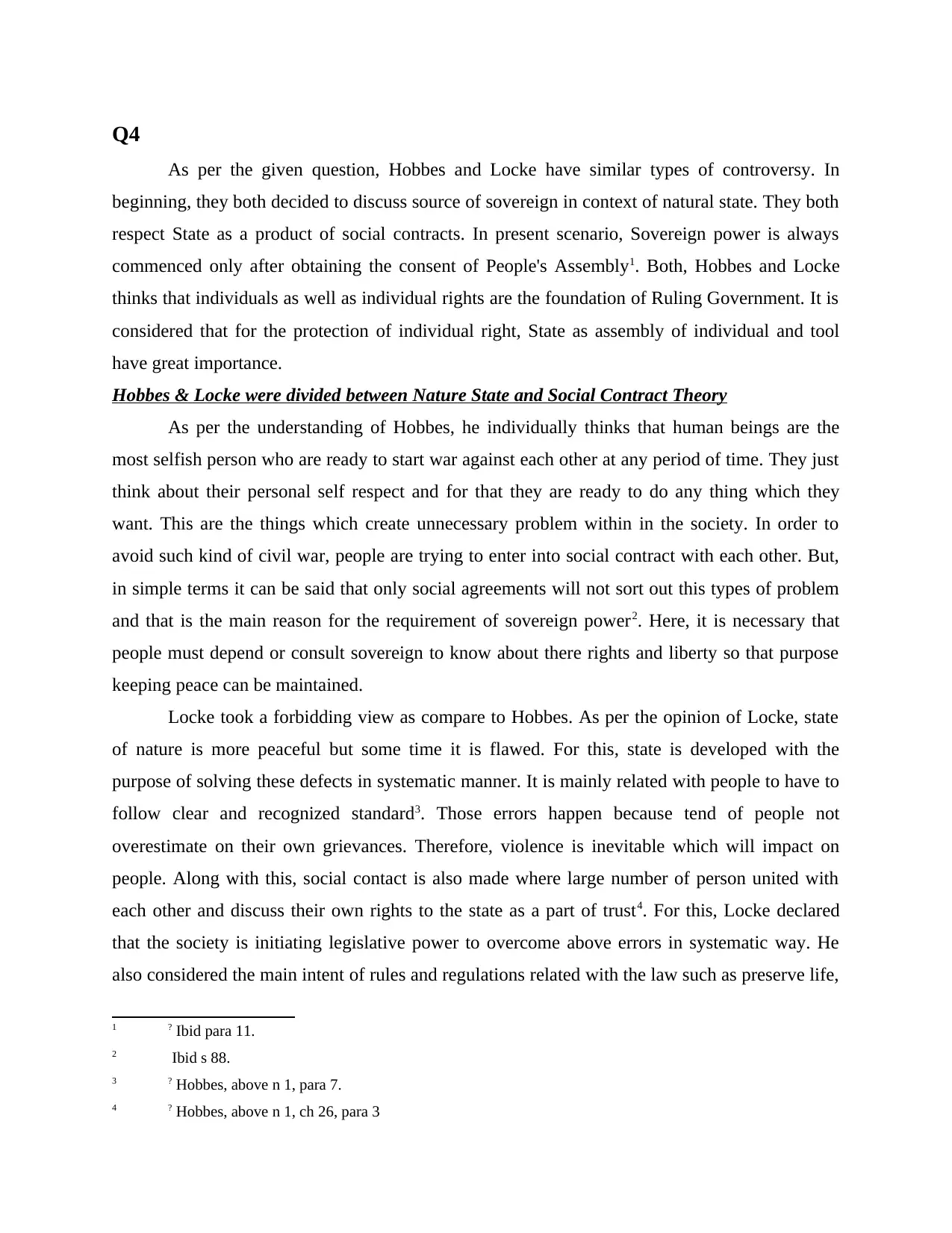
Q4
As per the given question, Hobbes and Locke have similar types of controversy. In
beginning, they both decided to discuss source of sovereign in context of natural state. They both
respect State as a product of social contracts. In present scenario, Sovereign power is always
commenced only after obtaining the consent of People's Assembly1. Both, Hobbes and Locke
thinks that individuals as well as individual rights are the foundation of Ruling Government. It is
considered that for the protection of individual right, State as assembly of individual and tool
have great importance.
Hobbes & Locke were divided between Nature State and Social Contract Theory
As per the understanding of Hobbes, he individually thinks that human beings are the
most selfish person who are ready to start war against each other at any period of time. They just
think about their personal self respect and for that they are ready to do any thing which they
want. This are the things which create unnecessary problem within in the society. In order to
avoid such kind of civil war, people are trying to enter into social contract with each other. But,
in simple terms it can be said that only social agreements will not sort out this types of problem
and that is the main reason for the requirement of sovereign power2. Here, it is necessary that
people must depend or consult sovereign to know about there rights and liberty so that purpose
keeping peace can be maintained.
Locke took a forbidding view as compare to Hobbes. As per the opinion of Locke, state
of nature is more peaceful but some time it is flawed. For this, state is developed with the
purpose of solving these defects in systematic manner. It is mainly related with people to have to
follow clear and recognized standard3. Those errors happen because tend of people not
overestimate on their own grievances. Therefore, violence is inevitable which will impact on
people. Along with this, social contact is also made where large number of person united with
each other and discuss their own rights to the state as a part of trust4. For this, Locke declared
that the society is initiating legislative power to overcome above errors in systematic way. He
also considered the main intent of rules and regulations related with the law such as preserve life,
1 ? Ibid para 11.
2 Ibid s 88.
3 ? Hobbes, above n 1, para 7.
4 ? Hobbes, above n 1, ch 26, para 3
As per the given question, Hobbes and Locke have similar types of controversy. In
beginning, they both decided to discuss source of sovereign in context of natural state. They both
respect State as a product of social contracts. In present scenario, Sovereign power is always
commenced only after obtaining the consent of People's Assembly1. Both, Hobbes and Locke
thinks that individuals as well as individual rights are the foundation of Ruling Government. It is
considered that for the protection of individual right, State as assembly of individual and tool
have great importance.
Hobbes & Locke were divided between Nature State and Social Contract Theory
As per the understanding of Hobbes, he individually thinks that human beings are the
most selfish person who are ready to start war against each other at any period of time. They just
think about their personal self respect and for that they are ready to do any thing which they
want. This are the things which create unnecessary problem within in the society. In order to
avoid such kind of civil war, people are trying to enter into social contract with each other. But,
in simple terms it can be said that only social agreements will not sort out this types of problem
and that is the main reason for the requirement of sovereign power2. Here, it is necessary that
people must depend or consult sovereign to know about there rights and liberty so that purpose
keeping peace can be maintained.
Locke took a forbidding view as compare to Hobbes. As per the opinion of Locke, state
of nature is more peaceful but some time it is flawed. For this, state is developed with the
purpose of solving these defects in systematic manner. It is mainly related with people to have to
follow clear and recognized standard3. Those errors happen because tend of people not
overestimate on their own grievances. Therefore, violence is inevitable which will impact on
people. Along with this, social contact is also made where large number of person united with
each other and discuss their own rights to the state as a part of trust4. For this, Locke declared
that the society is initiating legislative power to overcome above errors in systematic way. He
also considered the main intent of rules and regulations related with the law such as preserve life,
1 ? Ibid para 11.
2 Ibid s 88.
3 ? Hobbes, above n 1, para 7.
4 ? Hobbes, above n 1, ch 26, para 3

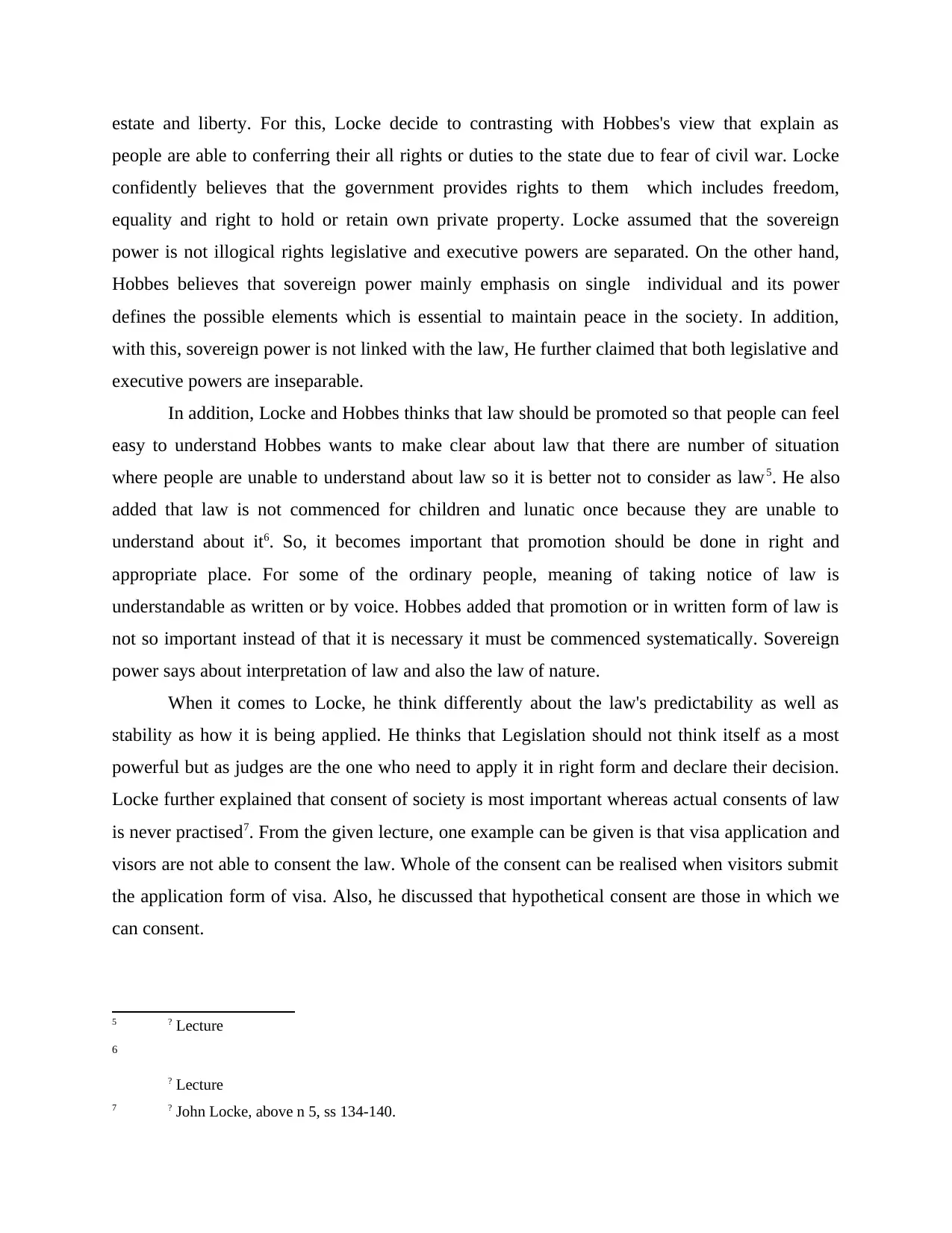
estate and liberty. For this, Locke decide to contrasting with Hobbes's view that explain as
people are able to conferring their all rights or duties to the state due to fear of civil war. Locke
confidently believes that the government provides rights to them which includes freedom,
equality and right to hold or retain own private property. Locke assumed that the sovereign
power is not illogical rights legislative and executive powers are separated. On the other hand,
Hobbes believes that sovereign power mainly emphasis on single individual and its power
defines the possible elements which is essential to maintain peace in the society. In addition,
with this, sovereign power is not linked with the law, He further claimed that both legislative and
executive powers are inseparable.
In addition, Locke and Hobbes thinks that law should be promoted so that people can feel
easy to understand Hobbes wants to make clear about law that there are number of situation
where people are unable to understand about law so it is better not to consider as law5. He also
added that law is not commenced for children and lunatic once because they are unable to
understand about it6. So, it becomes important that promotion should be done in right and
appropriate place. For some of the ordinary people, meaning of taking notice of law is
understandable as written or by voice. Hobbes added that promotion or in written form of law is
not so important instead of that it is necessary it must be commenced systematically. Sovereign
power says about interpretation of law and also the law of nature.
When it comes to Locke, he think differently about the law's predictability as well as
stability as how it is being applied. He thinks that Legislation should not think itself as a most
powerful but as judges are the one who need to apply it in right form and declare their decision.
Locke further explained that consent of society is most important whereas actual consents of law
is never practised7. From the given lecture, one example can be given is that visa application and
visors are not able to consent the law. Whole of the consent can be realised when visitors submit
the application form of visa. Also, he discussed that hypothetical consent are those in which we
can consent.
5 ? Lecture
6
? Lecture
7 ? John Locke, above n 5, ss 134-140.
people are able to conferring their all rights or duties to the state due to fear of civil war. Locke
confidently believes that the government provides rights to them which includes freedom,
equality and right to hold or retain own private property. Locke assumed that the sovereign
power is not illogical rights legislative and executive powers are separated. On the other hand,
Hobbes believes that sovereign power mainly emphasis on single individual and its power
defines the possible elements which is essential to maintain peace in the society. In addition,
with this, sovereign power is not linked with the law, He further claimed that both legislative and
executive powers are inseparable.
In addition, Locke and Hobbes thinks that law should be promoted so that people can feel
easy to understand Hobbes wants to make clear about law that there are number of situation
where people are unable to understand about law so it is better not to consider as law5. He also
added that law is not commenced for children and lunatic once because they are unable to
understand about it6. So, it becomes important that promotion should be done in right and
appropriate place. For some of the ordinary people, meaning of taking notice of law is
understandable as written or by voice. Hobbes added that promotion or in written form of law is
not so important instead of that it is necessary it must be commenced systematically. Sovereign
power says about interpretation of law and also the law of nature.
When it comes to Locke, he think differently about the law's predictability as well as
stability as how it is being applied. He thinks that Legislation should not think itself as a most
powerful but as judges are the one who need to apply it in right form and declare their decision.
Locke further explained that consent of society is most important whereas actual consents of law
is never practised7. From the given lecture, one example can be given is that visa application and
visors are not able to consent the law. Whole of the consent can be realised when visitors submit
the application form of visa. Also, he discussed that hypothetical consent are those in which we
can consent.
5 ? Lecture
6
? Lecture
7 ? John Locke, above n 5, ss 134-140.
⊘ This is a preview!⊘
Do you want full access?
Subscribe today to unlock all pages.

Trusted by 1+ million students worldwide

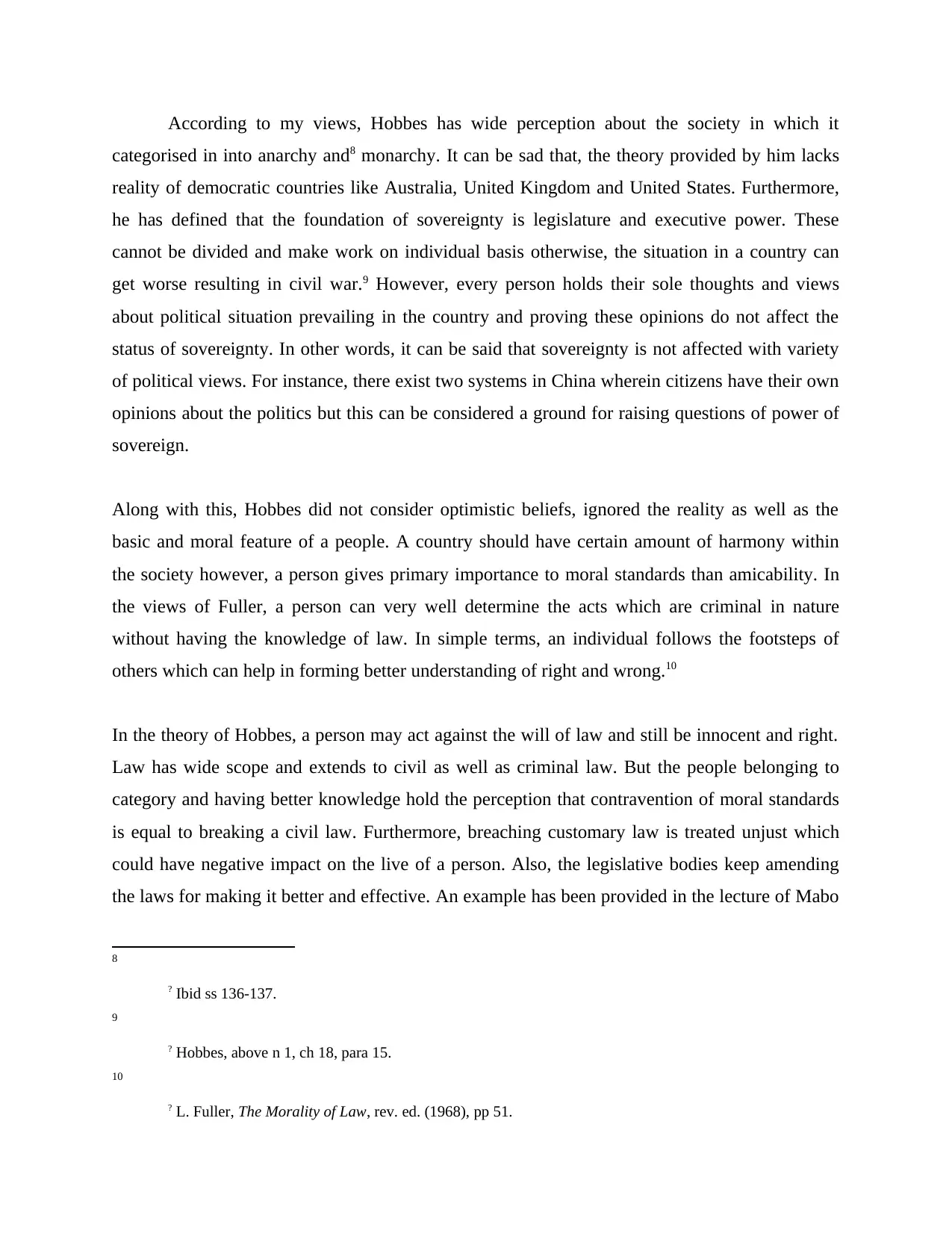
According to my views, Hobbes has wide perception about the society in which it
categorised in into anarchy and8 monarchy. It can be sad that, the theory provided by him lacks
reality of democratic countries like Australia, United Kingdom and United States. Furthermore,
he has defined that the foundation of sovereignty is legislature and executive power. These
cannot be divided and make work on individual basis otherwise, the situation in a country can
get worse resulting in civil war.9 However, every person holds their sole thoughts and views
about political situation prevailing in the country and proving these opinions do not affect the
status of sovereignty. In other words, it can be said that sovereignty is not affected with variety
of political views. For instance, there exist two systems in China wherein citizens have their own
opinions about the politics but this can be considered a ground for raising questions of power of
sovereign.
Along with this, Hobbes did not consider optimistic beliefs, ignored the reality as well as the
basic and moral feature of a people. A country should have certain amount of harmony within
the society however, a person gives primary importance to moral standards than amicability. In
the views of Fuller, a person can very well determine the acts which are criminal in nature
without having the knowledge of law. In simple terms, an individual follows the footsteps of
others which can help in forming better understanding of right and wrong.10
In the theory of Hobbes, a person may act against the will of law and still be innocent and right.
Law has wide scope and extends to civil as well as criminal law. But the people belonging to
category and having better knowledge hold the perception that contravention of moral standards
is equal to breaking a civil law. Furthermore, breaching customary law is treated unjust which
could have negative impact on the live of a person. Also, the legislative bodies keep amending
the laws for making it better and effective. An example has been provided in the lecture of Mabo
8
? Ibid ss 136-137.
9
? Hobbes, above n 1, ch 18, para 15.
10
? L. Fuller, The Morality of Law, rev. ed. (1968), pp 51.
categorised in into anarchy and8 monarchy. It can be sad that, the theory provided by him lacks
reality of democratic countries like Australia, United Kingdom and United States. Furthermore,
he has defined that the foundation of sovereignty is legislature and executive power. These
cannot be divided and make work on individual basis otherwise, the situation in a country can
get worse resulting in civil war.9 However, every person holds their sole thoughts and views
about political situation prevailing in the country and proving these opinions do not affect the
status of sovereignty. In other words, it can be said that sovereignty is not affected with variety
of political views. For instance, there exist two systems in China wherein citizens have their own
opinions about the politics but this can be considered a ground for raising questions of power of
sovereign.
Along with this, Hobbes did not consider optimistic beliefs, ignored the reality as well as the
basic and moral feature of a people. A country should have certain amount of harmony within
the society however, a person gives primary importance to moral standards than amicability. In
the views of Fuller, a person can very well determine the acts which are criminal in nature
without having the knowledge of law. In simple terms, an individual follows the footsteps of
others which can help in forming better understanding of right and wrong.10
In the theory of Hobbes, a person may act against the will of law and still be innocent and right.
Law has wide scope and extends to civil as well as criminal law. But the people belonging to
category and having better knowledge hold the perception that contravention of moral standards
is equal to breaking a civil law. Furthermore, breaching customary law is treated unjust which
could have negative impact on the live of a person. Also, the legislative bodies keep amending
the laws for making it better and effective. An example has been provided in the lecture of Mabo
8
? Ibid ss 136-137.
9
? Hobbes, above n 1, ch 18, para 15.
10
? L. Fuller, The Morality of Law, rev. ed. (1968), pp 51.
Paraphrase This Document
Need a fresh take? Get an instant paraphrase of this document with our AI Paraphraser

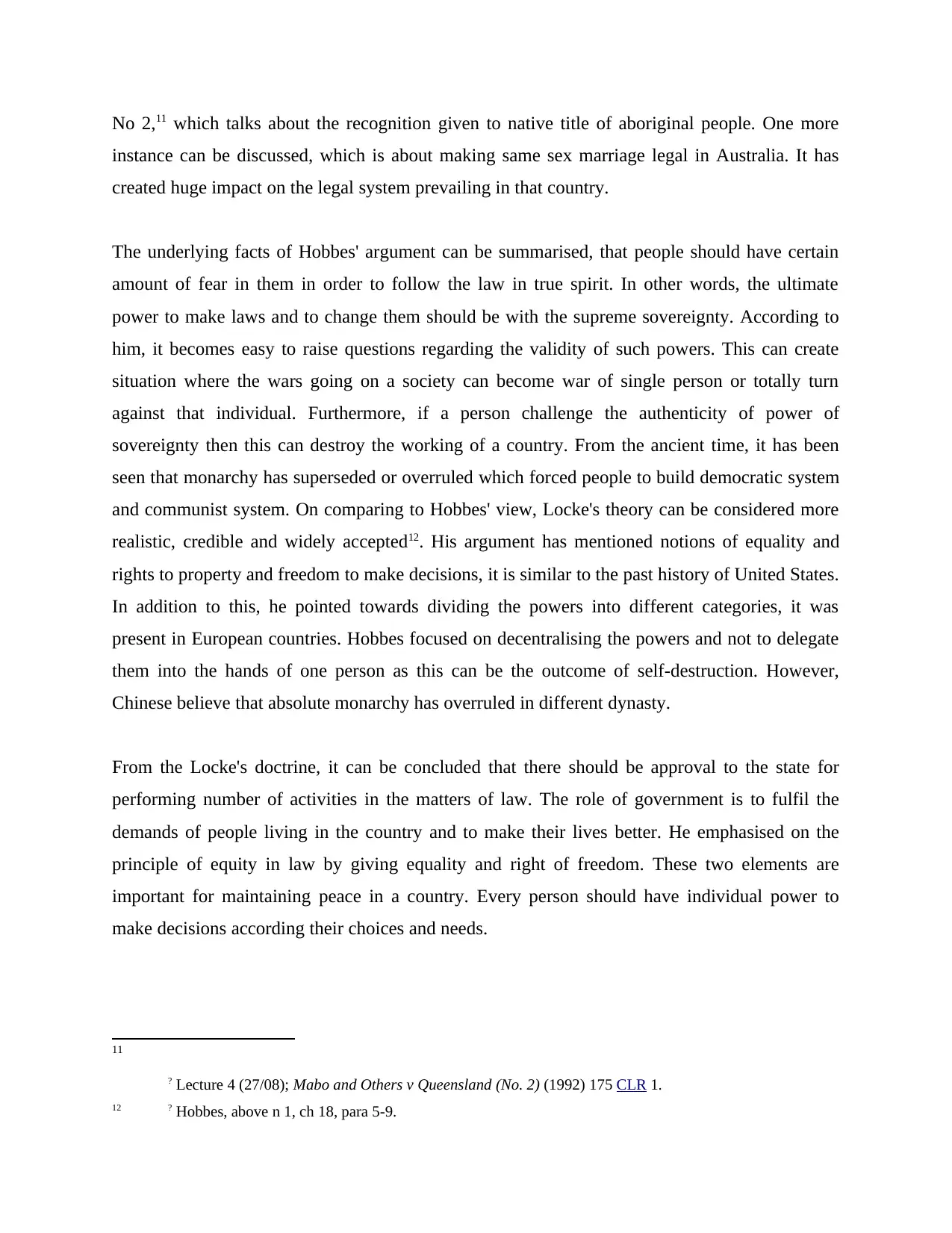
No 2,11 which talks about the recognition given to native title of aboriginal people. One more
instance can be discussed, which is about making same sex marriage legal in Australia. It has
created huge impact on the legal system prevailing in that country.
The underlying facts of Hobbes' argument can be summarised, that people should have certain
amount of fear in them in order to follow the law in true spirit. In other words, the ultimate
power to make laws and to change them should be with the supreme sovereignty. According to
him, it becomes easy to raise questions regarding the validity of such powers. This can create
situation where the wars going on a society can become war of single person or totally turn
against that individual. Furthermore, if a person challenge the authenticity of power of
sovereignty then this can destroy the working of a country. From the ancient time, it has been
seen that monarchy has superseded or overruled which forced people to build democratic system
and communist system. On comparing to Hobbes' view, Locke's theory can be considered more
realistic, credible and widely accepted12. His argument has mentioned notions of equality and
rights to property and freedom to make decisions, it is similar to the past history of United States.
In addition to this, he pointed towards dividing the powers into different categories, it was
present in European countries. Hobbes focused on decentralising the powers and not to delegate
them into the hands of one person as this can be the outcome of self-destruction. However,
Chinese believe that absolute monarchy has overruled in different dynasty.
From the Locke's doctrine, it can be concluded that there should be approval to the state for
performing number of activities in the matters of law. The role of government is to fulfil the
demands of people living in the country and to make their lives better. He emphasised on the
principle of equity in law by giving equality and right of freedom. These two elements are
important for maintaining peace in a country. Every person should have individual power to
make decisions according their choices and needs.
11
? Lecture 4 (27/08); Mabo and Others v Queensland (No. 2) (1992) 175 CLR 1.
12 ? Hobbes, above n 1, ch 18, para 5-9.
instance can be discussed, which is about making same sex marriage legal in Australia. It has
created huge impact on the legal system prevailing in that country.
The underlying facts of Hobbes' argument can be summarised, that people should have certain
amount of fear in them in order to follow the law in true spirit. In other words, the ultimate
power to make laws and to change them should be with the supreme sovereignty. According to
him, it becomes easy to raise questions regarding the validity of such powers. This can create
situation where the wars going on a society can become war of single person or totally turn
against that individual. Furthermore, if a person challenge the authenticity of power of
sovereignty then this can destroy the working of a country. From the ancient time, it has been
seen that monarchy has superseded or overruled which forced people to build democratic system
and communist system. On comparing to Hobbes' view, Locke's theory can be considered more
realistic, credible and widely accepted12. His argument has mentioned notions of equality and
rights to property and freedom to make decisions, it is similar to the past history of United States.
In addition to this, he pointed towards dividing the powers into different categories, it was
present in European countries. Hobbes focused on decentralising the powers and not to delegate
them into the hands of one person as this can be the outcome of self-destruction. However,
Chinese believe that absolute monarchy has overruled in different dynasty.
From the Locke's doctrine, it can be concluded that there should be approval to the state for
performing number of activities in the matters of law. The role of government is to fulfil the
demands of people living in the country and to make their lives better. He emphasised on the
principle of equity in law by giving equality and right of freedom. These two elements are
important for maintaining peace in a country. Every person should have individual power to
make decisions according their choices and needs.
11
? Lecture 4 (27/08); Mabo and Others v Queensland (No. 2) (1992) 175 CLR 1.
12 ? Hobbes, above n 1, ch 18, para 5-9.
1 out of 5
Related Documents
Your All-in-One AI-Powered Toolkit for Academic Success.
 +13062052269
info@desklib.com
Available 24*7 on WhatsApp / Email
Unlock your academic potential
Copyright © 2020–2025 A2Z Services. All Rights Reserved. Developed and managed by ZUCOL.