Porter's Five Forces Analysis Report: Smart TVs and Home Entertainment

Verified

Added on  2019/10/30

|4
|724
|277
Report
AI Summary
This report provides an analysis of the home entertainment market, specifically focusing on the impact of smart televisions, through the lens of Michael Porter's Five Forces framework. The analysis examines the threat of new entrants, the threat of substitutes, the bargaining power of customers and suppliers, and the intensity of rivalry among existing competitors. The report concludes that the smart television market faces moderate rivalry and significant competition from substitutes, such as online streaming services and newer technologies. The bargaining power of customers is high due to increased awareness and technological advancements, while suppliers also have considerable bargaining power. The report also discusses the strategic advantage of adopting a low-cost strategy to remain competitive in the market by offering appealing services and competitive pricing to attract customers. References to relevant research papers and online resources are included to support the analysis.
Document Page
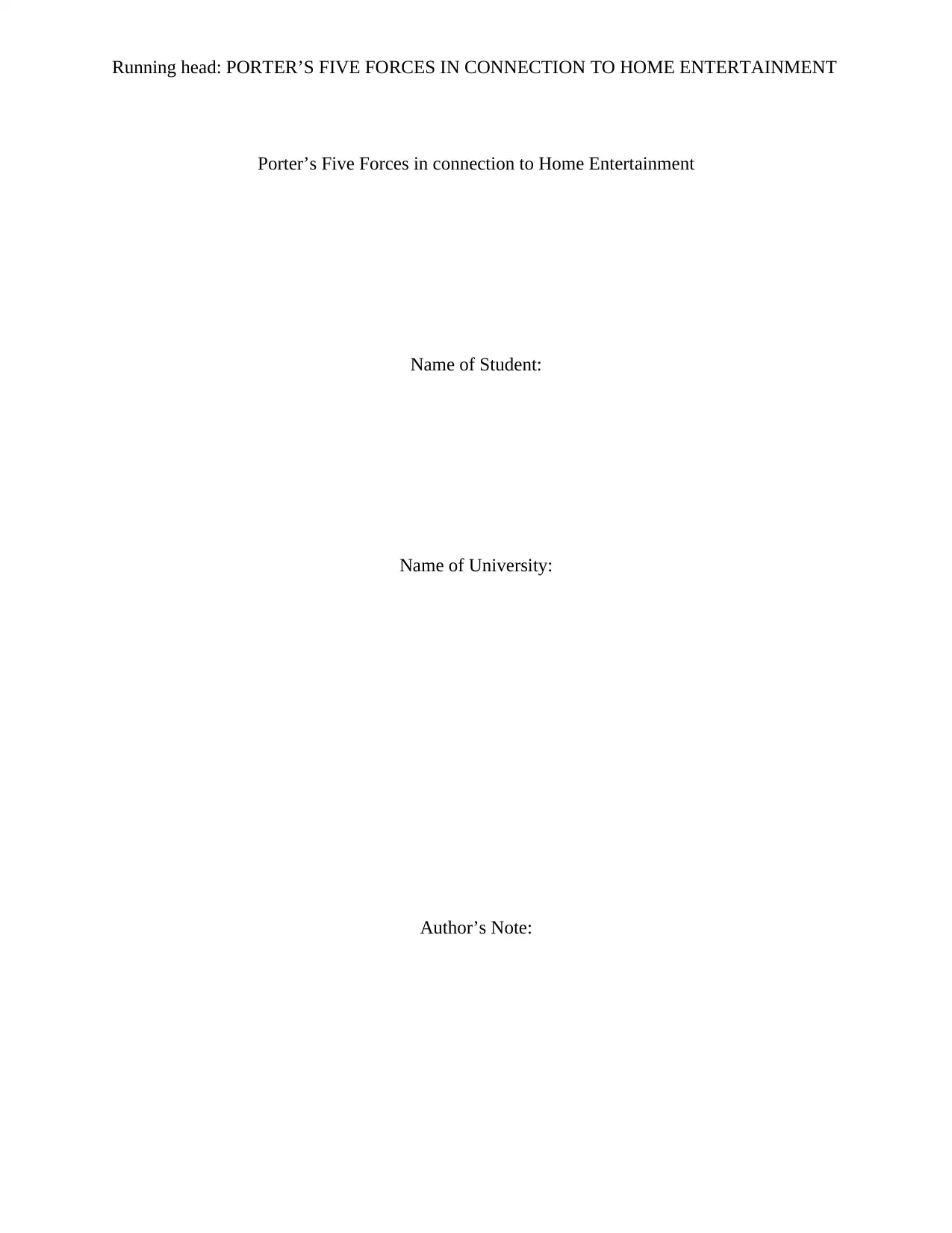
Running head: PORTER’S FIVE FORCES IN CONNECTION TO HOME ENTERTAINMENT
Porter’s Five Forces in connection to Home Entertainment
Name of Student:
Name of University:
Author’s Note:
tabler-icon-diamond-filled.svg

Paraphrase This Document

Need a fresh take? Get an instant paraphrase of this document with our AI Paraphraser
Document Page
Part B:
The smart televisions have changed the definition of home entertainment overnight.
Porter’s five forces analysis is discussed with regard to the home entertainment in connection to
the smart televisions.
The first and foremost aspect of the Porter’s Five Forces is the threat of new entrants to
the market in consideration. In this case, the market is that of home entertainment and it can be
said that there are possibilities of other better options entering the entertainment market which
have chances of being more suited to the needs of many customers. The online sites as well as
the newer entertainment apps also provide a range of shows which appeal to viewers of different
age groups. The newer and better technologies may prove to be competitors of the existent home
entertainment market if more lucrative deals are associated with them. Strong brand names have
a potential to challenge the smart television options. The options of cheaper but better
alternatives are bound to be more lucrative to the people. The degree of rivalry can be said to be
moderate (E. Dobbs 2014).
The next aspect is that of the threat of substitutes or copies of the products as well as
services provided. In this case, the smart televisions can easily face competition from substitutes
due to the fact that there are several options for viewing content or shows that appeal to all age
groups (Grimm 2017).
The next is the knowledge and the bargaining power of the customers. It can be stated
that in this case the bargaining power of the customers is quite high because, the advent of
technology has led to the high levels of awareness related to the smart television and newer
aspects of home entertainment.
Document Page
The fourth factor is the knowledge and the bargaining power of the suppliers. The
suppliers can put forward several points regarding the channels provided, the airtime supply, the
glitches in the channel broadcast and so on. The bargaining power in case of the suppliers is
relatively high.
The final factor is the rivalry among the existing businesses. This is also high because
television is one of the highest contributors to home entertainment and is bound to face several
challenges from probable competitors. This is relatively low as there are few competitors of the
TV market and the government has also limited chances of possible competition (BetaNews
2017).
Strategic advantage according to Michael Porter is the adoption of a low cost strategy
where the services are provided that are similar or superior to their competitors but the costs are
lower in comparison to them. In case of the home entertainment in connection to smart
televisions, it can be said that the services provided should be lucrative and beneficial in order to
appeal to the customers and it becomes difficult to substitute them (Lee, Kim and Park 2012).
The channels, subscription costs, the viewership rights should be the lowest in comparison to the
competitors. This should be done to ensure that no other competitor is able to overtake the
existing market dominance.
Document Page
References:
BetaNews. (2017). Smart TVs pose huge security risks. [online] Available at:
https://betanews.com/2016/01/20/smart-tvs-pose-huge-security-risks/ [Accessed 11 Sep. 2017].
E. Dobbs, M., 2014. Guidelines for applying Porter's five forces framework: a set of industry
analysis templates. Competitiveness Review, 24(1), pp.32-45.
Grimm, N. (2017). Samsung smart TV raises privacy issues. [online] ABC Radio. Available at:
http://www.abc.net.au/news/2015-02-10/samsung-smart-tv-raises-privacy-issues/6083058
[Accessed 11 Sep. 2017].
Lee, H., Kim, M.S. and Park, Y., 2012. An analytic network process approach to
operationalization of five forces model. Applied Mathematical Modelling, 36(4), pp.1783-1795.
chevron_up_icon
1 out of 4
circle_padding
hide_on_mobile
zoom_out_icon
[object Object]