Homeland Security Strategy and Policy: Immediate Actions Report
VerifiedAdded on 2019/09/26
|22
|8330
|225
Report
AI Summary
This report provides an in-depth analysis of the immediate actions taken in the United States regarding homeland security strategy and policy from 2001 to 2004, following the September 11th terrorist attacks. It examines both legislative and executive actions, including the USA PATRIOT Act, the Homeland Security Act of 2002, and Homeland Security Presidential Directives (HSPDs) 3, 5, and 8. The report discusses the implications of these policies, such as the establishment of the Department of Homeland Security (DHS) and the National Incident Management System (NIMS), and their impact on federal, state, and local governments. It highlights the key features of the legislative responses, executive orders, and their effects on homeland security, emphasizing the balance between security and civil liberties and the ongoing debate about the effectiveness and impact of these measures.
Module 2: Homeland Security Strategy and
Policy
Topics
1. Immediate Actions—Homeland Security Strategy and Policy, 2001 to 2004
2. The 9/11 Commission Report—General Findings and Recommendations
3. Homeland Security Strategy and Policy, 2004 to the Present
4. Summary
1. Immediate Actions—Homeland Security Strategy and Policy, 2001 to 2004
We believe the 9/11 attacks revealed four kinds of failures: in imagination, policy, capability,
and management.
—9/11 Commission
The surprise and shock of the terrorist attacks of September 11, 2001, required an immediate
government response. The government's actions of the period from September 2001 to the
release of The 9/11 Commission Report in July 2004 are considered immediate actions. These
actions were also influenced by the immediately following anthrax attacks of September and
October 2001. The people demanded swift governmental action to find those responsible for the
attacks and ensure that they would not occur again.
The following section outlines the major actions taken by the federal government during that
time frame. We have divided the discussion into legislative (congressional) and executive
(presidential and military) actions. A brief description of each policy and its implications for
homeland security is presented through interactive timelines, and we will discuss several of the
major policies and strategies in greater detail. The focus will remain on the homeland security
mission, essentially the "home game" against terrorism. Homeland defense (the "away game")
against terrorism will be briefly mentioned, but the focus in this course is on domestic homeland
security policy and its effects on the United States; its citizens; and state, local, and tribal
governments.
Legislative Actions, 2001 to 2004
Legislative actions consist of the steps that the US Congress takes to abate terrorism through the
passage of new laws. Once signed by the president of the United States, these proposals become
law, providing additional funding and/or new legal tools to combat terrorism.
The period immediately following September 11 saw a flurry of activity by Congress to
authorize presidential action for the use of military force, to provide for the safety and stability of
Policy
Topics
1. Immediate Actions—Homeland Security Strategy and Policy, 2001 to 2004
2. The 9/11 Commission Report—General Findings and Recommendations
3. Homeland Security Strategy and Policy, 2004 to the Present
4. Summary
1. Immediate Actions—Homeland Security Strategy and Policy, 2001 to 2004
We believe the 9/11 attacks revealed four kinds of failures: in imagination, policy, capability,
and management.
—9/11 Commission
The surprise and shock of the terrorist attacks of September 11, 2001, required an immediate
government response. The government's actions of the period from September 2001 to the
release of The 9/11 Commission Report in July 2004 are considered immediate actions. These
actions were also influenced by the immediately following anthrax attacks of September and
October 2001. The people demanded swift governmental action to find those responsible for the
attacks and ensure that they would not occur again.
The following section outlines the major actions taken by the federal government during that
time frame. We have divided the discussion into legislative (congressional) and executive
(presidential and military) actions. A brief description of each policy and its implications for
homeland security is presented through interactive timelines, and we will discuss several of the
major policies and strategies in greater detail. The focus will remain on the homeland security
mission, essentially the "home game" against terrorism. Homeland defense (the "away game")
against terrorism will be briefly mentioned, but the focus in this course is on domestic homeland
security policy and its effects on the United States; its citizens; and state, local, and tribal
governments.
Legislative Actions, 2001 to 2004
Legislative actions consist of the steps that the US Congress takes to abate terrorism through the
passage of new laws. Once signed by the president of the United States, these proposals become
law, providing additional funding and/or new legal tools to combat terrorism.
The period immediately following September 11 saw a flurry of activity by Congress to
authorize presidential action for the use of military force, to provide for the safety and stability of

Paraphrase This Document
Need a fresh take? Get an instant paraphrase of this document with our AI Paraphraser
the airline industry, to authorize new powers for law enforcement and intelligence authorities, to
enhance border security, to increase bioterrorism preparedness, to protect cyberspace and the
maritime environment, and to create the Department of Homeland Security.
Look for the link titled Timeline in the main module area. Click that link to see an interactive
timeline that summarizes the legislative responses—as well as the executive responses, which
we'll discuss later in this module—to the terrorist attacks of September 11 and subsequent major
events.
The USA PATRIOT Act
The USA PATRIOT Act, which was passed by Congress and signed into law by President Bush
on October 26, 2001, broadened the ability of law enforcement and intelligence agencies to
interdict terrorism in four ways (Congressional Research Service [CRS], 2002). First, it applied
toward the fight against terrorism a number of investigative tools that had previously been
available to fight other forms of organized crime. Second, the act removed many of the legal
barriers that prevented the intelligence community (IC) from sharing information with law
enforcement. Third, it updated laws to reflect new technology and new threats. Fourth, it
increased penalties and created new offenses for terrorism-related crimes. We will explore each
of these elements to develop an understanding of the scope of the changes effected by the
PATRIOT Act.
Many provisions of the PATRIOT Act are viewed by some as too great an expansion of
government power, which could violate the constitutional rights of American citizens.
The following is a brief summary of the major changes provided for in the USA PATRIOT Act,
as explained by the US Department of Justice (DOJ) in "The USA PATRIOT Act: Preserving
Life and Liberty?" (n.d.):
1. Legalized the use of a greater range of tools to fight terrorism
o allows law enforcement to use electronic surveillance against the full range of
terrorism-related crimes
o allows federal agents to follow terrorists by using "roving wiretaps" that can be
authorized by a federal judge to apply to a particular suspect, rather than just a
particular phone or device
o allows law enforcement to conduct investigations without tipping off terrorists, by
delaying when the subject is told that a search warrant was executed; this delay
gives law enforcement time to identify associates, eliminate immediate threats to
our communities, and coordinate the arrests of multiple individuals
o allows federal agents to ask a court for an order to examine business records from
the Foreign Intelligence Surveillance Court for activity in terrorism cases, if
needed to aid a terrorism investigation
2. Enabled information sharing
enhance border security, to increase bioterrorism preparedness, to protect cyberspace and the
maritime environment, and to create the Department of Homeland Security.
Look for the link titled Timeline in the main module area. Click that link to see an interactive
timeline that summarizes the legislative responses—as well as the executive responses, which
we'll discuss later in this module—to the terrorist attacks of September 11 and subsequent major
events.
The USA PATRIOT Act
The USA PATRIOT Act, which was passed by Congress and signed into law by President Bush
on October 26, 2001, broadened the ability of law enforcement and intelligence agencies to
interdict terrorism in four ways (Congressional Research Service [CRS], 2002). First, it applied
toward the fight against terrorism a number of investigative tools that had previously been
available to fight other forms of organized crime. Second, the act removed many of the legal
barriers that prevented the intelligence community (IC) from sharing information with law
enforcement. Third, it updated laws to reflect new technology and new threats. Fourth, it
increased penalties and created new offenses for terrorism-related crimes. We will explore each
of these elements to develop an understanding of the scope of the changes effected by the
PATRIOT Act.
Many provisions of the PATRIOT Act are viewed by some as too great an expansion of
government power, which could violate the constitutional rights of American citizens.
The following is a brief summary of the major changes provided for in the USA PATRIOT Act,
as explained by the US Department of Justice (DOJ) in "The USA PATRIOT Act: Preserving
Life and Liberty?" (n.d.):
1. Legalized the use of a greater range of tools to fight terrorism
o allows law enforcement to use electronic surveillance against the full range of
terrorism-related crimes
o allows federal agents to follow terrorists by using "roving wiretaps" that can be
authorized by a federal judge to apply to a particular suspect, rather than just a
particular phone or device
o allows law enforcement to conduct investigations without tipping off terrorists, by
delaying when the subject is told that a search warrant was executed; this delay
gives law enforcement time to identify associates, eliminate immediate threats to
our communities, and coordinate the arrests of multiple individuals
o allows federal agents to ask a court for an order to examine business records from
the Foreign Intelligence Surveillance Court for activity in terrorism cases, if
needed to aid a terrorism investigation
2. Enabled information sharing
o abolished the legal barriers that previously prevented the sharing of information
between the law enforcement and intelligence communities, allowing
coordination of information among the agencies to counter terrorism
3. Updated laws to reflect new technology
o allows warrants to be obtained in any district in where the terrorism activity being
investigated occurred, regardless of where those warrants will be executed
o allows cyber hacking victims to give law enforcement access to systems to
investigate and prosecute hackers
4. Increased penalties and added new offenses for terrorism-related crimes
o created a new offense that prohibits knowingly harboring persons involved in
terrorist offenses
o expanded the definitions of some conspiracy crimes and increased the number of
distinct conspiracy offenses
o increases the maximum penalties for terrorist crimes, including conspiracy crimes
o creates specific punishments for attacks using biological weapons and attacks on
mass transit
o eliminates the statutes of limitations on some terrorist crimes, and lengthens it on
others
The PATRIOT Act has spurred much debate concerning the balance between freedom and
security in America. Proponents of the act support the need for expanded law enforcement with
expanded powers to fight terrorism. Opponents cite the potential for abuses of rights that could
occur under the provisions of the act. Opponents of the act were fueled by a DOJ Office of the
Inspector General report that found abuses of the use of National Security Letters (USA
PATRIOT Act, Section 505) to obtain information from businesses and educational institutions
for investigations (2007). The act as originally legislated included sunset provisions that were to
expire at the end of 2005 unless expressly reauthorized. In 2006, the act was reauthorized,
making all sections of the original act permanent except for two sections: the National Security
Letters and roving wiretap provisions were reauthorized with four-year expirations. In 2011,
these provisions were again reauthorized for four years. The effectiveness of the PATRIOT Act
and its impact on the rights of American citizens continue as a topic of debate.
The Homeland Security Act of 2002
Dozens of agencies charged with homeland security will now be located within one Cabinet
department with the mandate and legal authority to protect our people. America will be better
able to respond to any future attacks, to reduce our vulnerability and, most important, prevent
the terrorists from taking innocent American lives.
—President George W. Bush, on signing the Homeland Security Act of 2002
between the law enforcement and intelligence communities, allowing
coordination of information among the agencies to counter terrorism
3. Updated laws to reflect new technology
o allows warrants to be obtained in any district in where the terrorism activity being
investigated occurred, regardless of where those warrants will be executed
o allows cyber hacking victims to give law enforcement access to systems to
investigate and prosecute hackers
4. Increased penalties and added new offenses for terrorism-related crimes
o created a new offense that prohibits knowingly harboring persons involved in
terrorist offenses
o expanded the definitions of some conspiracy crimes and increased the number of
distinct conspiracy offenses
o increases the maximum penalties for terrorist crimes, including conspiracy crimes
o creates specific punishments for attacks using biological weapons and attacks on
mass transit
o eliminates the statutes of limitations on some terrorist crimes, and lengthens it on
others
The PATRIOT Act has spurred much debate concerning the balance between freedom and
security in America. Proponents of the act support the need for expanded law enforcement with
expanded powers to fight terrorism. Opponents cite the potential for abuses of rights that could
occur under the provisions of the act. Opponents of the act were fueled by a DOJ Office of the
Inspector General report that found abuses of the use of National Security Letters (USA
PATRIOT Act, Section 505) to obtain information from businesses and educational institutions
for investigations (2007). The act as originally legislated included sunset provisions that were to
expire at the end of 2005 unless expressly reauthorized. In 2006, the act was reauthorized,
making all sections of the original act permanent except for two sections: the National Security
Letters and roving wiretap provisions were reauthorized with four-year expirations. In 2011,
these provisions were again reauthorized for four years. The effectiveness of the PATRIOT Act
and its impact on the rights of American citizens continue as a topic of debate.
The Homeland Security Act of 2002
Dozens of agencies charged with homeland security will now be located within one Cabinet
department with the mandate and legal authority to protect our people. America will be better
able to respond to any future attacks, to reduce our vulnerability and, most important, prevent
the terrorists from taking innocent American lives.
—President George W. Bush, on signing the Homeland Security Act of 2002
⊘ This is a preview!⊘
Do you want full access?
Subscribe today to unlock all pages.

Trusted by 1+ million students worldwide
The Homeland Security Act of 2002 was signed into law by President Bush on November 25,
2002. The law established the Department of Homeland Security (DHS) as an executive
department of the United States. The Homeland Security Act assigns the DHS the mission to
prevent terrorist attacks within the United States; reduce the vulnerability of the United States to
terrorism; and minimize the damage, and assist in the recovery, from terrorist attacks that do
occur within the United States.
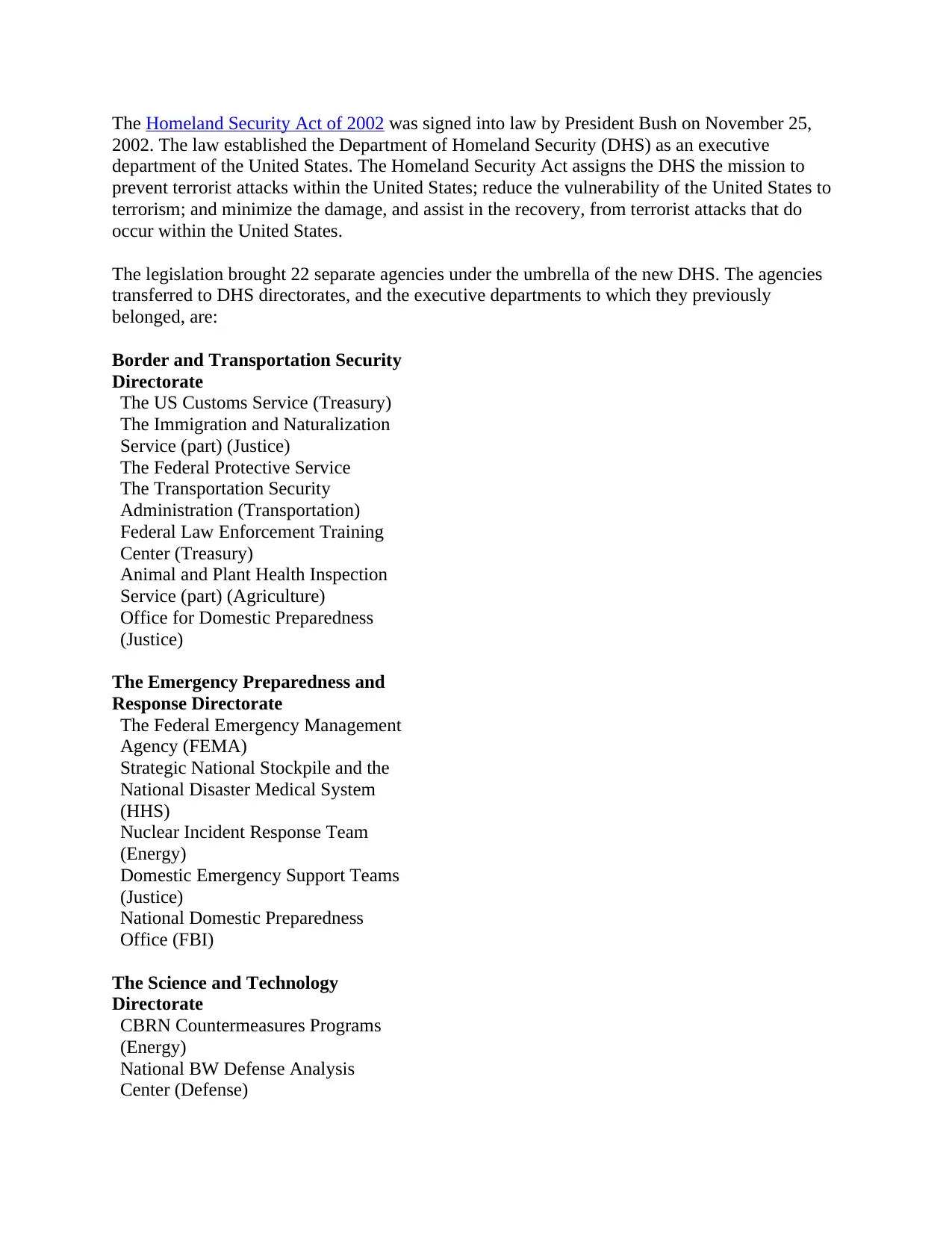
The legislation brought 22 separate agencies under the umbrella of the new DHS. The agencies
transferred to DHS directorates, and the executive departments to which they previously
belonged, are:
Border and Transportation Security
Directorate
The US Customs Service (Treasury)
The Immigration and Naturalization
Service (part) (Justice)
The Federal Protective Service
The Transportation Security
Administration (Transportation)
Federal Law Enforcement Training
Center (Treasury)
Animal and Plant Health Inspection
Service (part) (Agriculture)
Office for Domestic Preparedness
(Justice)
The Emergency Preparedness and
Response Directorate
The Federal Emergency Management
Agency (FEMA)
Strategic National Stockpile and the
National Disaster Medical System
(HHS)
Nuclear Incident Response Team
(Energy)
Domestic Emergency Support Teams
(Justice)
National Domestic Preparedness
Office (FBI)
The Science and Technology
Directorate
CBRN Countermeasures Programs
(Energy)
National BW Defense Analysis
Center (Defense)
2002. The law established the Department of Homeland Security (DHS) as an executive
department of the United States. The Homeland Security Act assigns the DHS the mission to
prevent terrorist attacks within the United States; reduce the vulnerability of the United States to
terrorism; and minimize the damage, and assist in the recovery, from terrorist attacks that do
occur within the United States.
The legislation brought 22 separate agencies under the umbrella of the new DHS. The agencies
transferred to DHS directorates, and the executive departments to which they previously
belonged, are:
Border and Transportation Security
Directorate
The US Customs Service (Treasury)
The Immigration and Naturalization
Service (part) (Justice)
The Federal Protective Service
The Transportation Security
Administration (Transportation)
Federal Law Enforcement Training
Center (Treasury)
Animal and Plant Health Inspection
Service (part) (Agriculture)
Office for Domestic Preparedness
(Justice)
The Emergency Preparedness and
Response Directorate
The Federal Emergency Management
Agency (FEMA)
Strategic National Stockpile and the
National Disaster Medical System
(HHS)
Nuclear Incident Response Team
(Energy)
Domestic Emergency Support Teams
(Justice)
National Domestic Preparedness
Office (FBI)
The Science and Technology
Directorate
CBRN Countermeasures Programs
(Energy)
National BW Defense Analysis
Center (Defense)
Paraphrase This Document
Need a fresh take? Get an instant paraphrase of this document with our AI Paraphraser
Plum Island Animal Disease Center
(Agriculture)
Environmental Measurements
Laboratory (Energy)
The Information Analysis and
Infrastructure Protection
Directorate
Federal Computer Incident Response
Center (GSA)
National Communications System
(Defense)
National Infrastructure Protection
Center (FBI)
Energy Security and Assurance
Program (Energy)
Direct Report to the Secretary of
DHS
US Secret Service
US Coast Guard
Direct Report to the Deputy
Secretary of DHS
US Citizenship and Immigration
Services
Source: US DHS, n.d.
The Homeland Security Act of 2002 initiated the largest reorganization of the federal
government since the creation of the Department of Defense in 1947. Those critical of the
reorganization claim that adding bureaucracy does not close the gaps exposed by the attacks of
September 11. Opposition also centers on the potential for constitutional right infringements by a
large law enforcement and intelligence organization. As with the USA PATRIOT Act, the
effectiveness and impact of the creation of the DHS by the Homeland Security Act of 2002 will
continue as a topic of debate.
The legislative actions presented in this section represent the immediate action taken by
Congress in the wake of the attacks of September 11. The laws created by Congress served to
authorize presidential action for the use military force
provide for the safety and stability of the airline industry
authorize new powers for law enforcement and intelligence authorities
enhance border security, increase bioterrorism preparedness
(Agriculture)
Environmental Measurements
Laboratory (Energy)
The Information Analysis and
Infrastructure Protection
Directorate
Federal Computer Incident Response
Center (GSA)
National Communications System
(Defense)
National Infrastructure Protection
Center (FBI)
Energy Security and Assurance
Program (Energy)
Direct Report to the Secretary of
DHS
US Secret Service
US Coast Guard
Direct Report to the Deputy
Secretary of DHS
US Citizenship and Immigration
Services
Source: US DHS, n.d.
The Homeland Security Act of 2002 initiated the largest reorganization of the federal
government since the creation of the Department of Defense in 1947. Those critical of the
reorganization claim that adding bureaucracy does not close the gaps exposed by the attacks of
September 11. Opposition also centers on the potential for constitutional right infringements by a
large law enforcement and intelligence organization. As with the USA PATRIOT Act, the
effectiveness and impact of the creation of the DHS by the Homeland Security Act of 2002 will
continue as a topic of debate.
The legislative actions presented in this section represent the immediate action taken by
Congress in the wake of the attacks of September 11. The laws created by Congress served to
authorize presidential action for the use military force
provide for the safety and stability of the airline industry
authorize new powers for law enforcement and intelligence authorities
enhance border security, increase bioterrorism preparedness
protect cyberspace and the maritime environments
create the DHS
Of all of the legislative actions during this period, the USA PATRIOT Act and the Homeland
Security Act of 2002 have had the most significant effects on the security of the homeland.
Executive Actions, 2001 to 2004
Following the events of September 11, President George W. Bush also utilized the powers
granted him under the US Constitution to determine the strategic direction of homeland security
policy. The president has the authority to issue executive orders that have the force of law.
Executive orders (EOs) usually are based on existing statutory authority of the president and
require no action by Congress to become effective. Following September 11, the president issued
several executive orders and, for the first time, EOs titled Homeland Security Presidential
Directives (HSPDs). The HSPDs issued between 2001 and 2004 set the direction for US
homeland security policy. The timeline in this module traces the actions taken by the president
between the September 11 attacks and the release of the 9/11 Commission Report in July 2004.
We will focus our discussion on three particular executive orders that have broad implications:
HSPD-3, HSPD-5, and HSPD-8 (replaced by PPD-8 in 2011). These directives have influenced
homeland security policy at the federal, state, and local levels of government and have been
translated into strategy documents and plans that affected the entire nation.
Focus on the Executive: Homeland Security Presidential Directives 3, 5, and 8
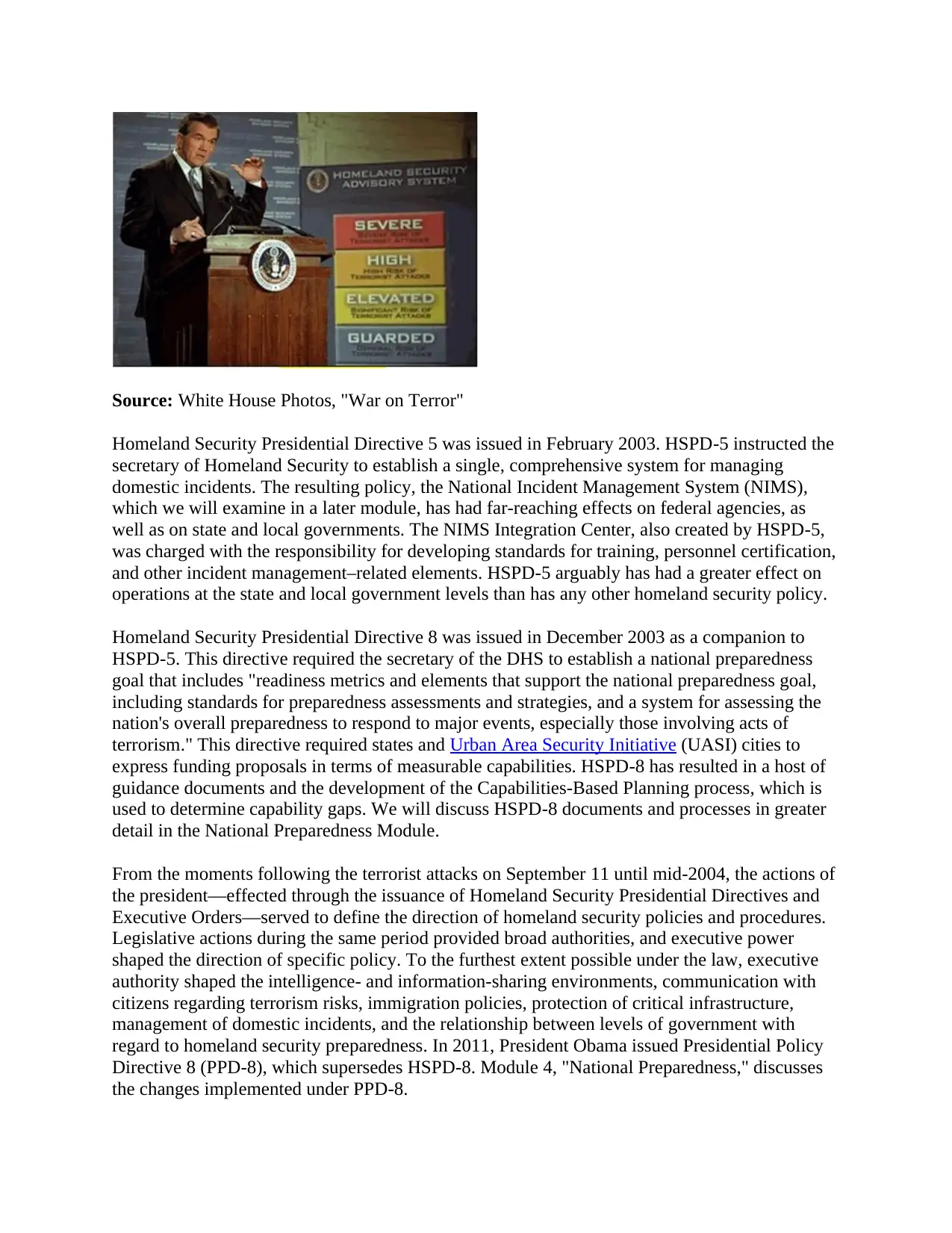
Homeland Security Presidential Directive 3 is probably the most recognizable executive order
issued by the president. Issued in March 2002 (figure 2.1), it established the Homeland Security
Advisory System (HSAS) to serve as a comprehensive means of disseminating information
regarding the risk of terrorist acts to federal, state, and local authorities and to the American
public. The five levels of terrorism risk are well known to most Americans by now. The system
is often criticized, primarily because it remained at yellow (elevated) for several years after
September 11, prompting many to question its effectiveness. In 2011, the National Terrorism
Advisory System replaced HSAS, dropping the color-coded system.
Figure 2.1
DHS Secretary Ridge announcing the Homeland Security Advisory System
create the DHS
Of all of the legislative actions during this period, the USA PATRIOT Act and the Homeland
Security Act of 2002 have had the most significant effects on the security of the homeland.
Executive Actions, 2001 to 2004
Following the events of September 11, President George W. Bush also utilized the powers
granted him under the US Constitution to determine the strategic direction of homeland security
policy. The president has the authority to issue executive orders that have the force of law.
Executive orders (EOs) usually are based on existing statutory authority of the president and
require no action by Congress to become effective. Following September 11, the president issued
several executive orders and, for the first time, EOs titled Homeland Security Presidential
Directives (HSPDs). The HSPDs issued between 2001 and 2004 set the direction for US
homeland security policy. The timeline in this module traces the actions taken by the president
between the September 11 attacks and the release of the 9/11 Commission Report in July 2004.
We will focus our discussion on three particular executive orders that have broad implications:
HSPD-3, HSPD-5, and HSPD-8 (replaced by PPD-8 in 2011). These directives have influenced
homeland security policy at the federal, state, and local levels of government and have been
translated into strategy documents and plans that affected the entire nation.
Focus on the Executive: Homeland Security Presidential Directives 3, 5, and 8
Homeland Security Presidential Directive 3 is probably the most recognizable executive order
issued by the president. Issued in March 2002 (figure 2.1), it established the Homeland Security
Advisory System (HSAS) to serve as a comprehensive means of disseminating information
regarding the risk of terrorist acts to federal, state, and local authorities and to the American
public. The five levels of terrorism risk are well known to most Americans by now. The system
is often criticized, primarily because it remained at yellow (elevated) for several years after
September 11, prompting many to question its effectiveness. In 2011, the National Terrorism
Advisory System replaced HSAS, dropping the color-coded system.
Figure 2.1
DHS Secretary Ridge announcing the Homeland Security Advisory System
⊘ This is a preview!⊘
Do you want full access?
Subscribe today to unlock all pages.
Trusted by 1+ million students worldwide
Source: White House Photos, "War on Terror"
Homeland Security Presidential Directive 5 was issued in February 2003. HSPD-5 instructed the
secretary of Homeland Security to establish a single, comprehensive system for managing
domestic incidents. The resulting policy, the National Incident Management System (NIMS),
which we will examine in a later module, has had far-reaching effects on federal agencies, as
well as on state and local governments. The NIMS Integration Center, also created by HSPD-5,
was charged with the responsibility for developing standards for training, personnel certification,
and other incident management–related elements. HSPD-5 arguably has had a greater effect on
operations at the state and local government levels than has any other homeland security policy.
Homeland Security Presidential Directive 8 was issued in December 2003 as a companion to
HSPD-5. This directive required the secretary of the DHS to establish a national preparedness
goal that includes "readiness metrics and elements that support the national preparedness goal,
including standards for preparedness assessments and strategies, and a system for assessing the
nation's overall preparedness to respond to major events, especially those involving acts of
terrorism." This directive required states and Urban Area Security Initiative (UASI) cities to
express funding proposals in terms of measurable capabilities. HSPD-8 has resulted in a host of
guidance documents and the development of the Capabilities-Based Planning process, which is
used to determine capability gaps. We will discuss HSPD-8 documents and processes in greater
detail in the National Preparedness Module.
From the moments following the terrorist attacks on September 11 until mid-2004, the actions of
the president—effected through the issuance of Homeland Security Presidential Directives and
Executive Orders—served to define the direction of homeland security policies and procedures.
Legislative actions during the same period provided broad authorities, and executive power
shaped the direction of specific policy. To the furthest extent possible under the law, executive
authority shaped the intelligence- and information-sharing environments, communication with
citizens regarding terrorism risks, immigration policies, protection of critical infrastructure,
management of domestic incidents, and the relationship between levels of government with
regard to homeland security preparedness. In 2011, President Obama issued Presidential Policy
Directive 8 (PPD-8), which supersedes HSPD-8. Module 4, "National Preparedness," discusses
the changes implemented under PPD-8.
Homeland Security Presidential Directive 5 was issued in February 2003. HSPD-5 instructed the
secretary of Homeland Security to establish a single, comprehensive system for managing
domestic incidents. The resulting policy, the National Incident Management System (NIMS),
which we will examine in a later module, has had far-reaching effects on federal agencies, as
well as on state and local governments. The NIMS Integration Center, also created by HSPD-5,
was charged with the responsibility for developing standards for training, personnel certification,
and other incident management–related elements. HSPD-5 arguably has had a greater effect on
operations at the state and local government levels than has any other homeland security policy.
Homeland Security Presidential Directive 8 was issued in December 2003 as a companion to
HSPD-5. This directive required the secretary of the DHS to establish a national preparedness
goal that includes "readiness metrics and elements that support the national preparedness goal,
including standards for preparedness assessments and strategies, and a system for assessing the
nation's overall preparedness to respond to major events, especially those involving acts of
terrorism." This directive required states and Urban Area Security Initiative (UASI) cities to
express funding proposals in terms of measurable capabilities. HSPD-8 has resulted in a host of
guidance documents and the development of the Capabilities-Based Planning process, which is
used to determine capability gaps. We will discuss HSPD-8 documents and processes in greater
detail in the National Preparedness Module.
From the moments following the terrorist attacks on September 11 until mid-2004, the actions of
the president—effected through the issuance of Homeland Security Presidential Directives and
Executive Orders—served to define the direction of homeland security policies and procedures.
Legislative actions during the same period provided broad authorities, and executive power
shaped the direction of specific policy. To the furthest extent possible under the law, executive
authority shaped the intelligence- and information-sharing environments, communication with
citizens regarding terrorism risks, immigration policies, protection of critical infrastructure,
management of domestic incidents, and the relationship between levels of government with
regard to homeland security preparedness. In 2011, President Obama issued Presidential Policy
Directive 8 (PPD-8), which supersedes HSPD-8. Module 4, "National Preparedness," discusses
the changes implemented under PPD-8.
Paraphrase This Document
Need a fresh take? Get an instant paraphrase of this document with our AI Paraphraser
Homeland Security Strategy, 2001 to 2004
strategy: a prudent idea or set of ideas for employing the instruments of national power in a
synchronized and integrated fashion to achieve theater, national, and/or multinational objectives
—US DoD, Dictionary of Military and Associated Terms
The period from 2001 to 2004 also saw the development of several strategy documents designed
to provide direction for the development of homeland security programs. Strategies are
essentially statements of how we are going to get from where we are now to the future condition
that is sought. The process of defining a strategy begins with setting a goal. Once established,
the strategy forms the road map to achieving the goal.
Many strategy documents were developed during the period of 2001 to 2004. Although each
strategy drills down to a specific area or mission of homeland security, our focus will be on the
overarching strategic direction provided by the National Strategy for Homeland Security.
Focus on Strategy: The National Strategy for Homeland Security
The National Strategy for Homeland Security (NSHS) is the key document for understanding the
strategic direction of homeland security. The development of this strategy was ordered by the
president in conjunction with the creation of the Office of Homeland Security in Executive Order
13228. The NSHS is the first document to provide a definition for homeland security: "a
concerted national effort to prevent terrorist attacks within the United States, reduce America's
vulnerability to terrorism, and minimize the damage and recover from attacks that do occur"
(President of the United States, NSHS, 2002). It also indicates that "the responsibility of
providing homeland security is shared between federal, state and local governments, and the
private sector" (President of the United States, NSHS, 2002). An updated version of The
National Strategy for Homeland Security was last released in 2007. The Obama administration
has not updated the National Strategy for Homeland Security.
Based on the definition, the 2002 NSHS identified three strategic objectives, in priority order:
1. prevention of terrorist attacks within the United States
2. reduction of America's vulnerability to terrorism
3. minimize the damage and recover from attacks that do occur
The 2002 NSHS also identified eight principles that guide the implementation of homeland
security programs:
require responsibility and accountability
mobilize our entire society
manage risk and allocate resources judiciously
seek opportunity out of adversity
foster flexibility
measure preparedness
strategy: a prudent idea or set of ideas for employing the instruments of national power in a
synchronized and integrated fashion to achieve theater, national, and/or multinational objectives
—US DoD, Dictionary of Military and Associated Terms
The period from 2001 to 2004 also saw the development of several strategy documents designed
to provide direction for the development of homeland security programs. Strategies are
essentially statements of how we are going to get from where we are now to the future condition
that is sought. The process of defining a strategy begins with setting a goal. Once established,
the strategy forms the road map to achieving the goal.
Many strategy documents were developed during the period of 2001 to 2004. Although each
strategy drills down to a specific area or mission of homeland security, our focus will be on the
overarching strategic direction provided by the National Strategy for Homeland Security.
Focus on Strategy: The National Strategy for Homeland Security
The National Strategy for Homeland Security (NSHS) is the key document for understanding the
strategic direction of homeland security. The development of this strategy was ordered by the
president in conjunction with the creation of the Office of Homeland Security in Executive Order
13228. The NSHS is the first document to provide a definition for homeland security: "a
concerted national effort to prevent terrorist attacks within the United States, reduce America's
vulnerability to terrorism, and minimize the damage and recover from attacks that do occur"
(President of the United States, NSHS, 2002). It also indicates that "the responsibility of
providing homeland security is shared between federal, state and local governments, and the
private sector" (President of the United States, NSHS, 2002). An updated version of The
National Strategy for Homeland Security was last released in 2007. The Obama administration
has not updated the National Strategy for Homeland Security.
Based on the definition, the 2002 NSHS identified three strategic objectives, in priority order:
1. prevention of terrorist attacks within the United States
2. reduction of America's vulnerability to terrorism
3. minimize the damage and recover from attacks that do occur
The 2002 NSHS also identified eight principles that guide the implementation of homeland
security programs:
require responsibility and accountability
mobilize our entire society
manage risk and allocate resources judiciously
seek opportunity out of adversity
foster flexibility
measure preparedness
sustain efforts over the long term
constrain government spending
The 2002 strategy further identifies six critical mission areas that form the core of homeland
security:
intelligence and warning
border and transportation security
domestic counterterrorism
protecting critical infrastructures and key assets
defending against catastrophic threats
emergency preparedness and response
Each mission area contains a set of major initiatives designed to achieve a secure homeland.
The future of homeland security was shaped by the legislative and executive actions that
followed the attacks of September 11. Through legislation, new tools were given to law
enforcement, and the responsibility for homeland security was consolidated into the newly
formed DHS. Executive actions shaped the homeland security environment by developing new
programs and providing guidance and strategy for achieving a secure homeland.
The governmental actions from 2001 to 2004 left an indelible mark on American government,
resulting in new legal authorities and the largest reorganization of the federal government in 50
years. The decisions made during this period will be judged for decades to come. There are no
definitive measures to quantify the effectiveness of these decisions; the question is what to use as
a measure—the number of terrorist attacks, or the level of preparedness of America (the latter
also lacks a way to definitively measure). The actions of the period were undertaken without the
benefit of hindsight, and in a time when Americans were demanding that the government do
something to protect them from terrorism.
Return to top of page
2. The 9/11 Commission Report—General Findings and Recommendations
imagination: the act or power of forming a mental image of something not present to the senses
or never before wholly perceived in reality
—Merriam-Webster Online
In this module, our study of strategy and policy is segmented by the release of the findings of the
National Commission for the Terrorist Attacks Upon the United States (9/11 Commission)
through The 9/11 Commission Report. The 9/11 Commission Report provides a complete
investigation into the events of September 11, including an examination of the perpetrators and
of the US government agencies and systems that were unable to counter the attacks. The policies
constrain government spending
The 2002 strategy further identifies six critical mission areas that form the core of homeland
security:
intelligence and warning
border and transportation security
domestic counterterrorism
protecting critical infrastructures and key assets
defending against catastrophic threats
emergency preparedness and response
Each mission area contains a set of major initiatives designed to achieve a secure homeland.
The future of homeland security was shaped by the legislative and executive actions that
followed the attacks of September 11. Through legislation, new tools were given to law
enforcement, and the responsibility for homeland security was consolidated into the newly
formed DHS. Executive actions shaped the homeland security environment by developing new
programs and providing guidance and strategy for achieving a secure homeland.
The governmental actions from 2001 to 2004 left an indelible mark on American government,
resulting in new legal authorities and the largest reorganization of the federal government in 50
years. The decisions made during this period will be judged for decades to come. There are no
definitive measures to quantify the effectiveness of these decisions; the question is what to use as
a measure—the number of terrorist attacks, or the level of preparedness of America (the latter
also lacks a way to definitively measure). The actions of the period were undertaken without the
benefit of hindsight, and in a time when Americans were demanding that the government do
something to protect them from terrorism.
Return to top of page
2. The 9/11 Commission Report—General Findings and Recommendations
imagination: the act or power of forming a mental image of something not present to the senses
or never before wholly perceived in reality
—Merriam-Webster Online
In this module, our study of strategy and policy is segmented by the release of the findings of the
National Commission for the Terrorist Attacks Upon the United States (9/11 Commission)
through The 9/11 Commission Report. The 9/11 Commission Report provides a complete
investigation into the events of September 11, including an examination of the perpetrators and
of the US government agencies and systems that were unable to counter the attacks. The policies
⊘ This is a preview!⊘
Do you want full access?
Subscribe today to unlock all pages.
Trusted by 1+ million students worldwide
created prior to the release of the report were developed without the benefit of investigation and
researched knowledge of the actual governmental failures. From 2004 to the present, the
government has had the benefit of The 9/11 Commission Report to gauge the need for policy and
legal changes to improve the government's ability to interdict a September 11-style attack. In this
section of Module 2, we will review the findings and recommendations of The 9/11 Commission
Report as they relate to homeland security strategy and to legislative and executive policy.
9/11 Commission Findings: Government-wide Failures
The 9/11 Commission reported government-wide failures and grouped these failures into four
broad categories: imagination, policy, capability, and management. We will briefly explore all of
these areas and discuss their implications for future homeland security policy. The full findings
of the report describe additional specific findings, but these four broad categories of failure set
the stage for understanding the development of homeland security policy created following the
release of The 9/11 Commission Report.
Imagination
The report identifies imagination as the most important failure. In explaining this failure, the
commission concedes that "imagination is not a gift usually associated with bureaucracies"
(National Commission, p. 344). This failure is centered on the inability to recognize the scope of
the threat posed by terrorism and al-Qaeda. The media and citizens were not concerned about
terrorism, and it had not appeared to be an issue during the 2000 presidential campaigns.
According to the 9/11 Commission, the failure of the government and its intelligence institutions
to conceive the threat constitutes a failure of imagination.
Policy
The failure of policy is directed at the ineffective actions taken against al-Qaeda following the
1998 East African embassy bombings, the 1999 bombing plots against Americans in Jordan, the
capture of Ahmed Ressam before his planned attack at Los Angeles International Airport, and
the 2000 bombing of the USS Cole. The problem in dealing with the al-Qaeda phenomenon lay
in the fact that there were essentially two methods in the American arsenal for dealing with these
types of threats: criminal trial and war. The problem is described in the report as stemming from
the fact that the terrorist attacks "were committed by a loose, far-flung, nebulous conspiracy with
no territories or citizens or assets that could be readily threatened, overwhelmed, or destroyed"
(National Commission, p. 348). Countering the threat from al-Qaeda required a different method
—one the United States could not handle. The limited responses to attacks against America left
the enemy emboldened. An invasion into the al-Qaeda sanctuary in Afghanistan was not
considered. The report contends:
The United States had warned the Taliban that they would be held accountable for further attacks
by Bin Ladin against Afghanistan's US interests. The warning had been given in 1998, again in
late 1999, once more in the fall of 2000, and again in the summer of 2001. Delivering it
repeatedly did not make it more effective (National Commission, p. 350).
researched knowledge of the actual governmental failures. From 2004 to the present, the
government has had the benefit of The 9/11 Commission Report to gauge the need for policy and
legal changes to improve the government's ability to interdict a September 11-style attack. In this
section of Module 2, we will review the findings and recommendations of The 9/11 Commission
Report as they relate to homeland security strategy and to legislative and executive policy.
9/11 Commission Findings: Government-wide Failures
The 9/11 Commission reported government-wide failures and grouped these failures into four
broad categories: imagination, policy, capability, and management. We will briefly explore all of
these areas and discuss their implications for future homeland security policy. The full findings
of the report describe additional specific findings, but these four broad categories of failure set
the stage for understanding the development of homeland security policy created following the
release of The 9/11 Commission Report.
Imagination
The report identifies imagination as the most important failure. In explaining this failure, the
commission concedes that "imagination is not a gift usually associated with bureaucracies"
(National Commission, p. 344). This failure is centered on the inability to recognize the scope of
the threat posed by terrorism and al-Qaeda. The media and citizens were not concerned about
terrorism, and it had not appeared to be an issue during the 2000 presidential campaigns.
According to the 9/11 Commission, the failure of the government and its intelligence institutions
to conceive the threat constitutes a failure of imagination.
Policy
The failure of policy is directed at the ineffective actions taken against al-Qaeda following the
1998 East African embassy bombings, the 1999 bombing plots against Americans in Jordan, the
capture of Ahmed Ressam before his planned attack at Los Angeles International Airport, and
the 2000 bombing of the USS Cole. The problem in dealing with the al-Qaeda phenomenon lay
in the fact that there were essentially two methods in the American arsenal for dealing with these
types of threats: criminal trial and war. The problem is described in the report as stemming from
the fact that the terrorist attacks "were committed by a loose, far-flung, nebulous conspiracy with
no territories or citizens or assets that could be readily threatened, overwhelmed, or destroyed"
(National Commission, p. 348). Countering the threat from al-Qaeda required a different method
—one the United States could not handle. The limited responses to attacks against America left
the enemy emboldened. An invasion into the al-Qaeda sanctuary in Afghanistan was not
considered. The report contends:
The United States had warned the Taliban that they would be held accountable for further attacks
by Bin Ladin against Afghanistan's US interests. The warning had been given in 1998, again in
late 1999, once more in the fall of 2000, and again in the summer of 2001. Delivering it
repeatedly did not make it more effective (National Commission, p. 350).
Paraphrase This Document
Need a fresh take? Get an instant paraphrase of this document with our AI Paraphraser
The policy response by the United States to the attacks of al-Qaeda clearly failed to deter further
terrorist activity.
Capability
International
The menu of options available to handle the problem posed by al-Qaeda was the same list of
cold-war options used for decades. These options were ineffective against a new enemy. The
report advises that CIA was not eager to conduct paramilitary operations and thought these types
of operations more appropriate for the military. The CIA also needed to increase its ability to
gather intelligence from human intelligence sources. The report asserts, "At no point before
September 11 was the Department of Defense fully engaged in the mission of countering al
Qaeda" (National Commission, p. 351). The report also states that the North American
Aerospace Defense Command (NORAD) was not prepared for the threat of domestic aircraft
hijacking, as it focused its attention outside our borders.
Domestic
The most glaring deficiencies were identified at home. The FBI had little capability to capture
and utilize knowledge gained in the field by its agents. Compounding the problem was the fact
that for terrorism-related concerns, other law enforcement agencies deferred to the FBI. The
Federal Aviation Administration (FAA) also failed to recognize many of its vulnerabilities, such
as inadequate no-fly lists, lack of cockpit door security, and inadequate procedures for
identifying and barring passengers who posed security risks.
Management
The report identifies many ways the September 11 attacks could have been prevented, had
information and operations been better managed across the intelligence community. The most
notable was the lack of coordination in the intelligence community and the failure of the IC to
notify domestic agencies of the identity of two al-Qaeda operatives who ended up participating
in the September 11 attacks. This failure was representative of the overall lack of system
planning for joint operations present in the pre-September 11 IC. These failures were indicative
of a larger management problem and an example of the CIA's lack of a comprehensive strategy
for terrorism intelligence. Also problematic was the distancing of the FBI from the IC, which
resulted in a failure to give proper consideration to domestic intelligence for a full-spectrum
threat assessment of terrorism.
9/11 Commission: Recommendations
The 9/11 Commission Report made 41 recommendations for change in the conclusions of its
report. The suggested changes address a broad spectrum of issues. The domestic preparedness
recommendations seek to increase the capability of first responders, increase transportation
security, and improve border security. Recommendations for reforms to government institutions
include broad changes to the structure of the IC, checks on executive power as it relates to civil
liberties, and changes in Congressional structure and oversight as it relates to homeland security
terrorist activity.
Capability
International
The menu of options available to handle the problem posed by al-Qaeda was the same list of
cold-war options used for decades. These options were ineffective against a new enemy. The
report advises that CIA was not eager to conduct paramilitary operations and thought these types
of operations more appropriate for the military. The CIA also needed to increase its ability to
gather intelligence from human intelligence sources. The report asserts, "At no point before
September 11 was the Department of Defense fully engaged in the mission of countering al
Qaeda" (National Commission, p. 351). The report also states that the North American
Aerospace Defense Command (NORAD) was not prepared for the threat of domestic aircraft
hijacking, as it focused its attention outside our borders.
Domestic
The most glaring deficiencies were identified at home. The FBI had little capability to capture
and utilize knowledge gained in the field by its agents. Compounding the problem was the fact
that for terrorism-related concerns, other law enforcement agencies deferred to the FBI. The
Federal Aviation Administration (FAA) also failed to recognize many of its vulnerabilities, such
as inadequate no-fly lists, lack of cockpit door security, and inadequate procedures for
identifying and barring passengers who posed security risks.
Management
The report identifies many ways the September 11 attacks could have been prevented, had
information and operations been better managed across the intelligence community. The most
notable was the lack of coordination in the intelligence community and the failure of the IC to
notify domestic agencies of the identity of two al-Qaeda operatives who ended up participating
in the September 11 attacks. This failure was representative of the overall lack of system
planning for joint operations present in the pre-September 11 IC. These failures were indicative
of a larger management problem and an example of the CIA's lack of a comprehensive strategy
for terrorism intelligence. Also problematic was the distancing of the FBI from the IC, which
resulted in a failure to give proper consideration to domestic intelligence for a full-spectrum
threat assessment of terrorism.
9/11 Commission: Recommendations
The 9/11 Commission Report made 41 recommendations for change in the conclusions of its
report. The suggested changes address a broad spectrum of issues. The domestic preparedness
recommendations seek to increase the capability of first responders, increase transportation
security, and improve border security. Recommendations for reforms to government institutions
include broad changes to the structure of the IC, checks on executive power as it relates to civil
liberties, and changes in Congressional structure and oversight as it relates to homeland security
and the IC. In the foreign policy realm the Commission makes recommendations on diplomacy
and foreign policy in the Middle East and worldwide nonproliferation efforts. The
recommendations of the Commission serve to influence the formulation of homeland security
policy in the period following its release in July 2004.
Return to top of page
3. Homeland Security Strategy and Policy, 2004 to the Present
Major Legislative and Executive Actions Since 2004
The July 2004 release of the 9/11 Commission Report had a profound impact on homeland
security policy. The initiatives that have been authorized through the use of legislative and
executive power since then directly address many of the findings and recommendations outlined
by the report. Although many of the 9/11 Commission recommendations have been incorporated
into policy during the period, others have not. The yet-unimplemented recommendations
continue to be a source of political contention.
The legislative and executive actions that have been taken since the release of The 9/11
Commission Report are summarized in this module's interactive timeline, which you will find in
its own tab at the top of this screen. Click again on the Timeline tab to see an interactive timeline
that summarizes the legislative and executive responses that occurred subsequent to the release
of The 9/11 Commission Report.
Focus on Legislation
The Intelligence Community and the Intelligence Reform and Terrorism Prevention Act of 2004 (IRTPA)
intelligence: 1. the product resulting from the collection, processing, integration, analysis,
evaluation, and interpretation of available information concerning foreign countries or areas; 2.
information and knowledge about an adversary obtained through observation, investigation,
analysis, or understanding
—US DoD, Dictionary of Military and Associated Terms
The IRTPA was signed into law on December 17, 2004 (IRTPA). It included many of the
report's suggested changes to intelligence, transportation security, border protection,
immigration, terrorist money laundering, and several first responder preparedness issues. The
greatest changes required by the law were to the US IC.
The government agencies that make up the intelligence community are as follows (US
Intelligence Community website, n.d.):
Air Force Intelligence
Department of the Treasury
and foreign policy in the Middle East and worldwide nonproliferation efforts. The
recommendations of the Commission serve to influence the formulation of homeland security
policy in the period following its release in July 2004.
Return to top of page
3. Homeland Security Strategy and Policy, 2004 to the Present
Major Legislative and Executive Actions Since 2004
The July 2004 release of the 9/11 Commission Report had a profound impact on homeland
security policy. The initiatives that have been authorized through the use of legislative and
executive power since then directly address many of the findings and recommendations outlined
by the report. Although many of the 9/11 Commission recommendations have been incorporated
into policy during the period, others have not. The yet-unimplemented recommendations
continue to be a source of political contention.
The legislative and executive actions that have been taken since the release of The 9/11
Commission Report are summarized in this module's interactive timeline, which you will find in
its own tab at the top of this screen. Click again on the Timeline tab to see an interactive timeline
that summarizes the legislative and executive responses that occurred subsequent to the release
of The 9/11 Commission Report.
Focus on Legislation
The Intelligence Community and the Intelligence Reform and Terrorism Prevention Act of 2004 (IRTPA)
intelligence: 1. the product resulting from the collection, processing, integration, analysis,
evaluation, and interpretation of available information concerning foreign countries or areas; 2.
information and knowledge about an adversary obtained through observation, investigation,
analysis, or understanding
—US DoD, Dictionary of Military and Associated Terms
The IRTPA was signed into law on December 17, 2004 (IRTPA). It included many of the
report's suggested changes to intelligence, transportation security, border protection,
immigration, terrorist money laundering, and several first responder preparedness issues. The
greatest changes required by the law were to the US IC.
The government agencies that make up the intelligence community are as follows (US
Intelligence Community website, n.d.):
Air Force Intelligence
Department of the Treasury
⊘ This is a preview!⊘
Do you want full access?
Subscribe today to unlock all pages.
Trusted by 1+ million students worldwide

1 out of 22


Related Documents


Your All-in-One AI-Powered Toolkit for Academic Success.
+13062052269
info@desklib.com
Available 24*7 on WhatsApp / Email
![[object Object]](/_next/static/media/star-bottom.7253800d.svg)
Unlock your academic potential
Copyright © 2020–2026 A2Z Services. All Rights Reserved. Developed and managed by ZUCOL.