Primary Health Care and Wellbeing in Hometown: A Report
VerifiedAdded on 2023/01/17
|8
|1847
|63
Report
AI Summary
This report provides an in-depth analysis of the primary health care (PHC) system in Hometown, a hypothetical rural town. It begins with a description of Hometown, including its demographics, healthcare infrastructure, and employment landscape. The report then identifies the social determinants of health (SDOH) that impact the community's wellbeing, such as working conditions, access to healthcare services, education levels, and income disparities. It evaluates the relevance of PHC principles and SDOH within Hometown, assessing areas of alignment and areas needing improvement, particularly regarding community participation, technology usage, and equitable distribution of care. The report further examines the health care services available for disadvantaged populations, such as palliative and aged care, highlighting their significance in addressing specific health needs. The conclusion emphasizes the need for a comprehensive approach to PHC, incorporating community involvement, appropriate technology, and readily available healthcare professionals to address the identified SDOH and improve overall community health outcomes. The report references multiple scholarly articles to support its findings.

UNIT:
NAME:
DATE:
NAME:
DATE:
Paraphrase This Document
Need a fresh take? Get an instant paraphrase of this document with our AI Paraphraser

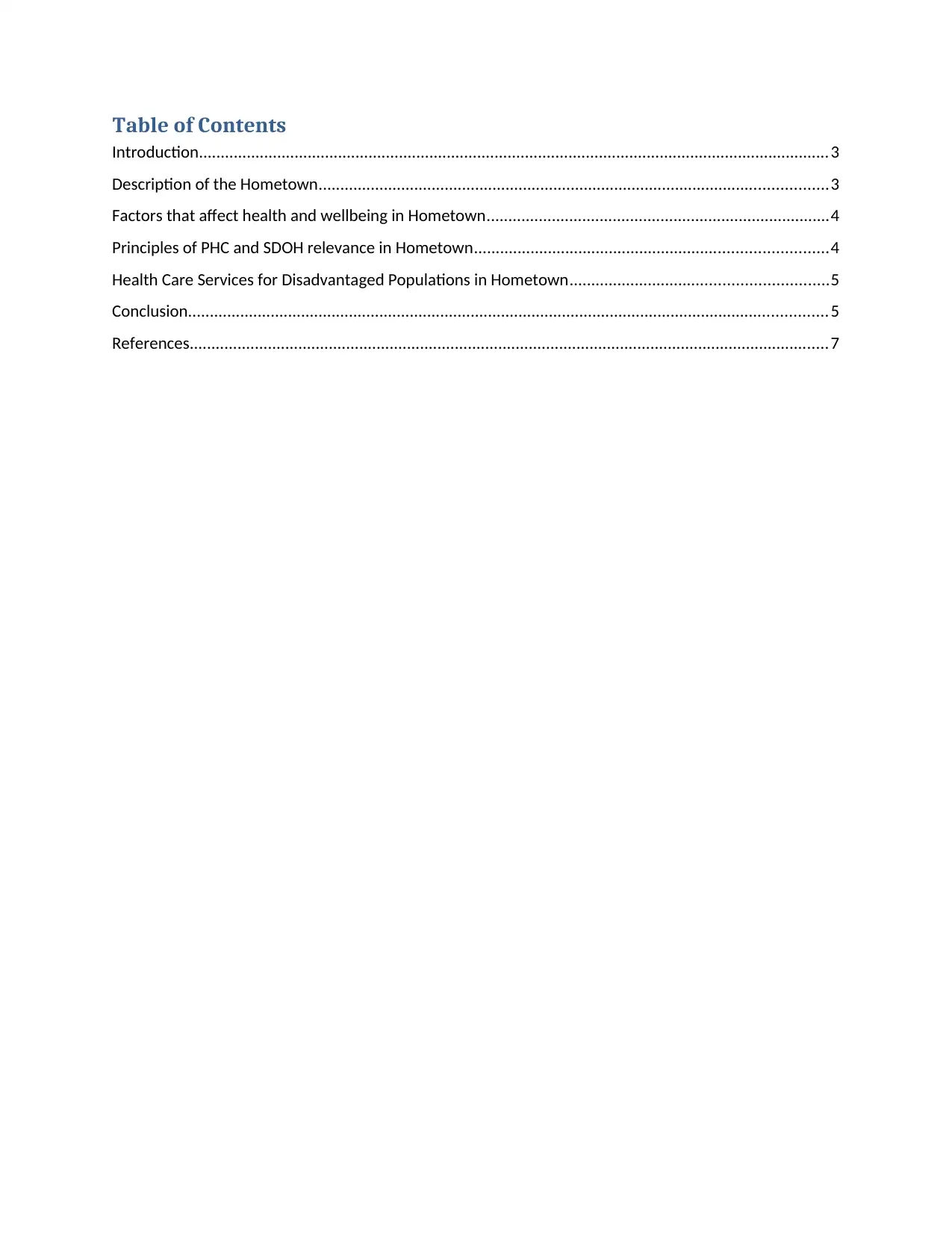
Table of Contents
Introduction.................................................................................................................................................3
Description of the Hometown.....................................................................................................................3
Factors that affect health and wellbeing in Hometown...............................................................................4
Principles of PHC and SDOH relevance in Hometown.................................................................................4
Health Care Services for Disadvantaged Populations in Hometown...........................................................5
Conclusion...................................................................................................................................................5
References...................................................................................................................................................7
Introduction.................................................................................................................................................3
Description of the Hometown.....................................................................................................................3
Factors that affect health and wellbeing in Hometown...............................................................................4
Principles of PHC and SDOH relevance in Hometown.................................................................................4
Health Care Services for Disadvantaged Populations in Hometown...........................................................5
Conclusion...................................................................................................................................................5
References...................................................................................................................................................7

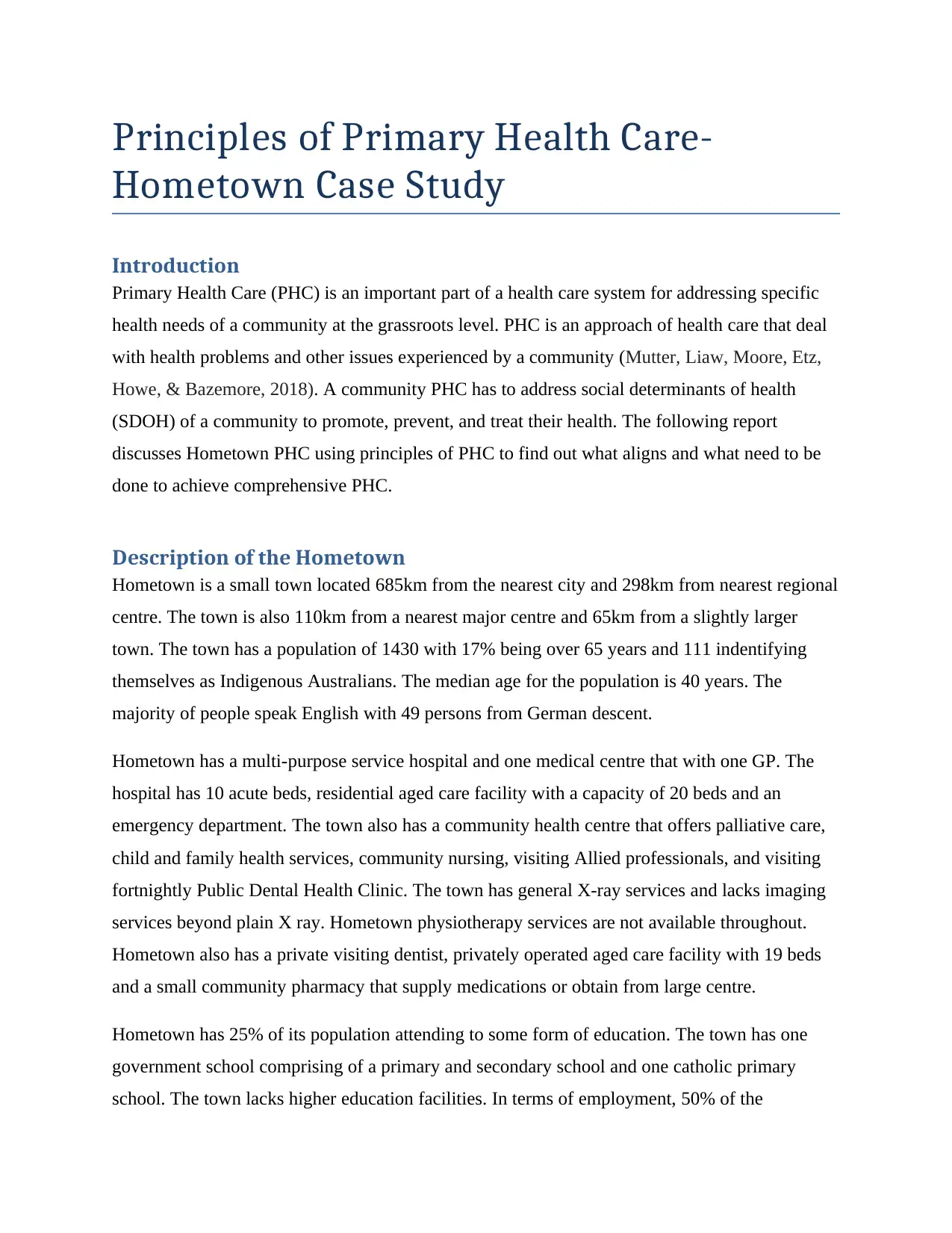
Principles of Primary Health Care-
Hometown Case Study
Introduction
Primary Health Care (PHC) is an important part of a health care system for addressing specific
health needs of a community at the grassroots level. PHC is an approach of health care that deal
with health problems and other issues experienced by a community (Mutter, Liaw, Moore, Etz,
Howe, & Bazemore, 2018). A community PHC has to address social determinants of health
(SDOH) of a community to promote, prevent, and treat their health. The following report
discusses Hometown PHC using principles of PHC to find out what aligns and what need to be
done to achieve comprehensive PHC.
Description of the Hometown
Hometown is a small town located 685km from the nearest city and 298km from nearest regional
centre. The town is also 110km from a nearest major centre and 65km from a slightly larger
town. The town has a population of 1430 with 17% being over 65 years and 111 indentifying
themselves as Indigenous Australians. The median age for the population is 40 years. The
majority of people speak English with 49 persons from German descent.
Hometown has a multi-purpose service hospital and one medical centre that with one GP. The
hospital has 10 acute beds, residential aged care facility with a capacity of 20 beds and an
emergency department. The town also has a community health centre that offers palliative care,
child and family health services, community nursing, visiting Allied professionals, and visiting
fortnightly Public Dental Health Clinic. The town has general X-ray services and lacks imaging
services beyond plain X ray. Hometown physiotherapy services are not available throughout.
Hometown also has a private visiting dentist, privately operated aged care facility with 19 beds
and a small community pharmacy that supply medications or obtain from large centre.
Hometown has 25% of its population attending to some form of education. The town has one
government school comprising of a primary and secondary school and one catholic primary
school. The town lacks higher education facilities. In terms of employment, 50% of the
Hometown Case Study
Introduction
Primary Health Care (PHC) is an important part of a health care system for addressing specific
health needs of a community at the grassroots level. PHC is an approach of health care that deal
with health problems and other issues experienced by a community (Mutter, Liaw, Moore, Etz,
Howe, & Bazemore, 2018). A community PHC has to address social determinants of health
(SDOH) of a community to promote, prevent, and treat their health. The following report
discusses Hometown PHC using principles of PHC to find out what aligns and what need to be
done to achieve comprehensive PHC.
Description of the Hometown
Hometown is a small town located 685km from the nearest city and 298km from nearest regional
centre. The town is also 110km from a nearest major centre and 65km from a slightly larger
town. The town has a population of 1430 with 17% being over 65 years and 111 indentifying
themselves as Indigenous Australians. The median age for the population is 40 years. The
majority of people speak English with 49 persons from German descent.
Hometown has a multi-purpose service hospital and one medical centre that with one GP. The
hospital has 10 acute beds, residential aged care facility with a capacity of 20 beds and an
emergency department. The town also has a community health centre that offers palliative care,
child and family health services, community nursing, visiting Allied professionals, and visiting
fortnightly Public Dental Health Clinic. The town has general X-ray services and lacks imaging
services beyond plain X ray. Hometown physiotherapy services are not available throughout.
Hometown also has a private visiting dentist, privately operated aged care facility with 19 beds
and a small community pharmacy that supply medications or obtain from large centre.
Hometown has 25% of its population attending to some form of education. The town has one
government school comprising of a primary and secondary school and one catholic primary
school. The town lacks higher education facilities. In terms of employment, 50% of the
⊘ This is a preview!⊘
Do you want full access?
Subscribe today to unlock all pages.

Trusted by 1+ million students worldwide

Hometown population is employed with 4.2% unemployed. The biggest industry is agriculture
and most people work in machinery operation and there is a small factory that offers some
employment. The town’s average weekly income is below Australian average. Hometown has
social services for the NSW government department that are offered in weekly basis.
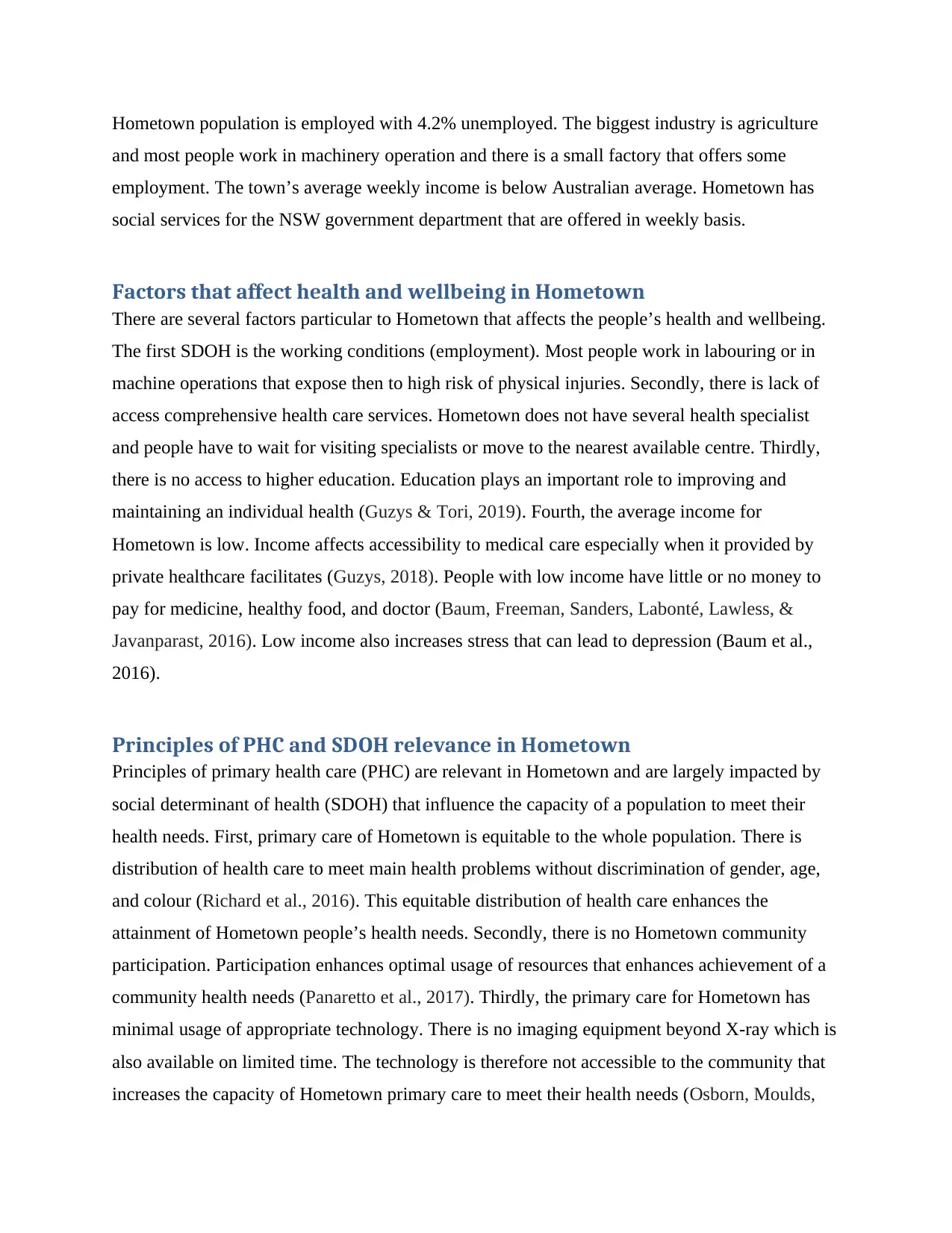
Factors that affect health and wellbeing in Hometown
There are several factors particular to Hometown that affects the people’s health and wellbeing.
The first SDOH is the working conditions (employment). Most people work in labouring or in
machine operations that expose then to high risk of physical injuries. Secondly, there is lack of
access comprehensive health care services. Hometown does not have several health specialist
and people have to wait for visiting specialists or move to the nearest available centre. Thirdly,
there is no access to higher education. Education plays an important role to improving and
maintaining an individual health (Guzys & Tori, 2019). Fourth, the average income for
Hometown is low. Income affects accessibility to medical care especially when it provided by
private healthcare facilitates (Guzys, 2018). People with low income have little or no money to
pay for medicine, healthy food, and doctor (Baum, Freeman, Sanders, Labonté, Lawless, &
Javanparast, 2016). Low income also increases stress that can lead to depression (Baum et al.,
2016).
Principles of PHC and SDOH relevance in Hometown
Principles of primary health care (PHC) are relevant in Hometown and are largely impacted by
social determinant of health (SDOH) that influence the capacity of a population to meet their
health needs. First, primary care of Hometown is equitable to the whole population. There is
distribution of health care to meet main health problems without discrimination of gender, age,
and colour (Richard et al., 2016). This equitable distribution of health care enhances the
attainment of Hometown people’s health needs. Secondly, there is no Hometown community
participation. Participation enhances optimal usage of resources that enhances achievement of a
community health needs (Panaretto et al., 2017). Thirdly, the primary care for Hometown has
minimal usage of appropriate technology. There is no imaging equipment beyond X-ray which is
also available on limited time. The technology is therefore not accessible to the community that
increases the capacity of Hometown primary care to meet their health needs (Osborn, Moulds,
and most people work in machinery operation and there is a small factory that offers some
employment. The town’s average weekly income is below Australian average. Hometown has
social services for the NSW government department that are offered in weekly basis.
Factors that affect health and wellbeing in Hometown
There are several factors particular to Hometown that affects the people’s health and wellbeing.
The first SDOH is the working conditions (employment). Most people work in labouring or in
machine operations that expose then to high risk of physical injuries. Secondly, there is lack of
access comprehensive health care services. Hometown does not have several health specialist
and people have to wait for visiting specialists or move to the nearest available centre. Thirdly,
there is no access to higher education. Education plays an important role to improving and
maintaining an individual health (Guzys & Tori, 2019). Fourth, the average income for
Hometown is low. Income affects accessibility to medical care especially when it provided by
private healthcare facilitates (Guzys, 2018). People with low income have little or no money to
pay for medicine, healthy food, and doctor (Baum, Freeman, Sanders, Labonté, Lawless, &
Javanparast, 2016). Low income also increases stress that can lead to depression (Baum et al.,
2016).
Principles of PHC and SDOH relevance in Hometown
Principles of primary health care (PHC) are relevant in Hometown and are largely impacted by
social determinant of health (SDOH) that influence the capacity of a population to meet their
health needs. First, primary care of Hometown is equitable to the whole population. There is
distribution of health care to meet main health problems without discrimination of gender, age,
and colour (Richard et al., 2016). This equitable distribution of health care enhances the
attainment of Hometown people’s health needs. Secondly, there is no Hometown community
participation. Participation enhances optimal usage of resources that enhances achievement of a
community health needs (Panaretto et al., 2017). Thirdly, the primary care for Hometown has
minimal usage of appropriate technology. There is no imaging equipment beyond X-ray which is
also available on limited time. The technology is therefore not accessible to the community that
increases the capacity of Hometown primary care to meet their health needs (Osborn, Moulds,
Paraphrase This Document
Need a fresh take? Get an instant paraphrase of this document with our AI Paraphraser

Schneider, Doty, Squires, & Sarnak, 2015). Social determinants of health that are relevant to
Hometown and influence capacity are low income and education. Low income below that of
average Australians make affordability for Hometown community low. They cannot afford to
access health care services that are available in the nearest towns or the city to book appointment
with private visiting health care practitioners. This SDOH influences the capacity of the
Hometown people to pay for health care services (Henderson, Javanparast, MacKean, Freeman,
Baum, & Ziersch, 2018). Another SDOH is education. There are no learning institutions for
higher education in Hometown. Education opens opportunities to better jobs ad high pay that
have positive impact to health (Guzyz, 2018). Education also enhances people’s capacity to
make health decisions and have healthy behaviours. Lack of high level education will therefore
reduce the capacity of achieving comprehensive primary health care (Herderson et al., 2018).
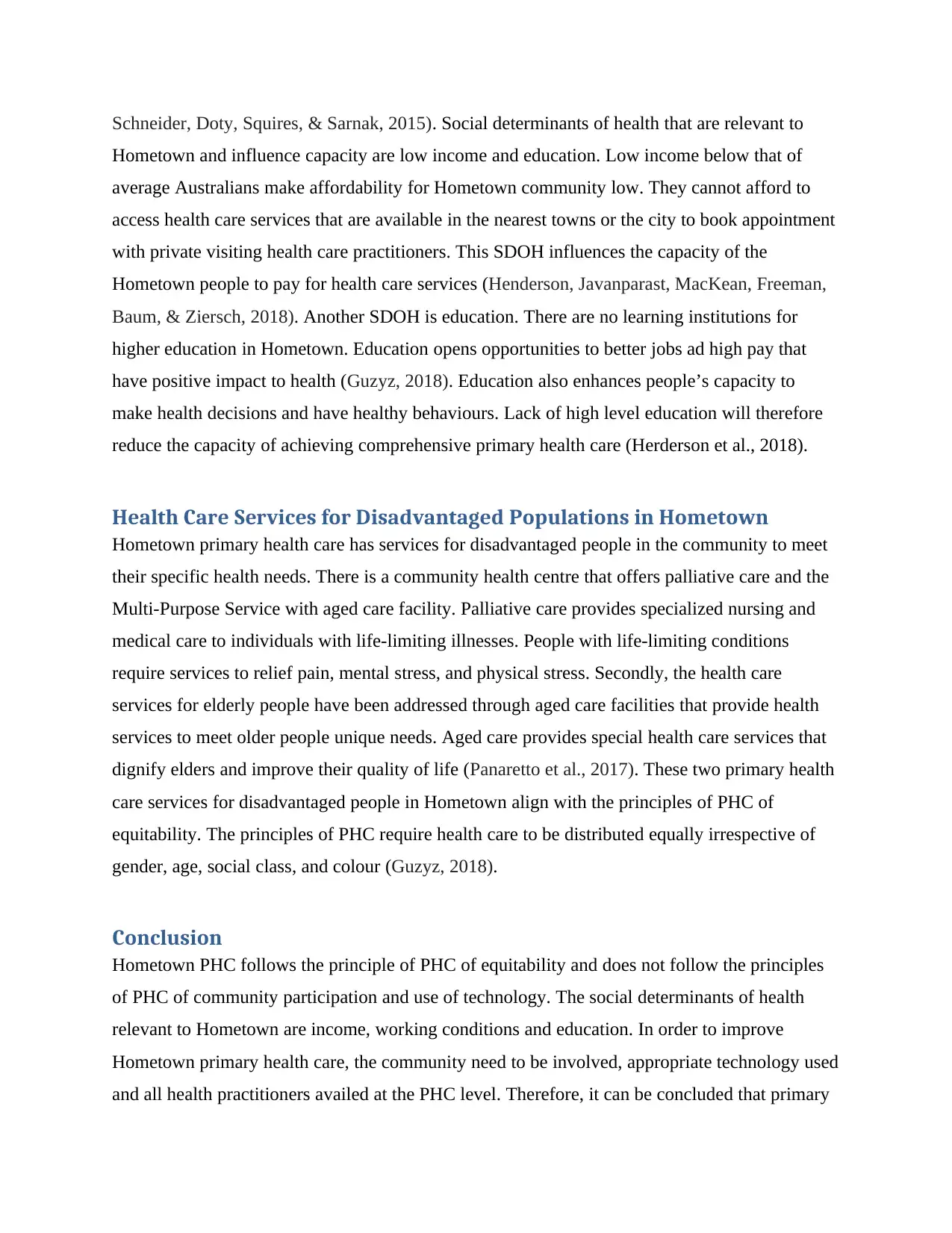
Health Care Services for Disadvantaged Populations in Hometown
Hometown primary health care has services for disadvantaged people in the community to meet
their specific health needs. There is a community health centre that offers palliative care and the
Multi-Purpose Service with aged care facility. Palliative care provides specialized nursing and
medical care to individuals with life-limiting illnesses. People with life-limiting conditions
require services to relief pain, mental stress, and physical stress. Secondly, the health care
services for elderly people have been addressed through aged care facilities that provide health
services to meet older people unique needs. Aged care provides special health care services that
dignify elders and improve their quality of life (Panaretto et al., 2017). These two primary health
care services for disadvantaged people in Hometown align with the principles of PHC of
equitability. The principles of PHC require health care to be distributed equally irrespective of
gender, age, social class, and colour (Guzyz, 2018).
Conclusion
Hometown PHC follows the principle of PHC of equitability and does not follow the principles
of PHC of community participation and use of technology. The social determinants of health
relevant to Hometown are income, working conditions and education. In order to improve
Hometown primary health care, the community need to be involved, appropriate technology used
and all health practitioners availed at the PHC level. Therefore, it can be concluded that primary
Hometown and influence capacity are low income and education. Low income below that of
average Australians make affordability for Hometown community low. They cannot afford to
access health care services that are available in the nearest towns or the city to book appointment
with private visiting health care practitioners. This SDOH influences the capacity of the
Hometown people to pay for health care services (Henderson, Javanparast, MacKean, Freeman,
Baum, & Ziersch, 2018). Another SDOH is education. There are no learning institutions for
higher education in Hometown. Education opens opportunities to better jobs ad high pay that
have positive impact to health (Guzyz, 2018). Education also enhances people’s capacity to
make health decisions and have healthy behaviours. Lack of high level education will therefore
reduce the capacity of achieving comprehensive primary health care (Herderson et al., 2018).
Health Care Services for Disadvantaged Populations in Hometown
Hometown primary health care has services for disadvantaged people in the community to meet
their specific health needs. There is a community health centre that offers palliative care and the
Multi-Purpose Service with aged care facility. Palliative care provides specialized nursing and
medical care to individuals with life-limiting illnesses. People with life-limiting conditions
require services to relief pain, mental stress, and physical stress. Secondly, the health care
services for elderly people have been addressed through aged care facilities that provide health
services to meet older people unique needs. Aged care provides special health care services that
dignify elders and improve their quality of life (Panaretto et al., 2017). These two primary health
care services for disadvantaged people in Hometown align with the principles of PHC of
equitability. The principles of PHC require health care to be distributed equally irrespective of
gender, age, social class, and colour (Guzyz, 2018).
Conclusion
Hometown PHC follows the principle of PHC of equitability and does not follow the principles
of PHC of community participation and use of technology. The social determinants of health
relevant to Hometown are income, working conditions and education. In order to improve
Hometown primary health care, the community need to be involved, appropriate technology used
and all health practitioners availed at the PHC level. Therefore, it can be concluded that primary

health care services should follow principles of PHC and assess community social determinant of
health for comprehensive/holistic approach to primary health care provision.
⊘ This is a preview!⊘
Do you want full access?
Subscribe today to unlock all pages.

Trusted by 1+ million students worldwide

References
Baum, F., Freeman, T., Sanders, D., Labonté, R., Lawless, A., & Javanparast, S. (2016).
Comprehensive primary health care under neo-liberalism in Australia. Social Science &
Medicine, 168, 43-52.
Guzyz, D. (2018). Community and primary health care. In Guzys, D., Brown, R., Halcomb, E.
and Whitehead, D. (2018). An introduction to Community and Primary Health Care.
Port Melbourne: Cambridge University Press. 4-16.
Guzys, D. (2018). Empowering individuals and communities. In Guzys, D., Brown, R.,
Halcomb, E. and Whitehead, D. (2018) An introduction to Community and Primary
Health Care. Port Melbourne: Cambridge University Press. 21-33
Guzys, D & Tori, K. (2019). Health and healthcare in Australia. In Arnott, N., Paliadelis, P. and
Cruickshank, M. (Eds) The Road to Nursing. Melbourne: Cambridge University Press.
138-147
Henderson, J., Javanparast, S., MacKean, T., Freeman, T., Baum, F., & Ziersch, A. (2018).
Commissioning and equity in primary care in Australia: Views from Primary Health
Networks. Health & social care in the community, 26(1), 80-89.
Mutter, J. B., Liaw, W., Moore, M. A., Etz, R. S., Howe, A., & Bazemore, A. (2018). Core
principles to improve primary care quality management. J Am Board Fam Med, 31(6),
931-940.
Osborn, R., Moulds, D., Schneider, E. C., Doty, M. M., Squires, D., & Sarnak, D. O. (2015).
Primary care physicians in ten countries report challenges caring for patients with
complex health needs. Health Affairs, 34(12), 2104-2112.
Panaretto, K. S., Dellit, A., Hollins, A., Wason, G., Sidhom, C., Chilcott, K., ... & McDermott,
R. (2017). Understanding patient access patterns for primary health-care services for
Aboriginal and Islander people in Queensland: a geospatial mapping
approach. Australian Journal of Primary Health, 23(1), 37-45.
Baum, F., Freeman, T., Sanders, D., Labonté, R., Lawless, A., & Javanparast, S. (2016).
Comprehensive primary health care under neo-liberalism in Australia. Social Science &
Medicine, 168, 43-52.
Guzyz, D. (2018). Community and primary health care. In Guzys, D., Brown, R., Halcomb, E.
and Whitehead, D. (2018). An introduction to Community and Primary Health Care.
Port Melbourne: Cambridge University Press. 4-16.
Guzys, D. (2018). Empowering individuals and communities. In Guzys, D., Brown, R.,
Halcomb, E. and Whitehead, D. (2018) An introduction to Community and Primary
Health Care. Port Melbourne: Cambridge University Press. 21-33
Guzys, D & Tori, K. (2019). Health and healthcare in Australia. In Arnott, N., Paliadelis, P. and
Cruickshank, M. (Eds) The Road to Nursing. Melbourne: Cambridge University Press.
138-147
Henderson, J., Javanparast, S., MacKean, T., Freeman, T., Baum, F., & Ziersch, A. (2018).
Commissioning and equity in primary care in Australia: Views from Primary Health
Networks. Health & social care in the community, 26(1), 80-89.
Mutter, J. B., Liaw, W., Moore, M. A., Etz, R. S., Howe, A., & Bazemore, A. (2018). Core
principles to improve primary care quality management. J Am Board Fam Med, 31(6),
931-940.
Osborn, R., Moulds, D., Schneider, E. C., Doty, M. M., Squires, D., & Sarnak, D. O. (2015).
Primary care physicians in ten countries report challenges caring for patients with
complex health needs. Health Affairs, 34(12), 2104-2112.
Panaretto, K. S., Dellit, A., Hollins, A., Wason, G., Sidhom, C., Chilcott, K., ... & McDermott,
R. (2017). Understanding patient access patterns for primary health-care services for
Aboriginal and Islander people in Queensland: a geospatial mapping
approach. Australian Journal of Primary Health, 23(1), 37-45.
Paraphrase This Document
Need a fresh take? Get an instant paraphrase of this document with our AI Paraphraser

Richard, L., Furler, J., Densley, K., Haggerty, J., Russell, G., Levesque, J. F., & Gunn, J. (2016).
Equity of access to primary healthcare for vulnerable populations: the IMPACT
international online survey of innovations. International journal for equity in
health, 15(1), 64.
Equity of access to primary healthcare for vulnerable populations: the IMPACT
international online survey of innovations. International journal for equity in
health, 15(1), 64.
1 out of 8
Related Documents
Your All-in-One AI-Powered Toolkit for Academic Success.
+13062052269
info@desklib.com
Available 24*7 on WhatsApp / Email
Unlock your academic potential
Copyright © 2020–2025 A2Z Services. All Rights Reserved. Developed and managed by ZUCOL.