Honey and Mumford Learning Styles: Understanding Students in Education

Verified

Added on  2023/06/08

|5
|1065
|298
Essay
AI Summary
This essay explores student learning styles using the Honey and Mumford model, which includes Activist, Reflector, Theorist, and Pragmatist styles. It discusses how understanding these styles can help educators create more effective learning environments. The essay references a literature review that highlights the heterogeneity of student motivations for attending lectures and how different learning styles impact their engagement and preferences. It concludes that a better understanding of student interests and learning styles is crucial for academic success and for professionals to develop meaningful learning opportunities. The study also emphasizes the importance of considering individual versus group situations when assessing student learning strategies.
Document Page
Understanding
students
tabler-icon-diamond-filled.svg

Paraphrase This Document

Need a fresh take? Get an instant paraphrase of this document with our AI Paraphraser
Document Page
Table of Contents
INTRODUCTION ..........................................................................................................................3
MAIN BODY...................................................................................................................................3
CONCLUSION................................................................................................................................4
REFERENCES................................................................................................................................5
Document Page
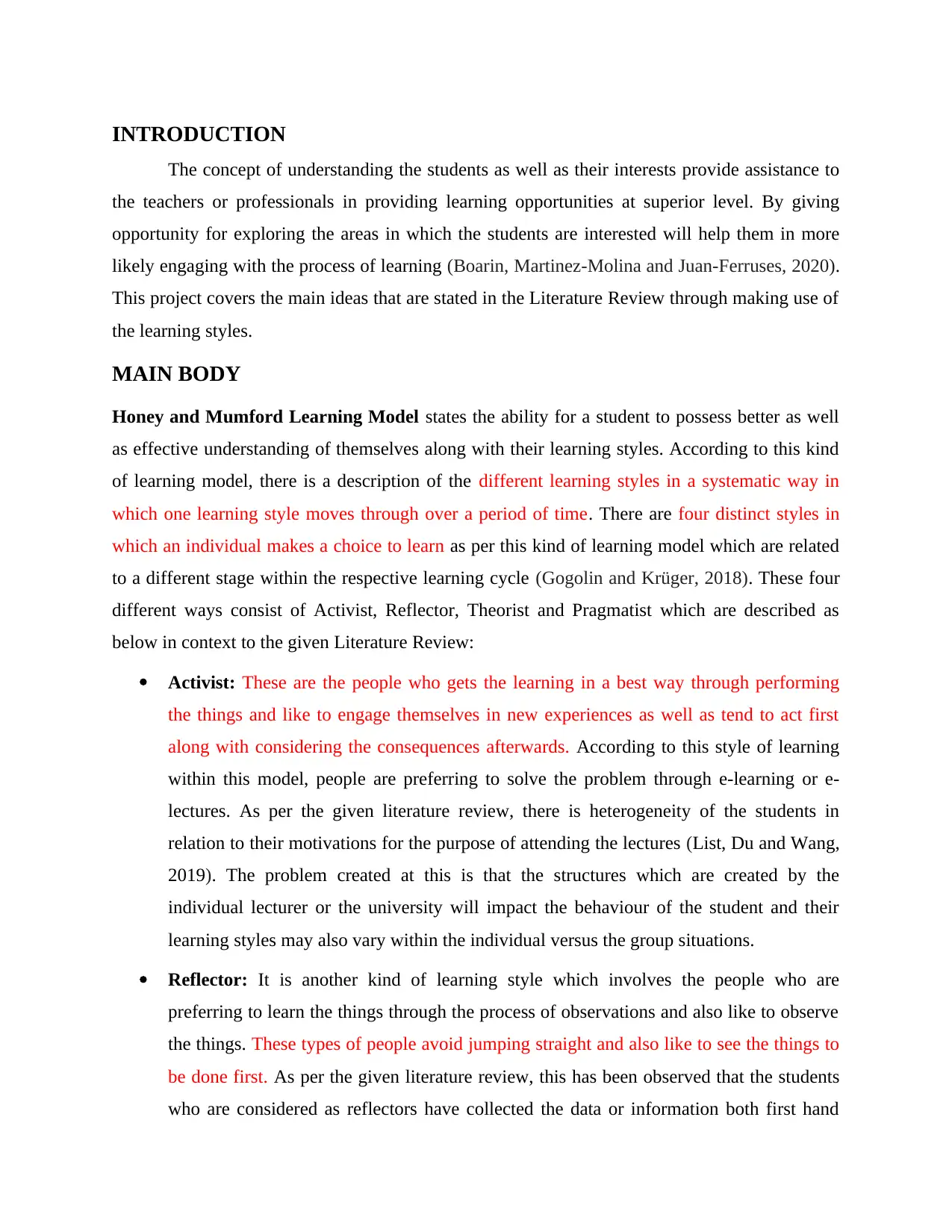
INTRODUCTION
The concept of understanding the students as well as their interests provide assistance to
the teachers or professionals in providing learning opportunities at superior level. By giving
opportunity for exploring the areas in which the students are interested will help them in more
likely engaging with the process of learning (Boarin, Martinez-Molina and Juan-Ferruses, 2020).
This project covers the main ideas that are stated in the Literature Review through making use of
the learning styles.
MAIN BODY
Honey and Mumford Learning Model states the ability for a student to possess better as well
as effective understanding of themselves along with their learning styles. According to this kind
of learning model, there is a description of the different learning styles in a systematic way in
which one learning style moves through over a period of time. There are four distinct styles in
which an individual makes a choice to learn as per this kind of learning model which are related
to a different stage within the respective learning cycle (Gogolin and Krüger, 2018). These four
different ways consist of Activist, Reflector, Theorist and Pragmatist which are described as
below in context to the given Literature Review:
Activist: These are the people who gets the learning in a best way through performing
the things and like to engage themselves in new experiences as well as tend to act first
along with considering the consequences afterwards. According to this style of learning
within this model, people are preferring to solve the problem through e-learning or e-
lectures. As per the given literature review, there is heterogeneity of the students in
relation to their motivations for the purpose of attending the lectures (List, Du and Wang,
2019). The problem created at this is that the structures which are created by the
individual lecturer or the university will impact the behaviour of the student and their
learning styles may also vary within the individual versus the group situations.
Reflector: It is another kind of learning style which involves the people who are
preferring to learn the things through the process of observations and also like to observe
the things. These types of people avoid jumping straight and also like to see the things to
be done first. As per the given literature review, this has been observed that the students
who are considered as reflectors have collected the data or information both first hand
Document Page
and also from other people. They had also analysed the information before coming to any
kind of conclusion. At this stage, it has been reflected that students attending the lectures
expressed that they enjoy the lecturer's individualized learning style, social interaction as
well as the opportunity for peer-to-peer learning.
Theorist: This stage includes individuals who chooses to get the learning of things
through dressing down the theory behind something and need frameworks, concepts and
facts for learning things effectively (Schoenfeld, Smith III and Arcavi, 2019). Such
people analyse information for developing own theories and also value rationale and
logical thinking. In present scenario, the author has considered these because the
objectives of lecture attendance include the informatiom development, the promotion of
ideas as well as a change in behaviour.
Pragmatist: This involves people who learn things with seeing as well as application of
these into the practice within the situation of the real world. As per the given scenario,
this stage allows students to put such ideas into practice immediately, as well as to take
new ideas for what they have learned. In such way, they are considered as practical and
choose to get on as well as getting things to be performed (Su and et.al., 2019). In
relation to given literature review, such students like to determine what they are required
for their learning and give their appropriate attention to the information regarding tasks as
well as not miss any sort of concerned information. According to the given LR, it has also
been stated that the students who are practical are over-represented in commerce and
informatics, along with being the youngest on campus, reporting the least rates of
attendance and scoring the greater marks. As usual, such kind of students also stated a
low opinion of the lectures as well as its quality.
CONCLUSION
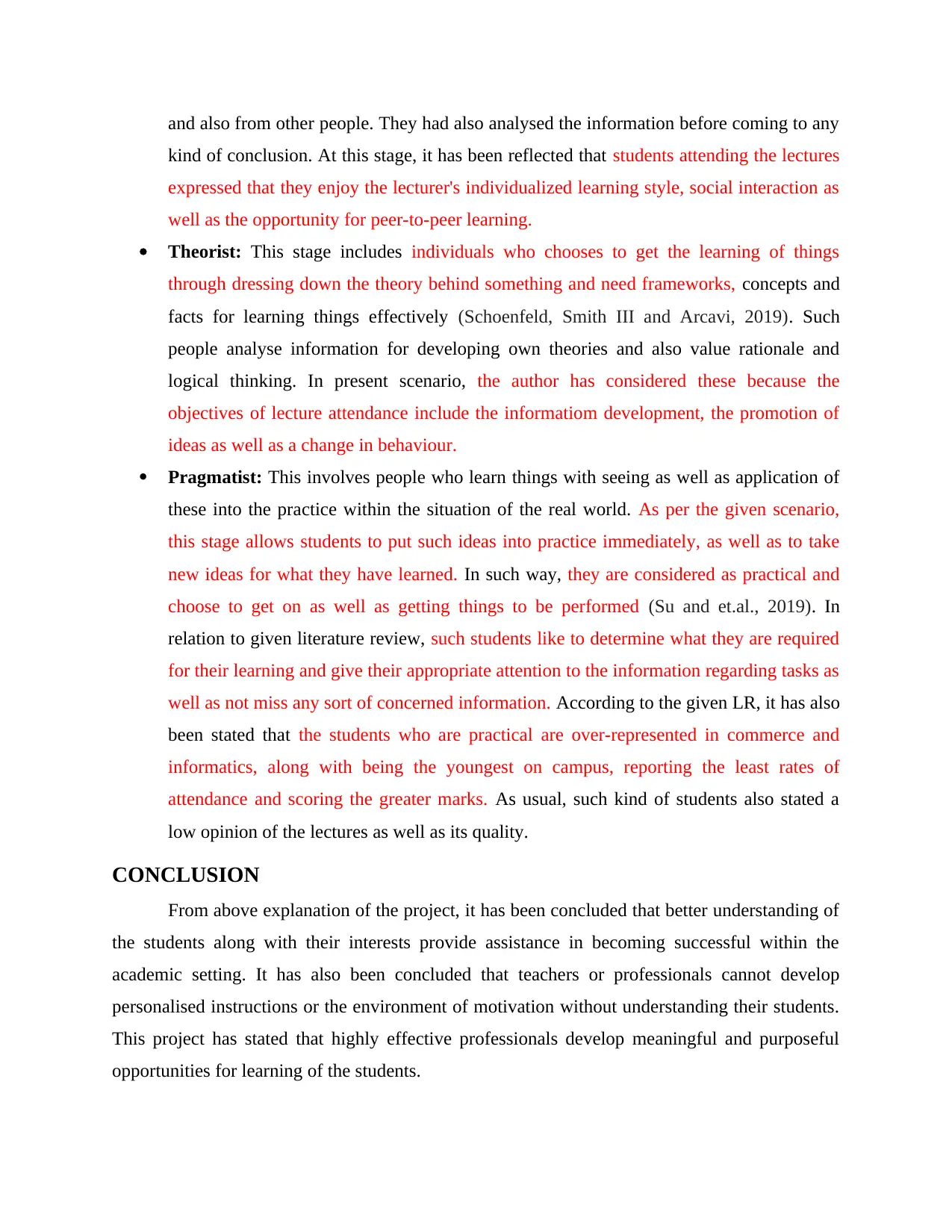
From above explanation of the project, it has been concluded that better understanding of
the students along with their interests provide assistance in becoming successful within the
academic setting. It has also been concluded that teachers or professionals cannot develop
personalised instructions or the environment of motivation without understanding their students.
This project has stated that highly effective professionals develop meaningful and purposeful
opportunities for learning of the students.
tabler-icon-diamond-filled.svg

Paraphrase This Document

Need a fresh take? Get an instant paraphrase of this document with our AI Paraphraser
Document Page
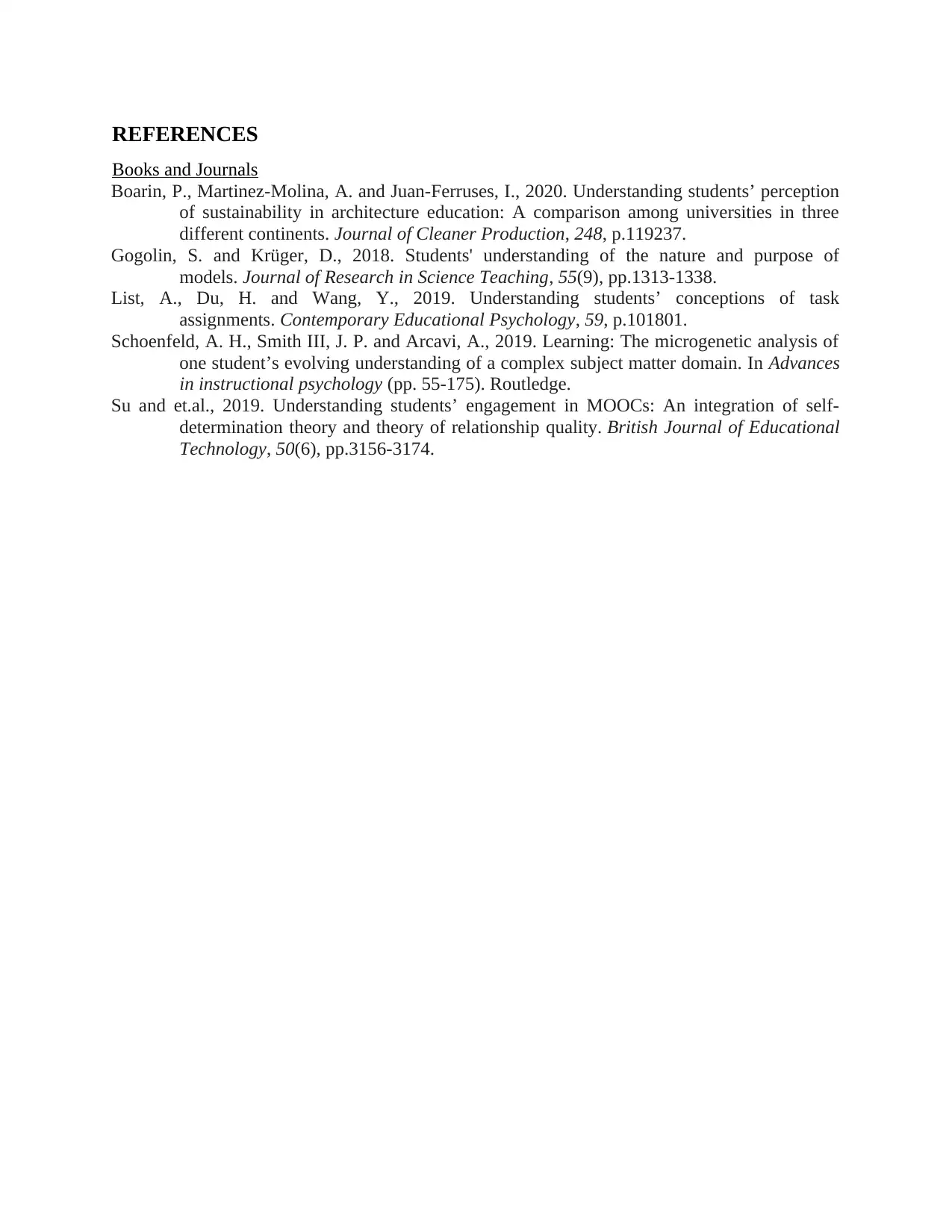
REFERENCES
Books and Journals
Boarin, P., Martinez-Molina, A. and Juan-Ferruses, I., 2020. Understanding students’ perception
of sustainability in architecture education: A comparison among universities in three
different continents. Journal of Cleaner Production, 248, p.119237.
Gogolin, S. and Krüger, D., 2018. Students' understanding of the nature and purpose of
models. Journal of Research in Science Teaching, 55(9), pp.1313-1338.
List, A., Du, H. and Wang, Y., 2019. Understanding students’ conceptions of task
assignments. Contemporary Educational Psychology, 59, p.101801.
Schoenfeld, A. H., Smith III, J. P. and Arcavi, A., 2019. Learning: The microgenetic analysis of
one student’s evolving understanding of a complex subject matter domain. In Advances
in instructional psychology (pp. 55-175). Routledge.
Su and et.al., 2019. Understanding students’ engagement in MOOCs: An integration of self‐
determination theory and theory of relationship quality. British Journal of Educational
Technology, 50(6), pp.3156-3174.
chevron_up_icon
1 out of 5
circle_padding
hide_on_mobile
zoom_out_icon
[object Object]