Financial Principles and Analysis Assignment: Hoosier Racing Company

Verified

Added on  2022/10/06

|9
|1899
|457
Report
AI Summary
This report provides a comprehensive financial analysis of the Hoosier Racing Company, evaluating its investment decisions using various capital budgeting techniques. The analysis includes the calculation of incremental free cash flows, net present value (NPV), internal rate of return (IRR), payback period, discounted payback period, and profitability index (PI). The report examines the accounting treatment of depreciation and its impact on project feasibility. The study determines the feasibility of the project based on the calculated NPV, IRR, and payback periods. Furthermore, the report discusses mutually exclusive projects and their evaluation criteria, concluding with a recommendation on whether the project should be accepted based on the financial metrics. The report utilizes a discounting rate of 16% and provides detailed calculations and interpretations of each financial metric to assess the project's viability and profitability, considering the company's investment and return expectations.
Document Page
Running head: FINANCE 1
FINANCIAL PRINCIPLES AND ANALYSIS
(HOOSIER RACING COMPANY)
tabler-icon-diamond-filled.svg

Paraphrase This Document

Need a fresh take? Get an instant paraphrase of this document with our AI Paraphraser
Document Page
Running head: FINANCE
Contents
Question 1...................................................................................................................................................3
Question 2...................................................................................................................................................4
Question 3...................................................................................................................................................4
Question 4...................................................................................................................................................4
Question 5...................................................................................................................................................6
Conclusion...................................................................................................................................................7
References...................................................................................................................................................8
Document Page
Running head: FINANCE
Question 1
Particulars Year 0 Year 1 Year 2 Year 3 Year 4
Initial
investment
$
(226,000,00
0.0000)
Sales
$
270,568,000.
0000
$
285,609,06
6.0800
$
301,488,025.308
1
$
318,251,65
2.8515
Variable cost
$
95,184,000.0
000
$
100,525,72
8.9600
$
106,167,869.835
8
$
112,127,35
2.8011
Gross profit
$
175,384,000.
0000
$
185,083,33
7.1200
$
195,320,155.472
2
$
206,124,30
0.0505
Less:
Expenses
Marketing
costs
$
25,000,000.0
000
$
25,812,500.
0000
$
26,651,406.2500
$
27,517,576.
9531
Depreciation
$
35,000,000.0
000
$
35,000,000.
0000
$
35,000,000.0000
$
35,000,000.
0000
Profit before
tax
$
115,384,000.
0000
$
124,270,83
7.1200
$
133,668,749.222
2
$
143,606,72
3.0973
Tax @ 35%
$
40,384,400.0
000
$
43,494,792.
9920
$
46,784,062.2278
$
50,262,353.
0841
Profit after tax
$
74,999,600.0
000
$
80,776,044.
1280
$
86,884,686.9944
$
93,344,370.
0133
Additional
Working
capital
$
11,000,000.0
000
$
71,402,266.
5200
$
75,372,006.3270
$
237,337,18
6.0599
Incremental
free cash flows
$
(226,000,00
0.0000)
$
98,999,600.0
000
$
44,373,777.
6080
$
46,512,680.6674
$
558,181,55
6.0732
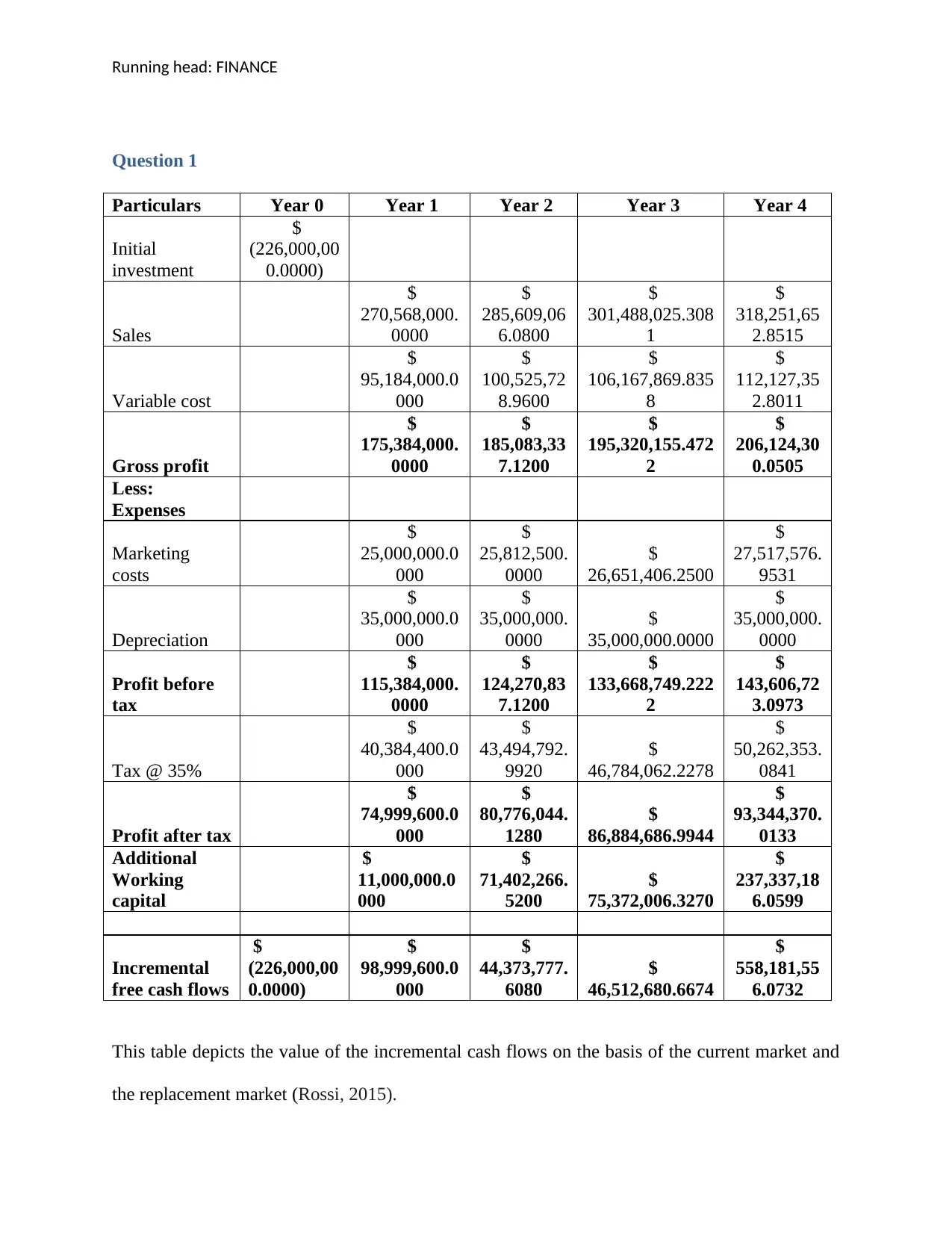
This table depicts the value of the incremental cash flows on the basis of the current market and
the replacement market (Rossi, 2015).
Document Page
Running head: FINANCE
Question 2
While calculating and making the implementation of the depreciation under the capital budgeting
technique, it is very well necessary to understand the accounting treatment of the same and the
logic behind it. The definition of depreciation can be referred to as reduction in the valuation of
the asset over the useful life of the asset. The devaluation is the declining in the estimation of the
benefit over the valuable existence of the asset. As the depreciation is a non-cash expense, so
when it is recorded for the particular proposal or project, the value of depreciation is reduced for
the purpose of getting the advantage of the tax. Thereafter the depreciation is added back to the
value of annual cash flows. This results in increasing the feasibility of the project (Al-Mutairi,
Naser & Saeid, 2018).
Question 3
In order to make the straw-man argument, the discounting rates helps in enabling incomparable
future numbers into present value terms so that the logical comparisons can be made. The
amounts are not considered at face value, rather they are considered at the present value. In the
present scenario the discounting rate that has been used is 16% as it is inclusive of the return to
compensate the perceived risk. The major fluctuations are experienced due to the up and down
scenario of the market (Sari & Kahraman, 2015).
Question 4
"Net present worth is the present estimation of the incomes at the necessary pace of
return of your venture contrasted with your underlying speculation as determined by knight. In
handy terms, it's a technique for figuring out one’s arrival on speculation, or ROI, for a task or
use. By taking a gander at all of the cash you hope to make from the venture and making an
tabler-icon-diamond-filled.svg

Paraphrase This Document

Need a fresh take? Get an instant paraphrase of this document with our AI Paraphraser
Document Page
Running head: FINANCE
interpretation of those profits into the present dollars, one can choose whether the undertaking is
advantageous or not or whether the project tends to be feasible and will give the returns in the
near future or not (Baucells & Bodily, 2018). The net present value in the present case is
$230398838 and since it is of the positive nature, it is very much feasible for the company. The
net present value has been arrived at by calculating the total revenue and the total variable costs
of both the sections such as original market and the replacement market. The fixed costs such as
marketing and the depreciation costs are deducted along with the amount of tax. However, the
working capital has been recorded as the percentage of the sales which will be recovered at the
end of the 4th year. The net present value of the company tends to be feasible only when it shows
that the annual cash flows are progressing towards the positive figure (Ghiami & Beullens,
2016).
The next measurement that has been utilized by the organization is IRR return, which is
also one of the most important techniques of capital budgeting and it assists in deciding whether
the projects shall be accepted or rejected. IRR is frequently known to as monetary pace of return
or the limited income return as well (DeFusco, et al 2015). There are different variables that are
not taken into the calculation of IRR, such as expansion or the other limiting returns. The best
strategy that can be utilized to compute the IRR is to summarize the yearly cash flows and
ascertaining the each progression separately as it is considered as the best technique and also it is
useful in demonstrating the cash flows which can be understood at each level. As per the current
case study it can be said that the rate of IRR is 46% which is greater than the cost of the capital
of 16%, hence the project on the basis of IRR shall be selected (Mishan, 2015).
The next technique of the capital budgeting that has been used by the company is
payback period. The payback time is the period which decides the timeframe in which the firm
Document Page
Running head: FINANCE
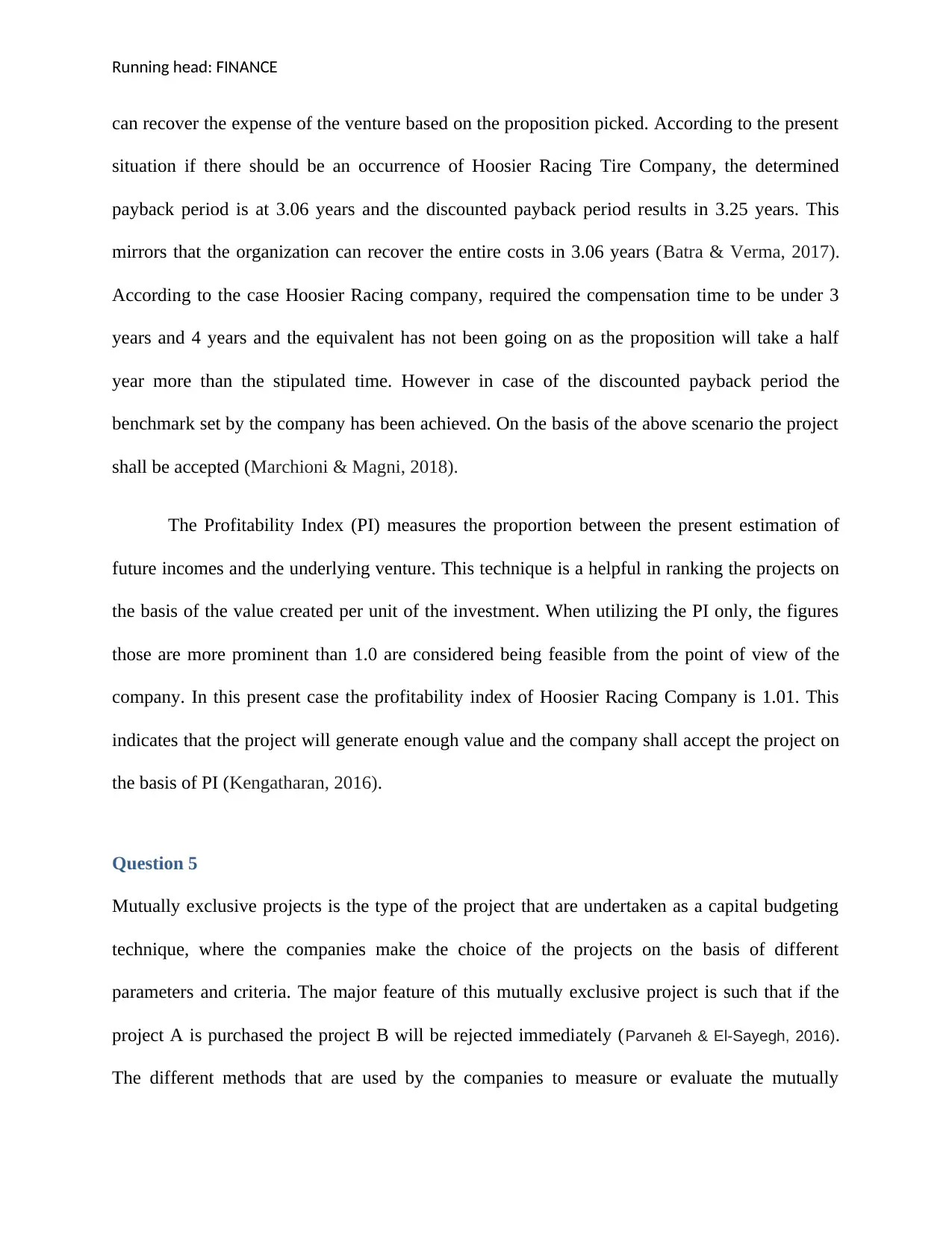
can recover the expense of the venture based on the proposition picked. According to the present
situation if there should be an occurrence of Hoosier Racing Tire Company, the determined
payback period is at 3.06 years and the discounted payback period results in 3.25 years. This
mirrors that the organization can recover the entire costs in 3.06 years (Batra & Verma, 2017).
According to the case Hoosier Racing company, required the compensation time to be under 3
years and 4 years and the equivalent has not been going on as the proposition will take a half
year more than the stipulated time. However in case of the discounted payback period the
benchmark set by the company has been achieved. On the basis of the above scenario the project
shall be accepted (Marchioni & Magni, 2018).
The Profitability Index (PI) measures the proportion between the present estimation of
future incomes and the underlying venture. This technique is a helpful in ranking the projects on
the basis of the value created per unit of the investment. When utilizing the PI only, the figures
those are more prominent than 1.0 are considered being feasible from the point of view of the
company. In this present case the profitability index of Hoosier Racing Company is 1.01. This
indicates that the project will generate enough value and the company shall accept the project on
the basis of PI (Kengatharan, 2016).
Question 5
Mutually exclusive projects is the type of the project that are undertaken as a capital budgeting
technique, where the companies make the choice of the projects on the basis of different
parameters and criteria. The major feature of this mutually exclusive project is such that if the
project A is purchased the project B will be rejected immediately (Parvaneh & El-Sayegh, 2016).
The different methods that are used by the companies to measure or evaluate the mutually
Document Page
Running head: FINANCE
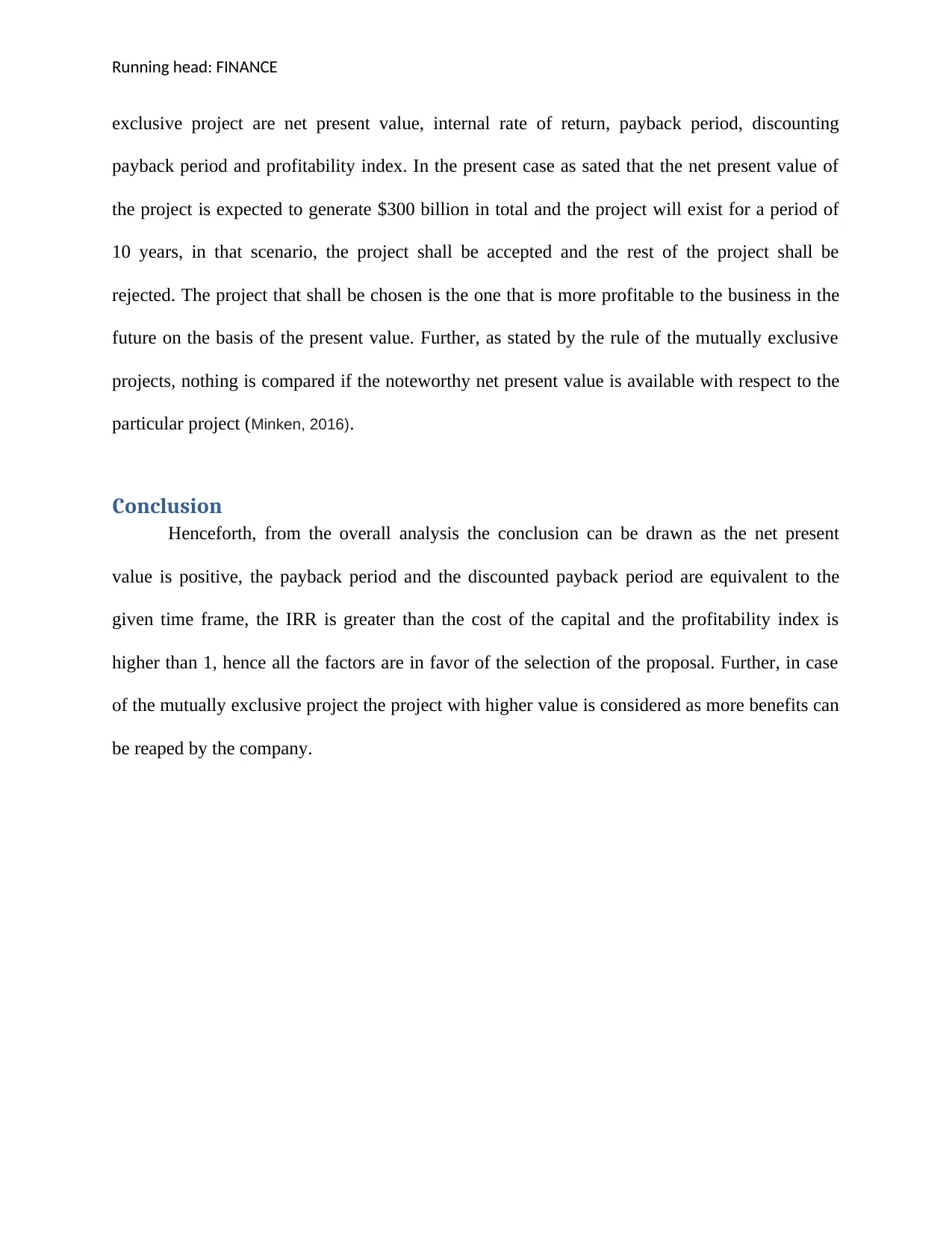
exclusive project are net present value, internal rate of return, payback period, discounting
payback period and profitability index. In the present case as sated that the net present value of
the project is expected to generate $300 billion in total and the project will exist for a period of
10 years, in that scenario, the project shall be accepted and the rest of the project shall be
rejected. The project that shall be chosen is the one that is more profitable to the business in the
future on the basis of the present value. Further, as stated by the rule of the mutually exclusive
projects, nothing is compared if the noteworthy net present value is available with respect to the
particular project (Minken, 2016).
Conclusion
Henceforth, from the overall analysis the conclusion can be drawn as the net present
value is positive, the payback period and the discounted payback period are equivalent to the
given time frame, the IRR is greater than the cost of the capital and the profitability index is
higher than 1, hence all the factors are in favor of the selection of the proposal. Further, in case
of the mutually exclusive project the project with higher value is considered as more benefits can
be reaped by the company.
tabler-icon-diamond-filled.svg

Paraphrase This Document

Need a fresh take? Get an instant paraphrase of this document with our AI Paraphraser
Document Page
Running head: FINANCE
References
Al-Mutairi, A., Naser, K., & Saeid, M. (2018). Capital budgeting practices by non-financial
companies listed on Kuwait Stock Exchange (KSE). Cogent Economics & Finance, 6(1),
1468232.
Batra, R., & Verma, S. (2017). Capital budgeting practices in Indian companies. IIMB
Management Review, 29(1), 29-44.
Baucells, M., & Bodily, S. E. (2018). Net Present Value Analysis of Projects Under Expected
Utility.
DeFusco, R. A., McLeavey, D. W., Pinto, J. E., Runkle, D. E., & Anson, M. J.
(2015). Quantitative investment analysis. John Wiley & Sons.
Ghiami, Y., & Beullens, P. (2016). Planning for shortages? Net Present Value analysis for a
deteriorating item with partial backlogging. International Journal of Production
Economics, 178, 1-11.
Kengatharan, L. (2016). Capital budgeting theory and practice: a review and agenda for future
research. Applied Economics and Finance, 3(2), 15-38.
Marchioni, A., & Magni, C. A. (2018). Investment decisions and sensitivity analysis: NPV-
consistency of rates of return. European Journal of Operational Research, 268(1), 361-
372.
Minken, H. (2016). Project selection with sets of mutually exclusive alternatives. Economics of
Transportation, 6, 11-17.
Document Page
Running head: FINANCE
Mishan, E. J. (2015). Elements of Cost-Benefit Analysis (Routledge Revivals). Routledge.
Parvaneh, F., & El-Sayegh, S. M. (2016). Project selection using the combined approach of AHP
and LP. Journal of Financial Management of Property and Construction, 21(1), 39-53.
Rossi, M. (2015). The use of capital budgeting techniques: an outlook from Italy. International
Journal of Management Practice, 8(1), 43-56.
Sari, I. U., & Kahraman, C. (2015). Interval type-2 fuzzy capital budgeting. International
Journal of Fuzzy Systems, 17(4), 635-646.
chevron_up_icon
1 out of 9
circle_padding
hide_on_mobile
zoom_out_icon
[object Object]