Horse Evolution: A Report on Timeline, Traits, and Adaptation
VerifiedAdded on  2023/06/07
|6
|862
|293
Report
AI Summary
This report provides a comprehensive overview of horse evolution, starting with Hyracotherium and progressing through various stages to Equus. It details the physical traits and adaptations of different horse species over millions of years. The report explores significant changes in leg structure, teeth, and overall body size. Furthermore, it focuses on the Arabian horse, detailing its characteristics and how these traits enable it to thrive in desert environments. The report also examines the potential adaptations of the Arabian horse if it were to be moved to a cool and wet climate, predicting changes in hoof structure, coat thickness, and teeth size. The report is supported by cited sources to back up claims and data.

Surname 1
Evolution
Name
ID
Course
Unit
Lecturer
Date
Evolution
Name
ID
Course
Unit
Lecturer
Date
Paraphrase This Document
Need a fresh take? Get an instant paraphrase of this document with our AI Paraphraser

Surname 2
Evolution of horses
Part 1: timeline evolution of horses over the past 54 million ears from Hyracotherium to
Equus.
Horse Traits and changes
Hyracotherium Hyracotherium horse lived in forest and was
looking like a dog. Its The legs had four toes
on every front foot, however, the hind feet
had three toes. This horse made use of pads
while walking. It had three incisors and the
teeth being lowly crowned. It had one canine,
different four premolars and three molars for
grinding in every jaw according to Collins,
11179.
Orohippus This horse was as a result of gradual change
of Hyracotherium. It was still looking like a
dog with legs short, neck short and its back
was arched. Its toes were similar with
Hyracotherium with three toes behind while
four toes on front. It was still having the pad
footed. However, there was distortion of first
and second toes. The teeth undergone some
changes the premolar on the behind
Evolution of horses
Part 1: timeline evolution of horses over the past 54 million ears from Hyracotherium to
Equus.
Horse Traits and changes
Hyracotherium Hyracotherium horse lived in forest and was
looking like a dog. Its The legs had four toes
on every front foot, however, the hind feet
had three toes. This horse made use of pads
while walking. It had three incisors and the
teeth being lowly crowned. It had one canine,
different four premolars and three molars for
grinding in every jaw according to Collins,
11179.
Orohippus This horse was as a result of gradual change
of Hyracotherium. It was still looking like a
dog with legs short, neck short and its back
was arched. Its toes were similar with
Hyracotherium with three toes behind while
four toes on front. It was still having the pad
footed. However, there was distortion of first
and second toes. The teeth undergone some
changes the premolar on the behind

Surname 3
transformed into molar.
Epihippus This generation was still having pad foot. It
looked like a dog. It had three toes behind
while four toes occupied the front. It
experienced evolution on the teeth. The last
two premolars transformed to molars.
Mesohippus Librado, 430 says that, Mesohippus horse
seemed to be large than the earlier generation.
It had evolved and not looking like a dog. The
legs became longer together with the neck.
Both the hind feet and the front feet had 3
toes. The tooth transformed and could feed
effectively.
Pliohippus This horse undergone some changes on the
toes. It had curved teeth unlike the other
generation.
Equus Equus had long neck, legs seemed to be long,
as well as the nose its jaws seemed to be deep.
It was looking like a horse not dog like. The
toes were fully transformed. The horse was
now living outside the forest and the long
limbs could allow it to run and escape enemy.
transformed into molar.
Epihippus This generation was still having pad foot. It
looked like a dog. It had three toes behind
while four toes occupied the front. It
experienced evolution on the teeth. The last
two premolars transformed to molars.
Mesohippus Librado, 430 says that, Mesohippus horse
seemed to be large than the earlier generation.
It had evolved and not looking like a dog. The
legs became longer together with the neck.
Both the hind feet and the front feet had 3
toes. The tooth transformed and could feed
effectively.
Pliohippus This horse undergone some changes on the
toes. It had curved teeth unlike the other
generation.
Equus Equus had long neck, legs seemed to be long,
as well as the nose its jaws seemed to be deep.
It was looking like a horse not dog like. The
toes were fully transformed. The horse was
now living outside the forest and the long
limbs could allow it to run and escape enemy.
⊘ This is a preview!⊘
Do you want full access?
Subscribe today to unlock all pages.

Trusted by 1+ million students worldwide

Surname 4
Arabian horse character traits
Arabian horse came from the desert. The character traits that have made Arabian horse to be bred
by human include; it has very strong hooves that can walk in the desert while carrying luggage,
the strong hooves allow the horse to pass through the stones and sand in the desert. It feeds on
less amount of food as compared to other types of horses according to Shoemaker, 220. Its tails
are always high when in motion and the skin seems to be thin, this makes it to lose little amount
of water and effective cooling of the body. While other breads of horse have fast-twitch muscles,
this breed have slow-twitch muscles. The trait enables the horse to withstand in limited oxygen
areas and walk longer distance. However, these character traits may change. Amount of food this
horse feeds on may increase. Apart from that, the traits of the hooves would change because
human travel with this horse in areas that is not desert.
Part 3
In this part, the area where the Arabian horse got lost is area where there is cool and wet climate.
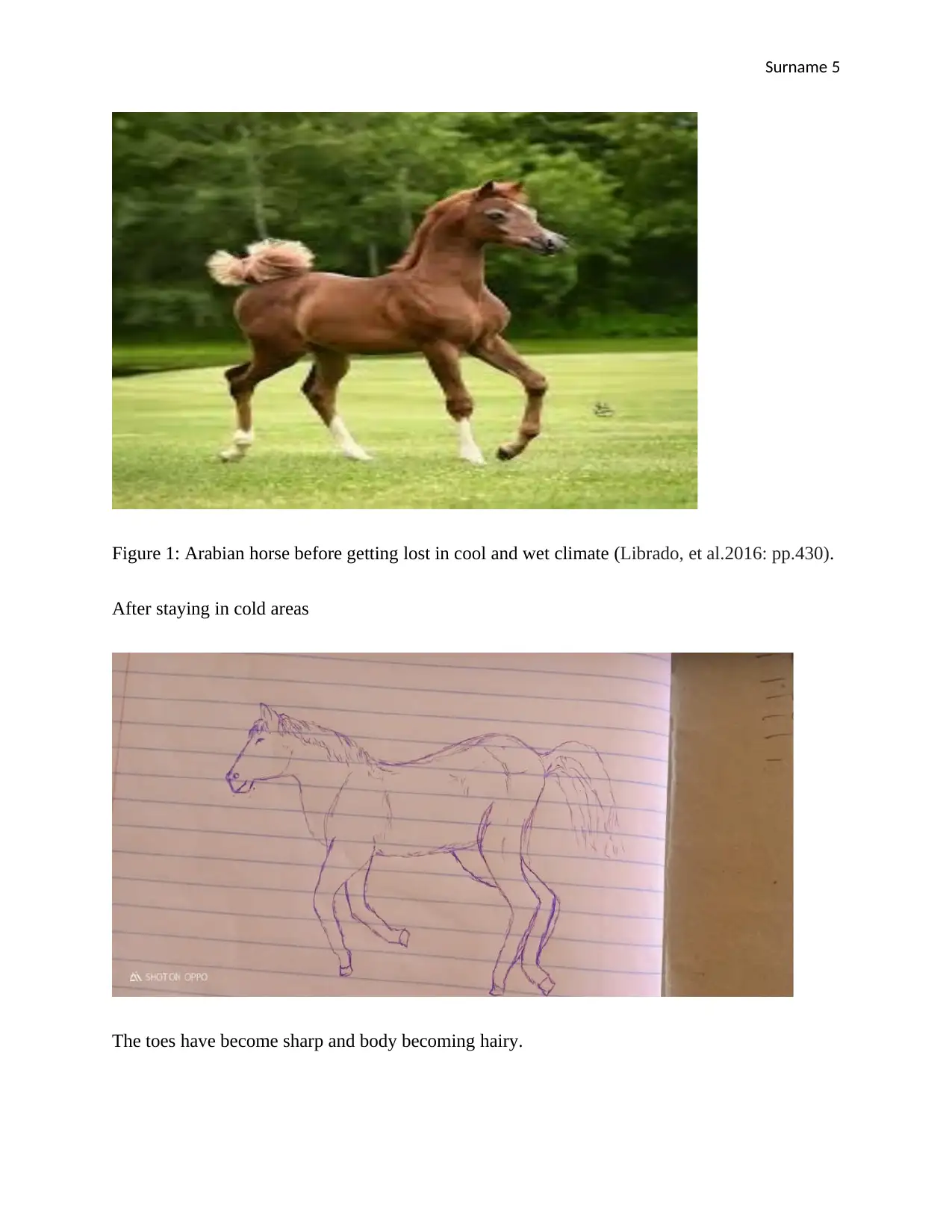
The changes that this horse would undergo is the trait of the hooves. The hooves would now
grow thin as compared to the large hooves used to adapt on sand in reference to Semprebon,115.
This place I muddy and thin hooves would now survive. The skin would develop thick hair to
adapt on the cold that is in the area. The other inevitable change that the horse would undergo is
the traits of the teeth. The teeth would grow smaller to feed on grass only as compared to the last
time it was feeding on hard desert food.
Part 4
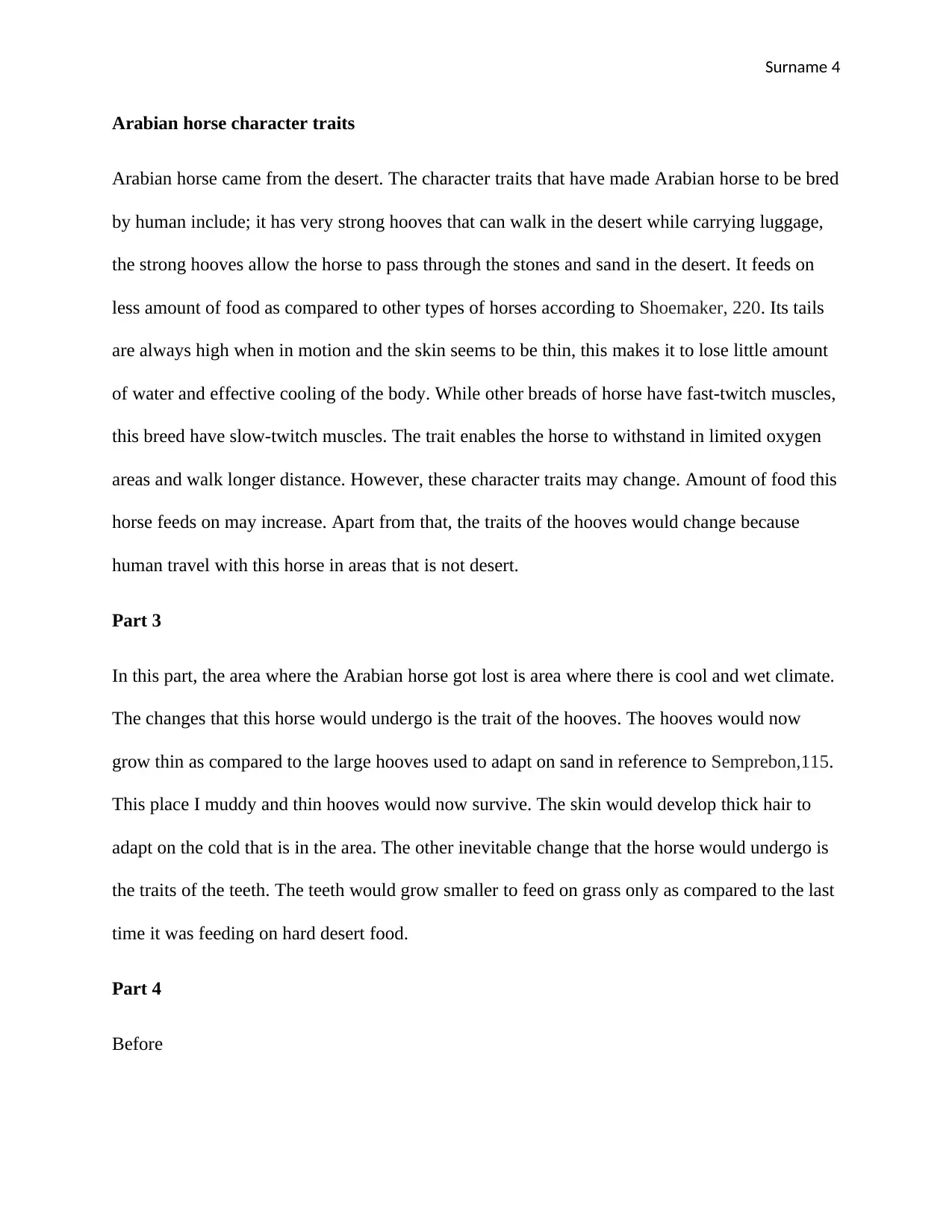
Before
Arabian horse character traits
Arabian horse came from the desert. The character traits that have made Arabian horse to be bred
by human include; it has very strong hooves that can walk in the desert while carrying luggage,
the strong hooves allow the horse to pass through the stones and sand in the desert. It feeds on
less amount of food as compared to other types of horses according to Shoemaker, 220. Its tails
are always high when in motion and the skin seems to be thin, this makes it to lose little amount
of water and effective cooling of the body. While other breads of horse have fast-twitch muscles,
this breed have slow-twitch muscles. The trait enables the horse to withstand in limited oxygen
areas and walk longer distance. However, these character traits may change. Amount of food this
horse feeds on may increase. Apart from that, the traits of the hooves would change because
human travel with this horse in areas that is not desert.
Part 3
In this part, the area where the Arabian horse got lost is area where there is cool and wet climate.
The changes that this horse would undergo is the trait of the hooves. The hooves would now
grow thin as compared to the large hooves used to adapt on sand in reference to Semprebon,115.
This place I muddy and thin hooves would now survive. The skin would develop thick hair to
adapt on the cold that is in the area. The other inevitable change that the horse would undergo is
the traits of the teeth. The teeth would grow smaller to feed on grass only as compared to the last
time it was feeding on hard desert food.
Part 4
Before
Paraphrase This Document
Need a fresh take? Get an instant paraphrase of this document with our AI Paraphraser

Surname 5
Figure 1: Arabian horse before getting lost in cool and wet climate (Librado, et al.2016: pp.430).
After staying in cold areas
The toes have become sharp and body becoming hairy.
Figure 1: Arabian horse before getting lost in cool and wet climate (Librado, et al.2016: pp.430).
After staying in cold areas
The toes have become sharp and body becoming hairy.

Surname 6
Work cited
Collins, Patrick J., et al. "Recent evolution of equine influenza and the origin of canine
influenza." Proceedings of the National Academy of Sciences 111.30 (2014): 11175-
11180.
Librado, Pablo, et al. "The evolutionary origin and genetic makeup of domestic
horses." Genetics 204.2 (2016): 423-434.
Semprebon, Gina M., et al. "Paleodietary reconstruction of fossil horses from the Eocene through
Pleistocene of North America." Palaeogeography, Palaeoclimatology,
Palaeoecology 442 (2016): 110-127.
Shoemaker, Lauren, and Aaron Clauset. "Body mass evolution and diversification within horses
(family Equidae)." Ecology letters 17.2 (2014): 211-220.
Work cited
Collins, Patrick J., et al. "Recent evolution of equine influenza and the origin of canine
influenza." Proceedings of the National Academy of Sciences 111.30 (2014): 11175-
11180.
Librado, Pablo, et al. "The evolutionary origin and genetic makeup of domestic
horses." Genetics 204.2 (2016): 423-434.
Semprebon, Gina M., et al. "Paleodietary reconstruction of fossil horses from the Eocene through
Pleistocene of North America." Palaeogeography, Palaeoclimatology,
Palaeoecology 442 (2016): 110-127.
Shoemaker, Lauren, and Aaron Clauset. "Body mass evolution and diversification within horses
(family Equidae)." Ecology letters 17.2 (2014): 211-220.
⊘ This is a preview!⊘
Do you want full access?
Subscribe today to unlock all pages.

Trusted by 1+ million students worldwide
1 out of 6
Your All-in-One AI-Powered Toolkit for Academic Success.
 +13062052269
info@desklib.com
Available 24*7 on WhatsApp / Email
Unlock your academic potential
Copyright © 2020–2025 A2Z Services. All Rights Reserved. Developed and managed by ZUCOL.