Analysis of Hospital Employee Education and Training Program's Impact

Verified

Added on  2022/11/07

|4
|388
|6
Report
AI Summary
This report examines the Hospital Employee Education and Training program, designed to address nursing shortages and enhance employee skills. The program, supported by the Washington State Board for Community and Technical Colleges, offers diverse educational opportunities including distance learning, simulation, and worksite classes. The report highlights the program's impact on increasing racial diversity in nursing, supporting working adults, and improving course completion rates. It further explores the interrelationships between lifelong learning, clinical reasoning, and clinical judgment, emphasizing the importance of education in managing stressful situations and improving patient care through critical thinking and informed decision-making. The report references key publications that support the program's significance in nursing education and its role in shaping the future of healthcare.

Document Page
NURSING 1
Nursing
Students Name
Institutional Affiliation
tabler-icon-diamond-filled.svg

Paraphrase This Document

Need a fresh take? Get an instant paraphrase of this document with our AI Paraphraser
Document Page
NURSING 2
Hospital Employee Education and Training
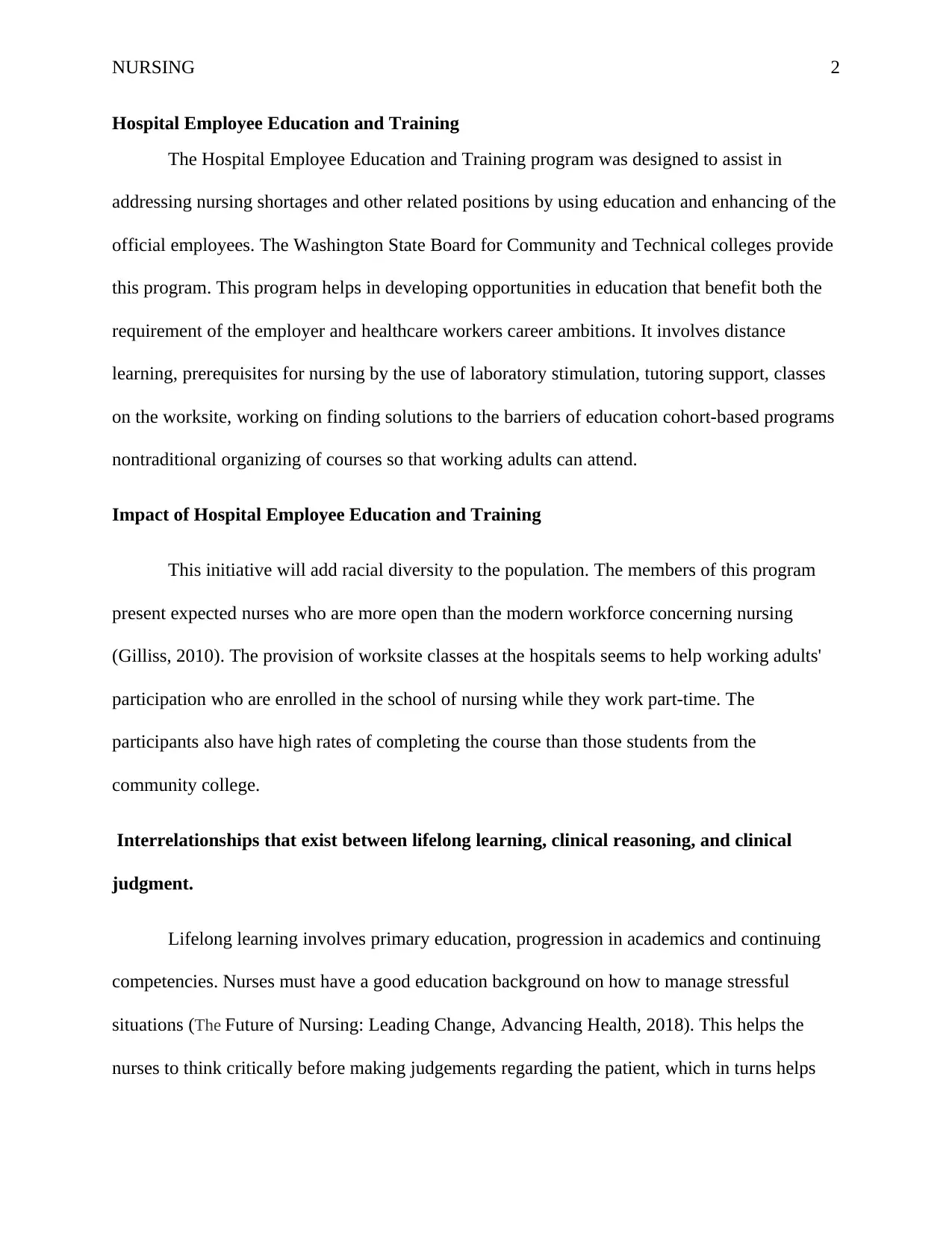
The Hospital Employee Education and Training program was designed to assist in
addressing nursing shortages and other related positions by using education and enhancing of the
official employees. The Washington State Board for Community and Technical colleges provide
this program. This program helps in developing opportunities in education that benefit both the
requirement of the employer and healthcare workers career ambitions. It involves distance
learning, prerequisites for nursing by the use of laboratory stimulation, tutoring support, classes
on the worksite, working on finding solutions to the barriers of education cohort-based programs
nontraditional organizing of courses so that working adults can attend.
Impact of Hospital Employee Education and Training
This initiative will add racial diversity to the population. The members of this program
present expected nurses who are more open than the modern workforce concerning nursing
(Gilliss, 2010). The provision of worksite classes at the hospitals seems to help working adults'
participation who are enrolled in the school of nursing while they work part-time. The
participants also have high rates of completing the course than those students from the
community college.
Interrelationships that exist between lifelong learning, clinical reasoning, and clinical
judgment.
Lifelong learning involves primary education, progression in academics and continuing
competencies. Nurses must have a good education background on how to manage stressful
situations (The Future of Nursing: Leading Change, Advancing Health, 2018). This helps the
nurses to think critically before making judgements regarding the patient, which in turns helps
Document Page
NURSING 3
them to make an appropriate judgement and improve their care management. This demonstrates
that they have a necessary and more in-depth understanding of the coordination of care, systems
thinking and quality improvement.
Reference
Document Page
NURSING 4
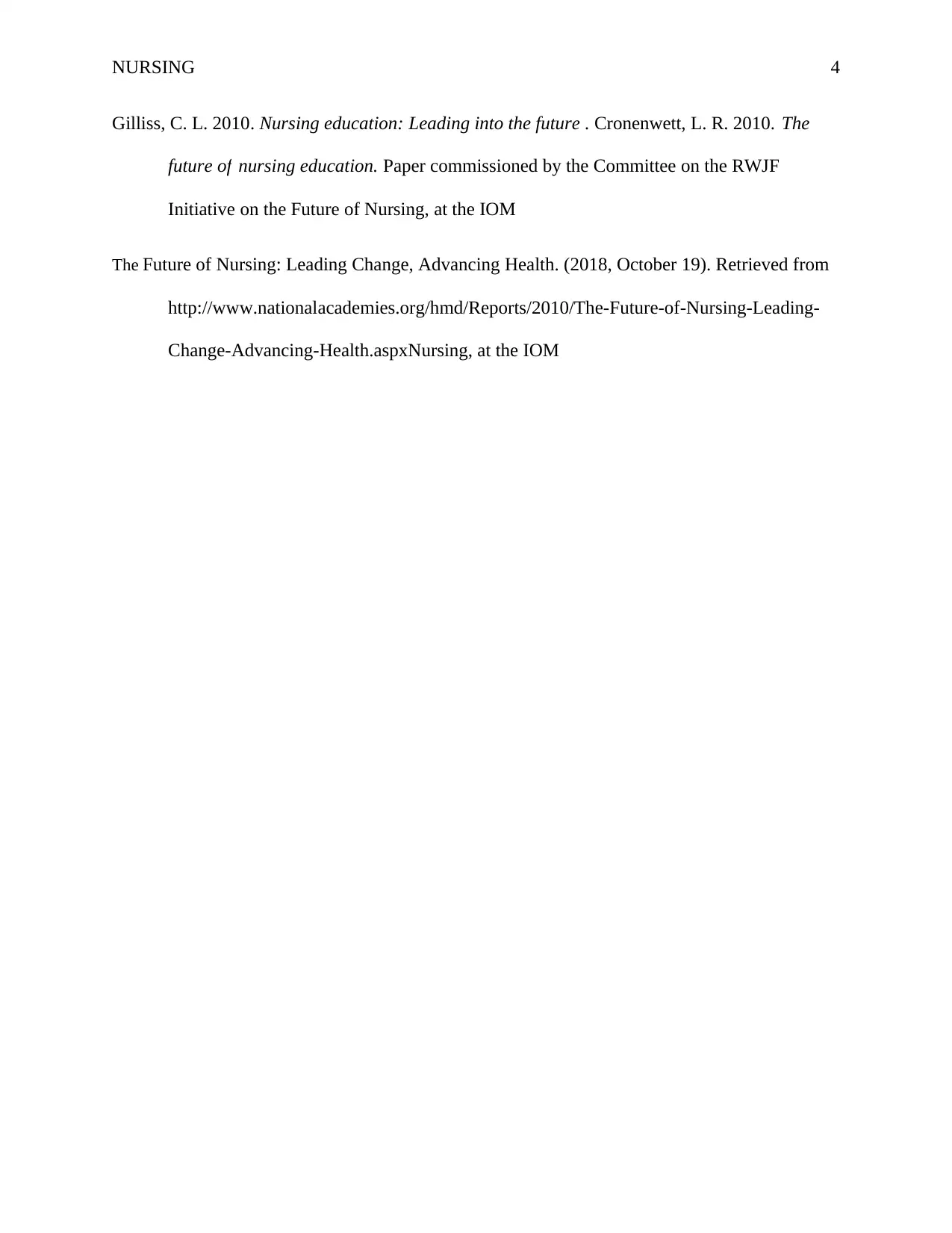
Gilliss, C. L. 2010. Nursing education: Leading into the future . Cronenwett, L. R. 2010. The
future of nursing education. Paper commissioned by the Committee on the RWJF
Initiative on the Future of Nursing, at the IOM
The Future of Nursing: Leading Change, Advancing Health. (2018, October 19). Retrieved from
http://www.nationalacademies.org/hmd/Reports/2010/The-Future-of-Nursing-Leading-
Change-Advancing-Health.aspxNursing, at the IOM
chevron_up_icon
1 out of 4
circle_padding
hide_on_mobile
zoom_out_icon
[object Object]