SBM3307 Unit Project: Northern Beaches Hospital Power Analysis Report
VerifiedAdded on 2023/03/23
|21
|4583
|26
Project
AI Summary
This project, undertaken as part of the SBM3307 Project Development and Optimisation unit at Asia Pacific International College, focuses on addressing the high power bills of the Northern Beaches Hospital. The project evaluates two primary alternatives: installing solar panels and installing diesel generators. The analysis includes a detailed background on the hospital's power consumption and the need for cost reduction. The project considers parameters affecting economic analysis, such as project life (10 years) and interest rates, including depreciation. It presents a thorough cost estimation for each alternative, including initial investment, annual savings, and market recovery values. The project utilizes cash flow analysis and present worth (PW) analysis to compare the economic viability of each option. The solar panel alternative involves an initial investment of AUD 21,000,000, with annual savings of AUD 600,000 and a positive PW. The diesel generator alternative requires an investment of AUD 26,800,000, with minimal annual savings and a smaller positive PW. The project concludes with a comparison of the alternatives, recommending the solar panel option due to its superior economic benefits. The project also includes a discussion of depreciation and its impact on the analysis.
ASSESSMENT 3: UNIT PROJECT PART B 1
ASSESSMENT 3: UNIT PROJECT PART B
Students’ Names
ASSESSMENT 3: UNIT PROJECT PART B
Students’ Names

Paraphrase This Document
Need a fresh take? Get an instant paraphrase of this document with our AI Paraphraser
Table of Contents
Background......................................................................................................................................3
Parameters That Can Affect Economic Analysis In This Activity..................................................3
Adequate Explanation for Each Alternative....................................................................................5
Fitting Solar Panels......................................................................................................................5
Cash Flow for Fitting Solar Panels Alternative........................................................................5
Present Worth (PW) Analysis..................................................................................................7
Installing Diesel Running Generators..........................................................................................7
Cash Flow for Diesel Running Generators Alternative............................................................8
Present Worth (PW) Analysis..................................................................................................9
Conclusion.....................................................................................................................................10
Bibliography..................................................................................................................................13
Background......................................................................................................................................3
Parameters That Can Affect Economic Analysis In This Activity..................................................3
Adequate Explanation for Each Alternative....................................................................................5
Fitting Solar Panels......................................................................................................................5
Cash Flow for Fitting Solar Panels Alternative........................................................................5
Present Worth (PW) Analysis..................................................................................................7
Installing Diesel Running Generators..........................................................................................7
Cash Flow for Diesel Running Generators Alternative............................................................8
Present Worth (PW) Analysis..................................................................................................9
Conclusion.....................................................................................................................................10
Bibliography..................................................................................................................................13
Background
The main purpose of this project is to address the menace of the increased power bills for
the Northern Beaches Hospital. The hospital carried out a fiscal study in which the findings were
that it consumed more power as compared to other hospitals of the same levels as well as other
facilities ranked equally with the hospital. The high consumption of power led to increased
power bills which in return resulted in lower revenues as more resources were used in the settling
of the increased power bills. The decision-making process encompassed a number of aspects: the
suggested alternatives to consider, the cost estimation for each of the options and selecting the
best alternative with the lowest cost. The options which were considered include: installing
diesel running generators or fitting solar panels.
Parameters That Can Affect Economic Analysis In This Activity
Project Life: project life, just like the name suggests refers to the period within which a
project is expected to serve the stakeholders in the most effective and optimum way possible
(Caskey and Hughes, 2011). In as much as the project time for a project may be indefinite until
the stakeholders do not want to use it anymore, the project life is usually taken as the first few
years during which the project offers the most deliverables and benefits and during which there
is minimum requirements for repairs or any upgrading. With respect to the Northern Beaches
The main purpose of this project is to address the menace of the increased power bills for
the Northern Beaches Hospital. The hospital carried out a fiscal study in which the findings were
that it consumed more power as compared to other hospitals of the same levels as well as other
facilities ranked equally with the hospital. The high consumption of power led to increased
power bills which in return resulted in lower revenues as more resources were used in the settling
of the increased power bills. The decision-making process encompassed a number of aspects: the
suggested alternatives to consider, the cost estimation for each of the options and selecting the
best alternative with the lowest cost. The options which were considered include: installing
diesel running generators or fitting solar panels.
Parameters That Can Affect Economic Analysis In This Activity
Project Life: project life, just like the name suggests refers to the period within which a
project is expected to serve the stakeholders in the most effective and optimum way possible
(Caskey and Hughes, 2011). In as much as the project time for a project may be indefinite until
the stakeholders do not want to use it anymore, the project life is usually taken as the first few
years during which the project offers the most deliverables and benefits and during which there
is minimum requirements for repairs or any upgrading. With respect to the Northern Beaches
⊘ This is a preview!⊘
Do you want full access?
Subscribe today to unlock all pages.

Trusted by 1+ million students worldwide
Hospital, the chosen project life is taken as 10 years. This is the period during which either of the
alternatives will serve the hospital without any need of upgrading.
Interest rate: Interest rates are also taken into consideration during the analysis of the
value brought about by each of the alternatives. Specifically, over the next ten years, it will be
assumed that the solar system will depreciate by 10%. As such, at the end of this period, should
the company decide to sell the system, it will sell it at less 10% of the initial amount hence that
will be the value of the alternative at the end of 10 years. Likewise, for the generator system, it
will depreciate at a rate of 10% hence the alternative will be worth less 10% of its initial cost of
implementation at the end of 10 years.
Cash flow: cash flow analysis affects how a project is viewed with respect its existing
economics and with respect to its life cycle (Chan and Rate 2018). Cash-flow items encompass
both inflows (market value) and outflows (capital, maintenance cost, tool cost, equipment cost
and so on). In this case, cash flows takes into consideration the amounts of funds that go in the
funding of a project, any other relevant costs and then takes into consideration the amount of
funds or profits that are likely to be accrued in profits or saved in operations as a result of the
alternative. In the case of the Northern Beaches Hospital, the aim of the project is not to make
any profits but rather to save the hospital on the amounts of money that it spends on its power
bills.
Present Worth (PW) Analysis: This tool entails analyzing a project’s economic value
mostly with respect to its future value in order to give either a positive or a negative PW (Chan
and Rate 2018). It encompasses a future amount of project funds converted to their equivalent
present value as the present worth (PW) value. If the PW is positive then the project alternative is
alternatives will serve the hospital without any need of upgrading.
Interest rate: Interest rates are also taken into consideration during the analysis of the
value brought about by each of the alternatives. Specifically, over the next ten years, it will be
assumed that the solar system will depreciate by 10%. As such, at the end of this period, should
the company decide to sell the system, it will sell it at less 10% of the initial amount hence that
will be the value of the alternative at the end of 10 years. Likewise, for the generator system, it
will depreciate at a rate of 10% hence the alternative will be worth less 10% of its initial cost of
implementation at the end of 10 years.
Cash flow: cash flow analysis affects how a project is viewed with respect its existing
economics and with respect to its life cycle (Chan and Rate 2018). Cash-flow items encompass
both inflows (market value) and outflows (capital, maintenance cost, tool cost, equipment cost
and so on). In this case, cash flows takes into consideration the amounts of funds that go in the
funding of a project, any other relevant costs and then takes into consideration the amount of
funds or profits that are likely to be accrued in profits or saved in operations as a result of the
alternative. In the case of the Northern Beaches Hospital, the aim of the project is not to make
any profits but rather to save the hospital on the amounts of money that it spends on its power
bills.
Present Worth (PW) Analysis: This tool entails analyzing a project’s economic value
mostly with respect to its future value in order to give either a positive or a negative PW (Chan
and Rate 2018). It encompasses a future amount of project funds converted to their equivalent
present value as the present worth (PW) value. If the PW is positive then the project alternative is
Paraphrase This Document
Need a fresh take? Get an instant paraphrase of this document with our AI Paraphraser
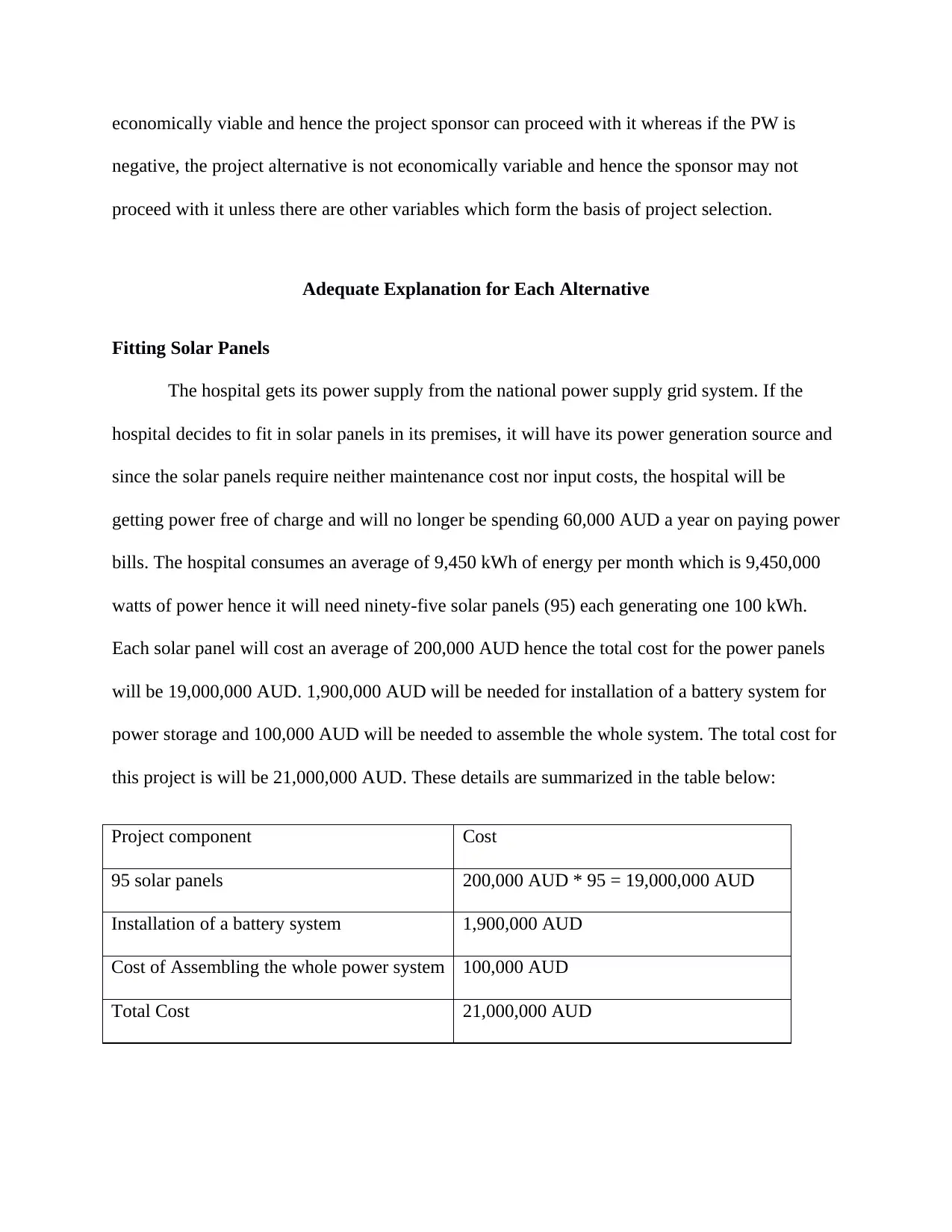
economically viable and hence the project sponsor can proceed with it whereas if the PW is
negative, the project alternative is not economically variable and hence the sponsor may not
proceed with it unless there are other variables which form the basis of project selection.
Adequate Explanation for Each Alternative
Fitting Solar Panels
The hospital gets its power supply from the national power supply grid system. If the
hospital decides to fit in solar panels in its premises, it will have its power generation source and
since the solar panels require neither maintenance cost nor input costs, the hospital will be
getting power free of charge and will no longer be spending 60,000 AUD a year on paying power
bills. The hospital consumes an average of 9,450 kWh of energy per month which is 9,450,000
watts of power hence it will need ninety-five solar panels (95) each generating one 100 kWh.
Each solar panel will cost an average of 200,000 AUD hence the total cost for the power panels
will be 19,000,000 AUD. 1,900,000 AUD will be needed for installation of a battery system for
power storage and 100,000 AUD will be needed to assemble the whole system. The total cost for
this project is will be 21,000,000 AUD. These details are summarized in the table below:
Project component Cost
95 solar panels 200,000 AUD * 95 = 19,000,000 AUD
Installation of a battery system 1,900,000 AUD
Cost of Assembling the whole power system 100,000 AUD
Total Cost 21,000,000 AUD
negative, the project alternative is not economically variable and hence the sponsor may not
proceed with it unless there are other variables which form the basis of project selection.
Adequate Explanation for Each Alternative
Fitting Solar Panels
The hospital gets its power supply from the national power supply grid system. If the
hospital decides to fit in solar panels in its premises, it will have its power generation source and
since the solar panels require neither maintenance cost nor input costs, the hospital will be
getting power free of charge and will no longer be spending 60,000 AUD a year on paying power
bills. The hospital consumes an average of 9,450 kWh of energy per month which is 9,450,000
watts of power hence it will need ninety-five solar panels (95) each generating one 100 kWh.
Each solar panel will cost an average of 200,000 AUD hence the total cost for the power panels
will be 19,000,000 AUD. 1,900,000 AUD will be needed for installation of a battery system for
power storage and 100,000 AUD will be needed to assemble the whole system. The total cost for
this project is will be 21,000,000 AUD. These details are summarized in the table below:
Project component Cost
95 solar panels 200,000 AUD * 95 = 19,000,000 AUD
Installation of a battery system 1,900,000 AUD
Cost of Assembling the whole power system 100,000 AUD
Total Cost 21,000,000 AUD
Cash Flow for Fitting Solar Panels Alternative
Cash flow management is an important determinant of the success of project management
(Ceribelli and Zhang, 2017). In an attempt to reduce project costs, project managers must
balance cost savings of materials due to early payments and interest expenses due to additional
overdraft. Cash-flow items encompass both inflows (market value) and outflows (capital,
maintenance cost, tool cost, equipment cost and so on). In order to measure the effectiveness of
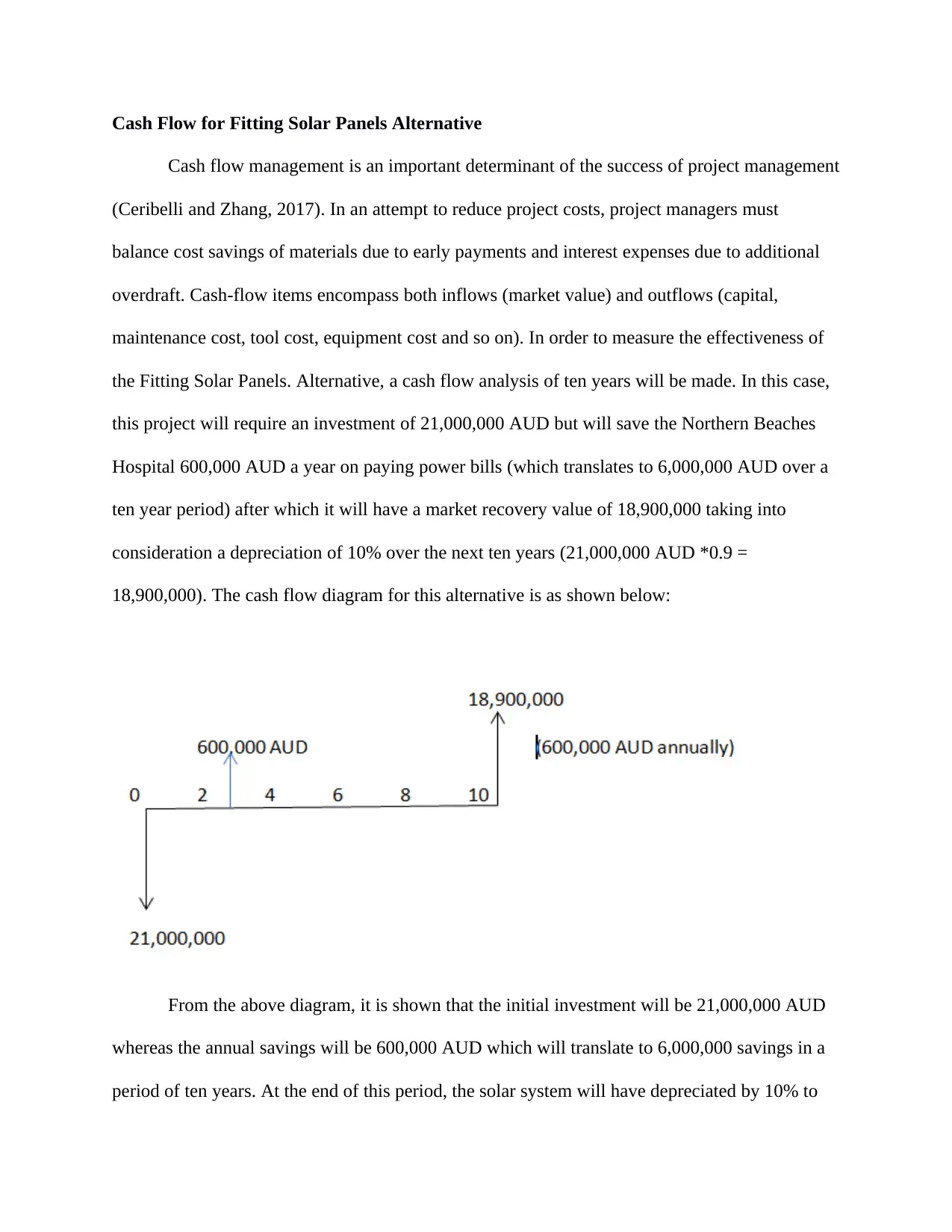
the Fitting Solar Panels. Alternative, a cash flow analysis of ten years will be made. In this case,
this project will require an investment of 21,000,000 AUD but will save the Northern Beaches
Hospital 600,000 AUD a year on paying power bills (which translates to 6,000,000 AUD over a
ten year period) after which it will have a market recovery value of 18,900,000 taking into
consideration a depreciation of 10% over the next ten years (21,000,000 AUD *0.9 =
18,900,000). The cash flow diagram for this alternative is as shown below:
From the above diagram, it is shown that the initial investment will be 21,000,000 AUD
whereas the annual savings will be 600,000 AUD which will translate to 6,000,000 savings in a
period of ten years. At the end of this period, the solar system will have depreciated by 10% to
Cash flow management is an important determinant of the success of project management
(Ceribelli and Zhang, 2017). In an attempt to reduce project costs, project managers must
balance cost savings of materials due to early payments and interest expenses due to additional
overdraft. Cash-flow items encompass both inflows (market value) and outflows (capital,
maintenance cost, tool cost, equipment cost and so on). In order to measure the effectiveness of
the Fitting Solar Panels. Alternative, a cash flow analysis of ten years will be made. In this case,
this project will require an investment of 21,000,000 AUD but will save the Northern Beaches
Hospital 600,000 AUD a year on paying power bills (which translates to 6,000,000 AUD over a
ten year period) after which it will have a market recovery value of 18,900,000 taking into
consideration a depreciation of 10% over the next ten years (21,000,000 AUD *0.9 =
18,900,000). The cash flow diagram for this alternative is as shown below:
From the above diagram, it is shown that the initial investment will be 21,000,000 AUD
whereas the annual savings will be 600,000 AUD which will translate to 6,000,000 savings in a
period of ten years. At the end of this period, the solar system will have depreciated by 10% to
⊘ This is a preview!⊘
Do you want full access?
Subscribe today to unlock all pages.
Trusted by 1+ million students worldwide
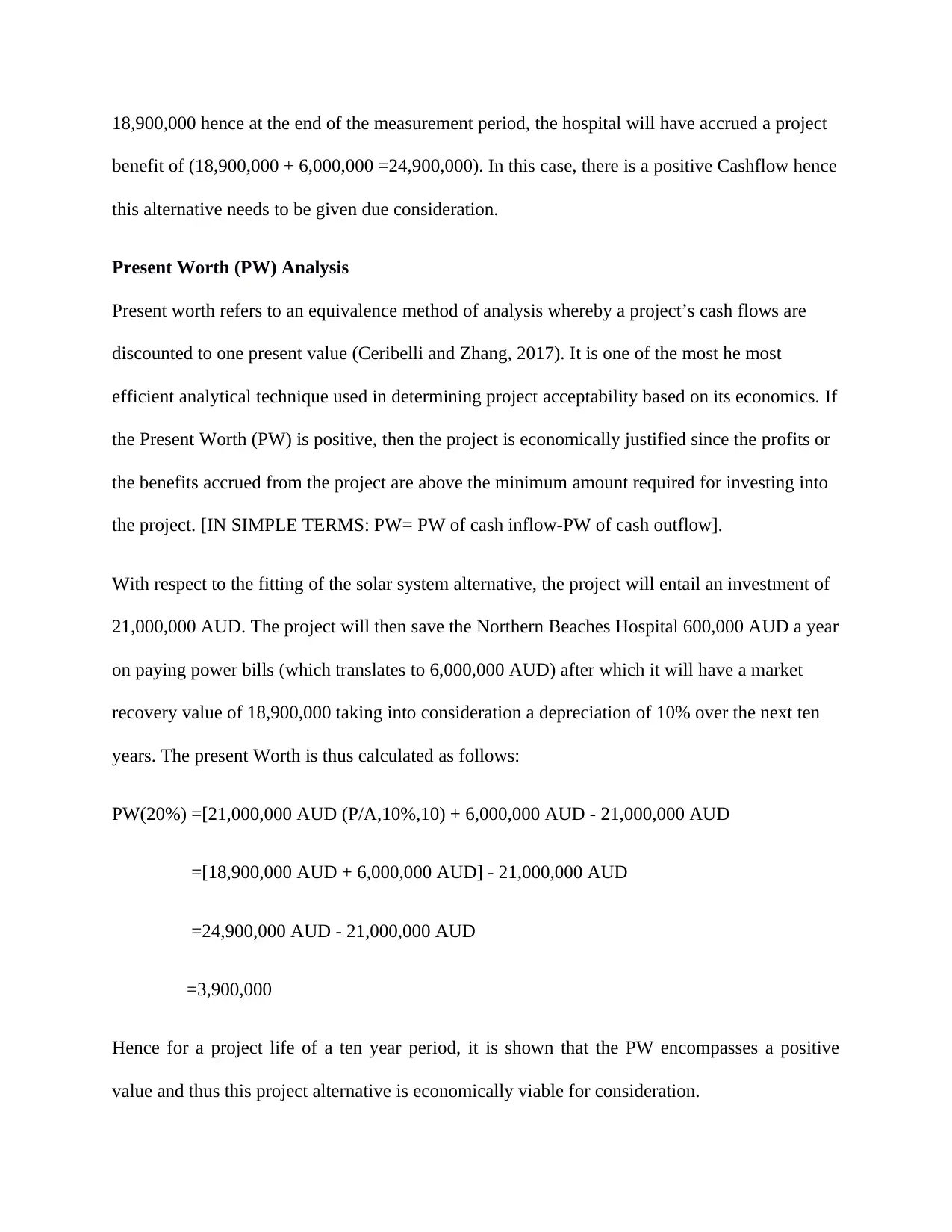
18,900,000 hence at the end of the measurement period, the hospital will have accrued a project
benefit of (18,900,000 + 6,000,000 =24,900,000). In this case, there is a positive Cashflow hence
this alternative needs to be given due consideration.
Present Worth (PW) Analysis
Present worth refers to an equivalence method of analysis whereby a project’s cash flows are
discounted to one present value (Ceribelli and Zhang, 2017). It is one of the most he most
efficient analytical technique used in determining project acceptability based on its economics. If
the Present Worth (PW) is positive, then the project is economically justified since the profits or
the benefits accrued from the project are above the minimum amount required for investing into
the project. [IN SIMPLE TERMS: PW= PW of cash inflow-PW of cash outflow].
With respect to the fitting of the solar system alternative, the project will entail an investment of
21,000,000 AUD. The project will then save the Northern Beaches Hospital 600,000 AUD a year
on paying power bills (which translates to 6,000,000 AUD) after which it will have a market
recovery value of 18,900,000 taking into consideration a depreciation of 10% over the next ten
years. The present Worth is thus calculated as follows:
PW(20%) =[21,000,000 AUD (P/A,10%,10) + 6,000,000 AUD - 21,000,000 AUD
=[18,900,000 AUD + 6,000,000 AUD] - 21,000,000 AUD
=24,900,000 AUD - 21,000,000 AUD
=3,900,000
Hence for a project life of a ten year period, it is shown that the PW encompasses a positive
value and thus this project alternative is economically viable for consideration.
benefit of (18,900,000 + 6,000,000 =24,900,000). In this case, there is a positive Cashflow hence
this alternative needs to be given due consideration.
Present Worth (PW) Analysis
Present worth refers to an equivalence method of analysis whereby a project’s cash flows are
discounted to one present value (Ceribelli and Zhang, 2017). It is one of the most he most
efficient analytical technique used in determining project acceptability based on its economics. If
the Present Worth (PW) is positive, then the project is economically justified since the profits or
the benefits accrued from the project are above the minimum amount required for investing into
the project. [IN SIMPLE TERMS: PW= PW of cash inflow-PW of cash outflow].
With respect to the fitting of the solar system alternative, the project will entail an investment of
21,000,000 AUD. The project will then save the Northern Beaches Hospital 600,000 AUD a year
on paying power bills (which translates to 6,000,000 AUD) after which it will have a market
recovery value of 18,900,000 taking into consideration a depreciation of 10% over the next ten
years. The present Worth is thus calculated as follows:
PW(20%) =[21,000,000 AUD (P/A,10%,10) + 6,000,000 AUD - 21,000,000 AUD
=[18,900,000 AUD + 6,000,000 AUD] - 21,000,000 AUD
=24,900,000 AUD - 21,000,000 AUD
=3,900,000
Hence for a project life of a ten year period, it is shown that the PW encompasses a positive
value and thus this project alternative is economically viable for consideration.
Paraphrase This Document
Need a fresh take? Get an instant paraphrase of this document with our AI Paraphraser
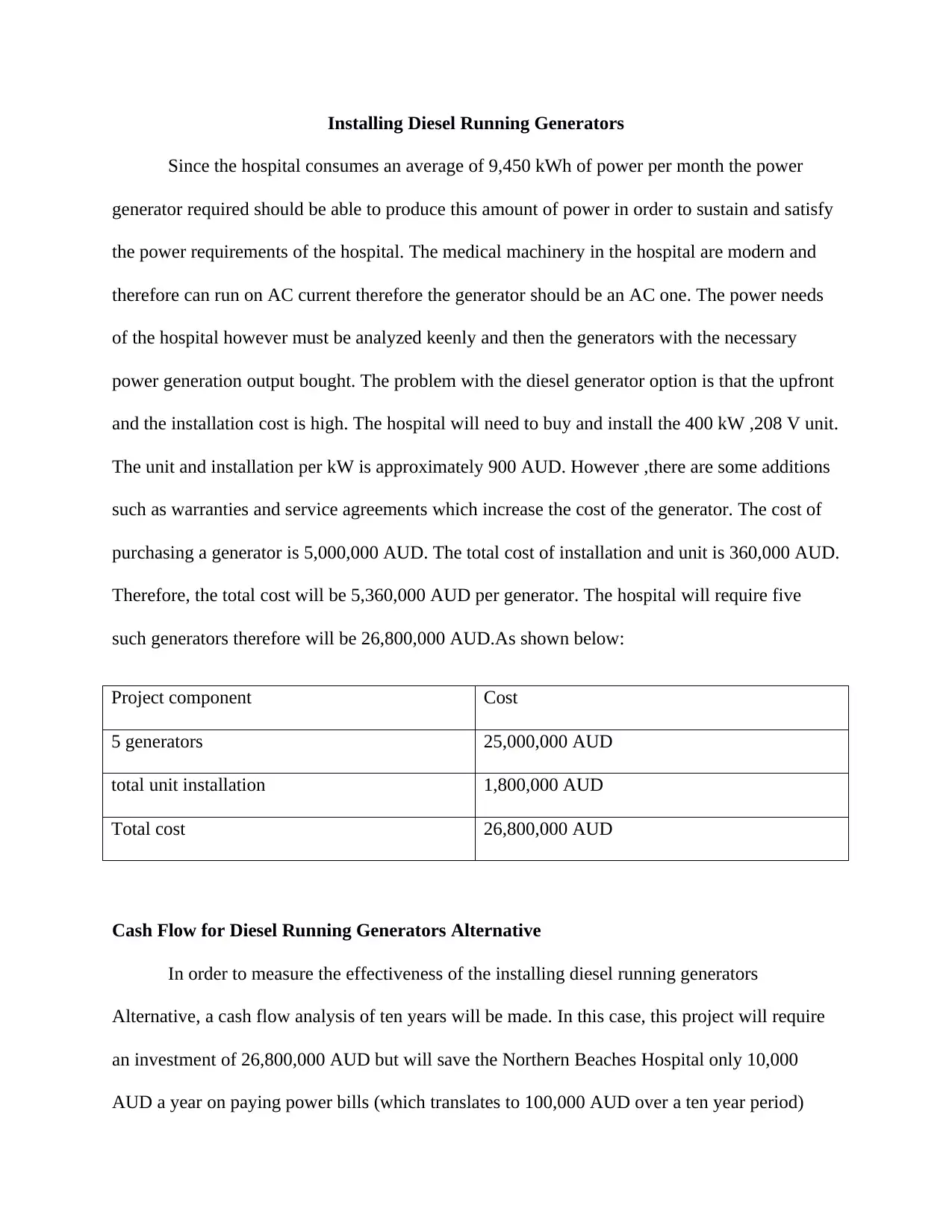
Installing Diesel Running Generators
Since the hospital consumes an average of 9,450 kWh of power per month the power
generator required should be able to produce this amount of power in order to sustain and satisfy
the power requirements of the hospital. The medical machinery in the hospital are modern and
therefore can run on AC current therefore the generator should be an AC one. The power needs
of the hospital however must be analyzed keenly and then the generators with the necessary
power generation output bought. The problem with the diesel generator option is that the upfront
and the installation cost is high. The hospital will need to buy and install the 400 kW ,208 V unit.
The unit and installation per kW is approximately 900 AUD. However ,there are some additions
such as warranties and service agreements which increase the cost of the generator. The cost of
purchasing a generator is 5,000,000 AUD. The total cost of installation and unit is 360,000 AUD.
Therefore, the total cost will be 5,360,000 AUD per generator. The hospital will require five
such generators therefore will be 26,800,000 AUD.As shown below:
Project component Cost
5 generators 25,000,000 AUD
total unit installation 1,800,000 AUD
Total cost 26,800,000 AUD
Cash Flow for Diesel Running Generators Alternative
In order to measure the effectiveness of the installing diesel running generators
Alternative, a cash flow analysis of ten years will be made. In this case, this project will require
an investment of 26,800,000 AUD but will save the Northern Beaches Hospital only 10,000
AUD a year on paying power bills (which translates to 100,000 AUD over a ten year period)
Since the hospital consumes an average of 9,450 kWh of power per month the power
generator required should be able to produce this amount of power in order to sustain and satisfy
the power requirements of the hospital. The medical machinery in the hospital are modern and
therefore can run on AC current therefore the generator should be an AC one. The power needs
of the hospital however must be analyzed keenly and then the generators with the necessary
power generation output bought. The problem with the diesel generator option is that the upfront
and the installation cost is high. The hospital will need to buy and install the 400 kW ,208 V unit.
The unit and installation per kW is approximately 900 AUD. However ,there are some additions
such as warranties and service agreements which increase the cost of the generator. The cost of
purchasing a generator is 5,000,000 AUD. The total cost of installation and unit is 360,000 AUD.
Therefore, the total cost will be 5,360,000 AUD per generator. The hospital will require five
such generators therefore will be 26,800,000 AUD.As shown below:
Project component Cost
5 generators 25,000,000 AUD
total unit installation 1,800,000 AUD
Total cost 26,800,000 AUD
Cash Flow for Diesel Running Generators Alternative
In order to measure the effectiveness of the installing diesel running generators
Alternative, a cash flow analysis of ten years will be made. In this case, this project will require
an investment of 26,800,000 AUD but will save the Northern Beaches Hospital only 10,000
AUD a year on paying power bills (which translates to 100,000 AUD over a ten year period)
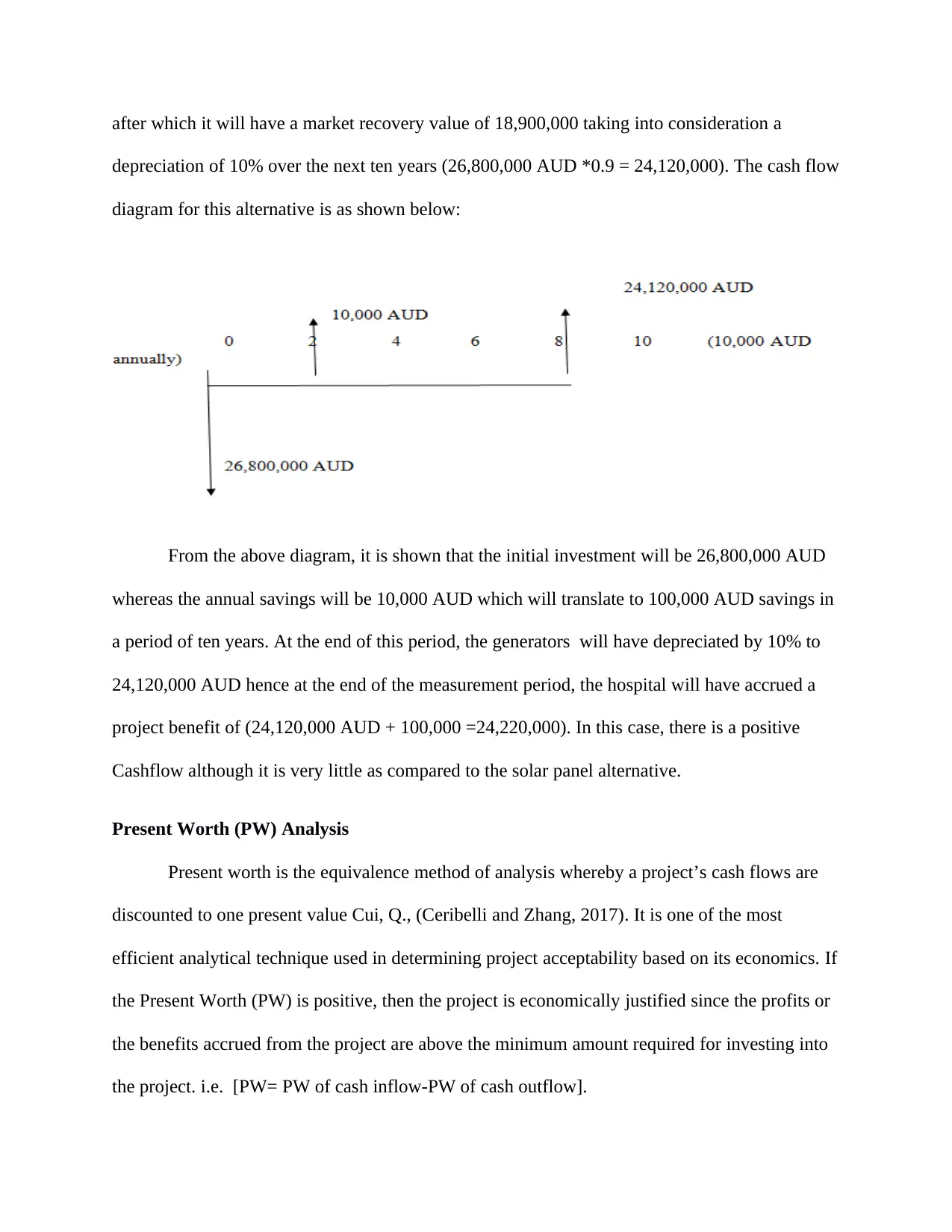
after which it will have a market recovery value of 18,900,000 taking into consideration a
depreciation of 10% over the next ten years (26,800,000 AUD *0.9 = 24,120,000). The cash flow
diagram for this alternative is as shown below:
From the above diagram, it is shown that the initial investment will be 26,800,000 AUD
whereas the annual savings will be 10,000 AUD which will translate to 100,000 AUD savings in
a period of ten years. At the end of this period, the generators will have depreciated by 10% to
24,120,000 AUD hence at the end of the measurement period, the hospital will have accrued a
project benefit of (24,120,000 AUD + 100,000 =24,220,000). In this case, there is a positive
Cashflow although it is very little as compared to the solar panel alternative.
Present Worth (PW) Analysis
Present worth is the equivalence method of analysis whereby a project’s cash flows are
discounted to one present value Cui, Q., (Ceribelli and Zhang, 2017). It is one of the most
efficient analytical technique used in determining project acceptability based on its economics. If
the Present Worth (PW) is positive, then the project is economically justified since the profits or
the benefits accrued from the project are above the minimum amount required for investing into
the project. i.e. [PW= PW of cash inflow-PW of cash outflow].
depreciation of 10% over the next ten years (26,800,000 AUD *0.9 = 24,120,000). The cash flow
diagram for this alternative is as shown below:
From the above diagram, it is shown that the initial investment will be 26,800,000 AUD
whereas the annual savings will be 10,000 AUD which will translate to 100,000 AUD savings in
a period of ten years. At the end of this period, the generators will have depreciated by 10% to
24,120,000 AUD hence at the end of the measurement period, the hospital will have accrued a
project benefit of (24,120,000 AUD + 100,000 =24,220,000). In this case, there is a positive
Cashflow although it is very little as compared to the solar panel alternative.
Present Worth (PW) Analysis
Present worth is the equivalence method of analysis whereby a project’s cash flows are
discounted to one present value Cui, Q., (Ceribelli and Zhang, 2017). It is one of the most
efficient analytical technique used in determining project acceptability based on its economics. If
the Present Worth (PW) is positive, then the project is economically justified since the profits or
the benefits accrued from the project are above the minimum amount required for investing into
the project. i.e. [PW= PW of cash inflow-PW of cash outflow].
⊘ This is a preview!⊘
Do you want full access?
Subscribe today to unlock all pages.
Trusted by 1+ million students worldwide
As for this alternative, the project will entail an investment of 26,800,000 AUD. The
project will then save the Northern Beaches Hospital only 10,000 AUD a year on paying power
bills (which translates to 100,000 AUD) after which it will have a market recovery value of
24,120,000 AUD taking into consideration a depreciation of 10% over the next ten years. The
present Worth is thus calculated as follows:
PW(20%) =[26,800,000 AUD (P/A,10%,10) + 100,000 AUD – 26,800,000 AUD
=[24,120,000 AUD + 100,000 AUD] - 26,800,000 AUD
=24,220,000 AUD - 21,000,000 AUD
=3,220,000
Hence for a project life of a ten year period, it is shown that the PW encompasses a
positive value which is less than that of the solar systems alternative and therefore this
alternative should not be chosen considering the amount of money it saves the hospital is
extremely little.
Introduction
Background and Rationale for the Project
Having done a cost comparison of the two possible sources of power for the Northern
Beaches Hospital, the present worth calculations gave the following figures;
Alternative
project will then save the Northern Beaches Hospital only 10,000 AUD a year on paying power
bills (which translates to 100,000 AUD) after which it will have a market recovery value of
24,120,000 AUD taking into consideration a depreciation of 10% over the next ten years. The
present Worth is thus calculated as follows:
PW(20%) =[26,800,000 AUD (P/A,10%,10) + 100,000 AUD – 26,800,000 AUD
=[24,120,000 AUD + 100,000 AUD] - 26,800,000 AUD
=24,220,000 AUD - 21,000,000 AUD
=3,220,000
Hence for a project life of a ten year period, it is shown that the PW encompasses a
positive value which is less than that of the solar systems alternative and therefore this
alternative should not be chosen considering the amount of money it saves the hospital is
extremely little.
Introduction
Background and Rationale for the Project
Having done a cost comparison of the two possible sources of power for the Northern
Beaches Hospital, the present worth calculations gave the following figures;
Alternative
Paraphrase This Document
Need a fresh take? Get an instant paraphrase of this document with our AI Paraphraser
Present Worth in AUD
Solar panel installation
3,900,000
Diesel generators
3,220,000
The solar installation project is therefore the most beneficial one in terms of the present
worth, and is therefore chosen over installing the diesel generators as a way to power the
Northern beaches Hospital. In addition to having a higher PW, the solar system is chosen
because it is green, meaning it uses clean renewable sun’s energy to power the hospital; this
implies reduced pollution and maintenance of a clean air when compared to installing the diesel
generators. This paper is a write up on the management of the solar panel installation project at
the hospital and includes selecting suitable project management methodology as well as
discussing how the project is to be managed effectively in order to achieve the set objectives.
Project Development and Optimization
Project development refers to the process of planning, coordinating, organizing, and
controlling resources in order to successfully accomplish and achieve the specific goals of a
project (Pitagorsky, 2019). The project development includes the initiation of the project,
planning, project execution, monitoring of performance, and closure. Project optimization, on the
other hand, refers to process of finding suitable solutions from the alternate options available
where the most cost effective project is chosen; this has already been done using the present
worth method. (Stewart, 2013)
Solar panel installation
3,900,000
Diesel generators
3,220,000
The solar installation project is therefore the most beneficial one in terms of the present
worth, and is therefore chosen over installing the diesel generators as a way to power the
Northern beaches Hospital. In addition to having a higher PW, the solar system is chosen
because it is green, meaning it uses clean renewable sun’s energy to power the hospital; this
implies reduced pollution and maintenance of a clean air when compared to installing the diesel
generators. This paper is a write up on the management of the solar panel installation project at
the hospital and includes selecting suitable project management methodology as well as
discussing how the project is to be managed effectively in order to achieve the set objectives.
Project Development and Optimization
Project development refers to the process of planning, coordinating, organizing, and
controlling resources in order to successfully accomplish and achieve the specific goals of a
project (Pitagorsky, 2019). The project development includes the initiation of the project,
planning, project execution, monitoring of performance, and closure. Project optimization, on the
other hand, refers to process of finding suitable solutions from the alternate options available
where the most cost effective project is chosen; this has already been done using the present
worth method. (Stewart, 2013)
Description of the Project
The project entails installing 95 solar panels at the Northern Beaches Hospital; the solar
panels will also be installed together with a battery system to store the energy generated by the
solar panels as well as additional installations and fixtures, including charge controllers and the
requisite wiring and safety features for the system. The entire system must be procured and
delivered to the site, assembled, installed, and then tested, and thereafter, documentation done.
The project is envisaged to cost AUD 21,000,000 and will have a useful life of ten years.
Overall project Objective
To provide clean, reliable electricity to the Northern Beaches Hospital in a manner that is
cost effective through the installation of a solar power system consisting of 95 solar panels.
Principles of project management economics, optimisation and principles of
sustainability in the context of the Northern Beach Hospital
Present demands for environmental sustainability, corporate social responsibility (CSR),
and the need to save costs and achieve operational efficiency in light of rising medical provision
costs require innovative approaches (Rangan, Chase & Karim, 2012). Rather than focus on
specific issues, there should be greater focus on principles of economics when managing
projects. This is because principles release all the stakeholders from bureaucracy and places
responsibility for successful project management on individuals (McKinsey & Company, 2011).
The sustainability of portfolios, projects, and programs must adhere to the following principles;
The project entails installing 95 solar panels at the Northern Beaches Hospital; the solar
panels will also be installed together with a battery system to store the energy generated by the
solar panels as well as additional installations and fixtures, including charge controllers and the
requisite wiring and safety features for the system. The entire system must be procured and
delivered to the site, assembled, installed, and then tested, and thereafter, documentation done.
The project is envisaged to cost AUD 21,000,000 and will have a useful life of ten years.
Overall project Objective
To provide clean, reliable electricity to the Northern Beaches Hospital in a manner that is
cost effective through the installation of a solar power system consisting of 95 solar panels.
Principles of project management economics, optimisation and principles of
sustainability in the context of the Northern Beach Hospital
Present demands for environmental sustainability, corporate social responsibility (CSR),
and the need to save costs and achieve operational efficiency in light of rising medical provision
costs require innovative approaches (Rangan, Chase & Karim, 2012). Rather than focus on
specific issues, there should be greater focus on principles of economics when managing
projects. This is because principles release all the stakeholders from bureaucracy and places
responsibility for successful project management on individuals (McKinsey & Company, 2011).
The sustainability of portfolios, projects, and programs must adhere to the following principles;
⊘ This is a preview!⊘
Do you want full access?
Subscribe today to unlock all pages.
Trusted by 1+ million students worldwide

1 out of 21


Your All-in-One AI-Powered Toolkit for Academic Success.
+13062052269
info@desklib.com
Available 24*7 on WhatsApp / Email
![[object Object]](/_next/static/media/star-bottom.7253800d.svg)
Unlock your academic potential
Copyright © 2020–2026 A2Z Services. All Rights Reserved. Developed and managed by ZUCOL.