Marketing Analysis: Thomas Cook Hospitality Industry Strategies
VerifiedAdded on 2020/11/23
|17
|3875
|180
Report
AI Summary
This report provides a comprehensive analysis of marketing strategies within the hospitality industry, using Thomas Cook as a primary case study. It begins by exploring fundamental marketing concepts, including the exchange, production, and product concepts, relevant to the industry. The report then delves into the impact of the marketing environment, utilizing SWOT and PESTLE analyses to assess internal and external factors affecting Thomas Cook. A significant portion of the report focuses on consumer markets, emphasizing their relevance and impact. It also discusses the rational scheme of market aspects like geographic, demographic, psychographic and behavioral segmentation and the importance of the marketing mix. The report further examines pricing policies, promotional strategies, including sales promotion, public relations, advertising campaigns, and the role of market research. Finally, it covers the suitability of different media for marketing and proposes an advertising campaign for a service-based industry, ultimately providing valuable insights into effective marketing practices.
Marketing in Hospitality

Paraphrase This Document
Need a fresh take? Get an instant paraphrase of this document with our AI Paraphraser
Table of Contents
INTRODUCTION...........................................................................................................................1
TASK 1............................................................................................................................................1
1.1 Concepts of marketing use in Thomas Cook company....................................................1
1.2 & M1. Impact of marketing environment on this industry...............................................2
1.3 Relevance of consumer markets in this industry..............................................................6
1.4 the rational scheme for different market aspects..............................................................6
TASK 2............................................................................................................................................7
2.1 Importance of marketing mix for the Thomas Cook........................................................7
2.2 Pricing policies and strategies use in this company.........................................................8
D2 Application of such pricing strategies..............................................................................8
TASK 3............................................................................................................................................8
3.1 Role of promotional mix..................................................................................................8
3.3 Role of sales promotion and public relation in promotional efforts.................................9
4.1 Importance of market research for the Thomas Cook....................................................10
TASK 4 .........................................................................................................................................11
3.2 Plan an advertising campaign for the Thomas cook.......................................................11
4.2 Conducting market research...........................................................................................11
4.3 Suitability of different media for marketing an appropriate product or service.............12
4.4 Implementation of the marketing plan for an appropriate product or service................13
CONCLUSION..............................................................................................................................13
REFERENCES..............................................................................................................................14
Books and Journals...............................................................................................................14
Online...................................................................................................................................14
INTRODUCTION...........................................................................................................................1
TASK 1............................................................................................................................................1
1.1 Concepts of marketing use in Thomas Cook company....................................................1
1.2 & M1. Impact of marketing environment on this industry...............................................2
1.3 Relevance of consumer markets in this industry..............................................................6
1.4 the rational scheme for different market aspects..............................................................6
TASK 2............................................................................................................................................7
2.1 Importance of marketing mix for the Thomas Cook........................................................7
2.2 Pricing policies and strategies use in this company.........................................................8
D2 Application of such pricing strategies..............................................................................8
TASK 3............................................................................................................................................8
3.1 Role of promotional mix..................................................................................................8
3.3 Role of sales promotion and public relation in promotional efforts.................................9
4.1 Importance of market research for the Thomas Cook....................................................10
TASK 4 .........................................................................................................................................11
3.2 Plan an advertising campaign for the Thomas cook.......................................................11
4.2 Conducting market research...........................................................................................11
4.3 Suitability of different media for marketing an appropriate product or service.............12
4.4 Implementation of the marketing plan for an appropriate product or service................13
CONCLUSION..............................................................................................................................13
REFERENCES..............................................................................................................................14
Books and Journals...............................................................................................................14
Online...................................................................................................................................14
Illustration Index
Illustration 1: Marketing Concepts..................................................................................................2
Illustration 2: SWOT Analysis.........................................................................................................4
Illustration 3: PESTLE Analysis......................................................................................................5
Illustration 4: Advertising campaign of Thomas Cook..................................................................12
Illustration 1: Marketing Concepts..................................................................................................2
Illustration 2: SWOT Analysis.........................................................................................................4
Illustration 3: PESTLE Analysis......................................................................................................5
Illustration 4: Advertising campaign of Thomas Cook..................................................................12
⊘ This is a preview!⊘
Do you want full access?
Subscribe today to unlock all pages.

Trusted by 1+ million students worldwide
INTRODUCTION
Marketing in the hospitality industry is very wide and it increases revenues in this sector.
It is a very competitive market and in this industry, there are many organizations that need
various strategies for profit (Welsh and et.al., 2014). In addition to this, the marketing is an
activity, process or set of institutions that communicate exchange and deliver many offers to
clients, partners and customers at large level.
In this report, marketing concepts of the hospitality industry and different marketing
segments will be discusses for Thomas Cook Travel company, established in UK and operated
its business activities as global travel company. It is listed in London Stock Exchange.
Furthermore, it describes importance of marketing mix of this industry and various pricing
policies related to this sector. Lastly, it covers marketing plan and suitability of different media
for marketing for an advertising campaign for this service based industry.
TASK 1
1.1 Concepts of marketing use in Thomas Cook company.
The marketing concept is a set of plans and strategies that follow and implement by a
firm in order to increase sales, maximize profits, satisfy all customers’ needs and beat the market
competition (Tresidder, 2015). Every company has many philosophies and ideas for making
more profits.
Thomas Cook has its own plan for production at the large level and maintains the cost at
optimum level. The organisation understands needs of their target customers and then makes
several strategies with respect to accomplishing it.
The major marketing concept is described below:
Marketing in the hospitality industry is very wide and it increases revenues in this sector.
It is a very competitive market and in this industry, there are many organizations that need
various strategies for profit (Welsh and et.al., 2014). In addition to this, the marketing is an
activity, process or set of institutions that communicate exchange and deliver many offers to
clients, partners and customers at large level.
In this report, marketing concepts of the hospitality industry and different marketing
segments will be discusses for Thomas Cook Travel company, established in UK and operated
its business activities as global travel company. It is listed in London Stock Exchange.
Furthermore, it describes importance of marketing mix of this industry and various pricing
policies related to this sector. Lastly, it covers marketing plan and suitability of different media
for marketing for an advertising campaign for this service based industry.
TASK 1
1.1 Concepts of marketing use in Thomas Cook company.
The marketing concept is a set of plans and strategies that follow and implement by a
firm in order to increase sales, maximize profits, satisfy all customers’ needs and beat the market
competition (Tresidder, 2015). Every company has many philosophies and ideas for making
more profits.
Thomas Cook has its own plan for production at the large level and maintains the cost at
optimum level. The organisation understands needs of their target customers and then makes
several strategies with respect to accomplishing it.
The major marketing concept is described below:
Paraphrase This Document
Need a fresh take? Get an instant paraphrase of this document with our AI Paraphraser
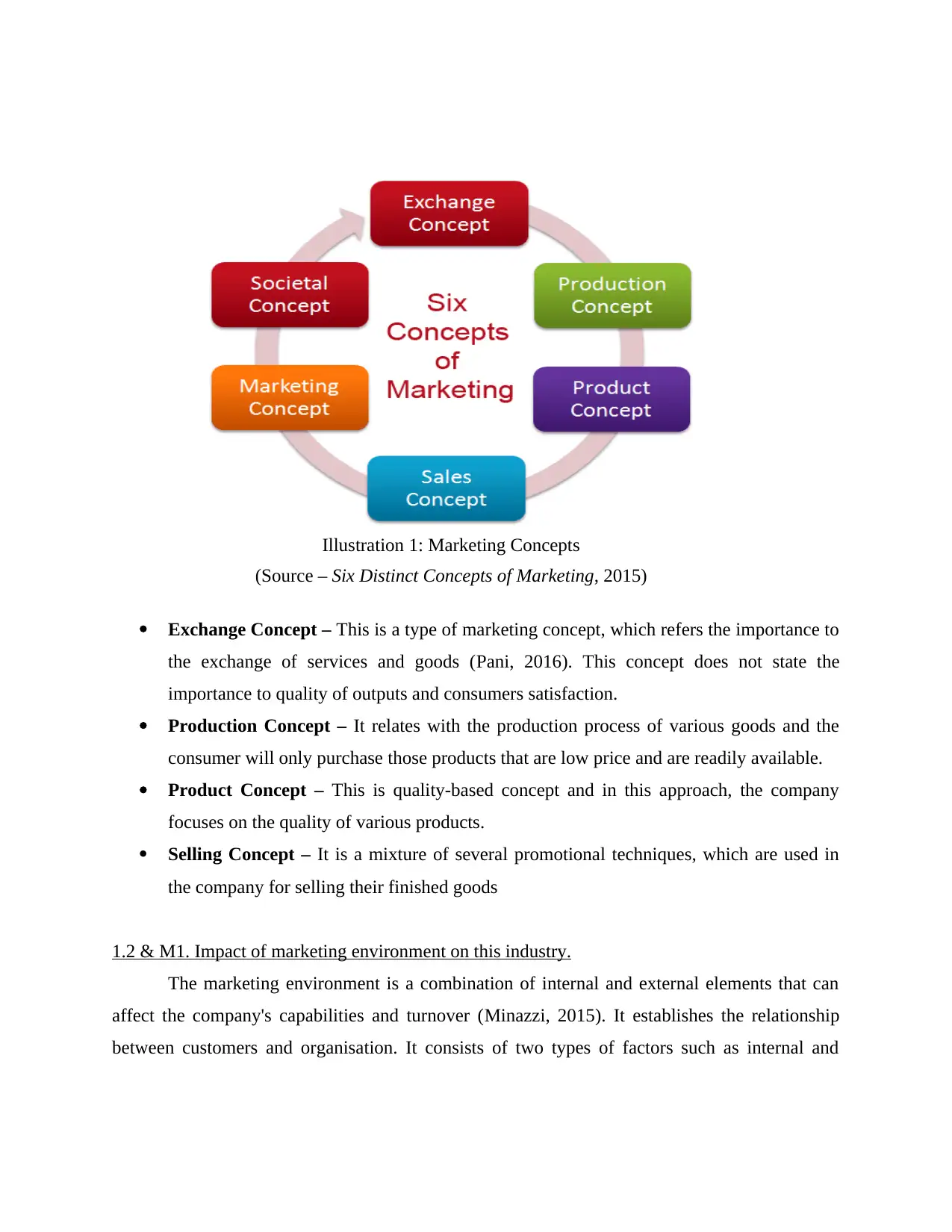
Exchange Concept – This is a type of marketing concept, which refers the importance to
the exchange of services and goods (Pani, 2016). This concept does not state the
importance to quality of outputs and consumers satisfaction.
Production Concept – It relates with the production process of various goods and the
consumer will only purchase those products that are low price and are readily available.
Product Concept – This is quality-based concept and in this approach, the company
focuses on the quality of various products.
Selling Concept – It is a mixture of several promotional techniques, which are used in
the company for selling their finished goods
1.2 & M1. Impact of marketing environment on this industry.
The marketing environment is a combination of internal and external elements that can
affect the company's capabilities and turnover (Minazzi, 2015). It establishes the relationship
between customers and organisation. It consists of two types of factors such as internal and
Illustration 1: Marketing Concepts
(Source – Six Distinct Concepts of Marketing, 2015)
the exchange of services and goods (Pani, 2016). This concept does not state the
importance to quality of outputs and consumers satisfaction.
Production Concept – It relates with the production process of various goods and the
consumer will only purchase those products that are low price and are readily available.
Product Concept – This is quality-based concept and in this approach, the company
focuses on the quality of various products.
Selling Concept – It is a mixture of several promotional techniques, which are used in
the company for selling their finished goods
1.2 & M1. Impact of marketing environment on this industry.
The marketing environment is a combination of internal and external elements that can
affect the company's capabilities and turnover (Minazzi, 2015). It establishes the relationship
between customers and organisation. It consists of two types of factors such as internal and
Illustration 1: Marketing Concepts
(Source – Six Distinct Concepts of Marketing, 2015)
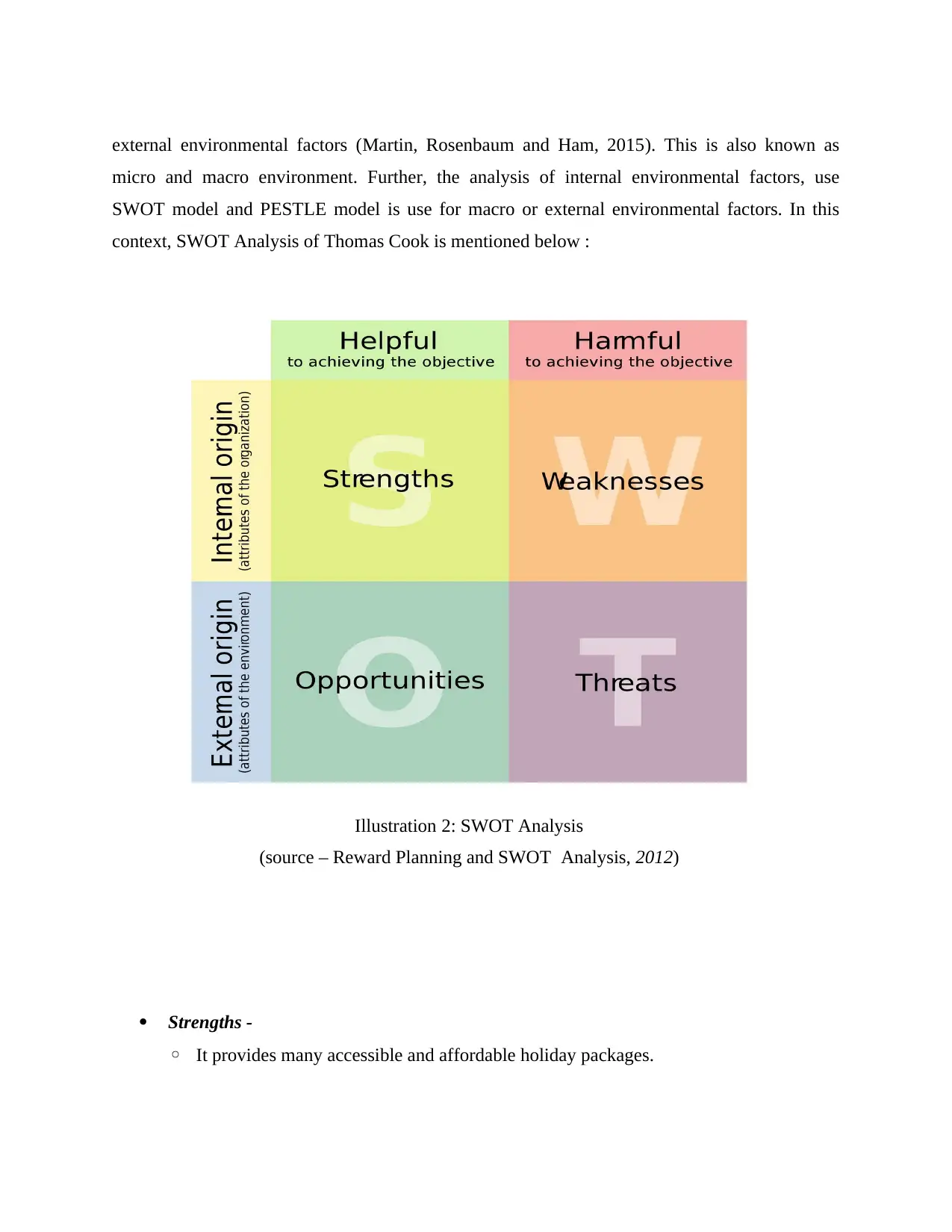
external environmental factors (Martin, Rosenbaum and Ham, 2015). This is also known as
micro and macro environment. Further, the analysis of internal environmental factors, use
SWOT model and PESTLE model is use for macro or external environmental factors. In this
context, SWOT Analysis of Thomas Cook is mentioned below :
Strengths -
◦ It provides many accessible and affordable holiday packages.
Illustration 2: SWOT Analysis
(source – Reward Planning and SWOT Analysis, 2012)
micro and macro environment. Further, the analysis of internal environmental factors, use
SWOT model and PESTLE model is use for macro or external environmental factors. In this
context, SWOT Analysis of Thomas Cook is mentioned below :
Strengths -
◦ It provides many accessible and affordable holiday packages.
Illustration 2: SWOT Analysis
(source – Reward Planning and SWOT Analysis, 2012)
⊘ This is a preview!⊘
Do you want full access?
Subscribe today to unlock all pages.
Trusted by 1+ million students worldwide
◦ It has a global presence.
◦ Increased organisational presence across the world.
◦ Sponsorships of various sports and events.
Weaknesses -
◦ Intense competition in its market.
◦ Low use of manpower.
Opportunities -
◦ It can digitalize there operational activities for creating better brand image.
◦ To make the largest travel company in UK.
◦ It can boost its services and expand its business.
Threats -
◦ There are price war, it can reduce its market share.
◦ Uncertainty in the airline business.
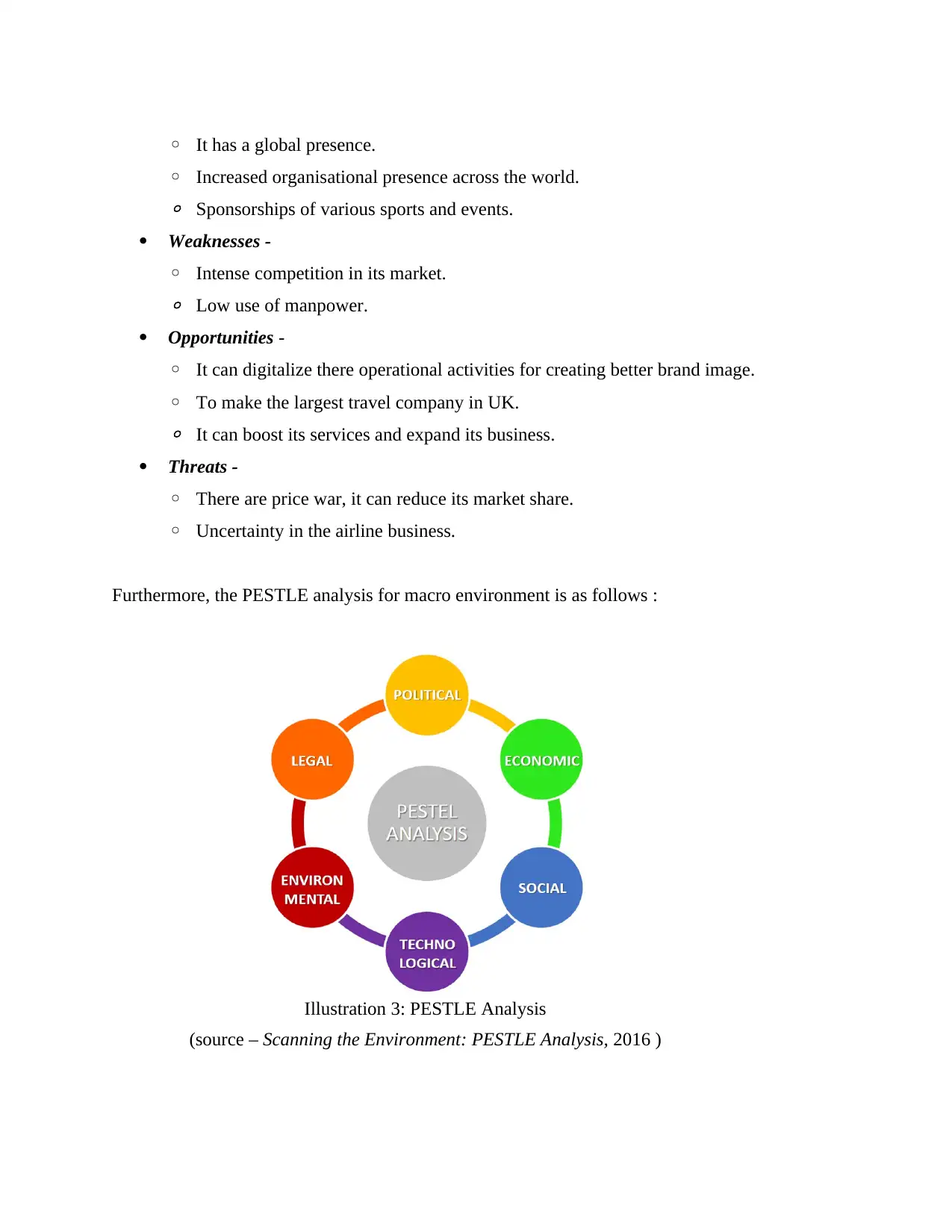
Furthermore, the PESTLE analysis for macro environment is as follows :
Illustration 3: PESTLE Analysis
(source – Scanning the Environment: PESTLE Analysis, 2016 )
◦ Increased organisational presence across the world.
◦ Sponsorships of various sports and events.
Weaknesses -
◦ Intense competition in its market.
◦ Low use of manpower.
Opportunities -
◦ It can digitalize there operational activities for creating better brand image.
◦ To make the largest travel company in UK.
◦ It can boost its services and expand its business.
Threats -
◦ There are price war, it can reduce its market share.
◦ Uncertainty in the airline business.
Furthermore, the PESTLE analysis for macro environment is as follows :
Illustration 3: PESTLE Analysis
(source – Scanning the Environment: PESTLE Analysis, 2016 )
Paraphrase This Document
Need a fresh take? Get an instant paraphrase of this document with our AI Paraphraser
Political Factors – In this sector, travel and tourism industry conduct its business activity
in public and private both sector so their employees are faced with fears of
embarrassment.
Economic Factors – The travel and tourism business gets affected from the economy of
that country in which the organisation is situated (Martin, Rosenbaum and Ham, 2015). It
is happened because the demand, inflation, cost rates usually changeable in different
country.
Social Factors – In this factor, living standard or demographic factors can affect to this
company. If income of people is decreases, then their spending will become low and it
will influence the organization's sales.
Technological Factors – The enhancement of internet leads to the business activities in
vast level and the organisation get affected (Pani, 2016). There is a great influence for
technical elements.
Legal Factors – Every organisation is get affected from various rules and regulations
made by the country in which this provides its services. There are many laws and acts
made in various nation.
Environmental Factors – In this context, social corporate responsibility is concluded
and every company must follow it.
1.3 Relevance of consumer markets in this industry.
The consumer market refers as the market dominated by various services and products
that designed for general consumers. It is into types such as primary categories retail products,
consumer products, transportation products, food and beverages products.
In hospitality, marketing is a managerial and social process by individuals and groups
which obtain the need of clients and after understanding, it creates and exchanging products
according to their customer's needs (Martin, Rosenbaum and Ham, 2015). The company use its
relevant consumer market, it gains profits and desired success because the organization is able to
understand needs of their potential customer and fulfil it. The hospitality industry increase in the
bottom line growth in 2007 and lowest increase in 2004 after the increase use of digital
in public and private both sector so their employees are faced with fears of
embarrassment.
Economic Factors – The travel and tourism business gets affected from the economy of
that country in which the organisation is situated (Martin, Rosenbaum and Ham, 2015). It
is happened because the demand, inflation, cost rates usually changeable in different
country.
Social Factors – In this factor, living standard or demographic factors can affect to this
company. If income of people is decreases, then their spending will become low and it
will influence the organization's sales.
Technological Factors – The enhancement of internet leads to the business activities in
vast level and the organisation get affected (Pani, 2016). There is a great influence for
technical elements.
Legal Factors – Every organisation is get affected from various rules and regulations
made by the country in which this provides its services. There are many laws and acts
made in various nation.
Environmental Factors – In this context, social corporate responsibility is concluded
and every company must follow it.
1.3 Relevance of consumer markets in this industry.
The consumer market refers as the market dominated by various services and products
that designed for general consumers. It is into types such as primary categories retail products,
consumer products, transportation products, food and beverages products.
In hospitality, marketing is a managerial and social process by individuals and groups
which obtain the need of clients and after understanding, it creates and exchanging products
according to their customer's needs (Martin, Rosenbaum and Ham, 2015). The company use its
relevant consumer market, it gains profits and desired success because the organization is able to
understand needs of their potential customer and fulfil it. The hospitality industry increase in the
bottom line growth in 2007 and lowest increase in 2004 after the increase use of digital
technology, this grown up at high rate and reach at the top of level. There are some limitations
also that are loss of existing customers and also revenue reduce due to over understanding the
customer market.
1.4 the rational scheme for different market aspects.
In today's market scenario, segmentation, targeting and positioning are familiar strategic
approaches, which should considered by every manager in the process of plan making. This
model is one of the most applied marketing models in order to achieve desired objectives ((Pani,
2016)). This is a very useful model in creating and managing marketing communication plans.
The needs of each segment are same and the management team of this company must focus on
its target market and become a perfect position in the mind of their target consumers.
In this context, the various elements are describes below:
Geographic – In this point, the company should know about its geographical area where
it can provide its target services to its customers.
Demographic – It is a combination of factors such as income, gender, ethnicity, age,
marital states, and size, type of residence. This will influence the target market.
Physiographic – It states the emotions and personality that are based on the behaviour
which linked to the purchase attitude, lifestyle, risk aversion and hobbies (Baker and
Magnini, 2016). It also refers to the leadership traits.
Behavioural – In the positioning of the brand, behaviour refers as the nature of brand
loyalty, usage level, distribution channels used and choice of purchase by the individual
or the group. In this context, it includes different types of personality or their nature.
TASK 2
2.1 Importance of marketing mix for the Thomas Cook.
The marketing mix is all about putting the best product or their combination at the right
place, price and right time (Bowie and et.al., 2016). It is a set of tactics or actions that the
also that are loss of existing customers and also revenue reduce due to over understanding the
customer market.
1.4 the rational scheme for different market aspects.
In today's market scenario, segmentation, targeting and positioning are familiar strategic
approaches, which should considered by every manager in the process of plan making. This
model is one of the most applied marketing models in order to achieve desired objectives ((Pani,
2016)). This is a very useful model in creating and managing marketing communication plans.
The needs of each segment are same and the management team of this company must focus on
its target market and become a perfect position in the mind of their target consumers.
In this context, the various elements are describes below:
Geographic – In this point, the company should know about its geographical area where
it can provide its target services to its customers.
Demographic – It is a combination of factors such as income, gender, ethnicity, age,
marital states, and size, type of residence. This will influence the target market.
Physiographic – It states the emotions and personality that are based on the behaviour
which linked to the purchase attitude, lifestyle, risk aversion and hobbies (Baker and
Magnini, 2016). It also refers to the leadership traits.
Behavioural – In the positioning of the brand, behaviour refers as the nature of brand
loyalty, usage level, distribution channels used and choice of purchase by the individual
or the group. In this context, it includes different types of personality or their nature.
TASK 2
2.1 Importance of marketing mix for the Thomas Cook.
The marketing mix is all about putting the best product or their combination at the right
place, price and right time (Bowie and et.al., 2016). It is a set of tactics or actions that the
⊘ This is a preview!⊘
Do you want full access?
Subscribe today to unlock all pages.
Trusted by 1+ million students worldwide
organisation use to it for their promotional activities in the target market. In this context, the
various marketing mix elements are refers as below :
Product – It means the item or thing that is being sold. The product and services must be
deliver a minimum level of performance other than the other elements of the marketing
mix won't do any good thing. Thomas Cook products are holidays packages, flights,
hotels.
Pricing strategy – The strategy of pricing model refers to the value that is put for the
particular product as well as service (Chhabra, 2015). There are many pricing strategies
like pricing at premium, market penetration, economy pricing, price skimming, bundle
pricing etc. Thomas cook company use price skimming as the strategy for its products.
Channel or place of distribution – It means the point of sale at which the product or
service can be sold to the target customers. In every sector, attract the customer and
making it easy for him or her to buy such products.
Promotional elements recommended – This refers various promotional plans and
activities required for the expansion of the Thomas Cook company's products as well as
its various services. It includes word of mouth, press reports, advertising and incentives.
2.2 Pricing policies and strategies use in this company.
The company Thomas Cook uses the single pricing strategy across high street and
various channels to help their combat consumer confusion. It is UK's largest travel company and
it provides various offers with similar package for holiday or leisure time (Jauhari and Bharwani,
2017). This organisation confirms their policies before the festival Christmas and the single
pricing had been introduced its various online trails and stores. It also uses the low deposit
schemes for its air tours branded packages for holidays. Anyone chooses this option with follow
company's all terms and condition.
D2 Application of such pricing strategies.
In above two points, there are various strategies and activities are use in the company's
pricing policies and plan, manage or organise all business activities. The company use low
deposit schemes and other plan like short haul type method (Kandampully, Zhang and Bilgihan,
various marketing mix elements are refers as below :
Product – It means the item or thing that is being sold. The product and services must be
deliver a minimum level of performance other than the other elements of the marketing
mix won't do any good thing. Thomas Cook products are holidays packages, flights,
hotels.
Pricing strategy – The strategy of pricing model refers to the value that is put for the
particular product as well as service (Chhabra, 2015). There are many pricing strategies
like pricing at premium, market penetration, economy pricing, price skimming, bundle
pricing etc. Thomas cook company use price skimming as the strategy for its products.
Channel or place of distribution – It means the point of sale at which the product or
service can be sold to the target customers. In every sector, attract the customer and
making it easy for him or her to buy such products.
Promotional elements recommended – This refers various promotional plans and
activities required for the expansion of the Thomas Cook company's products as well as
its various services. It includes word of mouth, press reports, advertising and incentives.
2.2 Pricing policies and strategies use in this company.
The company Thomas Cook uses the single pricing strategy across high street and
various channels to help their combat consumer confusion. It is UK's largest travel company and
it provides various offers with similar package for holiday or leisure time (Jauhari and Bharwani,
2017). This organisation confirms their policies before the festival Christmas and the single
pricing had been introduced its various online trails and stores. It also uses the low deposit
schemes for its air tours branded packages for holidays. Anyone chooses this option with follow
company's all terms and condition.
D2 Application of such pricing strategies.
In above two points, there are various strategies and activities are use in the company's
pricing policies and plan, manage or organise all business activities. The company use low
deposit schemes and other plan like short haul type method (Kandampully, Zhang and Bilgihan,
Paraphrase This Document
Need a fresh take? Get an instant paraphrase of this document with our AI Paraphraser
2015). It means every person decide their packages according to his or her financial suitability.
This schemes are also applied for children and disables.
TASK 3
3.1 Role of promotional mix.
Promotional mix refers as the organisational tools to communicate to the target market
and produce the sales according to it. It contains various methods like public relations, sales
promotion, advertising and personal selling for increase the turnover of the company. These
elements describe as follows :
Public Relations – In this point, this is an essential tool for the company that it makes
better relation with the public and increase the brand image with its promotion schemes.
Advertising – It is one of most important feature of promotional mix for the Thomas
Cook and the company attract new customers by creation of a viable advertising program
(Leung, Xue and Bai, 2015). It is a form of impersonal paid communication that are use
for company's identification.
Sales Promotion – In this method, stimulating consumer purchase and it is usually based
on the immediate and short term goal.
Direct Marketing – It is a form of advertising and its aim directly to the target
consumers and ordering many products and services.
Personal Selling – In this method face to face communication with several persons and
customers.
3.3 Role of sales promotion and public relation in promotional efforts.
Sales Promotion - The sales promotion is a technique of promotion of various products and
services (Baker and Magnini, 2016). In this tool a company can promote their products by using
various methods like giving discounts on the products, offers and schemes etc. The Thomas
Cook use this technique to increase their sales and various methods of sales promotion are
discusses as below :
This schemes are also applied for children and disables.
TASK 3
3.1 Role of promotional mix.
Promotional mix refers as the organisational tools to communicate to the target market
and produce the sales according to it. It contains various methods like public relations, sales
promotion, advertising and personal selling for increase the turnover of the company. These
elements describe as follows :
Public Relations – In this point, this is an essential tool for the company that it makes
better relation with the public and increase the brand image with its promotion schemes.
Advertising – It is one of most important feature of promotional mix for the Thomas
Cook and the company attract new customers by creation of a viable advertising program
(Leung, Xue and Bai, 2015). It is a form of impersonal paid communication that are use
for company's identification.
Sales Promotion – In this method, stimulating consumer purchase and it is usually based
on the immediate and short term goal.
Direct Marketing – It is a form of advertising and its aim directly to the target
consumers and ordering many products and services.
Personal Selling – In this method face to face communication with several persons and
customers.
3.3 Role of sales promotion and public relation in promotional efforts.
Sales Promotion - The sales promotion is a technique of promotion of various products and
services (Baker and Magnini, 2016). In this tool a company can promote their products by using
various methods like giving discounts on the products, offers and schemes etc. The Thomas
Cook use this technique to increase their sales and various methods of sales promotion are
discusses as below :
Financing – IT is a special ingenious type for sales promotions and many companies
have huge resources and they act like the financiers for their consumers. Discounts – It is most common type of sales promotion and it is too much useful for
organisation in order to increase their turnover. Coupons – It is most commonly used technique for motivating new customers to buy its
products and services threw various coupons. Gifting – This kind of sales promotional technique is too much useful in a particular
season or during festivals because in the festival time, gift attract new customers.
Contests – It is use for collect more information about their customers so that the
organisation create awareness in its target market.
Public Relationship – It is a special communication process and the individuals and
organisations use this method to build a mutually beneficial relationships with the public
(Chhabra, 2015). In addition to this, it uses various media and direct-indirect mediums to make
and stable a brand image with the target customers. There are so many types of public
relationships that are as follows : Internal Relations – In this method, counselling the employees of the company with
regard to strategies, course of action and cooperate with them during events and product
launches. Community Relations – It means handling the social aspect of the organisational
goodwill and establishing the positive reputation in its society. Government Relations – This method is focuses on creating and maintaining the
relationship with the government of that country (Jauhari and Bharwani, 2017). Media Relations – It is a compulsory method in present days that company should make
a better relationship with different media.
Investor Relations – Handling the company's investors and releasing various financial
reports to attract more investor towards the organisation.
have huge resources and they act like the financiers for their consumers. Discounts – It is most common type of sales promotion and it is too much useful for
organisation in order to increase their turnover. Coupons – It is most commonly used technique for motivating new customers to buy its
products and services threw various coupons. Gifting – This kind of sales promotional technique is too much useful in a particular
season or during festivals because in the festival time, gift attract new customers.
Contests – It is use for collect more information about their customers so that the
organisation create awareness in its target market.
Public Relationship – It is a special communication process and the individuals and
organisations use this method to build a mutually beneficial relationships with the public
(Chhabra, 2015). In addition to this, it uses various media and direct-indirect mediums to make
and stable a brand image with the target customers. There are so many types of public
relationships that are as follows : Internal Relations – In this method, counselling the employees of the company with
regard to strategies, course of action and cooperate with them during events and product
launches. Community Relations – It means handling the social aspect of the organisational
goodwill and establishing the positive reputation in its society. Government Relations – This method is focuses on creating and maintaining the
relationship with the government of that country (Jauhari and Bharwani, 2017). Media Relations – It is a compulsory method in present days that company should make
a better relationship with different media.
Investor Relations – Handling the company's investors and releasing various financial
reports to attract more investor towards the organisation.
⊘ This is a preview!⊘
Do you want full access?
Subscribe today to unlock all pages.
Trusted by 1+ million students worldwide

1 out of 17


Related Documents


Your All-in-One AI-Powered Toolkit for Academic Success.
+13062052269
info@desklib.com
Available 24*7 on WhatsApp / Email
![[object Object]](/_next/static/media/star-bottom.7253800d.svg)
Unlock your academic potential
Copyright © 2020–2026 A2Z Services. All Rights Reserved. Developed and managed by ZUCOL.