Strategic Decisions: Firm Resources, Capabilities, and Conditions
VerifiedAdded on 2019/12/03
|23
|7545
|173
Report
AI Summary
This report delves into the crucial role of firm resources, capabilities, and internal conditions in shaping strategic decisions within the hospitality industry, using Marriott International as a case study. The research begins with an introduction highlighting the increasing competition in the globalized market and the importance of strengthening resources and capabilities for enhanced performance. The rationale for the research focuses on understanding the factors that influence organizational performance in the hospitality sector. The report outlines the background of Marriott International, its core values, and the problem statement, which revolves around the strategic and financial capabilities of the organization in a dynamic and competitive industry. The research question explores how firm resources, capabilities, and internal conditions contribute to organizing entrepreneurship for improved performance within the Marriott Group. The objectives include identifying key business resources, exploring capability enhancement, and understanding the role of internal conditions. The literature review covers business resources (financial, manpower, physical, and intellectual), and capabilities. The research methodology section details the approach, philosophy, data collection methods, sampling, and analysis techniques, along with limitations, ethical considerations, and the timescale of the study.

Research Methodology
1
1

Paraphrase This Document
Need a fresh take? Get an instant paraphrase of this document with our AI Paraphraser
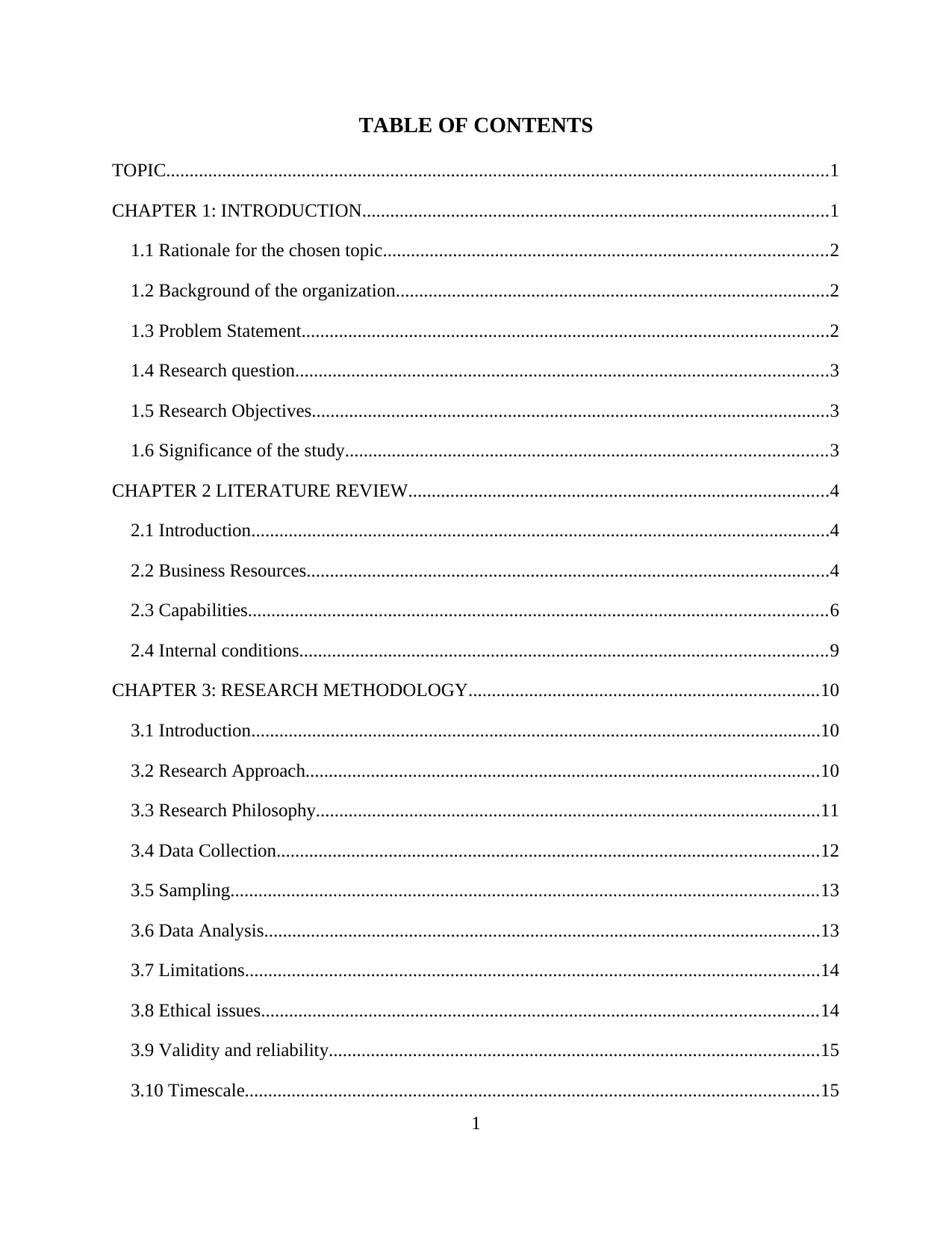
TABLE OF CONTENTS
TOPIC..............................................................................................................................................1
CHAPTER 1: INTRODUCTION....................................................................................................1
1.1 Rationale for the chosen topic...............................................................................................2
1.2 Background of the organization.............................................................................................2
1.3 Problem Statement.................................................................................................................2
1.4 Research question..................................................................................................................3
1.5 Research Objectives...............................................................................................................3
1.6 Significance of the study.......................................................................................................3
CHAPTER 2 LITERATURE REVIEW..........................................................................................4
2.1 Introduction............................................................................................................................4
2.2 Business Resources................................................................................................................4
2.3 Capabilities............................................................................................................................6
2.4 Internal conditions.................................................................................................................9
CHAPTER 3: RESEARCH METHODOLOGY...........................................................................10
3.1 Introduction..........................................................................................................................10
3.2 Research Approach..............................................................................................................10
3.3 Research Philosophy............................................................................................................11
3.4 Data Collection....................................................................................................................12
3.5 Sampling..............................................................................................................................13
3.6 Data Analysis.......................................................................................................................13
3.7 Limitations...........................................................................................................................14
3.8 Ethical issues.......................................................................................................................14
3.9 Validity and reliability.........................................................................................................15
3.10 Timescale...........................................................................................................................15
1
TOPIC..............................................................................................................................................1
CHAPTER 1: INTRODUCTION....................................................................................................1
1.1 Rationale for the chosen topic...............................................................................................2
1.2 Background of the organization.............................................................................................2
1.3 Problem Statement.................................................................................................................2
1.4 Research question..................................................................................................................3
1.5 Research Objectives...............................................................................................................3
1.6 Significance of the study.......................................................................................................3
CHAPTER 2 LITERATURE REVIEW..........................................................................................4
2.1 Introduction............................................................................................................................4
2.2 Business Resources................................................................................................................4
2.3 Capabilities............................................................................................................................6
2.4 Internal conditions.................................................................................................................9
CHAPTER 3: RESEARCH METHODOLOGY...........................................................................10
3.1 Introduction..........................................................................................................................10
3.2 Research Approach..............................................................................................................10
3.3 Research Philosophy............................................................................................................11
3.4 Data Collection....................................................................................................................12
3.5 Sampling..............................................................................................................................13
3.6 Data Analysis.......................................................................................................................13
3.7 Limitations...........................................................................................................................14
3.8 Ethical issues.......................................................................................................................14
3.9 Validity and reliability.........................................................................................................15
3.10 Timescale...........................................................................................................................15
1

CONCLUSION..............................................................................................................................16
REFERENCES..............................................................................................................................18
2
REFERENCES..............................................................................................................................18
2
⊘ This is a preview!⊘
Do you want full access?
Subscribe today to unlock all pages.

Trusted by 1+ million students worldwide
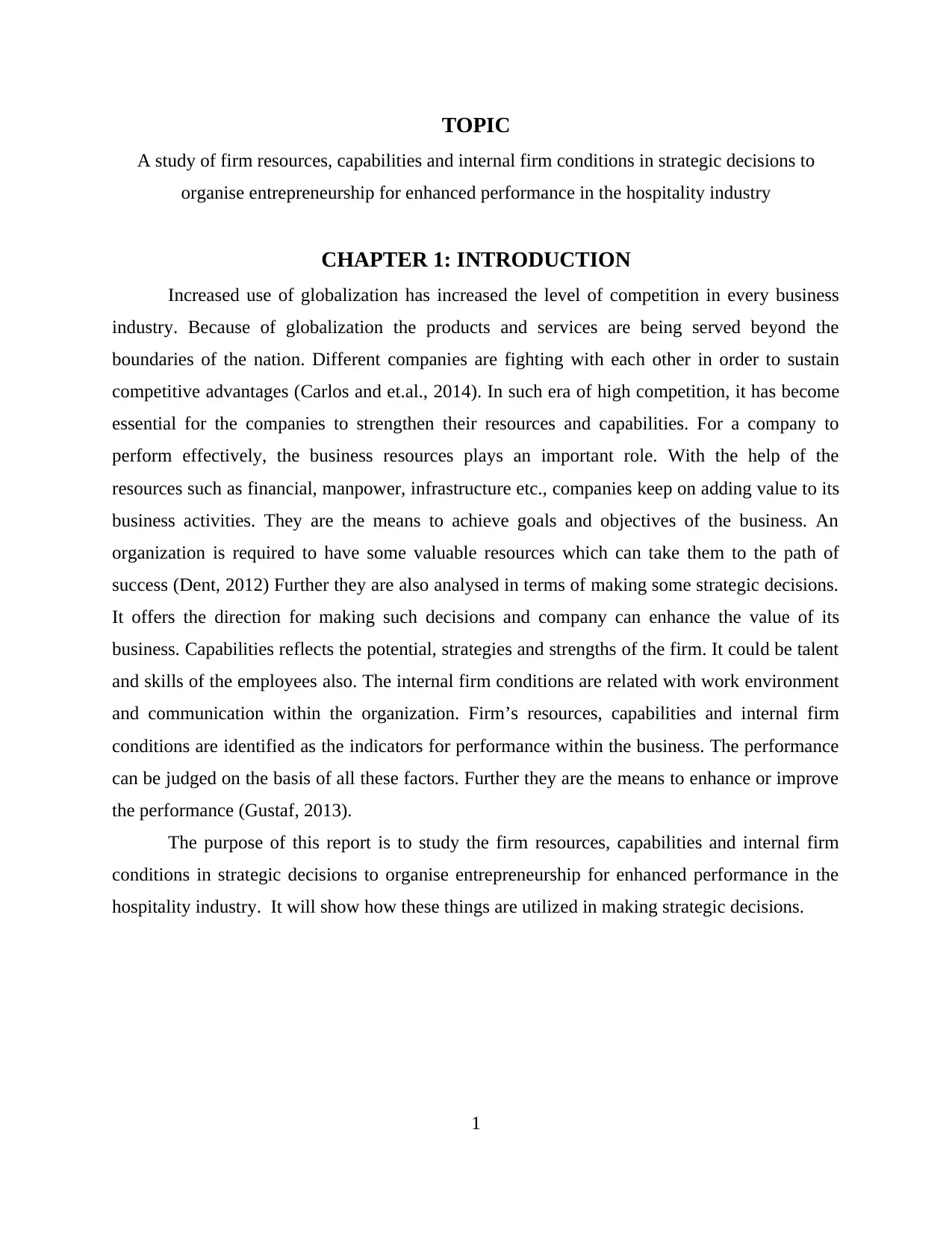
TOPIC
A study of firm resources, capabilities and internal firm conditions in strategic decisions to
organise entrepreneurship for enhanced performance in the hospitality industry
CHAPTER 1: INTRODUCTION
Increased use of globalization has increased the level of competition in every business
industry. Because of globalization the products and services are being served beyond the
boundaries of the nation. Different companies are fighting with each other in order to sustain
competitive advantages (Carlos and et.al., 2014). In such era of high competition, it has become
essential for the companies to strengthen their resources and capabilities. For a company to
perform effectively, the business resources plays an important role. With the help of the
resources such as financial, manpower, infrastructure etc., companies keep on adding value to its
business activities. They are the means to achieve goals and objectives of the business. An
organization is required to have some valuable resources which can take them to the path of
success (Dent, 2012) Further they are also analysed in terms of making some strategic decisions.
It offers the direction for making such decisions and company can enhance the value of its
business. Capabilities reflects the potential, strategies and strengths of the firm. It could be talent
and skills of the employees also. The internal firm conditions are related with work environment
and communication within the organization. Firm’s resources, capabilities and internal firm
conditions are identified as the indicators for performance within the business. The performance
can be judged on the basis of all these factors. Further they are the means to enhance or improve
the performance (Gustaf, 2013).
The purpose of this report is to study the firm resources, capabilities and internal firm
conditions in strategic decisions to organise entrepreneurship for enhanced performance in the
hospitality industry. It will show how these things are utilized in making strategic decisions.
1
A study of firm resources, capabilities and internal firm conditions in strategic decisions to
organise entrepreneurship for enhanced performance in the hospitality industry
CHAPTER 1: INTRODUCTION
Increased use of globalization has increased the level of competition in every business
industry. Because of globalization the products and services are being served beyond the
boundaries of the nation. Different companies are fighting with each other in order to sustain
competitive advantages (Carlos and et.al., 2014). In such era of high competition, it has become
essential for the companies to strengthen their resources and capabilities. For a company to
perform effectively, the business resources plays an important role. With the help of the
resources such as financial, manpower, infrastructure etc., companies keep on adding value to its
business activities. They are the means to achieve goals and objectives of the business. An
organization is required to have some valuable resources which can take them to the path of
success (Dent, 2012) Further they are also analysed in terms of making some strategic decisions.
It offers the direction for making such decisions and company can enhance the value of its
business. Capabilities reflects the potential, strategies and strengths of the firm. It could be talent
and skills of the employees also. The internal firm conditions are related with work environment
and communication within the organization. Firm’s resources, capabilities and internal firm
conditions are identified as the indicators for performance within the business. The performance
can be judged on the basis of all these factors. Further they are the means to enhance or improve
the performance (Gustaf, 2013).
The purpose of this report is to study the firm resources, capabilities and internal firm
conditions in strategic decisions to organise entrepreneurship for enhanced performance in the
hospitality industry. It will show how these things are utilized in making strategic decisions.
1
Paraphrase This Document
Need a fresh take? Get an instant paraphrase of this document with our AI Paraphraser
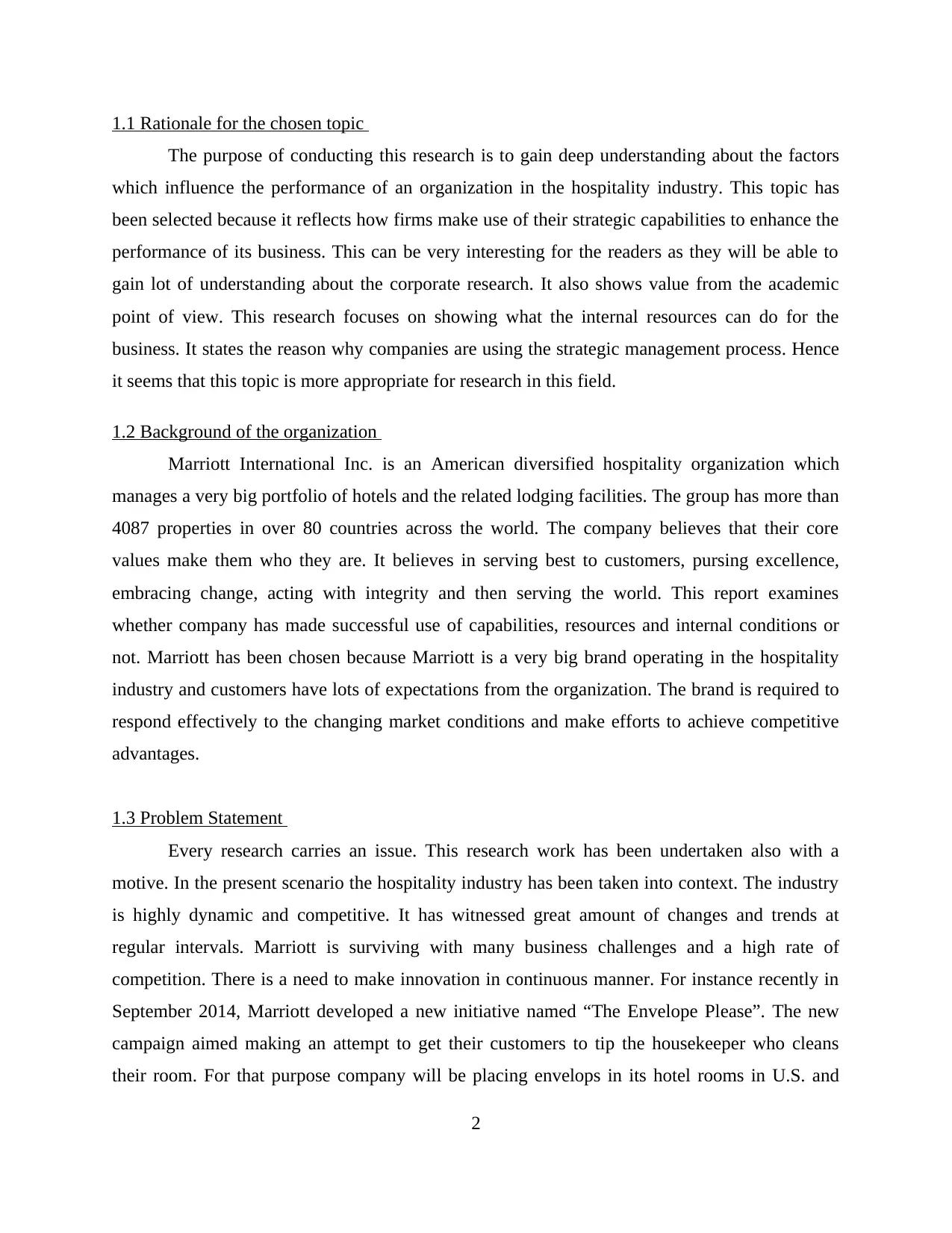
1.1 Rationale for the chosen topic
The purpose of conducting this research is to gain deep understanding about the factors
which influence the performance of an organization in the hospitality industry. This topic has
been selected because it reflects how firms make use of their strategic capabilities to enhance the
performance of its business. This can be very interesting for the readers as they will be able to
gain lot of understanding about the corporate research. It also shows value from the academic
point of view. This research focuses on showing what the internal resources can do for the
business. It states the reason why companies are using the strategic management process. Hence
it seems that this topic is more appropriate for research in this field.
1.2 Background of the organization
Marriott International Inc. is an American diversified hospitality organization which
manages a very big portfolio of hotels and the related lodging facilities. The group has more than
4087 properties in over 80 countries across the world. The company believes that their core
values make them who they are. It believes in serving best to customers, pursing excellence,
embracing change, acting with integrity and then serving the world. This report examines
whether company has made successful use of capabilities, resources and internal conditions or
not. Marriott has been chosen because Marriott is a very big brand operating in the hospitality
industry and customers have lots of expectations from the organization. The brand is required to
respond effectively to the changing market conditions and make efforts to achieve competitive
advantages.
1.3 Problem Statement
Every research carries an issue. This research work has been undertaken also with a
motive. In the present scenario the hospitality industry has been taken into context. The industry
is highly dynamic and competitive. It has witnessed great amount of changes and trends at
regular intervals. Marriott is surviving with many business challenges and a high rate of
competition. There is a need to make innovation in continuous manner. For instance recently in
September 2014, Marriott developed a new initiative named “The Envelope Please”. The new
campaign aimed making an attempt to get their customers to tip the housekeeper who cleans
their room. For that purpose company will be placing envelops in its hotel rooms in U.S. and
2
The purpose of conducting this research is to gain deep understanding about the factors
which influence the performance of an organization in the hospitality industry. This topic has
been selected because it reflects how firms make use of their strategic capabilities to enhance the
performance of its business. This can be very interesting for the readers as they will be able to
gain lot of understanding about the corporate research. It also shows value from the academic
point of view. This research focuses on showing what the internal resources can do for the
business. It states the reason why companies are using the strategic management process. Hence
it seems that this topic is more appropriate for research in this field.
1.2 Background of the organization
Marriott International Inc. is an American diversified hospitality organization which
manages a very big portfolio of hotels and the related lodging facilities. The group has more than
4087 properties in over 80 countries across the world. The company believes that their core
values make them who they are. It believes in serving best to customers, pursing excellence,
embracing change, acting with integrity and then serving the world. This report examines
whether company has made successful use of capabilities, resources and internal conditions or
not. Marriott has been chosen because Marriott is a very big brand operating in the hospitality
industry and customers have lots of expectations from the organization. The brand is required to
respond effectively to the changing market conditions and make efforts to achieve competitive
advantages.
1.3 Problem Statement
Every research carries an issue. This research work has been undertaken also with a
motive. In the present scenario the hospitality industry has been taken into context. The industry
is highly dynamic and competitive. It has witnessed great amount of changes and trends at
regular intervals. Marriott is surviving with many business challenges and a high rate of
competition. There is a need to make innovation in continuous manner. For instance recently in
September 2014, Marriott developed a new initiative named “The Envelope Please”. The new
campaign aimed making an attempt to get their customers to tip the housekeeper who cleans
their room. For that purpose company will be placing envelops in its hotel rooms in U.S. and
2
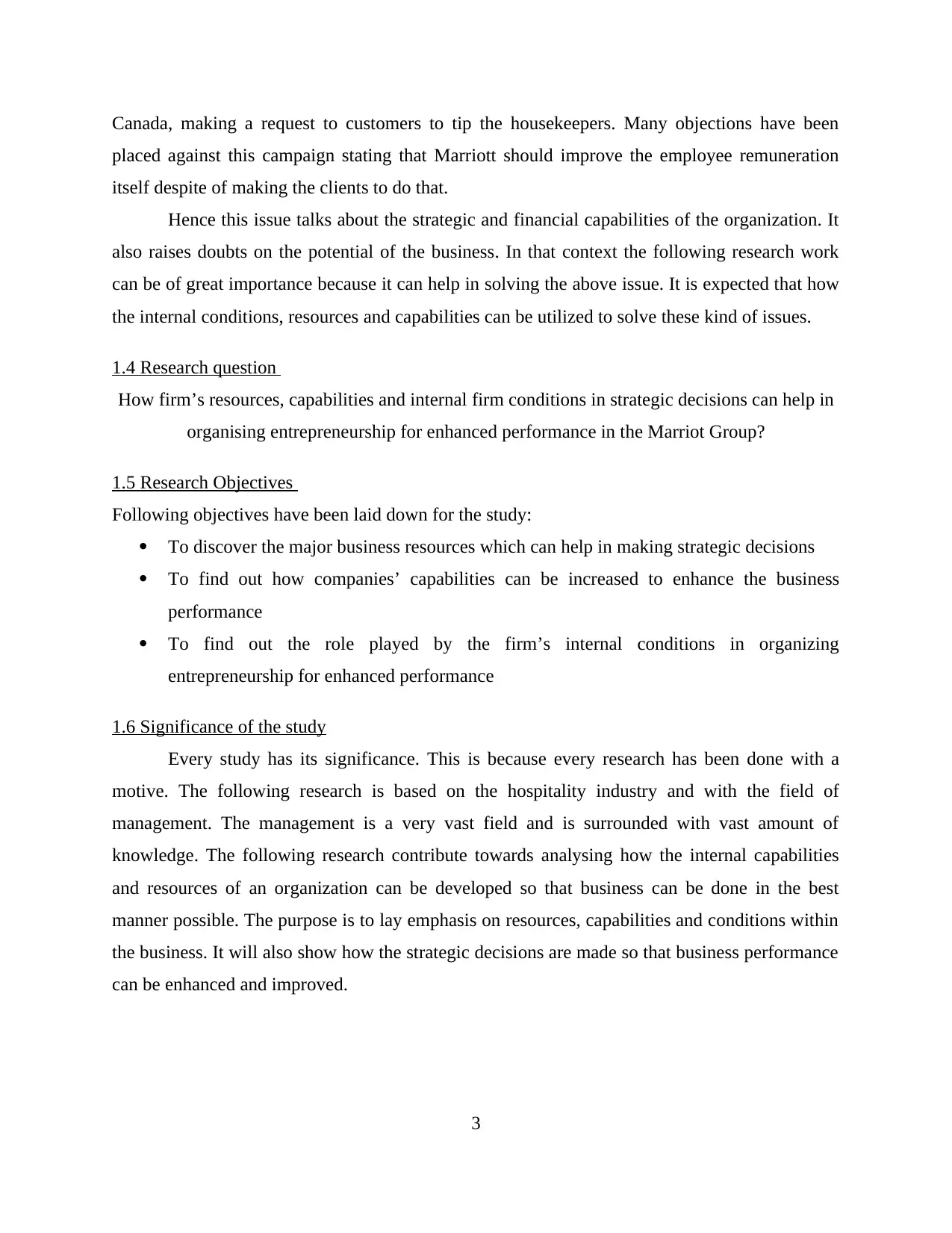
Canada, making a request to customers to tip the housekeepers. Many objections have been
placed against this campaign stating that Marriott should improve the employee remuneration
itself despite of making the clients to do that.
Hence this issue talks about the strategic and financial capabilities of the organization. It
also raises doubts on the potential of the business. In that context the following research work
can be of great importance because it can help in solving the above issue. It is expected that how
the internal conditions, resources and capabilities can be utilized to solve these kind of issues.
1.4 Research question
How firm’s resources, capabilities and internal firm conditions in strategic decisions can help in
organising entrepreneurship for enhanced performance in the Marriot Group?
1.5 Research Objectives
Following objectives have been laid down for the study:
To discover the major business resources which can help in making strategic decisions
To find out how companies’ capabilities can be increased to enhance the business
performance
To find out the role played by the firm’s internal conditions in organizing
entrepreneurship for enhanced performance
1.6 Significance of the study
Every study has its significance. This is because every research has been done with a
motive. The following research is based on the hospitality industry and with the field of
management. The management is a very vast field and is surrounded with vast amount of
knowledge. The following research contribute towards analysing how the internal capabilities
and resources of an organization can be developed so that business can be done in the best
manner possible. The purpose is to lay emphasis on resources, capabilities and conditions within
the business. It will also show how the strategic decisions are made so that business performance
can be enhanced and improved.
3
placed against this campaign stating that Marriott should improve the employee remuneration
itself despite of making the clients to do that.
Hence this issue talks about the strategic and financial capabilities of the organization. It
also raises doubts on the potential of the business. In that context the following research work
can be of great importance because it can help in solving the above issue. It is expected that how
the internal conditions, resources and capabilities can be utilized to solve these kind of issues.
1.4 Research question
How firm’s resources, capabilities and internal firm conditions in strategic decisions can help in
organising entrepreneurship for enhanced performance in the Marriot Group?
1.5 Research Objectives
Following objectives have been laid down for the study:
To discover the major business resources which can help in making strategic decisions
To find out how companies’ capabilities can be increased to enhance the business
performance
To find out the role played by the firm’s internal conditions in organizing
entrepreneurship for enhanced performance
1.6 Significance of the study
Every study has its significance. This is because every research has been done with a
motive. The following research is based on the hospitality industry and with the field of
management. The management is a very vast field and is surrounded with vast amount of
knowledge. The following research contribute towards analysing how the internal capabilities
and resources of an organization can be developed so that business can be done in the best
manner possible. The purpose is to lay emphasis on resources, capabilities and conditions within
the business. It will also show how the strategic decisions are made so that business performance
can be enhanced and improved.
3
⊘ This is a preview!⊘
Do you want full access?
Subscribe today to unlock all pages.
Trusted by 1+ million students worldwide
CHAPTER 2 LITERATURE REVIEW
2.1 Introduction
This part of the proposal demonstrate the knowledge of the literature related to the
identified subject. It tries to make a critical link with the research questions and the investigation
is raised. Major sources are critically reviewed to underpin the study. The literature relies on
published academic journal articles relevant to the investigation topic. This part is considered
very important from the knowledge and understanding point of view. The developed learning
from this section can help in generating some meaningful outcomes and results related with the
subject.
2.2 Business Resources
There are some key business resources which are essential to survive in the market for
the company. It can be regarded as the building block which identifies the most important assets
required to a business model work. With the help of it firms can generate value propositions and
revenues.
These are as follows:
Financial resources – According to Miguel and et.al., (2013), Finance is the backbone of every
business. In the absence of finance there is no chance that business can move in a particular
direction. Along with that is also regarded as the key to success. Finance is needed for making
significant investment in new products, distribution channels, generating production capacity etc.
A company cannot think of any expansion or diversification without money. It can place a great
strain on the potential.
According to Cattermole, Johnson and Roberts, (2013), Business need to make sure that
cash inflows are higher than the cash outflows. Financial management and planning plays an
important part in this context. There are many risks and uncertainties related with the future
which can arise at any point of time. It may be difficult to face them if appropriate liquid cash is
not there within the business. Financial planning can assists in removing those issues and
uncertainties. According to Dressler, (2004), The resources also includes the ability to raise the
funds. It is done through sales of goods and services and enhancing the market share. Another
important aspect is that company is required to maintain a good reputation so that investors and
financial institutions can help in raising the finance. A good financial position is also a sign of
4
2.1 Introduction
This part of the proposal demonstrate the knowledge of the literature related to the
identified subject. It tries to make a critical link with the research questions and the investigation
is raised. Major sources are critically reviewed to underpin the study. The literature relies on
published academic journal articles relevant to the investigation topic. This part is considered
very important from the knowledge and understanding point of view. The developed learning
from this section can help in generating some meaningful outcomes and results related with the
subject.
2.2 Business Resources
There are some key business resources which are essential to survive in the market for
the company. It can be regarded as the building block which identifies the most important assets
required to a business model work. With the help of it firms can generate value propositions and
revenues.
These are as follows:
Financial resources – According to Miguel and et.al., (2013), Finance is the backbone of every
business. In the absence of finance there is no chance that business can move in a particular
direction. Along with that is also regarded as the key to success. Finance is needed for making
significant investment in new products, distribution channels, generating production capacity etc.
A company cannot think of any expansion or diversification without money. It can place a great
strain on the potential.
According to Cattermole, Johnson and Roberts, (2013), Business need to make sure that
cash inflows are higher than the cash outflows. Financial management and planning plays an
important part in this context. There are many risks and uncertainties related with the future
which can arise at any point of time. It may be difficult to face them if appropriate liquid cash is
not there within the business. Financial planning can assists in removing those issues and
uncertainties. According to Dressler, (2004), The resources also includes the ability to raise the
funds. It is done through sales of goods and services and enhancing the market share. Another
important aspect is that company is required to maintain a good reputation so that investors and
financial institutions can help in raising the finance. A good financial position is also a sign of
4
Paraphrase This Document
Need a fresh take? Get an instant paraphrase of this document with our AI Paraphraser
good reputation. Financial institutions would prefer to give money to a company whose gearing
and liquidity position is effective and up to the mark.
Manpower – According to Evans, (2010), Employees are identified as assets for the firms.
Success cannot be imagined without an effective use of manpower. Success is achieved on the
basis of their efforts. They act as the means to achieve the goals and objectives of the business.
Their talent and skills are utilized in taking the business to a higher level. The use of resources
also depends upon the size and type of industry. All companies need human resources but they
are specifically noticeable in knowledge intensive and creative sectors. For instance hospitality
industry is the only industry which needs great support of the workforce. According to Görgens-
Albino and Kusek (2009), A hotel organization cannot be imagined without its employees.
These people are responsible for offering great customers services. They deals with the
customers on the behalf of the company also acting as a face of the company. These resources
are to be managed in effective manner and their optimum utilization is to be made. Company is
required to take care about their growth, training, development, retention, pay-scale etc. Their
development is to be made at regular intervals so that they contribute in achieving competitive
advantages within the business.
Physical resources – According to Griffin and Annulis, (2013), These resources also plays an
imperative role in the functioning of the business. It includes different kinds of assets, machines,
systems, transportation, infrastructure, building, offices etc. These resources also greatly
contributes in reaching to the desired aims and destinations. These also act as a source of
expansion and achievement of something within the business. They are important for the survival
as they provide high amount of strength to the company.
Intellectual – According to Crain and Abraham, (2008), Under intellectual type’s resources such
as brands, proprietary knowledge, patents, copyrights, partnership, customer database etc are
highlighted. These all are increasingly important components of a strong business model. These
type of resources needs time to engender and develop. Brand is something which is achieved
after a long wait and survival. It has the power to make the customers loyal and faithful towards
the company. According to Kaplan, (2005), Sometime companies also comes into joint venture
or partnership to increase the strength. Patents and copyrights gives the authority to hold a right
on something in an official manner. Customer relationship management also plays a crucial role
in enhancing the business performance. It point out towards maintaining a long term healthy and
5
and liquidity position is effective and up to the mark.
Manpower – According to Evans, (2010), Employees are identified as assets for the firms.
Success cannot be imagined without an effective use of manpower. Success is achieved on the
basis of their efforts. They act as the means to achieve the goals and objectives of the business.
Their talent and skills are utilized in taking the business to a higher level. The use of resources
also depends upon the size and type of industry. All companies need human resources but they
are specifically noticeable in knowledge intensive and creative sectors. For instance hospitality
industry is the only industry which needs great support of the workforce. According to Görgens-
Albino and Kusek (2009), A hotel organization cannot be imagined without its employees.
These people are responsible for offering great customers services. They deals with the
customers on the behalf of the company also acting as a face of the company. These resources
are to be managed in effective manner and their optimum utilization is to be made. Company is
required to take care about their growth, training, development, retention, pay-scale etc. Their
development is to be made at regular intervals so that they contribute in achieving competitive
advantages within the business.
Physical resources – According to Griffin and Annulis, (2013), These resources also plays an
imperative role in the functioning of the business. It includes different kinds of assets, machines,
systems, transportation, infrastructure, building, offices etc. These resources also greatly
contributes in reaching to the desired aims and destinations. These also act as a source of
expansion and achievement of something within the business. They are important for the survival
as they provide high amount of strength to the company.
Intellectual – According to Crain and Abraham, (2008), Under intellectual type’s resources such
as brands, proprietary knowledge, patents, copyrights, partnership, customer database etc are
highlighted. These all are increasingly important components of a strong business model. These
type of resources needs time to engender and develop. Brand is something which is achieved
after a long wait and survival. It has the power to make the customers loyal and faithful towards
the company. According to Kaplan, (2005), Sometime companies also comes into joint venture
or partnership to increase the strength. Patents and copyrights gives the authority to hold a right
on something in an official manner. Customer relationship management also plays a crucial role
in enhancing the business performance. It point out towards maintaining a long term healthy and
5
sound business relations with the customers. It is essential to make them loyal towards the
products and services because it promotes repetitive purchasing. Hence it can be said that
intellectual resources are considered very crucial for long term survival and growth of the
organization.
2.3 Capabilities
According to Lane, (2007), A business capability is about stating what a company needs
to do to execute its business strategy. Capabilities can be reflected in terms of people, process,
technology etc. Capability management make use of company’s customer value proposition so
that performance goals can be established. It helps in decreasing the inefficiencies in the
capabilities which ultimately results in low customer impact. While preserving or investing in the
capabilities for growth focus can be made on the efficiencies in the areas with high financial
leverage.
According to Thomas, (2007), process describes the way in which the capability is
executed. According to Craig, (2008), an organization capability refers to the way under which
all the systems and people work together to complete all the activities. It is to be noted that the
two terms capability and competency are often used interchangeably. However the two are quite
different. Individuals have competencies while organizations have capabilities. Both the terms
are having technical and social elements which can be seen as follows:
Individual Company
Technical Functional competencies Business capabilities
Social Leadership competencies Organizational capabilities
According to Freeman, (2010), Under the juncture of the individual and the technology,
employees bring functional skills and competencies. Under the intersection of the individual and
the society, leaders also have a set of competencies or skills. The business capabilities comes at
the intersection of organization and technology.
According to Hill, (2012), Organizational capability also mentions about the firm’s
ability to manage the people in effective manner so that competitive advantages can be attained.
It focuses on internal processes and systems for meeting the customer expectations. It also
ensures that skills and efforts of the employees are directed towards achievement of company
6
products and services because it promotes repetitive purchasing. Hence it can be said that
intellectual resources are considered very crucial for long term survival and growth of the
organization.
2.3 Capabilities
According to Lane, (2007), A business capability is about stating what a company needs
to do to execute its business strategy. Capabilities can be reflected in terms of people, process,
technology etc. Capability management make use of company’s customer value proposition so
that performance goals can be established. It helps in decreasing the inefficiencies in the
capabilities which ultimately results in low customer impact. While preserving or investing in the
capabilities for growth focus can be made on the efficiencies in the areas with high financial
leverage.
According to Thomas, (2007), process describes the way in which the capability is
executed. According to Craig, (2008), an organization capability refers to the way under which
all the systems and people work together to complete all the activities. It is to be noted that the
two terms capability and competency are often used interchangeably. However the two are quite
different. Individuals have competencies while organizations have capabilities. Both the terms
are having technical and social elements which can be seen as follows:
Individual Company
Technical Functional competencies Business capabilities
Social Leadership competencies Organizational capabilities
According to Freeman, (2010), Under the juncture of the individual and the technology,
employees bring functional skills and competencies. Under the intersection of the individual and
the society, leaders also have a set of competencies or skills. The business capabilities comes at
the intersection of organization and technology.
According to Hill, (2012), Organizational capability also mentions about the firm’s
ability to manage the people in effective manner so that competitive advantages can be attained.
It focuses on internal processes and systems for meeting the customer expectations. It also
ensures that skills and efforts of the employees are directed towards achievement of company
6
⊘ This is a preview!⊘
Do you want full access?
Subscribe today to unlock all pages.
Trusted by 1+ million students worldwide
goals and strategies. Capabilities can be categorized on the basis of traditional sources of
competitive advantages also:
Economic and financial capability – It shows the ability to produce goods and services at
lower cost as compared to the competitors (Jeffs, 2008).
Strategic marketing capability – It is about producing goods and services which can help
in achieving differentiation from the competitors within the market. It is an effort to
increase the portfolio of the products.
Technological capability – It is about producing products which are innovative and are of
high quality. Technology is a source of achieving competitive advantages so that value of
the business can be enhanced (Kale, 2014)
According to Plant, (2000), organizational capability can enhance the perceived customer
value in three ways. These are as follows:
Responsiveness – It reflects the ability of the company to understand and meet the needs
of the customers quickly as compared to its competitors.
Relationships – It shows the ability of the company regarding developing long term
relations with the customers and employees (Sadler, 2003)
Service quality – It states the ability of the business to design, develop and deliver
services which can meet the expectations of the customers.
One of the biggest challenge faced by the companies in developing capability models is to
move people from functional thinking to capability thinking. Functional thinking is about the
things which we do and capability thinking is the ability that we have to do the things. The
reason behind such difficulty is that companies usually create organizational functions around
the capabilities and that is why the two look similar (Sekhar, 2009). Taking that into
consideration, there are some five essential capabilities which every organization must have:
Leadership – According to Afiouni, (2013), Leadership is taken as set of people at the top
of the organization but in reality it is a skill which can be exists at every level. It is
regarded as the capability to give inspiration and motivation to the people so that a
particular mission can be fulfilled. At the top of the company leadership can be taken as
giving direction to the others while at the lower level it is accomplished through
influencing others (Agrwal, 2012). The company’s leadership performance is in great
integration with how much the company can accomplish in a given period of time.
7
competitive advantages also:
Economic and financial capability – It shows the ability to produce goods and services at
lower cost as compared to the competitors (Jeffs, 2008).
Strategic marketing capability – It is about producing goods and services which can help
in achieving differentiation from the competitors within the market. It is an effort to
increase the portfolio of the products.
Technological capability – It is about producing products which are innovative and are of
high quality. Technology is a source of achieving competitive advantages so that value of
the business can be enhanced (Kale, 2014)
According to Plant, (2000), organizational capability can enhance the perceived customer
value in three ways. These are as follows:
Responsiveness – It reflects the ability of the company to understand and meet the needs
of the customers quickly as compared to its competitors.
Relationships – It shows the ability of the company regarding developing long term
relations with the customers and employees (Sadler, 2003)
Service quality – It states the ability of the business to design, develop and deliver
services which can meet the expectations of the customers.
One of the biggest challenge faced by the companies in developing capability models is to
move people from functional thinking to capability thinking. Functional thinking is about the
things which we do and capability thinking is the ability that we have to do the things. The
reason behind such difficulty is that companies usually create organizational functions around
the capabilities and that is why the two look similar (Sekhar, 2009). Taking that into
consideration, there are some five essential capabilities which every organization must have:
Leadership – According to Afiouni, (2013), Leadership is taken as set of people at the top
of the organization but in reality it is a skill which can be exists at every level. It is
regarded as the capability to give inspiration and motivation to the people so that a
particular mission can be fulfilled. At the top of the company leadership can be taken as
giving direction to the others while at the lower level it is accomplished through
influencing others (Agrwal, 2012). The company’s leadership performance is in great
integration with how much the company can accomplish in a given period of time.
7
Paraphrase This Document
Need a fresh take? Get an instant paraphrase of this document with our AI Paraphraser
Collaboration – According to Armstrong and Taylor, (2014), Collaboration can be
defined as the ability to work in productive manner with others. At the low end of the
performance it performs the segmentation of the tasks. Collaboration helps in developing
a synergy at the high end of the performance. It is about producing a performance boost
where the whole is higher than the sum of its parts. Some firms may need high
collaboration as compared to others while some need to collaborate at all the levels.
Adaptability – According to Freeman, (2010), The history related to adaptability has not
so been critical in the previous time. The business environment has becomes so dynamic
and competitive that companies, products and services and even the whole industries
come and go in a fraction of sections. Adaptability shows the ability of the company to
give up on the existing processes, skills and systems and taking a diversion towards
innovation and new processes and systems (Gannon, Doherty and Roper, 2012). It is
done deliberately by making assure that it will lead to the success in the upcoming period.
It is essential to survive the competition and to develop an identity in the market.
Creativity – According to García-Vázquez, (2007), the problems faced by the firms in the
present context are much more complex. These cannot be solved easily. It describes the
company’s ability to think differently and how this thinking can influence the strategic
decision making process. The time which states to move on the path on which everyone
goes has gone now. Now the time is to come up with something new and challenging.
Customers usually get bored of things which are repetitively served to them. It is
essential to serve them something which is unique and different.
Innovation – Innovation goes beyond creativity to make sure that creative ideas turns into
reality. Business world is full of innovation as every time new things are emerging in
terms of technology, strategies, processes, systems, etc (Hill, 2012). It can be regarded as
the ability to transform a good concept into a compelling value proposition under which
others shows the willingness to support and invest. When the innovation ability is high,
firms go on producing innovative products, processes, management practices etc.
Workforce – This is one of the most essential capabilities within the business. All the
above identified capabilities are incomplete without this capability. Employees are the
assets for the company. They people are responsible for achieving the goals and
objectives of the business (Crain and Abraham, 2008). Without their support and efforts
8
defined as the ability to work in productive manner with others. At the low end of the
performance it performs the segmentation of the tasks. Collaboration helps in developing
a synergy at the high end of the performance. It is about producing a performance boost
where the whole is higher than the sum of its parts. Some firms may need high
collaboration as compared to others while some need to collaborate at all the levels.
Adaptability – According to Freeman, (2010), The history related to adaptability has not
so been critical in the previous time. The business environment has becomes so dynamic
and competitive that companies, products and services and even the whole industries
come and go in a fraction of sections. Adaptability shows the ability of the company to
give up on the existing processes, skills and systems and taking a diversion towards
innovation and new processes and systems (Gannon, Doherty and Roper, 2012). It is
done deliberately by making assure that it will lead to the success in the upcoming period.
It is essential to survive the competition and to develop an identity in the market.
Creativity – According to García-Vázquez, (2007), the problems faced by the firms in the
present context are much more complex. These cannot be solved easily. It describes the
company’s ability to think differently and how this thinking can influence the strategic
decision making process. The time which states to move on the path on which everyone
goes has gone now. Now the time is to come up with something new and challenging.
Customers usually get bored of things which are repetitively served to them. It is
essential to serve them something which is unique and different.
Innovation – Innovation goes beyond creativity to make sure that creative ideas turns into
reality. Business world is full of innovation as every time new things are emerging in
terms of technology, strategies, processes, systems, etc (Hill, 2012). It can be regarded as
the ability to transform a good concept into a compelling value proposition under which
others shows the willingness to support and invest. When the innovation ability is high,
firms go on producing innovative products, processes, management practices etc.
Workforce – This is one of the most essential capabilities within the business. All the
above identified capabilities are incomplete without this capability. Employees are the
assets for the company. They people are responsible for achieving the goals and
objectives of the business (Crain and Abraham, 2008). Without their support and efforts
8
it is not possible to drive on the path of the success. Their talent and skills are utilized in
taking the business to a higher level. These capabilities are to be managed in effective
manner and their optimum utilization is to be made. Management is required to take care
about their growth, training, development, retention, pay-scale etc. They are the backbone
upon which the business is structured.
2.4 Internal conditions
According to Carlos and et.al., (2014), While taking the strategic decisions in the
organizations the management considers the overall scenario of the business organization. The
complete analysis of the internal situation contributes significantly in taking the decisions with
respect to increasing the productivity and the profitability of the organization. The internal
situation of the organization encompasses different factors such as the financial position, the
operational structure, the employee’s related issues, the relational constructs between the
employer and the employees, the resource management and the technology used in the
organization (Dent, 2012). The mentioned factors are mentioned in detail below:
Financial position: The analysis of the current financial position of the organization helps
the management to take the decisions with respect to the sales maximization, profit
enhancement, the consistency in the economic situation and the further improvements.
The board members while making plans, keep into consideration the projected data and
figures of the organization. It helps them in building realistic plans. For that purpose they
undergo market research and with the help of specialists and expertise the plans are
proceeded (Miguel and et.al., 2013).
Operational structure: According to Cattermole, Johnson and Roberts, (2013) The central
part of the management is the operational structure of the organization. It inculcates that
part of the management which executes and implements the strategies and policies
framed by the decision takers. Based on the efficiency and the capabilities of the
employees and their strengths the management takes decision. On the contrary () stated
that its effect the profitability is negligible. It is independent of the operational
management.
The abilities of employees: According to Dressler, (2004), this is the major factor of
consideration for the decision takers and the management. By analysing the current
situation and development needs, the board make strategies with respect to the training
9
taking the business to a higher level. These capabilities are to be managed in effective
manner and their optimum utilization is to be made. Management is required to take care
about their growth, training, development, retention, pay-scale etc. They are the backbone
upon which the business is structured.
2.4 Internal conditions
According to Carlos and et.al., (2014), While taking the strategic decisions in the
organizations the management considers the overall scenario of the business organization. The
complete analysis of the internal situation contributes significantly in taking the decisions with
respect to increasing the productivity and the profitability of the organization. The internal
situation of the organization encompasses different factors such as the financial position, the
operational structure, the employee’s related issues, the relational constructs between the
employer and the employees, the resource management and the technology used in the
organization (Dent, 2012). The mentioned factors are mentioned in detail below:
Financial position: The analysis of the current financial position of the organization helps
the management to take the decisions with respect to the sales maximization, profit
enhancement, the consistency in the economic situation and the further improvements.
The board members while making plans, keep into consideration the projected data and
figures of the organization. It helps them in building realistic plans. For that purpose they
undergo market research and with the help of specialists and expertise the plans are
proceeded (Miguel and et.al., 2013).
Operational structure: According to Cattermole, Johnson and Roberts, (2013) The central
part of the management is the operational structure of the organization. It inculcates that
part of the management which executes and implements the strategies and policies
framed by the decision takers. Based on the efficiency and the capabilities of the
employees and their strengths the management takes decision. On the contrary () stated
that its effect the profitability is negligible. It is independent of the operational
management.
The abilities of employees: According to Dressler, (2004), this is the major factor of
consideration for the decision takers and the management. By analysing the current
situation and development needs, the board make strategies with respect to the training
9
⊘ This is a preview!⊘
Do you want full access?
Subscribe today to unlock all pages.
Trusted by 1+ million students worldwide

1 out of 23


Related Documents


Your All-in-One AI-Powered Toolkit for Academic Success.
+13062052269
info@desklib.com
Available 24*7 on WhatsApp / Email
![[object Object]](/_next/static/media/star-bottom.7253800d.svg)
Unlock your academic potential
Copyright © 2020–2026 A2Z Services. All Rights Reserved. Developed and managed by ZUCOL.