HRM Report: Analyzing Staff Turnover at X Sports Bar & Bistro
VerifiedAdded on 2023/06/13
|88
|11442
|434
Report
AI Summary
This report examines the high staff turnover rate at X Sports Bar and Bistro, a hospitality establishment in New South Wales. It investigates the causes of turnover, evaluates the impact of organizational practices, and recommends strategies for improvement. The research employs a mixed-methods approach, including literature review, data collection, and statistical analysis, to explore factors such as job satisfaction, employee engagement, and leader-member exchange. Findings highlight the importance of addressing employee needs, improving leadership, and fostering open communication to reduce turnover and enhance employee retention. The report concludes with actionable recommendations and acknowledges the limitations of the study. Desklib provides access to this assignment and numerous other solved papers to support student learning.
Running head: STAFF TURNOVER
STAFF TURNOVER
Name of the Student
Name of the University
Author Note
STAFF TURNOVER
Name of the Student
Name of the University
Author Note

Paraphrase This Document
Need a fresh take? Get an instant paraphrase of this document with our AI Paraphraser
1STAFF TURNOVER
Executive Summary
The given report throws light on the relationship between various factors which are present in the
organization and their impact on the staff turnover in the hospitality industry. The X Sports Bar
and Bistro is the concerned organization in the given paper. The given paper follows a
systematized structure whereby the first chapter is the introduction which introduces the case and
the research question. This is followed by a brief review of literature whereby the various
information available using different sources have been analysed. This is followed by the
research methodology and analysis of data which follows a mixed structure followed by a
discussion. Certain recommendations have been provided, followed by a brief conclusion.
Executive Summary
The given report throws light on the relationship between various factors which are present in the
organization and their impact on the staff turnover in the hospitality industry. The X Sports Bar
and Bistro is the concerned organization in the given paper. The given paper follows a
systematized structure whereby the first chapter is the introduction which introduces the case and
the research question. This is followed by a brief review of literature whereby the various
information available using different sources have been analysed. This is followed by the
research methodology and analysis of data which follows a mixed structure followed by a
discussion. Certain recommendations have been provided, followed by a brief conclusion.
2STAFF TURNOVER
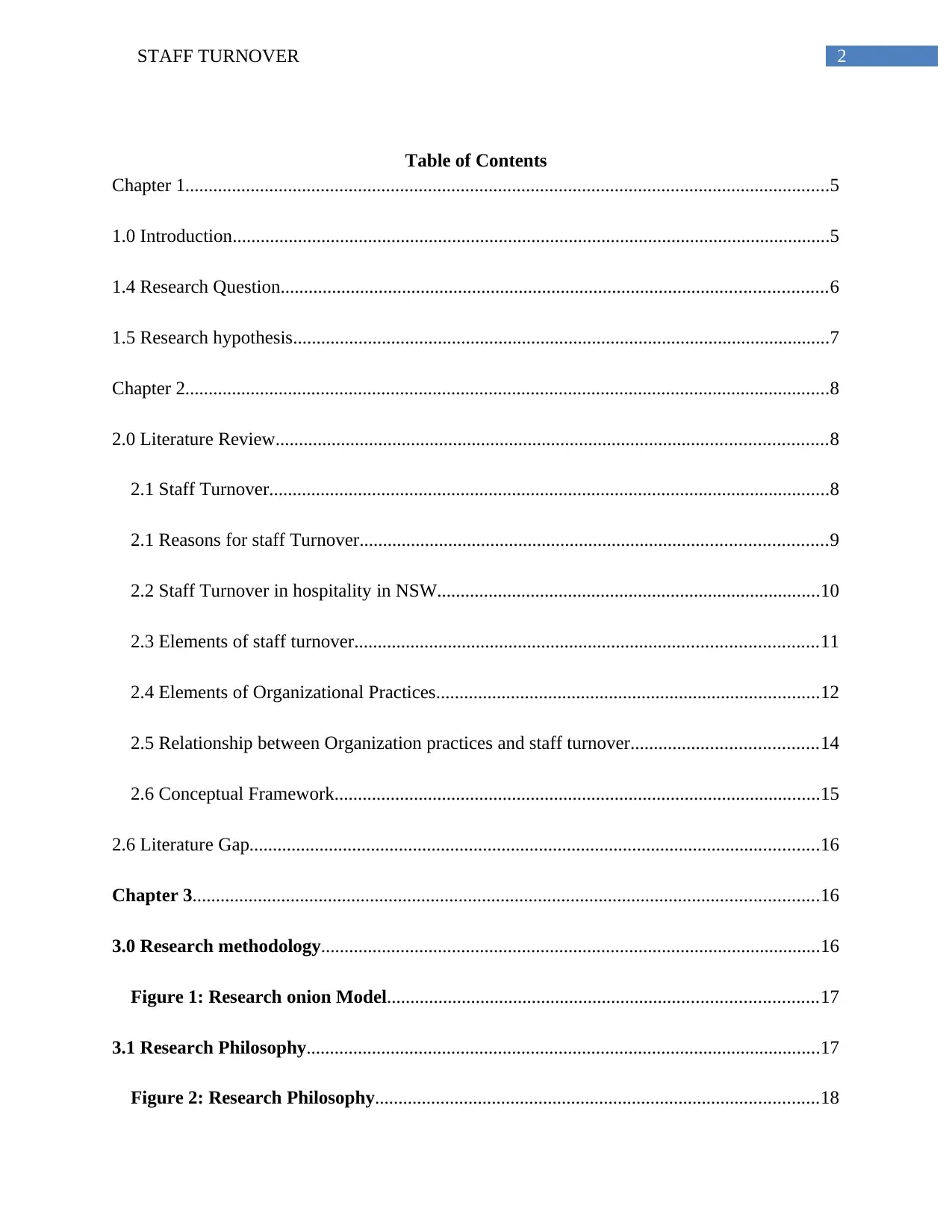
Table of Contents
Chapter 1..........................................................................................................................................5
1.0 Introduction................................................................................................................................5
1.4 Research Question.....................................................................................................................6
1.5 Research hypothesis...................................................................................................................7
Chapter 2..........................................................................................................................................8
2.0 Literature Review......................................................................................................................8
2.1 Staff Turnover........................................................................................................................8
2.1 Reasons for staff Turnover....................................................................................................9
2.2 Staff Turnover in hospitality in NSW..................................................................................10
2.3 Elements of staff turnover...................................................................................................11
2.4 Elements of Organizational Practices..................................................................................12
2.5 Relationship between Organization practices and staff turnover........................................14
2.6 Conceptual Framework........................................................................................................15
2.6 Literature Gap..........................................................................................................................16
Chapter 3......................................................................................................................................16
3.0 Research methodology...........................................................................................................16
Figure 1: Research onion Model............................................................................................17
3.1 Research Philosophy..............................................................................................................17
Figure 2: Research Philosophy...............................................................................................18
Table of Contents
Chapter 1..........................................................................................................................................5
1.0 Introduction................................................................................................................................5
1.4 Research Question.....................................................................................................................6
1.5 Research hypothesis...................................................................................................................7
Chapter 2..........................................................................................................................................8
2.0 Literature Review......................................................................................................................8
2.1 Staff Turnover........................................................................................................................8
2.1 Reasons for staff Turnover....................................................................................................9
2.2 Staff Turnover in hospitality in NSW..................................................................................10
2.3 Elements of staff turnover...................................................................................................11
2.4 Elements of Organizational Practices..................................................................................12
2.5 Relationship between Organization practices and staff turnover........................................14
2.6 Conceptual Framework........................................................................................................15
2.6 Literature Gap..........................................................................................................................16
Chapter 3......................................................................................................................................16
3.0 Research methodology...........................................................................................................16
Figure 1: Research onion Model............................................................................................17
3.1 Research Philosophy..............................................................................................................17
Figure 2: Research Philosophy...............................................................................................18
⊘ This is a preview!⊘
Do you want full access?
Subscribe today to unlock all pages.

Trusted by 1+ million students worldwide
3STAFF TURNOVER
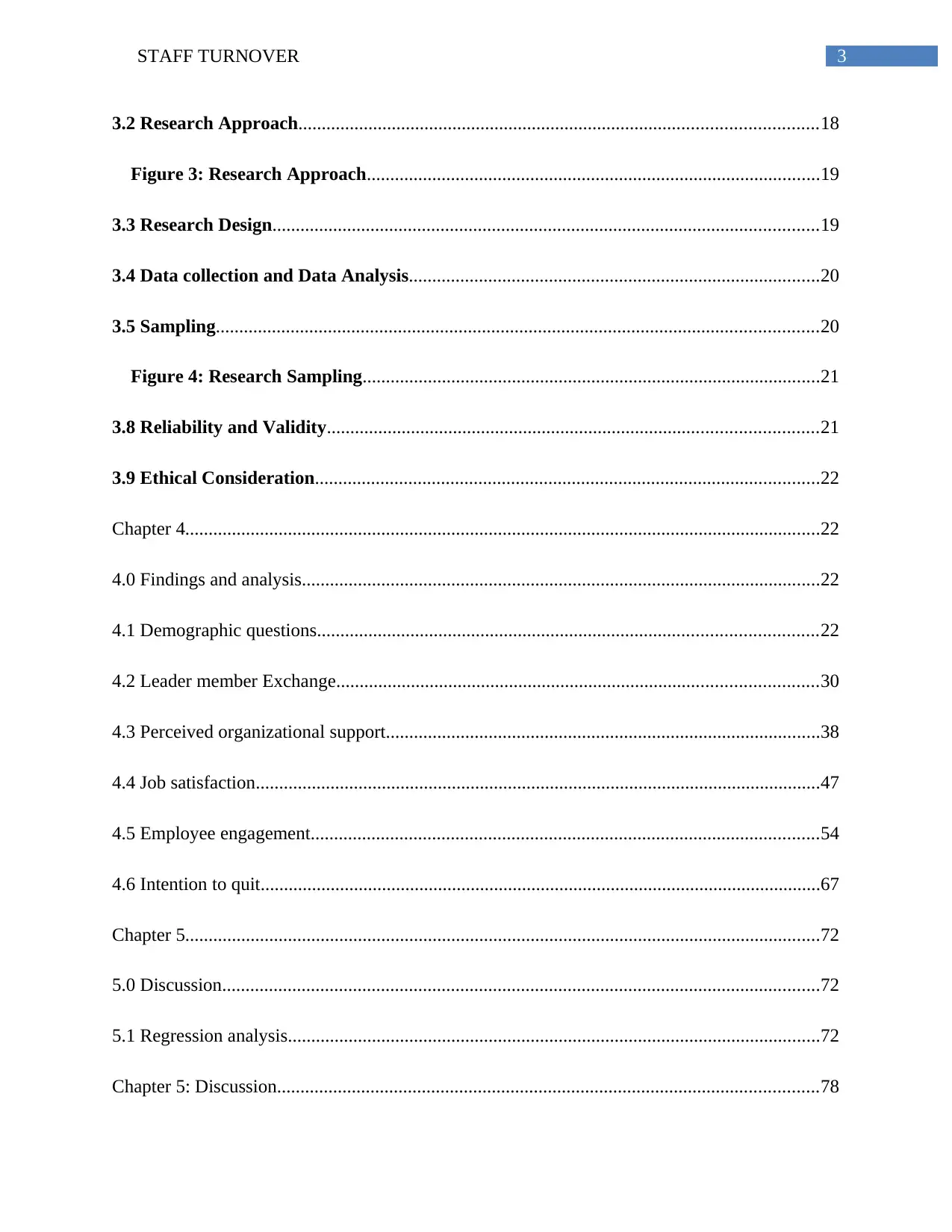
3.2 Research Approach...............................................................................................................18
Figure 3: Research Approach.................................................................................................19
3.3 Research Design.....................................................................................................................19
3.4 Data collection and Data Analysis........................................................................................20
3.5 Sampling.................................................................................................................................20
Figure 4: Research Sampling..................................................................................................21
3.8 Reliability and Validity.........................................................................................................21
3.9 Ethical Consideration............................................................................................................22
Chapter 4........................................................................................................................................22
4.0 Findings and analysis...............................................................................................................22
4.1 Demographic questions...........................................................................................................22
4.2 Leader member Exchange.......................................................................................................30
4.3 Perceived organizational support.............................................................................................38
4.4 Job satisfaction.........................................................................................................................47
4.5 Employee engagement.............................................................................................................54
4.6 Intention to quit........................................................................................................................67
Chapter 5........................................................................................................................................72
5.0 Discussion................................................................................................................................72
5.1 Regression analysis..................................................................................................................72
Chapter 5: Discussion....................................................................................................................78
3.2 Research Approach...............................................................................................................18
Figure 3: Research Approach.................................................................................................19
3.3 Research Design.....................................................................................................................19
3.4 Data collection and Data Analysis........................................................................................20
3.5 Sampling.................................................................................................................................20
Figure 4: Research Sampling..................................................................................................21
3.8 Reliability and Validity.........................................................................................................21
3.9 Ethical Consideration............................................................................................................22
Chapter 4........................................................................................................................................22
4.0 Findings and analysis...............................................................................................................22
4.1 Demographic questions...........................................................................................................22
4.2 Leader member Exchange.......................................................................................................30
4.3 Perceived organizational support.............................................................................................38
4.4 Job satisfaction.........................................................................................................................47
4.5 Employee engagement.............................................................................................................54
4.6 Intention to quit........................................................................................................................67
Chapter 5........................................................................................................................................72
5.0 Discussion................................................................................................................................72
5.1 Regression analysis..................................................................................................................72
Chapter 5: Discussion....................................................................................................................78
Paraphrase This Document
Need a fresh take? Get an instant paraphrase of this document with our AI Paraphraser
4STAFF TURNOVER
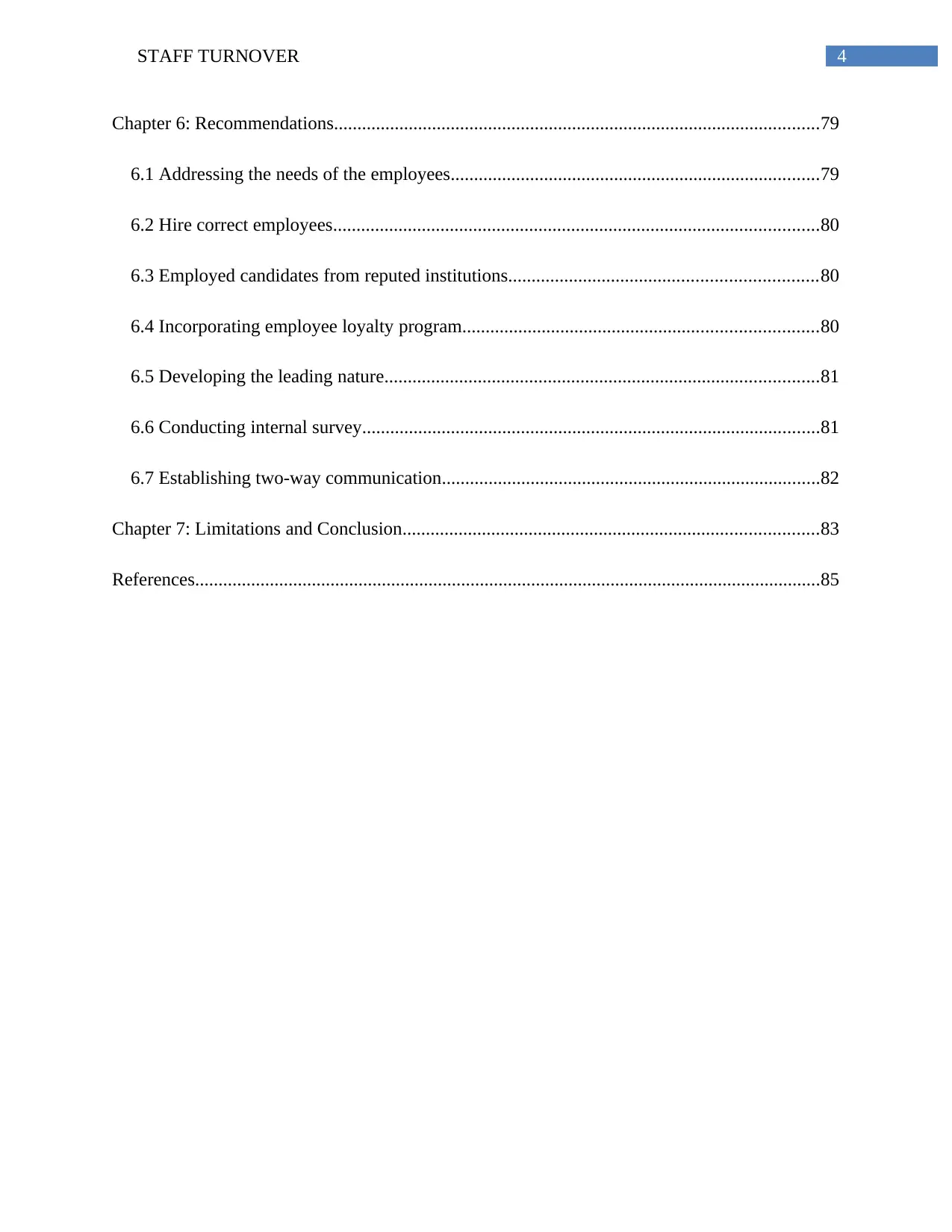
Chapter 6: Recommendations........................................................................................................79
6.1 Addressing the needs of the employees...............................................................................79
6.2 Hire correct employees........................................................................................................80
6.3 Employed candidates from reputed institutions..................................................................80
6.4 Incorporating employee loyalty program............................................................................80
6.5 Developing the leading nature.............................................................................................81
6.6 Conducting internal survey..................................................................................................81
6.7 Establishing two-way communication.................................................................................82
Chapter 7: Limitations and Conclusion.........................................................................................83
References......................................................................................................................................85
Chapter 6: Recommendations........................................................................................................79
6.1 Addressing the needs of the employees...............................................................................79
6.2 Hire correct employees........................................................................................................80
6.3 Employed candidates from reputed institutions..................................................................80
6.4 Incorporating employee loyalty program............................................................................80
6.5 Developing the leading nature.............................................................................................81
6.6 Conducting internal survey..................................................................................................81
6.7 Establishing two-way communication.................................................................................82
Chapter 7: Limitations and Conclusion.........................................................................................83
References......................................................................................................................................85
5STAFF TURNOVER
Chapter 1
1.0 Introduction
The report helps in analysis of the human resource management activities of the X Sports
Bar and Bistro. X Sports Bar and Bistro is situated in heart of Kingsford that is situated in New
South Wales. The sports bar consists of the two different sections that help in serving American
style of breakfast along with snacks throughout the day. The main aim along with research
questions has to be analysed effectively as this will help them in understanding the different
application of strategies that will help in overcoming the issues efficiently.
1.1. Background of the study
The respective company helps in offering proper entertainment to all the customers along
with different facilities of gaming as well. The entire literature review has to be done effectually
with the help of the strategies that will help in resolving the issues and reduce the turnover of
employees as well. The aim of the study of the research is to investigate and explore the different
kind of reasons for the high turnover of the employees at X Sports Bar and Bistro and effective
measures has to be analysed to mitigate the risks in an effectual manner.
The main aim and purpose of the report is to understand the different causes of the
turnover of the staffs at the X Sports Bar and Bistro and this will help in retaining the staffs in
the respective organization as well. Proper literature review has to be done in an appropriate
manner with the implementation of primary data collection such as through different kind of
interviews with the management along with the employees.
The different kind of practices and measures has to be identified effectually that is
required to be developed as to retain the staffs in the company as well. Proper strategies of the
Chapter 1
1.0 Introduction
The report helps in analysis of the human resource management activities of the X Sports
Bar and Bistro. X Sports Bar and Bistro is situated in heart of Kingsford that is situated in New
South Wales. The sports bar consists of the two different sections that help in serving American
style of breakfast along with snacks throughout the day. The main aim along with research
questions has to be analysed effectively as this will help them in understanding the different
application of strategies that will help in overcoming the issues efficiently.
1.1. Background of the study
The respective company helps in offering proper entertainment to all the customers along
with different facilities of gaming as well. The entire literature review has to be done effectually
with the help of the strategies that will help in resolving the issues and reduce the turnover of
employees as well. The aim of the study of the research is to investigate and explore the different
kind of reasons for the high turnover of the employees at X Sports Bar and Bistro and effective
measures has to be analysed to mitigate the risks in an effectual manner.
The main aim and purpose of the report is to understand the different causes of the
turnover of the staffs at the X Sports Bar and Bistro and this will help in retaining the staffs in
the respective organization as well. Proper literature review has to be done in an appropriate
manner with the implementation of primary data collection such as through different kind of
interviews with the management along with the employees.
The different kind of practices and measures has to be identified effectually that is
required to be developed as to retain the staffs in the company as well. Proper strategies of the
⊘ This is a preview!⊘
Do you want full access?
Subscribe today to unlock all pages.
Trusted by 1+ million students worldwide
6STAFF TURNOVER
strategic human resource management have to be utilized in an effectual manner that will help
the company named X Sports Bar and Bistro in solving such issues and reduce the turnover rate
of the employees in the organization as well.
1.2. Aim of the Research
The research problem will include the different kinds of problems of the staff turnover
along with finding the procedure to retain the staffs in the respective organization. The earnings
of the staffs have to be discussed as this will help in highlighting the different kind of options
and theories of the recruitment and selection has to be applied effectively to highlight the issues
and solve them efficiently as well.
Based on the research questions, the proper initiatives have to be undertaken as this will
help in solving the issues and analyse the effects in a positive manner as well. Proper analysis is
required to be done that will help the company in understanding the issues effectually.
1.3 Research objectives
To identify the causes of staff turnover at X sports Bar and Bistro
To evaluate the impact of organizational practices on staff turnover rate
To recommend suitable strategies for improving turnover rate at X sports Bar and Bistro
1.4 Research Question
1. What are the causes of staff turnover at the X Sports Bar and Bistro? Explain the reasons
behind such high rate of turnover in the respective organization?
2. What practices and measures the venue needs to develop to retain staff? Describe the different
measures that will help in solving the issues effectively?
strategic human resource management have to be utilized in an effectual manner that will help
the company named X Sports Bar and Bistro in solving such issues and reduce the turnover rate
of the employees in the organization as well.
1.2. Aim of the Research
The research problem will include the different kinds of problems of the staff turnover
along with finding the procedure to retain the staffs in the respective organization. The earnings
of the staffs have to be discussed as this will help in highlighting the different kind of options
and theories of the recruitment and selection has to be applied effectively to highlight the issues
and solve them efficiently as well.
Based on the research questions, the proper initiatives have to be undertaken as this will
help in solving the issues and analyse the effects in a positive manner as well. Proper analysis is
required to be done that will help the company in understanding the issues effectually.
1.3 Research objectives
To identify the causes of staff turnover at X sports Bar and Bistro
To evaluate the impact of organizational practices on staff turnover rate
To recommend suitable strategies for improving turnover rate at X sports Bar and Bistro
1.4 Research Question
1. What are the causes of staff turnover at the X Sports Bar and Bistro? Explain the reasons
behind such high rate of turnover in the respective organization?
2. What practices and measures the venue needs to develop to retain staff? Describe the different
measures that will help in solving the issues effectively?
Paraphrase This Document
Need a fresh take? Get an instant paraphrase of this document with our AI Paraphraser
7STAFF TURNOVER
1.5 Research hypothesis
H0 – Organization practices does not have any impact on staff turnover rate in X Sports Bar and
Bistro
H1 – Organization practices does have any impact on staff turnover rate in X Sports Bar and
Bistro
1.5 Research hypothesis
H0 – Organization practices does not have any impact on staff turnover rate in X Sports Bar and
Bistro
H1 – Organization practices does have any impact on staff turnover rate in X Sports Bar and
Bistro
8STAFF TURNOVER
Chapter 2
2.0 Literature Review
The given section will be introducing the concept of Staff Turnover and the various
factors that exist within the practice of organization which tend to be directly related to the staff
turnover and retention practises (Alfes et al. 2013). The various concepts and research related to
staff turnover will be discussed along with relevance to the hospitality industry in the NSW
region.
2.1 Staff Turnover
Staff turnover or employee turnover can be described as a percentage of workers who
tend to leave an organization and be replaced by new employees (Hausknecht and Holwerda
2013). Measurement of the employee turnover can be described as a helpful took for an
organization as it can be a clear indication of the organizations capability and efficiency in
maintaining the different employees. It also goes a long way in examining the reasons for the
turnover and estimating the cost which will be required to hire for budgetary purposes.
According to Anvari, JianFu and Chermahini (2014), there exists various kinds of
definitions of employee turnover, but the most common type of them can be stated as the
turnover which takes place in an organization when the employment relationship tends to come
to an end in the given organization of concern. Very often turnover and attrition are taken to be
the same and used interchangeably (Bratton and Gold 2017). There are various definitions to
Chapter 2
2.0 Literature Review
The given section will be introducing the concept of Staff Turnover and the various
factors that exist within the practice of organization which tend to be directly related to the staff
turnover and retention practises (Alfes et al. 2013). The various concepts and research related to
staff turnover will be discussed along with relevance to the hospitality industry in the NSW
region.
2.1 Staff Turnover
Staff turnover or employee turnover can be described as a percentage of workers who
tend to leave an organization and be replaced by new employees (Hausknecht and Holwerda
2013). Measurement of the employee turnover can be described as a helpful took for an
organization as it can be a clear indication of the organizations capability and efficiency in
maintaining the different employees. It also goes a long way in examining the reasons for the
turnover and estimating the cost which will be required to hire for budgetary purposes.
According to Anvari, JianFu and Chermahini (2014), there exists various kinds of
definitions of employee turnover, but the most common type of them can be stated as the
turnover which takes place in an organization when the employment relationship tends to come
to an end in the given organization of concern. Very often turnover and attrition are taken to be
the same and used interchangeably (Bratton and Gold 2017). There are various definitions to
⊘ This is a preview!⊘
Do you want full access?
Subscribe today to unlock all pages.
Trusted by 1+ million students worldwide
9STAFF TURNOVER
attrition as well however it is generally defined as an end to the employment relationship due to
retirement or elimination due to death.
However, the major difference that exists between attrition and a turnover is that attrition cannot
be filled up with a new employee.
2.1 Reasons for staff Turnover
The given section will discuss various reasons for staff turnover.
Rude behaviour
According to Trinkoff et al. (2013), staffs often tends to leave an organization because
daily indignities by the senior management or the related personal tend to have an adverse
impact on the productivity of the employee and results in the quitting. Playing blame games,
quitting the job and biased behaviour of the management often causes a higher turnover rate
among the employees and acts as a major reason, why the employees leave the organization
(Cheng and Brown 1998).
Work life imbalance
Work life imbalance is another reason why the employees often leave the organization.
When an employee is not being provided with adequate facilities and the working hours tend to
extend after their allotted shift time as well (Garner and Hunter 2013). They engage in practices
which tend to force them to leave the designated organization and that leads to a high rate of
turnover.
Unable to meet expectations
Very often the organization places huge amount of pressure on the different employees,
which they are very often unable to meet and abide by (Cascio 2018). Every individual has
different capabilities on the basis of which they are able to function in the given organization.
attrition as well however it is generally defined as an end to the employment relationship due to
retirement or elimination due to death.
However, the major difference that exists between attrition and a turnover is that attrition cannot
be filled up with a new employee.
2.1 Reasons for staff Turnover
The given section will discuss various reasons for staff turnover.
Rude behaviour
According to Trinkoff et al. (2013), staffs often tends to leave an organization because
daily indignities by the senior management or the related personal tend to have an adverse
impact on the productivity of the employee and results in the quitting. Playing blame games,
quitting the job and biased behaviour of the management often causes a higher turnover rate
among the employees and acts as a major reason, why the employees leave the organization
(Cheng and Brown 1998).
Work life imbalance
Work life imbalance is another reason why the employees often leave the organization.
When an employee is not being provided with adequate facilities and the working hours tend to
extend after their allotted shift time as well (Garner and Hunter 2013). They engage in practices
which tend to force them to leave the designated organization and that leads to a high rate of
turnover.
Unable to meet expectations
Very often the organization places huge amount of pressure on the different employees,
which they are very often unable to meet and abide by (Cascio 2018). Every individual has
different capabilities on the basis of which they are able to function in the given organization.
Paraphrase This Document
Need a fresh take? Get an instant paraphrase of this document with our AI Paraphraser
10STAFF TURNOVER
For this reason, it becomes extremely important for a business organization to ensure that it
successfully engages in various activities which are suitable with the needs of its employees.
Lack of proper feedback mechanism
When the employees feel like they are not being appreciated enough for the work which
they are performing and there lacks a system whereby, they are given proper feedback with
respect to the work which they are performing then in such cases they feel undervalued and tend
to leave and this increases the turnover rate.
Lack of adequate remuneration
The importance of remuneration in an organization cannot be undermined.
According to Purce (2014), the pay of the individual in an organization, tends to play a huge role
in deciding whether the employee will stay in the organization or not. If an organization is
unable to provide the remuneration which is based on industry standards and becomes
unsuccessful in providing them with a skill based pay, then the firm shall fail in general.
2.2 Staff Turnover in hospitality in NSW
According to Ahmad and Rainyee (2014), the hospitality industry is one of those
industries with the highest turnover rate. This is because there exists presence of a large number
of factors which lead to problems in the given sector and that leads to the presence of a high
turnover rate.
Renwick, Redman and Maguire (2013), states that in the hospitality sector there is an
existence of various factors like inconsistent customer demands, late working hours, direct
customer contacts, low pay and high skill requirement which stand as a barrier towards
For this reason, it becomes extremely important for a business organization to ensure that it
successfully engages in various activities which are suitable with the needs of its employees.
Lack of proper feedback mechanism
When the employees feel like they are not being appreciated enough for the work which
they are performing and there lacks a system whereby, they are given proper feedback with
respect to the work which they are performing then in such cases they feel undervalued and tend
to leave and this increases the turnover rate.
Lack of adequate remuneration
The importance of remuneration in an organization cannot be undermined.
According to Purce (2014), the pay of the individual in an organization, tends to play a huge role
in deciding whether the employee will stay in the organization or not. If an organization is
unable to provide the remuneration which is based on industry standards and becomes
unsuccessful in providing them with a skill based pay, then the firm shall fail in general.
2.2 Staff Turnover in hospitality in NSW
According to Ahmad and Rainyee (2014), the hospitality industry is one of those
industries with the highest turnover rate. This is because there exists presence of a large number
of factors which lead to problems in the given sector and that leads to the presence of a high
turnover rate.
Renwick, Redman and Maguire (2013), states that in the hospitality sector there is an
existence of various factors like inconsistent customer demands, late working hours, direct
customer contacts, low pay and high skill requirement which stand as a barrier towards
11STAFF TURNOVER
successful employee retention and a lower turnover rate. The factor of inconsistent customer
demand tends to play a huge role in the job satisfaction of the employee which keeps the
employee satisfied. According to Ahmad and Rainyee (2014), the late working hours and perfect
performance expectation also tend to play a huge role in acting as a high turnover factor which
influences the organization negatively.
2.3 Elements of staff turnover
2.3.1 Job satisfaction
Job satisfaction can be described as a measurement of the level of content an individual
as received with respect to the job that they perform. The job satisfaction can be with respect to
the various factors in a job like their job description, behaviour of the supervisors or the nature of
the work involved. According to Renwick, Redman and Maguire (2013), job satisfaction can be
easily measured in an evaluative or emotional component. It has also been noted that job
satisfaction is a result of a wide range of factors and not just dependent on one single factor.
According to Hameed, Ramzan and Zubair (2014), the nature of work, organization, personal
growth, polices, procedures, promotional opportunities, security and supervision are some of the
factors that tend to determine the job satisfaction in a given sphere.
2.3.2 Intention to quit
According to Ulrich and Brockbank (2016), the intention to work is also am major
element of the staff turnover aspect. It is believed that when an employee tends to leave an
organization then it may not always be due to reasons related to the factors in an organization but
due to those factors which lie in the outside environment of the business (Matz et al. 2013).
These factors include factors like personal issues, unable to meet up with targets due to personal
constraints, mental issues, health issues, sudden demise of someone close, maternity and other
successful employee retention and a lower turnover rate. The factor of inconsistent customer
demand tends to play a huge role in the job satisfaction of the employee which keeps the
employee satisfied. According to Ahmad and Rainyee (2014), the late working hours and perfect
performance expectation also tend to play a huge role in acting as a high turnover factor which
influences the organization negatively.
2.3 Elements of staff turnover
2.3.1 Job satisfaction
Job satisfaction can be described as a measurement of the level of content an individual
as received with respect to the job that they perform. The job satisfaction can be with respect to
the various factors in a job like their job description, behaviour of the supervisors or the nature of
the work involved. According to Renwick, Redman and Maguire (2013), job satisfaction can be
easily measured in an evaluative or emotional component. It has also been noted that job
satisfaction is a result of a wide range of factors and not just dependent on one single factor.
According to Hameed, Ramzan and Zubair (2014), the nature of work, organization, personal
growth, polices, procedures, promotional opportunities, security and supervision are some of the
factors that tend to determine the job satisfaction in a given sphere.
2.3.2 Intention to quit
According to Ulrich and Brockbank (2016), the intention to work is also am major
element of the staff turnover aspect. It is believed that when an employee tends to leave an
organization then it may not always be due to reasons related to the factors in an organization but
due to those factors which lie in the outside environment of the business (Matz et al. 2013).
These factors include factors like personal issues, unable to meet up with targets due to personal
constraints, mental issues, health issues, sudden demise of someone close, maternity and other
⊘ This is a preview!⊘
Do you want full access?
Subscribe today to unlock all pages.
Trusted by 1+ million students worldwide

1 out of 88


Related Documents


Your All-in-One AI-Powered Toolkit for Academic Success.
+13062052269
info@desklib.com
Available 24*7 on WhatsApp / Email
![[object Object]](/_next/static/media/star-bottom.7253800d.svg)
Unlock your academic potential
Copyright © 2020–2026 A2Z Services. All Rights Reserved. Developed and managed by ZUCOL.