Hospitality, Tourism, Events Environment Report - MOD004056
VerifiedAdded on 2022/12/27
|13
|3929
|73
Report
AI Summary
This report provides a comprehensive analysis of the Natural History Museum (NHM) in London, examining its role within the hospitality, tourism, and events environment. The report begins with an executive summary and introduction, followed by an organizational profile detailing the museum's structure, objectives, and the consumer trends it follows. It explores the museum's sustainability initiatives, financial operations, governance structure, and key stakeholders. The report also addresses current issues faced by the NHM. The main body covers the organizational profile, objectives, consumer trends, sustainability, financial operations, governance, and key stakeholders. The conclusion summarizes the key findings and insights. The report highlights the NHM's efforts to engage the public, expand its resources, secure its collections, and leverage digital technologies to enhance its operations and sustainability. The report also discusses the museum's financial operations, including grant-in-aid and other funding sources, and its strategies for managing consumer trends and addressing current challenges.
Hospitality, Tourism, Events
Environment
Environment

Paraphrase This Document
Need a fresh take? Get an instant paraphrase of this document with our AI Paraphraser
Executive summary
The report file given below covers hospitality industry and roles played by this industry in
society. Also the report will hover around Natural history museum which is a museum in
London. The report will include brief overview of the organisation, objective followed by
organisation and what type of consumer trend museum follow. Also the report file will cover
financial operations of organisation, governance and authority of organisation and key stake
holders of organisation. The report will also covers current issues faced by natural history
museum.
The report file given below covers hospitality industry and roles played by this industry in
society. Also the report will hover around Natural history museum which is a museum in
London. The report will include brief overview of the organisation, objective followed by
organisation and what type of consumer trend museum follow. Also the report file will cover
financial operations of organisation, governance and authority of organisation and key stake
holders of organisation. The report will also covers current issues faced by natural history
museum.
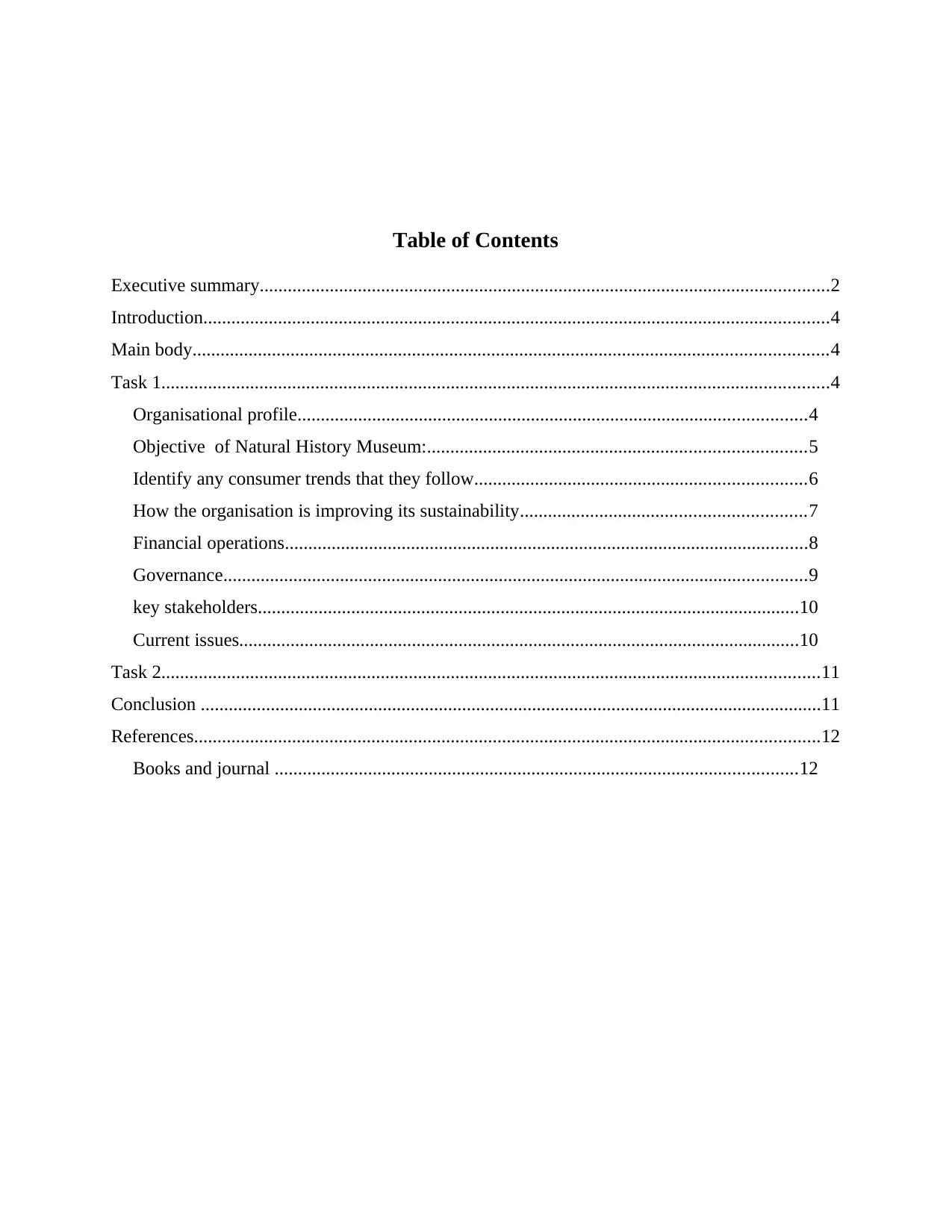
Table of Contents
Executive summary..........................................................................................................................2
Introduction......................................................................................................................................4
Main body........................................................................................................................................4
Task 1...............................................................................................................................................4
Organisational profile.............................................................................................................4
Objective of Natural History Museum:.................................................................................5
Identify any consumer trends that they follow.......................................................................6
How the organisation is improving its sustainability.............................................................7
Financial operations................................................................................................................8
Governance.............................................................................................................................9
key stakeholders....................................................................................................................10
Current issues........................................................................................................................10
Task 2.............................................................................................................................................11
Conclusion .....................................................................................................................................11
References......................................................................................................................................12
Books and journal ................................................................................................................12
Executive summary..........................................................................................................................2
Introduction......................................................................................................................................4
Main body........................................................................................................................................4
Task 1...............................................................................................................................................4
Organisational profile.............................................................................................................4
Objective of Natural History Museum:.................................................................................5
Identify any consumer trends that they follow.......................................................................6
How the organisation is improving its sustainability.............................................................7
Financial operations................................................................................................................8
Governance.............................................................................................................................9
key stakeholders....................................................................................................................10
Current issues........................................................................................................................10
Task 2.............................................................................................................................................11
Conclusion .....................................................................................................................................11
References......................................................................................................................................12
Books and journal ................................................................................................................12
⊘ This is a preview!⊘
Do you want full access?
Subscribe today to unlock all pages.

Trusted by 1+ million students worldwide
Introduction
Hospitality industry play a crucial role in provide superior class services, royal
accommodations, meaningful experience to the public, operations of hospitality industry are
wide and complex whether it is event, tourism, or hotel conduct. Tourism and events are
basically connected with each others due to similarity in functioning and providing client
services. They manage various functions all together such as operations, government regulations,
stakeholders, current market trends, issues in business conduct and many more. In this report,
Natural History Museum has taken which is one the great exposure of ancient and historic
collections (Agapito, 2018). This great museum was first established in 1881 in the London. The
report is going to carry out the challenges, trends, antiscience resolution, governmental control
and stakeholders existence which is necessary to understand about how these tourism
organisation manage their operations and sustainability into the leading dynamic world by
putting highlights on its financial funding as well as consumer preferences.
Main body
Task 1
Organisational profile
Natural history museum is a history museum in London which contains various specimen
related to history of nature. It includes specimen related to plants, extinct animals, insects,
minerals and animal kingdoms. It officially known as British Museum till 1962 later it
recognised as National history museum. The museum is managed by executive board and
museum director. It forms a tentative flow of authority and responsibility as boards of trustees is
responsible for all the management related to museum they manage funds for organisation as
well as maintenance of resources in museum where as the director of museum is answerable to
board of trustees (Bury, and Oka, 2017). The director of museum is Doug Gurr who manages
internal activities of organisations. He manages staff of museum and make internal strategies for
organisation. Executive board is also responsible for running the museum and they are
answerable to director of museum. They work under the direction of director and enjoy rights to
taker decision for museum. It is mainly known for dinosaur, skeleton sculptures. The museum
contains collection of books, articles, magazines and facts about the whole research in order to
Hospitality industry play a crucial role in provide superior class services, royal
accommodations, meaningful experience to the public, operations of hospitality industry are
wide and complex whether it is event, tourism, or hotel conduct. Tourism and events are
basically connected with each others due to similarity in functioning and providing client
services. They manage various functions all together such as operations, government regulations,
stakeholders, current market trends, issues in business conduct and many more. In this report,
Natural History Museum has taken which is one the great exposure of ancient and historic
collections (Agapito, 2018). This great museum was first established in 1881 in the London. The
report is going to carry out the challenges, trends, antiscience resolution, governmental control
and stakeholders existence which is necessary to understand about how these tourism
organisation manage their operations and sustainability into the leading dynamic world by
putting highlights on its financial funding as well as consumer preferences.
Main body
Task 1
Organisational profile
Natural history museum is a history museum in London which contains various specimen
related to history of nature. It includes specimen related to plants, extinct animals, insects,
minerals and animal kingdoms. It officially known as British Museum till 1962 later it
recognised as National history museum. The museum is managed by executive board and
museum director. It forms a tentative flow of authority and responsibility as boards of trustees is
responsible for all the management related to museum they manage funds for organisation as
well as maintenance of resources in museum where as the director of museum is answerable to
board of trustees (Bury, and Oka, 2017). The director of museum is Doug Gurr who manages
internal activities of organisations. He manages staff of museum and make internal strategies for
organisation. Executive board is also responsible for running the museum and they are
answerable to director of museum. They work under the direction of director and enjoy rights to
taker decision for museum. It is mainly known for dinosaur, skeleton sculptures. The museum
contains collection of books, articles, magazines and facts about the whole research in order to
Paraphrase This Document
Need a fresh take? Get an instant paraphrase of this document with our AI Paraphraser
provide details about the scientific experiments with accountability. The museum has attractive
features in order to attract large tourist without charging entrance fees as per all the other
publicly funded museums. It is incredibly and beautifully structured for containing by modern
valuable collection within the premises and designed as according to that. It has minimum of 850
employees in which they have separated departmental of groups public engagement and science
group (Catan, 2019). The museum has a lot to be a reason for tourist comeback due to having
rare specimen collection which could not found In modern world. The main purpose of setting
up these historical cultures to provide acknowledgement of past monuments that people are
unaware about. It provide a shocking and thrilled experience of knowing species, plans,
sculptures closely.
Objective of Natural History Museum:
As per annual report for 2019-2020 there are many strategic objective and activities
maintained by Natural History Museum. As technology is growing with time there are many
changes museum need to made to be in race with upcoming time. Natural history museum vision
is grounded on the perception of making advocates that can defend earth from human made
disasters and negative impact of environmental changes ( Cetin, and Okumus, 2018). Museum
also having vision in which both human and earth thrive and thus there is mutual growth of both
entities. As human and earth are interdependent on each other humans need to take care of their
activities as some of the activities are making drastic changes in environment and leading to
constant climate change. Biodiversity extinction and regular loss, Global warming, increasing
green house gases in environment, depletion of ozone layer, melting of glacier are some of the
consequences earth is facing due to human activities and thus museum aims to spreading
awareness related to these phenomenon by their strategic activities. Following are the strategic
objective made by Natural History Museum as per their annual report of 2019-2020:-
Engaging widest possible public:- As earth belongs to everyone therefore its everyone
responsibility to take care of their home by doing less harmful activities to earth
environment. With technological development there are many negative impacts which are
affecting earth environment and by involving more and more audience for motive of
safeguarding earth environment will help in decreasing such activities and also reducing
burden on earth (Chaudhary, and Shrivastava, 2020).
features in order to attract large tourist without charging entrance fees as per all the other
publicly funded museums. It is incredibly and beautifully structured for containing by modern
valuable collection within the premises and designed as according to that. It has minimum of 850
employees in which they have separated departmental of groups public engagement and science
group (Catan, 2019). The museum has a lot to be a reason for tourist comeback due to having
rare specimen collection which could not found In modern world. The main purpose of setting
up these historical cultures to provide acknowledgement of past monuments that people are
unaware about. It provide a shocking and thrilled experience of knowing species, plans,
sculptures closely.
Objective of Natural History Museum:
As per annual report for 2019-2020 there are many strategic objective and activities
maintained by Natural History Museum. As technology is growing with time there are many
changes museum need to made to be in race with upcoming time. Natural history museum vision
is grounded on the perception of making advocates that can defend earth from human made
disasters and negative impact of environmental changes ( Cetin, and Okumus, 2018). Museum
also having vision in which both human and earth thrive and thus there is mutual growth of both
entities. As human and earth are interdependent on each other humans need to take care of their
activities as some of the activities are making drastic changes in environment and leading to
constant climate change. Biodiversity extinction and regular loss, Global warming, increasing
green house gases in environment, depletion of ozone layer, melting of glacier are some of the
consequences earth is facing due to human activities and thus museum aims to spreading
awareness related to these phenomenon by their strategic activities. Following are the strategic
objective made by Natural History Museum as per their annual report of 2019-2020:-
Engaging widest possible public:- As earth belongs to everyone therefore its everyone
responsibility to take care of their home by doing less harmful activities to earth
environment. With technological development there are many negative impacts which are
affecting earth environment and by involving more and more audience for motive of
safeguarding earth environment will help in decreasing such activities and also reducing
burden on earth (Chaudhary, and Shrivastava, 2020).
Expanding organisational resources in term of garden and galleries:- As this is a
natural museum thus the organisation is full of natural resources which includes plant and
animal specimen, different minerals, specimen of insects and knowledge about different
animal kingdoms of current species as well as extinct and endangered species (Hall, and
Prayag, 2019). Thus expanding the base for natural resources such as garden and galleries
is very necessary for museum to attract audience and to spread awareness among
individuals related to different aspects of mother Earth.
Securing the future of organisation's collection:- As these resources are government
property and these are kept in museum on lease therefore its museum responsibility to
secure and protect their collection. Also there are chances that with time the life of these
natural resources get expired and thus they end up being no use to museum thus museum
is also responsible for protecting these natural resources in long term and their future use.
Digital availability of resources:- For spreading awareness among individuals about
safeguarding mother earth from any harm the data and knowledge should be as easy to
available as it can and thus availability of data digitally is very useful for museum. Thus
this is also one of the main objective of museum (HILTON, 2020).
Creating a sustainable and resilient museum:- As organisation environment is
changing with time, museum need to maintain some strategic methods to be dynamic in
nature so that they resile and sustain in difficult situations. They should have enough
financial fund to cope up with future uncertainties and also have strategic plans related to
organisational environment.
Identify any consumer trends that they follow
Consumer trends are the major factors that must be regulate in organisational operations
Managing trends makes the work easy and result in sound growth and success of the company.
As consumers are in search of receiving worth satisfaction by every time they visit to that
organization into tourism sector. This industry needs to accumulate trending factor at initial
basis due to the dynamic market and indifferent demand of customers. Every time their
consumers wants to something new and exciting which they have not seen previously while
taking existing services (Liburd, and Becken, 2017). Providing services as per their demand and
preferences is necessary to retain their arrival. There should be formation of plans, strategies
and implement in order to get the trends into organisation effectively. In context with National
natural museum thus the organisation is full of natural resources which includes plant and
animal specimen, different minerals, specimen of insects and knowledge about different
animal kingdoms of current species as well as extinct and endangered species (Hall, and
Prayag, 2019). Thus expanding the base for natural resources such as garden and galleries
is very necessary for museum to attract audience and to spread awareness among
individuals related to different aspects of mother Earth.
Securing the future of organisation's collection:- As these resources are government
property and these are kept in museum on lease therefore its museum responsibility to
secure and protect their collection. Also there are chances that with time the life of these
natural resources get expired and thus they end up being no use to museum thus museum
is also responsible for protecting these natural resources in long term and their future use.
Digital availability of resources:- For spreading awareness among individuals about
safeguarding mother earth from any harm the data and knowledge should be as easy to
available as it can and thus availability of data digitally is very useful for museum. Thus
this is also one of the main objective of museum (HILTON, 2020).
Creating a sustainable and resilient museum:- As organisation environment is
changing with time, museum need to maintain some strategic methods to be dynamic in
nature so that they resile and sustain in difficult situations. They should have enough
financial fund to cope up with future uncertainties and also have strategic plans related to
organisational environment.
Identify any consumer trends that they follow
Consumer trends are the major factors that must be regulate in organisational operations
Managing trends makes the work easy and result in sound growth and success of the company.
As consumers are in search of receiving worth satisfaction by every time they visit to that
organization into tourism sector. This industry needs to accumulate trending factor at initial
basis due to the dynamic market and indifferent demand of customers. Every time their
consumers wants to something new and exciting which they have not seen previously while
taking existing services (Liburd, and Becken, 2017). Providing services as per their demand and
preferences is necessary to retain their arrival. There should be formation of plans, strategies
and implement in order to get the trends into organisation effectively. In context with National
⊘ This is a preview!⊘
Do you want full access?
Subscribe today to unlock all pages.
Trusted by 1+ million students worldwide
history museum, it is one of the place which requires appropriate trends as the customer
expected something new every time they visits to the museum. In order to be innovative NHM
build these strategies for regulating trend and provide customers with new experiences:
Building effective team: The National history museum has different staffs and groups in each
segments of museums which are responsible for storing spaces in order to retain new collection
(Marvell, 2018). The team of botanicals science and palaeontologist carry on their research
process to find out what will be best attractive and meaningful solutions could be attain in order
to set the goals for launching new monuments.
Architectural solutions: The team of Architectural focus on giving reliable benefits through
museums activities by providing information and all accurate factors that will improvise visitors
knowledge stand of thrilled experience. For that instance, the team of architectural keeps in
digging, roaming around the world where they could find a tiny substance of historical period as
these substances are difficult to find with containing various risk factors ( Mishra, 2020).
In order to make retention of customers and tourists by gaining their trust, the museum
must focus on building connection with ancients suppliers and architectures who could serve
them every tiny information regarding unmounts or other finding such as animal skeleton who
are gone endangered. These attractions are beneficial for school, college level where students are
keen to know about what they have gone through in past decades.
How the organisation is improving its sustainability
Sustaining in the changing world is very important for the museum as there are many
organisation changes faced by these museums. These challenges can be lack of financial funds,
lack of proper resources, lack of audience etc. There are many ways by which they are working
in the direction of long term sustainability and survival (Nicolaides, 2018). They are also
following above mentioned objective for progressive growth of organisation. Some of the key
ways by which they are sustaining and surviving in the market of museum are mentioned below:-
Using digital technology:- Using digital technology is very important for museum to
sustain and thrive in changing business environment like united kingdom. More and more
audience prefer digital world for grabbing knowledge and awareness about natural world.
Also if the information and views of variety of species in different dimension is available
online then there will be high chance that audience will be highly attracted towards work
of museum and thus providing enough opportunity to grow and thrive.
expected something new every time they visits to the museum. In order to be innovative NHM
build these strategies for regulating trend and provide customers with new experiences:
Building effective team: The National history museum has different staffs and groups in each
segments of museums which are responsible for storing spaces in order to retain new collection
(Marvell, 2018). The team of botanicals science and palaeontologist carry on their research
process to find out what will be best attractive and meaningful solutions could be attain in order
to set the goals for launching new monuments.
Architectural solutions: The team of Architectural focus on giving reliable benefits through
museums activities by providing information and all accurate factors that will improvise visitors
knowledge stand of thrilled experience. For that instance, the team of architectural keeps in
digging, roaming around the world where they could find a tiny substance of historical period as
these substances are difficult to find with containing various risk factors ( Mishra, 2020).
In order to make retention of customers and tourists by gaining their trust, the museum
must focus on building connection with ancients suppliers and architectures who could serve
them every tiny information regarding unmounts or other finding such as animal skeleton who
are gone endangered. These attractions are beneficial for school, college level where students are
keen to know about what they have gone through in past decades.
How the organisation is improving its sustainability
Sustaining in the changing world is very important for the museum as there are many
organisation changes faced by these museums. These challenges can be lack of financial funds,
lack of proper resources, lack of audience etc. There are many ways by which they are working
in the direction of long term sustainability and survival (Nicolaides, 2018). They are also
following above mentioned objective for progressive growth of organisation. Some of the key
ways by which they are sustaining and surviving in the market of museum are mentioned below:-
Using digital technology:- Using digital technology is very important for museum to
sustain and thrive in changing business environment like united kingdom. More and more
audience prefer digital world for grabbing knowledge and awareness about natural world.
Also if the information and views of variety of species in different dimension is available
online then there will be high chance that audience will be highly attracted towards work
of museum and thus providing enough opportunity to grow and thrive.
Paraphrase This Document
Need a fresh take? Get an instant paraphrase of this document with our AI Paraphraser
Providing attractive content:- Audience are more attracted towards the museum which
have attractive, entertaining and knowledgeable natural resources. If Natural History
Museum wants to sustain then the organisation needs to attract as much customer they
can attract and for that there is high need of entertaining and knowledgeable content. For
that instance, the museum have great monuments of sculptures, skeleton, animal leather
and other varieties of shields (Penela, and Serrasqueiro, 2019). These attractive content
are done ensure about the sustainability in the services by using every safety and
protection to maintain sustainable development.
Carbon emission: In order to maintain carbon emission, the museum try to save every
wasteful substances through their machinery and working. They save more than 15000
tonnes of carbon dioxide for installation. They are working to build and operate an
effective energy centre to make it environment friendly. They have already launch solar
panels in order to deliver for building botanic and ornithology.
Financial operations
Financial operations are essential part to carry out the operation which an organisation
established into the market through which the company fulfil its requirement of funding. There
are immense need of financial resources to achieve set targets by engaging sound management
of funding. There are number of sources a museum could get fund due to its heavy operations
and knowledge based learning. In context with National history museum, it has vast and wide
operations to conduct research, maintain sculptures constructing surveys and maintaining
innovative ideas of historic creatures. the museum consist large cost in its maintenance due to
giant area in which the whole museum has covered its operations (Piskur, and Szymak, 2017) .
So that, it has various sources through which museum manage its financial operations.
Grant-in-aid: it is an effective source of funding through which all public factors supports
funding for public regulatory organisation. It consist less obligatory procedure and benefits to
make innovation and required changes into the organisation. National history museum receive
their funds through DCMS solution which is digital, culture, media and support. Through past
number of years, they are continuously working on getting these funding due to having reputed
image and licensing into tourism market.
have attractive, entertaining and knowledgeable natural resources. If Natural History
Museum wants to sustain then the organisation needs to attract as much customer they
can attract and for that there is high need of entertaining and knowledgeable content. For
that instance, the museum have great monuments of sculptures, skeleton, animal leather
and other varieties of shields (Penela, and Serrasqueiro, 2019). These attractive content
are done ensure about the sustainability in the services by using every safety and
protection to maintain sustainable development.
Carbon emission: In order to maintain carbon emission, the museum try to save every
wasteful substances through their machinery and working. They save more than 15000
tonnes of carbon dioxide for installation. They are working to build and operate an
effective energy centre to make it environment friendly. They have already launch solar
panels in order to deliver for building botanic and ornithology.
Financial operations
Financial operations are essential part to carry out the operation which an organisation
established into the market through which the company fulfil its requirement of funding. There
are immense need of financial resources to achieve set targets by engaging sound management
of funding. There are number of sources a museum could get fund due to its heavy operations
and knowledge based learning. In context with National history museum, it has vast and wide
operations to conduct research, maintain sculptures constructing surveys and maintaining
innovative ideas of historic creatures. the museum consist large cost in its maintenance due to
giant area in which the whole museum has covered its operations (Piskur, and Szymak, 2017) .
So that, it has various sources through which museum manage its financial operations.
Grant-in-aid: it is an effective source of funding through which all public factors supports
funding for public regulatory organisation. It consist less obligatory procedure and benefits to
make innovation and required changes into the organisation. National history museum receive
their funds through DCMS solution which is digital, culture, media and support. Through past
number of years, they are continuously working on getting these funding due to having reputed
image and licensing into tourism market.
The trading company: this company shows an integral part of National history museum. By
getting half of funds through grant-in-aid. Rest of the fund will get accumulated through
commercial activity of museum. It establish various exhibition into international level, catering,
retail, events consultancy and brand management. This trading company work as a subsidiary
where all the accounts get prepared separately to acknowledge how much funds it has gained into
financial years. The members of this company are museum director, finance director. The
museum does not grant or lend any loan to the outside and other than this company .
Governance
The governance play big and virtual role in affecting the organisation from external
environment. As the economy needs to be maintain and balanced with the operations and
activities of public bodies, these governance provide support and execution of plan according to
the target and objective of the enterprise. There are number of persons involved with the tasks
and activities running on regular basis. These people could the member of board and authorities
of trustee which contribute their efforts towards making the organisation fruitful. At National
history museum, they follow a chain of governance which are described below:
The board of trustee: This board of authority consist a group if 12 members in which eight
members are committee with governmental bodies, another members being into consideration
with the majority of society whereas, rest are chosen by the Museum committee itself. These
members are entitled to adjoin hands into meeting which held into once in 4 years. In meetings,
they decides all the laws, rules, budgets and operation's of the museum to build effective
changes compared t past performance (Shirazi, and Keivani, 2017).
The Executive board: The members involve into this board of authority, they are liable to plan
the strategies, provide decision making management, regulatory control, projects and
procedures. These all activities get execution after permitted by executives directors. The whole
museum all together function responsibility and authorities to each departments get monitored
and controlled by these members. Dr Tim Littlewood - Executive Director of Science, Fiona
McWilliams - Executive Director of Development.
These governance control and monitor all the functions and operations within the
museum in order to utilise effective resources and natural substance to avoid wastage, enhance
committee contribution and attract more of customers.
getting half of funds through grant-in-aid. Rest of the fund will get accumulated through
commercial activity of museum. It establish various exhibition into international level, catering,
retail, events consultancy and brand management. This trading company work as a subsidiary
where all the accounts get prepared separately to acknowledge how much funds it has gained into
financial years. The members of this company are museum director, finance director. The
museum does not grant or lend any loan to the outside and other than this company .
Governance
The governance play big and virtual role in affecting the organisation from external
environment. As the economy needs to be maintain and balanced with the operations and
activities of public bodies, these governance provide support and execution of plan according to
the target and objective of the enterprise. There are number of persons involved with the tasks
and activities running on regular basis. These people could the member of board and authorities
of trustee which contribute their efforts towards making the organisation fruitful. At National
history museum, they follow a chain of governance which are described below:
The board of trustee: This board of authority consist a group if 12 members in which eight
members are committee with governmental bodies, another members being into consideration
with the majority of society whereas, rest are chosen by the Museum committee itself. These
members are entitled to adjoin hands into meeting which held into once in 4 years. In meetings,
they decides all the laws, rules, budgets and operation's of the museum to build effective
changes compared t past performance (Shirazi, and Keivani, 2017).
The Executive board: The members involve into this board of authority, they are liable to plan
the strategies, provide decision making management, regulatory control, projects and
procedures. These all activities get execution after permitted by executives directors. The whole
museum all together function responsibility and authorities to each departments get monitored
and controlled by these members. Dr Tim Littlewood - Executive Director of Science, Fiona
McWilliams - Executive Director of Development.
These governance control and monitor all the functions and operations within the
museum in order to utilise effective resources and natural substance to avoid wastage, enhance
committee contribution and attract more of customers.
⊘ This is a preview!⊘
Do you want full access?
Subscribe today to unlock all pages.
Trusted by 1+ million students worldwide
key stakeholders
The organisation are established with the efforts of stakeholders contribution. No
organisation could get successful without being nice wit h them. There are several ways to
formulae strategies and plans in order be creative and innovating in delivering services, but this
could only get possible when these stakeholders come in practical contact with the situation.
These stakeholders include staffs, investors, directors, committee members and shareholders
which make their reliable aspect to deliver services at the best extent. In context with the
National history museum,due to its giant operations and public control over the institution. It
has built number of partners integrated with the projects and exhibition. These stakeholders
provide support in terms of advices, decision making concept, fund resolution and promotion of
new and innovative service come into museum.
The museum have develop several relation with the internal and external stakeholders
where it can think of expansion of sources and services . these stakeholder of museum include
colleagues, universities professors, journalist and reporters who take initiative toward
understanding the importance of monuments and sculptures. With due efforts of these
stakeholders, Museums are under opportunities to find an area of contradiction into worldwide
level and keep gaining millions of visitors towards their operations.
Current issues
Every institution or public body are integrated with problems and issues into leading
world as there are many factors that could create impact on their functioning and services.
Mainly on large institutions, there are many problems faced by the institution in order to regulate
into complex situation. In context with National history museum, they are serving historical
implications and ancient bodies to provide their visitors an incredible experience of information
and knowledge about world happening. There are a lot of problem facing by the museum in
retaining the bodies, wildlife protection, animal skeleton for the longer period of time. Apart
from this, the museum is one of the place which people think for its one time visit, due to these
factors, museums could not get able to maintain customer welcome. This has become the biggest
issues in the history of NHM (Viljoen, and Henama, 2017). They need to follow customer trends
and be innovative in providing their services. Their main target is to attract number of visitors
which come across the world to see the beauty of world, so that, the institution must ensure that,
they would return back with the great experience.
The organisation are established with the efforts of stakeholders contribution. No
organisation could get successful without being nice wit h them. There are several ways to
formulae strategies and plans in order be creative and innovating in delivering services, but this
could only get possible when these stakeholders come in practical contact with the situation.
These stakeholders include staffs, investors, directors, committee members and shareholders
which make their reliable aspect to deliver services at the best extent. In context with the
National history museum,due to its giant operations and public control over the institution. It
has built number of partners integrated with the projects and exhibition. These stakeholders
provide support in terms of advices, decision making concept, fund resolution and promotion of
new and innovative service come into museum.
The museum have develop several relation with the internal and external stakeholders
where it can think of expansion of sources and services . these stakeholder of museum include
colleagues, universities professors, journalist and reporters who take initiative toward
understanding the importance of monuments and sculptures. With due efforts of these
stakeholders, Museums are under opportunities to find an area of contradiction into worldwide
level and keep gaining millions of visitors towards their operations.
Current issues
Every institution or public body are integrated with problems and issues into leading
world as there are many factors that could create impact on their functioning and services.
Mainly on large institutions, there are many problems faced by the institution in order to regulate
into complex situation. In context with National history museum, they are serving historical
implications and ancient bodies to provide their visitors an incredible experience of information
and knowledge about world happening. There are a lot of problem facing by the museum in
retaining the bodies, wildlife protection, animal skeleton for the longer period of time. Apart
from this, the museum is one of the place which people think for its one time visit, due to these
factors, museums could not get able to maintain customer welcome. This has become the biggest
issues in the history of NHM (Viljoen, and Henama, 2017). They need to follow customer trends
and be innovative in providing their services. Their main target is to attract number of visitors
which come across the world to see the beauty of world, so that, the institution must ensure that,
they would return back with the great experience.
Paraphrase This Document
Need a fresh take? Get an instant paraphrase of this document with our AI Paraphraser
For that instance, the museum needs to be valuable and accountable towards maintaining
stakeholders relation as in recent times, people are more concerned about their health an
infectious diseases. So that, they must regulate proper safety measures and shields. There should
be different department for children and middle aged People in order to move away with terrified
sculptures to the reach of low aged group that could be the reason for balancing their health.
There is need to build effective team who could properly guide visits so that they could roam
around all the departments an segments and make a reliable experience over the journey. There is
always be uncertain solution to overcome these issues or better working,.
Task 2
Conclusion
This report file hovers around Natural History Museum and covers various details related to
museum. The report contains history and organisational structure of organisation as well as
covers various objective of organisation made for thriving in changing business environment.
The report also contains consumer trend followed by museum as well as ways which is used by
museum to sustain in long term. The report also covers financial operation of organisation,
governance of organisation and how the organisation is operated by top level management. The
report also hovers around different stake holders of museum and critical role of these stake
holders in fulfilling organisational objective as well as their role in growth and survival of
organisation.
stakeholders relation as in recent times, people are more concerned about their health an
infectious diseases. So that, they must regulate proper safety measures and shields. There should
be different department for children and middle aged People in order to move away with terrified
sculptures to the reach of low aged group that could be the reason for balancing their health.
There is need to build effective team who could properly guide visits so that they could roam
around all the departments an segments and make a reliable experience over the journey. There is
always be uncertain solution to overcome these issues or better working,.
Task 2
Conclusion
This report file hovers around Natural History Museum and covers various details related to
museum. The report contains history and organisational structure of organisation as well as
covers various objective of organisation made for thriving in changing business environment.
The report also contains consumer trend followed by museum as well as ways which is used by
museum to sustain in long term. The report also covers financial operation of organisation,
governance of organisation and how the organisation is operated by top level management. The
report also hovers around different stake holders of museum and critical role of these stake
holders in fulfilling organisational objective as well as their role in growth and survival of
organisation.
References
Books and journal
Agapito, D., 2018. The contribution of external factors to the marketing management of
appealing hospitality experiences: Testing a framework in a rural tourism context.
Bury, J. and Oka, T., 2017. Undergraduate students’ perceptions of the importance of English in
the tourism and hospitality industry. Journal of Teaching in Travel & Tourism, 17(3),
pp.173-188.
Catan, M., 2019. Environmental Practices in Hospitality Industry for a more Sustainable
Tourism (Case Study-Sheraton Lisboa Hotel & Spa) (Doctoral dissertation).
Cetin, G. and Okumus, F., 2018. Experiencing local Turkish hospitality in Istanbul,
Turkey. International Journal of Culture, Tourism and Hospitality Research.
Chaudhary, M. and Shrivastava, D., 2020. Corporate governance practices of Indian listed
tourism & hospitality firms. Anatolia, 31(2), pp.274-287.
Hall, C.M. and Prayag, G., 2019. Emerging and Future Issues in Halal Hospitality and Islamic
Tourism. The Routledge Handbook of Halal Hospitality and Islamic Tourism.
HILTON, M., 2020. Personal resilience in the hospitality experience. Managing Hospitality
Experiences, p.67.
Liburd, J.J. and Becken, S., 2017. Values in nature conservation, tourism and UNESCO World
Heritage Site stewardship. Journal of Sustainable Tourism, 25(12), pp.1719-1735.
Marvell, A., 2018. Student experiences of facilitating knowledge exchange: Developing an
understanding of responsible events through blog writing. Journal of Hospitality,
Leisure, Sport & Tourism Education, 23, pp.1-9.
Mishra, R.R., 2020. Innovations in Hospitality and Tourism Industry: A Systematic
Review. International Journal of Transformation in Tourism & Hospitality Management
and Cultural Heritage [ISSN: 2581-4869 (online)], 4(1).
Nicolaides, A., 2018. The role of spirituality in moderating hospitality industry conflict
management and promoting sustainability. African Journal of Hospitality, Tourism and
Leisure, 7(2), pp.1-18.
Penela, D. and Serrasqueiro, R.M., 2019. Identification of risk factors in the hospitality industry:
Evidence from risk factor disclosure. Tourism Management Perspectives, 32, p.100578.
Piskur, P. and Szymak, P., 2017. Algorithms for passive detection of moving vessels in marine
environment. Journal of Marine Engineering & Technology, 16(4), pp.377-385.
Shirazi, M.R. and Keivani, R., 2017. Critical reflections on the theory and practice of social
sustainability in the built environment–a meta-analysis. Local Environment, 22(12),
pp.1526-1545.
Viljoen, J. and Henama, U.S., 2017. Growing heritage tourism and social cohesion in South
Africa. African Journal of Hospitality, Tourism and Leisure, 6(4), pp.1-15.
Books and journal
Agapito, D., 2018. The contribution of external factors to the marketing management of
appealing hospitality experiences: Testing a framework in a rural tourism context.
Bury, J. and Oka, T., 2017. Undergraduate students’ perceptions of the importance of English in
the tourism and hospitality industry. Journal of Teaching in Travel & Tourism, 17(3),
pp.173-188.
Catan, M., 2019. Environmental Practices in Hospitality Industry for a more Sustainable
Tourism (Case Study-Sheraton Lisboa Hotel & Spa) (Doctoral dissertation).
Cetin, G. and Okumus, F., 2018. Experiencing local Turkish hospitality in Istanbul,
Turkey. International Journal of Culture, Tourism and Hospitality Research.
Chaudhary, M. and Shrivastava, D., 2020. Corporate governance practices of Indian listed
tourism & hospitality firms. Anatolia, 31(2), pp.274-287.
Hall, C.M. and Prayag, G., 2019. Emerging and Future Issues in Halal Hospitality and Islamic
Tourism. The Routledge Handbook of Halal Hospitality and Islamic Tourism.
HILTON, M., 2020. Personal resilience in the hospitality experience. Managing Hospitality
Experiences, p.67.
Liburd, J.J. and Becken, S., 2017. Values in nature conservation, tourism and UNESCO World
Heritage Site stewardship. Journal of Sustainable Tourism, 25(12), pp.1719-1735.
Marvell, A., 2018. Student experiences of facilitating knowledge exchange: Developing an
understanding of responsible events through blog writing. Journal of Hospitality,
Leisure, Sport & Tourism Education, 23, pp.1-9.
Mishra, R.R., 2020. Innovations in Hospitality and Tourism Industry: A Systematic
Review. International Journal of Transformation in Tourism & Hospitality Management
and Cultural Heritage [ISSN: 2581-4869 (online)], 4(1).
Nicolaides, A., 2018. The role of spirituality in moderating hospitality industry conflict
management and promoting sustainability. African Journal of Hospitality, Tourism and
Leisure, 7(2), pp.1-18.
Penela, D. and Serrasqueiro, R.M., 2019. Identification of risk factors in the hospitality industry:
Evidence from risk factor disclosure. Tourism Management Perspectives, 32, p.100578.
Piskur, P. and Szymak, P., 2017. Algorithms for passive detection of moving vessels in marine
environment. Journal of Marine Engineering & Technology, 16(4), pp.377-385.
Shirazi, M.R. and Keivani, R., 2017. Critical reflections on the theory and practice of social
sustainability in the built environment–a meta-analysis. Local Environment, 22(12),
pp.1526-1545.
Viljoen, J. and Henama, U.S., 2017. Growing heritage tourism and social cohesion in South
Africa. African Journal of Hospitality, Tourism and Leisure, 6(4), pp.1-15.
⊘ This is a preview!⊘
Do you want full access?
Subscribe today to unlock all pages.
Trusted by 1+ million students worldwide

1 out of 13


Related Documents


Your All-in-One AI-Powered Toolkit for Academic Success.
+13062052269
info@desklib.com
Available 24*7 on WhatsApp / Email
![[object Object]](/_next/static/media/star-bottom.7253800d.svg)
Unlock your academic potential
Copyright © 2020–2026 A2Z Services. All Rights Reserved. Developed and managed by ZUCOL.