Software Project Scope Statement for Hoteling Business in Pakistan
VerifiedAdded on 2022/07/21
|8
|2070
|24
Report
AI Summary
This report outlines the scope of a software project designed for a multinational hoteling firm, XYZ, aiming to automate its operations in a new branch in Pakistan. The project's goal is to develop an effective, user-friendly, and informative online software application to replace the current manual reservation system. The report details the aims and objectives of the project, including systematic booking management, customer record-keeping, and online room booking capabilities. It also covers constraints, assumptions, project organization, managerial process plans (including start-up, staffing, resource acquisition, and training), work plan, resource allocation, and various control plans (requirements, schedule, budget, and quality). The project will utilize an iterative waterfall model, with phases including requirement engineering, planning, analysis, design, coding, testing, and deployment. The timeline for the project is one year, with specific start and completion dates for each phase. The report also includes a risk management plan and a project developing plan.

Assignment No:(LO 1)
Subject: Managing a successful software project
Paraphrase This Document
Need a fresh take? Get an instant paraphrase of this document with our AI Paraphraser

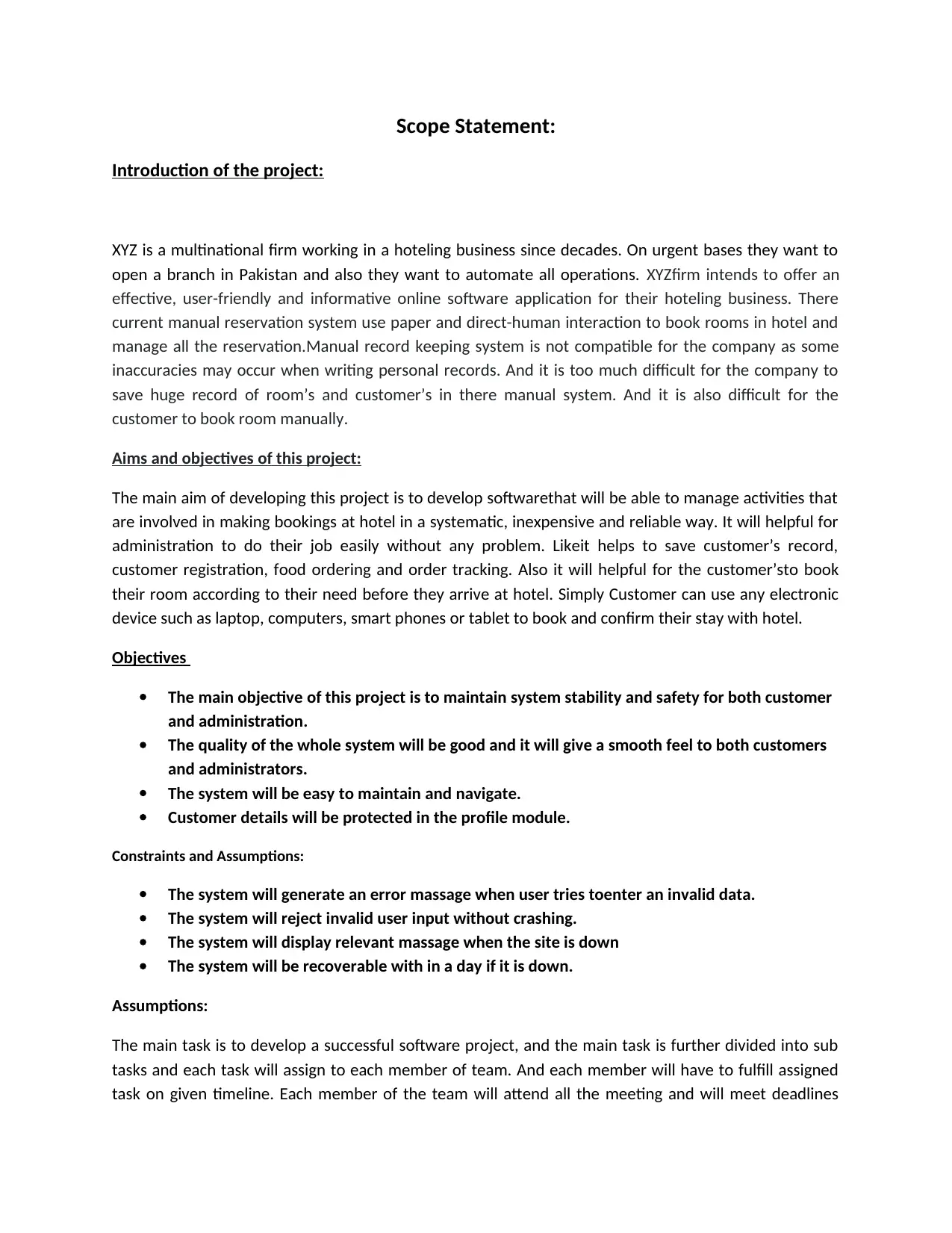
Scope Statement:
Introduction of the project:
XYZ is a multinational firm working in a hoteling business since decades. On urgent bases they want to
open a branch in Pakistan and also they want to automate all operations. XYZfirm intends to offer an
effective, user-friendly and informative online software application for their hoteling business. There
current manual reservation system use paper and direct-human interaction to book rooms in hotel and
manage all the reservation.Manual record keeping system is not compatible for the company as some
inaccuracies may occur when writing personal records. And it is too much difficult for the company to
save huge record of room’s and customer’s in there manual system. And it is also difficult for the
customer to book room manually.
Aims and objectives of this project:
The main aim of developing this project is to develop softwarethat will be able to manage activities that
are involved in making bookings at hotel in a systematic, inexpensive and reliable way. It will helpful for
administration to do their job easily without any problem. Likeit helps to save customer’s record,
customer registration, food ordering and order tracking. Also it will helpful for the customer’sto book
their room according to their need before they arrive at hotel. Simply Customer can use any electronic
device such as laptop, computers, smart phones or tablet to book and confirm their stay with hotel.
Objectives
The main objective of this project is to maintain system stability and safety for both customer
and administration.
The quality of the whole system will be good and it will give a smooth feel to both customers
and administrators.
The system will be easy to maintain and navigate.
Customer details will be protected in the profile module.
Constraints and Assumptions:
The system will generate an error massage when user tries toenter an invalid data.
The system will reject invalid user input without crashing.
The system will display relevant massage when the site is down
The system will be recoverable with in a day if it is down.
Assumptions:
The main task is to develop a successful software project, and the main task is further divided into sub
tasks and each task will assign to each member of team. And each member will have to fulfill assigned
task on given timeline. Each member of the team will attend all the meeting and will meet deadlines
Introduction of the project:
XYZ is a multinational firm working in a hoteling business since decades. On urgent bases they want to
open a branch in Pakistan and also they want to automate all operations. XYZfirm intends to offer an
effective, user-friendly and informative online software application for their hoteling business. There
current manual reservation system use paper and direct-human interaction to book rooms in hotel and
manage all the reservation.Manual record keeping system is not compatible for the company as some
inaccuracies may occur when writing personal records. And it is too much difficult for the company to
save huge record of room’s and customer’s in there manual system. And it is also difficult for the
customer to book room manually.
Aims and objectives of this project:
The main aim of developing this project is to develop softwarethat will be able to manage activities that
are involved in making bookings at hotel in a systematic, inexpensive and reliable way. It will helpful for
administration to do their job easily without any problem. Likeit helps to save customer’s record,
customer registration, food ordering and order tracking. Also it will helpful for the customer’sto book
their room according to their need before they arrive at hotel. Simply Customer can use any electronic
device such as laptop, computers, smart phones or tablet to book and confirm their stay with hotel.
Objectives
The main objective of this project is to maintain system stability and safety for both customer
and administration.
The quality of the whole system will be good and it will give a smooth feel to both customers
and administrators.
The system will be easy to maintain and navigate.
Customer details will be protected in the profile module.
Constraints and Assumptions:
The system will generate an error massage when user tries toenter an invalid data.
The system will reject invalid user input without crashing.
The system will display relevant massage when the site is down
The system will be recoverable with in a day if it is down.
Assumptions:
The main task is to develop a successful software project, and the main task is further divided into sub
tasks and each task will assign to each member of team. And each member will have to fulfill assigned
task on given timeline. Each member of the team will attend all the meeting and will meet deadlines

related to tasks. And also they will follow the requirements that specified in (system requirements
specifications).
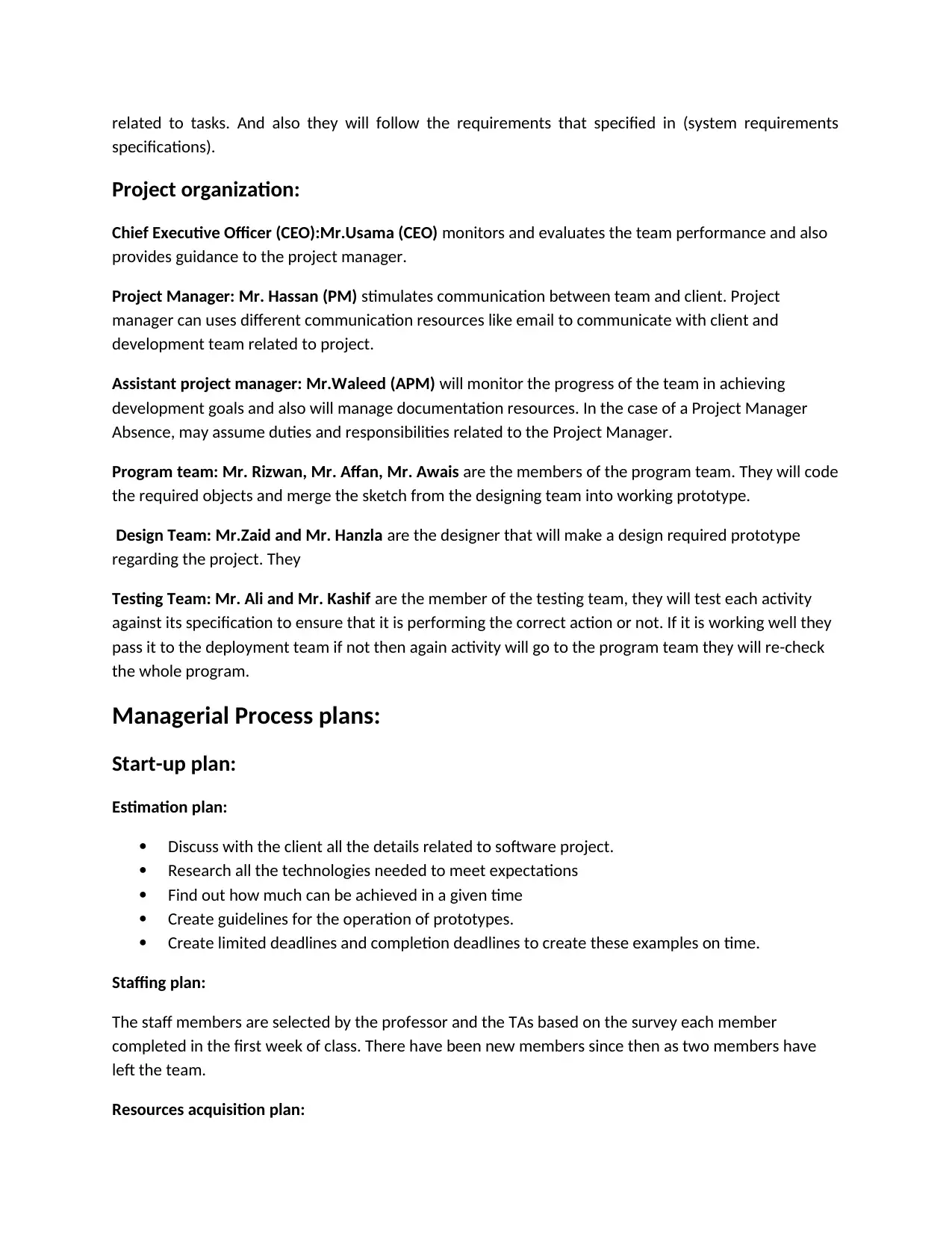
Project organization:
Chief Executive Officer (CEO):Mr.Usama (CEO) monitors and evaluates the team performance and also
provides guidance to the project manager.
Project Manager: Mr. Hassan (PM) stimulates communication between team and client. Project
manager can uses different communication resources like email to communicate with client and
development team related to project.
Assistant project manager: Mr.Waleed (APM) will monitor the progress of the team in achieving
development goals and also will manage documentation resources. In the case of a Project Manager
Absence, may assume duties and responsibilities related to the Project Manager.
Program team: Mr. Rizwan, Mr. Affan, Mr. Awais are the members of the program team. They will code
the required objects and merge the sketch from the designing team into working prototype.
Design Team: Mr.Zaid and Mr. Hanzla are the designer that will make a design required prototype
regarding the project. They
Testing Team: Mr. Ali and Mr. Kashif are the member of the testing team, they will test each activity
against its specification to ensure that it is performing the correct action or not. If it is working well they
pass it to the deployment team if not then again activity will go to the program team they will re-check
the whole program.
Managerial Process plans:
Start-up plan:
Estimation plan:
Discuss with the client all the details related to software project.
Research all the technologies needed to meet expectations
Find out how much can be achieved in a given time
Create guidelines for the operation of prototypes.
Create limited deadlines and completion deadlines to create these examples on time.
Staffing plan:
The staff members are selected by the professor and the TAs based on the survey each member
completed in the first week of class. There have been new members since then as two members have
left the team.
Resources acquisition plan:
specifications).
Project organization:
Chief Executive Officer (CEO):Mr.Usama (CEO) monitors and evaluates the team performance and also
provides guidance to the project manager.
Project Manager: Mr. Hassan (PM) stimulates communication between team and client. Project
manager can uses different communication resources like email to communicate with client and
development team related to project.
Assistant project manager: Mr.Waleed (APM) will monitor the progress of the team in achieving
development goals and also will manage documentation resources. In the case of a Project Manager
Absence, may assume duties and responsibilities related to the Project Manager.
Program team: Mr. Rizwan, Mr. Affan, Mr. Awais are the members of the program team. They will code
the required objects and merge the sketch from the designing team into working prototype.
Design Team: Mr.Zaid and Mr. Hanzla are the designer that will make a design required prototype
regarding the project. They
Testing Team: Mr. Ali and Mr. Kashif are the member of the testing team, they will test each activity
against its specification to ensure that it is performing the correct action or not. If it is working well they
pass it to the deployment team if not then again activity will go to the program team they will re-check
the whole program.
Managerial Process plans:
Start-up plan:
Estimation plan:
Discuss with the client all the details related to software project.
Research all the technologies needed to meet expectations
Find out how much can be achieved in a given time
Create guidelines for the operation of prototypes.
Create limited deadlines and completion deadlines to create these examples on time.
Staffing plan:
The staff members are selected by the professor and the TAs based on the survey each member
completed in the first week of class. There have been new members since then as two members have
left the team.
Resources acquisition plan:
⊘ This is a preview!⊘
Do you want full access?
Subscribe today to unlock all pages.

Trusted by 1+ million students worldwide

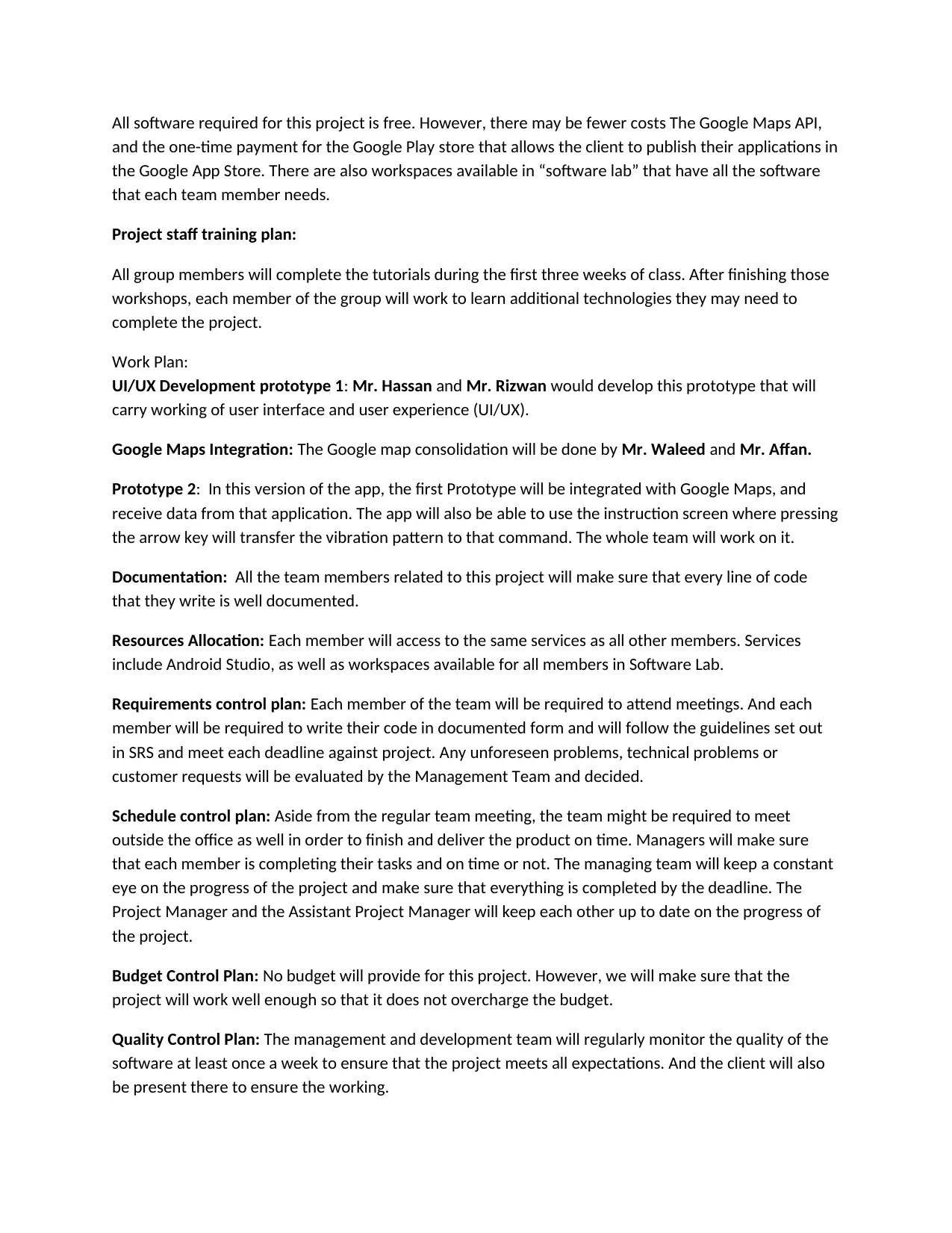
All software required for this project is free. However, there may be fewer costs The Google Maps API,
and the one-time payment for the Google Play store that allows the client to publish their applications in
the Google App Store. There are also workspaces available in “software lab” that have all the software
that each team member needs.
Project staff training plan:
All group members will complete the tutorials during the first three weeks of class. After finishing those
workshops, each member of the group will work to learn additional technologies they may need to
complete the project.
Work Plan:
UI/UX Development prototype 1: Mr. Hassan and Mr. Rizwan would develop this prototype that will
carry working of user interface and user experience (UI/UX).
Google Maps Integration: The Google map consolidation will be done by Mr. Waleed and Mr. Affan.
Prototype 2: In this version of the app, the first Prototype will be integrated with Google Maps, and
receive data from that application. The app will also be able to use the instruction screen where pressing
the arrow key will transfer the vibration pattern to that command. The whole team will work on it.
Documentation: All the team members related to this project will make sure that every line of code
that they write is well documented.
Resources Allocation: Each member will access to the same services as all other members. Services
include Android Studio, as well as workspaces available for all members in Software Lab.
Requirements control plan: Each member of the team will be required to attend meetings. And each
member will be required to write their code in documented form and will follow the guidelines set out
in SRS and meet each deadline against project. Any unforeseen problems, technical problems or
customer requests will be evaluated by the Management Team and decided.
Schedule control plan: Aside from the regular team meeting, the team might be required to meet
outside the office as well in order to finish and deliver the product on time. Managers will make sure
that each member is completing their tasks and on time or not. The managing team will keep a constant
eye on the progress of the project and make sure that everything is completed by the deadline. The
Project Manager and the Assistant Project Manager will keep each other up to date on the progress of
the project.
Budget Control Plan: No budget will provide for this project. However, we will make sure that the
project will work well enough so that it does not overcharge the budget.
Quality Control Plan: The management and development team will regularly monitor the quality of the
software at least once a week to ensure that the project meets all expectations. And the client will also
be present there to ensure the working.
and the one-time payment for the Google Play store that allows the client to publish their applications in
the Google App Store. There are also workspaces available in “software lab” that have all the software
that each team member needs.
Project staff training plan:
All group members will complete the tutorials during the first three weeks of class. After finishing those
workshops, each member of the group will work to learn additional technologies they may need to
complete the project.
Work Plan:
UI/UX Development prototype 1: Mr. Hassan and Mr. Rizwan would develop this prototype that will
carry working of user interface and user experience (UI/UX).
Google Maps Integration: The Google map consolidation will be done by Mr. Waleed and Mr. Affan.
Prototype 2: In this version of the app, the first Prototype will be integrated with Google Maps, and
receive data from that application. The app will also be able to use the instruction screen where pressing
the arrow key will transfer the vibration pattern to that command. The whole team will work on it.
Documentation: All the team members related to this project will make sure that every line of code
that they write is well documented.
Resources Allocation: Each member will access to the same services as all other members. Services
include Android Studio, as well as workspaces available for all members in Software Lab.
Requirements control plan: Each member of the team will be required to attend meetings. And each
member will be required to write their code in documented form and will follow the guidelines set out
in SRS and meet each deadline against project. Any unforeseen problems, technical problems or
customer requests will be evaluated by the Management Team and decided.
Schedule control plan: Aside from the regular team meeting, the team might be required to meet
outside the office as well in order to finish and deliver the product on time. Managers will make sure
that each member is completing their tasks and on time or not. The managing team will keep a constant
eye on the progress of the project and make sure that everything is completed by the deadline. The
Project Manager and the Assistant Project Manager will keep each other up to date on the progress of
the project.
Budget Control Plan: No budget will provide for this project. However, we will make sure that the
project will work well enough so that it does not overcharge the budget.
Quality Control Plan: The management and development team will regularly monitor the quality of the
software at least once a week to ensure that the project meets all expectations. And the client will also
be present there to ensure the working.
Paraphrase This Document
Need a fresh take? Get an instant paraphrase of this document with our AI Paraphraser

Reporting plan: The management team will inform Mr. Usama of the weekly meetings twice. The
project manager will usually send the presence of team members and confirm that the application is in
status/progress.
Risk Management Plan: The team will meet regularly to ensure that production is not suspended in one
place. There will be set deadlines that everyone will follow to make sure that project is not delayed.
Each team member will be kept up-to-date, and notify the team project manager of any changes or
difficulties or restrictions that may affect their ability to complete the task on time.
Project Failure: if the project is not completed or by any chance the project is fail the management
team will meet with the client and ensure that there is another route that will lead to an acceptable
result.
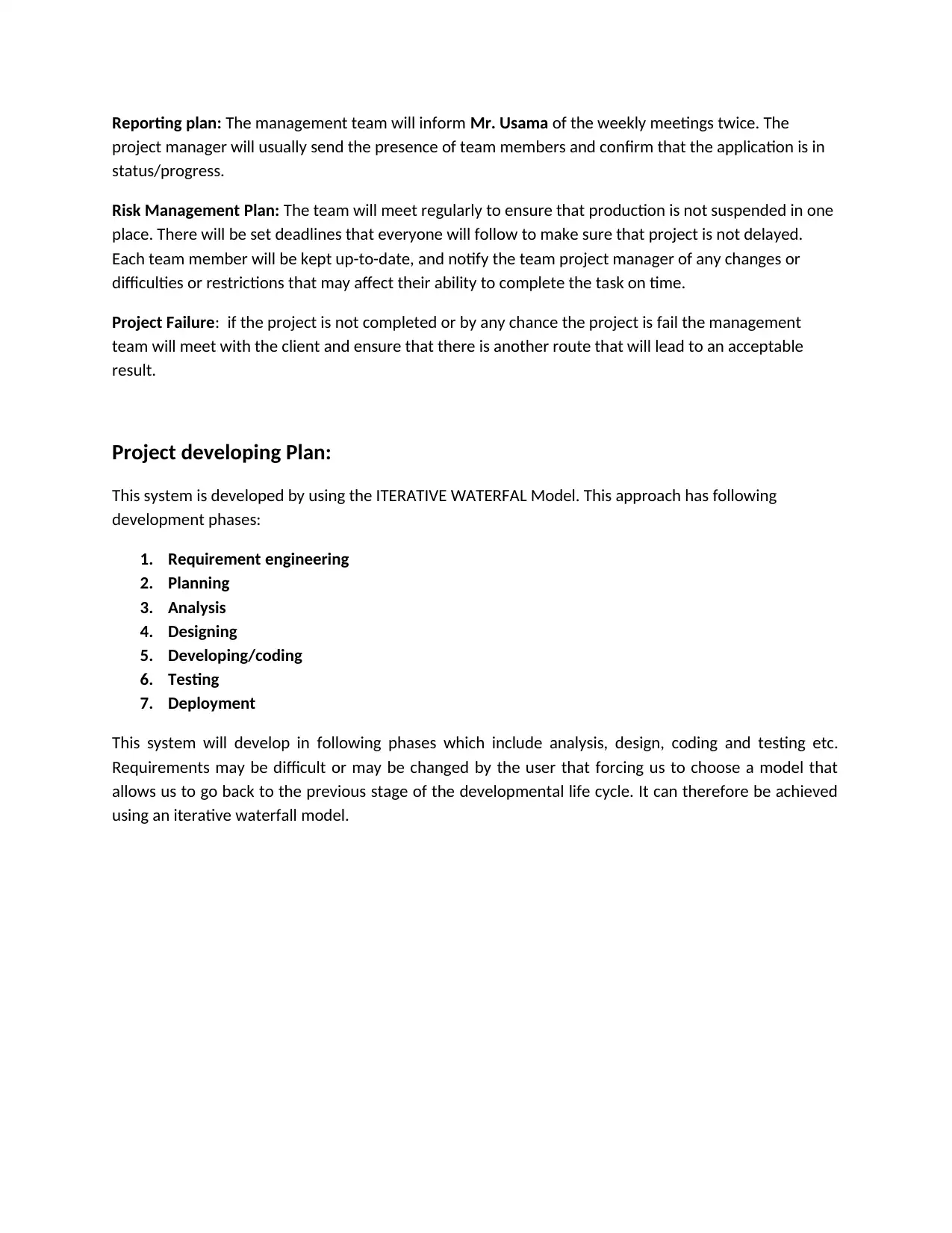
Project developing Plan:
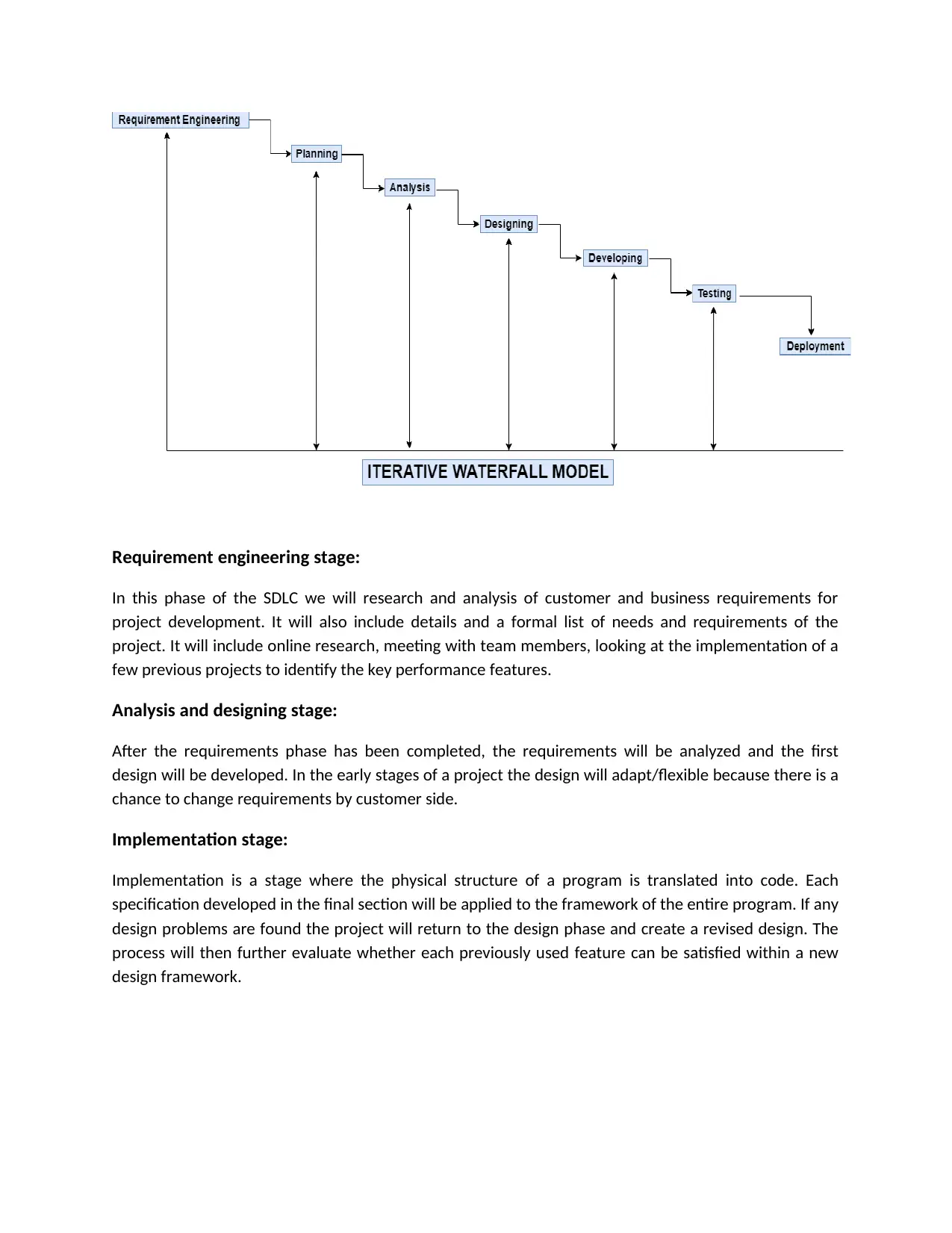
This system is developed by using the ITERATIVE WATERFAL Model. This approach has following
development phases:
1. Requirement engineering
2. Planning
3. Analysis
4. Designing
5. Developing/coding
6. Testing
7. Deployment
This system will develop in following phases which include analysis, design, coding and testing etc.
Requirements may be difficult or may be changed by the user that forcing us to choose a model that
allows us to go back to the previous stage of the developmental life cycle. It can therefore be achieved
using an iterative waterfall model.
project manager will usually send the presence of team members and confirm that the application is in
status/progress.
Risk Management Plan: The team will meet regularly to ensure that production is not suspended in one
place. There will be set deadlines that everyone will follow to make sure that project is not delayed.
Each team member will be kept up-to-date, and notify the team project manager of any changes or
difficulties or restrictions that may affect their ability to complete the task on time.
Project Failure: if the project is not completed or by any chance the project is fail the management
team will meet with the client and ensure that there is another route that will lead to an acceptable
result.
Project developing Plan:
This system is developed by using the ITERATIVE WATERFAL Model. This approach has following
development phases:
1. Requirement engineering
2. Planning
3. Analysis
4. Designing
5. Developing/coding
6. Testing
7. Deployment
This system will develop in following phases which include analysis, design, coding and testing etc.
Requirements may be difficult or may be changed by the user that forcing us to choose a model that
allows us to go back to the previous stage of the developmental life cycle. It can therefore be achieved
using an iterative waterfall model.

Requirement engineering stage:
In this phase of the SDLC we will research and analysis of customer and business requirements for
project development. It will also include details and a formal list of needs and requirements of the
project. It will include online research, meeting with team members, looking at the implementation of a
few previous projects to identify the key performance features.
Analysis and designing stage:
After the requirements phase has been completed, the requirements will be analyzed and the first
design will be developed. In the early stages of a project the design will adapt/flexible because there is a
chance to change requirements by customer side.
Implementation stage:
Implementation is a stage where the physical structure of a program is translated into code. Each
specification developed in the final section will be applied to the framework of the entire program. If any
design problems are found the project will return to the design phase and create a revised design. The
process will then further evaluate whether each previously used feature can be satisfied within a new
design framework.
In this phase of the SDLC we will research and analysis of customer and business requirements for
project development. It will also include details and a formal list of needs and requirements of the
project. It will include online research, meeting with team members, looking at the implementation of a
few previous projects to identify the key performance features.
Analysis and designing stage:
After the requirements phase has been completed, the requirements will be analyzed and the first
design will be developed. In the early stages of a project the design will adapt/flexible because there is a
chance to change requirements by customer side.
Implementation stage:
Implementation is a stage where the physical structure of a program is translated into code. Each
specification developed in the final section will be applied to the framework of the entire program. If any
design problems are found the project will return to the design phase and create a revised design. The
process will then further evaluate whether each previously used feature can be satisfied within a new
design framework.
⊘ This is a preview!⊘
Do you want full access?
Subscribe today to unlock all pages.

Trusted by 1+ million students worldwide

Evaluation stage:
Sometimes this stage will be used to evaluate whether the developed prototype meets all project
requirements. If the prototype does not meet these requirements, the process will continue with
additional iteration. If the prototype meets all the requirements then it will stop the repetition cycle and
move on to the next stage. The test phase also gives us an opportunity to measure progress in the past
to determine the amount of time taken and adjust the timeline accordingly.
Testing stage:
During the testing phase each activity included in the implementation phase is evaluated against its
specification to ensure that it is performing the correct action or not.Testing will ensure that our system
works efficiently under all valid inputs and does not give any errors.Detailed testing will be done and
details of the testing processes will share with the project manager.
Deployment stage:
Deployment is the process when the system has come to an end and is ready to launch to its expected
location/environment. Deployment will also include the development of a project review that will look
at each phase of the project determining how successful each component is and highlighting future
development features.
Project schedule:
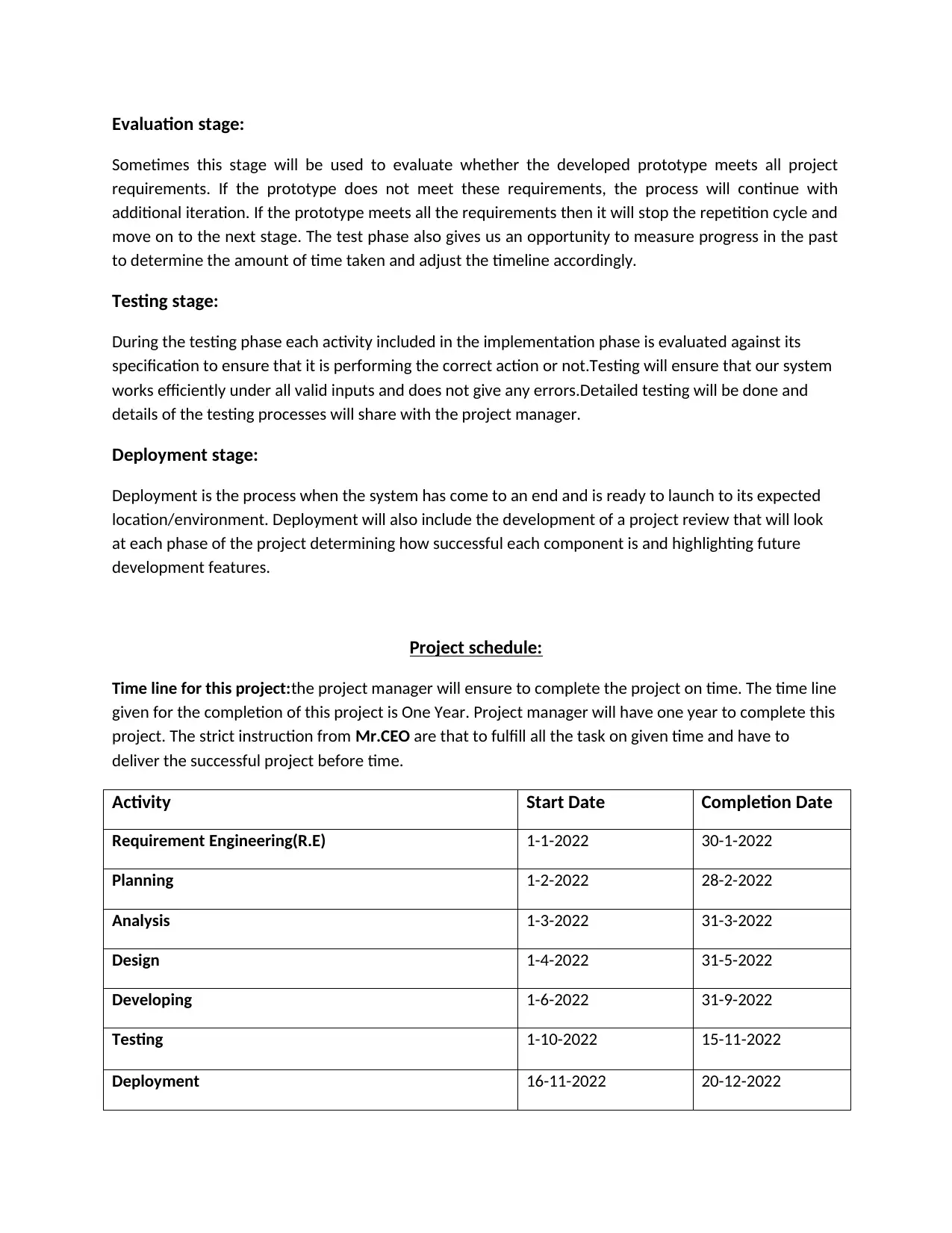
Time line for this project:the project manager will ensure to complete the project on time. The time line
given for the completion of this project is One Year. Project manager will have one year to complete this
project. The strict instruction from Mr.CEO are that to fulfill all the task on given time and have to
deliver the successful project before time.
Activity Start Date Completion Date
Requirement Engineering(R.E) 1-1-2022 30-1-2022
Planning 1-2-2022 28-2-2022
Analysis 1-3-2022 31-3-2022
Design 1-4-2022 31-5-2022
Developing 1-6-2022 31-9-2022
Testing 1-10-2022 15-11-2022
Deployment 16-11-2022 20-12-2022
Sometimes this stage will be used to evaluate whether the developed prototype meets all project
requirements. If the prototype does not meet these requirements, the process will continue with
additional iteration. If the prototype meets all the requirements then it will stop the repetition cycle and
move on to the next stage. The test phase also gives us an opportunity to measure progress in the past
to determine the amount of time taken and adjust the timeline accordingly.
Testing stage:
During the testing phase each activity included in the implementation phase is evaluated against its
specification to ensure that it is performing the correct action or not.Testing will ensure that our system
works efficiently under all valid inputs and does not give any errors.Detailed testing will be done and
details of the testing processes will share with the project manager.
Deployment stage:
Deployment is the process when the system has come to an end and is ready to launch to its expected
location/environment. Deployment will also include the development of a project review that will look
at each phase of the project determining how successful each component is and highlighting future
development features.
Project schedule:
Time line for this project:the project manager will ensure to complete the project on time. The time line
given for the completion of this project is One Year. Project manager will have one year to complete this
project. The strict instruction from Mr.CEO are that to fulfill all the task on given time and have to
deliver the successful project before time.
Activity Start Date Completion Date
Requirement Engineering(R.E) 1-1-2022 30-1-2022
Planning 1-2-2022 28-2-2022
Analysis 1-3-2022 31-3-2022
Design 1-4-2022 31-5-2022
Developing 1-6-2022 31-9-2022
Testing 1-10-2022 15-11-2022
Deployment 16-11-2022 20-12-2022
Paraphrase This Document
Need a fresh take? Get an instant paraphrase of this document with our AI Paraphraser

1 out of 8
Related Documents
Your All-in-One AI-Powered Toolkit for Academic Success.
+13062052269
info@desklib.com
Available 24*7 on WhatsApp / Email
Unlock your academic potential
Copyright © 2020–2026 A2Z Services. All Rights Reserved. Developed and managed by ZUCOL.