Research Project: Equality and Diversity at Hotel Crowne Plaza
VerifiedAdded on 2023/01/11
|18
|3385
|50
Report
AI Summary
This research project investigates equality and diversity in the workplace, focusing on a case study of Hotel Crowne Plaza. The methodology includes an explanation of access, sampling, and data collection instruments, specifically using questionnaires for primary data. Ethical considerations such as informed consent and confidentiality are addressed. The study analyzes data using a content analytical approach, presenting findings through frequency tables and thematic interpretations of employee responses. The results section reveals insights into employee understanding of workplace discrimination, the bases of discrimination (age, gender, religion), the impact of discrimination on performance, and the complexities faced by the hotel. Strategies to minimize discrimination and recommendations for improvement are also discussed, concluding with reflections on the research process. The report is a comprehensive analysis of workplace dynamics and their impact on organizational performance and employee relations.

RESEARCH PROJECT

Paraphrase This Document
Need a fresh take? Get an instant paraphrase of this document with our AI Paraphraser
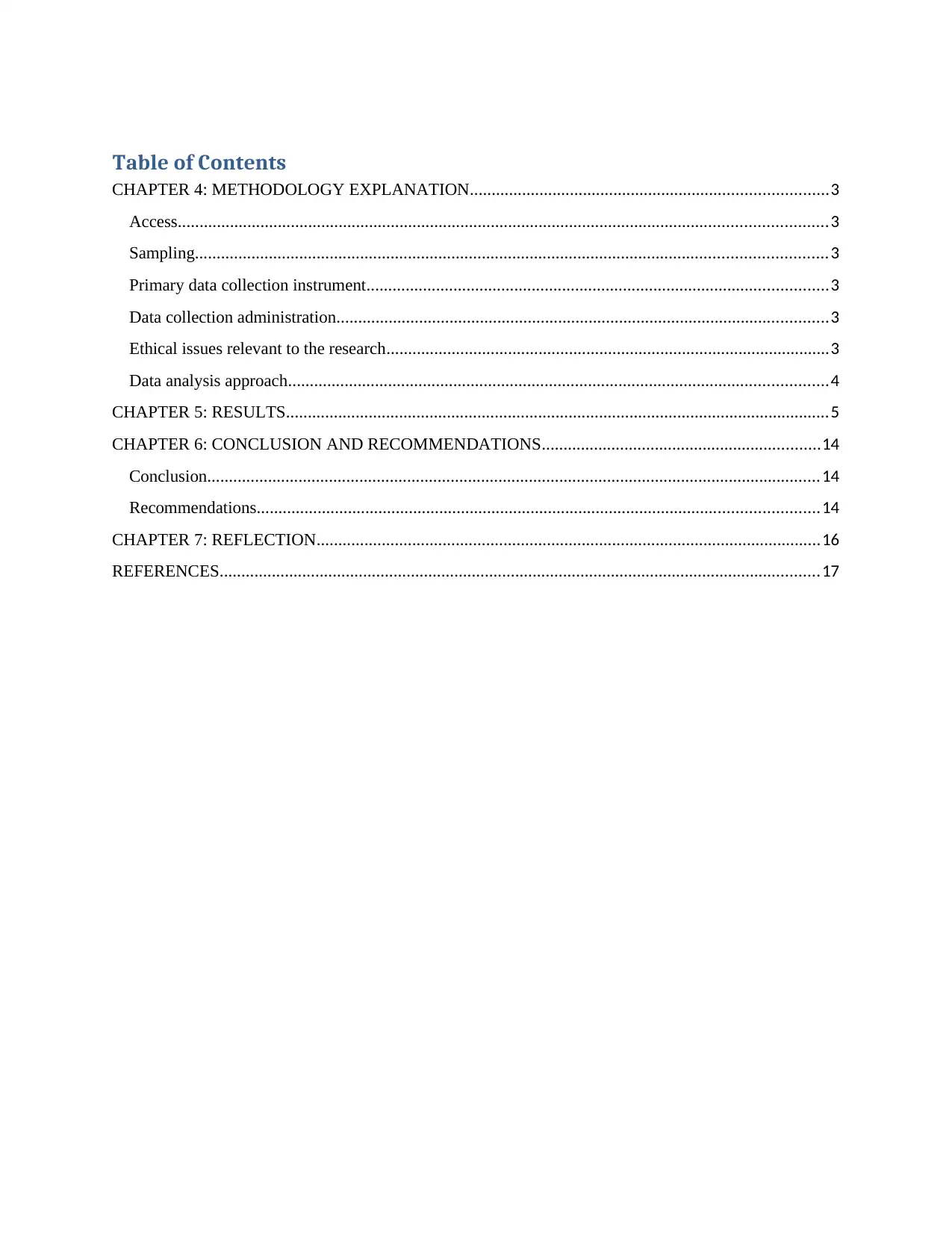
Table of Contents
CHAPTER 4: METHODOLOGY EXPLANATION..................................................................................3
Access.....................................................................................................................................................3
Sampling.................................................................................................................................................3
Primary data collection instrument..........................................................................................................3
Data collection administration.................................................................................................................3
Ethical issues relevant to the research......................................................................................................3
Data analysis approach............................................................................................................................4
CHAPTER 5: RESULTS.............................................................................................................................5
CHAPTER 6: CONCLUSION AND RECOMMENDATIONS................................................................14
Conclusion.............................................................................................................................................14
Recommendations.................................................................................................................................14
CHAPTER 7: REFLECTION....................................................................................................................16
REFERENCES..........................................................................................................................................17
CHAPTER 4: METHODOLOGY EXPLANATION..................................................................................3
Access.....................................................................................................................................................3
Sampling.................................................................................................................................................3
Primary data collection instrument..........................................................................................................3
Data collection administration.................................................................................................................3
Ethical issues relevant to the research......................................................................................................3
Data analysis approach............................................................................................................................4
CHAPTER 5: RESULTS.............................................................................................................................5
CHAPTER 6: CONCLUSION AND RECOMMENDATIONS................................................................14
Conclusion.............................................................................................................................................14
Recommendations.................................................................................................................................14
CHAPTER 7: REFLECTION....................................................................................................................16
REFERENCES..........................................................................................................................................17
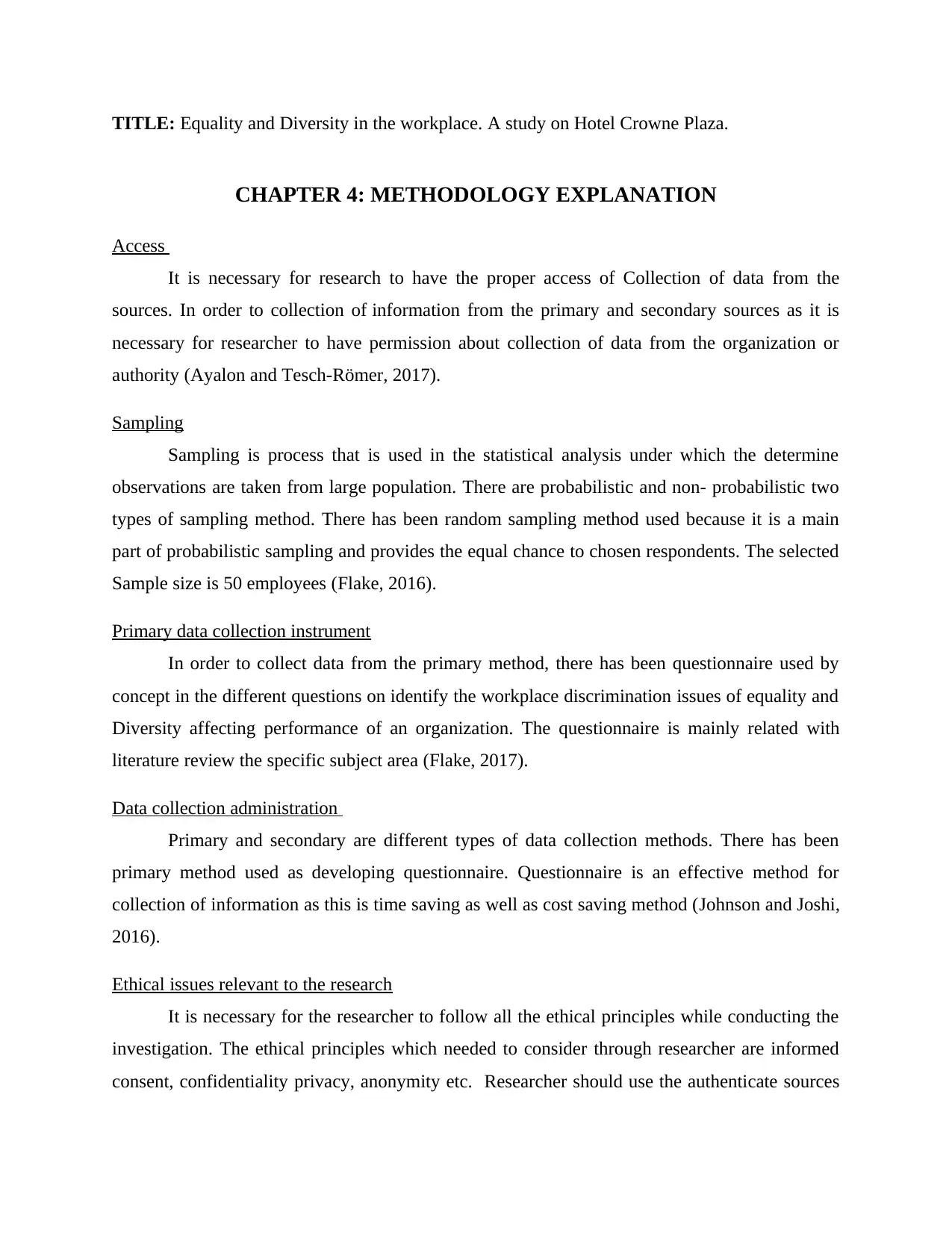
TITLE: Equality and Diversity in the workplace. A study on Hotel Crowne Plaza.
CHAPTER 4: METHODOLOGY EXPLANATION
Access
It is necessary for research to have the proper access of Collection of data from the
sources. In order to collection of information from the primary and secondary sources as it is
necessary for researcher to have permission about collection of data from the organization or
authority (Ayalon and Tesch-Römer, 2017).
Sampling
Sampling is process that is used in the statistical analysis under which the determine
observations are taken from large population. There are probabilistic and non- probabilistic two
types of sampling method. There has been random sampling method used because it is a main
part of probabilistic sampling and provides the equal chance to chosen respondents. The selected
Sample size is 50 employees (Flake, 2016).
Primary data collection instrument
In order to collect data from the primary method, there has been questionnaire used by
concept in the different questions on identify the workplace discrimination issues of equality and
Diversity affecting performance of an organization. The questionnaire is mainly related with
literature review the specific subject area (Flake, 2017).
Data collection administration
Primary and secondary are different types of data collection methods. There has been
primary method used as developing questionnaire. Questionnaire is an effective method for
collection of information as this is time saving as well as cost saving method (Johnson and Joshi,
2016).
Ethical issues relevant to the research
It is necessary for the researcher to follow all the ethical principles while conducting the
investigation. The ethical principles which needed to consider through researcher are informed
consent, confidentiality privacy, anonymity etc. Researcher should use the authenticate sources
CHAPTER 4: METHODOLOGY EXPLANATION
Access
It is necessary for research to have the proper access of Collection of data from the
sources. In order to collection of information from the primary and secondary sources as it is
necessary for researcher to have permission about collection of data from the organization or
authority (Ayalon and Tesch-Römer, 2017).
Sampling
Sampling is process that is used in the statistical analysis under which the determine
observations are taken from large population. There are probabilistic and non- probabilistic two
types of sampling method. There has been random sampling method used because it is a main
part of probabilistic sampling and provides the equal chance to chosen respondents. The selected
Sample size is 50 employees (Flake, 2016).
Primary data collection instrument
In order to collect data from the primary method, there has been questionnaire used by
concept in the different questions on identify the workplace discrimination issues of equality and
Diversity affecting performance of an organization. The questionnaire is mainly related with
literature review the specific subject area (Flake, 2017).
Data collection administration
Primary and secondary are different types of data collection methods. There has been
primary method used as developing questionnaire. Questionnaire is an effective method for
collection of information as this is time saving as well as cost saving method (Johnson and Joshi,
2016).
Ethical issues relevant to the research
It is necessary for the researcher to follow all the ethical principles while conducting the
investigation. The ethical principles which needed to consider through researcher are informed
consent, confidentiality privacy, anonymity etc. Researcher should use the authenticate sources
⊘ This is a preview!⊘
Do you want full access?
Subscribe today to unlock all pages.

Trusted by 1+ million students worldwide
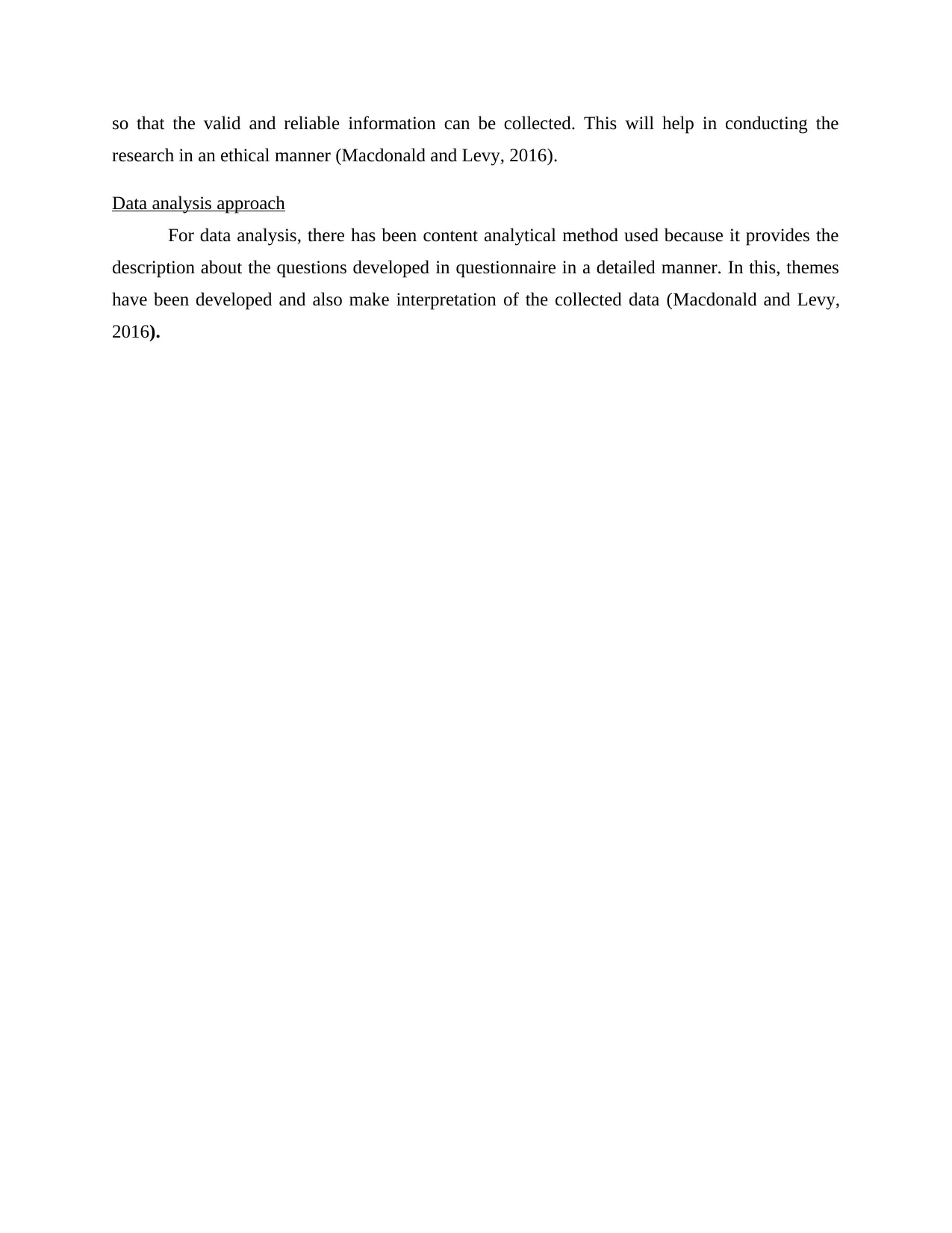
so that the valid and reliable information can be collected. This will help in conducting the
research in an ethical manner (Macdonald and Levy, 2016).
Data analysis approach
For data analysis, there has been content analytical method used because it provides the
description about the questions developed in questionnaire in a detailed manner. In this, themes
have been developed and also make interpretation of the collected data (Macdonald and Levy,
2016).
research in an ethical manner (Macdonald and Levy, 2016).
Data analysis approach
For data analysis, there has been content analytical method used because it provides the
description about the questions developed in questionnaire in a detailed manner. In this, themes
have been developed and also make interpretation of the collected data (Macdonald and Levy,
2016).
Paraphrase This Document
Need a fresh take? Get an instant paraphrase of this document with our AI Paraphraser
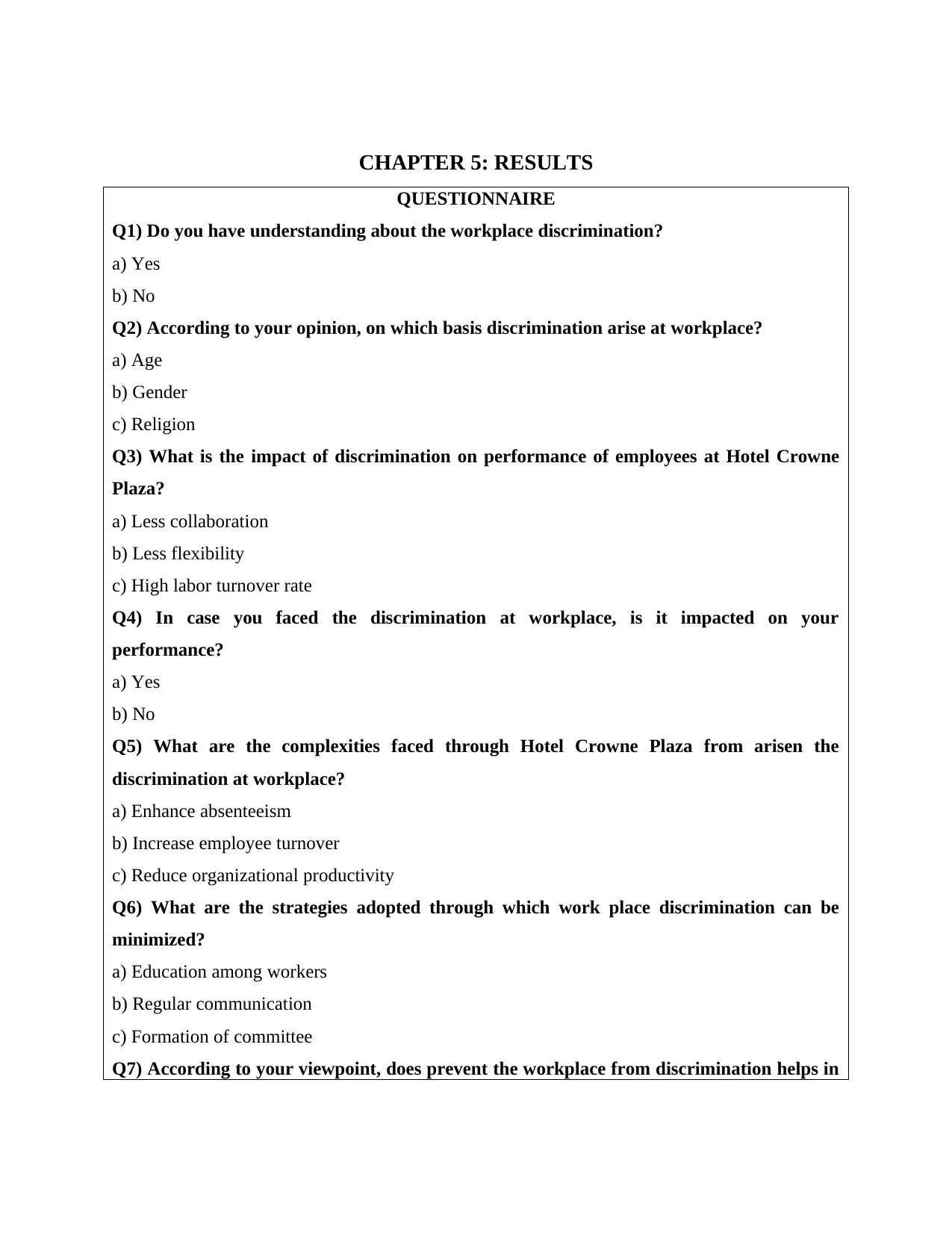
CHAPTER 5: RESULTS
QUESTIONNAIRE
Q1) Do you have understanding about the workplace discrimination?
a) Yes
b) No
Q2) According to your opinion, on which basis discrimination arise at workplace?
a) Age
b) Gender
c) Religion
Q3) What is the impact of discrimination on performance of employees at Hotel Crowne
Plaza?
a) Less collaboration
b) Less flexibility
c) High labor turnover rate
Q4) In case you faced the discrimination at workplace, is it impacted on your
performance?
a) Yes
b) No
Q5) What are the complexities faced through Hotel Crowne Plaza from arisen the
discrimination at workplace?
a) Enhance absenteeism
b) Increase employee turnover
c) Reduce organizational productivity
Q6) What are the strategies adopted through which work place discrimination can be
minimized?
a) Education among workers
b) Regular communication
c) Formation of committee
Q7) According to your viewpoint, does prevent the workplace from discrimination helps in
QUESTIONNAIRE
Q1) Do you have understanding about the workplace discrimination?
a) Yes
b) No
Q2) According to your opinion, on which basis discrimination arise at workplace?
a) Age
b) Gender
c) Religion
Q3) What is the impact of discrimination on performance of employees at Hotel Crowne
Plaza?
a) Less collaboration
b) Less flexibility
c) High labor turnover rate
Q4) In case you faced the discrimination at workplace, is it impacted on your
performance?
a) Yes
b) No
Q5) What are the complexities faced through Hotel Crowne Plaza from arisen the
discrimination at workplace?
a) Enhance absenteeism
b) Increase employee turnover
c) Reduce organizational productivity
Q6) What are the strategies adopted through which work place discrimination can be
minimized?
a) Education among workers
b) Regular communication
c) Formation of committee
Q7) According to your viewpoint, does prevent the workplace from discrimination helps in
retaining the staff members for longer time period?
a) Yes
b) No
Q8) Give suggestions to organisation to combat the workplace discrimination.
Frequency Table
Q1) Do you have understanding about the workplace discrimination? Frequency
a) Yes 45
b) No 5
Q2) According to your opinion, on which basis discrimination arise at
workplace?
Frequency
a) Age 15
b) Gender 18
c) Religion 17
Q3) What is the impact of discrimination on performance of
employees at Hotel Crowne Plaza?
Frequency
a) Less collaboration 12
b) Less flexibility 20
c) High labor turnover rate 18
Q4) In case you faced the discrimination at workplace, is it impacted
on your performance?
Frequency
a) Yes 35
b) No 15
Q5) What are the complexities faced through Hotel Crowne Plaza
from arisen the discrimination at workplace?
Frequency
a) Enhance absenteeism 20
b) Increase employee turnover 20
c) Reduce organizational productivity 10
Q6) What are the strategies adopted through which work place
discrimination can be minimized?
Frequency
a) Yes
b) No
Q8) Give suggestions to organisation to combat the workplace discrimination.
Frequency Table
Q1) Do you have understanding about the workplace discrimination? Frequency
a) Yes 45
b) No 5
Q2) According to your opinion, on which basis discrimination arise at
workplace?
Frequency
a) Age 15
b) Gender 18
c) Religion 17
Q3) What is the impact of discrimination on performance of
employees at Hotel Crowne Plaza?
Frequency
a) Less collaboration 12
b) Less flexibility 20
c) High labor turnover rate 18
Q4) In case you faced the discrimination at workplace, is it impacted
on your performance?
Frequency
a) Yes 35
b) No 15
Q5) What are the complexities faced through Hotel Crowne Plaza
from arisen the discrimination at workplace?
Frequency
a) Enhance absenteeism 20
b) Increase employee turnover 20
c) Reduce organizational productivity 10
Q6) What are the strategies adopted through which work place
discrimination can be minimized?
Frequency
⊘ This is a preview!⊘
Do you want full access?
Subscribe today to unlock all pages.
Trusted by 1+ million students worldwide
a) Education among workers 10
b) Regular communication 10
c) Formation of committee 30
Q7) According to your viewpoint, does prevent the workplace from
discrimination helps in retaining the staff members for longer time
period?
Frequency
a) Yes 40
b) No 10
THEME 1: Understanding about the workplace discrimination
Q1) Do you have understanding about the workplace
discrimination?
Frequency
a) Yes 45
b) No 5
a) Yes b) No
0
5
10
15
20
25
30
35
40
45
45
5
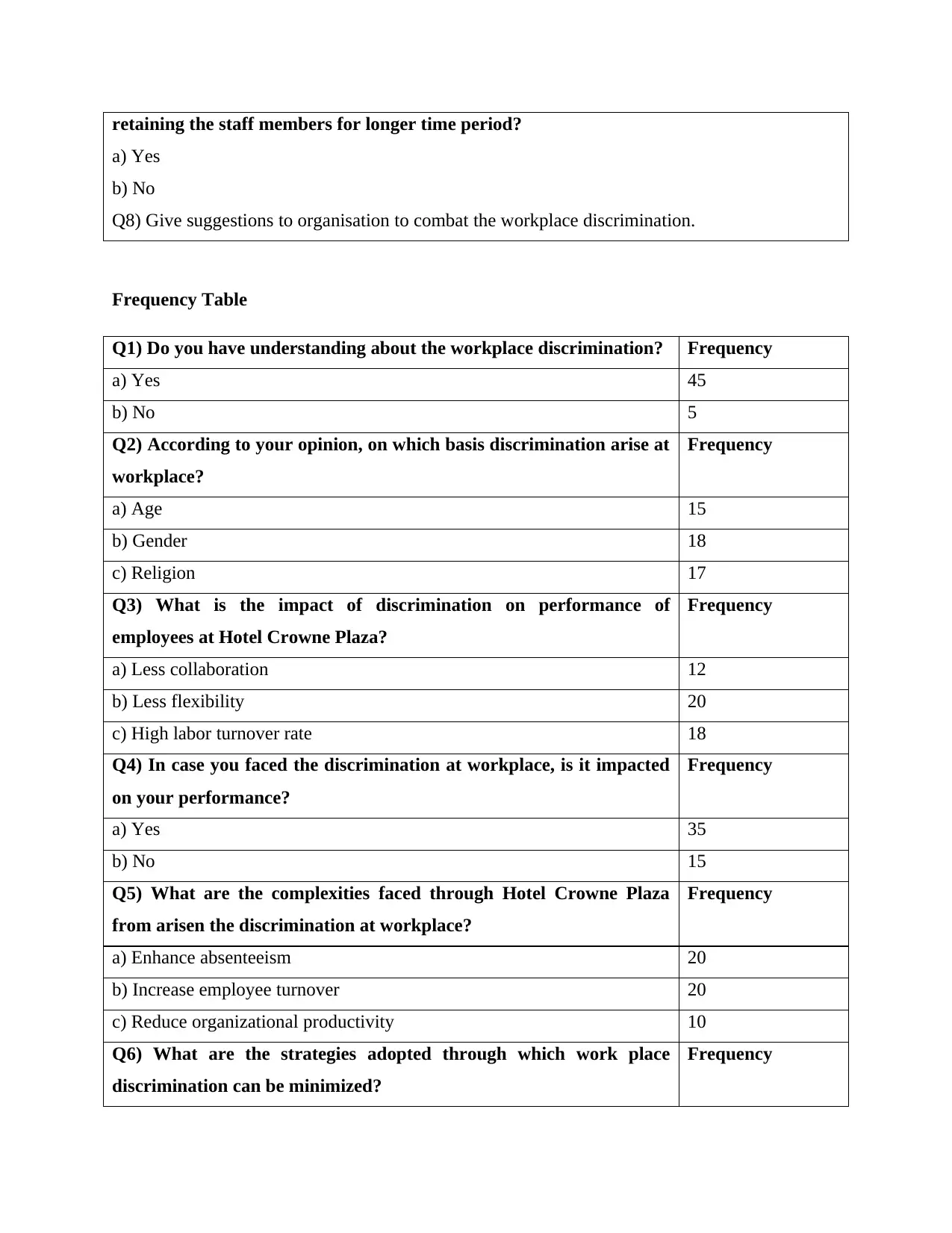
Interpretation: On the basis of 45 respondents that they have to understanding regarding
workplace discrimination. According to their opinion that discrimination at workplace is related
to certain prejudices when an employee is treated in an unfavourable manner due to gender,
religion, disability, race and many other characteristics. Other than this, there are 5 remaining
respondents which are not fully aware about the workplace discrimination.
b) Regular communication 10
c) Formation of committee 30
Q7) According to your viewpoint, does prevent the workplace from
discrimination helps in retaining the staff members for longer time
period?
Frequency
a) Yes 40
b) No 10
THEME 1: Understanding about the workplace discrimination
Q1) Do you have understanding about the workplace
discrimination?
Frequency
a) Yes 45
b) No 5
a) Yes b) No
0
5
10
15
20
25
30
35
40
45
45
5
Interpretation: On the basis of 45 respondents that they have to understanding regarding
workplace discrimination. According to their opinion that discrimination at workplace is related
to certain prejudices when an employee is treated in an unfavourable manner due to gender,
religion, disability, race and many other characteristics. Other than this, there are 5 remaining
respondents which are not fully aware about the workplace discrimination.
Paraphrase This Document
Need a fresh take? Get an instant paraphrase of this document with our AI Paraphraser
THEME 2: Which basis discrimination arise at workplace
Q2) According to your opinion, on which basis discrimination arise
at workplace?
Frequency
a) Age 15
b) Gender 18
c) Religion 17
a) Age b) Gender c) Religion
13.5
14
14.5
15
15.5
16
16.5
17
17.5
18
15
18
17
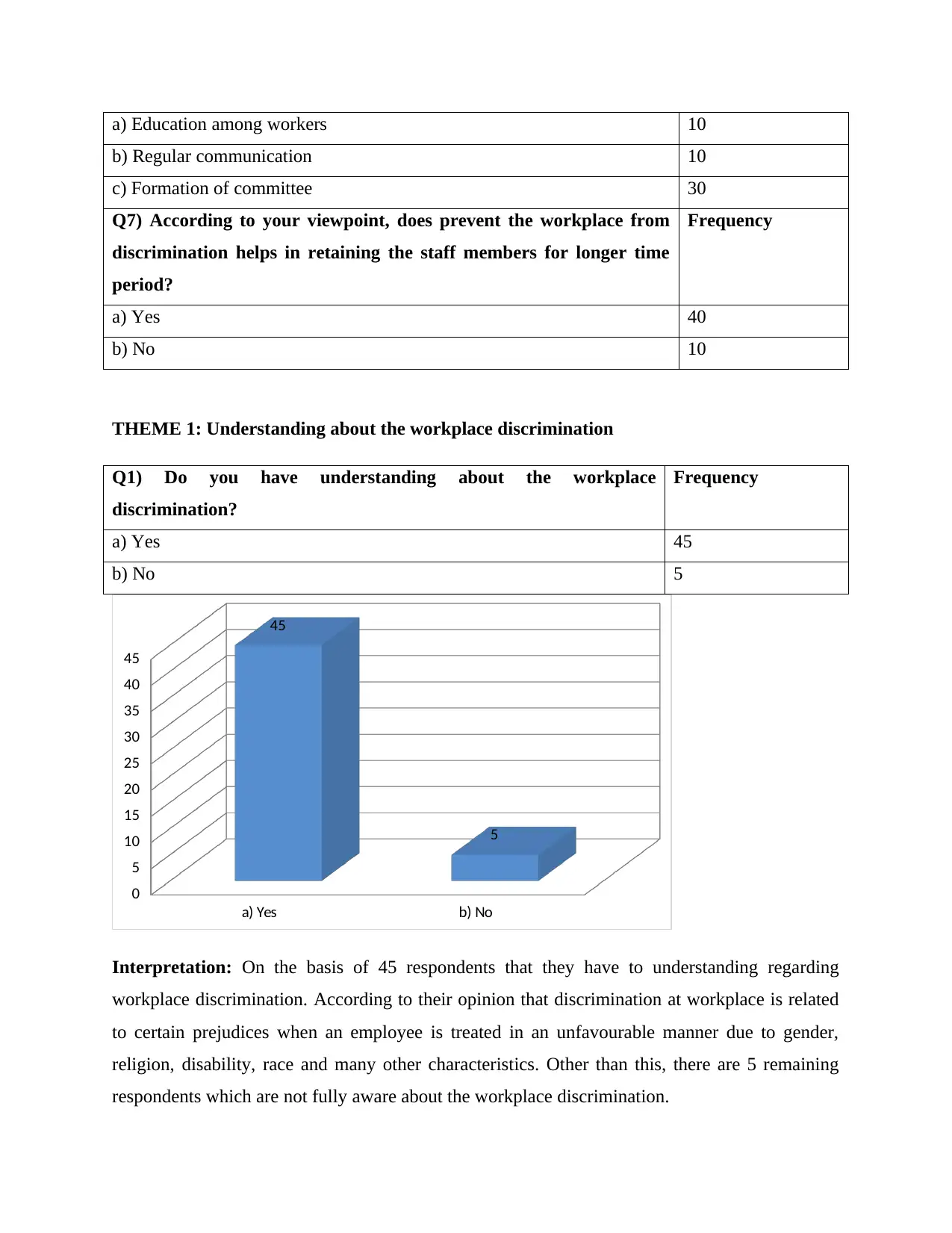
Interpretation: According to the mention graph there are some bases on which discrimination
happen at workplace. There are 15 respondents which said that on the basis of age discrimination
arise at the workplace. In this kind of discrimination, the older employees treat less favourable
then the new staff. According to 18 respondents that gender is a main basis of discrimination
arises at workplace. It is related to not treating the men and women employees equally at the
workplace. There are 17 remaining respondents which agree with the religion based
discrimination at workplace.
THEME 3: Impact of discrimination on performance of employees
Q3) What is the impact of discrimination on performance of
employees at Hotel Crowne Plaza?
Frequency
a) Less collaboration 12
b) Less flexibility 20
Q2) According to your opinion, on which basis discrimination arise
at workplace?
Frequency
a) Age 15
b) Gender 18
c) Religion 17
a) Age b) Gender c) Religion
13.5
14
14.5
15
15.5
16
16.5
17
17.5
18
15
18
17
Interpretation: According to the mention graph there are some bases on which discrimination
happen at workplace. There are 15 respondents which said that on the basis of age discrimination
arise at the workplace. In this kind of discrimination, the older employees treat less favourable
then the new staff. According to 18 respondents that gender is a main basis of discrimination
arises at workplace. It is related to not treating the men and women employees equally at the
workplace. There are 17 remaining respondents which agree with the religion based
discrimination at workplace.
THEME 3: Impact of discrimination on performance of employees
Q3) What is the impact of discrimination on performance of
employees at Hotel Crowne Plaza?
Frequency
a) Less collaboration 12
b) Less flexibility 20
c) High labor turnover rate 18
a) Less collaboration b) Less flexibility c) High labor turnover
rate
0
2
4
6
8
10
12
14
16
18
20
12
20
18
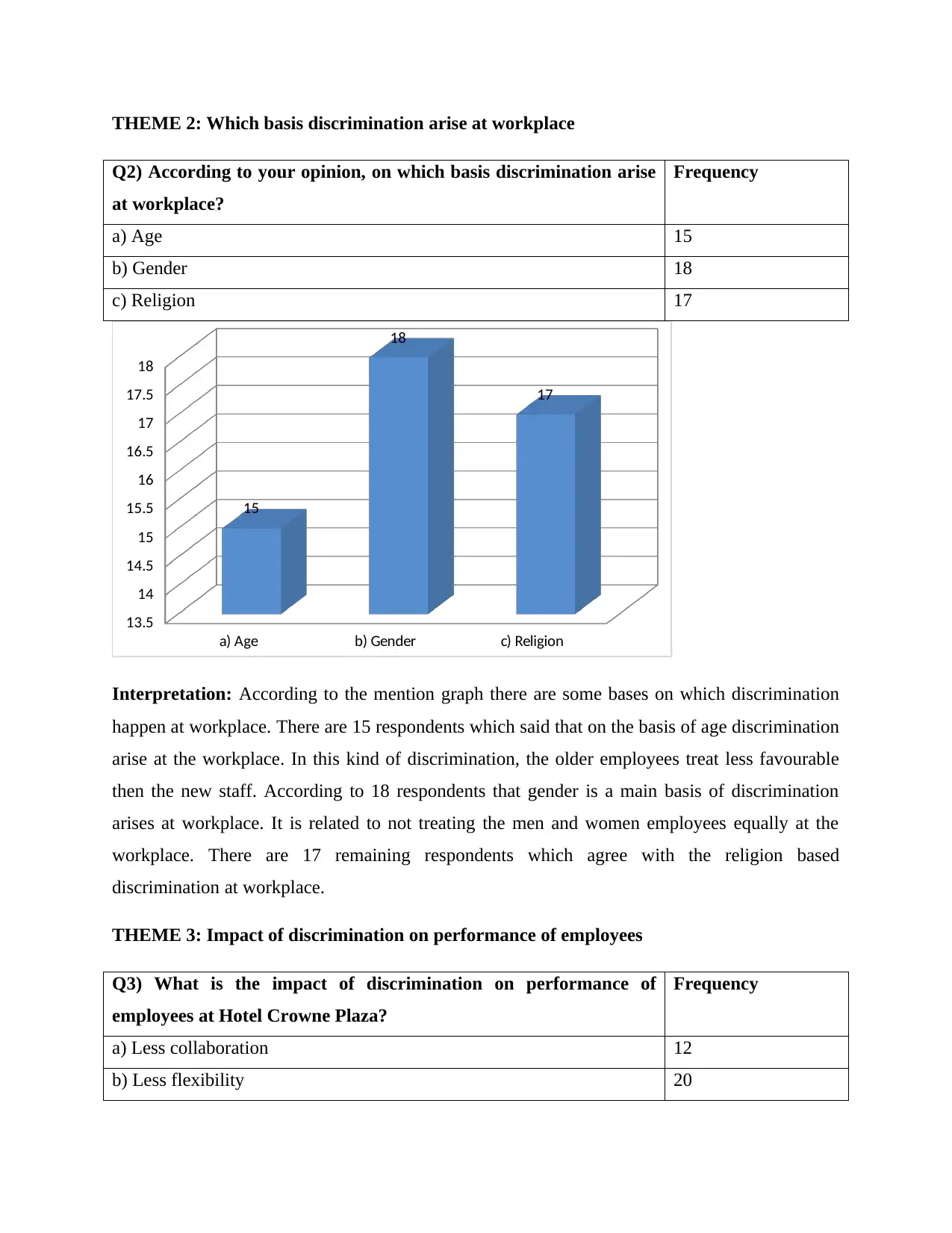
Interpretation: On the basis 12 respondents that less collaboration is a main impact of
discrimination that affected the performance level of staff members. Under this, there is a less
cooperation among the managers and employees and this reduces the moral of the staff members
at workplace. It is necessary for the manager to motivate the employees and also right time to
work in a right direction. There are 20 respondents which are agree with the less flexibility also
affect the adverse performance. There is less flexibility at workplace because the terms and
condition for the employees arise. This develops the negative impact on performance level and
they are not able to serve the best services to their customers. There are 18 remaining
respondents which said that workplace discrimination increase the labour turnover rate as the
moral of employees reduce and they are not able to sustain at workplace for long period.
THEME 4: Discrimination impacted on your performance
Q4) In case you faced the discrimination at workplace, is it
impacted on your performance?
Frequency
a) Yes 35
b) No 15
a) Less collaboration b) Less flexibility c) High labor turnover
rate
0
2
4
6
8
10
12
14
16
18
20
12
20
18
Interpretation: On the basis 12 respondents that less collaboration is a main impact of
discrimination that affected the performance level of staff members. Under this, there is a less
cooperation among the managers and employees and this reduces the moral of the staff members
at workplace. It is necessary for the manager to motivate the employees and also right time to
work in a right direction. There are 20 respondents which are agree with the less flexibility also
affect the adverse performance. There is less flexibility at workplace because the terms and
condition for the employees arise. This develops the negative impact on performance level and
they are not able to serve the best services to their customers. There are 18 remaining
respondents which said that workplace discrimination increase the labour turnover rate as the
moral of employees reduce and they are not able to sustain at workplace for long period.
THEME 4: Discrimination impacted on your performance
Q4) In case you faced the discrimination at workplace, is it
impacted on your performance?
Frequency
a) Yes 35
b) No 15
⊘ This is a preview!⊘
Do you want full access?
Subscribe today to unlock all pages.
Trusted by 1+ million students worldwide
a) Yes b) No
0
5
10
15
20
25
30
35
35
15
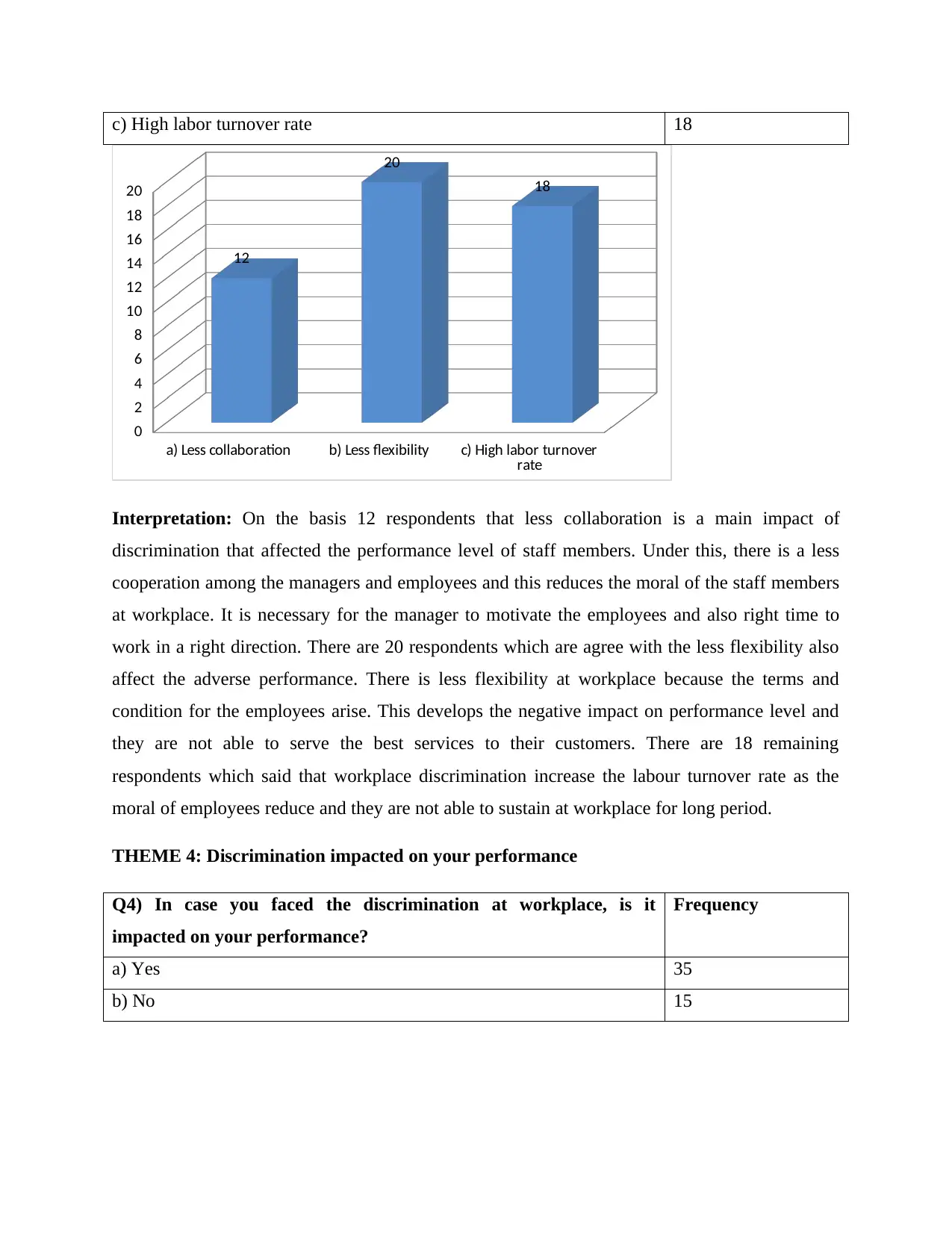
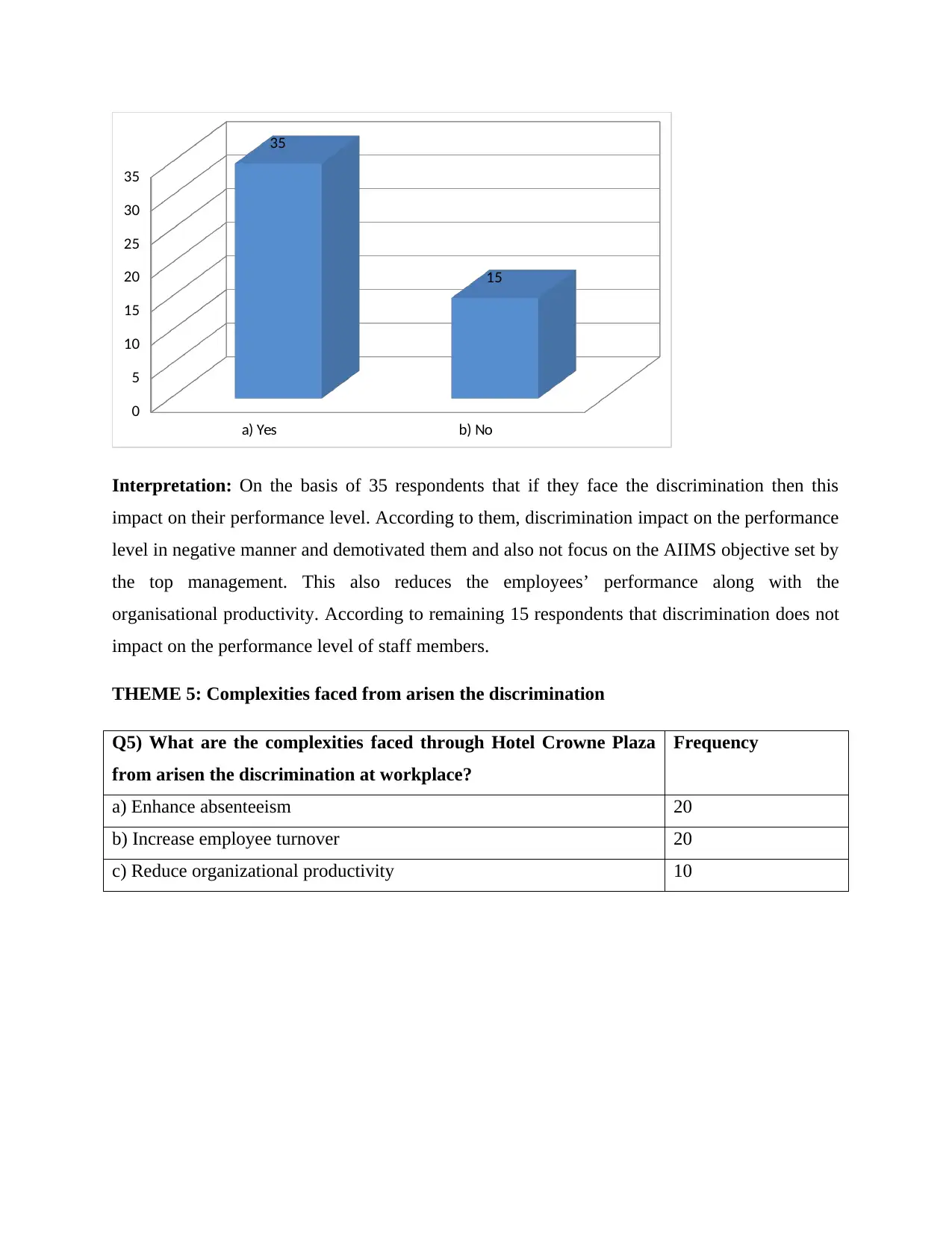
Interpretation: On the basis of 35 respondents that if they face the discrimination then this
impact on their performance level. According to them, discrimination impact on the performance
level in negative manner and demotivated them and also not focus on the AIIMS objective set by
the top management. This also reduces the employees’ performance along with the
organisational productivity. According to remaining 15 respondents that discrimination does not
impact on the performance level of staff members.
THEME 5: Complexities faced from arisen the discrimination
Q5) What are the complexities faced through Hotel Crowne Plaza
from arisen the discrimination at workplace?
Frequency
a) Enhance absenteeism 20
b) Increase employee turnover 20
c) Reduce organizational productivity 10
0
5
10
15
20
25
30
35
35
15
Interpretation: On the basis of 35 respondents that if they face the discrimination then this
impact on their performance level. According to them, discrimination impact on the performance
level in negative manner and demotivated them and also not focus on the AIIMS objective set by
the top management. This also reduces the employees’ performance along with the
organisational productivity. According to remaining 15 respondents that discrimination does not
impact on the performance level of staff members.
THEME 5: Complexities faced from arisen the discrimination
Q5) What are the complexities faced through Hotel Crowne Plaza
from arisen the discrimination at workplace?
Frequency
a) Enhance absenteeism 20
b) Increase employee turnover 20
c) Reduce organizational productivity 10
Paraphrase This Document
Need a fresh take? Get an instant paraphrase of this document with our AI Paraphraser
a) Enhance
absenteeism b) Increase employee
turnover c) Reduce
organizational
productivity
0
2
4
6
8
10
12
14
16
18
20
20 20
10
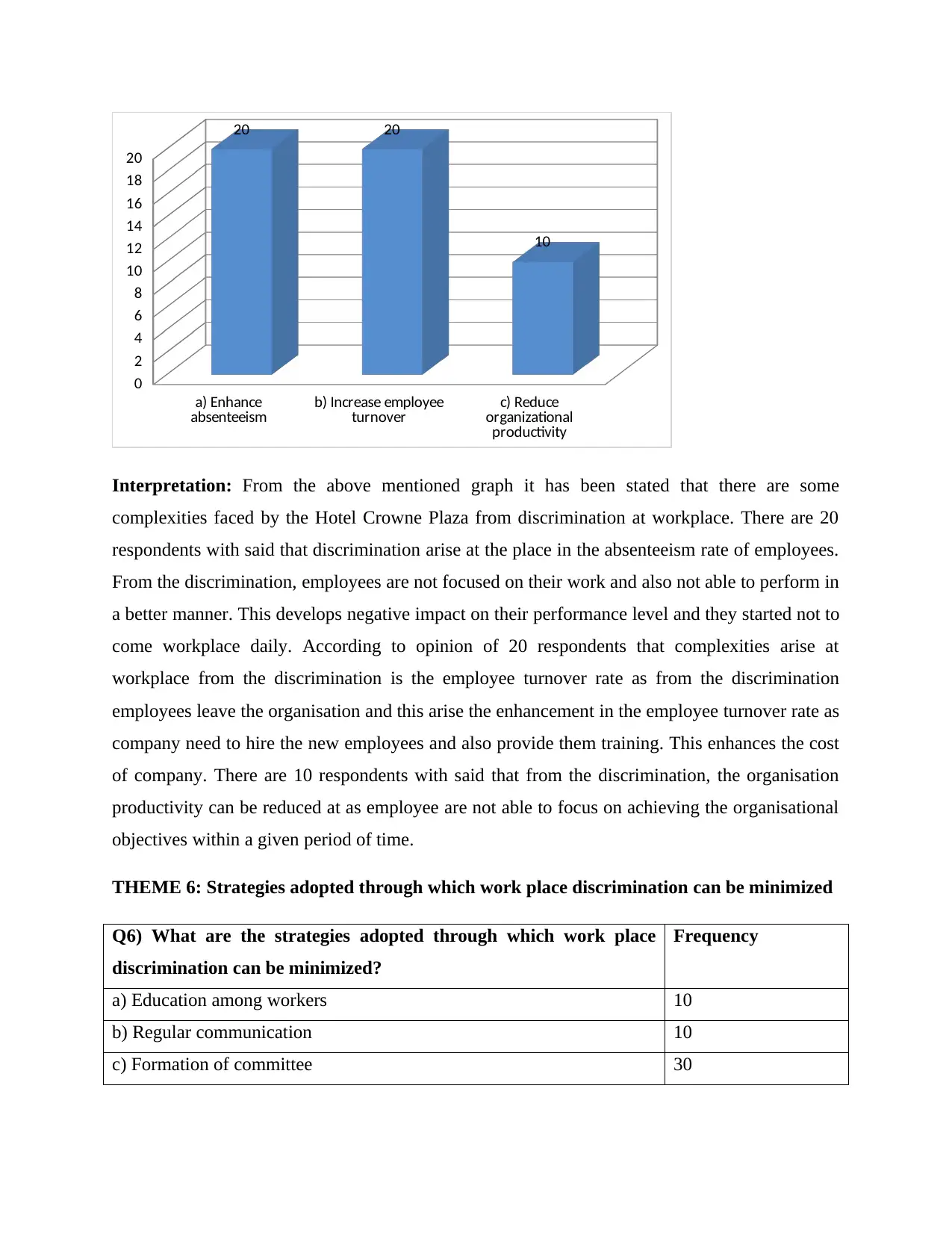
Interpretation: From the above mentioned graph it has been stated that there are some
complexities faced by the Hotel Crowne Plaza from discrimination at workplace. There are 20
respondents with said that discrimination arise at the place in the absenteeism rate of employees.
From the discrimination, employees are not focused on their work and also not able to perform in
a better manner. This develops negative impact on their performance level and they started not to
come workplace daily. According to opinion of 20 respondents that complexities arise at
workplace from the discrimination is the employee turnover rate as from the discrimination
employees leave the organisation and this arise the enhancement in the employee turnover rate as
company need to hire the new employees and also provide them training. This enhances the cost
of company. There are 10 respondents with said that from the discrimination, the organisation
productivity can be reduced at as employee are not able to focus on achieving the organisational
objectives within a given period of time.
THEME 6: Strategies adopted through which work place discrimination can be minimized
Q6) What are the strategies adopted through which work place
discrimination can be minimized?
Frequency
a) Education among workers 10
b) Regular communication 10
c) Formation of committee 30
absenteeism b) Increase employee
turnover c) Reduce
organizational
productivity
0
2
4
6
8
10
12
14
16
18
20
20 20
10
Interpretation: From the above mentioned graph it has been stated that there are some
complexities faced by the Hotel Crowne Plaza from discrimination at workplace. There are 20
respondents with said that discrimination arise at the place in the absenteeism rate of employees.
From the discrimination, employees are not focused on their work and also not able to perform in
a better manner. This develops negative impact on their performance level and they started not to
come workplace daily. According to opinion of 20 respondents that complexities arise at
workplace from the discrimination is the employee turnover rate as from the discrimination
employees leave the organisation and this arise the enhancement in the employee turnover rate as
company need to hire the new employees and also provide them training. This enhances the cost
of company. There are 10 respondents with said that from the discrimination, the organisation
productivity can be reduced at as employee are not able to focus on achieving the organisational
objectives within a given period of time.
THEME 6: Strategies adopted through which work place discrimination can be minimized
Q6) What are the strategies adopted through which work place
discrimination can be minimized?
Frequency
a) Education among workers 10
b) Regular communication 10
c) Formation of committee 30
a) Education among
workers b) Regular
communication c) Formation of
committee
0
5
10
15
20
25
30
10 10
30
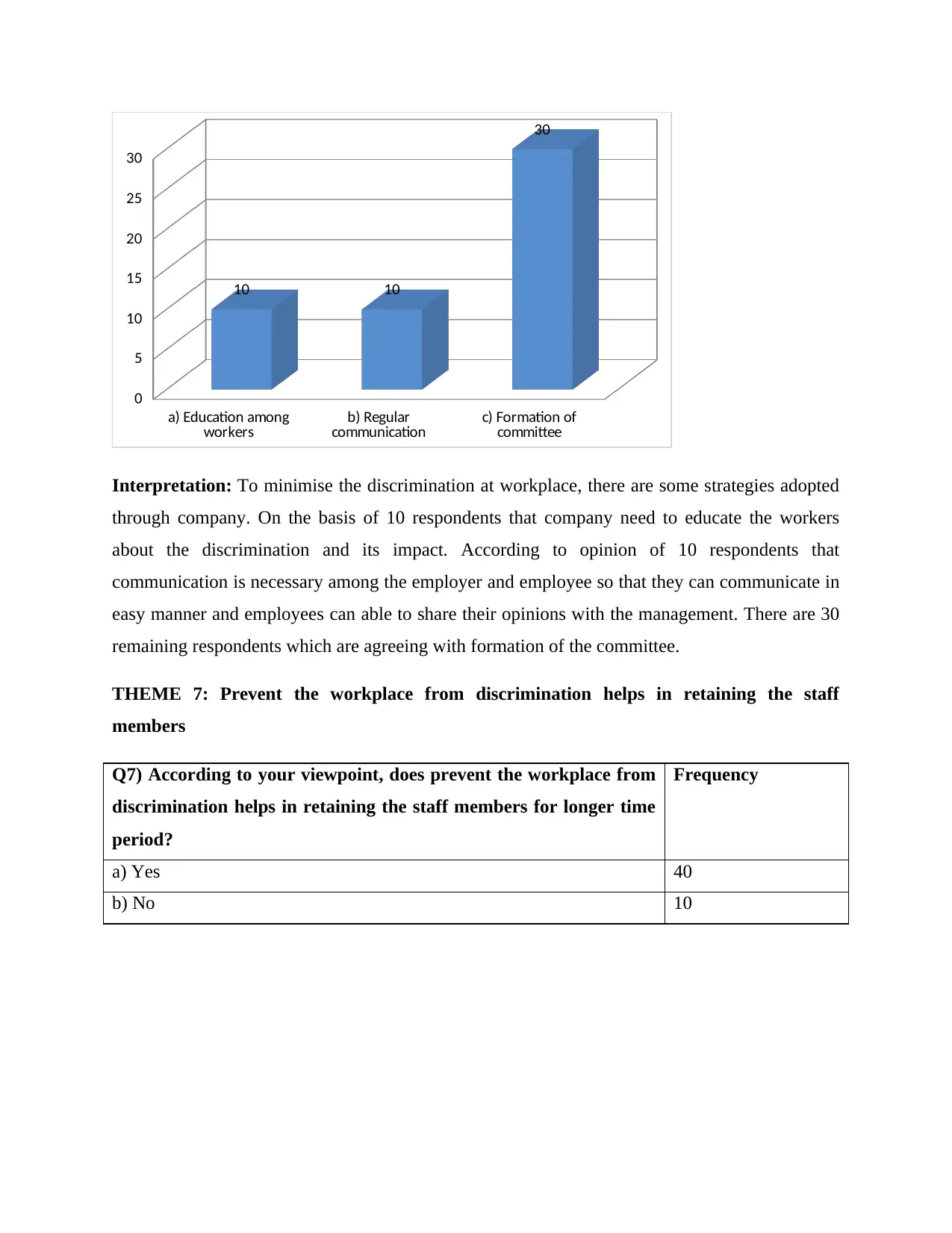
Interpretation: To minimise the discrimination at workplace, there are some strategies adopted
through company. On the basis of 10 respondents that company need to educate the workers
about the discrimination and its impact. According to opinion of 10 respondents that
communication is necessary among the employer and employee so that they can communicate in
easy manner and employees can able to share their opinions with the management. There are 30
remaining respondents which are agreeing with formation of the committee.
THEME 7: Prevent the workplace from discrimination helps in retaining the staff
members
Q7) According to your viewpoint, does prevent the workplace from
discrimination helps in retaining the staff members for longer time
period?
Frequency
a) Yes 40
b) No 10
workers b) Regular
communication c) Formation of
committee
0
5
10
15
20
25
30
10 10
30
Interpretation: To minimise the discrimination at workplace, there are some strategies adopted
through company. On the basis of 10 respondents that company need to educate the workers
about the discrimination and its impact. According to opinion of 10 respondents that
communication is necessary among the employer and employee so that they can communicate in
easy manner and employees can able to share their opinions with the management. There are 30
remaining respondents which are agreeing with formation of the committee.
THEME 7: Prevent the workplace from discrimination helps in retaining the staff
members
Q7) According to your viewpoint, does prevent the workplace from
discrimination helps in retaining the staff members for longer time
period?
Frequency
a) Yes 40
b) No 10
⊘ This is a preview!⊘
Do you want full access?
Subscribe today to unlock all pages.
Trusted by 1+ million students worldwide

1 out of 18


Related Documents


Your All-in-One AI-Powered Toolkit for Academic Success.
+13062052269
info@desklib.com
Available 24*7 on WhatsApp / Email
![[object Object]](/_next/static/media/star-bottom.7253800d.svg)
Unlock your academic potential
Copyright © 2020–2026 A2Z Services. All Rights Reserved. Developed and managed by ZUCOL.