Hotel and Guest Experience: Economic Progression Analysis
VerifiedAdded on 2021/02/20
|9
|2793
|27
Report
AI Summary
This report delves into the intricate relationship between hotels and their guests, examining the hospitality sector's strategies to enhance customer experiences. It explores the application of Pine and Gilmore's experience economy framework, analyzing economic progression through customization and commoditization within the hotel industry. The report investigates consumer behavior trends influenced by technological advancements, emphasizing the importance of memorable experiences and personalized services. It further assesses how the hotel market adapts to changing consumer sensibilities, including online booking platforms, personalized branding, and the integration of technology to improve customer satisfaction. Case studies of successful hotels like Brando French Polynesia, Four Seasons Resorts, and Saffire Freycinet are used to illustrate effective strategies. The report concludes by highlighting the significance of adapting to consumer needs, leveraging technology, and offering unique value propositions to ensure long-term success in the competitive hospitality landscape.
HOTEL AND GUEST
EXPERIENCES
EXPERIENCES

Paraphrase This Document
Need a fresh take? Get an instant paraphrase of this document with our AI Paraphraser
ABSTRACT
Hospitality sectors resulting in identifying the strong relationship between the guest and
hotel and also the polices which the hotels are adapting to grab their interest towards such
services. In respect of hotel industry, the manager had to carry various duties in respect of
entertaining the customer or also providing effective customer services so that they can avail the
services online or booking room through digital platform. In this report, following aspects are
examined in respect of implementing the theory of economic progression and also the two drive
forces such as Customization and commoditization. It also result in identifying the consumer
behaviour in perspective of changes in technology.
Hospitality sectors resulting in identifying the strong relationship between the guest and
hotel and also the polices which the hotels are adapting to grab their interest towards such
services. In respect of hotel industry, the manager had to carry various duties in respect of
entertaining the customer or also providing effective customer services so that they can avail the
services online or booking room through digital platform. In this report, following aspects are
examined in respect of implementing the theory of economic progression and also the two drive
forces such as Customization and commoditization. It also result in identifying the consumer
behaviour in perspective of changes in technology.
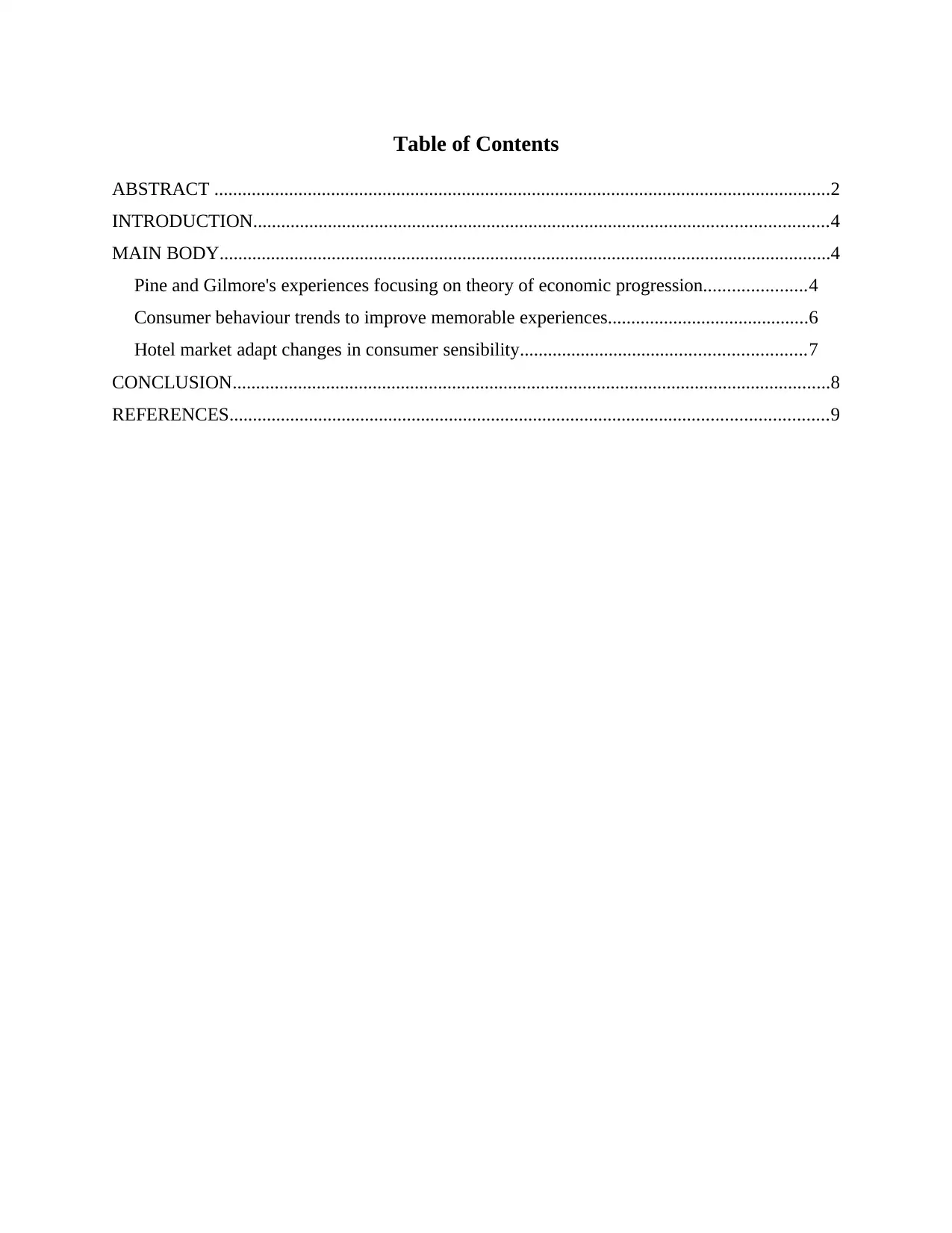
Table of Contents
ABSTRACT ....................................................................................................................................2
INTRODUCTION...........................................................................................................................4
MAIN BODY...................................................................................................................................4
Pine and Gilmore's experiences focusing on theory of economic progression......................4
Consumer behaviour trends to improve memorable experiences...........................................6
Hotel market adapt changes in consumer sensibility.............................................................7
CONCLUSION................................................................................................................................8
REFERENCES................................................................................................................................9
ABSTRACT ....................................................................................................................................2
INTRODUCTION...........................................................................................................................4
MAIN BODY...................................................................................................................................4
Pine and Gilmore's experiences focusing on theory of economic progression......................4
Consumer behaviour trends to improve memorable experiences...........................................6
Hotel market adapt changes in consumer sensibility.............................................................7
CONCLUSION................................................................................................................................8
REFERENCES................................................................................................................................9
⊘ This is a preview!⊘
Do you want full access?
Subscribe today to unlock all pages.

Trusted by 1+ million students worldwide
INTRODUCTION
Hospitality sectors carries the wider range of services sectors which involves foods and
beverages, conducting the event planning and also includes transportation and travelling
expenses to visit unique places. In recent times, this is one of the most earning field and also it
carries multiple sectors which satisfy the needs and demands of the customer and also retain
them for longer time time period (Treuren, Manoharan & Vishnu, 2019). Present report is covered with
the experiences of the Pine and Gilmore regarding experience economy under which the
economy fluctuates through examining the interest of the customer towards the products and
services which is offering. This report will includes the various concepts and development under
the professionalism under the hospitality sectors. It also includes the changes in consumer
behaviour and its impact on consumer services. Further it determines the correlation between the
culture, customer and business experiences. Lastly the report ends up with examining the
different strategies that hotels can take in improving the customer experiences.
MAIN BODY
Pine and Gilmore's experiences focusing on theory of economic progression
Economy is examined on the bases of determining the goods and services through which
the hospitality sectors are dealing on. If there is high volume of customer, it results in bringing
more economy in country as if there is high visitors in country, their is also increases in economy
in country. Usually people share their reviews regarding considering the particular place and
planning for some vacation to express such country which is unique and attach to natural
environment. In such perspective they are Pine and Gilmore applied this model which is related
to experiences the economy (McPhail & et.al., 2015). As every customer had different opinion and
demand regarding attaining the particular task and also had different choice to prefer the
services. In that manner they mainly concentrates on getting special and attractive offers and
scheme through which they can make the right choice. Thus, the theory related to experiences
economy refers to examining the long changes in structural business which is to be changed as
per changes occurs in present decades (Welcome to Experience Economy, 2019). In such
perspective, the theory which is related to theory of economic profession refers to undermining
the customer experiences through managing its overall activity. It can be focused through getting
the unique architecture design or getting good budgets for their travelling or also setting accurate
taste of the foods which they are mainly demanding at the time of travelling.
Hospitality sectors carries the wider range of services sectors which involves foods and
beverages, conducting the event planning and also includes transportation and travelling
expenses to visit unique places. In recent times, this is one of the most earning field and also it
carries multiple sectors which satisfy the needs and demands of the customer and also retain
them for longer time time period (Treuren, Manoharan & Vishnu, 2019). Present report is covered with
the experiences of the Pine and Gilmore regarding experience economy under which the
economy fluctuates through examining the interest of the customer towards the products and
services which is offering. This report will includes the various concepts and development under
the professionalism under the hospitality sectors. It also includes the changes in consumer
behaviour and its impact on consumer services. Further it determines the correlation between the
culture, customer and business experiences. Lastly the report ends up with examining the
different strategies that hotels can take in improving the customer experiences.
MAIN BODY
Pine and Gilmore's experiences focusing on theory of economic progression
Economy is examined on the bases of determining the goods and services through which
the hospitality sectors are dealing on. If there is high volume of customer, it results in bringing
more economy in country as if there is high visitors in country, their is also increases in economy
in country. Usually people share their reviews regarding considering the particular place and
planning for some vacation to express such country which is unique and attach to natural
environment. In such perspective they are Pine and Gilmore applied this model which is related
to experiences the economy (McPhail & et.al., 2015). As every customer had different opinion and
demand regarding attaining the particular task and also had different choice to prefer the
services. In that manner they mainly concentrates on getting special and attractive offers and
scheme through which they can make the right choice. Thus, the theory related to experiences
economy refers to examining the long changes in structural business which is to be changed as
per changes occurs in present decades (Welcome to Experience Economy, 2019). In such
perspective, the theory which is related to theory of economic profession refers to undermining
the customer experiences through managing its overall activity. It can be focused through getting
the unique architecture design or getting good budgets for their travelling or also setting accurate
taste of the foods which they are mainly demanding at the time of travelling.
Paraphrase This Document
Need a fresh take? Get an instant paraphrase of this document with our AI Paraphraser
In respect of matter related to focusing the customization which is interpreted that in the
concept of hotels, they are mainly concerned with the customized the existing products and
services. So that it provides chances to customer to visit such places or review the services again.
In context of hotels and also entertaining guest, the customization can be done on the bases of
reminding them about their hotel booking before two days on the date of visiting to that hotels.
The customization can also be done on the bases of providing exiting services which attract
their interest and also organise activities which reflect the country culture (Yoo & Lee. 2016). This
attract visitor to visit to such places which bring more speciality to them at the time of availing
such services. Through this factors, the economy raises as it results in getting more customer
towards their hotels,which means getting more employment and also the supply of the country
raises. As raises in GDP rate results in raises in supply of the country.
In hotel industry, commoditization can be done in respect of differentiating the same
products and services which is offering by the other companies. Thus, customer mainly demand
the unique services which can easily make them preferable to select the best services. The
differentiation can be done on the bases of services, offers, schemes, attractive activities through
presenting the tradition of the country or any other aspects. In hospitality sectors, the
commoditisation can be done through targeting the right customers (Breakey, Robinson & Brenner,
2015). As before reaching to any customer, first determine their needs and demand regarding
visiting to particular place and than through the hotel polices, target the customer by fulfilling
their interest and wants in authentic way. The another methods which they can adapt in respect
of differentiating their services from another hotel is that customer hate such hotels which keeps
them waiting and also not giving accurate information regarding their queries raised. In such
manner, to attract the customer interest towards the service, it can be through fulfilling their
queries before facing any barriers in reaching to large customer base.
In such manner, Pine and Gilmore share their experiences in respective of economies as
if their are lot of visitors in hotels than it resulting in raising in employment aspects. As
employees get more chances to maintain their livelihood by working at that places and also t
resulting in increasing in capital of the country. As by reviewing different traveller in hotel
results in increasing the production capacity and also the supply of the products and services are
also more. As customer visits to place which are unique and attractive and also purchase
concept of hotels, they are mainly concerned with the customized the existing products and
services. So that it provides chances to customer to visit such places or review the services again.
In context of hotels and also entertaining guest, the customization can be done on the bases of
reminding them about their hotel booking before two days on the date of visiting to that hotels.
The customization can also be done on the bases of providing exiting services which attract
their interest and also organise activities which reflect the country culture (Yoo & Lee. 2016). This
attract visitor to visit to such places which bring more speciality to them at the time of availing
such services. Through this factors, the economy raises as it results in getting more customer
towards their hotels,which means getting more employment and also the supply of the country
raises. As raises in GDP rate results in raises in supply of the country.
In hotel industry, commoditization can be done in respect of differentiating the same
products and services which is offering by the other companies. Thus, customer mainly demand
the unique services which can easily make them preferable to select the best services. The
differentiation can be done on the bases of services, offers, schemes, attractive activities through
presenting the tradition of the country or any other aspects. In hospitality sectors, the
commoditisation can be done through targeting the right customers (Breakey, Robinson & Brenner,
2015). As before reaching to any customer, first determine their needs and demand regarding
visiting to particular place and than through the hotel polices, target the customer by fulfilling
their interest and wants in authentic way. The another methods which they can adapt in respect
of differentiating their services from another hotel is that customer hate such hotels which keeps
them waiting and also not giving accurate information regarding their queries raised. In such
manner, to attract the customer interest towards the service, it can be through fulfilling their
queries before facing any barriers in reaching to large customer base.
In such manner, Pine and Gilmore share their experiences in respective of economies as
if their are lot of visitors in hotels than it resulting in raising in employment aspects. As
employees get more chances to maintain their livelihood by working at that places and also t
resulting in increasing in capital of the country. As by reviewing different traveller in hotel
results in increasing the production capacity and also the supply of the products and services are
also more. As customer visits to place which are unique and attractive and also purchase
products from that place. In such manner, they are increasing in outputs in country (Nimri, Patiar &
Kensbock, 2017). Thus, theory of economic growth arises in respective of four factors such as:
Land – Through this aspects, it resulting in getting more customer to visit to such places.
Labour - With their effective management skills and high communication power to enhances the
interest of customer, it resulting in promoting more growth to country.
Capital – By innovating the hotels as per the needs and wants of the customer resulting in getting
higher capital in country and also through this aspects the supply is also high.
Entrepreneurship - It depends upon the company, that how they use different methods to attract
large customer base.
Thus, in respective of preferring the Walt Rostow's stages of growth, it mainly
determines the various stages of the economic growth in which the first stage is related to
traditional society. This factors mainly focus on examined the economic aspects such as capital,
labour, technology development and many more. In context of hotel industry, these factors are
important and also the polices are working from traditional times only. The second stage is
related to precondition to take off in which the technology and other activity is started in getting
increase in productivity (Patiar, 2016). The third stage is related to take-off in which the new
activity is indulge into the existing activity to get god recommendation and reviews. This is
mainly adapted in hotel industry. The fourth stage is relating to drive to the stage of maturity. In
this the diversification is to be done and than accordingly the expansion procedure is to be
committed. The last stages is resulting to age of high mass consumption. In which the services
are to be offered through high technology which directly reach to customer to fulfil their needs in
better scale.
Consumer behaviour trends to improve memorable experiences
Every business perspective is to keep their customer happy and also provides appropriate
services. In respective of hospitality sectors, it is important for hotel to keep their guest engaged
in this business as through their marketing and innovative ideas it helps, hotel to grab more
opportunities. Thus, in context of consumer behaviour which keeps on fluctuation due to changes
in environment and also if they want any new facilities. The authentic and memorable
experiences is to be gathered in perspective of getting good schemes at the time of booking. As
customer are always in anxiety mood if they get good discount or schemes at the time of availing
the services (Manhas & Tukamushaba, 2015). Thus, in such manner, their memorable experiences can
Kensbock, 2017). Thus, theory of economic growth arises in respective of four factors such as:
Land – Through this aspects, it resulting in getting more customer to visit to such places.
Labour - With their effective management skills and high communication power to enhances the
interest of customer, it resulting in promoting more growth to country.
Capital – By innovating the hotels as per the needs and wants of the customer resulting in getting
higher capital in country and also through this aspects the supply is also high.
Entrepreneurship - It depends upon the company, that how they use different methods to attract
large customer base.
Thus, in respective of preferring the Walt Rostow's stages of growth, it mainly
determines the various stages of the economic growth in which the first stage is related to
traditional society. This factors mainly focus on examined the economic aspects such as capital,
labour, technology development and many more. In context of hotel industry, these factors are
important and also the polices are working from traditional times only. The second stage is
related to precondition to take off in which the technology and other activity is started in getting
increase in productivity (Patiar, 2016). The third stage is related to take-off in which the new
activity is indulge into the existing activity to get god recommendation and reviews. This is
mainly adapted in hotel industry. The fourth stage is relating to drive to the stage of maturity. In
this the diversification is to be done and than accordingly the expansion procedure is to be
committed. The last stages is resulting to age of high mass consumption. In which the services
are to be offered through high technology which directly reach to customer to fulfil their needs in
better scale.
Consumer behaviour trends to improve memorable experiences
Every business perspective is to keep their customer happy and also provides appropriate
services. In respective of hospitality sectors, it is important for hotel to keep their guest engaged
in this business as through their marketing and innovative ideas it helps, hotel to grab more
opportunities. Thus, in context of consumer behaviour which keeps on fluctuation due to changes
in environment and also if they want any new facilities. The authentic and memorable
experiences is to be gathered in perspective of getting good schemes at the time of booking. As
customer are always in anxiety mood if they get good discount or schemes at the time of availing
the services (Manhas & Tukamushaba, 2015). Thus, in such manner, their memorable experiences can
⊘ This is a preview!⊘
Do you want full access?
Subscribe today to unlock all pages.
Trusted by 1+ million students worldwide
be improved by getting quick responses and also availing special discount if they are premium
customer of their hotels. Though this process, they are attracting the guest interest for longer
time period. Customer behaviours are fluctuated if they not get good services at the time of
booking rooms or undertaking any of the services which is offered by hotels to manage their
interest. In such manner, hotel duty is to improve their customer services as many of the
customer books hotel online. They they can provides various services in respect of getting pre
check in or also resulting in providing pick up service (Cassel, Thulemark & Duncan, 2018). This
resulting in attracting their interest as by fulfilling the most innovative services which is provided
by only few hotels.
Thus, In such manner the behaviour of the consumer are reflected through making the
memorable experiences by availing the services which is provided by hotels. Through this
aspects they are satisfying the needs and demands of the customer and expecting them to
undertake the best services which is provided at hotels (Tufts, 2016). In such aspects it mainly
covers tangible services or goods which is specially designed for customer to satisfy their needs
and wants in right manner.
Hotel market adapt changes in consumer sensibility
In hospitality sector, technology plays the important role and also the booking through
digital platform is also important. Thus, in such perspective the hotel industry adapt changes in
respect of appointing the skilled person to handle the queries which is faced by customer at the
time of booking online. As through effective technology, it helps to reduce cost and also build
strong relationship between the customer and hotels. They can improve their communication
through personally taking the reviews from customer once they avail the services. Through the
technology, hotels can also improve the reservation procedure which sometimes the issue faced
by customer at the time of booking (Gatt & Schranz, 2015). Through the personalized and unique
brand positioning, they can maintain their standards by stipulating the standards pricing even
when there is high demand of the hotels. As usually the issues arises in respect of charging high
prices for the hotels when there is tourist season. Thus, the brand name is to be adapted in respect
of getting discount to the customer once they prefer the online services. For e.g.
In case of Brando French Polynesia, they also carry the renowned brand image as they
are situated near the beaches who is mainly choose by customer. As the main speciality of this
customer of their hotels. Though this process, they are attracting the guest interest for longer
time period. Customer behaviours are fluctuated if they not get good services at the time of
booking rooms or undertaking any of the services which is offered by hotels to manage their
interest. In such manner, hotel duty is to improve their customer services as many of the
customer books hotel online. They they can provides various services in respect of getting pre
check in or also resulting in providing pick up service (Cassel, Thulemark & Duncan, 2018). This
resulting in attracting their interest as by fulfilling the most innovative services which is provided
by only few hotels.
Thus, In such manner the behaviour of the consumer are reflected through making the
memorable experiences by availing the services which is provided by hotels. Through this
aspects they are satisfying the needs and demands of the customer and expecting them to
undertake the best services which is provided at hotels (Tufts, 2016). In such aspects it mainly
covers tangible services or goods which is specially designed for customer to satisfy their needs
and wants in right manner.
Hotel market adapt changes in consumer sensibility
In hospitality sector, technology plays the important role and also the booking through
digital platform is also important. Thus, in such perspective the hotel industry adapt changes in
respect of appointing the skilled person to handle the queries which is faced by customer at the
time of booking online. As through effective technology, it helps to reduce cost and also build
strong relationship between the customer and hotels. They can improve their communication
through personally taking the reviews from customer once they avail the services. Through the
technology, hotels can also improve the reservation procedure which sometimes the issue faced
by customer at the time of booking (Gatt & Schranz, 2015). Through the personalized and unique
brand positioning, they can maintain their standards by stipulating the standards pricing even
when there is high demand of the hotels. As usually the issues arises in respect of charging high
prices for the hotels when there is tourist season. Thus, the brand name is to be adapted in respect
of getting discount to the customer once they prefer the online services. For e.g.
In case of Brando French Polynesia, they also carry the renowned brand image as they
are situated near the beaches who is mainly choose by customer. As the main speciality of this
Paraphrase This Document
Need a fresh take? Get an instant paraphrase of this document with our AI Paraphraser
hotels is that they are covered with natural beauty and also they make all the necessary changes
to make the trip memorable to customer.
The another case study is related to hotel of Four season resorts in which they are famous
in fulfilling the customer needs by taking reviews once they avail the services. They implement
on customer reviews by tagging them in such activity which result in enhancing their interest for
longer time period.
The next example is related to Saffire Freycinet hotel which attract customer through
their innovative architecture and design. As this hotel is famous in following the tradition norms
such as welcoming customer through the country culture and also fulfilling their needs in better
way.
The last example is related to Blanket Bay, Glenorchy in which the traveller usually
prefers to visit to such places as they offers the organic and hygienic products which attract the
customer to prefers such hotels for their vacations. As they are mainly designed with the natural
beauty and also they undertake numerous activities for kids to which is mainly preferable for
family to visits to such place.
CONCLUSION
From the above report, the discussion is to be concluded that hospitality sectors is one of
the fastest growing sectors and also it mainly depends upon the marketing tactic which is usually
adapted by hotels to grab customer interest. In this report, it concludes various aspects which is
adapted by hotels to maintain the consumer interest towards the services which they are offering
for longer time period. By applying the theory of economic profession resulting in gaining
various competitive advantages through which it determines the role of GDP by increase in
prices and supply in market. It also examines the aspects of changes in consumer behaviour
resulting in getting good and innovative services.
to make the trip memorable to customer.
The another case study is related to hotel of Four season resorts in which they are famous
in fulfilling the customer needs by taking reviews once they avail the services. They implement
on customer reviews by tagging them in such activity which result in enhancing their interest for
longer time period.
The next example is related to Saffire Freycinet hotel which attract customer through
their innovative architecture and design. As this hotel is famous in following the tradition norms
such as welcoming customer through the country culture and also fulfilling their needs in better
way.
The last example is related to Blanket Bay, Glenorchy in which the traveller usually
prefers to visit to such places as they offers the organic and hygienic products which attract the
customer to prefers such hotels for their vacations. As they are mainly designed with the natural
beauty and also they undertake numerous activities for kids to which is mainly preferable for
family to visits to such place.
CONCLUSION
From the above report, the discussion is to be concluded that hospitality sectors is one of
the fastest growing sectors and also it mainly depends upon the marketing tactic which is usually
adapted by hotels to grab customer interest. In this report, it concludes various aspects which is
adapted by hotels to maintain the consumer interest towards the services which they are offering
for longer time period. By applying the theory of economic profession resulting in gaining
various competitive advantages through which it determines the role of GDP by increase in
prices and supply in market. It also examines the aspects of changes in consumer behaviour
resulting in getting good and innovative services.
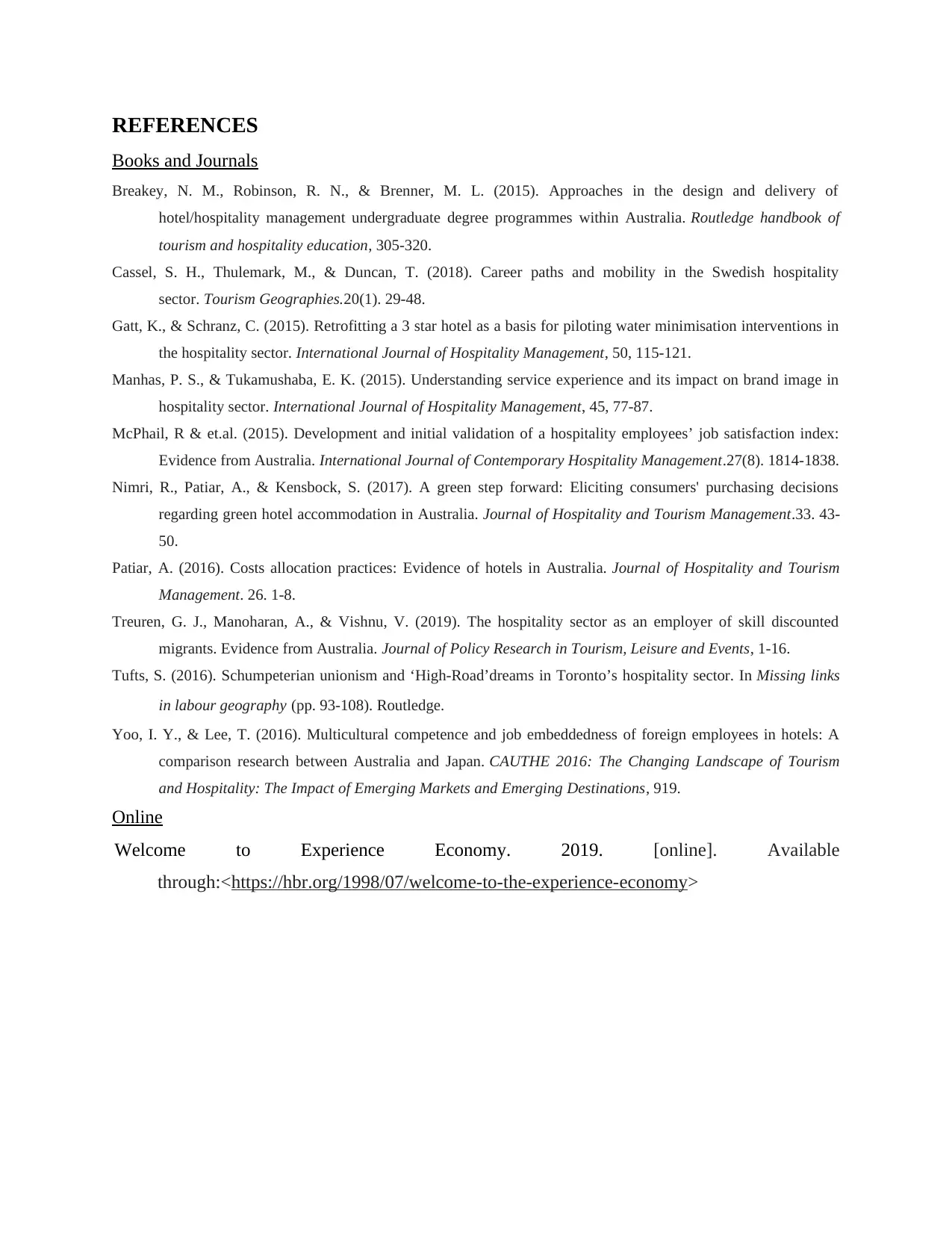
REFERENCES
Books and Journals
Breakey, N. M., Robinson, R. N., & Brenner, M. L. (2015). Approaches in the design and delivery of
hotel/hospitality management undergraduate degree programmes within Australia. Routledge handbook of
tourism and hospitality education, 305-320.
Cassel, S. H., Thulemark, M., & Duncan, T. (2018). Career paths and mobility in the Swedish hospitality
sector. Tourism Geographies.20(1). 29-48.
Gatt, K., & Schranz, C. (2015). Retrofitting a 3 star hotel as a basis for piloting water minimisation interventions in
the hospitality sector. International Journal of Hospitality Management, 50, 115-121.
Manhas, P. S., & Tukamushaba, E. K. (2015). Understanding service experience and its impact on brand image in
hospitality sector. International Journal of Hospitality Management, 45, 77-87.
McPhail, R & et.al. (2015). Development and initial validation of a hospitality employees’ job satisfaction index:
Evidence from Australia. International Journal of Contemporary Hospitality Management.27(8). 1814-1838.
Nimri, R., Patiar, A., & Kensbock, S. (2017). A green step forward: Eliciting consumers' purchasing decisions
regarding green hotel accommodation in Australia. Journal of Hospitality and Tourism Management.33. 43-
50.
Patiar, A. (2016). Costs allocation practices: Evidence of hotels in Australia. Journal of Hospitality and Tourism
Management. 26. 1-8.
Treuren, G. J., Manoharan, A., & Vishnu, V. (2019). The hospitality sector as an employer of skill discounted
migrants. Evidence from Australia. Journal of Policy Research in Tourism, Leisure and Events, 1-16.
Tufts, S. (2016). Schumpeterian unionism and ‘High-Road’dreams in Toronto’s hospitality sector. In Missing links
in labour geography (pp. 93-108). Routledge.
Yoo, I. Y., & Lee, T. (2016). Multicultural competence and job embeddedness of foreign employees in hotels: A
comparison research between Australia and Japan. CAUTHE 2016: The Changing Landscape of Tourism
and Hospitality: The Impact of Emerging Markets and Emerging Destinations, 919.
Online
Welcome to Experience Economy. 2019. [online]. Available
through:<https://hbr.org/1998/07/welcome-to-the-experience-economy>
Books and Journals
Breakey, N. M., Robinson, R. N., & Brenner, M. L. (2015). Approaches in the design and delivery of
hotel/hospitality management undergraduate degree programmes within Australia. Routledge handbook of
tourism and hospitality education, 305-320.
Cassel, S. H., Thulemark, M., & Duncan, T. (2018). Career paths and mobility in the Swedish hospitality
sector. Tourism Geographies.20(1). 29-48.
Gatt, K., & Schranz, C. (2015). Retrofitting a 3 star hotel as a basis for piloting water minimisation interventions in
the hospitality sector. International Journal of Hospitality Management, 50, 115-121.
Manhas, P. S., & Tukamushaba, E. K. (2015). Understanding service experience and its impact on brand image in
hospitality sector. International Journal of Hospitality Management, 45, 77-87.
McPhail, R & et.al. (2015). Development and initial validation of a hospitality employees’ job satisfaction index:
Evidence from Australia. International Journal of Contemporary Hospitality Management.27(8). 1814-1838.
Nimri, R., Patiar, A., & Kensbock, S. (2017). A green step forward: Eliciting consumers' purchasing decisions
regarding green hotel accommodation in Australia. Journal of Hospitality and Tourism Management.33. 43-
50.
Patiar, A. (2016). Costs allocation practices: Evidence of hotels in Australia. Journal of Hospitality and Tourism
Management. 26. 1-8.
Treuren, G. J., Manoharan, A., & Vishnu, V. (2019). The hospitality sector as an employer of skill discounted
migrants. Evidence from Australia. Journal of Policy Research in Tourism, Leisure and Events, 1-16.
Tufts, S. (2016). Schumpeterian unionism and ‘High-Road’dreams in Toronto’s hospitality sector. In Missing links
in labour geography (pp. 93-108). Routledge.
Yoo, I. Y., & Lee, T. (2016). Multicultural competence and job embeddedness of foreign employees in hotels: A
comparison research between Australia and Japan. CAUTHE 2016: The Changing Landscape of Tourism
and Hospitality: The Impact of Emerging Markets and Emerging Destinations, 919.
Online
Welcome to Experience Economy. 2019. [online]. Available
through:<https://hbr.org/1998/07/welcome-to-the-experience-economy>
⊘ This is a preview!⊘
Do you want full access?
Subscribe today to unlock all pages.
Trusted by 1+ million students worldwide

1 out of 9


Related Documents


Your All-in-One AI-Powered Toolkit for Academic Success.
+13062052269
info@desklib.com
Available 24*7 on WhatsApp / Email
![[object Object]](/_next/static/media/star-bottom.7253800d.svg)
Unlock your academic potential
Copyright © 2020–2026 A2Z Services. All Rights Reserved. Developed and managed by ZUCOL.