Dubai Hotel Handbook: A Guide to Serving European Guests Well
VerifiedAdded on 2023/06/16
|10
|1801
|77
Report
AI Summary
This hotel handbook aims to equip hotel staff in Dubai with the necessary knowledge and skills to provide excellent service to European guests. It highlights key cultural differences between European and UAE cultures, focusing on aspects such as time consciousness, greetings, communication styles, personal space, dress code, and food and beverage preferences. The handbook offers practical do's and don'ts for staff interactions, emphasizing the importance of addressing guests formally, respecting privacy, and avoiding assumptions about familiarity with local customs. It also recommends staff training on cultural sensitivity and the creation of a guest cultural guide. By following the guidelines, hotel staff can ensure a comfortable and pleasant stay for European guests, enhancing their overall experience in Dubai.
1
Hotel Handbook Report
Name
Institution
Course
Professor
Date
Hotel Handbook Report
Name
Institution
Course
Professor
Date

Paraphrase This Document
Need a fresh take? Get an instant paraphrase of this document with our AI Paraphraser
2
Hotel Handbook Report
Executive Summary
The purpose of this hotel handbook is to ensure that all European hotel guests in
Dubai receive the best possible service during their stay. The hotel staff can do a better job of
making guests feel at ease and protecting them from harm if they are aware of and able to
adapt to the cultural norms and social mores of Dubai. Included in this guidebook are
important cultural distinctions, etiquette guidelines, and other nuggets of information that
staff members engaging with European guests should be aware of. Each guest will have a
pleasant stay at the hotel if the staff follows the guidelines outlined in the manual. Staff
members at the hotel should use the manual as a reference for correct etiquette, behavior, and
service, keeping in mind that guests from different cultures would expect different things.
Hotel Handbook Report
Executive Summary
The purpose of this hotel handbook is to ensure that all European hotel guests in
Dubai receive the best possible service during their stay. The hotel staff can do a better job of
making guests feel at ease and protecting them from harm if they are aware of and able to
adapt to the cultural norms and social mores of Dubai. Included in this guidebook are
important cultural distinctions, etiquette guidelines, and other nuggets of information that
staff members engaging with European guests should be aware of. Each guest will have a
pleasant stay at the hotel if the staff follows the guidelines outlined in the manual. Staff
members at the hotel should use the manual as a reference for correct etiquette, behavior, and
service, keeping in mind that guests from different cultures would expect different things.
3
Contents
Introduction..............................................................................................................................4
European Culture.................................................................................................................4
Key Differences and Customs.............................................................................................5
Do's and Don'ts.....................................................................................................................7
Recommendations for Staff.................................................................................................7
Conclusion.............................................................................................................................8
References.................................................................................................................................9
Contents
Introduction..............................................................................................................................4
European Culture.................................................................................................................4
Key Differences and Customs.............................................................................................5
Do's and Don'ts.....................................................................................................................7
Recommendations for Staff.................................................................................................7
Conclusion.............................................................................................................................8
References.................................................................................................................................9
⊘ This is a preview!⊘
Do you want full access?
Subscribe today to unlock all pages.

Trusted by 1+ million students worldwide
4
Introduction
Dubai attracts international visitors. So, Dubai's hotel business must serve a diverse
population. The Dubai Department of Tourism and Commerce Marketing has published a
hospitality handbook to help hotel staff make tourists feel welcome (García-Hernández et al.,
2017, pg 4). Dubai hotels must serve everyone, especially Europeans. To make guests' stays
comfortable, hotel staff must understand the differences between European and UAE cultures
(Luka, 2021, pg 506).This manual handbook aims to equip your personnel with the
information they need to succeed in these roles.
European Culture
Europe's diverse cultures coexist peacefully. European culture can be generalized.
Europeans enjoy literature and the arts, equality and human rights, education, and cultural
diversity (Adie, Falk & Savioli, 2020, pg 1739). Europeans value their privacy and are shy.
They also emphasize timeliness and business etiquette (Sesana et al., 2021, pg 701).
Europeans appreciate their ancestors, culture, and history by preserving historical
monuments, locations, and architecture. Europeans may speak more plainly and avoid
euphemisms.
Key Differences and Customs
Hotel workers must understand a few cultural norms when serving European
customers. Europeans may be less likely to chat to strangers (Boboc et al., 2019, pg 1168).
Europeans may also speak less obliquely. Europeans also prioritize work over friendship.
They may also prefer that you call them by their formal titles, such as Mr. or Ms. Europeans
may be more punctual and have higher standards for others' timeliness (Jelinčić & Tišma,
2020, 80). Cultural differences can cause misunderstandings and communication difficulties
if people aren't aware of them. Finally, Europeans may use different utensils and eat at
Introduction
Dubai attracts international visitors. So, Dubai's hotel business must serve a diverse
population. The Dubai Department of Tourism and Commerce Marketing has published a
hospitality handbook to help hotel staff make tourists feel welcome (García-Hernández et al.,
2017, pg 4). Dubai hotels must serve everyone, especially Europeans. To make guests' stays
comfortable, hotel staff must understand the differences between European and UAE cultures
(Luka, 2021, pg 506).This manual handbook aims to equip your personnel with the
information they need to succeed in these roles.
European Culture
Europe's diverse cultures coexist peacefully. European culture can be generalized.
Europeans enjoy literature and the arts, equality and human rights, education, and cultural
diversity (Adie, Falk & Savioli, 2020, pg 1739). Europeans value their privacy and are shy.
They also emphasize timeliness and business etiquette (Sesana et al., 2021, pg 701).
Europeans appreciate their ancestors, culture, and history by preserving historical
monuments, locations, and architecture. Europeans may speak more plainly and avoid
euphemisms.
Key Differences and Customs
Hotel workers must understand a few cultural norms when serving European
customers. Europeans may be less likely to chat to strangers (Boboc et al., 2019, pg 1168).
Europeans may also speak less obliquely. Europeans also prioritize work over friendship.
They may also prefer that you call them by their formal titles, such as Mr. or Ms. Europeans
may be more punctual and have higher standards for others' timeliness (Jelinčić & Tišma,
2020, 80). Cultural differences can cause misunderstandings and communication difficulties
if people aren't aware of them. Finally, Europeans may use different utensils and eat at
Paraphrase This Document
Need a fresh take? Get an instant paraphrase of this document with our AI Paraphraser
5
different times than Americans.The following are some of the differences that hotel staff
should be aware of:
1. Time-consciousness: Europeans appreciate promptness and demand it from others. On
the other hand, people in Dubai might stick to their schedules more than they would in
other places (De Luca et al., 2021, pg 3929). For this reason, hotel employees must be
aware of the many time consciousness norms their guests may bring from their home
countries.
2. Greetings: The European Union is home to various welcome customs, the most
frequent of which is the handshake, while in some nations, like France, a cheek kiss is
more common. Common greetings in Dubai include "As-salaam alaykum" (peace be
upon you). Also, as different cultures have different expectations, hotel workers must
be sensitive to welcoming traditions from those nations.
3. Communication: Europeans admire openness of speech and tend to speak in sentences
of no more than a few dozen words. As a counterpoint, Dubai is a city where
ambiguity and subtly are highly prized; therefore, its residents often choose to avoid
confrontation (Boniotti, 2023, pg 5). Hotel employees should be aware of when it is
suitable to utilize direct and unambiguous communication and when it may be more
useful to adopt more subtle and indirect ways of communication to satisfy the
expectations of both cultures best.
4. Personal Space: Europeans maintain a comfortable distance from one another when
speaking. The residents of Dubai are known for their proximity to one another and
their penchant for making physical touch (Parrinello et al., 2019, pg 3). Hotel
employees who want success should know when to stand close and make physical
contact and when it might be better to preserve a greater physical space.
5. Dress Code:
different times than Americans.The following are some of the differences that hotel staff
should be aware of:
1. Time-consciousness: Europeans appreciate promptness and demand it from others. On
the other hand, people in Dubai might stick to their schedules more than they would in
other places (De Luca et al., 2021, pg 3929). For this reason, hotel employees must be
aware of the many time consciousness norms their guests may bring from their home
countries.
2. Greetings: The European Union is home to various welcome customs, the most
frequent of which is the handshake, while in some nations, like France, a cheek kiss is
more common. Common greetings in Dubai include "As-salaam alaykum" (peace be
upon you). Also, as different cultures have different expectations, hotel workers must
be sensitive to welcoming traditions from those nations.
3. Communication: Europeans admire openness of speech and tend to speak in sentences
of no more than a few dozen words. As a counterpoint, Dubai is a city where
ambiguity and subtly are highly prized; therefore, its residents often choose to avoid
confrontation (Boniotti, 2023, pg 5). Hotel employees should be aware of when it is
suitable to utilize direct and unambiguous communication and when it may be more
useful to adopt more subtle and indirect ways of communication to satisfy the
expectations of both cultures best.
4. Personal Space: Europeans maintain a comfortable distance from one another when
speaking. The residents of Dubai are known for their proximity to one another and
their penchant for making physical touch (Parrinello et al., 2019, pg 3). Hotel
employees who want success should know when to stand close and make physical
contact and when it might be better to preserve a greater physical space.
5. Dress Code:
6
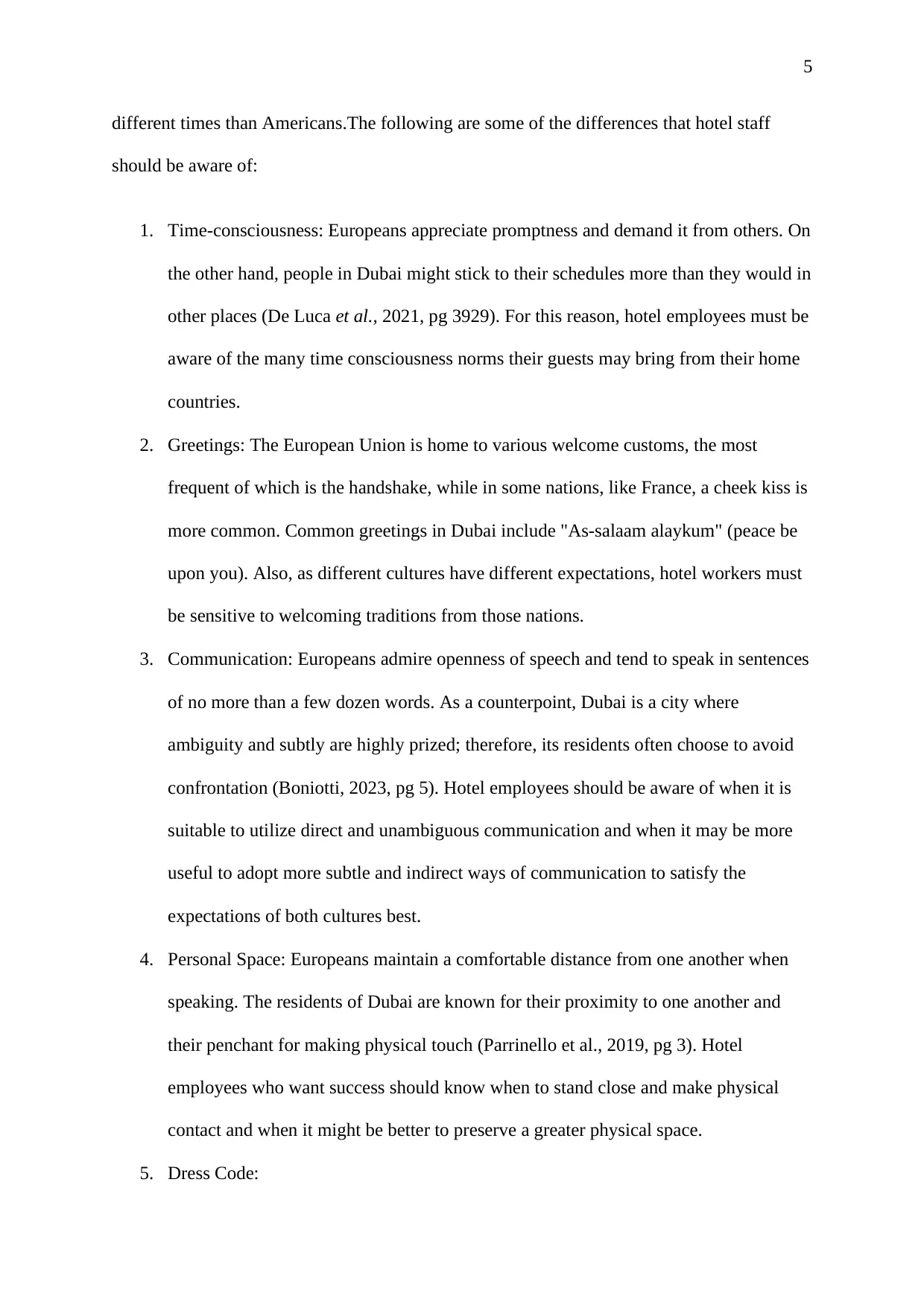
Photograp 1: What to wear in Dubai- The Dubai Dress Code. Retrieved from;
https://www.tantalisemytastebuds.com/what-to-wear-in-dubai-dress-code/
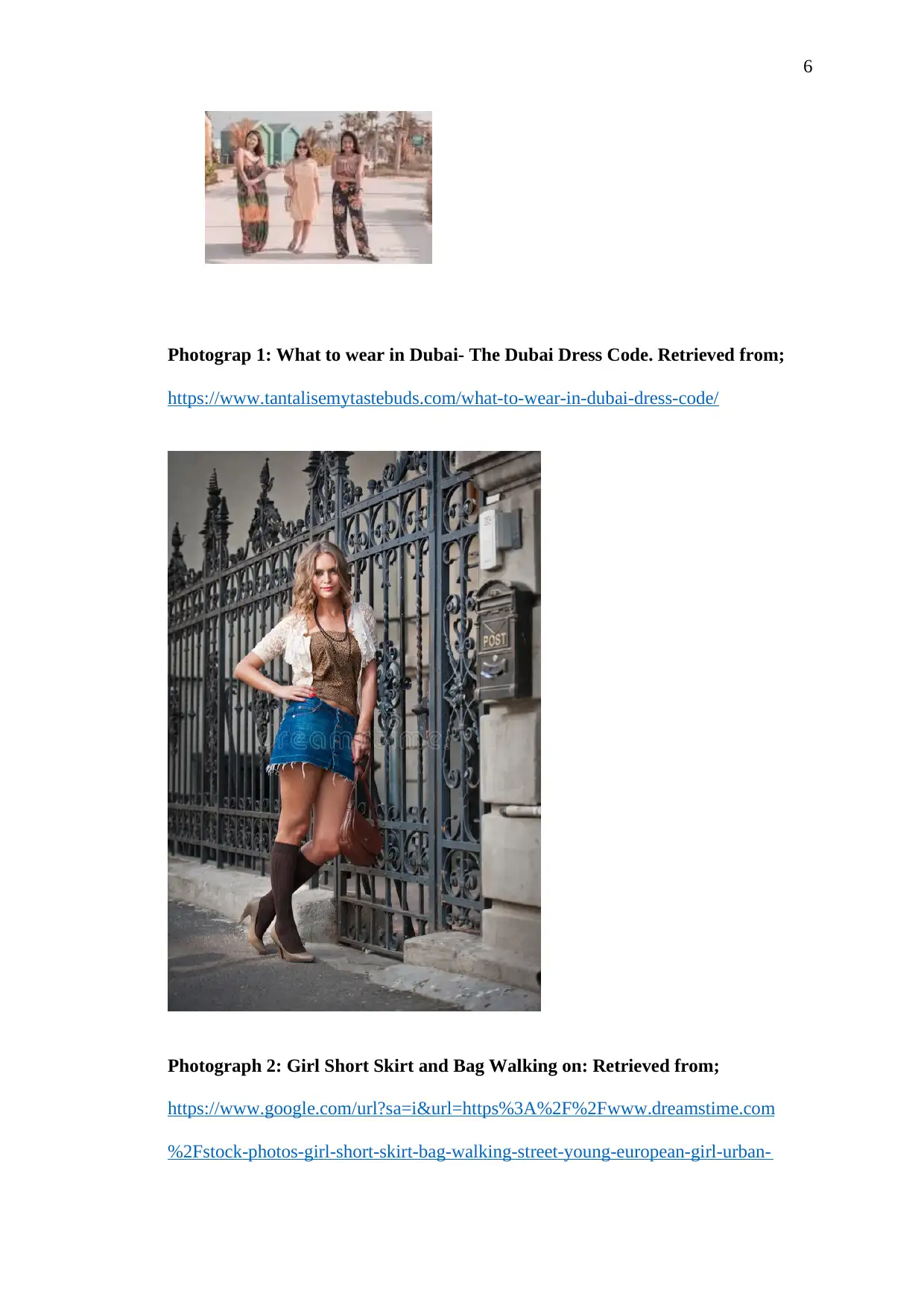
Photograph 2: Girl Short Skirt and Bag Walking on: Retrieved from;
https://www.google.com/url?sa=i&url=https%3A%2F%2Fwww.dreamstime.com
%2Fstock-photos-girl-short-skirt-bag-walking-street-young-european-girl-urban-
Photograp 1: What to wear in Dubai- The Dubai Dress Code. Retrieved from;
https://www.tantalisemytastebuds.com/what-to-wear-in-dubai-dress-code/
Photograph 2: Girl Short Skirt and Bag Walking on: Retrieved from;
https://www.google.com/url?sa=i&url=https%3A%2F%2Fwww.dreamstime.com
%2Fstock-photos-girl-short-skirt-bag-walking-street-young-european-girl-urban-
⊘ This is a preview!⊘
Do you want full access?
Subscribe today to unlock all pages.
Trusted by 1+ million students worldwide
7
setting-sexy-woman-dressed-provocatively-posing-
image30415193&psig=AOvVaw1r-
sbAvC0TX41GIFKqFHQJ&ust=1677569779455000&source=images&cd=vfe&ved=
0CBAQjhxqFwoTCMiW4ceYtf0CFQAAAAAdAAAAABAE
Photograph 1 and 2 are illustrations of Dubai’s dresscode and Europe’s dress code
respectively. Tourists, especially ladies, must respect Dubai's dress code, especially in
public. This differs from European clothing freedom. Europeans dress less modestly
than Middle Easterners. Dubai employers should remind European visitors to dress
conservatively. Because guests may need to be more familiar with local norms than
their own, hotel personnel must educate them on local etiquette.
6. Food and Beverage: Europeans have diverse eating tastes, thus they may need to
adjust to Dubai's cuisine. Offering options that suit their tastes and dietary limitations
is essential. Europe drinks more than Dubai, which is dry. Employees must notify
customers that the legal drinking age in the US is 21 and where alcohol is allowed
(Della Spina, 2020, pg 1368). To ensure a good visit, staff must know Dubai's
drinking laws.
Do's and Don'ts
To provide the best possible service to European guests, hotel staff should follow these Do's
and Don'ts;
1. Do address guests by their formal titles, such as Mr. or Ms.
2. Do be punctual for appointments and meetings.
3. Do be respectful of personal space and privacy.
4. Do be prepared to engage in formal etiquette in business settings.
setting-sexy-woman-dressed-provocatively-posing-
image30415193&psig=AOvVaw1r-
sbAvC0TX41GIFKqFHQJ&ust=1677569779455000&source=images&cd=vfe&ved=
0CBAQjhxqFwoTCMiW4ceYtf0CFQAAAAAdAAAAABAE
Photograph 1 and 2 are illustrations of Dubai’s dresscode and Europe’s dress code
respectively. Tourists, especially ladies, must respect Dubai's dress code, especially in
public. This differs from European clothing freedom. Europeans dress less modestly
than Middle Easterners. Dubai employers should remind European visitors to dress
conservatively. Because guests may need to be more familiar with local norms than
their own, hotel personnel must educate them on local etiquette.
6. Food and Beverage: Europeans have diverse eating tastes, thus they may need to
adjust to Dubai's cuisine. Offering options that suit their tastes and dietary limitations
is essential. Europe drinks more than Dubai, which is dry. Employees must notify
customers that the legal drinking age in the US is 21 and where alcohol is allowed
(Della Spina, 2020, pg 1368). To ensure a good visit, staff must know Dubai's
drinking laws.
Do's and Don'ts
To provide the best possible service to European guests, hotel staff should follow these Do's
and Don'ts;
1. Do address guests by their formal titles, such as Mr. or Ms.
2. Do be punctual for appointments and meetings.
3. Do be respectful of personal space and privacy.
4. Do be prepared to engage in formal etiquette in business settings.
Paraphrase This Document
Need a fresh take? Get an instant paraphrase of this document with our AI Paraphraser
8
5. Only engage in casual conversation if invited to do so.
6. Refrain from assuming that guests are familiar with local customs or practices.
7. Be familiar with guests and use informal language.
8. Be on time for appointments or meetings.
9. Refrain from assuming that all Europeans have the same customs or culture.
Recommendations for Staff
1. Provide staff training on cultural differences and customs to ensure that all staff
knows how to interact with European guests.
2. Create a cultural guide for guests that includes information on local customs and
practices and recommendations for local attractions and activities.
Conclusion
Europeans have a wide variety of tastes when it comes to food, and they might need
to be more accustomed to the dishes commonly served in Dubai. It's crucial to provide
options that suit their tastes and dietary restrictions. In contrast to Dubai's dry policy, where
few people drink, alcohol consumption is high across Europe. The legal drinking age in the
United States is 21, and employees must inform customers of this fact and of any areas where
alcohol use is permitted. Staff members must be educated on Dubai's alcohol rules to
guarantee their customers a pleasant stay.
5. Only engage in casual conversation if invited to do so.
6. Refrain from assuming that guests are familiar with local customs or practices.
7. Be familiar with guests and use informal language.
8. Be on time for appointments or meetings.
9. Refrain from assuming that all Europeans have the same customs or culture.
Recommendations for Staff
1. Provide staff training on cultural differences and customs to ensure that all staff
knows how to interact with European guests.
2. Create a cultural guide for guests that includes information on local customs and
practices and recommendations for local attractions and activities.
Conclusion
Europeans have a wide variety of tastes when it comes to food, and they might need
to be more accustomed to the dishes commonly served in Dubai. It's crucial to provide
options that suit their tastes and dietary restrictions. In contrast to Dubai's dry policy, where
few people drink, alcohol consumption is high across Europe. The legal drinking age in the
United States is 21, and employees must inform customers of this fact and of any areas where
alcohol use is permitted. Staff members must be educated on Dubai's alcohol rules to
guarantee their customers a pleasant stay.
9
References
Adie, B.A., Falk, M. and Savioli, M., 2020. Overtourism as a perceived threat to cultural
heritage in Europe. Current Issues in Tourism, 23(14), pp.1737-1741.
Boboc, R.G., Duguleană, M., Voinea, G.D., Postelnicu, C.C., Popovici, D.M. and Carrozzino,
M., 2019. Mobile augmented reality for cultural heritage: Following the footsteps of
Ovid among different locations in Europe. Sustainability, 11(4), p.1167.
Boniotti, C., 2023. The public–private–people partnership (P4) for cultural heritage
management purposes. Journal of Cultural Heritage Management and Sustainable
Development, 13(1), pp.1-14.
De Luca, G., Shirvani Dastgerdi, A., Francini, C. and Liberatore, G., 2020. Sustainable
cultural heritage planning and management of over-tourism in art cities: Lessons from
atlas world heritage. Sustainability, 12(9), p.3929.
Della Spina, L., 2020. Adaptive sustainable reuse for cultural heritage: A multiple criteria
decision aiding approach supporting urban development
processes. Sustainability, 12(4), p.1363.
García-Hernández, M., De la Calle-Vaquero, M. and Yubero, C., 2017. Cultural heritage and
urban tourism: Historic city centres under pressure. Sustainability, 9(8), p.1346.
Jelinčić, D.A. and Tišma, S., 2020. Ensuring sustainability of cultural heritage through
effective public policies. Urbani Izziv, 31(2), pp.78-87.
Luka, I., 2021. EUROPEAN CULTURAL HERITAGE AND SKILLS DEVELOPMENT
COURSE FOR ADULT LEARNERS’SELF-DEVELOPMENT. The Journal of
Education, Culture, and Society, 12(2), pp.505-526.
Parrinello, S., Picchio, F., De Marco, R. and Dell'Amico, A., 2019. Documenting The
Cultural Heritage Routes. The Creation of Informative Models of Historical Russian
References
Adie, B.A., Falk, M. and Savioli, M., 2020. Overtourism as a perceived threat to cultural
heritage in Europe. Current Issues in Tourism, 23(14), pp.1737-1741.
Boboc, R.G., Duguleană, M., Voinea, G.D., Postelnicu, C.C., Popovici, D.M. and Carrozzino,
M., 2019. Mobile augmented reality for cultural heritage: Following the footsteps of
Ovid among different locations in Europe. Sustainability, 11(4), p.1167.
Boniotti, C., 2023. The public–private–people partnership (P4) for cultural heritage
management purposes. Journal of Cultural Heritage Management and Sustainable
Development, 13(1), pp.1-14.
De Luca, G., Shirvani Dastgerdi, A., Francini, C. and Liberatore, G., 2020. Sustainable
cultural heritage planning and management of over-tourism in art cities: Lessons from
atlas world heritage. Sustainability, 12(9), p.3929.
Della Spina, L., 2020. Adaptive sustainable reuse for cultural heritage: A multiple criteria
decision aiding approach supporting urban development
processes. Sustainability, 12(4), p.1363.
García-Hernández, M., De la Calle-Vaquero, M. and Yubero, C., 2017. Cultural heritage and
urban tourism: Historic city centres under pressure. Sustainability, 9(8), p.1346.
Jelinčić, D.A. and Tišma, S., 2020. Ensuring sustainability of cultural heritage through
effective public policies. Urbani Izziv, 31(2), pp.78-87.
Luka, I., 2021. EUROPEAN CULTURAL HERITAGE AND SKILLS DEVELOPMENT
COURSE FOR ADULT LEARNERS’SELF-DEVELOPMENT. The Journal of
Education, Culture, and Society, 12(2), pp.505-526.
Parrinello, S., Picchio, F., De Marco, R. and Dell'Amico, A., 2019. Documenting The
Cultural Heritage Routes. The Creation of Informative Models of Historical Russian
⊘ This is a preview!⊘
Do you want full access?
Subscribe today to unlock all pages.
Trusted by 1+ million students worldwide
10
Churches On Upper Kama Region. International Archives of the Photogrammetry,
Remote Sensing & Spatial Information Sciences.
Sesana, E., Gagnon, A.S., Ciantelli, C., Cassar, J. and Hughes, J.J., 2021. Climate change
impacts on cultural heritage: A literature review. Wiley Interdisciplinary Reviews:
Climate Change, 12(4), p.e710.
Churches On Upper Kama Region. International Archives of the Photogrammetry,
Remote Sensing & Spatial Information Sciences.
Sesana, E., Gagnon, A.S., Ciantelli, C., Cassar, J. and Hughes, J.J., 2021. Climate change
impacts on cultural heritage: A literature review. Wiley Interdisciplinary Reviews:
Climate Change, 12(4), p.e710.

1 out of 10


Your All-in-One AI-Powered Toolkit for Academic Success.
+13062052269
info@desklib.com
Available 24*7 on WhatsApp / Email
![[object Object]](/_next/static/media/star-bottom.7253800d.svg)
Unlock your academic potential
Copyright © 2020–2026 A2Z Services. All Rights Reserved. Developed and managed by ZUCOL.