Comparative Analysis: Hotel Industry in Australia and China
VerifiedAdded on 2020/05/11
|6
|1730
|92
Report
AI Summary
This report presents an analysis of the hotel industries in Australia and China, based on an interview with John Hills, a professional with over ten years of experience in the hotel sector across both countries. The report compares the two countries across key aspects including human resource management, customer service, ethical practices, and the impact of political and economic factors. The analysis reveals significant differences in employment standards, occupational health and safety, and human rights between Australia and China, with Australia demonstrating higher standards. Customer service also differs, with China noted for its focus on domestic tourism. The report further explores ethical considerations, highlighting Australia's regulatory framework compared to China's issues with bribery and honesty. Political and economic influences are also assessed, showing how favorable diplomatic relations and economic growth in China have impacted the hotel industry differently in each country. The report concludes with lessons learned from the interview, emphasizing the importance of understanding the political, economic, and social environments that shape the success of the hotel industry, as well as the significance of human resource management, ethics, and customer relations. The report includes a list of questions asked during the interview and references used.
UNIVERSITY NAME
Student’s name
Student’s ID
Interview report
Student’s name
Student’s ID
Interview report
Paraphrase This Document
Need a fresh take? Get an instant paraphrase of this document with our AI Paraphraser

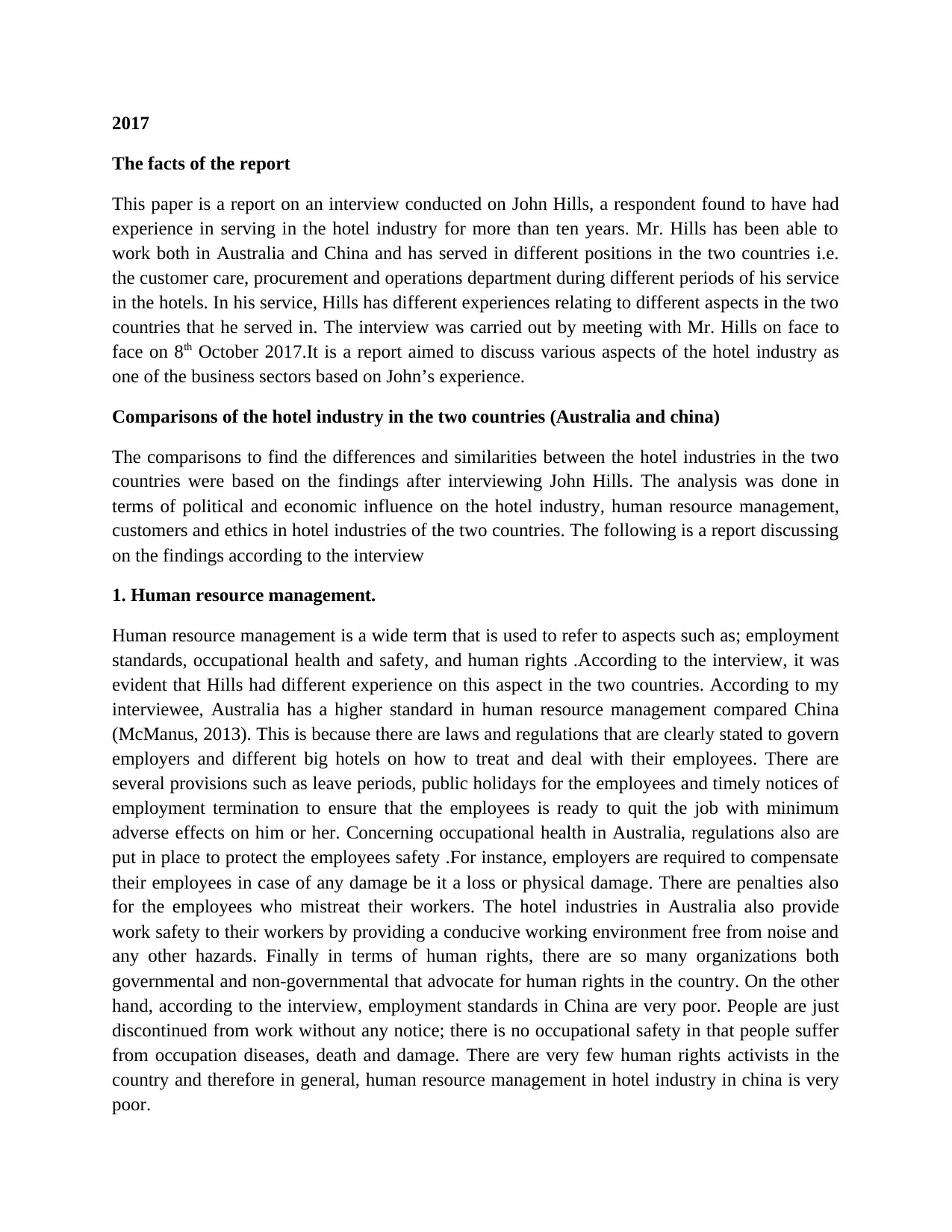
2017
The facts of the report
This paper is a report on an interview conducted on John Hills, a respondent found to have had
experience in serving in the hotel industry for more than ten years. Mr. Hills has been able to
work both in Australia and China and has served in different positions in the two countries i.e.
the customer care, procurement and operations department during different periods of his service
in the hotels. In his service, Hills has different experiences relating to different aspects in the two
countries that he served in. The interview was carried out by meeting with Mr. Hills on face to
face on 8th October 2017.It is a report aimed to discuss various aspects of the hotel industry as
one of the business sectors based on John’s experience.
Comparisons of the hotel industry in the two countries (Australia and china)
The comparisons to find the differences and similarities between the hotel industries in the two
countries were based on the findings after interviewing John Hills. The analysis was done in
terms of political and economic influence on the hotel industry, human resource management,
customers and ethics in hotel industries of the two countries. The following is a report discussing
on the findings according to the interview
1. Human resource management.
Human resource management is a wide term that is used to refer to aspects such as; employment
standards, occupational health and safety, and human rights .According to the interview, it was
evident that Hills had different experience on this aspect in the two countries. According to my
interviewee, Australia has a higher standard in human resource management compared China
(McManus, 2013). This is because there are laws and regulations that are clearly stated to govern
employers and different big hotels on how to treat and deal with their employees. There are
several provisions such as leave periods, public holidays for the employees and timely notices of
employment termination to ensure that the employees is ready to quit the job with minimum
adverse effects on him or her. Concerning occupational health in Australia, regulations also are
put in place to protect the employees safety .For instance, employers are required to compensate
their employees in case of any damage be it a loss or physical damage. There are penalties also
for the employees who mistreat their workers. The hotel industries in Australia also provide
work safety to their workers by providing a conducive working environment free from noise and
any other hazards. Finally in terms of human rights, there are so many organizations both
governmental and non-governmental that advocate for human rights in the country. On the other
hand, according to the interview, employment standards in China are very poor. People are just
discontinued from work without any notice; there is no occupational safety in that people suffer
from occupation diseases, death and damage. There are very few human rights activists in the
country and therefore in general, human resource management in hotel industry in china is very
poor.
The facts of the report
This paper is a report on an interview conducted on John Hills, a respondent found to have had
experience in serving in the hotel industry for more than ten years. Mr. Hills has been able to
work both in Australia and China and has served in different positions in the two countries i.e.
the customer care, procurement and operations department during different periods of his service
in the hotels. In his service, Hills has different experiences relating to different aspects in the two
countries that he served in. The interview was carried out by meeting with Mr. Hills on face to
face on 8th October 2017.It is a report aimed to discuss various aspects of the hotel industry as
one of the business sectors based on John’s experience.
Comparisons of the hotel industry in the two countries (Australia and china)
The comparisons to find the differences and similarities between the hotel industries in the two
countries were based on the findings after interviewing John Hills. The analysis was done in
terms of political and economic influence on the hotel industry, human resource management,
customers and ethics in hotel industries of the two countries. The following is a report discussing
on the findings according to the interview
1. Human resource management.
Human resource management is a wide term that is used to refer to aspects such as; employment
standards, occupational health and safety, and human rights .According to the interview, it was
evident that Hills had different experience on this aspect in the two countries. According to my
interviewee, Australia has a higher standard in human resource management compared China
(McManus, 2013). This is because there are laws and regulations that are clearly stated to govern
employers and different big hotels on how to treat and deal with their employees. There are
several provisions such as leave periods, public holidays for the employees and timely notices of
employment termination to ensure that the employees is ready to quit the job with minimum
adverse effects on him or her. Concerning occupational health in Australia, regulations also are
put in place to protect the employees safety .For instance, employers are required to compensate
their employees in case of any damage be it a loss or physical damage. There are penalties also
for the employees who mistreat their workers. The hotel industries in Australia also provide
work safety to their workers by providing a conducive working environment free from noise and
any other hazards. Finally in terms of human rights, there are so many organizations both
governmental and non-governmental that advocate for human rights in the country. On the other
hand, according to the interview, employment standards in China are very poor. People are just
discontinued from work without any notice; there is no occupational safety in that people suffer
from occupation diseases, death and damage. There are very few human rights activists in the
country and therefore in general, human resource management in hotel industry in china is very
poor.

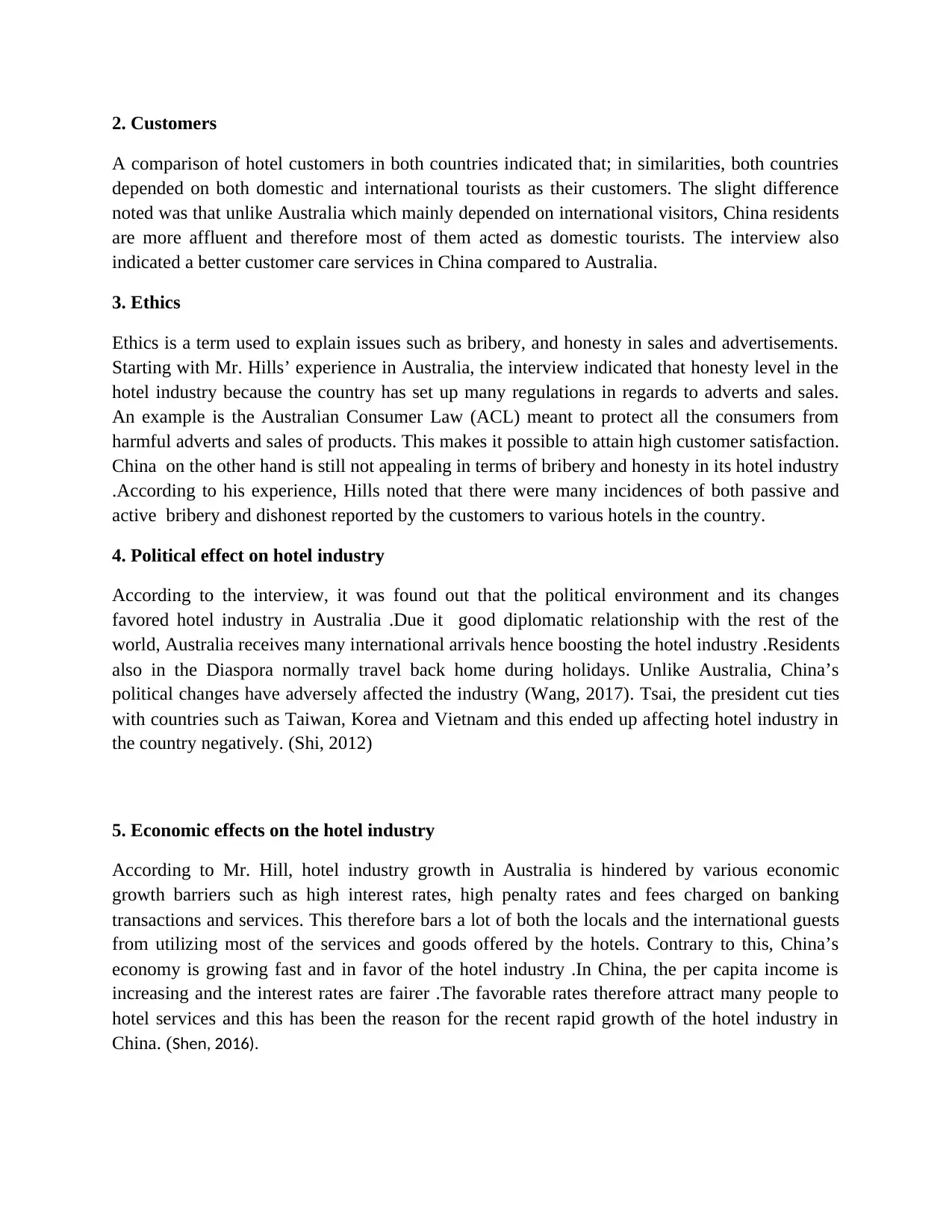
2. Customers
A comparison of hotel customers in both countries indicated that; in similarities, both countries
depended on both domestic and international tourists as their customers. The slight difference
noted was that unlike Australia which mainly depended on international visitors, China residents
are more affluent and therefore most of them acted as domestic tourists. The interview also
indicated a better customer care services in China compared to Australia.
3. Ethics
Ethics is a term used to explain issues such as bribery, and honesty in sales and advertisements.
Starting with Mr. Hills’ experience in Australia, the interview indicated that honesty level in the
hotel industry because the country has set up many regulations in regards to adverts and sales.
An example is the Australian Consumer Law (ACL) meant to protect all the consumers from
harmful adverts and sales of products. This makes it possible to attain high customer satisfaction.
China on the other hand is still not appealing in terms of bribery and honesty in its hotel industry
.According to his experience, Hills noted that there were many incidences of both passive and
active bribery and dishonest reported by the customers to various hotels in the country.
4. Political effect on hotel industry
According to the interview, it was found out that the political environment and its changes
favored hotel industry in Australia .Due it good diplomatic relationship with the rest of the
world, Australia receives many international arrivals hence boosting the hotel industry .Residents
also in the Diaspora normally travel back home during holidays. Unlike Australia, China’s
political changes have adversely affected the industry (Wang, 2017). Tsai, the president cut ties
with countries such as Taiwan, Korea and Vietnam and this ended up affecting hotel industry in
the country negatively. (Shi, 2012)
5. Economic effects on the hotel industry
According to Mr. Hill, hotel industry growth in Australia is hindered by various economic
growth barriers such as high interest rates, high penalty rates and fees charged on banking
transactions and services. This therefore bars a lot of both the locals and the international guests
from utilizing most of the services and goods offered by the hotels. Contrary to this, China’s
economy is growing fast and in favor of the hotel industry .In China, the per capita income is
increasing and the interest rates are fairer .The favorable rates therefore attract many people to
hotel services and this has been the reason for the recent rapid growth of the hotel industry in
China. (Shen, 2016).
A comparison of hotel customers in both countries indicated that; in similarities, both countries
depended on both domestic and international tourists as their customers. The slight difference
noted was that unlike Australia which mainly depended on international visitors, China residents
are more affluent and therefore most of them acted as domestic tourists. The interview also
indicated a better customer care services in China compared to Australia.
3. Ethics
Ethics is a term used to explain issues such as bribery, and honesty in sales and advertisements.
Starting with Mr. Hills’ experience in Australia, the interview indicated that honesty level in the
hotel industry because the country has set up many regulations in regards to adverts and sales.
An example is the Australian Consumer Law (ACL) meant to protect all the consumers from
harmful adverts and sales of products. This makes it possible to attain high customer satisfaction.
China on the other hand is still not appealing in terms of bribery and honesty in its hotel industry
.According to his experience, Hills noted that there were many incidences of both passive and
active bribery and dishonest reported by the customers to various hotels in the country.
4. Political effect on hotel industry
According to the interview, it was found out that the political environment and its changes
favored hotel industry in Australia .Due it good diplomatic relationship with the rest of the
world, Australia receives many international arrivals hence boosting the hotel industry .Residents
also in the Diaspora normally travel back home during holidays. Unlike Australia, China’s
political changes have adversely affected the industry (Wang, 2017). Tsai, the president cut ties
with countries such as Taiwan, Korea and Vietnam and this ended up affecting hotel industry in
the country negatively. (Shi, 2012)
5. Economic effects on the hotel industry
According to Mr. Hill, hotel industry growth in Australia is hindered by various economic
growth barriers such as high interest rates, high penalty rates and fees charged on banking
transactions and services. This therefore bars a lot of both the locals and the international guests
from utilizing most of the services and goods offered by the hotels. Contrary to this, China’s
economy is growing fast and in favor of the hotel industry .In China, the per capita income is
increasing and the interest rates are fairer .The favorable rates therefore attract many people to
hotel services and this has been the reason for the recent rapid growth of the hotel industry in
China. (Shen, 2016).
⊘ This is a preview!⊘
Do you want full access?
Subscribe today to unlock all pages.

Trusted by 1+ million students worldwide

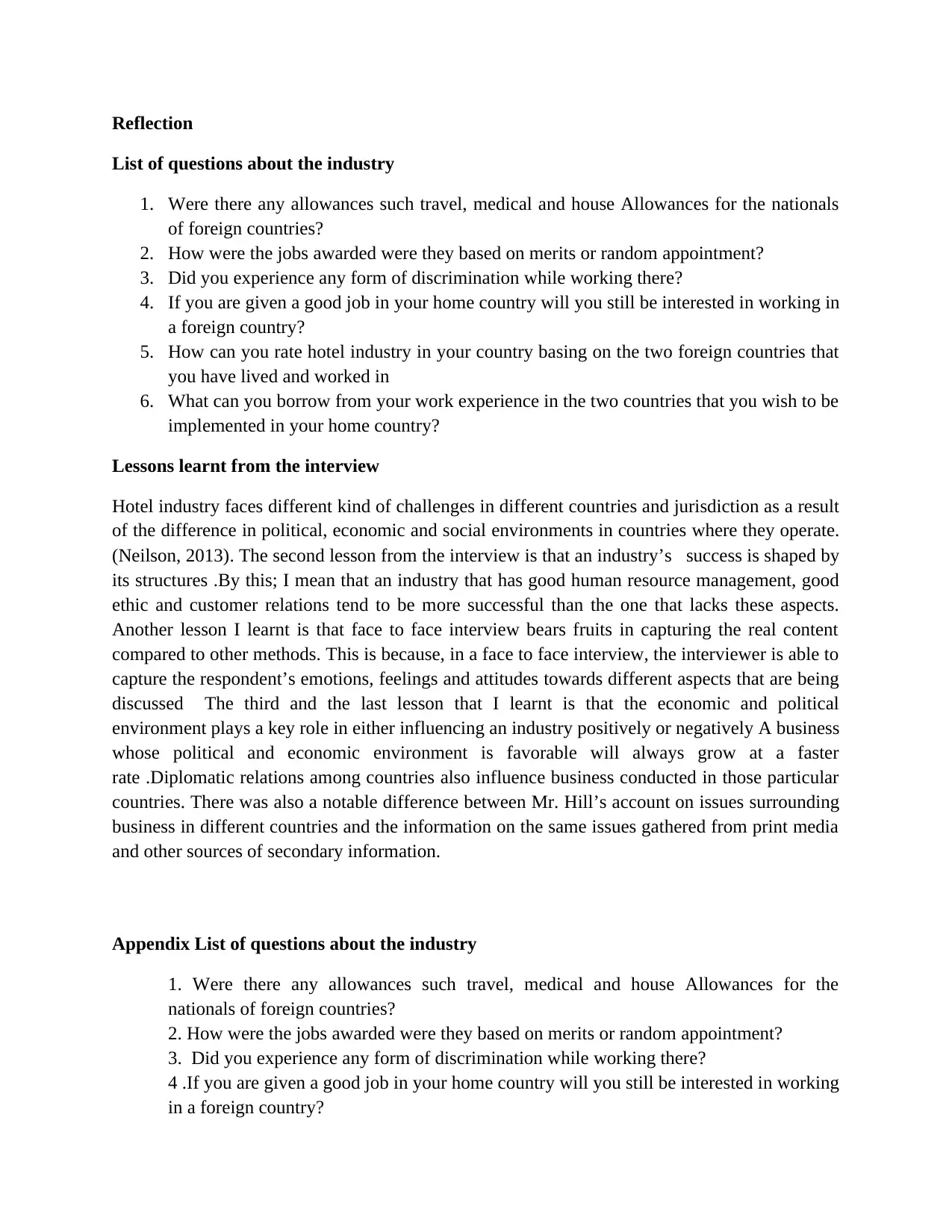
Reflection
List of questions about the industry
1. Were there any allowances such travel, medical and house Allowances for the nationals
of foreign countries?
2. How were the jobs awarded were they based on merits or random appointment?
3. Did you experience any form of discrimination while working there?
4. If you are given a good job in your home country will you still be interested in working in
a foreign country?
5. How can you rate hotel industry in your country basing on the two foreign countries that
you have lived and worked in
6. What can you borrow from your work experience in the two countries that you wish to be
implemented in your home country?
Lessons learnt from the interview
Hotel industry faces different kind of challenges in different countries and jurisdiction as a result
of the difference in political, economic and social environments in countries where they operate.
(Neilson, 2013). The second lesson from the interview is that an industry’s success is shaped by
its structures .By this; I mean that an industry that has good human resource management, good
ethic and customer relations tend to be more successful than the one that lacks these aspects.
Another lesson I learnt is that face to face interview bears fruits in capturing the real content
compared to other methods. This is because, in a face to face interview, the interviewer is able to
capture the respondent’s emotions, feelings and attitudes towards different aspects that are being
discussed The third and the last lesson that I learnt is that the economic and political
environment plays a key role in either influencing an industry positively or negatively A business
whose political and economic environment is favorable will always grow at a faster
rate .Diplomatic relations among countries also influence business conducted in those particular
countries. There was also a notable difference between Mr. Hill’s account on issues surrounding
business in different countries and the information on the same issues gathered from print media
and other sources of secondary information.
Appendix List of questions about the industry
1. Were there any allowances such travel, medical and house Allowances for the
nationals of foreign countries?
2. How were the jobs awarded were they based on merits or random appointment?
3. Did you experience any form of discrimination while working there?
4 .If you are given a good job in your home country will you still be interested in working
in a foreign country?
List of questions about the industry
1. Were there any allowances such travel, medical and house Allowances for the nationals
of foreign countries?
2. How were the jobs awarded were they based on merits or random appointment?
3. Did you experience any form of discrimination while working there?
4. If you are given a good job in your home country will you still be interested in working in
a foreign country?
5. How can you rate hotel industry in your country basing on the two foreign countries that
you have lived and worked in
6. What can you borrow from your work experience in the two countries that you wish to be
implemented in your home country?
Lessons learnt from the interview
Hotel industry faces different kind of challenges in different countries and jurisdiction as a result
of the difference in political, economic and social environments in countries where they operate.
(Neilson, 2013). The second lesson from the interview is that an industry’s success is shaped by
its structures .By this; I mean that an industry that has good human resource management, good
ethic and customer relations tend to be more successful than the one that lacks these aspects.
Another lesson I learnt is that face to face interview bears fruits in capturing the real content
compared to other methods. This is because, in a face to face interview, the interviewer is able to
capture the respondent’s emotions, feelings and attitudes towards different aspects that are being
discussed The third and the last lesson that I learnt is that the economic and political
environment plays a key role in either influencing an industry positively or negatively A business
whose political and economic environment is favorable will always grow at a faster
rate .Diplomatic relations among countries also influence business conducted in those particular
countries. There was also a notable difference between Mr. Hill’s account on issues surrounding
business in different countries and the information on the same issues gathered from print media
and other sources of secondary information.
Appendix List of questions about the industry
1. Were there any allowances such travel, medical and house Allowances for the
nationals of foreign countries?
2. How were the jobs awarded were they based on merits or random appointment?
3. Did you experience any form of discrimination while working there?
4 .If you are given a good job in your home country will you still be interested in working
in a foreign country?
Paraphrase This Document
Need a fresh take? Get an instant paraphrase of this document with our AI Paraphraser

5 .How can you rate hotel industry in your country basing on the two foreign countries
that you have lived and worked in
6. What can you borrow from your work experience in the two countries that you wish
to be implemented in your home country?
that you have lived and worked in
6. What can you borrow from your work experience in the two countries that you wish
to be implemented in your home country?

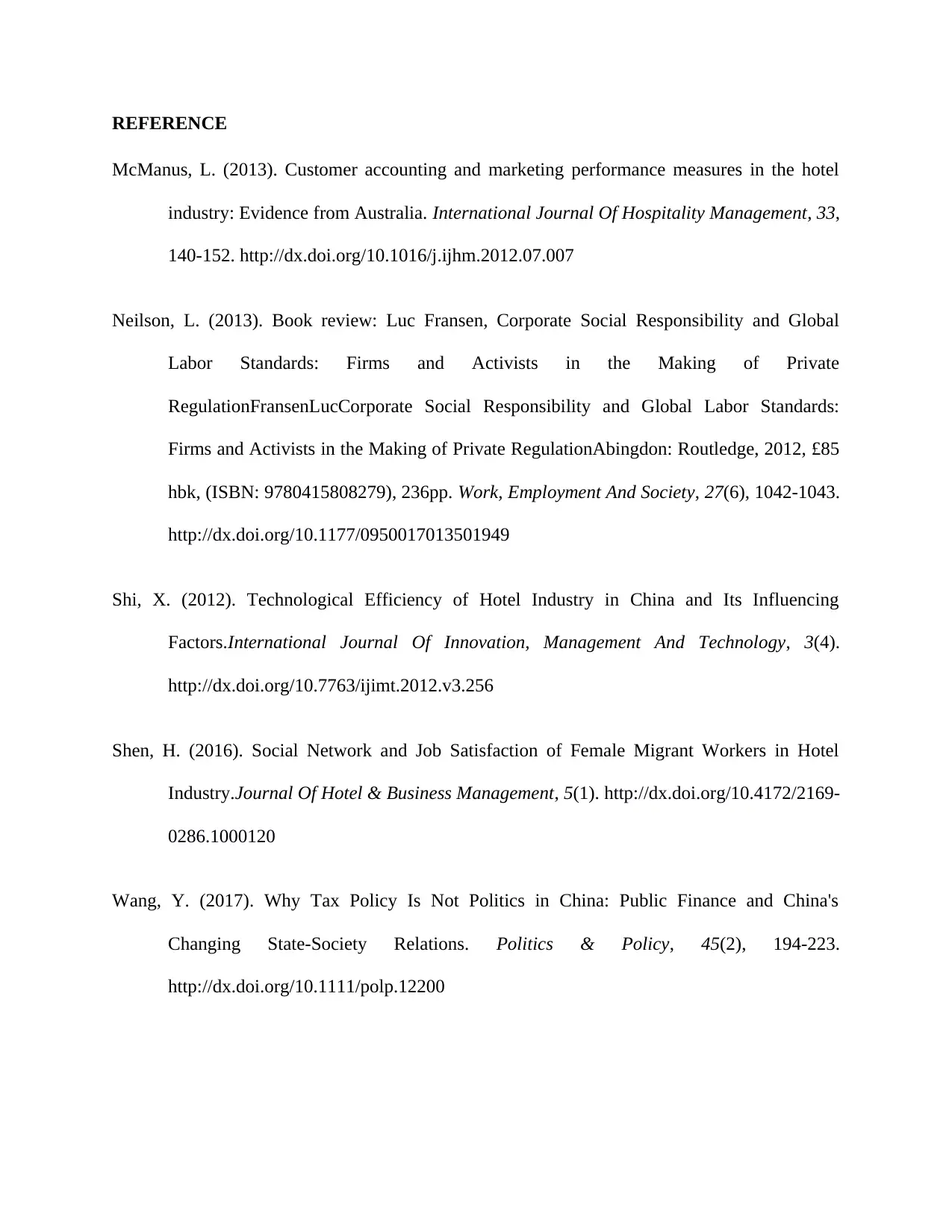
REFERENCE
McManus, L. (2013). Customer accounting and marketing performance measures in the hotel
industry: Evidence from Australia. International Journal Of Hospitality Management, 33,
140-152. http://dx.doi.org/10.1016/j.ijhm.2012.07.007
Neilson, L. (2013). Book review: Luc Fransen, Corporate Social Responsibility and Global
Labor Standards: Firms and Activists in the Making of Private
RegulationFransenLucCorporate Social Responsibility and Global Labor Standards:
Firms and Activists in the Making of Private RegulationAbingdon: Routledge, 2012, £85
hbk, (ISBN: 9780415808279), 236pp. Work, Employment And Society, 27(6), 1042-1043.
http://dx.doi.org/10.1177/0950017013501949
Shi, X. (2012). Technological Efficiency of Hotel Industry in China and Its Influencing
Factors.International Journal Of Innovation, Management And Technology, 3(4).
http://dx.doi.org/10.7763/ijimt.2012.v3.256
Shen, H. (2016). Social Network and Job Satisfaction of Female Migrant Workers in Hotel
Industry.Journal Of Hotel & Business Management, 5(1). http://dx.doi.org/10.4172/2169-
0286.1000120
Wang, Y. (2017). Why Tax Policy Is Not Politics in China: Public Finance and China's
Changing State-Society Relations. Politics & Policy, 45(2), 194-223.
http://dx.doi.org/10.1111/polp.12200
McManus, L. (2013). Customer accounting and marketing performance measures in the hotel
industry: Evidence from Australia. International Journal Of Hospitality Management, 33,
140-152. http://dx.doi.org/10.1016/j.ijhm.2012.07.007
Neilson, L. (2013). Book review: Luc Fransen, Corporate Social Responsibility and Global
Labor Standards: Firms and Activists in the Making of Private
RegulationFransenLucCorporate Social Responsibility and Global Labor Standards:
Firms and Activists in the Making of Private RegulationAbingdon: Routledge, 2012, £85
hbk, (ISBN: 9780415808279), 236pp. Work, Employment And Society, 27(6), 1042-1043.
http://dx.doi.org/10.1177/0950017013501949
Shi, X. (2012). Technological Efficiency of Hotel Industry in China and Its Influencing
Factors.International Journal Of Innovation, Management And Technology, 3(4).
http://dx.doi.org/10.7763/ijimt.2012.v3.256
Shen, H. (2016). Social Network and Job Satisfaction of Female Migrant Workers in Hotel
Industry.Journal Of Hotel & Business Management, 5(1). http://dx.doi.org/10.4172/2169-
0286.1000120
Wang, Y. (2017). Why Tax Policy Is Not Politics in China: Public Finance and China's
Changing State-Society Relations. Politics & Policy, 45(2), 194-223.
http://dx.doi.org/10.1111/polp.12200
⊘ This is a preview!⊘
Do you want full access?
Subscribe today to unlock all pages.

Trusted by 1+ million students worldwide
1 out of 6
Related Documents
Your All-in-One AI-Powered Toolkit for Academic Success.
+13062052269
info@desklib.com
Available 24*7 on WhatsApp / Email
Unlock your academic potential
Copyright © 2020–2026 A2Z Services. All Rights Reserved. Developed and managed by ZUCOL.