Innovation & Entrepreneurship in Hotels
VerifiedAdded on 2019/11/20
|9
|2169
|187
Essay
AI Summary
This essay examines the application of innovation and entrepreneurship in the hotel industry. It begins by establishing the context of a new hotel business, then delves into how innovation and entrepreneurship techniques, such as disruptive and open innovation, can be used to gain a competitive edge. The essay highlights the interconnectedness of innovation and entrepreneurship, emphasizing their crucial role in achieving strategic goals, optimizing resource utilization, and enhancing customer satisfaction within a competitive market. Different levels of innovation (revolution, renewal, resilience) are discussed, along with the importance of understanding customer preferences and market conditions. The essay concludes by stressing the necessity of innovative and entrepreneurial practices for new hotel companies to achieve market success and build a strong brand reputation.

Running Head: Management and Business context
Management and Business context
Management and Business context

Paraphrase This Document
Need a fresh take? Get an instant paraphrase of this document with our AI Paraphraser
Management and Business context 1
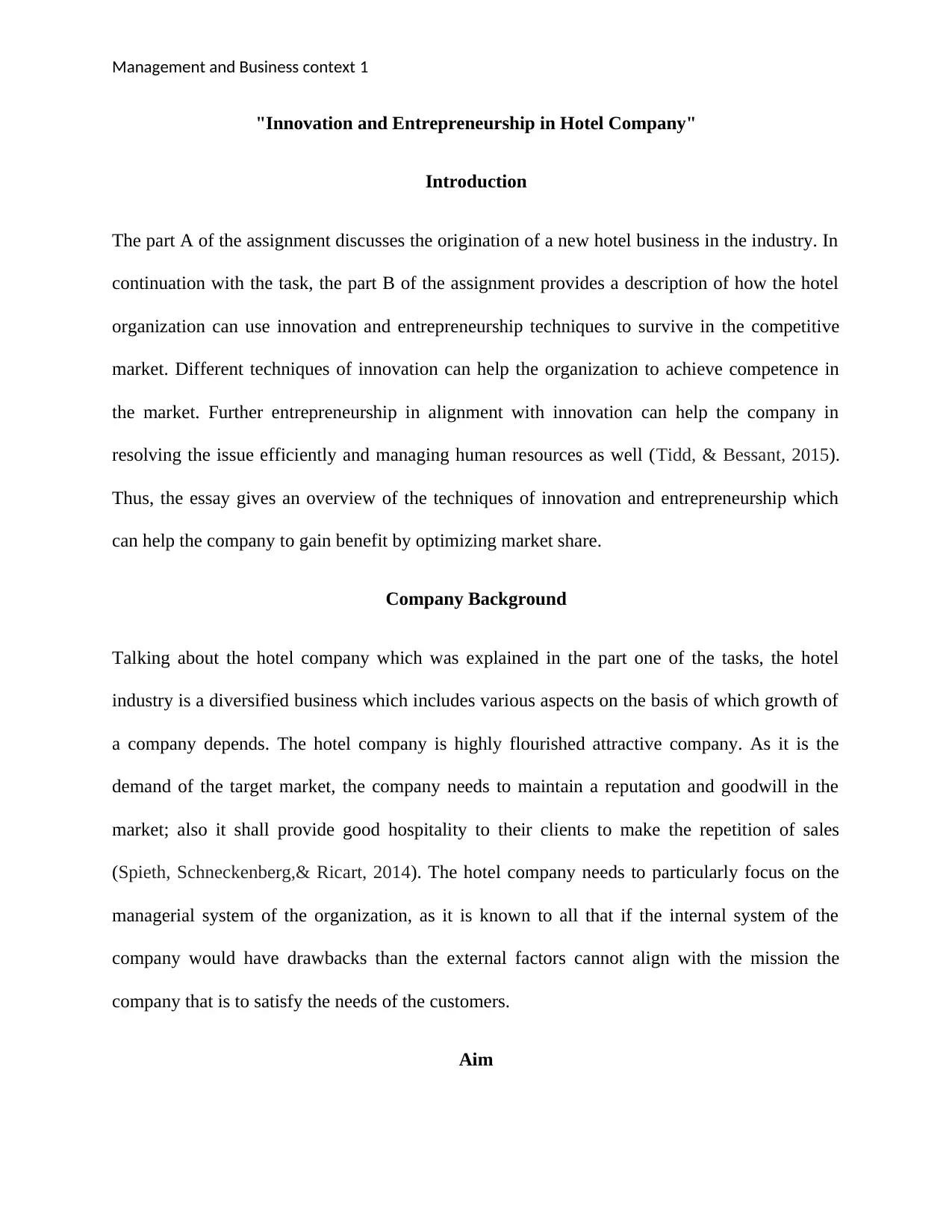
"Innovation and Entrepreneurship in Hotel Company"
Introduction
The part A of the assignment discusses the origination of a new hotel business in the industry. In
continuation with the task, the part B of the assignment provides a description of how the hotel
organization can use innovation and entrepreneurship techniques to survive in the competitive
market. Different techniques of innovation can help the organization to achieve competence in
the market. Further entrepreneurship in alignment with innovation can help the company in
resolving the issue efficiently and managing human resources as well (Tidd, & Bessant, 2015).
Thus, the essay gives an overview of the techniques of innovation and entrepreneurship which
can help the company to gain benefit by optimizing market share.
Company Background
Talking about the hotel company which was explained in the part one of the tasks, the hotel
industry is a diversified business which includes various aspects on the basis of which growth of
a company depends. The hotel company is highly flourished attractive company. As it is the
demand of the target market, the company needs to maintain a reputation and goodwill in the
market; also it shall provide good hospitality to their clients to make the repetition of sales
(Spieth, Schneckenberg,& Ricart, 2014). The hotel company needs to particularly focus on the
managerial system of the organization, as it is known to all that if the internal system of the
company would have drawbacks than the external factors cannot align with the mission the
company that is to satisfy the needs of the customers.
Aim
"Innovation and Entrepreneurship in Hotel Company"
Introduction
The part A of the assignment discusses the origination of a new hotel business in the industry. In
continuation with the task, the part B of the assignment provides a description of how the hotel
organization can use innovation and entrepreneurship techniques to survive in the competitive
market. Different techniques of innovation can help the organization to achieve competence in
the market. Further entrepreneurship in alignment with innovation can help the company in
resolving the issue efficiently and managing human resources as well (Tidd, & Bessant, 2015).
Thus, the essay gives an overview of the techniques of innovation and entrepreneurship which
can help the company to gain benefit by optimizing market share.
Company Background
Talking about the hotel company which was explained in the part one of the tasks, the hotel
industry is a diversified business which includes various aspects on the basis of which growth of
a company depends. The hotel company is highly flourished attractive company. As it is the
demand of the target market, the company needs to maintain a reputation and goodwill in the
market; also it shall provide good hospitality to their clients to make the repetition of sales
(Spieth, Schneckenberg,& Ricart, 2014). The hotel company needs to particularly focus on the
managerial system of the organization, as it is known to all that if the internal system of the
company would have drawbacks than the external factors cannot align with the mission the
company that is to satisfy the needs of the customers.
Aim
Management and Business context 2
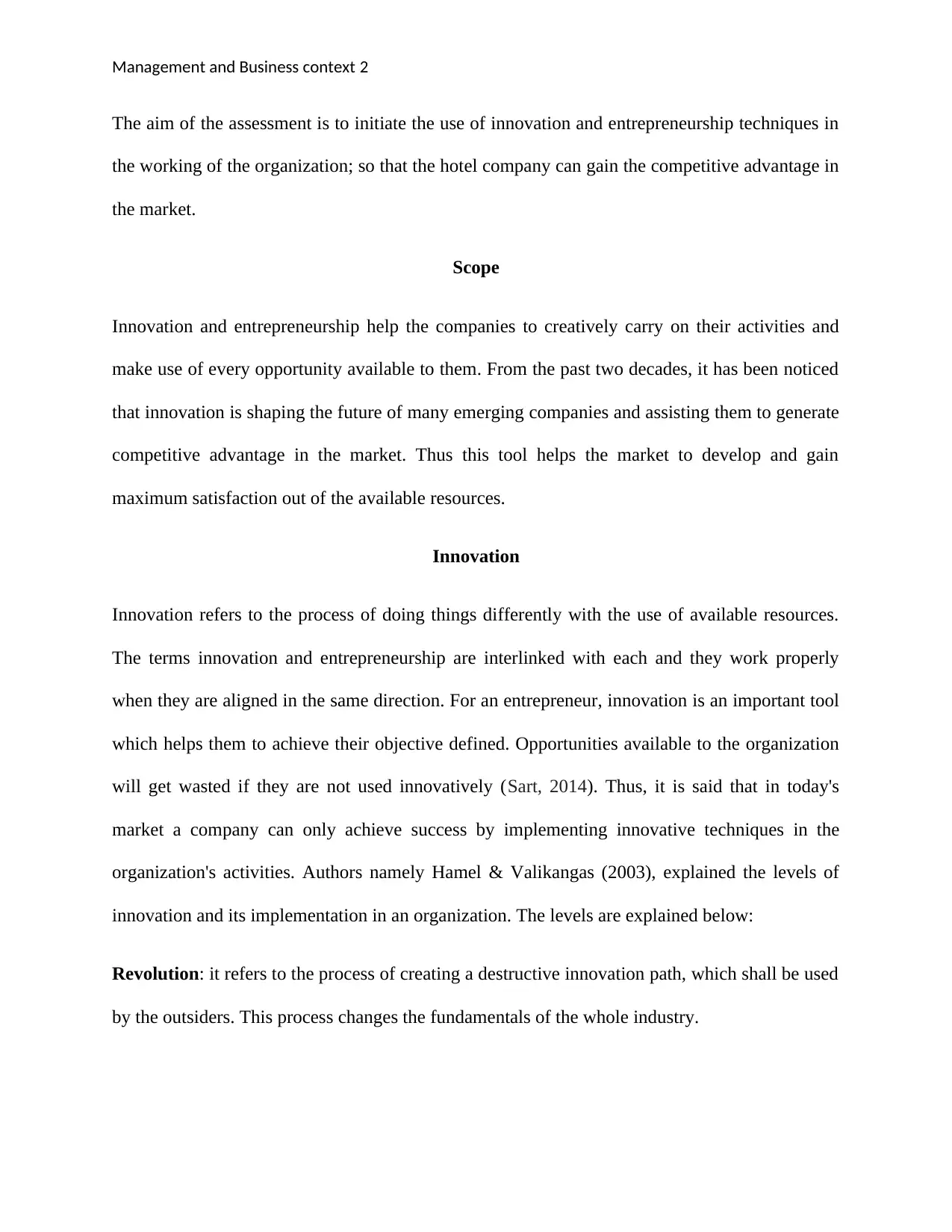
The aim of the assessment is to initiate the use of innovation and entrepreneurship techniques in
the working of the organization; so that the hotel company can gain the competitive advantage in
the market.
Scope
Innovation and entrepreneurship help the companies to creatively carry on their activities and
make use of every opportunity available to them. From the past two decades, it has been noticed
that innovation is shaping the future of many emerging companies and assisting them to generate
competitive advantage in the market. Thus this tool helps the market to develop and gain
maximum satisfaction out of the available resources.
Innovation
Innovation refers to the process of doing things differently with the use of available resources.
The terms innovation and entrepreneurship are interlinked with each and they work properly
when they are aligned in the same direction. For an entrepreneur, innovation is an important tool
which helps them to achieve their objective defined. Opportunities available to the organization
will get wasted if they are not used innovatively (Sart, 2014). Thus, it is said that in today's
market a company can only achieve success by implementing innovative techniques in the
organization's activities. Authors namely Hamel & Valikangas (2003), explained the levels of
innovation and its implementation in an organization. The levels are explained below:
Revolution: it refers to the process of creating a destructive innovation path, which shall be used
by the outsiders. This process changes the fundamentals of the whole industry.
The aim of the assessment is to initiate the use of innovation and entrepreneurship techniques in
the working of the organization; so that the hotel company can gain the competitive advantage in
the market.
Scope
Innovation and entrepreneurship help the companies to creatively carry on their activities and
make use of every opportunity available to them. From the past two decades, it has been noticed
that innovation is shaping the future of many emerging companies and assisting them to generate
competitive advantage in the market. Thus this tool helps the market to develop and gain
maximum satisfaction out of the available resources.
Innovation
Innovation refers to the process of doing things differently with the use of available resources.
The terms innovation and entrepreneurship are interlinked with each and they work properly
when they are aligned in the same direction. For an entrepreneur, innovation is an important tool
which helps them to achieve their objective defined. Opportunities available to the organization
will get wasted if they are not used innovatively (Sart, 2014). Thus, it is said that in today's
market a company can only achieve success by implementing innovative techniques in the
organization's activities. Authors namely Hamel & Valikangas (2003), explained the levels of
innovation and its implementation in an organization. The levels are explained below:
Revolution: it refers to the process of creating a destructive innovation path, which shall be used
by the outsiders. This process changes the fundamentals of the whole industry.
⊘ This is a preview!⊘
Do you want full access?
Subscribe today to unlock all pages.

Trusted by 1+ million students worldwide
Management and Business context 3
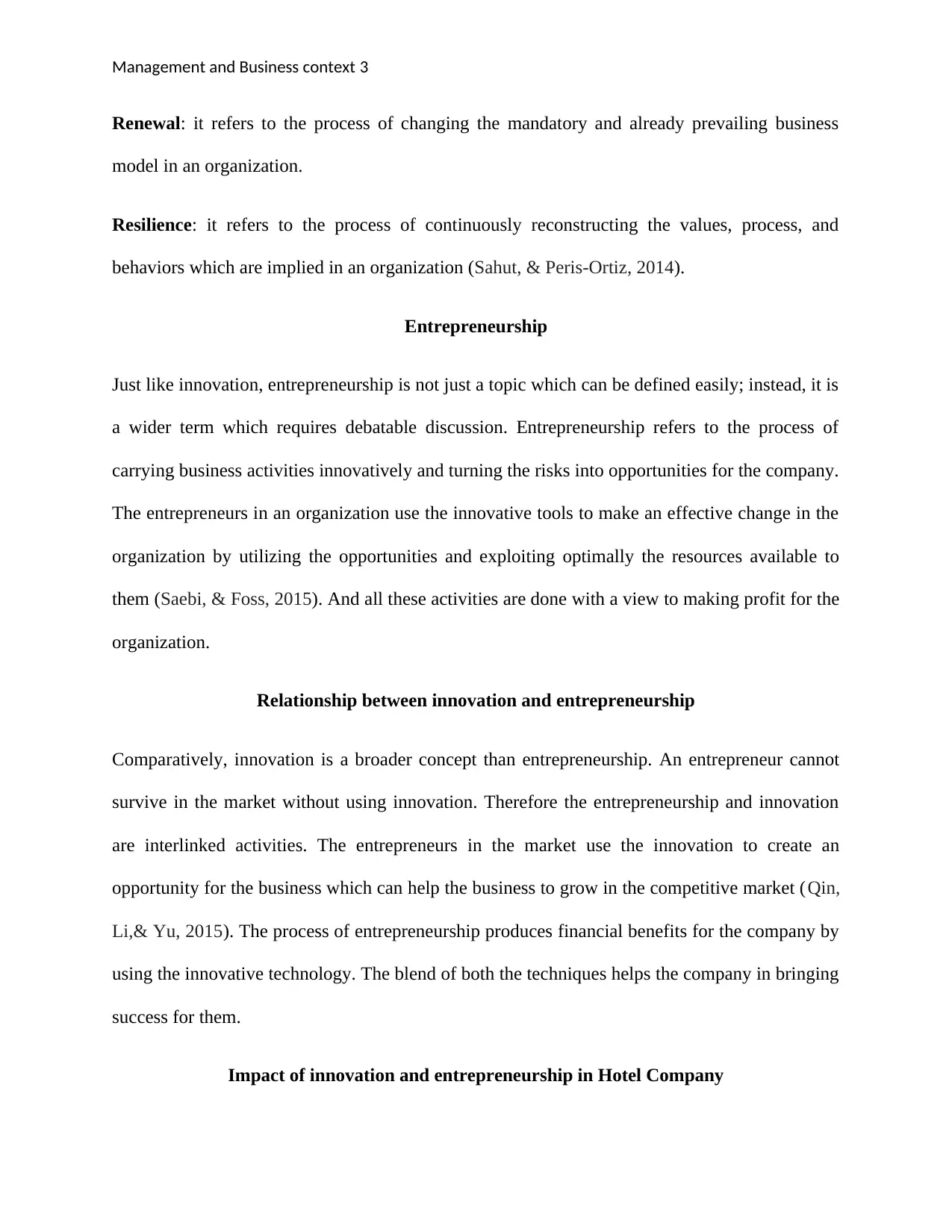
Renewal: it refers to the process of changing the mandatory and already prevailing business
model in an organization.
Resilience: it refers to the process of continuously reconstructing the values, process, and
behaviors which are implied in an organization (Sahut, & Peris-Ortiz, 2014).
Entrepreneurship
Just like innovation, entrepreneurship is not just a topic which can be defined easily; instead, it is
a wider term which requires debatable discussion. Entrepreneurship refers to the process of
carrying business activities innovatively and turning the risks into opportunities for the company.
The entrepreneurs in an organization use the innovative tools to make an effective change in the
organization by utilizing the opportunities and exploiting optimally the resources available to
them (Saebi, & Foss, 2015). And all these activities are done with a view to making profit for the
organization.
Relationship between innovation and entrepreneurship
Comparatively, innovation is a broader concept than entrepreneurship. An entrepreneur cannot
survive in the market without using innovation. Therefore the entrepreneurship and innovation
are interlinked activities. The entrepreneurs in the market use the innovation to create an
opportunity for the business which can help the business to grow in the competitive market (Qin,
Li,& Yu, 2015). The process of entrepreneurship produces financial benefits for the company by
using the innovative technology. The blend of both the techniques helps the company in bringing
success for them.
Impact of innovation and entrepreneurship in Hotel Company
Renewal: it refers to the process of changing the mandatory and already prevailing business
model in an organization.
Resilience: it refers to the process of continuously reconstructing the values, process, and
behaviors which are implied in an organization (Sahut, & Peris-Ortiz, 2014).
Entrepreneurship
Just like innovation, entrepreneurship is not just a topic which can be defined easily; instead, it is
a wider term which requires debatable discussion. Entrepreneurship refers to the process of
carrying business activities innovatively and turning the risks into opportunities for the company.
The entrepreneurs in an organization use the innovative tools to make an effective change in the
organization by utilizing the opportunities and exploiting optimally the resources available to
them (Saebi, & Foss, 2015). And all these activities are done with a view to making profit for the
organization.
Relationship between innovation and entrepreneurship
Comparatively, innovation is a broader concept than entrepreneurship. An entrepreneur cannot
survive in the market without using innovation. Therefore the entrepreneurship and innovation
are interlinked activities. The entrepreneurs in the market use the innovation to create an
opportunity for the business which can help the business to grow in the competitive market (Qin,
Li,& Yu, 2015). The process of entrepreneurship produces financial benefits for the company by
using the innovative technology. The blend of both the techniques helps the company in bringing
success for them.
Impact of innovation and entrepreneurship in Hotel Company
Paraphrase This Document
Need a fresh take? Get an instant paraphrase of this document with our AI Paraphraser
Management and Business context 4
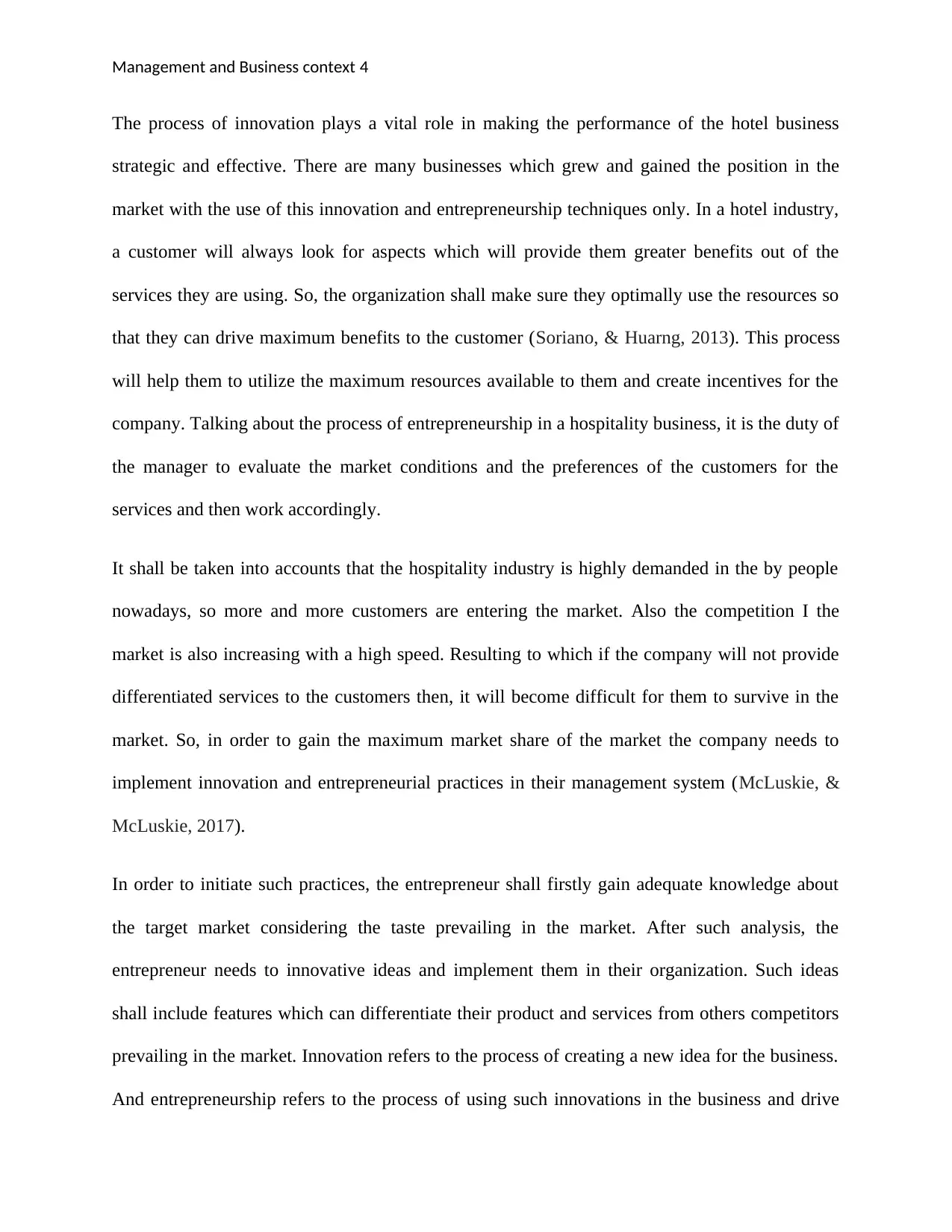
The process of innovation plays a vital role in making the performance of the hotel business
strategic and effective. There are many businesses which grew and gained the position in the
market with the use of this innovation and entrepreneurship techniques only. In a hotel industry,
a customer will always look for aspects which will provide them greater benefits out of the
services they are using. So, the organization shall make sure they optimally use the resources so
that they can drive maximum benefits to the customer (Soriano, & Huarng, 2013). This process
will help them to utilize the maximum resources available to them and create incentives for the
company. Talking about the process of entrepreneurship in a hospitality business, it is the duty of
the manager to evaluate the market conditions and the preferences of the customers for the
services and then work accordingly.
It shall be taken into accounts that the hospitality industry is highly demanded in the by people
nowadays, so more and more customers are entering the market. Also the competition I the
market is also increasing with a high speed. Resulting to which if the company will not provide
differentiated services to the customers then, it will become difficult for them to survive in the
market. So, in order to gain the maximum market share of the market the company needs to
implement innovation and entrepreneurial practices in their management system (McLuskie, &
McLuskie, 2017).
In order to initiate such practices, the entrepreneur shall firstly gain adequate knowledge about
the target market considering the taste prevailing in the market. After such analysis, the
entrepreneur needs to innovative ideas and implement them in their organization. Such ideas
shall include features which can differentiate their product and services from others competitors
prevailing in the market. Innovation refers to the process of creating a new idea for the business.
And entrepreneurship refers to the process of using such innovations in the business and drive
The process of innovation plays a vital role in making the performance of the hotel business
strategic and effective. There are many businesses which grew and gained the position in the
market with the use of this innovation and entrepreneurship techniques only. In a hotel industry,
a customer will always look for aspects which will provide them greater benefits out of the
services they are using. So, the organization shall make sure they optimally use the resources so
that they can drive maximum benefits to the customer (Soriano, & Huarng, 2013). This process
will help them to utilize the maximum resources available to them and create incentives for the
company. Talking about the process of entrepreneurship in a hospitality business, it is the duty of
the manager to evaluate the market conditions and the preferences of the customers for the
services and then work accordingly.
It shall be taken into accounts that the hospitality industry is highly demanded in the by people
nowadays, so more and more customers are entering the market. Also the competition I the
market is also increasing with a high speed. Resulting to which if the company will not provide
differentiated services to the customers then, it will become difficult for them to survive in the
market. So, in order to gain the maximum market share of the market the company needs to
implement innovation and entrepreneurial practices in their management system (McLuskie, &
McLuskie, 2017).
In order to initiate such practices, the entrepreneur shall firstly gain adequate knowledge about
the target market considering the taste prevailing in the market. After such analysis, the
entrepreneur needs to innovative ideas and implement them in their organization. Such ideas
shall include features which can differentiate their product and services from others competitors
prevailing in the market. Innovation refers to the process of creating a new idea for the business.
And entrepreneurship refers to the process of using such innovations in the business and drive
Management and Business context 5
the human resource in the correct direction so that maximum satisfaction is derived by the
customers. The main focus of an entrepreneur is to generate maximum profits for the company
through risk taking measures (Lee, Hallak, & Sardeshmukh, 2016).
Innovation helps the organization in creating new outcomes for the business whereas
entrepreneurship helps the organization in resolving the problems efficiently and motivating the
human resource to gain individual as well as organizational profit. So in order to enhance the
capabilities of the business, the company shall provide quality and cost effective services to the
customers. Along with regular hospitality services, the entrepreneur shall ensure that the internal
management of the system work efficient and it optimally uses all the available resources as
well. Activities like tourism, traveling, food etc. are some of the services which are connected
with the hotel company, so in order to create a position in the market; the company shall focus
on providing such services which are not provided by other competitors (Henkel, Schöberl, &
Alexy, 2014). This will build goodwill of the company in the eyes of the customers and also
drive them to enjoy the services of the company repeatedly.
Use and impact of Disruptive Innovation in Hotel Company
It refers to the type of innovative activities which the business precedes so that highest position is
created by the company in the market. In disruptive innovation a new product is created and
placed in a new target market. The product or services are designed innovatively so that they
stand differently in the eyes of the customers (Drucker, 2014). As the hotel company is a new
and emerging company so it shall make use of disruptive innovation technique in the market.
With this effect, the customer will get attracted towards the company due to which the sales will
increase. The entrepreneur shall make sure that the disruptive innovation activities are properly
the human resource in the correct direction so that maximum satisfaction is derived by the
customers. The main focus of an entrepreneur is to generate maximum profits for the company
through risk taking measures (Lee, Hallak, & Sardeshmukh, 2016).
Innovation helps the organization in creating new outcomes for the business whereas
entrepreneurship helps the organization in resolving the problems efficiently and motivating the
human resource to gain individual as well as organizational profit. So in order to enhance the
capabilities of the business, the company shall provide quality and cost effective services to the
customers. Along with regular hospitality services, the entrepreneur shall ensure that the internal
management of the system work efficient and it optimally uses all the available resources as
well. Activities like tourism, traveling, food etc. are some of the services which are connected
with the hotel company, so in order to create a position in the market; the company shall focus
on providing such services which are not provided by other competitors (Henkel, Schöberl, &
Alexy, 2014). This will build goodwill of the company in the eyes of the customers and also
drive them to enjoy the services of the company repeatedly.
Use and impact of Disruptive Innovation in Hotel Company
It refers to the type of innovative activities which the business precedes so that highest position is
created by the company in the market. In disruptive innovation a new product is created and
placed in a new target market. The product or services are designed innovatively so that they
stand differently in the eyes of the customers (Drucker, 2014). As the hotel company is a new
and emerging company so it shall make use of disruptive innovation technique in the market.
With this effect, the customer will get attracted towards the company due to which the sales will
increase. The entrepreneur shall make sure that the disruptive innovation activities are properly
⊘ This is a preview!⊘
Do you want full access?
Subscribe today to unlock all pages.
Trusted by 1+ million students worldwide
Management and Business context 6
implemented in the market otherwise the company can face failure (Fraj, Matute, & Melero,
2015).
Use and impact of open Innovation in Hotel Company
Open innovation refers to the process of innovation which includes all people connected with the
company to work together to gain benefit. Not only the smart people are required but all people
shall come together and perform the business functions. The company can also use this type of
innovation as they already have an entrepreneur who is creative enough to lead the company. So
with the guidance of a creative leader and a team manager, the company can grace the market
(Drucker, 2014).
Conclusion
Thus in the limelight of above events, it shall be noted that the hotel management company is a
new company need to do effective entrepreneurial activities in order to gain market
capitalization. Along with entrepreneurship activities, the management also needs to innovatively
carry on their business functions to gain success. So, it shall be concluded that it is important for
an entrepreneur to initiate innovation and entrepreneurship in the activities of the business, so
that maximum benefit can be achieved.
implemented in the market otherwise the company can face failure (Fraj, Matute, & Melero,
2015).
Use and impact of open Innovation in Hotel Company
Open innovation refers to the process of innovation which includes all people connected with the
company to work together to gain benefit. Not only the smart people are required but all people
shall come together and perform the business functions. The company can also use this type of
innovation as they already have an entrepreneur who is creative enough to lead the company. So
with the guidance of a creative leader and a team manager, the company can grace the market
(Drucker, 2014).
Conclusion
Thus in the limelight of above events, it shall be noted that the hotel management company is a
new company need to do effective entrepreneurial activities in order to gain market
capitalization. Along with entrepreneurship activities, the management also needs to innovatively
carry on their business functions to gain success. So, it shall be concluded that it is important for
an entrepreneur to initiate innovation and entrepreneurship in the activities of the business, so
that maximum benefit can be achieved.
Paraphrase This Document
Need a fresh take? Get an instant paraphrase of this document with our AI Paraphraser
Management and Business context 7
References
Drucker, P. (2014). Innovation and entrepreneurship. Routledge.
Fraj, E., Matute, J., & Melero, I. (2015). Environmental strategies and organizational
competitiveness in the hotel industry: The role of learning and innovation as determinants
of environmental success. Tourism Management, 46, 30-42.
Henkel, J., Schöberl, S., & Alexy, O. (2014). The emergence of openness: How and why firms
adopt selective revealing in open innovation. Research Policy, 43(5), 879-890.
Lee, C., Hallak, R., & Sardeshmukh, S. R. (2016). Innovation, entrepreneurship, and restaurant
performance: a higher-order structural model. Tourism Management, 53, 215-228.
McLuskie, P., & McLuskie, P. (2017). Innovation and Entrepreneurship. International Journal of
Entrepreneurial Behavior & Research, 23(1), 159-162.
Qin, Y., Li, B., & Yu, L. (2015). Management innovations in a Chinese hotel company: the case
of 7 Days Inn. International Journal of Contemporary Hospitality Management, 27(8),
1856-1880.
Saebi, T., & Foss, N. J. (2015). Business models for open innovation: Matching heterogeneous
open innovation strategies with business model dimensions. European Management
Journal, 33(3), 201-213.
Sahut, J. M., & Peris-Ortiz, M. (2014). Small business, innovation, and entrepreneurship. Small
Business Economics, 42(4), 663-668.
References
Drucker, P. (2014). Innovation and entrepreneurship. Routledge.
Fraj, E., Matute, J., & Melero, I. (2015). Environmental strategies and organizational
competitiveness in the hotel industry: The role of learning and innovation as determinants
of environmental success. Tourism Management, 46, 30-42.
Henkel, J., Schöberl, S., & Alexy, O. (2014). The emergence of openness: How and why firms
adopt selective revealing in open innovation. Research Policy, 43(5), 879-890.
Lee, C., Hallak, R., & Sardeshmukh, S. R. (2016). Innovation, entrepreneurship, and restaurant
performance: a higher-order structural model. Tourism Management, 53, 215-228.
McLuskie, P., & McLuskie, P. (2017). Innovation and Entrepreneurship. International Journal of
Entrepreneurial Behavior & Research, 23(1), 159-162.
Qin, Y., Li, B., & Yu, L. (2015). Management innovations in a Chinese hotel company: the case
of 7 Days Inn. International Journal of Contemporary Hospitality Management, 27(8),
1856-1880.
Saebi, T., & Foss, N. J. (2015). Business models for open innovation: Matching heterogeneous
open innovation strategies with business model dimensions. European Management
Journal, 33(3), 201-213.
Sahut, J. M., & Peris-Ortiz, M. (2014). Small business, innovation, and entrepreneurship. Small
Business Economics, 42(4), 663-668.
Management and Business context 8
Sart, G. (2014). The new leadership model of university management for innovation and
entrepreneurship. Eurasian Journal of Educational Research, (57).
Soriano, D. R., & Huarng, K. H. (2013). Innovation and entrepreneurship in knowledge
industries. Journal of Business Research, 66(10), 1964-1969.
Spieth, P., Schneckenberg, D., & Ricart, J. E. (2014). Business model innovation–state of the art
and future challenges for the field. R&D Management, 44(3), 237-247.
Tidd, J., & Bessant, J. (2015). Innovation and entrepreneurship (No. 3). Wiley.
Sart, G. (2014). The new leadership model of university management for innovation and
entrepreneurship. Eurasian Journal of Educational Research, (57).
Soriano, D. R., & Huarng, K. H. (2013). Innovation and entrepreneurship in knowledge
industries. Journal of Business Research, 66(10), 1964-1969.
Spieth, P., Schneckenberg, D., & Ricart, J. E. (2014). Business model innovation–state of the art
and future challenges for the field. R&D Management, 44(3), 237-247.
Tidd, J., & Bessant, J. (2015). Innovation and entrepreneurship (No. 3). Wiley.
⊘ This is a preview!⊘
Do you want full access?
Subscribe today to unlock all pages.
Trusted by 1+ million students worldwide

1 out of 9


Related Documents


Your All-in-One AI-Powered Toolkit for Academic Success.
+13062052269
info@desklib.com
Available 24*7 on WhatsApp / Email
![[object Object]](/_next/static/media/star-bottom.7253800d.svg)
Unlock your academic potential
Copyright © 2020–2026 A2Z Services. All Rights Reserved. Developed and managed by ZUCOL.