CA5058 Report: Risk Management and Business Continuity in Hotels
VerifiedAdded on 2023/06/14
|11
|3035
|479
Report
AI Summary
This report provides a comprehensive overview of risk management and business continuity within the hotel industry. It outlines two key risk models—strategic and compliance risk—and explains the rule of tort as it applies to risk management, including examples of real, perceived, and inherent risks. The report details the importance of business continuity planning (BCP) in mitigating disruptions from disasters, emphasizing its role in maintaining essential functions and ensuring resilience. Furthermore, it identifies five significant risks relevant to the hospitality sector: credit card fraud, cybercrime attacks, lack of security audits, physical crime, and loss of competitive advantage post-security incident. Finally, the report suggests innovative mitigation strategies, such as proactive management leadership and the establishment of surveillance teams. The report is contributed by a student and available on Desklib, a platform offering study tools and resources.

REPORT CA

Paraphrase This Document
Need a fresh take? Get an instant paraphrase of this document with our AI Paraphraser
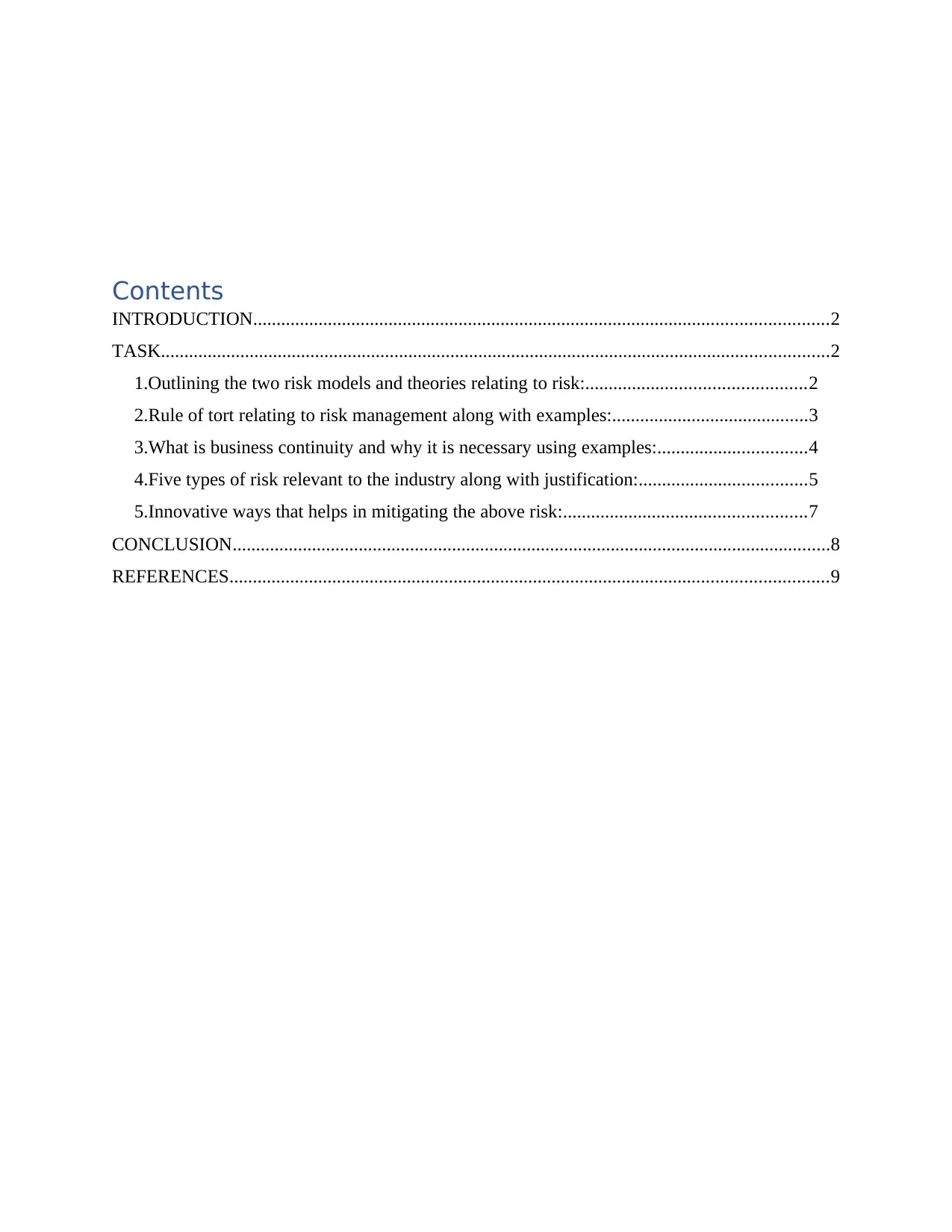
Contents
INTRODUCTION...........................................................................................................................2
TASK...............................................................................................................................................2
1.Outlining the two risk models and theories relating to risk:...............................................2
2.Rule of tort relating to risk management along with examples:..........................................3
3.What is business continuity and why it is necessary using examples:................................4
4.Five types of risk relevant to the industry along with justification:....................................5
5.Innovative ways that helps in mitigating the above risk:....................................................7
CONCLUSION................................................................................................................................8
REFERENCES................................................................................................................................9
INTRODUCTION...........................................................................................................................2
TASK...............................................................................................................................................2
1.Outlining the two risk models and theories relating to risk:...............................................2
2.Rule of tort relating to risk management along with examples:..........................................3
3.What is business continuity and why it is necessary using examples:................................4
4.Five types of risk relevant to the industry along with justification:....................................5
5.Innovative ways that helps in mitigating the above risk:....................................................7
CONCLUSION................................................................................................................................8
REFERENCES................................................................................................................................9
INTRODUCTION
Risk management is a tool to manage risk within the organisation so that any disruption in
the operational activities can be mitigated. Risk differs from industry to industry and this report
covers the hotel industry and their associated risk they are facing in the changing world. This
report outlines about the types of risk an hotel is facing and explain some innovative ways
through which such risk can be reduced. Further in this report business continuity planning has
been outlines along with its salient features to business and explains to importance of such plan
to business in today changing environment and technology (Bhattacharyya and Jha, 2018).
TASK
1.Outlining the two risk models and theories relating to risk:
Risk related to business is broadly classified into various categories such as strategic risk,
compliance risk, operational risk, reputational risk and so on. From this risk the two risks have
been explained below: -
Strategic Risk: -
Such risk arises when the entity does not perform their business activity according to
their business model or the plan they have made. When an organisation does not carry the
business according to their model then the strategy, they have made becomes less
effective over the period of time and they have to struggle a lot in achieving their goals
and objectives. One of the examples can be that Walmart strategically position itself as
low-cost provider in the market and reduce their price accordingly but it will create
strategic risk for them in order to survive their business (Chen, 2020).
Compliance Risk: -
Such risk arises on those sectors where requirement of laws and regulation is higher and
very strict too. The example can be the wine industry which involves three tier system in
its distribution process in the US to sell wine to retailers. This system will restrict the
winegrowers to sell their goods in some states in retail outlets. However, such system of
distribution in not followed in all the other states in US and such risk arises the individual
requirement and needs are not fulfilled and it ultimately leads to failure of brand
(DePaula, 2018)
Risk management is a tool to manage risk within the organisation so that any disruption in
the operational activities can be mitigated. Risk differs from industry to industry and this report
covers the hotel industry and their associated risk they are facing in the changing world. This
report outlines about the types of risk an hotel is facing and explain some innovative ways
through which such risk can be reduced. Further in this report business continuity planning has
been outlines along with its salient features to business and explains to importance of such plan
to business in today changing environment and technology (Bhattacharyya and Jha, 2018).
TASK
1.Outlining the two risk models and theories relating to risk:
Risk related to business is broadly classified into various categories such as strategic risk,
compliance risk, operational risk, reputational risk and so on. From this risk the two risks have
been explained below: -
Strategic Risk: -
Such risk arises when the entity does not perform their business activity according to
their business model or the plan they have made. When an organisation does not carry the
business according to their model then the strategy, they have made becomes less
effective over the period of time and they have to struggle a lot in achieving their goals
and objectives. One of the examples can be that Walmart strategically position itself as
low-cost provider in the market and reduce their price accordingly but it will create
strategic risk for them in order to survive their business (Chen, 2020).
Compliance Risk: -
Such risk arises on those sectors where requirement of laws and regulation is higher and
very strict too. The example can be the wine industry which involves three tier system in
its distribution process in the US to sell wine to retailers. This system will restrict the
winegrowers to sell their goods in some states in retail outlets. However, such system of
distribution in not followed in all the other states in US and such risk arises the individual
requirement and needs are not fulfilled and it ultimately leads to failure of brand
(DePaula, 2018)
⊘ This is a preview!⊘
Do you want full access?
Subscribe today to unlock all pages.

Trusted by 1+ million students worldwide
.
2.Rule of tort relating to risk management along with examples:
The tort may be defined as mental or physical harm to any person or group of people or
damage to physical or tangible property belong to any person. Such harm can be compensated by
the court of law with the help of grant of compensation to those parties who faces such harm. In
rule of tort the liability may arise due to negligence made by persons involved or failure at
international level where individual has the responsibility to act but they make failure on their
part (Kavanagh, 2021).
Risk management is the practice which involves various policies and procedures which are
incorporated to minimise or mitigate risk to acceptable level. The risk management process
various from industry to industry and business to business. Risk management practice can be
undertaken at any scale and any company, society, communities’ regions or even the government
can practice the same so that they can protect themselves from the unwanted risk they undertake.
Some of the risk management initiatives are easier as compare to others as they are required by
law and enforced by government agencies.
One of the best examples can be that in case of public transportation business the travel operator
needs to follow the guidelines provided by the government such as bus driver must carry the
driving license, the operator must have the license to carry out such travelling business, they
must have vehicle inspection certificate from the approved authority with respect to condition of
vehicle etc and if they don’t follow the same then their license will get suspended for the defined
period. Not only this they have to pay fine or imprisonment or both for their noncompliance.
Further there are also some concepts relating to risk such as real risk, perceived risk and inherent
risk that is broadly explained as under:
Real Risk: It can be defined as the actual arithmetical probability of the occurrence of
incident and it is established through reviews come from the statistics and other relevant
2.Rule of tort relating to risk management along with examples:
The tort may be defined as mental or physical harm to any person or group of people or
damage to physical or tangible property belong to any person. Such harm can be compensated by
the court of law with the help of grant of compensation to those parties who faces such harm. In
rule of tort the liability may arise due to negligence made by persons involved or failure at
international level where individual has the responsibility to act but they make failure on their
part (Kavanagh, 2021).
Risk management is the practice which involves various policies and procedures which are
incorporated to minimise or mitigate risk to acceptable level. The risk management process
various from industry to industry and business to business. Risk management practice can be
undertaken at any scale and any company, society, communities’ regions or even the government
can practice the same so that they can protect themselves from the unwanted risk they undertake.
Some of the risk management initiatives are easier as compare to others as they are required by
law and enforced by government agencies.
One of the best examples can be that in case of public transportation business the travel operator
needs to follow the guidelines provided by the government such as bus driver must carry the
driving license, the operator must have the license to carry out such travelling business, they
must have vehicle inspection certificate from the approved authority with respect to condition of
vehicle etc and if they don’t follow the same then their license will get suspended for the defined
period. Not only this they have to pay fine or imprisonment or both for their noncompliance.
Further there are also some concepts relating to risk such as real risk, perceived risk and inherent
risk that is broadly explained as under:
Real Risk: It can be defined as the actual arithmetical probability of the occurrence of
incident and it is established through reviews come from the statistics and other relevant
Paraphrase This Document
Need a fresh take? Get an instant paraphrase of this document with our AI Paraphraser
data. However, there is a little doubt or we can say that subjectivity in real risk as
compared to others (Ke, Svartaas, and Chen, 2019).
Perceived Risk: It is the perception of risk by those undertaking and it may differ
depending upon the level of gratitude, nervousness and knowledge relating to specific
risk. Such risk may vary from the real risk and can be upper side or lower side from the
actual risk occurrence.
Inherent Risk: Inherent risk is the minimum amount of risk that is involved in the
particular activity or process under consideration. It is impossible to eliminate inherent
risk completely however it can be mitigated to an extent by implementing proper
measures such as availability of safety measures for the guest in hotel, prper and adequate
training must be provided to staff, proper intimation must be given to members of
hazards of the activity.
3.What is business continuity and why it is necessary using examples:
Business continuity is an ability of the enterprise to maintain their important functions after
and before the occurrence of the disaster. Business continuity planning inaugurates risk
management procedures and processes whose objective to prevent the disruption which has been
taken place in the name of mission serious services so that organisation can recover from such
disaster very quickly and smartly as possible (Kim, 2021).
In order to mitigate such disaster occurrence a business continuity plan has been implemented
whose aim is to reduce the impact of disaster as soon as possible. These plans consider various
aspects and volatile events which includes natural disasters, fire occurrence, cybercrime and
attacks or any other exterior threats.
There is a need of business continuity plan as it considers potential disturbances that may affect
the entity’s operational activities. This plan helps the enterprise to run their business in downtime
situation as well so that minimum output can be generated by the business concern. They also
help the entity in order to maintain resiliency in order to respond quick against the interruption
that has been taken place (Kuijper, 2022).
compared to others (Ke, Svartaas, and Chen, 2019).
Perceived Risk: It is the perception of risk by those undertaking and it may differ
depending upon the level of gratitude, nervousness and knowledge relating to specific
risk. Such risk may vary from the real risk and can be upper side or lower side from the
actual risk occurrence.
Inherent Risk: Inherent risk is the minimum amount of risk that is involved in the
particular activity or process under consideration. It is impossible to eliminate inherent
risk completely however it can be mitigated to an extent by implementing proper
measures such as availability of safety measures for the guest in hotel, prper and adequate
training must be provided to staff, proper intimation must be given to members of
hazards of the activity.
3.What is business continuity and why it is necessary using examples:
Business continuity is an ability of the enterprise to maintain their important functions after
and before the occurrence of the disaster. Business continuity planning inaugurates risk
management procedures and processes whose objective to prevent the disruption which has been
taken place in the name of mission serious services so that organisation can recover from such
disaster very quickly and smartly as possible (Kim, 2021).
In order to mitigate such disaster occurrence a business continuity plan has been implemented
whose aim is to reduce the impact of disaster as soon as possible. These plans consider various
aspects and volatile events which includes natural disasters, fire occurrence, cybercrime and
attacks or any other exterior threats.
There is a need of business continuity plan as it considers potential disturbances that may affect
the entity’s operational activities. This plan helps the enterprise to run their business in downtime
situation as well so that minimum output can be generated by the business concern. They also
help the entity in order to maintain resiliency in order to respond quick against the interruption
that has been taken place (Kuijper, 2022).
This plan helps the entity to look itself and evaluate the potential & significant areas of weakness
and gather all the important information such as list of contacts, operation technical diagram etc.
that can be beneficial to fight with situation of disaster. Nowadays business continuity plan
becomes part of entity structure and also required to be implemented as it becomes part of legal
and regulatory requirement for the organisation.
Business continuity plan has its own advantage in the following ways mentioned under: -
The entity will start handling the unexpected situation very well that’s makes them
stronger in handling such tough situation.
The business must have safeguarding plans other than insurances as insurance of the
business is not sufficient to handle of major disaster.
It majors the business to sustain as fixed cost always due in if the disaster occurs and
business continuity plan helps in developing a sustainable approach to business.
The disruption in business activity also leads to loss of revenue and increase in cost which
automatically affects the profitability of entity and BCP helps the organisation to sustain its
operations which also helps in retaining the customer base (Morris, 2018).
4.Five types of risk relevant to the industry along with justification:
Rapidly changing needs of the customer demands and boom in technological changes are
amongst the factors that are affecting the hospitality companies. The hospitality industries and
companies are regularly working hard to fulfil their customer demands along with changing
requirement. The following are the five types of risk that is affecting the hospitality industry: -
Theft of identification involving credit card fraud: Protecting the identity is nowadays
become so challenging because there are various frauds which has been carried out these
days and one of the examples is credit card fraud which has been takes place very
frequently. From all over the world the criminals hack the hotel network and steal the
credit card or any other confidential information and they are not targeting the individual
but also group of people at the same time (Müller, 2018).
Cybercrime attacks: Cybercrime is another crime that has been taken place in hotel
industry very frequently and it order to deal with these situations they need to upgrade the
and gather all the important information such as list of contacts, operation technical diagram etc.
that can be beneficial to fight with situation of disaster. Nowadays business continuity plan
becomes part of entity structure and also required to be implemented as it becomes part of legal
and regulatory requirement for the organisation.
Business continuity plan has its own advantage in the following ways mentioned under: -
The entity will start handling the unexpected situation very well that’s makes them
stronger in handling such tough situation.
The business must have safeguarding plans other than insurances as insurance of the
business is not sufficient to handle of major disaster.
It majors the business to sustain as fixed cost always due in if the disaster occurs and
business continuity plan helps in developing a sustainable approach to business.
The disruption in business activity also leads to loss of revenue and increase in cost which
automatically affects the profitability of entity and BCP helps the organisation to sustain its
operations which also helps in retaining the customer base (Morris, 2018).
4.Five types of risk relevant to the industry along with justification:
Rapidly changing needs of the customer demands and boom in technological changes are
amongst the factors that are affecting the hospitality companies. The hospitality industries and
companies are regularly working hard to fulfil their customer demands along with changing
requirement. The following are the five types of risk that is affecting the hospitality industry: -
Theft of identification involving credit card fraud: Protecting the identity is nowadays
become so challenging because there are various frauds which has been carried out these
days and one of the examples is credit card fraud which has been takes place very
frequently. From all over the world the criminals hack the hotel network and steal the
credit card or any other confidential information and they are not targeting the individual
but also group of people at the same time (Müller, 2018).
Cybercrime attacks: Cybercrime is another crime that has been taken place in hotel
industry very frequently and it order to deal with these situations they need to upgrade the
⊘ This is a preview!⊘
Do you want full access?
Subscribe today to unlock all pages.
Trusted by 1+ million students worldwide
security system on regular interval of time. The reason for such threats can be the wife
system hotel provides to their guests which has a very poor security that provides a open
gate for hackers that put the data of number of guest at risk immediately.
No security audit cycles: There is a rapid growth in hotel industry around the world at a
very fast rate which covers a group of hotels or a small café. It is important to carry out
physical audit so that hotel standards are complied with accordingly. In is necessary to
increase the number of market if industry in rapidly growing and if audit are not
conducted properly then it will create various complication and make hotels at the risk
point. The major reason for skipping such periodic audit is the cost involved in such audit
in the form of audit fees as some considered them to be more expensive and some
believes that their quality is not worthy and it ultimately affect the guest and investor in
the form of higher risk (Sagar and Sagar, 2018).
Physical crime: Such crime differs from country to country and in a global scale physical
crime has increased and recognised by authorities and security experts. The ranges from
professional housebreaks by using social engineering techniques to temporary drugs case
in the hotel room. Not only this there are also terrorist activities which has been done by
certain militants or organised groups that too target hotels prima facie. Unfortunately,
restaurant and hotels, multiple theme-based parks, tourist attractions places and other
public places are classified as high-risk zone areas and easily targeted.
Loss of competitive advantage after a major security incident: It is one of the major
incidents which shuts down many of the business carrying hotel business as one major
incident breaks their complete business and revenue as the business is closed for
investigation and repairs. It is important for the management to come forward to mitigate
such king of risk to an acceptable level. When security and business continuity plans are
maintained properly then likely of damage will gets reduced automatically. Reputation of
the group provides an undue advantage as due to technological advancement nowadays
booking has been carried out on the basis of reviews and comments made by other guests
on hotel portals (Sale and Thielke, 2018).
system hotel provides to their guests which has a very poor security that provides a open
gate for hackers that put the data of number of guest at risk immediately.
No security audit cycles: There is a rapid growth in hotel industry around the world at a
very fast rate which covers a group of hotels or a small café. It is important to carry out
physical audit so that hotel standards are complied with accordingly. In is necessary to
increase the number of market if industry in rapidly growing and if audit are not
conducted properly then it will create various complication and make hotels at the risk
point. The major reason for skipping such periodic audit is the cost involved in such audit
in the form of audit fees as some considered them to be more expensive and some
believes that their quality is not worthy and it ultimately affect the guest and investor in
the form of higher risk (Sagar and Sagar, 2018).
Physical crime: Such crime differs from country to country and in a global scale physical
crime has increased and recognised by authorities and security experts. The ranges from
professional housebreaks by using social engineering techniques to temporary drugs case
in the hotel room. Not only this there are also terrorist activities which has been done by
certain militants or organised groups that too target hotels prima facie. Unfortunately,
restaurant and hotels, multiple theme-based parks, tourist attractions places and other
public places are classified as high-risk zone areas and easily targeted.
Loss of competitive advantage after a major security incident: It is one of the major
incidents which shuts down many of the business carrying hotel business as one major
incident breaks their complete business and revenue as the business is closed for
investigation and repairs. It is important for the management to come forward to mitigate
such king of risk to an acceptable level. When security and business continuity plans are
maintained properly then likely of damage will gets reduced automatically. Reputation of
the group provides an undue advantage as due to technological advancement nowadays
booking has been carried out on the basis of reviews and comments made by other guests
on hotel portals (Sale and Thielke, 2018).
Paraphrase This Document
Need a fresh take? Get an instant paraphrase of this document with our AI Paraphraser
5.Innovative ways that helps in mitigating the above risk:
Here are some innovative ways that would help in mitigating the above risk in hotel businesses: -
Manager must lead the team: It is important for hotel management and staff that they
must aware of all the security issues and awareness about them before the hotel answer to
possible and actual events took place. It is important that management must be aware
about the theoretically serious significances so that any emergency can be deal with
accordingly and in more appropriate manner. It is important that hotel must implement
training program with respect to security awareness for manager so that they can lead
them accordingly to reduce the effect of risk.
Team of Surveillance officers must be built: It is important for the managers and other
staff to train itself with worst situation so that dependency on external workforce who
specialized in security can be reduced. This can be done by providing complete education
to employees, hotel staff etc which includes guiding them towards investigation processes
and what techniques needs to be implemented depending upon the situation (Trafimow,
Hyman, and Kostyk, 2022).
Duty care model must be implemented: It is important to work as a team and working for
each other that will automatically create the work environment and security awareness
will be understood accordingly. When the outside guest sees the work culture within the
hotel then they gain certain amount of confidence and everyone’s safety and welfare
become a major concern for each other and they all get united at the time of certain level
of disruption.
Skill enhancement: It is important that skill must be enhanced from the ground level
stating from the basis that is hotel management courses where different types of risk
associated with the industry and how to face and mitigate them must be teached so that
ground level base can be created initially amongst the staff and employees. Due to rapid
changing environment and changing risk it is important to update the employees and
Here are some innovative ways that would help in mitigating the above risk in hotel businesses: -
Manager must lead the team: It is important for hotel management and staff that they
must aware of all the security issues and awareness about them before the hotel answer to
possible and actual events took place. It is important that management must be aware
about the theoretically serious significances so that any emergency can be deal with
accordingly and in more appropriate manner. It is important that hotel must implement
training program with respect to security awareness for manager so that they can lead
them accordingly to reduce the effect of risk.
Team of Surveillance officers must be built: It is important for the managers and other
staff to train itself with worst situation so that dependency on external workforce who
specialized in security can be reduced. This can be done by providing complete education
to employees, hotel staff etc which includes guiding them towards investigation processes
and what techniques needs to be implemented depending upon the situation (Trafimow,
Hyman, and Kostyk, 2022).
Duty care model must be implemented: It is important to work as a team and working for
each other that will automatically create the work environment and security awareness
will be understood accordingly. When the outside guest sees the work culture within the
hotel then they gain certain amount of confidence and everyone’s safety and welfare
become a major concern for each other and they all get united at the time of certain level
of disruption.
Skill enhancement: It is important that skill must be enhanced from the ground level
stating from the basis that is hotel management courses where different types of risk
associated with the industry and how to face and mitigate them must be teached so that
ground level base can be created initially amongst the staff and employees. Due to rapid
changing environment and changing risk it is important to update the employees and
management towards the same so that security practices can be implemented successfully
(Walls and Zhang, 2019).
CONCLUSION
Risk and its management play a Vitol role in every business as it is important to take prompt
action against any emergency that has been taken place. It is important for every business and
their management to must equipped themselves with all the safety features and plans that will
serve as the guard at the time of emergency situation. This report works around the hotel industry
and businesses that what are the various types of risk faced in that particular industry and what
are the ways at organisational level to reduce their impact. Such risk if not mitigated on time and
in due course then it will disrupt whole of the business and if consequences are tough to deal
with. This report also highlight about the business continuity plans that safeguard the business by
providing additional security along with insurance to the hotel business. At the end of this report
certain innovative measures has been explained that will mitigate the effect of risk facing by the
hotel industry and respective businesses.
(Walls and Zhang, 2019).
CONCLUSION
Risk and its management play a Vitol role in every business as it is important to take prompt
action against any emergency that has been taken place. It is important for every business and
their management to must equipped themselves with all the safety features and plans that will
serve as the guard at the time of emergency situation. This report works around the hotel industry
and businesses that what are the various types of risk faced in that particular industry and what
are the ways at organisational level to reduce their impact. Such risk if not mitigated on time and
in due course then it will disrupt whole of the business and if consequences are tough to deal
with. This report also highlight about the business continuity plans that safeguard the business by
providing additional security along with insurance to the hotel business. At the end of this report
certain innovative measures has been explained that will mitigate the effect of risk facing by the
hotel industry and respective businesses.
⊘ This is a preview!⊘
Do you want full access?
Subscribe today to unlock all pages.
Trusted by 1+ million students worldwide
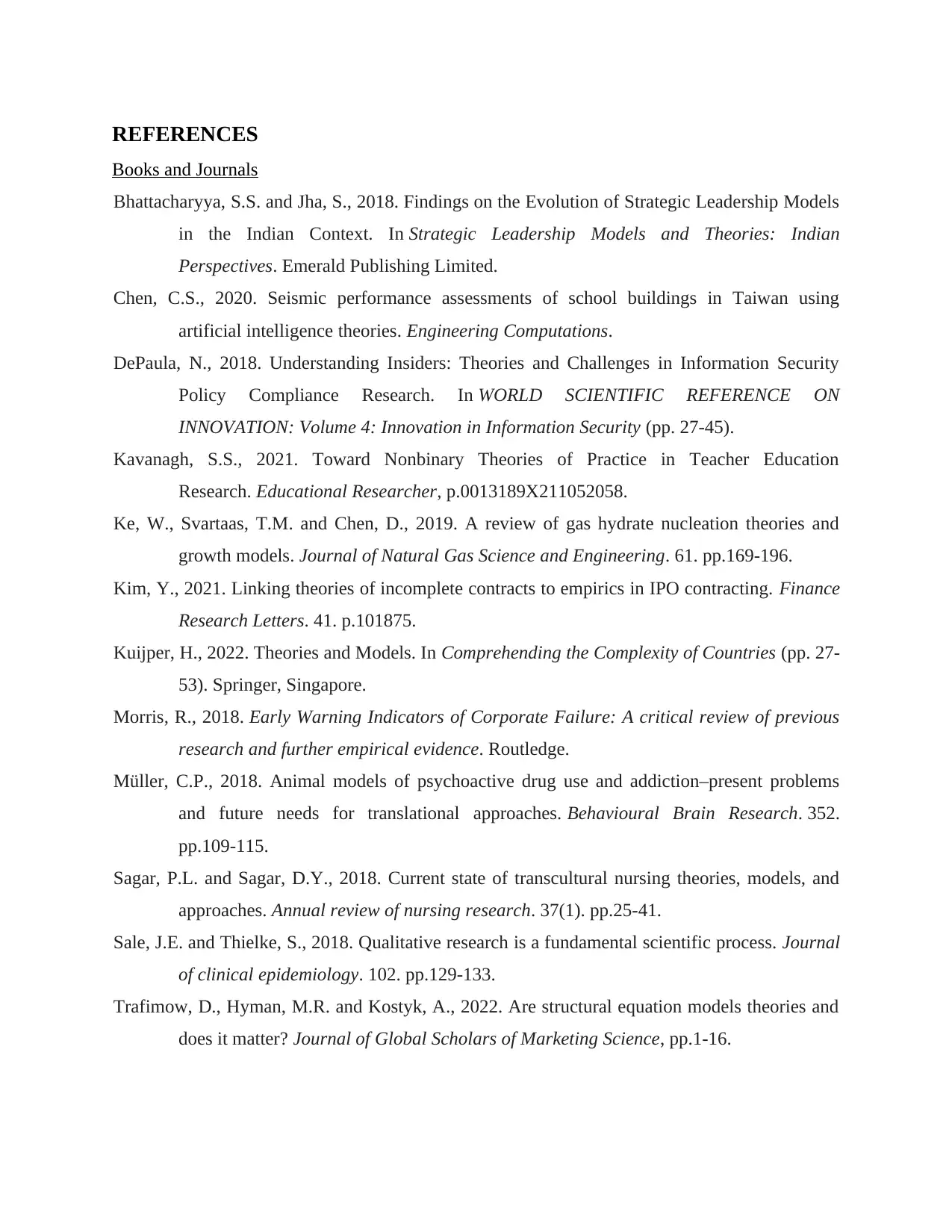
REFERENCES
Books and Journals
Bhattacharyya, S.S. and Jha, S., 2018. Findings on the Evolution of Strategic Leadership Models
in the Indian Context. In Strategic Leadership Models and Theories: Indian
Perspectives. Emerald Publishing Limited.
Chen, C.S., 2020. Seismic performance assessments of school buildings in Taiwan using
artificial intelligence theories. Engineering Computations.
DePaula, N., 2018. Understanding Insiders: Theories and Challenges in Information Security
Policy Compliance Research. In WORLD SCIENTIFIC REFERENCE ON
INNOVATION: Volume 4: Innovation in Information Security (pp. 27-45).
Kavanagh, S.S., 2021. Toward Nonbinary Theories of Practice in Teacher Education
Research. Educational Researcher, p.0013189X211052058.
Ke, W., Svartaas, T.M. and Chen, D., 2019. A review of gas hydrate nucleation theories and
growth models. Journal of Natural Gas Science and Engineering. 61. pp.169-196.
Kim, Y., 2021. Linking theories of incomplete contracts to empirics in IPO contracting. Finance
Research Letters. 41. p.101875.
Kuijper, H., 2022. Theories and Models. In Comprehending the Complexity of Countries (pp. 27-
53). Springer, Singapore.
Morris, R., 2018. Early Warning Indicators of Corporate Failure: A critical review of previous
research and further empirical evidence. Routledge.
Müller, C.P., 2018. Animal models of psychoactive drug use and addiction–present problems
and future needs for translational approaches. Behavioural Brain Research. 352.
pp.109-115.
Sagar, P.L. and Sagar, D.Y., 2018. Current state of transcultural nursing theories, models, and
approaches. Annual review of nursing research. 37(1). pp.25-41.
Sale, J.E. and Thielke, S., 2018. Qualitative research is a fundamental scientific process. Journal
of clinical epidemiology. 102. pp.129-133.
Trafimow, D., Hyman, M.R. and Kostyk, A., 2022. Are structural equation models theories and
does it matter? Journal of Global Scholars of Marketing Science, pp.1-16.
Books and Journals
Bhattacharyya, S.S. and Jha, S., 2018. Findings on the Evolution of Strategic Leadership Models
in the Indian Context. In Strategic Leadership Models and Theories: Indian
Perspectives. Emerald Publishing Limited.
Chen, C.S., 2020. Seismic performance assessments of school buildings in Taiwan using
artificial intelligence theories. Engineering Computations.
DePaula, N., 2018. Understanding Insiders: Theories and Challenges in Information Security
Policy Compliance Research. In WORLD SCIENTIFIC REFERENCE ON
INNOVATION: Volume 4: Innovation in Information Security (pp. 27-45).
Kavanagh, S.S., 2021. Toward Nonbinary Theories of Practice in Teacher Education
Research. Educational Researcher, p.0013189X211052058.
Ke, W., Svartaas, T.M. and Chen, D., 2019. A review of gas hydrate nucleation theories and
growth models. Journal of Natural Gas Science and Engineering. 61. pp.169-196.
Kim, Y., 2021. Linking theories of incomplete contracts to empirics in IPO contracting. Finance
Research Letters. 41. p.101875.
Kuijper, H., 2022. Theories and Models. In Comprehending the Complexity of Countries (pp. 27-
53). Springer, Singapore.
Morris, R., 2018. Early Warning Indicators of Corporate Failure: A critical review of previous
research and further empirical evidence. Routledge.
Müller, C.P., 2018. Animal models of psychoactive drug use and addiction–present problems
and future needs for translational approaches. Behavioural Brain Research. 352.
pp.109-115.
Sagar, P.L. and Sagar, D.Y., 2018. Current state of transcultural nursing theories, models, and
approaches. Annual review of nursing research. 37(1). pp.25-41.
Sale, J.E. and Thielke, S., 2018. Qualitative research is a fundamental scientific process. Journal
of clinical epidemiology. 102. pp.129-133.
Trafimow, D., Hyman, M.R. and Kostyk, A., 2022. Are structural equation models theories and
does it matter? Journal of Global Scholars of Marketing Science, pp.1-16.
Paraphrase This Document
Need a fresh take? Get an instant paraphrase of this document with our AI Paraphraser
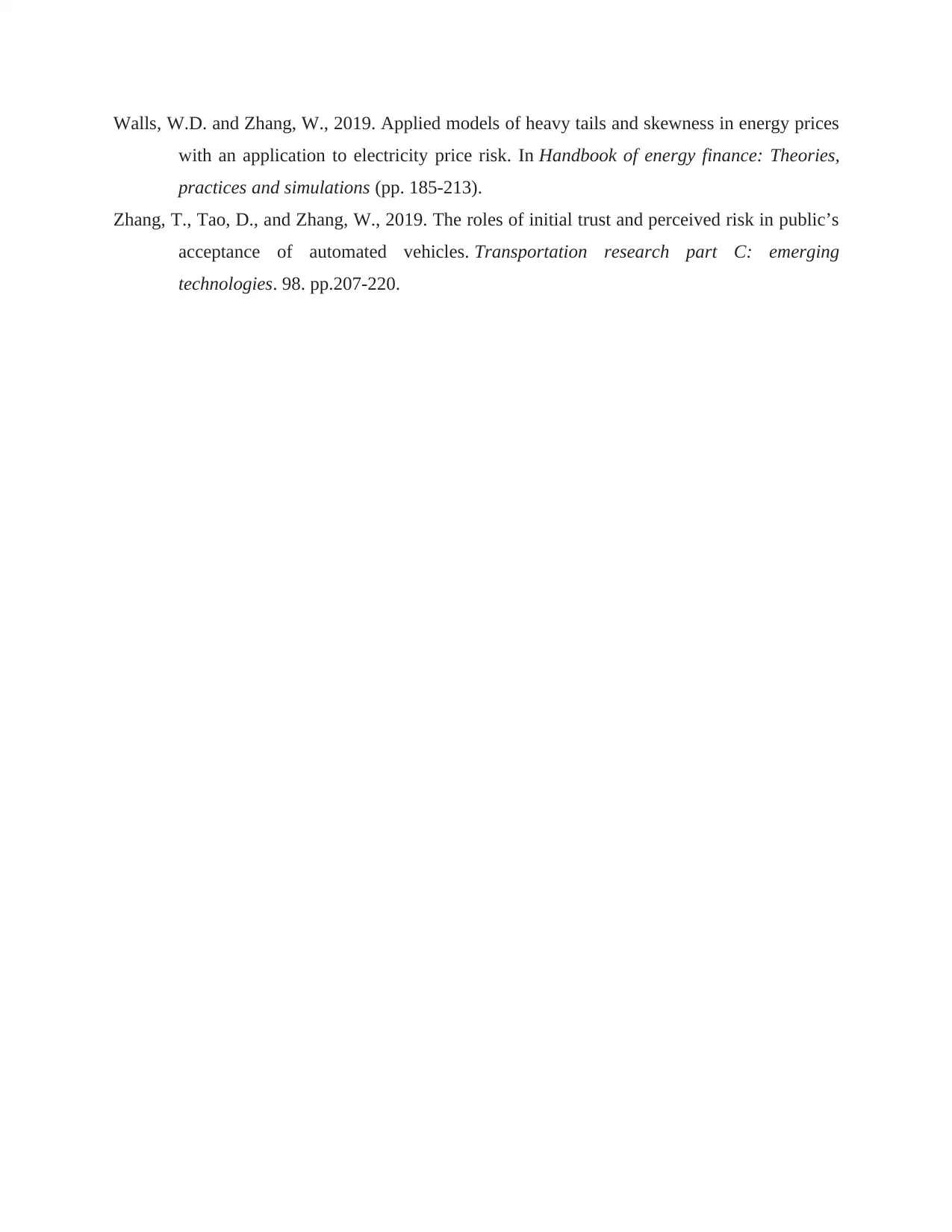
Walls, W.D. and Zhang, W., 2019. Applied models of heavy tails and skewness in energy prices
with an application to electricity price risk. In Handbook of energy finance: Theories,
practices and simulations (pp. 185-213).
Zhang, T., Tao, D., and Zhang, W., 2019. The roles of initial trust and perceived risk in public’s
acceptance of automated vehicles. Transportation research part C: emerging
technologies. 98. pp.207-220.
with an application to electricity price risk. In Handbook of energy finance: Theories,
practices and simulations (pp. 185-213).
Zhang, T., Tao, D., and Zhang, W., 2019. The roles of initial trust and perceived risk in public’s
acceptance of automated vehicles. Transportation research part C: emerging
technologies. 98. pp.207-220.

1 out of 11


Related Documents


Your All-in-One AI-Powered Toolkit for Academic Success.
+13062052269
info@desklib.com
Available 24*7 on WhatsApp / Email
![[object Object]](/_next/static/media/star-bottom.7253800d.svg)
Unlock your academic potential
Copyright © 2020–2026 A2Z Services. All Rights Reserved. Developed and managed by ZUCOL.